|
EXELON 2014 Profits: $236,000/per HOUR and THEY WANT A BAILOUT???
Tuesday, Feb 17, 2015 - Posted by Advertising Department [The following is a paid advertisement.] While the state budget crisis increasingly hits struggling Illinois families, Exelon demands a corporate bailout. This is exactly the wrong thing for Illinois’ citizens and businesses. Exelon is a successful, profitable company. While we appreciate success, when they claim they need more of OUR MONEY, it’s time to be skeptical. EXELON 2014 PROFITS: $2,068,000,000.00 That’s two BILLION with a B. And yet this wildly profitable company is asking US for a bailout while Illinois struggles. So let’s review: 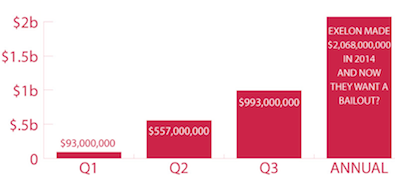 In 2014, EXELON made $5,665,753 per day or $236,073 per hour When legislators are being asked to slash everything from education to healthcare to mental health services, and when Crain’s Chicago Business says Exelon actually MADE money from its Illinois Nuclear Fleet, how can anyone think having struggling Illinois businesses and families bail out a highly profitable company is a good use of OUR money? It just isn’t fair. Just say no to the Exelon Bailout.
Comments Off |


|
John’s Story: Chicago Legend Gets a Tough Call
Tuesday, Feb 17, 2015 - Posted by Advertising Department [The following is a paid advertisement.] My name is John Lattner. I grew up and raised my family in the Chicago area. I played football for the University of Notre Dame and was honored to have won the Heisman Trophy in 1953 and went on to continue my football career playing for the Pittsburgh Steelers in 1954. I have recently learned from my doctors that I have been diagnosed with malignant mesothelioma and that I have a challenging prognosis. I am hoping that I get luckier than most folks who get this kind of news. I have been very lucky most of my life and I hope that luck holds up. Any man who has had the life I have had and the family with which I have been blessed with has already had more than his share of good luck. My doctors told me that it is medically impossible to get mesothelioma before a minimum of 15 to 20 years of exposure. The outlook for my condition is not good and I’ve been told most people who are diagnosed with this disease die within a year or two. I am someone who has always believed in fairness. I don’t think anyone should have a leg up on any other person. A strong civil justice system in Illinois provides that fairness not just for me, but for the other men and women who get the call from the doctor that I got. I know how tough of a call it is to get. For John’s story, click here.
Comments Off |
| « NEWER POSTS | PREVIOUS POSTS » |