|
No Cuts. Increase Funding. Save Lives.
Wednesday, May 27, 2026 - Posted by Advertising Department [The following is a paid advertisement.] These hospitals are lifelines for Black and Brown communities, providing critical care, supporting local jobs, and stabilizing entire neighborhoods. After years of chronic underinvestment, many are already operating on the edge. Even small cuts could lead to closures, fewer services, and dangerous gaps in care. The message is urgent and clear: Illinois cannot balance its budget on the backs of vulnerable communities. Protecting these hospitals means more than preventing cuts, it means increasing investment so they can meet the growing needs of the people they serve. Fully fund and strengthen safety-net hospitals. Lives depend on it. Paid for by Association of Safety-Net Community Hospitals
|
|
HB 2371 SA 2 Is A Needed Fix – Support Your Constituents By Passing The 340B Bill
Wednesday, May 27, 2026 - Posted by Advertising Department [The following is a paid advertisement.] The 340B program has made a difference to patients struggling to make ends meet. Take Correy Bell, who was able to afford an inhaler for her chronic asthma and bronchitis because of the federal program. There were “no confusing hoops, no shame, no judgment, just real savings when I needed it the most,” said Bell, a long-time patient at Family Christian Health Center in Harvey. The federal government created the 340B Drug Pricing Program to help hospitals and Federally Qualified Health Centers (FQHCs) serving many low-income patients expand access to care and provide more comprehensive healthcare services. In addition to passing on prescription discounts to patients, hospitals and FQHCs are investing in patients in a variety of ways, including:
• Expanding critical healthcare services in underserved communities • Providing free transportation to medical appointments • Adding mobile clinics and new freestanding clinics 340B was designed to fix an unintended consequence of the Medicaid Drug Discount Program—revealed when drugmakers dropped the required voluntary discounts included with their best market price. Fast forward to the early 2020s, when drugmakers—in a parallel move—began restricting pharmacy contracts with 340B hospitals and FQHCs.
|
|
Illinois Positioned To Become A National Leader On AI Safety
Wednesday, May 27, 2026 - Posted by Advertising Department [The following is a paid advertisement.] California and New York have already moved forward with frontier AI safety and transparency laws. Illinois legislators are building on these “blue-state” models by establishing some of the strongest protections in the country to safeguard residents from the risks posed by the most powerful AI systems. As artificial intelligence continues to evolve, the need for clear standards around safety, transparency, incident reporting, and accountability becomes increasingly important. While a comprehensive federal framework for frontier AI oversight would be preferable, states have a critical role to play. Illinois, alongside California and New York, is helping shape an emerging national model for responsible AI governance. When major states align on policy, companies often adopt those standards nationwide. Illinois lawmakers are helping position our state to benefit from the enormous potential of artificial intelligence, including job creation, healthcare breakthroughs, and technological innovation. In addition, these proposals help ensure AI systems are developed responsibly with transparency, accountability, and meaningful oversight. We appreciate the Senate’s partnership in passing legislation on these issues and look forward to the House supporting these vital measures. Paid for by Build American AI
|
|
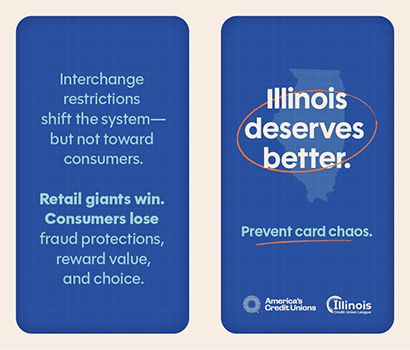
Who Really Benefits From Swipe-Fee Restrictions?
Wednesday, May 27, 2026 - Posted by Advertising Department [The following is a paid advertisement.] Supporters of Illinois’ swipe-fee proposal claim it will lower costs for consumers. But there’s no requirement that retailers pass along any savings - and history suggests they won’t. Instead, the law would strip away funding that supports key consumer benefits like fraud protection, card rewards, and low-cost banking access. Those costs don’t disappear - they shift back to consumers in the form of fewer benefits and higher fees. The biggest beneficiaries are likely to be large retailers, not Illinois households. Evidence from similar efforts shows savings tend to increase retailer margins rather than reduce prices at the register. The bill could also introduce unnecessary complexity into the payments system, creating inefficiencies, reducing security, and making transactions less seamless. Consumers ultimately bear those costs through inconvenience, risk, and reduced choice. At its core, this policy isn’t about affordability, it’s about reallocating resources. And that reallocation puts consumers at a disadvantage while boosting large retailers’ bottom lines. For more information, visit https://www.icul.com/advocacy/ifpa/. Paid for by Illinois Credit Union League.
|
| « NEWER POSTS | PREVIOUS POSTS » |