Sen. Villivalam, Sen. Villanueva, and Rep. Williams today joined the Illinois Clean Jobs Coalition (ICJC) to introduce the ICJC Platform—a slate of legislation outlining critical solutions in the power, buildings, and transportation sectors that accelerate Illinois’ climate, equity, and energy goals. Historic investments in clean energy through Illinois’ 2021 Climate and Equitable Jobs Act (CEJA) and the 2022 federal Inflation Reduction Act (IRA) have uniquely positioned Illinois to leverage our climate progress and competitively attract unprecedented jobs and federal investment. With the passage of the ICJC Platform, Illinois can lean into our strengths, double down on bold climate policy, and secure an equitable, affordable, and healthy future for all Illinoisans.
In the ICJC Platform, the Clean and Reliable Grid Act (SB3636), Clean and Healthy Buildings Act, and Clean and Equitable Transportation Act work together to tackle issues that impact Illinoisans in every facet of daily life. The Clean and Reliable Grid Act expedites our path to 100% clean renewable energy and strengthens the capacity and reliability of our electric grid.
“Illinois is already a leader on climate justice and workforce transition, but we still have work to do to secure a resilient, affordable power grid operating on 100 percent clean energy. We know that power grids in Illinois and across the country are outdated, inefficient, and increasingly vulnerable in extreme weather events, which are all the more common due to the effects of climate change,” said Representative Ann Williams, Chairwoman of the Energy and Environment Committee. “With the implementation of the Clean and Reliable Grid Act, we will reduce barriers to building necessary transmission lines, maximize energy efficiency policies, and offer customers options to save money on electricity. These sensible policies will support Illinois’ carbon reduction goals in the Climate and Equitable Jobs Act and enable us to rapidly modernize and electrify the buildings and transportation sectors. The Clean and Reliable Grid Act will ensure our electric grid is strong, reliable, and affordable so that we can tackle these new horizons in our clean energy economy.”
By improving Illinois’ electric grid and speeding up the approval and connection of clean energy projects, Illinois will be ready to capitalize on the benefits of transitioning the heating systems and appliances that power homes and buildings to clean energy. The Clean and Healthy Buildings Act will require gas utilities to reduce greenhouse gas emissions by 2050, require the Illinois Commerce Commission to embed affordability into ratemaking and decision-making, and help people lower their gas bills through gas energy efficiency standards.
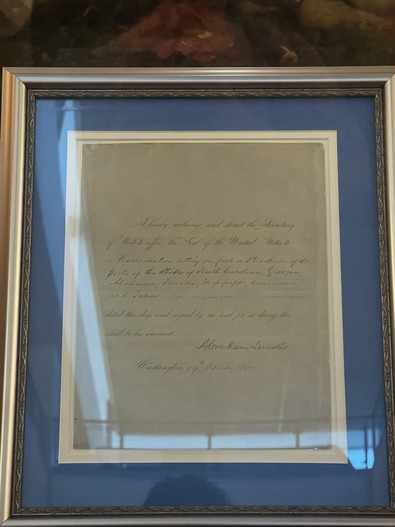
The document in which Abraham Lincoln set in motion the Union’s military response to the launch of the U.S. Civil War is now among Illinois’ prized papers of the 16th president, thanks to a donation by the state’s governor and first lady.
The order to blockade Southern ports to prevent the Confederacy from shipping economically vital cotton or importing critical needs was signed April 19, 1861 — one week after secessionist forces fired on Fort Sumter at the entrance to Charleston harbor in South Carolina.
An anonymous collector who owned the document put it up for auction, where Gov. J.B. Pritzker and his wife, M.K. Pritzker, bought it. The Pritzkers were scheduled to visit the Abraham Lincoln Presidential Library and Museum in Springfield, which will house the artifact, later Tuesday. […]
The blockade proclamation will go on display in the museum’s light- and climate-controlled Treasures Gallery beginning Wednesday. It will be on display until February 2025.
The Chicago Tribune and seven other newspapers sued Microsoft and OpenAI on Tuesday, claiming the technology giants illegally harvested millions of copyrighted articles to create their cutting-edge “generative” artificial intelligence products including OpenAI’s ChatGPT and Microsoft’s Copilot.
While the newspapers’ publishers have spent billions of dollars to send “real people to real places to report on real events in the real world,” the two tech firms are “purloining” the papers’ reporting without compensation “to create products that provide news and information plagiarized and stolen,” according to the lawsuit in federal court. […]
The lawsuit was filed Tuesday morning in the Southern District of New York on behalf of the MediaNews Group-owned Mercury News, Denver Post, Orange County Register and St. Paul Pioneer-Press; Tribune Publishing’s Chicago Tribune, Orlando Sentinel and South Florida Sun Sentinel; and the New York Daily News.
* Members of the Mayor’s Advisory Council on LGBTQ+ Affairs….
Members of the Mayor’s Advisory Council on LGBTQ+ Affairs, the Chicago Pride Parade Organizers, and supporting organizations call Mayor Brandon Johnson to promptly restore the 2024 Chicago Pride Parade to its original capacity.
The Chicago Pride parade is an important historical, cultural, and community event. On June 27, 1970, Chicago became one of the first four American cities where a Pride parade was held after the Stonewall riots. The Chicago Pride parade is one of the largest and most prominent Pride Parades in the world. It is an important symbol of LGBTQ+ empowerment and visibility where LGBTQ+ people and our allies come together to celebrate our community as we demonstrate our collective power. The Pride Parade is also an important venue for our community. It is often the first place where young people can show up as themselves, celebrating their identities in a supportive, loving, and celebratory environment. The fact that so many allies want to be a part of the Pride celebration is a testament to the power the LGBTQ community has garnered over the years.
The City of Chicago and the State of Illinois have made great strides to advance the rights and protections of LGBTQ+ people. We urge the City of Chicago to work towards having the largest, most visible, and most powerful Pride Parade in the country especially at a time when LGBTQ+ communities, and in particular trans youth, are facing unprecedented and life threatening attacks.
We understand that the City is asking for some adjustments to the schedule to accommodate shift changes at the Chicago Police Department (CPD). We also understand that without much notice, CPD is now looking to enforce an ordinance that has never been enforced in this context. We urge community conversations around equitable enforcement of this previously unenforced rule and any other adjustments the City wants to make to the Parade..
The Pride Parade Organizers, Members of Mayor’s Advisory on LGBTQ+ Affairs, and supporting organizations, call on the Mayor to do the following:
1 Restore participation in the parade commensurate with prior years
2 Start the parade one hour earlier, as requested, to accommodate for CPD’s shift change
3 Along with the undersigned parties and organization, schedule community conversations to equitably discuss any concerns or proposed changes to all parades held in the City of Chicago including the St. Patrick’s Day Parade, the Bud Billiken Parade, etc. engaging and collecting input from all relevant parties, the relevant Advisory Councils, and directly impacted communities.
We ask the Mayor and the City of Chicago to lean into their values of equity and transparency and work with Parade Organizers, the Advisory Council, and the supporting organizations to restore the Pride Parade and support the LGBTQ+ community in Chicago and beyond.
Respectfully,
Members of the Mayor’s Advisory Council on LGBTQ+ Affairs
*** Statewide ***
* Press Release | Andrade-Backed Measure Secures Prosthetics Coverage for Cancer Survivors: The Andrade-backed Senate Bill 2573 would require insurance companies to cover the cost of one wig or scalp prosthesis every 12 months for cancer survivors, those with alopecia or other conditions that would cause hair loss. The initiative is supported by the Illinois State Medical Society and passed unanimously out of the Senate on Friday, April 12.
* The Guardian | Tyson Foods dumps millions of pounds of toxic pollutants into US rivers and lakes: Tyson Foods dumped millions of pounds of toxic pollutants directly into American rivers and lakes over the last five years, threatening critical ecosystems, endangering wildlife and human health, a new investigation reveals. Nitrogen, phosphorus, chloride, oil and cyanide were among the 371m lb of pollutants released into waterways by just 41 Tyson slaughterhouses and mega processing plants between 2018 and 2022. […] The water pollution from Tyson, a Fortune 100 company and the world’s second largest meat producer, was spread across 17 states but about half the contaminants were dumped into streams, rivers, lakes and wetlands in Nebraska, Illinois and Missouri.
* Press release | As Respiratory Virus Season Winds Down, Virus Levels Continue Downward Trend Across Illinois: With the respiratory virus season continuing to wind down, Illinois’ overall respiratory virus level is now Minimal and all counties in the state are at Low level for COVID-19 hospitalizations, according to CDC data for the week ending April 20. The total number of COVID-19 hospitalizations in Illinois declined 22% during the same week, according to the CDC COVID Data Tracker.
*** Chicago ***
* Tribune | Support letters for convicted ex-Ald. Edward Burke to be made public in advance of sentencing : The agreement came after several letters sent on Burke’s behalf were posted on the federal court docket under seal. Last week, attorney Steven Mandell filed a motion on behalf of the Sun-Times and WBEZ arguing there is a longstanding presumption under the First Amendment that such letters should be open to public scrutiny, particularly if the judge is going to consider them in fashioning a sentence for a high-profile defendant like Burke.
* WaPo | As Chicago Trader Joe’s votes on unionizing, grocer fights other efforts: The outcome of a vote on unionizing a Trader Joe’s on Chicago’s North Side is unclear after ballots were tallied late Monday in a closely watched union election at the national grocery chain, which has been gaining a reputation for opposing labor efforts. Workers voted 70 to 70, with one contested vote, which will determine whether the union succeeds, according to the National Labor Relations Board. If the NLRB decides to count the vote and it’s a yes, the union wins; if the vote is determined invalid or a no, the union loses
* ABC Chicago | Organizers push back against plan to downsize the Chicago Pride Parade 2024 in Lakeview on June 30: Organizers announced in early April that this year’s event would be smaller than previous years. They announced entries would be capped at 125 groups, down 35% from last year, and would start an hour earlier at 11 a.m. “We understand there will be some disappointed groups that will not march with us this year; we extend a heartfelt thank you for your support and understanding,” a statement from parade organizers read. “We remain committed to prioritizing LGBTQ+ organizations, LGBTQ+-owned businesses, and businesses with LGBTQ Employee Resource Groups.”
* ABC Chicago | Relative of suspect in murder of CPD Officer Huesca in court on gun charge: Chicago police are still searching for the man charged with Officer Luis Huesca’s murder. But a relative of Xavier Tate Jr. has been charged with aggravated unlawful use of a weapon. A Cook County state’s attorney spokesperson said Caschaus Tate is still in custody after prosecutors moved to revoke his pre-trial release for a burglary earlier this month after allegedly violating it with this new gun charge.
* Crain’s | Loop office tower owner hit with $276 million foreclosure lawsuit: A joint venture of local real estate firm Hearn, Chicago-based GEM Realty Capital and San Francisco-based Farallon Capital Management defaulted on a $305 million mortgage loan tied to the office tower at 70 W. Madison St., according to a complaint filed last week in Cook County Circuit Court. Lender Bank of America, which leads a group of financial firms that provided the mortgage in 2018, alleged in the lawsuit that the ownership venture failed to make its loan payment last month.
* Greg Hinz | Bigger hurdles await as Johnson tries to put the start-up blues behind him: Despite some nasty fights and the unexpected influx of tens of thousands of refugees from the Southern border, Johnson has pretty much had his progressive way with the City Council. Allies such as Chicago Teachers Union President Stacy Davis Gates and Chicago Federation of Labor President Bob Reiter say they are pleased with his performance. Notably, so does anti-violence crusader Arne Duncan, who almost ran for mayor against Johnson. Beyond that, Johnson has shown signs of at least soothing some wounds with an irate business community, beginning to recognize that focusing on jobs and economic development is a win-win proposition, as Chicagoland Chamber of Commerce chief Jack Lavin puts it.
*** Cook County and Suburbs ***
* Crain’s | Daily Herald names longtime staffer as next executive editor: The Daily Herald is heralding a change in leadership as longtime editor Jim Baumann is set to leave the suburban news publication. Managing Editor Lisa Miner will succeed Baumann as executive editor starting May 13. Transitioning to the role of executive editor looks to be effortless for Miner, who in her current role takes on day-to-day activities, including supervising editors of various departments, the copy and design desk and photo staff. As executive director, Miner will continue to oversee news operations while also being in charge of budgeting, strategic planning and collaboration between all departments.
* Daily Herald | Developer pays $9 million for long-sought Guitar Center property in Arlington Heights: Work has begun to transform the southern gateway of Arlington Heights, but developer Bradford Allen is already eyeing its next phase of redevelopment. The Chicago-based real estate firm recently paid $9 million for the long-sought Guitar Center property at 2375 S. Arlington Heights Road, according to Cook County property records.
* WCIA | Harvest Moon Drive-In closes in on #1 in USA Today competition: Gibson City’s beloved Harvest Moon Twin Drive-In Theatre is currently in second place for USA Today’s 10 Best Readers’ Choice Awards for the Top 10 Best Drive-Ins. They are encouraging more votes to become number one. Currently, another Illinois drive-in — the Skyview Drive-In in Belleville — is in the top spot. Staff from Harvest Moon Drive-In believe their theater can take the throne with enough votes, and are encouraging their fans to spread the word.
*** National ***
* AP | US drug control agency will move to reclassify marijuana in a historic shift, AP sources say: The DEA’s proposal, which still must be reviewed by the White House Office of Management and Budget, would recognize the medical uses of cannabis and acknowledge it has less potential for abuse than some of the nation’s most dangerous drugs. However, it would not legalize marijuana outright for recreational use.
* Axios | COVID-era hospital reporting set to end: Hospitals starting this week will no longer have to report data on admissions, occupancy and other indicators of possible system stress from respiratory diseases to federal officials as another COVID-era mandate expires. The sunset of the reporting requirement on May 1 marks a turning point in the government’s real-time tracking of airborne pathogens that helped drive coronavirus surveillance and reports like the Centers for Disease Control and Prevention’s FluView.
* NYT | Inside an Abortion Clinic Days Before Florida’s Six-Week Ban Takes Effect: Starting on Wednesday, Florida will ban abortions after six weeks, a dramatic change in a state that less than two years ago allowed the procedure up to about 24 weeks. Prohibiting it at six weeks, when many women do not yet know that they are pregnant, will further restrict access to abortion in the Deep South where a number of other states have near-total bans, and force many patients to travel much farther for care.
Tuesday, Apr 30, 2024 - Posted by Advertising Department
[The following is a paid advertisement.]
The price-setting board proposed in HB4472 is not the solution for Illinois. It would give bureaucrats the power to arbitrarily set medicine prices, deciding what medicines and treatments are “worth” paying for. We can’t leave Illinoisans’ health care up to political whims. Let’s make it easier, not harder for patients to access their medicines. Click here to learn more.
Bears executives are set to meet with Gov. JB Pritzker’s chief of staff, Anne Caprara, and Deputy Gov. Andy Manar on May 1, the governor’s office confirmed. It will be the first formal sit-down between the governor’s staff and the team on the plan.
* The Question: What’s your prediction(s) for that meeting? Snark is heavily encouraged.
“Menu prices are sure to increase, making restaurant visits less appetizing. We’re also wondering: Will customers continue to eat out as often and tip generously — or at all — when prices increase and service charges and other fees are added to bills? And what about those servers who already make more than minimum wage because of tips, especially in bustling, high-end establishments? Nationally, according to a 2022 survey by the National Restaurant Association, tipped workers make an average of $27 an hour.”
* For whatever reason, WSIU-TV stopped production on this valuable program, which was a darned shame because it was a must-watch and an opportunity for viewers to see and hear influential legislators questioned by one of the best in the business about the issues of the day. I’m glad to see it’s coming back…
Capitol News Illinois announced today it will produce the long-running “Illinois Lawmakers” program this spring, in partnership with longtime host and producer Jak Tichenor.
“This new partnership is absolutely critical to providing Illinois residents with reliable, independent, in-depth, up to date coverage from the Illinois Capitol after many newspapers and broadcasters shuttered their Statehouse bureaus over the last decade,” Tichenor said of the announcement.
“Illinois Lawmakers” is the longest-running television series offering continuing coverage of the Illinois General Assembly, having done so for the past 38 years. Capitol News Illinois will continue producing the respected program in a manner that largely leaves the show’s familiar format unchanged, but with a significant upgrade in its distribution. Beginning with the first episode this May, “Illinois Lawmakers” will be distributed to all radio and public and commercial broadcast outlets across Illinois and its border states.
The program debuted statewide on the state’s nine Illinois public television stations in 1986 with political analyst Bruce DuMont as host and WTTW Chicago’s Marty McLaughlin as executive producer. “Illinois Lawmakers” was launched by the Illinois Public Broadcasting Council and a bipartisan group of House and Senate lawmakers who sought to create a series on the General Assembly that was impartial, bipartisan, and in-depth in the spirit of the PBS Newshour. The program frequently offers breaking news coverage with lawmakers coming right off the floor to debate the issues of the day.
“I couldn’t be happier in this new venture,” CNI Broadcast Director Jennifer Fuller said. “In making this great coverage available for all of our broadcast partners, we’re continuing our mission of providing reliable, experienced reporting to a larger audience – keeping the public informed about what’s happening in their government.”
Legislative leaders of both parties, committee chairs, as well as rank-and-file lawmakers from border to border are regular guests on set in the Speaker’s Gallery in the Illinois House of Representatives. Live coverage of the governor’s annual State of the State speeches and budget messages have been a staple of the series from the very start, along with the annual fall veto session.
CNI also announced that several sponsorship level opportunities are available to offset production costs.
“Although the show is free for its viewers, there are costs associated to produce the episodes,” CNI Executive Director Jeff Rogers said. “To help offset these costs, we have established several sponsorship levels and are seeking financial support to ensure that this important programming remains on air beyond this legislative session.”
Programs will begin weekly production in May and continue through the end of the spring legislative session. You can find each episode at capitolnewsillinois.com/illinois-lawmakers. For more information on sponsorship opportunities, contact Jeff Rogers, executive director of Capitol News Illinois, by email at jrogers@capitolnewsillinois.com or by phone at 815-238-7806.
Tuesday, Apr 30, 2024 - Posted by Advertising Department
[The following is a paid advertisement.]
Retail provides one out of every five Illinois jobs, generates the second largest amount of tax revenue for the state, and is the largest source of revenue for local governments. But retail is also so much more, with retailers serving as the trusted contributors to life’s moments, big and small.
We Are Retail and IRMA are dedicated to sharing the stories of retailers like the Trebacz’s, who serve their communities with dedication and pride.
The following is a joint statement from Chicago Federation of Labor President Bob Reiter and Illinois AFL-CIO President Tim Drea on the Chicago Metropolitan Agency for Planning’s proposed legislation to fully fund public transit in Northeastern Illinois and consolidate its transit service boards.
Public transit is a critical public service that connects workers to their workplace, school, healthcare and their daily lives. According to the Economic Policy Institute, transportation ranks among the largest monthly expenditures for families of four, on par with food, childcare, housing and healthcare. Maintaining reliable and safe public transit is critical for the working families who power nearly every sector of our local economy. Therefore, finding a solution that fully funds transit is one of our top priorities.
We agree with CMAP’s call for the Illinois General Assembly to increase state funding for transit in Northeastern Illinois, as CTA, METRA, and PACE are essential to the regional economy.
However, we must caution that consolidating our vital regional transit boards into a singular centralized entity would erect a web of bureaucratic barriers between the workers who both operate and utilize our public transit system and the board members tasked with overseeing its success. We cannot support a proposal that erodes the direct communication channels that currently exist to provide the public with a voice in our public transit system.
We look forward to continuing conversations about optimizing our public transit system and commend Senator Ram Villivalam and Representative Eva Dina Delgado for taking the lead on shaping legislation that will affect Illinoisans for generations to come.
Labor is committed to fully funding our public transit agencies to increase the economic mobility of workers in our region. Any reforms to the current structure of these agencies must be done in a thoughtful manner that supports the workers who operate these lines and the public our transit system serves. We’re committed to working with all stakeholders to deliver a solution that addresses the impending fiscal cliff and prioritizes maintaining and improving a safe and reliable transit service for all.
* Related…
* CTA, Metra and Pace could be merged into one transit agency under bill proposed in Springfield: State legislators are proposing legislation that would create a transit agency to oversee public transit across northeastern Illinois and provide an additional $1.5 billion in annual funding for public transportation. State Sen. Ram Villivalam, D-Chicago, and state Rep. Eva-Dina Delgado, D-Chicago, have introduced the Metropolitan Mobility Authority Act, which would create the Metropolitan Mobility Authority to oversee all public transit operations and replace the Regional Transportation Authority.
* Illinois Lawmakers Unveil Proposal to Merge CTA, Metra and Pace; Plan Would Replace RTA and Add $1.5B in New Funding: “The upcoming fiscal cliff facing transit is a moment that demands we reimagine transit so it is the first choice for people to travel, not a service of last resort,” said Derek Douglas, president of the Civic Committee of the Commercial Club of Chicago. “To achieve this goal, we need reforms. We cannot just throw more money at the same system at the same problems and expect a different result.”
* Illinois lawmakers unveil plan to combine Metra, CTA and Pace into one: “The intent behind the consolidation is more about being a more responsive transit agency, to make sure that we’re not kind of in our own little silos providing certain services,” said state Rep. Eva-Dina Delgado, a Democrat representing the Northwest Side.
…Adding… Illinois Transportation Labor Association Chairman J.J. Balonek…
“The Illinois Transportation Labor Association (ITLA) strongly supports proposals for additional funding for transportation in Northern Illinois and believes the funds are critical to making sure access to public transportation is available to residents throughout the region. However, any changes to the current structure need to protect the rights that members of labor have secured in over a century of holding employers accountable. ITLA supports a voting labor member on any transit board to ensure our voices are heard. We are looking forward to working together with the stakeholders as this vital legislation evolves.”
The ITLA is a group of transportation labor unions advocating for labor reform in Illinois. ITLA represents thousands of Illinois transit workers across the state.
“Most of your domestic batteries are misdemeanors. Those would always result in some type of a cash bond and most of those defendants were getting out. Now we’re seeking detention on most domestic batteries. You can see out of 177 detention petitions, 71 had been granted, that’s actually pretty good,” said Berlin.
A man released from jail earlier this month on misdemeanor domestic battery charges shot and killed his wife Friday night in Villa Park, authorities said. […]
Prosecutors did not seek to detain Elguezabal pretrial. He was accused of pulling Julie Elguezabal’s hair, and punching her several times in the face, neck and back, according to court records.
There’s new information about the man who police said shot and killed his wife before turning the gun on himself in west suburban Villa Park.
He’d just been released from jail on domestic battery charges and why the DuPage County State’s Attorney is pledging to fix the system as a result. […]
Winston Elguezabal had been arrested just 12 days earlier, on April 14, and charged with domestic battery against Julie.
But he was released two days later.
The DuPage County States Attorneys office said that’s because he did not meet the criteria for detention under the SAFE-T Act.
Upon verified petition by the State, the court shall hold a hearing and may deny a defendant pretrial release only if: […]
(4) the defendant is charged with domestic battery or aggravated domestic battery under Section 12-3.2 or 12-3.3 of the Criminal Code of 2012 and it is alleged that the defendant’s pretrial release poses a real and present threat to the safety of any person or persons or the community, based on the specific articulable facts of the case
Somebody needs to send all Illinois reporters an easy to understand list of detainable offenses.
Either way, the Daily Herald reported that Berlin’s office didn’t even ask that the defendant be detained.
…Adding… Sens. Robert Peters and Celina Villanueva and Rep. Kelly Cassidy…
We grieve the loss of Julie Elguezabal and send our deepest condolences to her family and loved ones. Any loss of life is a tragedy, but the Pretrial Fairness Act is not to blame for this horrific act of domestic violence. The old money bond system did not keep our communities safe, and the new system gives prosecutors and judges the discretion they need to make release and detention decisions based on the danger someone may pose—not how much they can afford to pay. Public safety is our top priority. That’s why we’ve implemented this new system.
As legislators who center our work on pretrial justice and domestic violence around the needs of survivors of violence, and as survivors of domestic violence ourselves, we are extremely concerned by DuPage County State’s Attorney Bob Berlin’s insinuation that this tragedy was a failure of the law. Specifically, State’s Attorney Berlin has indicated his office didn’t have enough time to properly evaluate and mediate the potential risk of Mr. Elguezabal’s release.
The Pretrial Fairness Act is supported by the leading organizations working to end gender-based violence precisely because it focuses on protecting survivors. Under the money bond system, police could release people accused of misdemeanor domestic violence without even sending them to court. If they did go to court, hearings lasted a few minutes or even mere seconds. Now, for the first time, the law requires everyone accused of domestic battery to appear before a judge where a transparent release or detention decision is made. Survivors are notified of these hearings and can make decisions about their involvement in the case and plan for their safety. The Pretrial Fairness Act created the ability for prosecutors to request detention in misdemeanor domestic violence cases, aggressively expanded victim notification requirements, and abolished the money bond system that allowed people to buy their way out of any judicial decision-making.
There is much we do not yet know about the process that led to the tragic murder of Julie Elguezabal. What we do know is that earlier this month, her husband was arrested and charged with two counts of domestic battery. In that case, the DuPage County State’s Attorney chose not to request detention of her husband. Mr. Elguezabal was released on GPS monitoring and ordered to stay away from Mrs. Elguezabal. He was required to surrender his FOID card and any firearms in his possession to local law enforcement. Despite surrendering his FOID card, Mr. Elguezabal was still able to access a firearm, and on Friday night, he arrived at his wife’s house where he killed her and then himself.
As we learn more about what happened in this tragic series of events, we must remember that the Pretrial Fairness Act provides far greater protections for survivors of domestic violence than the old money bond system. No system is fool-proof, and no law can prevent all future violence. Rather than reacting and rushing to revise pretrial laws based on this horrific incident, we must continue to build a holistic vision of safety for all, work to reduce gun violence and provide increased resources to survivors of domestic violence.
A perfect example of a good policy that needs to be adopted immediately is Karina’s Bill, which would create much-needed enforcement mechanisms for the existing law preventing people accused of domestic violence from retaining possession of firearms. Like Mrs. Elguezabal, Karina Gonzalez was murdered by a violent partner who retained access to a firearm even after he had been ordered by a judge to surrender his guns.
We look forward to working with advocates and our partners in the legislature to ensure we close this loophole in the enforcement of existing laws and reduce the number of women murdered by partners. We don’t want more laws named after domestic violence victims—we want fewer domestic violence victims.
…Adding… Gov. Pritzker was asked about the DuPage case today…
I don’t know that there needs to be any legislative change. But, just in the way cases are handled, we need to make sure that domestic violence is something that gets taken very seriously.
He also said that accused domestic abusers “should remain incarcerated.”
* The governor was also asked about the above-mentioned Karina’s Law proposal…
In general I support the concept of the bill. I will say if you listen to the State Police and actually all the other police [agencies] too, it’s quite difficult to remove a firearm from somebody, even if they’ve given up their FOID card. But in the instance where you’ve got to go confiscate the firearm, literally you have to bring sometimes four officers to one situation in order to remove the weapon. And if somebody doesn’t want to give it to you, it becomes quite complicated.
North Carolina just went through a horrible experience with just this sort of thing. [OK, it’s been pointed out to me that the NC tragedy is not the same. However, it’s what the police do worry about, and that, and the police staffing levels, are some of the main obstacles to overcome as far as the bill goes.]
State lawmakers proposed new legislation on Monday that would overhaul public transportation in northeastern Illinois by merging CTA, Metra and Pace under a single agency.
The bill, sponsored by Sen. Ram Villivalam (D-Chicago) and Rep. Eva-Dina Delgado (D-Chicago), is part of a package that also creates an additional $1.5 billion in annual transit operational funding. […]
The bill, backed by the Illinois Clean Jobs Coalition, essentially erases each of the independent transit agencies and establishes a regional entity called the Metropolitan Mobility Authority. That new agency would eliminate the Regional Transportation Authority, which currently oversees the three transit agencies. […]
The Metropolitan Mobility Authority’s governing board would include 19 directors with voting power. Three are appointed by the governor, five are appointed by Chicago’s mayor and five are appointed by the Cook County Board president.
Creates the Metropolitan Mobility Authority Act, and establishes the Metropolitan Mobility Authority. Provides that the Chicago Transit Authority, the Commuter Rail Division and the Suburban Bus Division of the Regional Transportation Authority, and the Regional Transportation Authority are consolidated into the Metropolitan Mobility Authority and the Service Boards are abolished, instead creating the Suburban Bus Operating Division, Commuter Rail Operating Division, and the Chicago Transit Operating Division. Reinserts, reorganizes, and changes some provisions from the Metropolitan Transit Authority Act and the Regional Transportation Authority Act into the new Act. Includes provisions about the operation of the Metropolitan Mobility Authority. Repeals the Metropolitan Transit Authority Act and the Regional Transportation Authority Act. Amends various Acts, Laws, and Codes to make conforming changes. Creates the Equitable Transit-Supportive Development Act. Establishes the Office of Transit-Oriented Development and the Transit-Supportive Development Fund. Provides that the Office and the Fund are to aid transit-supportive development near high-quality transit by providing specified funding to municipalities that have adopted the standards in the transit support overlay district for that area or that have adopted zoning and other changes that the Office determines have benefits greater than or equal to such a District, including transit support overlay districts. Includes provisions relating to Office standards, procedures, and reports. Amends the State Finance Act to make a conforming change. Amends the Department of Transportation Law of the Civil Administrative Code. Requires the Department to establish, staff, and support an Office of Public Transportation Support for the purpose of optimizing the operation of public transportation vehicles and the delivery of public transportation services on highways under the Department’s jurisdiction in the Metropolitan Mobility Authority’s metropolitan region. Describes the duties and operations of the Office. Amends the Toll Highway Act. Provides that the Chair of the Metropolitan Mobility Authority is a nonvoting member of the Illinois State Toll Highway Authority.
A great thread from Metropolitan Planning Council Senior Advisor Thomas Bamonte…
Much of the rest of the bill is routine stuff, but note new 20 ILCS 2705/2705-594 on pg. 268, which requires @IDOTDistrict1 to establish an Office of Public Transit Support and affirmatively work to make its roadways, many of which host public transit, more supportive of transit.
State Rep. Maura Hirschauer, D-Batavia, issued the following statement regarding the tragic homicide that took place over the weekend in Villa Park:
“The murder of Julie Elguezabal is a tragedy and another unacceptable loss resulting from the intersection of domestic violence and firearms. While we collectively condemn this horrific act of violence, we must also collectively take action to right this wrong. Legislation that would remove firearms from the hands of domestic abusers remains stalled in the Illinois State Senate. Karina’s Bill (SB 2633) would allow judges to issue search warrants along with orders of protection so that law enforcement can search homes and immediately remove firearms from domestic abusers. Compared to this time last year, there is a 65% increase in the number of victims killed in firearm-related incidents across Illinois, according to The Network: Advocating Against Domestic Violence. We cannot let this trend continue and must pass this lifesaving bill this session. […]
“Each day that passes without action on Karina’s Bill means more lives shattered and more futures stolen. We owe it to every victim and their families to ensure that they have the protection they need to reclaim their safety. My heart is with the family of Julie Elguezabal, and for hopefully the last time, I say: enough is enough. It is time that we pass Karina’s Bill and end the cycle of firearm-involved domestic violence homicides.”
* The Illinois Grape Growers and Vintners Alliance…
The Illinois Grape Growers and Vintners Alliance (IGGVA) today urged Illinois lawmakers to support House Bill 2864 to provide parity for wineries at a time when they are facing an inability to grow under current law.
While Illinois is one of the top wine-drinking states in the country and the state’s wine industry has grown in esteem, current law places inequitable restrictions on production and sales for wineries compared to the beer and spirits sectors. In effect, the law limits the ability to grow and innovate for wineries, many of which are small, family-owned operations and provide significant tourism revenue for Illinois.
The current limitations stem from outdated regulations dating back nearly 90 years that govern wine production, distribution, and sales. The law caps production and self-distribution for Illinois wineries at 25,000 gallons and 5,000 gallons, respectively. Meanwhile, the spirits and beer industries are allowed to produce and self-distribute significantly more under the law – for spirits, 50,000 gallons of production and 5,000 gallons to self-distribute; and for beer, 930,000 gallons of production and 232,500 gallons to self-distribute.
HB 2864 would:
• Increase caps on winery production to 250,000 gallons and distribution to 25,000 gallons – levels that are on par with Illinois distillers and brewers.
• Allow wineries to grow both sales and employment, increasing their contributions to the Illinois economy.
• Address antiquated laws that prevent wineries from selling their wine in the marketplace, prevent retail stores from diversifying their products, and prevent consumers from buying local wines they enjoy.
Many Illinois wineries have reached their limit to self-distribute their wine, so their only option under existing law is to find a distributor to partner with to sell their product. However, this process has been plagued by problems, with most distributors uninterested in working with small business operations like many of the wineries in Illinois. Wineries are left to sell their wine themselves, but the law caps their ability to sell more product and grow as a business.
“Our state has one of the most competitive wine markets in the country. For an Illinois winery, the barriers are incredibly tough to succeed,” said Greg Fischer, owner of Chicago’s Wild Blossom Meadery & Winery. “In Chicago, 99 percent of the wine sold comes from out of state, even though homegrown Illinois wine has grown in quality and popularity. Every sip of Illinois wine benefits our state from the ground up. We urge Illinois lawmakers to work with us to reduce barriers and help us become successful.”
HB2864 has been re-referred to the Rules Committee in the House. The House committee deadline has long past and the bill does not have an extension.
If passed into law, the state’s Fuel Gas Detector Act would require gas alarms to be installed inside buildings. […]
The purpose is to protect against gas explosions, which have increased in number and can destroy property and cause serious injuries.
In cities such as Chicago, which has aging infrastructure, proponents of Senate Bill 1161 say this legislation could potentially save lives.
“We treat so many other hazards in our home. Why would we let this one go?” said state Sen. Craig Wilcox, a Republican from Woodstock, who supports the legislation. […]
Last year, there were at least 10 explosions in Illinois.
SB1161 is on Third Reading and has until May 3 to pass through the Senate.
The Pritzker administration and Democratic lawmakers say every woman in Illinois deserves the right to a healthy and safe pregnancy. A plan moving to the Senate could drastically improve maternal healthcare for Black women in Illinois.
The monumental bill in Springfield would require private insurance companies to cover maternal services provided by midwives, doulas and lactation consultants. This comes as the Illinois Department of Public Health reports Black mothers are three times more likely to die from pregnancy-related medical issues than white women. […]
Gov. JB Pritzker also hopes to provide $4.4 million to IDPH in the Fiscal Year 2025 budget to address the state’s maternal mortality rate and create an action plan to support community-based full spectrum care. The Democrat wants lawmakers to approve a $5 million expansion of the state’s home visiting program and $1 million for a new diaper distribution program as well. […]
House Bill 5142 passed out of the House on a 72-37 vote on April 18. Senators could discuss the plan when they return to Springfield this week. Meanwhile, Pritzker’s maternal healthcare budget priorities could be approved during the final days of session next month.
Bills concerning employers and changes they will have to make passed the House last week.
House Bill 3763 makes a change where an employee’s legal representation can request access to personnel records, not just the employee themselves.
State Rep. Patrick Windhorst, R-Metropolis, asked why the bill was necessary. The sponsor of the bill is state Rep. Will Guzzardi, D-Chicago.
“So for instance, if an employee gets laid off in a hostile work environment, they have a right to their personnel records from that employer,” said Guzzardi. “Right now, as the courts have interpreted this law, that employee needs to go present themself and request these records. We think it is better for everybody if their lawyer could just get these records. If there’s tension between the employer and former employee, let’s just have an attorney submit the records request and have them be delivered to that person’s representative.”
Carbon dioxide pipeline and sequestration projects would face significant new scrutiny and regulations under proposed legislation introduced in April in Illinois.
Advocates who helped draft the proposal (SB 3930, HB 5814) say it is crucial to institute standards and protections, as multiple companies seek to sequester carbon in Illinois’ Mount Simon sandstone geology and reap lucrative federal tax credits. The legislation was formally introduced Monday.
State lawmakers held a hearing earlier this month on separate bills (HB 4835, SB 3441) that would place a moratorium on carbon dioxide pipelines for four years or until new federal safety regulations are adopted by the Pipeline and Hazardous Materials Safety Administration (PHMSA). […]
Companies seeking to sequester carbon dioxide in Illinois have so far failed to secure county approvals for proposed sites, and two major carbon dioxide pipeline proposals — from the companies Navigator CO2 Ventures and Wolf Carbon Solutions — were withdrawn from consideration by the Illinois Commerce Commission last year. But Wolf is expected to refile its application for a necessary certificate of authority. And the commerce commission is currently considering a proposal from One Earth Energy for a six-mile pipeline that — if built — is expected to spur proposals for longer pipelines that would connect to it and a proposed sequestration site.
Illinois’s House Bill 4895, one of three climate change education bills active in the Illinois legislature, was passed by the House of Representatives on a 70-37 vote on April 18, 2024, and is now with the Senate.
The bill was amended before the vote. It now provides that, “Beginning with the 2026-2027 school year, every public school shall provide instruction on climate change, which shall include, but not be limited to, identifying the environmental and ecological impacts of climate change on individuals and communities and evaluating solutions for addressing and mitigating the impact of climate change and shall be in alignment with State learning standards, as appropriate. The State Board of Education shall, subject to appropriation, prepare and make available multi-disciplinary instructional resources and professional learning opportunities for educators that may be used to meet the requirements of this subsection.”
The provisions of the bill as passed are thus substantially less ambitious than the bill as introduced. As introduced, the bill would have required every public high school in Illinois to “include in its curriculum a unit of instruction addressing climate change in either a required science class or a required social studies class.” It would also have required instruction on climate change to be included in all high school courses in science, agriculture, social science, and relevant career and technical education courses. The state superintendent of education would have been charged with preparing appropriate instructional materials and professional development training for educators.
The other two climate change education bills active in the Illinois legislature — Senate Bill 3644, which was similar but not identical to House Bill 4895 as introduced, and House Bill 4319 — are still in committee.
A bill that would change the pension code and allow quicker access to payments for state employee retirees has passed the state’s House of Representatives.
The vote in the House occurred on April 16th and was unanimous. State Rep. Stephanie Kifowit sponsored the bill and commended her colleagues in the House for the bipartisan support.
House Bill 4870 focuses on providing state employees greater flexibility and expedite access to retirement benefits by allowing for an estimated payment, which would occur within 30 days of either the employee’s last day of employment or 30 days after filing for retirement benefits in the state’s system. Kifowit says the bill makes sure that state retirees can get access to the retirement they earned as quickly as possible.
The bill now heads to the Senate. If approved and signed into law, the bill would take immediate effect, providing relief and assistance to state employees navigating the retirement process.
A proposed Illinois Bill, HB5527, would provide Narcan to those leaving jail or prison who struggle with substance abuse problems to help keep them safe upon release. […]
Pat Tyler is the executive director of the Well House, an organization that helps women who are getting out of prison or jail overcome challenges. She said they help women who deal with substance abuse problems by taking them to clinics to get assessed to see what level of care they need, as well as help them get in contact with programs to help them stay clean. She said it’s important they have support from the community to help keep them clean. She said having NARCAN on hand can help keep them safe if they relapse. […]
[Sheriff Anthony Grootens of the Adams County Sheriff’s Office] said they have NARCAN in the jail and provide treatment for prisoners suffering from substance abuse. However, when they are released, it gets difficult to track them.
Grootens said hospitals don’t have to inform them if a formerly incarcerated prisoner has overdosed. He said there’s been instances where they’ve revived a person who overdosed, taken them to the hospital, only for them to leave and overdose again later. He said while having NARCAN available to help is good, there should be a focus on trying to get people long-term help to have them stay clean.
Lawyers for the executive director of the Democratic Party of Illinois argued Darren Bailey and Dan Proft colluded on the 2022 gubernatorial campaign during an Illinois State Board of Elections hearing today.
Proft used his super PAC, the People Who Play By the Rules PAC, to create ads that would boost Bailey or hurt incumbent Gov. J.B. Pritzker during the 2022 campaign. Super PACs, or independent expenditure-only committees, can make unlimited contributions, but are barred from coordinating messaging and other decisions with the campaign they support. […]
Lawyers today presented their case to hearing officer Jim Tenuto. The Illinois State Board of Elections is expected to reach a decision in June or July, he said. That could clarify what it means for a super PAC to coordinate with a candidate, a parameter detailed in federal election law but previously left undefined in Illinois. […]
What is alleged to have ensued on June 29, 2022, the day after the Illinois primary, is a scene that is too on the nose for Chicago politics. According to today’s testimony, after Bailey initially rebuffed Proft, telling him he was too busy to meet following the primary, the candidate and his campaign manager arrived in the backroom of a Chicago country club. There, Proft slid over an envelope which he said contained $20 million. Proft said Bailey’s campaign would get that money if he gave him sole control of the campaign, which Bailey refused.
Governor Pritzker and First Lady MK Pritzker to announce historic document donation to Abraham Lincoln Presidential Museum at 1:00 pm. Click here to watch.
* Pantagraph | Lincoln mayor pledges to fight Logan Correctional Center move: Lincoln Mayor Tracy Welch said Monday that he and other elected officials were not given much notice of Illinois Department of Corrections’ recommendation to shutter the Logan Correctional Center in Lincoln and rebuild the prison in Will County. While hoping for greater transparency in the future before such decisions are made, he said he was focused on making the city fiscally stable and continuing to provide goods and services to the community.
*** Statehouse News ***
* WBEZ | Weight-loss drug coverage for Illinois state workers could cost hundreds of millions of dollars: Pritzker’s administration says access to the medication will yield important health benefits for those who take advantage of the benefit and would equitably give access to the medication across the state’s insurance plans. But one economist who has studied the cost impact of this new class of drugs told WBEZ the state’s yearly outlay could cost as much as three times the state’s estimate, depending on the number of people who access the program.
* Tribune | Illinois lawmakers consider measures aimed at making mental health care more accessible: Illinois legislators have advanced two measures pushed by proponents of reform in the state’s behavioral health system that are intended to expand the insurance coverage available for those seeking care. The bills, both of which were passed by the House on April 19 and are now before the Senate, aim to combat what supporters say are inequities in access to support systems for people suffering mental health and substance abuse issues, which have remained at stubbornly high rates following the COVID-19 pandemic.
* WBEZ | What is ranked choice voting? And what could it mean for Illinois?: The 2024 elections are just seven months away, but a task force of state lawmakers, county officials and voters’ rights advocates are already thinking about the way Illinois residents will vote in the 2028 presidential primaries. They’re mulling over a process called ranked choice voting, where voters can rank multiple candidates instead of choosing one candidate per party. The Illinois Ranked Choice Voting Task Force, which launched in January, has concluded its monthly meetings and is expected to release their report recommending whether to adopt the voting method to Illinois lawmakers in the coming weeks.
*** Chicago ***
* WBEZ | Chicago will relaunch a guaranteed basic income program: The relaunch was announced as part of the Johnson Administration’s plan to dedicate and spend more than $374 million in federal funds earmarked for community projects. The city — which has been slow to spend the money it received in 2021 — has to allocate all funds by the end of this year, and spend them by 2026, or lose the money. City officials hope to have the funds allocated by November ahead of the end-of-year deadline.
* ABC Chicago | Many iconic Chicago bridges are deteriorating, officials race to fix problem before disaster strikes: City and state transportation officials tasked with maintaining these bridges are adamant that any bridge that’s open is considered safe to use, and “rigorous inspection schedules” are in place to keep travelers safe. Right now, there are billions of dollars earmarked for repairing the long list of bridges in poor condition across the state and city, something Illinois has never had before, officials say.
* Crain’s | Peeling back the sticker price on Bears stadium reveals even more costs: The total cost to taxpayers to build a domed stadium on the lakefront in an effort to keep the Chicago Bears in the city will be nearly $5 billion and would not be paid off until the team’s 22-year-old rookie quarterback, Caleb Williams, is in his 60s. The Bears’ plan to tap into government bonds to pay for their dream stadium is estimated at $4.97 billion over 40 years, when accounting for interest payments. That’s roughly $4 billion more than the $900 million in upfront capital the team would receive to build their new home.
* WGN | ‘The city is up for grabs’: Chicago Tribune reporter’s new book details Lightfoot’s tenure as mayor: Lightfoot won in a landslide, sweeping all 50 wards. She made history as the first openly gay person, and first black woman to hold the office. But, in Pratt’s analysis, she made an immediate error: alienating city council during her inauguration speech, in which she called out corruption in city government. Pratt’s book argues that the moment was indicative of a theme throughout Lightfoot’s time in office — the impulse to act as a prosecutor instead of a politician. “You can’t slap everybody all the time as though they were a criminal, because that’s just not the way you get stuff done., and she could not adapt her personality and her leadership style,” Pratt said.
* WBBM | Wish granted: Nine-year-old boy takes his family for a ride on CTA train: dris Lockett has a life-threatening heart condition and has endured several surgeries, but on World Wish Day, the 9-year-old’s wish of being a Chicago Transit Authority train operator came true. […] Jessica Miller, senior communications manager for Make-A-Wish Illinois, said granting Idris’ wish to be a CTA train operator was no easy task. “Logistically speaking, this is kind of a complicated wish,” Miller said. “There’s a lot of agencies involved. We live in a big city, so there’s a lot of people we need to connect with.”
* Daily Herald | Merge CTA, Metra and Pace? Lawmakers debut fix amid pushback from suburbs, transit agencies: Proponents promised benefits such as a universal fare and more efficiency, but the seismic shift will be anything but a smooth ride in Springfield. “We know that our current regional transit system needs improvement to provide integrated and community-centered service for all of our residents,” Democratic state Sen. Ram Villivalam of Chicago said during a Union Station briefing.
* WGN | All eyes on Angel Reese, Kamilla Cardoso as Sky start training camp: “It’s a mindset being able to come in here and not make any excuses because everybody is here is just fighting to be on the team and just fighting for greatness,” remarked Reese. “Coming in here, I didn’t have the mindset to be tired. I had the mindset to go into work every single day and figure everything else out later. I’m just happy to be here.”
*** Cook County and Suburbs ***
* Wednesday Journal | Housing Forward opens Broadview Legacy Apartments: Housing Forward, a nonprofit organization working to end homelessness, has opened a permanent supportive housing development on Roosevelt Road called Broadview Legacy Apartments. The apartment complex has 16 apartments for individuals and families who were experiencing homelessness, 12 of which are one-bedroom units and four of which are two-bedroom units. The complex also has communal spaces and office space for Housing Forward. […] The project cost $7.8 million, according to the release, and was funded through the Illinois Housing Development Authority, Cook County Department of Planning and West Cook Coalition – Illinois Healthcare Transformation Collaborative.
* Fox Chicago | Thornton Township subpoenas reveal Tiffany Henyard is target of criminal investigation: One subpoena focuses entirely on Henyard, including two businesses she owns: a restaurant and a property management company, as well as Henyard’s political fund and the charity bearing her name. It asks for all records including personnel files, wage and tax statements, time and attendance, records of work performed, contracts, and checks written to “cash.”
*** Downstate ***
* WPSD | Carbondale city councilwoman receives death threats: She said she’s gotten emails consistently over the course of being a public figure. She said within two weeks of setting up her city council email account, she received an email in which a constituent said she was “a branch on the tree of life that necessarily must be pruned.” Worse are the death threats and messages explicitly advocating that she kill herself. She said people have told her the world would be better if she found the nearest chair and rope. “It does beg the question, ‘What about me is so threatening that it prompts this sort of rhetoric?’ And that’s a question I still haven’t quite answered,” she said.
* SJ-R | ‘Pain, grief, with a sense of joy and unity’: Lincoln Christian University says goodbye: Brian Messner plunks down on his desk a manila envelope full of notes from his former students telling him what a difference he made in their lives. A 29-year teaching veteran in Lincoln Christian University’s history department, Messner admitted his favorite came from a student working at a state agency. She thanked him for making her write shorter papers. “I never thought anybody would thank me for (that), but those kinds of things are meaningful,” Messner said.
* SJ-R | Illinois State Fair: Get early taste of Fair food, discounts at 100 Days Out celebration: You can get your hands on juicy ribeye sandwiches, fluffy cozy corndogs, tart and chilly lemon shakeups and of course – the infamous turkey legs. The cherry on-top of the day isn’t on the donuts, but the savings Springfieldians can claim at the event. Every menu item purchased comes with a ticket that can be used in a raffle to win State Fair prizes.