* Mayor Lightfoot went well beyond state rules and strictly limited indoor dining until late September. And now…
Mayor Lori Lightfoot pushed back late Tuesday on Gov. J.B. Pritzker’s order to suspend indoor dining and drinking in Chicago to stop a dramatic surge in coronavirus cases, the latest sign of a serious split between the officials leading the effort to stem the pandemic.
“Communication is the key to navigating through this crisis,” Lightfoot said in a statement to reporters. “We will continue our efforts to engage with the governor and his team to better understand their metrics so that we can forge targeted solutions to address the public health challenges here in Chicago and across the state.”
During an interview Tuesday evening on the “PBS NewsHour,” Lightfoot said she had asked Pritzker to reverse his order.
“If the governor’s order goes into effect, it’s shutting down a significant portion of our economy at a time when those same businesses are hanging on by a thread,” Lightfoot said.
But a clearly angry source close to the governor pushed back on the assertion that Lightfoot was blindsided…
The governor and the mayor were supposed to speak on Monday, but the mayor didn’t call the governor. Staff were briefed on the metrics.
Not to mention that all anyone had to do was look at the numbers and it was pretty crystal clear what was about to happen for days in advance.
* Greg Hinz…
Lightfoot immediately pushed back on that assertion.
“The mayor reached out on Monday to the governor” to schedule a meeting to talk about COVID and the state’s plans, said spokeswoman Jordan Troy. “The governor was traveling, so they didn’t talk but to accommodate the governor’s schedule a meeting was set for tomorrow (Wednesday). ” As a result, “There was no need for another talk.”
Team Pritzker is sticking with its story that Lightfoot was the one who was supposed to have called to finalize a time to talk. “The governor has been publicly warning for days about Chicago’s troubling numbers,” said the senior Pritzker aide.
…Adding… Hannah makes a very valid point…
The time to address the “metrics” was in August, or September or even early October.
20 Comments  
|
Winter sports guidelines released
Tuesday, Oct 27, 2020 - Posted by Rich Miller
* Click here for a document entitled “Science Behind Winter Sports Guidance.” Press release…
Governor JB Pritzker and IDPH announced updated guidance for youth and adult recreational sports, including, but not limited to, school-based sports, travel clubs, private leagues and clubs, recreational leagues and centers, and park district sports programs. Collegiate sports and professional leagues are not impacted by these restrictions. The updated guidance was developed by the Illinois Department of Public Health (IDPH) in conjunction with public health experts from around the state and nation and reflects the high levels of risk associated with contact sports played indoors. The guidance also accounts for new research related to COVID-19 and sports, sports related outbreaks in other states, and the fact that the second wave of the pandemic is now well underway in all regions of Illinois.
“We can’t ignore what is happening around us – because without action, this could look worse than anything we saw in the spring.” said Governor JB Pritzker. “It’s with that in mind that today, my administration is releasing our updated guidance for youth and adult recreational sports in Illinois ahead of the winter season. As with sports in the fall, nothing is ‘cancelled,’ just put on hold until we’re through the thick of this pandemic. We adapt as we learn. That has been our mantra throughout this pandemic, and as is true in every other facet of life, we know this virus is of most concern when people are indoors with high contact, especially in vigorous situations that bring about heavy breathing – like in wrestling, hockey and basketball. Life in a pandemic is hard for everyone, and it’s hard for all of our kids, whether or not they play sports. That doesn’t make it any easier – but we really are all in this together.”
The youth sports guidance puts sports into three risk levels, lower, medium, or higher, based on the amount of contact between athletes and their proximity during play. The guidance sets four levels of play allowed based on current public health conditions. In all levels, some form of play is allowed ranging from practice and trainings in level 1 to tournaments and conference play in level 4.
In level 1, only no-contact practices and training are allowed.
In level 2, intra-team scrimmages are allowed with parental consent for minors but there can be no competitive play.
In level 3 intra-conference, intra-EMS-region or intra-league play is allowed and there may be state- or league-championship games allowed for low-risk sports only.
In level 4, tournaments, out-of-conference/league play, and out-of-state play are allowed. Championship games would also be allowed in level 4.
Based on current conditions, lower risk sports can be played at levels 1, 2, and 3. Medium risk sports can be played at levels 1 and 2, and higher risk sports can be played at level 1.
The updated guidance moves basketball from medium risk to high risk due to the close contact of players and indoor play. Wrestling and hockey continue to be categorized as high risk as well. Cheer and dance will be categorized as lower risk, only if masking and distance are enforced. Low risk sports like bowling, gymnastics, swimming and diving will be permitted to play during winter.
“The science, as we know it right now, applies in all situations,” said IDPH Director Dr. Ngozi Ezike. “The more people you are in contact with, the longer you are together, and the closer you are together, the greater your risk of getting COVID-19. Being face to face with another person for a basketball or football game puts players at higher risk of getting and spreading the virus. Right now, cases across Illinois and the country are increasing.”
Similar to other guidance, sports organizations should make temperature checks available and participants and coaches should monitor for symptoms of COVID-19 and should not participate if they are experiencing illness. If multiple individuals have symptoms or test positive, coaches or organizations should alert their local health department. Sports organizers or coaches also must maintain attendance logs of participants for contact tracing purposes. Masks should be worn by everyone in attendance. Spectator limits should follow mitigation occupancy limits in each region. For Tier One mitigation that limits spectators to 25 people or less. For Tier Two mitigations no spectators should be allowed.
Athletic equipment such as bats and hockey sticks should be cleaned between each use. Other equipment, including personal gear such as hockey, football, lacrosse, or other sports using helmets, pads, or gloves should only be used by one person and not shared. Coaches should limit access to locker rooms as much as possible.
Illinois first issued guidelines for youth and recreational sports in late May when every region in the state advanced to Phase 3 of the Restore Illinois plan, marked by return to work, the reopening of retail as well as the return of specific recreational activities. The latest guidelines make adjustments to temporarily halt competitive play for most higher to medium-risk sports pending further health progress, as well as to provide additional clarity on capacity limits and high school sports.
A full list of the winter safety guidelines can be found on the Illinois Department of Commerce and Economic Opportunity (DCEO) website at https://dceocovid19resources.com/restore-illinois/.
27 Comments
|
* Kelly Bauer yesterday…
The city could soon face more restrictions, including the banning of indoor dining and drinking, to try to rein in the coronavirus surge here.
Starting Wednesday, six of Illinois’ 11 regions, including the suburbs in Cook County, will be under what Gov. JB Pritzker has dubbed “enhanced mitigations.” The mitigations include stopping indoor service, limiting gathering sizes and putting an 11 p.m. curfew on bars and restaurants.
Chicago, where cases and the positivity rate have skyrocketed in recent weeks, is well on its way to tripping the same metrics that will lead to those stricter rules.
Officials will take action if they see an increase in a region’s seven-day average positivity rate for seven days out of 10, as well as one of these indicators:
A seven-day increase in hospital admissions for a coronavirus-like illness.
A reduction in hospital capacity that would threaten the area’s surge capabilities
Three consecutive days where a region averaged a positivity rate of 8 percent or higher.
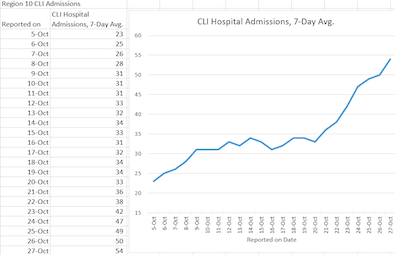
According to IDPH, the city has now reached the seven-day increase in hospital admissions mark. Daily hospital admissions for coronavirus-like illness increased by 43 percent in that week.
In suburban Cook, daily hospital admissions for coronavirus-like illness increased by 58 percent in a week. That is not a trend anyone wants.
* Meanwhile…
The Illinois Department of Public Health (IDPH) today reported 4,000 new confirmed cases of coronavirus disease (COVID-19) in Illinois, including 46 additional deaths.
- Adams County: 1 female 70s
- Carroll County: 1 male 90s
- Clinton County: 1male 60s, 1 male 80s
- Coles County: 1 female 90s
- Cook County: 1 male 60s, 2 females 70s, 1 male 70s, 1 female 80s, 1 female 90s
- DuPage County: 1 female 60s, 1 female 80s
- Jefferson County: 1 female 90s
- Jo Daviess County: 2 females 90s
- Kane County: 1 male 80s
- Knox County: 1 female 70s, 1 female 90s, 1 male 90s
- LaSalle County: 2 female 80s
- Macon County: 1 female 70s
- Madison County: 1 female 80s
- Mason County: 1 female 70s, 1 male 70s, 1 female 90s, 1 male 90s
- McLean County: 1 male 60s, 1 female 90s
- Moultrie County: 1 female 50s
- Pike County: 1 female 70s
- Richland County: 2 females 90s
- Rock Island County: 1 female 80s, 1 male 80s
- St. Clair County: 1 male 70s
- Vermilion County: 1 male 70s
- Warren County: 1 male 60s
- Wayne County: 1 male 90s
- Whiteside County: 1 female 80s
- Will County: 1 female 70s, 1 male 80s
- Williamson County: 1 female 60s, 1 female 80s
- Woodford County: 1 male 90s
Currently, IDPH is reporting a total of 382,985 cases, including 9,568 deaths, in 102 counties in Illinois. The age of cases ranges from younger than one to older than 100 years. The preliminary seven-day statewide positivity for cases as a percent of total test from October 20 – October 26 is 6.4%. Within the past 24 hours, laboratories have reported 62,074 specimens for a total 7,388,290. As of last night, 2,758 people in Illinois were reported to be in the hospital with COVID-19. Of those, 595 patients were in the ICU and 241 patients with COVID-19 were on ventilators.
*All data are provisional and will change. In order to rapidly report COVID-19 information to the public, data are being reported in real-time. Information is constantly being entered into an electronic system and the number of cases and deaths can change as additional information is gathered. For health questions about COVID-19, call the hotline at 1-800-889-3931 or email dph.sick@illinois.gov.
*** UPDATE 1 *** As noted by a commenter, Region 3, which includes Springfield, just hit an average 8 percent positivity rate. Two more days in a row of this will trigger mitigation.
*** UPDATE 2 *** Region 10 is suburban Cook County. From IDPH…
38 Comments
|
* Eric Schelkopf at the Kane County Chronicle…
Kane County judge Kevin Busch on Monday granted a temporary restraining order to prevent Gov. JB Pritzker, the Illinois Department of Public Health and the Kane County Health Department from enforcing an indoor dining ban at FoxFire restaurant in Geneva. […]
“There is no question that a person’s ability to pursue their calling, to earn a living and to run a business is a protectable right under both the federal and state constitution and is inherent in everyone’s natural right to liberty,” Busch said, in issuing his opinion. “The state’s ability to deprive people of their life, liberty and the pursuit of happiness is tempered by due process.” […]
Busch agreed with the suit’s contention that Pritzker exceeded the 30-day emergency powers granted to him. In March, he issued a disaster proclamation because of COVID-19. […]
“The crowds at our local food stores are much greater than the crowds that can, and I expect do, populate our local restaurants, including FoxFire,” he said. “I note that in our community that every one of the big box stores is open. And again, the crowds that populate these stores are significantly greater than the crowds that populate are local restaurants, including those like FoxFire. And the court cannot turn a blind eye to these facts. If there was such a compelling public need to shut down businesses for public health, then how did we pick the winners and losers?”
The Patch’s coverage included this important context to the judge’s comments…
According to the Centers for Disease Control and Prevention, dining at bars and restaurants is closely linked to the spread of the virus in many communities. Adults who tested positive for the virus were approximately twice as likely to have reported dining at a restaurant than those with negative test results, according to a CDC study published in September. Experts now believe the coronavirus is airborne, and tiny droplets containing the virus can linger indoors for hours as aerosols, making indoor dining especially risky since diners can’t wear masks while eating.
* Maybe if the state had been allowed to brief the case, the judge would’ve had some answers. From the governor’s office…
The administration is disappointed the court has ruled against public health protections that keep people safe. This decision was made without briefing and is contrary to how many other Illinois state and federal courts have ruled on this matter. Positivity rates and hospitalizations are rising across the state; this public health crisis is not over. The administration will review the court’s order and determine the appropriate next steps.
From the attorney general’s office…
With 9,522 lives lost and half the counties in Illinois now at the Illinois Department of Public Health’s warning level, the need for these lifesaving measures could not be more evident. As we have argued successfully in other Illinois courts that have considered these issues, the governor’s constitutional and statutory authority to protect Illinois residents during the pandemic is clear. We are committed to continuing to defend the well-reasoned measures being implemented to mitigate the spread of COVID-19 throughout Illinois, particularly as the numbers of positive cases and hospitalizations once again increase.
The lawyers representing the restaurant were on WGN Radio yesterday. Click here to listen to the interview.
The TRO is here.
*** UPDATE 1 *** From the plaintiff’s petition…
(T)he [Illinois Emergency Management Agency Act] does not authorize Gov. Pritzker to declare a “disaster” to manage an existing “disaster” for an additional thirty (30) days, and certainly not ad nauseum.
Judge Busch…
“The state has argued that there’s nothing in the Emergency Management Act that suggests that the governor couldn’t issue then successive proclamations,” Busch said. “And while that is certainly true, there’s nothing in the act that suggests he can.”
* From an Illinois Supreme Court order issued today…
Illinois has been in a state of emergency since Governor Pritzker’s declaration on March 9, 2020, due to the COVID-19 pandemic, necessitating temporary court-imposed restrictions to minimize the impact of COVID-19 on the court system, while continuing to provide access to justice.
That could be a pretty good hint at where the high court is going here.
*** UPDATE 2 *** The attorney general’s office has asked 2nd Appellate District to hear its appeal of the TRO. Click here. The AG also filed this document with Judge Busch. Worth a read.
62 Comments
|
|
 Support CapitolFax.com
Visit our advertisers...
  ...............
 ...............
 ...............
 ...............
 ...............
 ...............


|
   
|
Hosted by MCS |
SUBSCRIBE to Capitol Fax |
Advertise Here |
Mobile Version |
Contact Rich Miller
|




