* I suppose this happens when the President travels, but, man, the lack of any information about his speech this week has been frustrating…
Five days ahead of President Barack Obama’s visit to Springfield, residents were awaiting to hear details of when exactly he’ll address the Illinois General Assembly and what else he might do during his stop in the capital city. […]
The only activity [White House Press Secretary Josh Earnest] listed for Wednesday is the appearance before the legislature in Springfield.
“Now in the final year of his second term, the president looks forward to addressing the Illinois General Assembly about what we can do together to build a better politics, one that reflects our better selves,” Earnest said.
On Wednesday evening, Obama is scheduled to fly to the San Jose, California, area, where he’ll spend the night.
* I was able to get some information this afternoon, however.
The Capitol Building will be closed from 7:30 am until 10 am. But don’t even think about trying to get in early. They want an empty building.
The tunnels in the Capitol Complex will be closed from 7:30 until President Obama leaves.
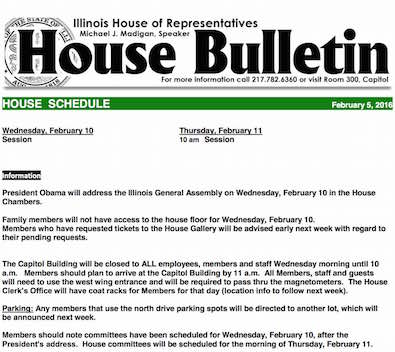
The President will speak in the House chambers. There’s word that Obama might - might - do some sort of thing in the Senate afterward.
*** UPDATE *** The House Speaker’s office just sent out some more information…
Comments Off  
|
* From AFSCME Local 51…
Spread the word. Folks should refuse to take this phony poll. Below is a sample of a phone call received from a Local 31 member:
Call from a local leader re phone survey she believed came from the Governor’s Office:
just received a call from I believe Rauners office asking me about the union informing me about contract negotiations. He wanted to know my stance on paying dues, am I for unions and will I strike. He wanted to know how do I feel abou medical & merit comp. He asked a lot of personal questions and wanted to know my name which he already knew and asked to speak to me by my full name.
He asked me how much of my salary was I willing to go without.
It is recommended that you do not answer these questions.
In Solidarity
Lori Gladson
President, Local 51
* A reader forwarded me that e-mail and said he had also received the call. I asked for details…
Received a call at 6:13 pm yesterday from a [redacted] number. I’m in [redacted], so I answered. They confirmed my name, that I was a state employee, and represented by AFSCME. I assumed it was a poll commissioned by AFSCME, since they had all this information. I agreed to answer their questions believing it was an AFSCME poll (dumb, I know). The first few questions regarded opinion of the Governor (very unfavorable), opinion of AFSCME (favorable), opinion of state finances (very dire), etc. They then asked about my willingness to strike (refused to answer), how much money I would be willing to give up for a strike (refused to answer), how often do I hear updates from the union (once a week), do I believe the union is representing me well (yes). They then confirmed my name, which I found odd because they stated my name at the beginning of the call. They asked my “position”.
When I started getting suspicious (around the time of the strike questions), I asked who the poll was for. The poller stated that he didn’t even know who it was for. I confirmed that my name would not be used with my answers, and he agreed. The call lasted 9 minutes. Needless to say, I became more and more uncomfortable as the night wore on and wish I had refused to answer any of the questions.
I convinced myself that the Governor’s office wouldn’t share my personal information (phone number) with a polling agency for political reasons. Now I’m not so sure.
Shortly after receiving the call, I started going through the comments on yesterday’s AFSCME posts on the blog looking for anybody mentioning something similar, but found none.
Then I received the forwarded email this morning. Crap… Hopefully we’re just paranoid….
* Council 31 is now warning members about the poll…
PHONY POLL: Company tied to the Raunerites is using a phony “poll” to pressure state employees to make negative statements about our union. YOU DO NOT HAVE TO TAKE THIS CALL. If you get it, you can just hang up immediately.
Anyone else get this call?
*** UPDATE *** From the governor’s office…
Hi, Rich:
The administration is not aware of this survey and has nothing to do with it.
Best,
ck
* From a reader…
Rich-
This may or may not be a coincidence. I am a county official, and received this FOIA request at the end of January.
The e-mail…
From: Research Policy [mailto:research@illinoispolicy.org]
Sent: Wednesday, January 27, 2016 3:19 PM
Subject: Illinois Policy FOIA 1.27.2016
To whom it may concern,
This is a request for information under the Illinois Freedom of Information Act (5 ILCS 140).
I am seeking documents related to the number of and names of (redacted) employees who are union members with the name of their affiliated union and residential zip codes.
As I am a researcher acting in the public interest, I ask that you waive any fees. Please notify me by telephone at 217.528.8800 or by email if you have any questions regarding my request. If possible, please forward the requested document(s) by e-mail.
I will expect to receive your response within five business days, as required by the statute (5 ILCS 140/3(d)).
Thank you very much for your assistance.
Chris Andriesen
Illinois Policy Institute
I’ve asked the Illinois Policy Institute about this. Stay tuned.
171 Comments
|
* Press release…
The Board of Trustees at Chicago State University took steps at a special meeting today to officially declare financial exigency and prepare the University to continue operating in the absence of state funding. Like all public universities, CSU enters its eighth month with no funding due to the historic state budget impasse.
“The actions taken by the Board today are meant to give the administration of the University some additional flexibility as it works through this unprecedented situation,” Anthony Young, Chairman of the Board of Trustees said. “Over the past year, this University has made significant cuts to personnel and spending but has reached a tipping point where the ability to function is threatened. I want to be very clear, this action may help the administration manage this crisis in the short term, but exigency is by no means a solution to our budget woes. The only real solution is for the Governor and the leaders to come together and provide the necessary funding to avoid further damage to our universities.”
In declaring financial exigency, the Board is officially recognizing that the unforeseen fiscal situation compels CSU to reevaluate all programs, services and organizational structures in order to fulfill its core mission and to complete the current semester. In addition to declaring exigency, the Board established a Management Action Committee, which is chaired by the President of the University and includes senior members of the administration, who will continue the ongoing task of thoroughly reviewing all aspects of University spending and make recommendations on where additional cost saving measurers can be found. Lastly, the Board created an Advisory Committee, which will have faculty, staff and student representation and will give input to the Management Action Committee.
“We find ourselves in this unprecedented situation because, while the state has not honored its commitment to our students, we still intend to do so,” Thomas Calhoun Jr., CSU President said. “We are committed to finishing this semester and to graduating our seniors, and in order to accomplish that goal in the absence of state dollars or MAP grant funding, we are forced to take these extraordinary measures. I would hope the necessary but unfortunate steps we are taking here today will help all elected officials who represent public universities and care about higher education recognize that this is not just a Chicago State problem, it can and will affect the entire public university system. On behalf of our students who have bravely and proudly stood at the front lines of this crisis and fought for their university, I once again call on the Governor and the leaders of Illinois to put aside your political differences and take necessary action to prevent students from being the victims of this catastrophe.”
* Meanwhile…
February 4, 2016
To: The Honorable Governor Rauner
Senate President Cullerton
Senate Minority Leader Radogno
House Speaker Madigan
House Minority Leader Durkin
Members of the General Assembly
I am writing on behalf of the Higher Learning Commission (HLC), the regional accrediting agency for nineteen states, including Illinois. HLC is recognized by the United States Department of Education to assure quality in higher education and to serve as the gatekeeper to federal financial aid for students in our region.
As your role in Illinois includes consequential decisions regarding the governance and funding for colleges and universities, I am notifying you of the potential accreditation outcomes that may result from not approving a budget that will provide funding to Illinois colleges and universities and their students.
A criterion for accreditation is demonstration of the availability of financial, physical, and human resources necessary to provide quality higher education. HLC is aware that the colleges and universities in Illinois may need to suspend operations because financial resources from the state are not available. HLC is obligated to move swiftly to protect Illinois students and to ensure the quality of the colleges and universities they attend.
Following federal regulations, HLC has notified all Illinois colleges and universities that if they believe they will have to suspend operations or close in the next several months, they must provide HLC with a plan for how students can continue at another college or university to avoid eliminating their access to higher education. For students to continue at another institution, it could mean having to transfer to private universities or leave the state. It is also probable some students may drop out of college. The plan also must explain how students will be informed about this urgent situation, including how they access transcripts if operations have been suspended due to lack of state funding.
HLC’s analysis of that plan about the college or university’s viability in the weeks ahead could result in 1) a review of the college or university’s compliance with HLC’s Criteria for Accreditation, 2) a sanction – in which the college or university would have two years or fewer to demonstrate corrective action, or 3) withdrawal of accreditation. After such a withdrawal, there is a multi-year process for institutions to regain status with an accrediting agency. Students attending institutions that do not have status with an accrediting agency recognized by the federal government cannot access federal financial aid.
I served as a college president at two institutions in Ohio and know it is critical for state leadership to have every fact and potential outcome available. The lack of state funding is putting Illinois colleges and universities at serious risk and jeopardizing the future of students. I recognize the pain of budget shortfalls, especially in our home state of Illinois. The economic challenges the state faces are significant, and difficult decisions undoubtedly must be made. I am writing because I believe it is important for you to have all the relevant information before making the tough decisions that fall to your positions.
As you struggle with these difficult and life-changing decisions, if you have questions about the role of accreditation, please contact me.
Sincerely,
Barbara Gellman-Danley, Ph.D.
President, Higher Learning Commission
Emphasis in original.
…Adding… From the IBHE…
Statement from Dr. James Applegate, Executive Director
“The IBHE has been informed by Chicago State University that the Board of Trustees have declared financial exigency. They are taking steps to mitigate the financial situation on their campus in order to address the needs of their students, faculty, and staff.
The Board of Higher Education is keenly aware of the uncertainty the lack of a Fiscal Year 2016 budget is creating for Illinois college students, professors and staff at all of Illinois’ 48 community colleges and twelve public universities.
While IBHE has no direct role or authority in overseeing the actions of the CSU Trustees, we extend our support to the campus leaders as they seek to minimize the impact on their students’ academic progress.”
60 Comments
|
* From an e-mail that was forwarded to me by a labor lobbyist…
Wanted to make sure everyone has this as we prepare to testify in the capitol and speak before other groups this year. Governor Rauner and his friends like to say that businesses are leaving Illinois.
I ran this report from the Bureau of Labor Statistics web site. It tracks the number of employers (both public and private sector) in Illinois. As you can see, the number of employers in Illinois has grown in every quarter since the first quarter of 2003.
Thank you.
Jason Keller
Illinois AFL-CIO
Legislative Director
* The spreadsheet…
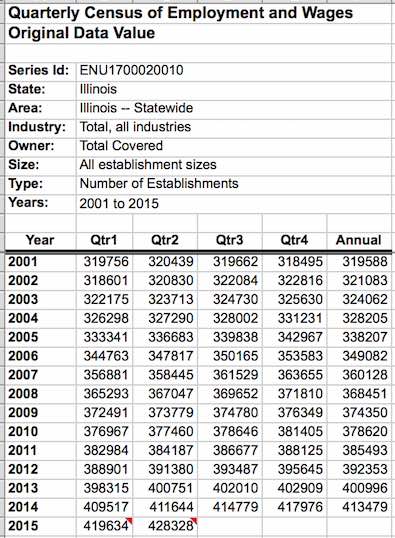
That’s a 33 percent increase in employers since the first quarter of 2003.
* But what about other states? I asked the lobster to see if he could get Keller to run more numbers and was forwarded this e-mail today…
After I sent the email yesterday regarding the number of employers in Illinois, I was asked by several people how Illinois compares to other states in terms of growth of businesses. I updated the chart (see attached) with the number of business establishments in every state from 2001-2015. Since the first quarter of 2003, when Governor Blagojevich took office and Senate President Emil Jones, Jr. gained control of the State Senate (which is when we first heard the complaint that Illinois was a bad place to do business). I specifically looked at growth in each quarter. This is what I found:
Illinois has seen growth in the number of businesses in the state for approximately 49 consecutive quarters (and hopefully will still continue to increase). 2003-2015. NO OTHER STATE CAN MATCH THAT STEADY AND SUSTAINED GROWTH. None. This means that since 2003, Illinois has not lost one net business (contrary to what we hear from Republicans). Other people may play with the numbers and see other states have a larger percentage growth, but no one can point to such a long term sustained growth of businesses. Illinois weathered the Great Recession without losing growth. North Dakota and Texas come close with the oil and fracking growth – but they still saw a drop in businesses in several quarters. As a reminder, during these years, Illinois labor was successful in passing:
· Minimum wage increases that became effective in 2004, 2007, 2008, 2009, and 2010 – and still businesses grew.
· Numerous times prevailing wage laws were strengthened – and still businesses grew.
· Effective in 2008, employee misclassification law was passed – and still businesses grew.
· Three times in the past 11 years, the workers’ compensation law has been changed – and businesses grew.
· The unemployment insurance law was changed multiple times, through the agreed bill process – and businesses grew.
· Card check for public employees organizing passed in 2003 (PA 93-444) – and businesses still grew.
· Equal Pay Act passed in 2003 (PA 93-0006) – and businesses grew.
· Corporate Accountability passed (PA 93-552) – and businesses still grew.
There were other laws passed, but this gives you a snap shot.
For background, I spoke with an economist at the Bureau of Labor Statistics – the measure of “number of establishments” is the most accurate way to count the number of businesses in the state.
Thank you.
Jason Keller
Illinois AFL-CIO
Legislative Director
See the numbers for yourself by clicking here.
The number of Texas business establishments grew by about 27 percent since that first quarter of 2003. Indiana’s grew by just 4 percent.
* Keep in mind that these numbers include both public and private sector establishments. Even so, it’s something that deserves more attention and investigation.
*** UPDATE *** From the Illinois Policy Institute…
Rich,
We took a quick look at the same survey (QCEW) and same timeline (Q1 2003 - Q2 2015) as in the study you posted. Attached are the rankings.
For 2003-2015 growth, Illinois’ growth ranks 4th for establishments, 43rd for jobs, and 42nd for average weekly wage (AWW).
It’s important to note that the combined weak jobs growth and weak average weekly wage growth is a double whammy. Imagine adding 500,000 new jobs, all paying at the average weekly wage. Great news, right? That would bump up the jobs number and even though it wouldn’t bump up the wage number, we’d all cheer it.
In Illinois’ case, both job growth and average wage growth were bad. So not only is job growth weak, the average wage has grown slowly on that slow-growing job base.
The 2003-2015 timeline included the recession right in the middle. So we also looked at the same data set on the recession recovery timeline, starting from Q1 2010 when everyone had basically bottomed out (after various degrees of collapse, Illinois’ fall ranked among the worst).
For growth over that recovery time period, Illinois’ ranked 4th for establishments, 32nd for jobs, and 45th for average weekly wage (AWW).
Michael
–
Michael Lucci
Vice President of Policy
Illinois Policy Institute
Illinois Policy Action
Click here.
41 Comments
|
* Look past Rep. Kelly Cassidy’s rhetoric here for the actual news…
Nearly five months ago, House Leadership provided members with a survey asking for us to prioritize items that remain unfunded. I released a survey reflecting the choices, and set the rankings to reflect the responses. Since then, we have passed a handful of bills funding portions of programs but have made no progress towards a comprehensive solution. We have seen numerous non-profit organizations go under, and services for tens of thousands have ended. The unfunded line items represent hostages in this budget standoff, and they are beginning to fall. Meanwhile, in spite of making significant progress on unpaid bills since 2012, from $6.8 billion to $4.3 billion, we are now seeing that pile of bills growing to record levels, projected to reach $10-$12 billion.
We have once again been asked to identify priorities for unfunded items, choosing 10 out of a total of 58, many of which are matters of life and death. Pitting critically needed services and programs against each other in a budgetary “hunger games” is repulsive.
There is only one rational and moral choice: getting the revenue needed to stabilize government and provide services that are fundamental to the well being of tens of thousands of Illinoisans. There is no correct order of priorities, because there are life and death consequences. Any choice but appropriate revenue is morally reprehensible and will continue to lead to suffering.
I reject the notion that we can only prioritize a small number of these programs, and instead invite my colleagues to join me in demanding we stop talking about what essential line items to fund, and instead talk about how we are going to fund them.
The fact that we are having this discussion represents the utter lack of morality of our budget situation. Putting aside the fact that our outlined priorities may very well not be funded in the near future, the choices given are hardly choices at all. How does one decide which order to prioritize funding for sexual assault victim services or the developmentally disabled? All sides of the budget standoff agree that revenue is an absolutely necessary part of the solution. With billions of dollars in unpaid bills and the collapse of our social safety net, the harm is unacceptable. I strongly support returning the tax rate to the previous levels, and working towards a progressive income tax. Until then, we are tasked with trying to prioritize a few of the many services that impact the lives of tens of thousands in in our state.
That said, if there is to be another stopgap funding initiative in the near future, there is an opportunity to offer input. Once again, I am asking my constituents to share their priorities, and their experiences, to help drive us towards a more comprehensive solution. I recognize that, like me, many of you will choose to rank revenue as priorities 1-10. For those of you specifically impacted by program cuts, please use the narrative area of the survey to share your story so that I can better illustrate the real world impact of this impasse. I have met with and spoken to so many people either already feeling the loss of services or living in fear of losing their independence as a result of looming cuts. Know that I will continue to push forward towards a solution that protects working families and the most vulnerable people we serve.
Due to the timeframe given by leadership, we need your responses by 3pm on Friday, February 5th.
Emphasis added.
* The full list is here.
Your top choices?
*** UPDATE *** From Emily Miller…
Hi Rich.
I saw that you posted the newest priority ranking list given to members. It is notable that there are items left off the list, as one commenter said.
More notable, though, is how much this list has changed and grown from previous member polls.
Items like Teen Reach (which the Governor completely eliminated in his budget proposal last year) were not even included in previous member polls. But children, families and communities have made it so clear how vital afterschool programs are that it has emerged as a priority.
Programs don’t show up on a list by accident. These are obviously issues members across the state are hearing a lot about from constituents, advocates and the local press. It goes to reason that, in turn, the Governor’s office is getting a fair amount of grief from lawmakers who know the anger present in their communities, and want to be able to deliver some good news ASAP.
We’ll see in a few weeks during his budget address if, given the clear support these services have from families across Illinois, the governor will directly address how he’d like to see these services get funded now and in the future.
Emily Miller
Policy and Advocacy Director, Voices for Illinois Children
Co-Coordinator, Responsible Budget Coalition
27 Comments
|
Madigan announces education funding task force
Thursday, Feb 4, 2016 - Posted by Rich Miller
* Press release…
House Speaker Michael J. Madigan, D-Chicago, issued the following statement Thursday announcing hearings to be held by the bipartisan Education Funding Task Force throughout the spring to help craft a legislative plan to equitably fund education throughout Illinois:
“Senate President Cullerton has shown strong leadership on the issue of fair and equitable education funding, which is so important to every community across our state. The President’s commitment to fairly funding our schools and helping all students meet their full potential is one that I share, and I plan to work with him to achieve this goal while making sure that voices from across our state are heard and that all schools and programs are protected throughout this process.
“Beginning February 16 and continuing throughout the spring, House Majority Leader Barbara Flynn Currie will lead hearings of the bipartisan Education Funding Task Force. The House Democratic members of the task force, who represent Chicago, suburban areas and downstate, bring to the discussion the views and concerns of residents from all across Illinois to help ensure a comprehensive approach to any changes in how our schools are funded. The task force will hear input from educators and advocates from throughout the state, and will work with all interested parties to craft legislation aimed at ensuring all students in Illinois receive the excellent education they deserve.”
The Education Funding Task Force will convene Tuesday, Feb. 16 at 10:30 a.m. in Room 114 of the State Capitol.
Rough translation: Thanks, John, but I’ll take it from here.
Several suburban Democrats aren’t exactly thrilled with the direction this topic has been going. As Senate GOP Leader Radogno pointed out the other day, the suburbs are mainly responsible for paying for the funding shift to lower-income schools as it stands right now.
…Adding… As expected…
The president’s commitment to fairly funding our schools and helping all students meet their full potential is one that I share, and I plan to work with him to achieve this goal while making sure that voices from across our state are heard and that all schools and programs are protected,” Madigan added. […]
Steve Brown, Madigan’s spokesman, suggested in a follow-up conversation that protecting “all schools and programs” means that no district would get less than they do now.
“You’re very unlikely to pass a bill that will cost districts money,” Brown said. That means the state would have to come up with potentially hundreds of millions of dollars a year more, and, “You need a source. . . .You don’t know the price tag now.”
37 Comments
|
CMS on AFSCME: “This is bad faith in spades”
Thursday, Feb 4, 2016 - Posted by Rich Miller
…Adding… The governor’s complete contract offer can be read by clicking here.
* The war of words continues…
Dear Colleagues,
As you know, on three separate occasions our CMS labor relations team negotiated and signed a Tolling Agreement with AFSCME leadership. The Tolling Agreement provided for a process, agreed to by AFSCME, that allows the parties to either agree that impasse in negotiations has been reached or, in the event one party does not agree, allows either party to ask the Illinois Labor Relations Board to decide if the parties are at an impasse-that is, the Labor Board would decide whether further negotiations between the parties would be worthwhile. On January 15, 2016, after weeks of no meaningful progress at the bargaining table, the Governor asked the Illinois Labor Relations Board to determine whether we are at an impasse in collective bargaining negotiations with AFSCME. In the weeks since, work in the State of Illinois has continued as usual. The Governor and the labor relations team at CMS are committed to respecting the Labor Board process, and we appreciate that members of AFSCME want to do the same.
There has, however, been a great deal of incorrect information circulated about our negotiation and proposals. We know that, in recent days, AFSCME has been conducting “informational sessions,” but we question how productive those sessions can be if AFSCME does not provide accurate information.
We cannot sit idly by without correcting the incorrect information being provided to AFSCME bargaining unit employees and the public. We have asked AFSCME to let you vote on our proposals, but we believe you must have accurate information to make a fully informed decision. As the State’s lead negotiator who sat across the table from Roberta Lynch and Mike Newman for the past year and explained the State’s proposals, I would like to take this opportunity to correct numerous incorrect statements. That information is enclosed.
Further, I believe that employees should not be satisfied with summaries and that they deserve a full picture. It is my understanding that AFSCME has failed to provide you with the State’s full proposal. I believe that is counter-productive. You should be able to read the State’s proposal in full, and determine for yourselves whether the State’s offer, which is substantially similar to those accepted by seventeen other unions, is fair and reasonable, particularly in light of the State’s fiscal condition. I am enclosing with this letter the actual language of the 2015-2019 collective bargaining agreement as proposed by the State in its last, best and final offer. That document shows all the changes proposed by the State from the contract that expired on June 30, 2015. You can now evaluate for yourselves the State’s complete proposal.
We have asked AFSCME to let you vote this proposal up or down. We hope you will ask AFSCME’s leadership to allow you to take such a vote. Seventeen other unions ratified similar terms and conditions by wide margins-often over 80% of state employees in those unions approved-and we think if provided a fair vote, this proposal will be approved as well. Thank you for giving it your consideration.
John Terranova
Deputy Director
CMS Office of Labor Relations
* And here’s his fact check…
Fact Check - Correcting Misinformation
Myth: The State’s proposal would give Illinois state workers the worst health insurance coverage in the nation.
Fact: False. In fact, we’re not even close. With retiree coverage included, Illinois pays nearly 3/4 of the total cost of coverage for its workers. In comparison, Indiana pays less than 45% of the total cost of coverage. Paying 100% of retiree premiums is a huge benefit to our workers-if current employees were responsible for those retiree healthcare premiums, they would need to be putting away $947/month now to cover that future benefit! Even if we only look at coverage for active employees-where the State is proposing to pay 60% of costs-the State’s proposal is still better than many other States and on par with the private sector.
Myth: The State’s current healthcare plans aren’t actually Platinum or luxury.
Fact: The average actuarial plan value (what federal regulations and insurance companies use to assess how rich a health plan is) for the State’s current plans is 92%. This means that out of every dollar in healthcare expenses, the insurance plan covers 92 cents and the employee pays 8 cents in deductibles, co-pays, and other such expenses. “Platinum” under the Affordable Care Act is defined as plans that are between 88 % and 92%. Platinum is the highest level under the Affordable Care Act-above Gold, Silver, and Bronze. And as mentioned, the State’s average plan value is 92%-the high end of Platinum.
Moreover, to be clear: under the State’s proposal, employees will have the option to continue this rich coverage at higher premiums, should they so choose. Alternatively, employees would have the option to have less-rich coverage and maintain current premiums. Employees will not have to both pay higher premiums and receive less-rich coverage.
Myth: The State’s proposal would wipe out all job security rights.
Fact: The State’s offer does not eliminate these rights. Layoffs would still happen in reverse seniority order. Employees would still have the opportunity to “bump” less senior individuals in the same position and qualifications. Employees would also still have the opportunity to transfer to other vacancies for which they are qualified.
Myth: If I have a major medical issue under the new insurance, there is no limit on what I could pay. I could go bankrupt!
Fact: The Affordable Care Act has an annual out-of-pocket maximum of $6,850 for an individual. While that’s a lot of money, it prevents people from being financially ruined due to a medical issue. You can go here to fact-check this for yourself: http://obamacarefacts.com/
health-insurance/out-of-pocket-maximum. The bottom line is no matter what coverage level employees select, there will be strict limits on how much each employee is going to be asked to pay in any given year.
Myth: Merit pay is just political pay.
Fact: Politics has nothing to do with it. In fact, the State would prohibit any Governor’s staff and appointees from being eligible for performance bonuses. The State has also proposed working with all unions to find fair, objective standards to measure performance. The program that’s now in place for Teamsters will give half of all their members a bonus. While we guaranteed that a minimum of 25% of members would receive a performance bonus (the same guarantee that we made in the Teamsters contract), that percentage is the floor, not the ceiling. In developing the program, the number could go up, just as it did for the Teamsters. And the total bonus payout would remain the same regardless of how many people receive a bonus, so the State doesn’t gain anything financially by giving it to fewer employees.
Myth: The Labor Board is biased in favor of the Administration.
Fact: A majority of the Labor Board was originally appointed by Governor Pat Quinn. Governor Rauner reappointed two individuals Governor Quinn had previously appointed or re-appointed. Significantly, all members of the Labor Board appointed or re-appointed since 2015 were confirmed by a supermajority-Democrat Senate. Furthermore, the Chairman of the Board is, hardly an “enemy” of AFSCME. For many years he was responsible for negotiating collective bargaining agreements on behalf of the State, including many of the prior state contracts that AFSCME now praises. Most importantly, both AFSCME and the Administration voluntarily signed a legally binding tolling agreement providing for the Labor Board to resolve any dispute over whether the parties are at impasse. For AFSCME to preemptively impugn the integrity of the Labor Board is puzzling.
AFSCME complains that “in a recent case regarding an issue related to contract negotiations, the Board hastily rushed a decision and completely upheld the Administration’s position.” Although AFSCME did not identify the case, we believe it must be referring to an FAQ on the State’s website, which can be found at http://www.illinois.gov/EmployeeFAQs. In that FAQ, the State responded that, during a strike, the State can charge striking workers the full cost of their health insurance. AFSCME filed an unfair labor practice charge. After carefully considering the parties’ written submissions, the Board’s Executive Director dismissed the complaint and acknowledged the State’s longstanding policy to charge striking workers for the full cost of their insurance. The well-reasoned decision was upheld on appeal to the full Board. That AFSCME brought and lost a baseless charge is no reason to doubt that the Board gives a fair consideration to every case before it. For AFSCME to suggest otherwise is regrettable, let alone begging the question why AFSCME would voluntarily enter into an agreement to submit the impasse dispute to such a tribunal.
Myth: The Governor is “now seeking to impose on state employees” his contract.
Fact: Under the terms of the tolling agreement, it is up to the Labor Board’s to decide if the parties are at an impasse and whether the State may implement its last, best and final offer. It is critical to mention that the last offer made by the State to AFSCME is substantially similar to the agreements signed by 17 other unions. These agreements were ratified in many cases by over 80% of state employees in those unions. This is not a radical or extreme contract as AFSCME has portrayed, but one that is fair, reasonable, and overwhelming accepted by several thousand State employees already.
By submitting this dispute to the Labor Board, the Governor did nothing more than invoke the very process to which both parties voluntarily agreed.
What the Governor is seeking, and AFSCME is refusing, is for AFSCME to submit the Governor’s actual proposal to employees for a vote. What better way is there to determine whether the proposal is deemed fair and reasonable by the very people whose work will be governed by that proposed contract?
Myth: The Teamsters’ agreements provide “far more generous health insurance terms.”
Fact: Comparing Teamsters’ health insurance to AFSCME’s is like comparing apples and platypuses. AFSCME employees’ health insurance is provided by the State, where the State charges premiums. Teamsters’ health insurance is provided by Teamsters’ own health and welfare funds. The State contributes to those funds but does not get to decide the level of coverage or premiums. It is entirely out of the State’s control. Teamsters can provide the bare minimum coverage under the Affordable Care Act or they can provide more. Either way, the State plays no role.
The most that can be said in comparing Teamsters and AFSCME for health insurance is that, unlike AFSCME’s demand for a guarantee of Platinum coverage at Silver prices, Teamsters received no such guarantee from the State. What Teamsters get is entirely up to Teamsters’ own funds. This is similar to the point AFSCME makes about the trade unions with whom the Governor signed twelve separate collective bargaining agreements. AFSCME claims the distinguishing feature is that the trades’ agreements do not include a wage freeze. But what AFSCME fails to mention is the trades get compensated on a wholly different metric, known as the prevailing wage. That wage is determined through a certification process administered by the Department of Labor and is not guaranteed to increase during the course of the contract. In fact, the prevailing wage could go down over the life of the contract. So, there too, while AFSCME is demanding guaranteed wage increases through general and step increases every year of the contract, other unions have received no such guarantees.
As against seventeen other unions that have ratified the State’s offer by wide margins, AFSCME stands alone in demanding guaranteed wage increases and luxury health insurance coverage at what could be characterized as garage sale prices.
Myth: Only union workers are being asked to sacrifice due to the financial circumstances in the State.
Fact: Everyone is making sacrifices. Non-union employees are also on the State’s health insurance and will be subject to any premium increases or plan changes. This includes the Governor’s staff and the labor relations people who made this proposal. It’s also worth noting that non-union employees haven’t received an across-the-board wage increase in ten years. Cherry-picking salaries of some in the Governor’s office-without noting that the Governor’s office payroll is less now than it was during his predecessor-is as uninformative as focusing on the compensation of AFSCME’s top executives.
Fact is, our employees tell us all the time, as Teamsters and other unions told us during bargaining, that they are ready to be part of the solution, not the problem. They recognize that state employees in Illinois make more than their counterparts in other Midwestern States. For example, Illinois state workers made, on average, over $20,000 more per year in 2014 than state workers in Indiana or Missouri. In absolute dollars, Illinois state worker pay was third-highest. The two higher-paying States, California and New Jersey, have significantly higher costs of living. After adjusting for cost of living, Illinois workers are the highest paid in the country. The Governor is proud of our state workers and has never proposed to cut their salaries. He only asked for true shared sacrifice as we, all of us, together right our State’s fiscal ship.
Myth: The Administration does not accurately report what is said at the bargaining table.
Fact: Here’s what AFSCME’s Executive Director Roberta Lynch said during bargaining: “People who came up with this [merit pay proposal] ought to go to f**king prison . . . fact that you want to give measly 25% to some who are doing the job already . . . 75% of people not doing their best - that’s a f**king lie. I think it’s an insult to every single person who works for the State of Illinois.”
Here’s how AFSCME interprets the above quote: “it wasn’t fair to leave out 75% of employees from getting a bonus, given the difficult jobs that employees do-and that whoever came up with that idea should try going and actually working in a prison so they’d know how hard the job is.”
We appreciate that AFSCME’s Executive Director regrets her choice of words when she reads those words on paper. Nonetheless, she does not get to rewrite the history of negotiations based on what she wishes she has said.
Myth: SB1229, the arbitration bill that AFSCME unsuccessfully lobbied last summer and fall, was an opportunity to resolve outstanding contract disputes in a fair and rational manner.
Fact: Make no mistake about it, SB1229 was AFSCME’s attempt to rewrite the State’s labor laws as they have existed for over thirty years to saddle the State’s taxpayers with a multi-billion dollar cost of AFSCME’s unreasonable contract proposal that it knew, under the existing laws, it could never get the State to agree to at the bargaining table. Outstanding contract disputes-like the current dispute between the parties as to whether they are at an impasse-already have a fair and rational forum, which is the Labor Board, a process to which both sides voluntarily agreed. SB1229, or the new HB580–another version of the same failed bill, which would strip the Governor of his constitutional authority–is as unaffordable and damaging now as it was then. Several other Unions have already negotiated agreements with the State under the existing labor laws. Why must the rules be rewritten to give AFSCME what it wants and the State’s taxpayers cannot afford?
We now know that AFSCME is urging its members to support HB580, to once more ask to strip this Governor-and only this Governor-of his authority to negotiate with employees. This is as clear a signal as any that AFSCME is not interested in negotiating. AFSCME is not interested in defending its unaffordable proposals. AFSCME is only interested in imposing its will through an unelected, unaccountable arbitrator. This is bad faith in spades, and why the matter is now before the Labor Board.
176 Comments
|
|
 Support CapitolFax.com
Visit our advertisers...

 ...............
 ...............
 ...............
 ...............


|
   
|
Hosted by MCS |
SUBSCRIBE to Capitol Fax |
Advertise Here |
Mobile Version |
Contact Rich Miller
|



