[The time stamp on this post has been altered for Friday visibility.]
* Question time for Gov. Pritzker. Did you get a COVID test before you came to Springfield after you had been isolating?…
I did not. I was tested before I was isolated and because I isolated the entire time, right up to the point where I came to Springfield. I didn’t get another test.
Please remember to pardon all transcription errors.
* One of the measures that the General Assembly is working on is this vote by mail so several questions there I’ll try to group them together for one. Does it go far enough? This would merely be mailing to people who voted in recent elections applications for vote by mail you would want natural ballots mails so doesn’t go far enough. And then on the opposite end some Republicans are saying that this could lead to ballot stuffing. So, how do you ensure the validity of this particularly the President Donald Trump has raised questions about voting…
Well this has obviously been a republican strategy, all across the country to deny people the ability to actually go to the ballot box or to deliver their ballot to vote. Republicans generally speaking, have been in favor of suppressing the vote, all across the nation they think it’s bad for them if more people vote. I think everybody has the right to vote. We live in a democracy The vote is sacred. And so I’m very much in favor of making sure that everybody gets a ballot who is eligible to vote, and then returns that ballot
Does it go far enough?…
In my view, I would like more done, and of course this has been a discussion and negotiation, conversation, about how to make sure that the most people get it, and that, you know, we’re doing the best we can with the resources that we have. So, allowing people to send out ballots, or rather applications to everybody that voted in the last number of elections and still giving everybody else the ability to apply to get a valid, I think is a reasonable compromise and gets us what we want which is people don’t need to go to a physical validating location, and you see by the way that there are other aspects of that legislation that do provide easier access to the ballot box for people who do need to go in person.
* There are concerns about Illinois losing federal funding, getting threats by President Trump regarding states that do proceed with expanding vote by mail. Is that a concern? And this is from Mark Maxwell is jumping off of that. You have made similar threats to local governments in terms of holding up funds from the States. If they don’t comply with your executive orders. So, why might it be bad when the President does something like that but okay when you do it? [Somebody needs to brush up on their federalism.]…
Well there’s an awfully big difference. The President is threatening to take away funds from states [that are] doing something that’s legal. And what we were talking about, as you suggest in the week before about the possibility of holding up funding for local governments because they’re not following the law. That’s a much different thing. But look, I want, I think it’s very important for people to get access to the ballot. The President doesn’t want that. I do want people to get a ballot and to vote and that’s just an enormous, enormous ideological difference. I believe in democracy and the right to vote.
* The Republican delegation to Congress has sent you a letter that wants to know more about what Illinois is doing as it allocates federal funding that is received for the coronavirus response, it was appropriated recently, of course under the cares act, citing a report from the National League of Cities that says Illinois is a state that is withholding funding from municipalities…
No funding is being withheld at all. We need enabling legislation. We needed the legislature to actually get together to provide that enabling legislation and that’s what’s happening over the next day and a half.
* I know that there were a lot of folks who rejoiced about your announcement yesterday and yet, a lot of questions so I’m going to try rapid fire these from news organizations, for starters that Mayor Lori Lightfoot in Chicago has said that restaurants in the city are not going to be able to open, restaurants, by the end of May. What is your response to that and does that underscore complaints, particularly from leaders in the collar counties in the suburbs, that they have been unfairly lumped in with Chicago…
Well the decision by a municipality like Chicago to not have outdoor seating is completely up to them as I’ve said all along. We’ve tried to provide a baseline to protect people in various communities in different cities and counties, they can do something that’s more stringent and decide not to allow certain activities because maybe they’re a hotspot. Maybe they’re concerned about something in particular that they want to deal with on a local level. But I think many many towns, cities and counties across the state will in fact be having outdoor seating for restaurants and, and, you know, those that choose not to, that’s a completely local decision.
* And you did ease up on those restrictions obviously from the original Restore Illinois plan. Again, we’re still hearing a lot from those suburban leaders and collar county executives that are saying, why are we part of Cook County and Chicago. So do you have any plans any second thoughts as to whether that might change?…
That’s not something that I’m looking at doing and we have four regions, they’ve all been moving in the right direction. You see that everybody in Illinois now, all four regions are not only moving in the right direction, but are going to be able to. barring some catastrophic thing that may happen in the next eight days, will move into the next phase.
* Retail stores are going to in phase three be able to reopen with capacity limits. There are of course, large places of worship. Will they be able to observe capacity limits in phase three as opposed to the restriction of 10 people or fewer?…
Well, again, capacity limits are intended. We’re still in a phase where 10 people or fewer is the desired number that’s what the epidemiologists are recommending and so on. Many small stores that is a number that maybe less than they normally have in their store, but it’s still a reasonably good number and they can keep track of people who are coming in and out and those who can’t fit in can certainly socially distance outside as they wait to go in with regard to churches and mosques and synagogues. I think it’s important for people to be able to get together and worship. But again, we’ve got to follow the same rules. The whole idea here, this isn’t something that I made up. This is something that the epidemiologists really have emphasized that until we know whether having larger groups together you know and what the effect of that is we need to watch what it’s like when we let everybody get together in a group of 10, in groups of 10. Even with social distancing. We don’t really know, right it’s what you’re doing is watching and that’s why you have a phase. We’re watching week by week, day by day, through the phase to see what’s the effect on the number of people who are coming down with COVID-19, the number of people who end up in hospital, and you’ll see as we move forward, we’ll provide you with more data but you can see it yourself if you go to the DPH website that it takes several weeks for these things to work through you know groups people get together and they do something that they shouldn’t have done and someone spreads it in a group. You don’t see an immediate effect. Two weeks later, you start to see maybe people are entering the hospital more people are in in hospital and then perhaps two weeks later you’re seeing people going into the ICU and perhaps on a ventilator, and even a week after that perhaps people dying. And so that’s why we’re trying to take a gradual approach here to all of us.
* Today, the Illinois Department of Employment Security came out with new figures, pretty awful ones regarding the number of people who have lost work last month, and yet there continued to be issues with IDES and filing for that. Elizabeth Matthews at Fox asks about someone who was given a runaround as they tried to receive pandemic unemployment assistance, the caller hung up. So are workers properly trained for this, or was training at all rushed? Can you address as well just the general high figures of unemployment?…
Let me start with just saying that this is a tremendously disturbing problem that everybody in the country is facing and the high unemployment, the number of people who have been furloughed laid off, perhaps permanently. The number of businesses that especially small businesses which are really the lifeblood of job creation in our country, right those small businesses when they close up it’s hard for them to restart. And this is, it’s a tragedy that requires us to really put shoulder to the wheel to make sure that not only the federal dollars that have been provided through PPP but also the state COVID relief effort is trying to revive is working to revive employment and revive small businesses, and to get people back to work that’s certainly a very, an extraordinarily high priority for me.
As to people who are experiencing problems connecting with unemployment and I know the PA system as you mentioned, look I there. There are going to be these circumstances, there have been, it’s not you know it’s not something’s not excused in any way. It is something that when we have these rush of applications that come in a single day, the number of people answering the phone there’s only a certain number of people who can. And then, things are going to happen. I mean, there’s no doubt that mistakes get made, if somebody gets cut off the phone line it’s not because there’s somebody on the other end who’s saying I don’t really want to do that work and hitting a button. That’s not what’s happening. And yeah you should see these IDES employees. TheRE are people who are you know yelling at them because they’re angry about their situations, but the IDES employees are working so hard to try to get the job done. And I just want you to know that for people who are continuing to have difficulties, please keep trying. I’ve been, we’ve been doing our best to expand the ability, both to take phone line calls, as well as online applications.
* If they are unable to find childcare, can they continue to receive unemployment? There are those who say that they are fearful that they won’t be able to go back to their job because they have nowhere to send their children, then therefore what do they do well quit right so that’s one of the things…
Well, number one, as you know, we created emergency licenses and we’ve licensed to more than 2500 I think we’re at about 2650 or more emergency childcare locations. Remember, you have to back up to second This isn’t a desire on any of our part to limit childcare. The idea here is that with everything that we know especially the, the, the potential that there are COVID related illnesses that can befall children that we want to make sure that we’re also limiting the social interaction the numbers of people that are in a childcare setting, both the children and the adults. And so, this is obviously a difficult circumstance when you think about most childcare facilities have many more than 10 children they may have, you know, 15 or 20 in a space and then they have multiple spaces, and they often are you know running into each other in the hallways. Under normal circumstances so when you you know when we have a pandemic and mystery, you know, that is COVID-19, that we’re all trying to unravel. And we’re trying to protect people. We’ve got to move to what’s the best way to protect them and so moving to these emergency 10 person 10 child facilities has been the best thing to do. Now we also need much more child care. And so we’re working with childcare providers … I really believe in providing childcare for families. It’s something I’ve worked on a long time and I’ve been expanding into the state of Illinois before COVID-19 came along. So it’s something I believe in. So we are working with childcare providers to try to figure out how in their facilities where we’ve only said you could have 10. Is there a way to keep children separated in groups of 10 without having the kind of interactions that you normally would have in a childcare facility, between all the people the teachers that are there the childcare providers and the children themselves so we’re working on it we have a task force of childcare providers who are motivated trust me to want to open their facilities and I am motivated because I know as we get people back to work, they need more childcare so we’ve been at this for some time. Suffice to say my deputy governor and my first Assistant Deputy Governor are on top of it, working with this task force to make sure we expand.
[There was a long question and a long answer on contact tracing. Not much new, so we’ll skip to the privacy angle.]
* Apple and Google are now out with apps that have these abilities to do some of that contract tracing work. So, can you respond to that particularly given Illinois biometrics laws and limitations fears about breaches?…
Privacy is a huge concern, online privacy huge concern. We have good laws on the books today, we probably need even more privacy legislation. But suffice to say there’s nothing that we’re going to do with our contact tracing that will violate those laws. And the Apple and Google apps that you’re talking about is something that, genuinely I’m a little concerned about because it it potentially and I don’t know the intricacies of it, but I’ve read enough to say it potentially could invade someone’s privacy. Having said that, we do need to make sure that we’re doing our best at all levels to identify contacts and this may be, it may be a worthwhile thing for us to do if we can maintain people’s privacy.
* So when it comes to the budget, your original proposal called for putting money in reserves that counted on your graduated income tax constitutional amendment getting approved in November’s election. Is that still what you want to happen or given the great many other unknowns, having to do with borrowing what we will or will not get with the from the feds how conservative do you plan to be in terms of spending with all of those outliers those monster questions?…
Well, let’s be clear that the budget that is now in the General Assembly is one that the General Assembly has worked very hard on. It comes with an outline that that perhaps started with what I had in February proposed. But today is much different. I mean obviously we are in a much different situation for our state. So I’m gonna look at what the legislature has done. Our team has been responsive to questions the legislature has put to us. You know, we need to make sure that we’re working together as best we can to have a budget that pays the bills for the state. And as I’ve said many times before, we have a sincere hope and belief that there will be help that comes from the federal government because without it, this state and states all across the nation will end up laying off firefighters and police officers and nurses and and so many other people in the services that people need exactly in one of the worst economic circumstances that we’ve had will go away without that federal help.
* Rep. Fred Crespo … said that he’s talked with IDES about answers. Says that it’s time for you to work with the legislature to do something about this problem. When’s that going to happen and what does that look like?…
Well we’ve talked to the legislature about, particularly with the budget as you know IDES is one of those agencies that was woefully inadequately funded for many years. And we talked about government getting hollowed out over the last few years, that’s just one of the agencies, but it is one of them. And you can imagine that well gee when the economy is getting better every year. People don’t pay much attention to the unemployment system because it’s, you know, too small, it doesn’t really affect that many people, that’s the theory that the General Assembly has gone by for many years now here we are, right with all that underfunding affecting idea so I am absolutely we first were working with them on making sure we get the right funding levels for it. Yes. And secondly, that we are working to use that funding to upgrade the systems that exist, and the people because there’s been a drop in the number of employees.
* Businesses have made significant sacrifices during the pandemic. How is your administration going to help offset the expected increased burden, because of unemployment insurance?…
Yeah. So again, two things to keep in mind. The first is typically unemployment is something that is an agreed upon, understanding between business and labor and employees, and so we’re going to continue that. But, as every state in the United States and I’ve talked to many Republican and Democratic governors about unemployment in particular and about the funding of unemployment. Again, this is part of what the cares Act, or this next heroes act addresses is unemployment support and we’re going to need that like every other state.
* Also with unemployment. When do you anticipate things getting back to normal? Peter Hancock capital news Illinois, are the programs now in place extended benefits and federally funded pandemic related extensions is going to be enough to carry people through?…
I’m concerned that it’s not enough. I’ll be honest with you I see the $600 extra that people got and are getting in unemployment benefits, even that, you know, added on top of the existing unemployment benefits it doesn’t seem to be enough. And when you think about the amount of time that … economists are saying that it might take us to get back to normal. I’m concerned that the typical number of weeks that are allowed and may not be enough.
* How realistic is it for the state to spend around the same next year as it spending this year, given the state’s dire financial situation?…
So, again, one of the challenges when you get into an emergency when you get into a, an economic downturn, is that you have not only a increased number of people unemployed, decreased number of people who are paying taxes. Revenues dropping for the state. You also have a massive increase in the amount of services that people need more middle class families, drop their income substantially people who’ve never needed the state’s supports perhaps. Now they need that support. So you you can’t say as a state, we’re just not going to help people. And that’s why we’ve asked the federal government like all the other states for help, we’re just trying to replace the revenues that were lost this is not anything more than that.
* Well, on that question about getting funding from the federal reserve fund for instance, I spoke with Congressman Rodney Davis today, he said you know it’s a good program glad the state’s looking into it but he says it still doesn’t take away the bad policies the state’s had in place for decades that have led to a lot of the underfunding that’s happened, even before the pandemic. Is it time to reassess those programs and the policies that have been in place to, you know, ensure that we’re ready for any other possible pandemics or any other disasters that may be down the pike?…
First of all, once again, if all we did was restore the state to where would have been, we still would have challenges, no doubt about it. And that’s not something that’sstarted this year, right, that’s something that existed for years before I became governor. So I think that Congressman Davis probably does understand that balancing the budget is a hugely important goal of mine, that I’ve been focused on since before I became governor. We balanced the budget we put the only budget that I put forward the first budget that I put forward, was a balanced budget and indeed, even reporting you could look at COGFA for numbers and others even reporting, up to the time of the pandemic. We were on track to have a mild surplus in the state something that hasn’t happened for a long time, which would have been used to pay down some of our bills. We were on track to do better. Obviously everybody has a different opinion about how much you should do how fast, and so on. But here we are. Look, here we are, we have to take care of people in our state, who need us. This is what government is for.
* After this is done, is it time to reassess the policies that have led to before the pandemic the incredible financial problems that the states had?…
Yeah. And as I say you know when you set aside, it’s hard to do that but setting aside the question of the effect that the pandemic has had on our budget, if you were able to put that aside, we’ve been making progress. And again we have differences of opinion about how fast that progress is and what we ought to be doing.
This is not a business though I want to be clear. Running government is not like running a business, you would take maybe different measures if you’re running a business here. Our job is to take care of people or, that is to say people who are in need, people who are falling through the cracks people who are in extreme poverty, people who now have lost their jobs, people who need medical care who no longer have insurance. So our job is to provide those services for them in government and so for people who want to make massive cuts in government today, think about who you’re doing that to you’re doing that to the middle class you’re doing that to the working class you’re doing that to the people who need government the most.
* Ohio has just canceled their 2020 State Fair, when do you expect to make a formal decision on the state fair here in Illinois, and if so, if it’s canceled, how do you comply with the state law that says the fair shall be held in DuQuoin and Springfield?…
We’re working on that now. I don’t have an answer for you, we’re still trying to figure out what we can do if there’s something we can do. But again, on the current situation of phase two, moving into phase three, we couldn’t do it within that timeframe, but it isn’t scheduled for that timeframe. So I’m very hopeful once again I’ve said all along that the greatest thing that would happen and I hope everybody will put this in their prayers today, would be an effective treatment and or a vaccine. Because if that happens, then we can do things like have. [garbled] So I do think it’d be something you may cancel it, but then revisit it and see if we can postpone it or something to that effect I think all of us enjoy the state fair so I mean I would love to make it happen. We just have to, you know, do the best we can.
* We’ve received a lot of calls from youth sports leagues wondering what specifications are in place for when phase three and 10 person gathering sizes are happening, mainly Have there been they’ve been wondering if there will only be 10 on a field or multiple groups of 10, can you offer any clarification, when it comes to the phase three for gatherings, when it comes to sports?…
We’re certainly working with IDPH to make sure that summer sports, to the extent we can do it with 10 or fewer people. You know that we want to make that happen. Again more outdoor activity within the parameters of what the epidemiologists are saying. I think it will be difficult to have crowds in the stand watching those games, but I know that there are literally games and other sports during the summer that perhaps could happen. And again we’re we’re working with IDPH or IDPH is working with folks who run those games to make sure that you know if you can do it that they’re done safely.
* Do you have a sort of apologies to those states [Florida, Georgia] for saying that they’re doing this wrong and jumping the gun and reopening their states?…
Well I think I expressed my deep concern and I think now you’re seeing that in Florida perhaps the data isn’t accurate. Right. They fired the person who was managing the data, and she says it was because she was reporting trying to report it accurately and couldn’t. So I look I can’t speak to you know the comparison I can only tell you that we’re in our state doing the best we can to open carefully. We’re not an outlier in any way there are many states that are following our lead and I think doing it in the right way. But look, our number one consideration again is to keep people out of the hospital and make sure that we are providing the healthcare service that people need and hopefully we can continue to reduce the outbreaks.
* When are state employees going to be back to work?…
In phase three there we bring it back. As you’ve seen DNR as we will open all the state parks, all the DNR employees will be back. We’re moving people back as fast as we can. But to be clear. Just as with offices, remember as we open in phase three lots of offices, businesses that are in offices have to follow certain social distancing guidelines and therefore telework will continue. That’s very likely to continue for state workers as well.
* Fox 32, numerous construction workers in the Chicago area are driving up to Wisconsin every day to work on a large construction project on your Kenosha County horse farm. You’ve been vocal about urging Illinois residents to not cross borders. Does this travel square with your advice? Are you concerned they’re traveling to a state that is essentially opened up?…
Well, first of all, they’re operating an essential function. Construction is an essential function. And second of all, they’re union employees that are going to do the work that they do. And I’ve never said that people can’t cross the border into another state. That’s not something I’ve said, I have urged people against crossing the border and going into situations in which there’s no social distancing, aren’t wearing, following any of these rules right away, not wearing face coverings not washing their hands. So you know all the things that can be happening in Wisconsin because they have literally no orders in place as far as I understand, except perhaps in certain local areas.
[That was some weak oppo. He’s paying unionized Illinois construction workers during a recession! The horror!]
* Governor a deal has been reached on workers compensation that enshrines the gist of what you wanted in your emergency rule with the ability for businesses to give a rebuttal. Do you regret putting that workers’ comp rule forward since it was ultimately struck down by a judge and worked out among stakeholders anyway?…
Well I’m glad that both sides were able to work on getting something done. Because that ultimately that’s the best solution for all. As you know we’ve been working in pandemic time right I mean everything is moving very fast, every day is like a week. And so we have to get things done, decisions need to be made. And so, you know, look, glad that we’re finally, we’ve got the right answer.
* Chicago’s mayor is still hopeful the tweaks for the Chicago casino will get legislative approval what’s going on with the negotiation?…
I can tell you this that I have encouraged every legislator that I talked to make sure that Chicago was able to get the casino bill passed. And it’s very important I think for not only for the city of Chicago, for their pensions, but also for jobs that will get created. And of course for the capital program for the state. Again, eventually casinos will reopen. I can’t tell you exactly when, but just by passing that bill at least give Chicago the ability to build the [garbled] to locate it. I don’t know where they will, and then build that casino. So I’m very much in favor and I want people to know that this is a hugely important priority for the city of Chicago.
* Dave Dahl wants to know what exactly can get done in a day and a half?…
Who has that question? [Dave Dahl, he was told.] He should know that miracles can happen in a day and a half in Springfield. I’ve only had one May in Springfield and we’ve seen an awful lot can happen in a day and a half.
* The Archdiocese of Chicago submitted a plan for what he wants to do in phase three, we’ve heard from other faith groups who expect to be given the same provisions will they have the same provisions in phase three as the Catholic Church?…
It’s appropriate that’s the question right after the miracles. But the answer is that the Catholic Church, I mean every church is different, and mosques and synagogues. And so we’ve tried to provide guidance where we’ve been asked. The city, I mean sorry that the Archdiocese of Chicago, did a terrific job with their plan, very detailed webinars and lots of detail. So I hope that other churches will take that lead from the Archdiocese.
* The AG removed Rep Bailey’s lawsuit against you to federal court and Bailey’s lawyers have asked to keep it in state court. Why remove the case to federal court, any response to Bailey’s latest request to keep it in state court?…
I mean, it’s the attorney general’s office who handles these things. It’s a legal manner. I would say, I think they they felt like there were federal issues at hand.
-30-
52 Comments  
|
* Press release…
The Illinois Department of Employment Security (IDES) announced today that the unemployment rate jumped +12.2 percentage points to 16.4 percent, while nonfarm payrolls shed -762,200 jobs in April, as the COVID-19 pandemic continued to impact Illinois businesses and households, based on preliminary data provided by the U.S. Bureau of Labor Statistics (BLS) and released by IDES. The monthly unemployment rate rose to a new record high since current methodologies were enacted in 1976 and the monthly decline in nonfarm payroll jobs also set a record. The March monthly change in payrolls was revised from the preliminary report from -34,100 to -60,900 jobs. The March unemployment rate was also revised from the preliminary report, from 4.6 percent to 4.2 percent, as a result of a downward revision to the number of people in the labor force in March.
The April payroll jobs estimate and unemployment rate reflects activity for the week including the 12th. The BLS has published FAQs for the April payroll jobs and the unemployment rate.
The state’s unemployment rate was +1.7 percentage point higher than the record high national unemployment rate reported for April, which was 14.7 percent, up +10.3 percentage points from the previous month. The Illinois unemployment rate was up +12.2 percentage points from a year ago when it was 4.2 percent.
The three-month average Illinois payroll employment estimate was down -278,200 jobs during the February to April three-month period, compared to the January to March three-month period. The largest average declines were found in Leisure and Hospitality (-107,800), Trade, Transportation and Utilities (-37,700) and Professional and Business Services (-36,800).
“The COVID-19 pandemic has had an unprecedented impact on our economy, as has been the case in states across the nation,” said Deputy Governor Dan Hynes. “As we move to safely reopen much of our economy, we are focused on ensuring working families and small business have the resources they need to recover, and we urge the federal government to step up and provide additional relief.”
“As Illinois tackles this unprecedented crisis, Governor Pritzker has taken action to support a swift public health recovery that will in turn enable residents and businesses to make an economic recovery,” said Erin Guthrie, Director of the Department of Commerce and Economic Opportunity. “This administration’s focus on workforce development, rebuilding our crumbling infrastructure, and creating new industries will help us start to bring Illinoisans back to work and rebuild our economy.”
Compared to a year ago, nonfarm payroll employment decreased by -822,800 jobs, with losses across all major industries. The industry groups with the biggest jobs decreases were: Leisure and Hospitality (-320,500), Professional and Business Services (-119,800) and Trade, Transportation and Utilities (-110,000). Illinois nonfarm payrolls were down -13.4 percent over-the-year as compared to the nation’s -12.9 percent over-the-year decline in April.
The number of unemployed workers increased dramatically from the prior month, a +280.3 percent increase to 1,004,400, a new record high, and was up +270.6 percent over the same month for the prior year. The labor force was down -2.9 percent over-the-month and -5.2 percent over-the-year. The unemployment rate identifies those individuals who are out of work and seeking employment.
An individual who exhausts or is ineligible for benefits is still reflected in the unemployment rate if they actively seek work.
April year-over year: Mining -1,300 jobs; Construction -28,700, Manufacturing -65,800; Trade, Transportation, and Utilities -110,000; Information -6,600; Financial Activities -8,600; Professional and Business Services -119,800; Educational and Health Services -77,100; Leisure and Hospitality -320,500; Other Services -48,500; Government -35,900.
…Adding… Oof…
…Adding… IDES…
The Illinois Department of Employment Security (IDES) today released new statewide data showing the department processed 72,780 new initial claims for regular unemployment benefits during the week ending May 16. The department has now processed 1,226,394 claims for unemployment benefits from March 1 through May 16. This amount is 12 times the number of claims the department processed over the same period last year, when IDES processed just 93,000 claims for regular unemployment benefits.
The Pandemic Unemployment Assistance (PUA) program, launched May 11, processed 74,515 initial claims in its first week. PUA provides 100% federally-funded unemployment benefits for individuals who are unemployed for specified COVID-19-related reasons and are not eligible for the state’s regular unemployment insurance program, the extended benefit (EB) program under Illinois law, or the Pandemic Emergency Unemployment Compensation program (PEUC), including independent contractors and sole-proprietors. Up to 39 weeks’ worth of benefits are potentially available under the program for COVID-19-related unemployment claims.
IDES processed 36,367 Pandemic Emergency Unemployment Compensation claims (PEUC), which provides up to 13 weeks’ worth of 100% federally funded benefits to individuals who have exhausted their regular state unemployment benefits. PEUC is potentially available for weeks beginning on or after March 29, 2020 and continuing through the week ending December 26, 2020.
The Department also announced state extended benefits (EB) are now available to those who exhaust the allotted 26 weeks of regular state unemployment and the additional 13 weeks of federal PEUC benefits. EB provides an additional 13 weeks of regular unemployment benefits and is made available when the state experiences a high unemployment rate. The Illinois unemployment rate currently sits at 16.4%.
*** UPDATE *** Oy…
10 Comments
|
The Democrats’ favorite Republican
Thursday, May 21, 2020 - Posted by Rich Miller
* A House Republican sent me this spot-on email today. Posted with permission…
Yesterday should have been a great day for the Republicans. We’ve been asking for weeks to be brought back into session, and on the first day back, the Republicans on JCAR held firm and forced the repeal of the IDPH rule which would have allowed small business owners to be charged with a Class A misdemeanor. Leader Durkin spoke well on the floor and properly shamed a protester who went over the top with Holocaust references.
But were those the stories of the day? Of course not, it was the Darren Bailey Show, where everyone played their assigned parts to perfection. The Speaker was able to fracture our caucus with his rule-making authority, Bailey got another 15 minutes of fame and the Governor was able to duck serious criticism of his disastrous rule. It’s rare that the Republican Caucus gets an opportunity to get the kind of positive exposure it deserved yesterday, and it was totally squandered.
Bailey ought to be thanking us for throwing this party on his behalf, and both the Governor and the Speaker should be wearing big Darren Bailey buttons with the message “My Favorite Republican.”
…Adding… Leader Durkin did try to talk some sense into Bailey yesterday. A Ted Schurter pic…
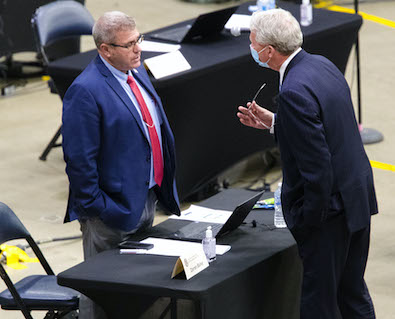
…Adding… The protesters are gone, so he’s lost his audience…
71 Comments
|
* Jon Seidel at the Sun-Times…
One day before a hearing scheduled to be held before a skeptical downstate judge that threatened his stay-at-home order, a lawyer for Gov. J.B. Pritzker on Thursday moved a lawsuit from Rep. Darren Bailey out of state court in Clay County and into federal court.
It wasn’t immediately clear what the move would mean for the court hearing on Friday before Clay County Judge Michael McHaney, who has already said “the Bill of Rights is being shredded” by the stay-at-home order. If nothing else, it could delay a ruling. Tom DeVore, Bailey’s attorney, told the Chicago Sun-Times Thursday it is a “stall tactic.”
“The governor’s trying to buy time,” said DeVore, who added that there are “zero federal issues raised” in Bailey’s lawsuit.
Legal experts told the Sun-Times parties can move cases from state court to federal court if there is a constitutional issue at play, but opposing parties can fight the move. State lawyer Thomas Verticchio wrote in Thursday’s removal notice that Bailey’s lawsuit “seeks redress for alleged deprivations of Bailey’s federal constitutional rights caused by actions taken under color of state law.” […]
A state court judge in Sangamon County also on Tuesday denied a request for a temporary restraining order against Pritzker sought by a running store. That case had been moved to Sangamon County from Peoria County.
* From the AG’s notice of removal filed in federal court…
Federal courts have long exercised jurisdiction over challenges to allegedly ultra vires state quarantine orders. See, e.g., Compagnie Francaise de Navigation a Vapeur v. State Bd. of Health, 186 U.S. 380, 386, 393-94 (1902) (exercising appellate jurisdiction based on due process protections in the Fomieenth Amendment over challenge to allegedly ultra vires state quarantine order). This Court has original jurisdiction in this case because Bailey challenges an allegedly ultra vires quarantine order that he alleges has deprived him of his liberty interest without the procedural due process to which he is entitled under the Fourteenth Amendment.
Second, Bailey seeks to redress an alleged violation ofhis right to free exercise of religion. (See, e.g., Am. Comp!., Ex. A, ii 71, seeking redress for Governor’s alleged actions “preventing Bailey from attending worship services.”) The freedom of religion that Bailey alleges to have been violated, and for which Bailey seeks redress, is secured by the United States Constitution. See U.S. Const. amend. I; Church of the Lukumi Babalu Aye, Inc. v. City of Hialeah, 508 U.S. 520, 532 (1993). The First Amendment to the United States Constitution, as applied to the states through the Fourteenth Amendment, forbids the Governor, in his official capacity, from making any law “respecting an establishment of religion, or prohibiting the free exercise thereof[.]” U.S. Const. amend. I.
Third, Bailey seeks to redress an alleged violation of his right to freedom of travel. (See, e.g., Am. Comp!., Ex. A, ifif 105-110, seeking redress for Governor’s alleged actions “restrict[ing] … citizen’s movement.”) The freedom to travel that Bailey alleges to have been violated, and for which Bailey seeks redress, is secured by the United States Constitution. See Attorney Gen. of New York v. Soto-Lopez, 476 U.S. 898, 901-02 (1986) (”Freedom to travel throughout the United States has long been recognized as a basic right under the Constitution.”) (internal citations and quotation marks omitted) (collecting cases).
Fourth, Bailey seeks to redress an alleged violation of Article IV, Section 4 of the United States Constitution, which provides that “[t]he United States shall guarantee to every State in this Union a Republican Form of Government.” Bailey’s complaint alleges that the Governor, through the disaster proclamations and executive orders that Bailey seeks to void, has seized “unilateral control over the movement and livelihood of eve1y citizen in the State. The legislative branch during this period of executive rule under the emergency powers has been rendered meaningless.” (See, e.g., Am. Comp!., Ex. A, ifif 84-85.) In other words, Bailey alleges that the Governor’s actions have transformed the state government of Illinois to such a degree that Illinois no longer enjoys the “Republican Form of Government” guaranteed by the United States Constitution. U.S. Const. art. IV, § 4.
Because Bailey’s action seeks redress for alleged deprivation of at least four rights secured by the United States Constitution, this Court has original jurisdiction over Bailey’s action under 28 U.S.C. § 1343(a)(3), and removal is proper under 28 U.S.C. § 1441(a) and§ 1446.
…Adding… From the AG’s office…
The Attorney General’s office will continue to defend the governor’s constitutional and statutory right to act to protect the health and safety of all Illinois residents.
The law gives a defendant the right to remove a case to federal court when a plaintiff files a complaint in state court alleging a violation of rights that are enshrined the U.S. Constitution, and we have done so in several other cases challenging the governor’s executive orders. Because Mr. Bailey’s amended complaint alleges violations of his federal constitutional rights, we removed his case to the U.S. District Court for the Southern District of Illinois.
The AG’s office also sent a copy of the Sangamon County judicial opinion. Click here.
42 Comments
|
* Greg Hinz…
Some details are still in flux, but it looks like lawmakers are settling on a plan as to how to balance the proposed 2021 budget as state finances reel amid the COVID-19 pandemic. The plan: borrowing up to $4.5 billion from a special Federal Reserve program. […]
The borrowing apparently would occur under a Federal Reserve program in which the bank has the authority to lend up to $500 billion to states and municipalities. The U.S. Treasury Department has the authority to cover up to $35 billion in losses, with the loans to have maturities of up to three years.
Officials here hope the borrowing will serve as “sort of a bridge loan,” covering state cash needs until either Washington Republicans relent and agree to boost direct financial aid to state and municipalities or voters this fall enact Gov. J.B. Pritzker’s proposed graduated income tax amendment, one source told me.
With the money, the state will be able to make its full statutory pension payment and avoid major layoffs or cuts in aid to schools and other local governments, multiple sources close to the matter told me.
The idea, I’m told, is that Congress will come through with an aid package and the loan can be paid back quickly. But we’ll see.
* Yvette Shields at the Bond Buyer…
Legislative sources cautioned that the amount of borrowing and the overall budget plans are still fluid and have not been finalized. The state must close a $6 billion to $7 billion gap in the next fiscal year that begins July 1.
Pritzker said he remains hopeful that federal aid will eventually pass Congress and the state won’t have to turn to borrowing.
“We hope not” to fully use the proposed authorization “because there is a state and local funding bill that is working its way through the Congress,” Pritzker said when asked if the state would tap the full $4.5 billion amount during his daily briefing Wednesday on the state’s response to the pandemic. […]
As previously reported by The Bond Buyer, Pritzker’s administration on Friday said the state would submit a notice of interest to potentially tap the program to competitive sell its $1.2 billion of one-year certificates that are on the day-to-day calendar. Under the new program, the state has access to nearly $9.7 billion of MLF borrowing based on its applicable revenues. […]
The debt authorization requires a three-fifths majority of the Illinois Legislature. Pritzker is a Democrat and Democrats hold a three-fifths majority in both chambers.
Senate Democrats were missing three members yesterday, so they’ll still have enough to pass something with a three-fifths majority if everyone sticks around and sticks together and the Republicans refuse to play ball. The House Democrats had four excused absences yesterday, at least one of whom returns today (Rep. Conroy). That’s cutting it awful close.
…Adding… I’m told another HDem will also return today.
26 Comments
|
Illinois set to greatly expand vote by mail
Thursday, May 21, 2020 - Posted by Rich Miller
* Tina Sfondeles…
The elections omnibus measure would allow for a vote-by-mail application to be sent to any voter who previously voted-by-mail or who cast a ballot in 2018, 2019 or 2020. It would also allow any Illinois resident who filled out a change of address or a voter registration application between the March 17 primary and July 31 to be sent a vote-by-mail application.
The measure also includes language designed to provide more election judges, in light of the mess of the March primary in which many older election judges opted out for safety concerns.
Under the new measure, any U.S. citizen 16 or older would be able to serve as an election judge. High school students, community college and university students would be notified of their option to serve as election judges, and the Illinois Department of Employment Security would be required to notify the unemployed that they could serve as an election judge.
Election Day would also be considered a holiday.
The holiday wouldn’t apply to businesses, just government and schools.
…Adding… I should note that most of the bill’s changes are only for this year’s general election.
The language is here. As I told subscribers earlier this week, its contents are very similar to the House Democratic Women’s Caucus list of ideas from last week.
* Sun-Times editorial…
As the bill’s House sponsor, Rep. Greg Harris, D-Chicago, said, “Our goal is to ensure the greatest possibility of access for citizens to be able to go and cast votes in November in the pandemic.”
Illinois already has a comparatively voter-friendly system of elections. Mail-in ballots postmarked by Election Day are counted even if they arrive two week later. No witness signature is needed to vote by mail. And unlike with absentee ballots, no one has to provide an excuse for voting by mail, such as an illness.
Illinois can do even better to ensure full and fair elections this fall.
…Adding… The bill was advanced to the floor today. Some stories…
* Bill to expand vote-by-mail heads to House floor
* Vote by mail expansion moves to House floor
* Despite concerns, measure expanding vote-by-mail in Illinois advances
…Adding… I’m hearing the Senate may take up this bill tonight…
…Adding… Now the SDems are saying that it may not be taken up tonight.
35 Comments
|
|
 Support CapitolFax.com
Visit our advertisers...
  ...............
 ...............
 ...............
 ...............
 ...............
 ...............


|
   
|
Hosted by MCS |
SUBSCRIBE to Capitol Fax |
Advertise Here |
Mobile Version |
Contact Rich Miller
|




