* Gov. Pritzker began his briefing today by talking about testing. From a press release…
Expanding COVID-19 testing capabilities in the State of Illinois is a crucial part of the state’s plan to Restore Illinois. With increased testing we can make educated decisions that protect our state, our communities and our families. Today, the State is announcing new drive-thru COVID-19 testing facilities will be available in the coming days on Chicago’s southside (May 16), Champaign (May 19), Rolling Meadows (May 20), while drive-thru and walk-up services will be offered in Peoria (May 23). These free community services will be open seven days a week to test individuals with COVID-19 symptoms and those employees who support critical services.
“Not everyone with COVID-19 has symptoms. Without greater testing, it is difficult to know who is infected with this virus. This could mean a person who thinks they are healthy may unknowingly pass the virus to someone else, potentially with deadly consequences. I encourage residents in these areas to take advantage of this opportunity to get tested for free and to take action to help prevent further spread of the virus,” said Dr. Ngozi Ezike, Director of Illinois Department of Public Health.
All individuals with symptoms are encouraged to seek testing at these Community Based Testing Sites. Additional accommodations have been made for the following individuals with or without COVID-like symptoms.
• Healthcare workers
• First Responders
• Employees of Correctional Facilities
• Individuals exposed to confirmed COVID-19 patients
• Employees that support Critical Infrastructure (grocery stores, pharmacies, restaurants, gas stations, public utilities, factories, childcare and sanitation)
• All local and state government employees
• Individuals with compromised immune systems, chronic medical conditions
* The governor also talked about positivity rates…
Our current seven day average is 12%. The cumulative statewide positivity rate since way back in February is 16.8%.
Looking back, remember that our peak positivity rate was on April 4, when 23.6% of tests back positive on a rolling average. I would urge caution and reading too far into this decline as there is a strong inverse correlation between the number of tests taken per day, and the associated positive rate, meaning that part of the reason for the lower positivity rate can be attributed to our increased testing.
Remember, we surpassed 10,000 tests per day for the first time on April,24, and we’ve stayed above 11,000 every day since then. Over the last seven days we’ve nearly doubled that, with an average of 20,000 tests per day. The good news is that our current statewide positivity rate, under 14% on average for the last 14 days, that’s likely becoming a better indicator of the true infection rate from the general public than it was when testing was probably limited expanding testing.
Please remember to pardon all transcription errors.
* On to questions. The question was about Iowa and his concerns…
We’re not collecting the data about people who are crossing over from Iowa. But there is a lot of data about people who are gathering together in large groups. We know that there is a widespread positivity rate everywhere in the nation. There are COVID positive people that are walking around, and maybe not taking the proper social distancing or precautions. But either way, I am concerned, I am genuinely concerned that with no stay at home order in place in Iowa people who are traveling across the border and in gathering in large groups or going into restaurants or bars or getting in close contact with others will come back to Illinois and spread it. And there is lots of evidence of that sort of spread taking place not necessarily across that border because there isn’t data about that border in particular, but there’s lots of evidence of asymptomatic spread. And that’s the reason remember originally for a stay at home order. We still have a lot of people are walking around untested, who have COVID-19.
That’s why I’ve told you more testing leads to more positive results. Because we know people are out there but haven’t been tested. They are in fact symptomatic carriers. That’s my concern and I would just warn the people of the Quad Cities region, be extraordinarily careful I would suggest that if you’re looking for the opportunity to get together to do the things that you’ve been doing in the past to go into a retail store or something like that. We’re 14 days away according to the data from you being able to do that and we’ve done so well up to now I hope you’ll continue on the same course.
* In light of you saying you’re worried about neighboring states opening too early and people crossing the border into Indiana and Wisconsin and bringing the virus back to Illinois, have you joined your family at your Wisconsin home and if not, how are they ensuring they don’t bring the virus back to you?…
Well, I am as you know isolated at home. So, I have not joined anybody in another state.
I’m safe at home and I’m not a carrier in any way if that’s your question.
I think that’s part of the question but also if they are out of state how will you then ensure they don’t bring the virus back to you?…
So, let me begin by saying that my wife and my daughter were in Florida before the stay at home, shelter in place orders were put in place. And they stayed there when the orders were put in place, they sheltered in place, as was the order and the suggestion.
And they have since returned home and isolated for a period of time. But they’re home now and they’re safe and no one is a carrier.
I shouldn’t say that definitively because the reality is that anytime you walk out the door, even if you’re wearing a mask I mean there is some possibility that people could become infected. So please don’t assume that someone can’t be a carrier that they think is possible, but we’re taking every precaution.
* Georgia which has a population similar to Illinois and a similar COVID-19 spread pattern is reopened basically and not demonstrating the potential transmission you’ve referenced possible in the past here. Can you say you’re reopening policy is working when it appears other states are outperforming Illinois, in terms of a restart and go back and redo anything to, what would it be?…
Well, I think that ignores a whole lot of different facts about Illinois than about Georgia, or another state. First of all, we have a major global city in Chicago, that has international passengers that were passing through coming to and staying in Chicago and even traveling throughout the state of Illinois, that’s you know that’s a, that’s one fact, to take note of. Another is that whatever the circumstances were or are in Georgia, we know what the pattern of the spread has been in Illinois. We know that the R Naughtthe essentially the rate at which it spreads come way down as a result of the stay at home rules that we put in place the order has really brought that R Naught down from 3.6 around 3.6 all the way down to near one. And that’s tremendous I mean that’s, I can’t speak to what other states R Naught sort of go into because I haven’t watched every state or the particular one you mentioned.
And lastly, I would say that when things open up here’s why it’s important that you have a period of time that you are gradually opening, because you are going to get a higher infection rate that’s just sort of a fact of life in a pandemic with no treatment with no nothing to stop the virus are going to get spread. We are testing, as much as anybody could at this point. Like I said, we’re among the top states for testing. So, we’re finding more people are positive here. But that doesn’t mean there are a lot of people that are positive and other state that aren’t being tested.
Lastly, I would just say that it takes weeks between the time that you open things up. That’s why you want this period of time, and a gradual opening it takes weeks and weeks, between the time that you open things up when people start interacting with one another and maybe you see in the cell phone data of people’s interactions and the time that they end up going to the hospital. The time that they end up on a ventilator and the time that unfortunately they may pass. So, these are all things that are perhaps unique from one place to another, other than the fact that the virus knows no boundaries and the virus only knows that it is sort of searching for the next person to infect.
* What do you say to small charter operators that are asking how a couple can fly to Chicago, take a train downtown, hop a bus to a harbor, and then be refused to board a small boat or a private sightseeing tour of Chicago’s lakefront miles offshore? Is this an entirely arbitrary policy and are you considering loosening those rules?…
The policies around air travel are not set by the state of Illinois. They are set by the federal government. So that’s the first thing when you say people are flying. That’s not under our control that is a decision by the federal government.
Secondly, we obviously a lot of work has been done to try to make sure that the trains, whether they’re, we’re talking CTA RTA or others are cleaned, you know are kept in condition, so that there’s a minimizing of any potential spread, not suggesting that one couldn’t contract it possible it’s possible really anywhere. But if people are taking the proper precautions, then it’s okay.
Now you’re saying, why wouldn’t we allow lots of people on a boat or why wouldn’t we open up Navy Pier, or something like that? The reality is that again when we see lots of people getting together in a single place, and one could easily bring a COVID-19 into that environment and spread it, we’ve seen the circumstances you read stories no doubt about someone who was infected infecting 100 other people in a location with a lot of people in a room in a boat and something else. So all I can say is that we’re doing the best that we can with the rules that we have in place. The orders, really are following the science, and I think we’ve done a pretty good job in Illinois, we have a ways to go, and certainly along the way to completely defeating the virus which isn’t under our control entirely, something that I think medical science and the researchers are going to have to ultimately come up with a vaccine for.
* It sounds to me like what you’re saying regarding like a boat or charter operators, and even if they were able to present a plan that they could do reservation only thoroughly clean boats in between tours allow let’s say only two or four people. It doesn’t sound like you’re at a point where you’re saying you’re willing or able to loosen those rules…
Well, again, we have rules in place now around two people in a boat as a limitation. It’s really for the purposes of advancing, people just as a leisure time want to go fishing and want to have somebody with them and you know the theory is that a typical boat might allow distance between two people in a boat that was at least a recommendation that we received around boating. When you talk about reopening a business, again, I want to reopen everything as fast as everybody else does. But I just want to be clear that when you get a group of people, jammed together in a space. There is potential for spread and we’re trying to avoid that. But in phase three and phase four you can read it yourself, there are opportunities for people to get together in an increasing amount.
He was then asked a question about the Abbott Labs rapid tests. Click here for more info.
* Response to the five Republican congressman who have sent you a letter raising concerns that you threatened to withhold federal funding in the state?…
My response is that they understand, I’m sure that the laws of the state need to be followed, that the executive orders of the state need to be followed and we will pursue enforcement actions wherever necessary, where people are flaunting the health and safety, they’re ignoring the rules that would keep people safe in their communities. So I know those five congressmen and I have spoken with them over the course of my term in office. I know they have the best interests of their constituents at heart but in this case I think they’re missing the point.
* Governor in late April you said the state was monitoring study about antibody tests but you were hesitant to recommend any because of the inconsistency in results. Has anything changed since then?…
There is a lot of work that’s been done, I’d like to turn it over to Dr Ezike because she understands these antibody tests better than I do, but I’ll just say that there is a lot of work that’s been done around these antibody tests and to my knowledge anyway there are quite a number of them that are ineffectual or not really the kinds of tests that will be useful for us. We want to be able to parse between those kinds of tests, which ones are effective which ones not but I’ll turn it over to Dr Ezike for a more informed view.
Dr. Ezike: So we are trying to learn as much as we can, along with the rest of the country and the rest of the world to see how these antibody tests can be a part of our reopening of the state. And so we do, we have just convened a group of experts of hospital epidemiologist, immunologist, biologists, academicians from across the state who will be convening to try to gather some of the information that’s around there and give you official guidance. You’ve probably heard reports from the feds that even if, and I think the WHO has said this publicly as well. But even if we do know that people develop antibodies, it’s not clear how long that protection would last, it’s not clear the level of antibodies that would be protective. So there’s a, I think there’s more questions than answers at this point. But we have some people in the state that have been doing a lot of antibody testing and so I’d like to see what we can garner maybe if there is some useful information, maybe it’s not specific as to okay you’re good to go and you’ll be immune for the next 10 years but maybe there’s some helpful information that can be garnered so we have a very esteemed group that’s convening to gather some information and see what our official guidance will be.
* Under your reopening plan to get to phase four testing must be widely available in each region regardless of symptoms or underlying risk factors. How close is the state to getting to reaching that sort of testing capacity that would allow for that?…
More testing is better and so, what’s the definition of adequate testing. The answer is that we want it widely available and so we, in my view, as we open up more testing sites and as we make available more materials for testing, I think we’re in a much better place. So we’re making a lot of progress I feel like we’re on a path to being in that spot as needed for every region of the state.
* What are your thoughts about the Naperville park district’s plans to pursue legal action seeking authority to reopen summer programming and facilities, independent of the timeline and Restore Illinois?…
Again, all I can say is that they should be following the data and the science here and not their guts. I too would like to allow all children my own included to participate in summer sports and group [garbled]. I hope we’ll be able to do that soon enough as we move through the phases of the plan and the Restore Illinois plan but I recommend against it. And of course you know people have every right to go to the courts. Too many people choose that. I think, in this circumstance and and so you know I realized that the the local officials there are going to do whatever it is that they want to do but I wish they would show some leadership.
* New questions about the whereabouts of your family, do you want to address that?…
Let me first say that I’ve been private and reserved when it comes to my children. And it’s because there are threats to my safety and to their safety. And so you’ve seen that there are people that stand outside the Thompson Center and stand outside the Capitol in Springfield, the whole thing I mean hateful signs that reference me personally, and that suggests, if not say, but suggests potential for violence.
And so, I told you earlier that my wife and daughter were down in Florida in early March, and in fact even a little before that, and you know they sheltered in place when the stay at home order came up and they stayed there until very recently.
So, we have a working farm there [Wisconsin]. There are animals on that farm, that is the central function to take care of animals at a farm and so you know that’s what they’re doing and I would hope that the GOP the Republican super PAC that’s pushing stories like this about my family would stop doing it because they are putting my children and my family in danger.
…Adding… The governor’s office clarified that his family is in Chicago, but they have visited the farm in Wisconsin.
* Has Illinois seen any confirmed cases of reinfection among people who have recovered? Are you following reports of reinfection and do you have any concerns about that?…
Dr. Ezike: Yes, I mean I get as much as I’m able to watch the news, I follow what everyone else has seen and I remember there was initially some cases, I believe it was out of Korea where they cited dozens if not hundreds of individuals who supposedly had been reinfected after an earlier infection. And I think I saw a follow up story regarding that saying that in fact, the test had been positive but it wasn’t active infection so it wasn’t a clear case of reinfection So, again, I don’t have the answers in terms of how long immunity lasts and if people can get reinfected. We know that there are diseases for which people do have lifelong immunity. We know that there are diseases that people receive a vaccine and then that immunity wanes. So again, this is a new virus, I think time is going to have to tell us that as we look around the world and see cases and cases of infection that have happened earlier, we’ll follow those down the road to see if in fact people do have real infection later on down the road. I don’t have the answer but we will continue to follow the science which will give us the answer.
* How many Illinois testing sites are relying on ABS rapid tests? And do we have plans to make changes?…
I want to be clear that the state doesn’t own a whole bunch of Abbott machines. The federal government did send us 15 machines, but they didn’t send us any many cartridges to go with itt o use the machines but they sent the machines. And so we have used some of those cartridges that we received. There are places that are using their own cartridges and as I say, we can’t control what they do. What we can do is look at the data as it comes to us as it gets reported to us, and just make sure we’re aware where that data came from. But, of course, I want to repeat that I want to discourage those folks from using it until they know what the FDA guidance will be to make sure that the sensitivity is proper to get the results that I think we all hope and expect to get from the COVID-19 test.
-30-
36 Comments  
|
2,432 new cases, 130 additional deaths
Friday, May 15, 2020 - Posted by Rich Miller
* Press release…
The Illinois Department of Public Health (IDPH) today announced 2,432 new cases of coronavirus disease (COVID-19) in Illinois, including 130 additional deaths.
Boone County: 1 male 70s
Champaign County: 1 female 40s
Cook County: 1 male youth, 2 males 30s, 2 females 40s, 4 males 40s, 5 males 50s, 4 females 60s, 8 males 60s, 10 females 70s, 8 males 70s, 18 females 80s, 9 males 80s, 3 unknown 80s, 6 females 90s, 5 males 90s, 1 male 100+
DuPage County: 1 male 60s, 1 female 70s, 2 males 70s, 3 females 80s, 1 male 90s
Kane County: 2 females 60s, 1 male 80s
Lake County: 1 male 40s, 2 males 50s, 1 female 60s, 1 female 80s
LaSalle County: 1 female 60s, 1 female 80s
Macon County: 1 male 80s
Madison County: 1 female 80s, 2 females 90s
McHenry County: 1 female 50s, 1 male 50s, 1 male 70s, 1 female 80s, 1 male 80s
McLean County: 1 female 70s
Rock Island: 1 female 90s
Sangamon County: 1 female 60s
St. Clair County: 1 male 60s, 1 female 80s
Union County: 1 female 80s, 1 male 80s, 1 female 90s
Will County: 1 female 70s, 4 females 80s, 1 female 90s
Winnebago County: 1 female 90s
Currently, IDPH is reporting a total of 90,369 cases, including 4,058 deaths, in Illinois. The age of cases ranges from younger than one to older than 100 years. Within the past 24 hours, laboratories have reported 26,565 specimens for a total of 538,602. The statewide 7-day rolling positivity rate (positive tests) is 16%.
The Illinois Manteno Veterans’ Home (IVHM) is reporting the passing of a second resident with COVID-19. Since the beginning of the pandemic, 53 individuals at IVHM have contracted COVID-19, including two cases who have passed away.
* Dr. Ezike…
4367 individuals were in the hospital with COVID-19. Of those 26%, 1129 individuals were in the ICU, and 675 patients were on ventilators
3 Comments
|
COVID-19 roundup
Friday, May 15, 2020 - Posted by Rich Miller
* More than doubled…
With routines disrupted, unemployment skyrocketing and families forced into close quarters for extended periods, domestic violence is tragically on the rise in Williamson County, State’s Attorney Brandon Zanotti said Thursday while announcing a new capital campaign to support victims.
Zanotti said his office compared charges for domestic violence, aggravated domestic violence and order of protection petitions between March 16 and May 13 of this year compared to the same time last year. Zanotti said these filings have “more than doubled” under the stay-at-home order intended to slow the spread of COVID-19.
* Sun-Times…
Is Mayor Lori Lightfoot planning to close streets and sidewalks so restaurants can safely reopen and give residents a place to run, walk and play? Sure sounds like it.
“People are itching to get outside. Businesses are looking at creative ways to serve customers. The key is how we do it,” the mayor tweeted Friday.
“Stay tuned for some changes to our streets and sidewalks. Transportation is more than just cars. We’ll show how Chicago can be safer and easier to get around.” […]
“The mayor is trying to be very progressive with us. There’s communication going on about maybe closing some streets for outside dining with the tables on the street. That way, we could have social distancing,” [Illinois Restaurant Association President Sam Toia] said.
* From the News-Gazette’s regular interview of the local public health director…
Since toilet rooms have a lot of high-touch surfaces, door handles, faucets and stall doors, transfer risk in this environment can be high. According to the Centers for Disease Control and Prevention, the virus that causes COVID-19 has been found in the feces of some patients diagnosed with COVID-19. However, it is unclear whether the virus found in feces may be capable of causing COVID-19.
There has not been any confirmed report of the virus spreading from feces to a person. Scientists also do not know how much risk there is that the virus could be spread from the feces of an infected person to another person.
However, they think this risk is low based on data from previous outbreaks of diseases caused by related coronaviruses, such as Severe Acute Respiratory Syndrome and Middle East Respiratory Syndrome.
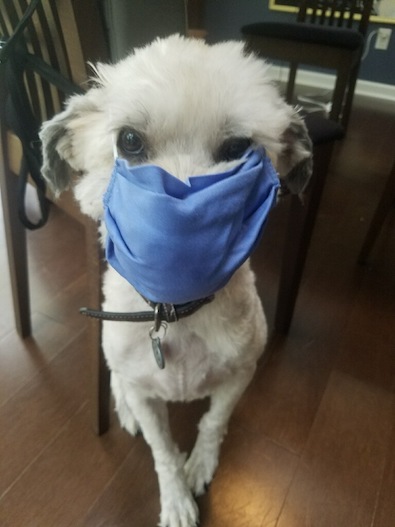
* And here’s Nugget…

Heh. Such a cutie.
…Adding… Not to be outdone, here’s Oscar…
* Tribune live blog headlines…
Chicago libraries looking to reopen by June 1
Education Secretary Betsy DeVos funnels millions in coronavirus relief funds intended primarily for public schools to private, religious schools
DePaul says it will offer in-person classes in the fall as new committee takes up question for other Illinois universities
Lightfoot urges Chicago faith leaders to observe stay-at-home order
Naperville Park Board votes to take legal action to make its own decisions on reopening
‘It’s like a hurricane came and leveled the entire economy’: Retail sales fall 16.4%, a record
‘Everything we did was to predict the next outbreak.’ Yet scientists at Northwestern and elsewhere weren’t prepared for COVID-19. Why?
COVID-19 hitting hardest in Chicago ZIP codes already struggling with deadly threat of gun violence
StreetWise vendors face empty streets and empty pockets amid COVID-19: ‘Things are hard for everybody. Think how hard it is for those in the streets to survive.’
Woman and her 89-year-old mother both survive COVID-19: ‘I didn’t know if she was gonna live or die’
* Sun-Times live blog…
Cook County has most coronavirus cases in US
Lightfoot warns religious leaders she is prepared to enforce stay-at-home order
Cubs chairman Tom Ricketts not sure baseball will be played this season: report
The high cost of quarantine
What’s the first meal you’ll want at a restaurant post-pandemic? We asked, Chicagoans answered.
How we should honor our youngest COVID-19 victim
With the focus on the coronavirus, Lightfoot opts for bare-bones capital plan
Chicago’s flag, civic pride and the fight against COVID-19
Navy Pier is an arm of government, no matter what it claims — so let’s see every contract
‘Stories from Six Feet’ documents search for connection in isolation
3 Comments
|
* Cook County Public Defender Amy P. Campanelli writing in the Sun-Times last week…
Whenever a crisis hits, it is the most vulnerable among us that are hit the hardest. This is happening now to poor families involved with the Department of Children and Family Services.
Since March, when the COVID-19 pandemic intensified, children who were taken from their parents by DCFS have not been allowed to have supervised visits with each other or their siblings. In a blanket order, DCFS banned all supervised visits between children, parents, and siblings.
Banning supervised visits significantly harms the bond between parent and child and sets vulnerable families up for failure. […]
Many parents have very young children who cannot communicate via phone or video conferencing, and because of this ban they are deprived of the opportunity to see, touch and hold their young children. Even mothers who breastfeed their infant children are prevented from doing so. […]
Supervised visits can be done in a safe way, like all the other acceptable activities permitted during the shelter-in-place order. If we can safely prepare and distribute food, we can safely allow parents and their children to visit one another.
* Campanelli’s office has filed a lawsuit…
On March 25, DCFS suspended in-person supervised visits between parents and children in foster care because of COVID-19. The policy says phone and video conferencing can be replacements while the state is under a stay-at-home order.
Wednesday’s complaint takes a different view, including that of a clinical psychologist who warns that video and audio calls fail for children under three years old, because children that age depend on physical proximity. Mothers in the legal complaint say the lack of contact with their children is creating emotional harm.
Aaron Goldstein is chief of the civil division of the Cook County Public Defender’s office, which represents parents trying to reunite with children removed from their custody. He said even when the governor lifts the stay-at-home-order, problems remain in a system overwhelmingly poor and black.
“That means we will have had close to two months of no visits for a lot of families, and then how does that play into their case going forward?” Goldstein said. “So even if [the stay-at-home order] ends on May 31, it doesn’t end for our clients, as their case continues and potentially has some serious, serious negative impacts on reunification of bringing these families back together, which in theory is the goal of this system.”
* Sun-Times…
DCFS spokesman Jassen Strokosch said the agency and its partner were finding “creative ways” for supervised visits with the aid of technology, and that judges in some counties were making allowances to facilitate in-person visits.
“We understand people’s frustration, but we want to do what’s in the best interest of children,” he said. “That includes taking into consideration parents’ needs and in maintaining a relationship and also keeping everyone safe.”
Cook County Judge Patricia Martin, who presides over Child Protective courts, said judges still are hearing “emergency” cases. While she has sympathy for parents and children in her court, Martin is trying to adhere to guidelines from DCFS and the Centers for Disease Control by limiting in-person contact, including the number of court hearings she allows. The court, she said, is looking to broaden the list of issues eligible for emergency hearings as soon as this week.
* From yesterday’s hearing…
On Thursday, her office argued before Judge Caroline Kate Moreland for an emergency motion declaring the DCFS policy “unlawful.”
“Maintaining a parental relationship with one’s child is a fundamental human interest,” argued Assistant Public Defender Aaron Goldstein, adding these visits could be conducted safely with masks, social distancing and temperature screenings to protect against COVID-19. […]
But attorneys representing DCFS and the Cook County public guardian argued the case should be dismissed, claiming the suit has no merit and accusing the public defender of “forum shopping” as there’s already a prior pending case in juvenile court raising the same issues.
“The notion that DCFS is defying court orders is frankly fundamentally wrong,” Assistant Attorney General Barbara Greenspan said during Thursday’s hearing. The balance the DCFS had struck between safety and visitation ability is the “appropriate one,” she said.
…Adding… Believe it or not, the Cook County Public Guardian sided with DCFS. From his brief…
The world is in the midst of a global pandemic the likes of which has not occurred for over a century. The DCFS policy at issue requires that caseworkers identify alternative ways to allow parent/child contact during this crisis, and specifically mentions videoconferencing, telephones, etc, to continue meaningful contact during the public health crisis. The children agree with plaintiffs that the electronic visitation in the absence of in-person contact is not ideal. However, it cannot be said that the DCFS policy is patently unreasonable under the circumstances. The policy strikes a balance between the health and safety of the children, the plaintiffs, the involved caseworkers, the childrens’ caregivers and the public, and is consistent with the Governor’s emergency stay-at-home order.
* Related…
* ‘A sustained surge’: Child welfare advocates warn of looming post-pandemic crisis
6 Comments
|
* Mark Brown…
Roosevelt Journigans hasn’t left his workplace in 30 days, and he just signed up to extend that streak to 45 days before he finally goes home again.
Journigans is among 120 employees of Trinity Services Inc. who during the COVID-19 pandemic have moved into residential facilities for developmentally disabled individuals in Illinois to reduce the risk of transmitting the disease.
Instead of eight or nine different staff members a day coming and going across three eight-hour shifts at the Joliet care home where he works, Journigans and two other women left their own homes behind to live 24/7 at the facility for a month.
“At first I wasn’t interested,” said Journigans, 63, who normally lives with his sister in Lockport. “It worked out pretty good.”
It’s quite a personal sacrifice, albeit one that comes with additional compensation of overtime pay and bonuses.
The sacrifice also is made easier by the special relationships that often exist between residents and workers.
“You develop bonds with them. I always worry about them. Basically, we are their family,” he said.
The so-called “stay in place” approach requires workers to cut themselves off physically from the community, almost as if they were working on an oil well at sea.
And it appears to have worked. According to Brown, just six cases and one death have occurred at Trinity’s 100 facilities.
These workers, by the way, are AFSCME Local 2690 members. Journigans is the local president.
…Adding… Kathy Carmody, the CEO of the Institute on Public Policy for People with Disabilities…
Hi Rich –
Below is an excerpt from The Institute’s testimony on Wednesday before the Senate Healthcare and Human Services Workgroup. Agencies that have moved to this staffing model are literally saving the lives of some of our most vulnerable Illinoisans. Roosevelt Journigans and others like him across the state are truly deserving of our praise and appreciation.
Community organizations supporting people in residential settings, like other sectors of the health care industry, have been forced to adapt to the current landscape and make significant changes to their business and service models. In an effort to reduce exposure among CILA residents (nearly 30% of whom are age 60+ and many of whom have co-morbid conditions), agencies have changed their staffing model where possible from a shift-staff to a live-in model. This model greatly reduces exposure and risk however it is a costly proposition which cannot continue indefinitely. In addition to paying overtime and premium wages to staff working under the live-in model, organization are also paying staff who are not working regular wages to retain them. While this approach has indisputably saved lives, it is not a long-term sustainable staffing model. You may have read the article in today’s Chicago Sun Times about Trinity Services, an Institute member and their heroic team member Mr. Roosevelt Journigans who has been living in a Trinity facility for over a month with 2 more weeks still to go. In addition to the live-in model, organizations have widely implemented enhanced wages to staff working during this period in recognition of the risks they are exposed to on a daily basis. While our direct support workforce is as heroic and essential as other members of the healthcare sector, they unfortunately, are not as identifiable as many of their peers in that space.
25 Comments
|
|
 Support CapitolFax.com
Visit our advertisers...
  ...............
 ...............
 ...............
 ...............
 ...............
 ...............


|
   
|
Hosted by MCS |
SUBSCRIBE to Capitol Fax |
Advertise Here |
Mobile Version |
Contact Rich Miller
|




