* The bad news never seems to end for Gov. Rauner when it comes to the Quincy veterans’ home…
An Air Force veteran who was a guest of Gov. Bruce Rauner at his State of the State speech is among the three new cases of Legionnaires’ disease at the Quincy Veterans Home.
Ivan Jackson, 79, was first hospitalized Saturday, according to daughter Marianne Jackson. She said he initially was admitted for pneumonia, but tests confirmed days later that he has Legionnaires’.
Ivan Jackson was one of two residents Rauner invited to his Jan. 31 speech at the Capitol. Jackson and the governor met when Rauner spent a week at the state-run veterans home to meet with staff, learn about operations and spend time with residents. […]
Rauner was asked about the new cases at a stop in Peoria on Thursday.
“Oh, so frustrating. So we have done everything that the national experts have said we should do. We have, it’s extraordinary what the team has done. We’ve acted quickly and decisively…and still we got a couple cases,” he said. “We may look at completely ripping out every type of plumbing, we may look at building a completely new building, and looking at completely different water source.”
*** UPDATE *** Downward spiral…
The daughter of Gov. Rauner’s Legionnaires’-stricken State of the State guest from the Quincy veterans’ home: “If something is not done, I feel that I need to move him.” https://t.co/nOpnZC9mUA
Defendant, Scott Drury, is a candidate for the Democratic nomination for the office of Illinois Attorney General in the general primary election to be held on March 20, 2018. Plaintiff, Thomas J. Rottman, Jr., objected to Drury’s nomination petition. The State Officers Electoral Board (Board) overruled Rottman’s objection. Rottman sought review of the Board’s decision in the circuit court, which reversed the Board’s decision and ordered that Drury’s name not appear on the ballot. Drury appeals, contending that the Board correctly found that he satisfied the requirements of section 7-12(8) of the Election Code (10 ILCS 5/7-12(8) (West 2016)) when he submitted a receipt with his nomination petition that showed that within the preceding year, he filed his statement of economic interests with the Secretary of State in connection with his position as state representative. We reverse the circuit court’s decision and conclude that Drury’s name should appear on the ballot.
Drury has been a state representative in the General Assembly. On November 27, 2017, Drury filed a nomination petition with the Illinois State Board of Elections for nomination as the Democratic candidate for the office of Illinois Attorney General. The nomination petition included a statement of candidacy and a receipt from the Office of the Secretary of State dated November 17, 2017, which stated:
“Please accept this receipt as acknowledgment that our office has received and filed your Statement of Economic Interests pursuant to the Illinois Governmental Ethics Act. Your statement was filed on April 10, 2017 for the following agencies:
REPRESENTATIVE IN THE GENERAL ASSEMBLY.”
On December 11, 2017, Rottman filed an objection with the Illinois State Board of Elections, contending that under section 7-10 of the Election Code (10 ILCS 5/7-10 (West 2016)), Drury should have filed a statement of economic interests “ ‘in relation to his candidacy,’ to-wit, his candidacy for Illinois Attorney General, not later than December 4, 2017.” Rottman continued that the Election Code only excused this requirement where, within the last year, a candidate filed a statement of economic interests in relation to the same governmental unit for which the candidate now sought office. However, state representative and attorney general are not in the same governmental unit because the positions are in two distinct and separate branches of government. According to Rottman, Drury should have filed a new statement of economic interests and receipt, and by not doing so, Drury failed to comply with the Election Code and should be removed from the ballot. […]
Our supreme court has stated that “access to a place on the ballot is a substantial right not lightly to be denied.” Jackson-Hicks v. East St. Louis Board of Election Commissioners, 2015 IL 118929, ¶ 32; Welch v. Johnson, 147 Ill. 2d 40, 56 (1992). Further, we must tread cautiously when construing statutory language that restricts the people’s right to endorse and nominate the candidate of their choice. Lucas v. Lakin, 175 Ill. 2d 166, 176 (1997). We believe that our interpretation of the relevant enactments comports with those principles. Drury complied with section 7-12(8) of the Election Code (10 ILCS 5/7-12(8) (West 2016)) when he relied on his previously-filed statement of economic interests for his position as state representative.
No word about an appeal.
*** UPDATE ***
Earlier today, the Appellate Court of Illinois, First Judicial District, in a unanimous decision, declared that Scott Drury’s name should appear on the ballot for the March 20, 2018 primary election. In the opinion, the appellate court makes clear that Drury fully complied with the requirements of the Illinois Election Code and properly filed all necessary paperwork. In reaching its decision, the court noted that the legislature did not intend “absurdity, inconvenience, or injustice” in drafting the Election Code. According to the court, the objection at issue merely wanted Drury to fill out a form he already completed – “we do not believe that the legislature intended that result.”
“I am obviously delighted with the decision,” said Casey Westover, Drury’s attorney. “I have known all along that Scott fully complied with the Illinois Election Code. The court’s opinion is complete vindication for him, and I’m glad he can now turn his focus to winning this election.”
Drury said he is extremely pleased with the court’s opinion and hopes the havoc machine insiders have caused to the primary election based on their fear of Drury being the attorney general has finally come to an end. According to reports, several counties delayed the start of early voting because of the pending objection to Drury’s candidacy.
“Mike Madigan and the political machine have come at me with everything they’ve got – and lost,” said Drury. “It’s time for Madigan to act graciously in defeat, focus on real issues like the sexual harassment scandal roiling his political organization and threatening the Democratic Party’s success in November, and get comfortable with the fact that Illinois is going to have an Attorney General who works for people, attacks corruption, and is not scared of him.”
Kennedy also plans to increase the minimum wage to $15 per hour if elected. While that would be an extra cost for businesses to pay in addition to regulations such as workers’ compensation, Kennedy said workers’ comp only affects a “small segment of the (business) population,” such as small manufacturers and other companies with workers who could sustain injuries on the job.
“I dealt with more than 5,000 companies … when all those companies moved to Illinois when I talked about coming here, not one of them ever asked me about workers’ comp, Right to Work, tort reform, how we draw our maps or term limits,” Kennedy said. “Those are important issues, but not to everybody all the time. What drives success and great economic development from a government is stability and predictability. They want to know what the taxes are going to be; they want to know what the regulations are going to be. Uncertainty and chaos is the enemy of economic development.”
Agreed on the uncertainty angle, but, dude, small manufacturing is suffering mightily in this state after keeping countless Downstate communities alive for decades. Just because a bunch of interior design vendors at the Merchandise Mart don’t care all that much about workers’ comp doesn’t mean it isn’t hugely important to places like… I don’t know… maybe… Galesburg?
* As for the rest of what Kennedy said, I asked Mark Denzler at the IMA to respond. Here’s most of it…
Chris Kennedy clearly does not have a fundamental understanding of the issues faced by job creators every single day in Illinois including workers’ compensation.
Let’s take a look. Illinois has the 8th most expensive system in the nation with costs nearly 20 percent higher than the average state. I’m not sure if he is aware but every employer in Illinois, regardless of size, is required to provide coverage for their employees. Perhaps Mr. Kennedy can explain why a doctor who performs two identical surgeries is paid 200-300 percent more for the operation covered by workers compensation rather than private insurance. Or why the average maximum compensation for an arm injury in Illinois is $439,858 when the national average is $169,878 according to the Pro Publica study. And by the way, when he proposes to nearly double the minimum wage, he is also increasing costs for workers’ compensation and unemployment insurance where benefits are calculated on a wage-based formula.
He mentions that workers’ compensation only impacts a “small segment” of the business community. Perhaps he’d be interested in learning that Illinois manufacturers employ nearly 570,000 people in good, high-paying jobs that average more than $84,000 in wages and benefits. Ninety-two percent of manufacturers provide health insurance benefits and manufacturing has the highest jobs multiplier for any industry. The industrial sector contributes the single largest share of the Gross State Product and more than ninety percent of Illinois exports are manufactured products. Total manufacturing output in 2016 was $100.4 billion and if the Illinois manufacturing economy was its own country, it would be the 62nd largest economy in the world. This is hardly a “small segment” of the economy.
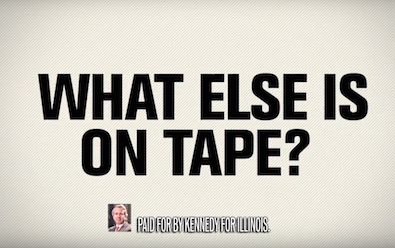
Democratic governor candidate Chris Kennedy has a new digital ad criticizing primary rival J.B. Pritzker over comments made in a November 2008 phone call with then-Gov. Rod Blagojevich about potential African-American appointees to the U.S. Senate.
The half-minute ad features various broadcast reporters and anchors giving their interpretations of a Chicago Tribune report on the government-recorded conversation, which was part of the federal corruption investigation into the now-imprisoned Blagojevich.
What jumps out at me most about this online ad are the images of Pritzker’s face. Striking stuff. Always watch an ad with the sound off to get a good gauge.
* Script…
Reporter: New problems for JB Pritzker, struggling to explain racially insensitive comments about two high-profile African-American politicians.
Reporter: The comments are being denounced by the African American Community.
He was caught on tap bad mouthing Jesse White. Calling him quote “The Least offensive African American.”
Reporter: Pritzker denigrated former state senate president Emil Jones. He referred to Jones as quote “Crass.”
Reporter: Congressman Bobby Rush is calling the wire taps despicable, dismissive and disrespectful.
*** UPDATE *** A commenter mentioned the ad’s last panel…
Yep. A powerful question that pretty much everyone is asking.