Mendoza fundraising off Trump visit
Tuesday, Jul 12, 2016 - Posted by Rich Miller
* From a Sunsana Mendoza blast e-mail …
Leslie & Donald: Good ole pals?
Friend,
Comptroller Leslie Munger has been silent on Donald Trump’s rise in the Republican party while he calls Mexicans rapists, mocks disabled reporters and disparages women, just to name a few. She is looking like quite the ally to her party’s new leader, even sitting with him at a City Club event.
But I’m not staying quiet… or having lunch with Donald Trump.
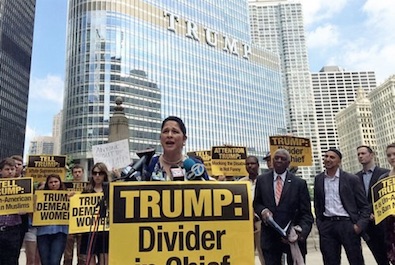
This morning, I stood in front of Trump Tower in Chicago to say enough is enough.
We need to build a symbolic wall between Trump and the White House.
It’s time to unite and tell our opponent Leslie Munger and her pal Donald Trump that his hateful rhetoric, and her silence in the face of it, are destructive to the well being of our state and country.
If you’re ready to send a clear message to Leslie and her friends, chip in $10 today and say ‘enough is enough.’
Together, we can make sure Donald Trump’s hateful and divisive rhetoric stays far away from Springfield.
* The accompanying pic…
* And you may remember this tweet during Trump’s City Club speech…
Your thoughts?
…Adding… Sun-Times…
Mendoza, who is running for Illinois comptroller, said she came to denounce Trump’s “message of hate.”
“Our job is to stand up against that, to espouse about love. Talking about our differences is what makes us great and to actually get through our differences through talking as professionals, adults, rationally, instead of as, like, bullies on the playground,” Mendoza said.
The incumbent comptroller, Leslie Munger, last month said she wouldn’t attend the Republican National Convention in Cleveland, but wouldn’t comment on whether she supports Trump.
Mendoza on Tuesday called on Munger to publicly denounce Trump.
“It takes about a half a nanosecond to know where you should stand when it comes to Donald Trump,” Mendoza said. “She should be denouncing him, just like pretty much anybody who has half a brain is doing these days.”
30 Comments  
|
*** UPDATED x1 *** Not buying the spin
Tuesday, Jul 12, 2016 - Posted by Rich Miller
* Pearson at the Tribune…
The House Republican Organization has been prolific in its TV advertising against potential Democratic targets in the fall’s legislative contests, and it’s back at it again.
But in its latest ad, linking three Downstate Democrats to powerful House Speaker Michael Madigan, it accuses them of backing “a bailout for Chicago schools.”
This raises the conundrum facing Republicans — including Gov. Rauner. They vowed not to give the city’s financially troubled schools any extra money. But in a full-year school funding deal that Rauner and many Republicans supported, CPS gets extra funding, including the possibility of a state taxpayer-financed pension subsidy.
Republicans backing the deal quickly wanted to let their suburban and Downstate constituents know that the bill was not a Chicago “bailout,” just as Democrats had insisted. Now, Republicans may be faced with being asked to define the word “bailout.”
…Adding… I was looking at the wrong roll call. Sorry about that! Targets in both parties were pulled off that roll call.
* Geiger in this afternoon’s Tribune…
In the end, Rauner and lawmakers agreed on a spending plan for schools that ensured that no school district would receive less money that it got last year, while sending extra money to poorer districts, including an additional $130 million to CPS and potentially more than $200 million for teacher pensions on top of that.
But that battle of wills, waged most publicly by Rauner, positioned him as the chief obstructionist in the school funding formula issue, even though lawmakers themselves can’t agree on how the formula should be changed. The new commission is an attempt by Rauner to seize control of that discussion, and to potentially reposition himself as an advocate for the school districts that routinely lose out under the current formula.
Even so, Rauner on Tuesday was vague about what he’d like to see emerge from the commission. And while he acknowledged that spending more money on schools will require the state to find a way to pay for it, he wouldn’t commit to raising taxes to do so, saying he’s an “anti-tax person,” who ran for office “to try to bring down the tax burden.”
No love for the guv there.
* If you look at the timing of the governor’s announcement today, and couple it with the fact that he seemed kinda uninformed about his own commission (30 members or 25?), I can’t help but wonder if he at least partly wanted to prove to everyone that he was nowhere near Donald Trump’s downtown fundraiser today. Whether that was intentional or not, he certainly succeeded.
*** UPDATE *** Charles Thomas and I are apparently on the same wavelength…
Republican presidential candidate Donald Trump is in Chicago and the state’s top Republican - Gov. Bruce Rauner - was not with him.
The governor announced Tuesday morning he will form a commission to change the way that Illinois funds public education. Not only is he not attending the fundraiser with Trump, but his office scheduled that event at the same time. Intentional or not, it does drive home the point that Rauner has not endorsed Trump for the presidency.
“I love you, Charles. I am not going to comment,” Gov. Rauner said. “I have said everything I am going to say about the presidential race.”
The governor said he has so much to do in the state of Illinois that he has no time for presidential politics - at least that is how he is avoiding the Trump controversy.
[ *** End Of Update *** ]
All he has to do now is come up with a plan for next week…
At an unrelated news conference Tuesday morning at the Thompson Center, Rauner walked out without responding to reporters who asked what he’d be doing instead of attending his party’s national convention.
23 Comments
|
* Pro Publica estimates that at least 100,000 people every year plead guilty to drug-possession charges which rely on inexpensive (often two dollars each) police field-test results as evidence…
Police officers arrest more than 1.2 million people a year in the United States on charges of illegal drug possession. Field tests like the one Officer Helms used in front of Amy Albritton help them move quickly from suspicion to conviction. But the kits — which cost about $2 each and have changed little since 1973 — are far from reliable.
The field tests seem simple, but a lot can go wrong. Some tests, including the one the Houston police officers used to analyze the crumb on the floor of Albritton’s car, use a single tube of a chemical called cobalt thiocyanate, which turns blue when it is exposed to cocaine. But cobalt thiocyanate also turns blue when it is exposed to more than 80 other compounds, including methadone, certain acne medications and several common household cleaners. Other tests use three tubes, which the officer can break in a specific order to rule out everything but the drug in question — but if the officer breaks the tubes in the wrong order, that, too, can invalidate the results. The environment can also present problems. Cold weather slows the color development; heat speeds it up, or sometimes prevents a color reaction from taking place at all. Poor lighting on the street — flashing police lights, sun glare, street lamps — often prevents officers from making the fine distinctions that could make the difference between an arrest and a release.
There are no established error rates for the field tests, in part because their accuracy varies so widely depending on who is using them and how. In Las Vegas, authorities re-examined a sampling of cocaine field tests conducted between 2010 and 2013 and found that 33 percent of them were false positives. Data from the Florida Department of Law Enforcement lab system show that 21 percent of evidence that the police listed as methamphetamine after identifying it was not methamphetamine, and half of those false positives were not any kind of illegal drug at all. In one notable Florida episode, Hillsborough County sheriff’s deputies produced 15 false positives for methamphetamine in the first seven months of 2014. When we examined the department’s records, they showed that officers, faced with somewhat ambiguous directions on the pouches, had simply misunderstood which colors indicated a positive result.
No central agency regulates the manufacture or sale of the tests, and no comprehensive records are kept about their use. In the late 1960s, crime labs outfitted investigators with mobile chemistry sets, including small plastic test tubes and bottles of chemical reagents that reacted with certain drugs by changing colors, more or less on the same principle as a home pregnancy test. But the reagents contained strong acids that leaked and burned the investigators. In 1973, the same year that Richard Nixon formally established the Drug Enforcement Administration, declaring “an all-out global war on the drug menace,” a pair of California inventors patented a “disposable comparison detector kit.” It was far simpler, just a glass vial or vials inside a plastic pouch. Open the pouch, add the compound to be tested, seal the pouch, break open the vials and watch the colors change. The field tests, convenient and imbued with an aura of scientific infallibility, were ordered by police departments across the country. In a 1974 study, however, the National Bureau of Standards warned that the kits “should not be used as sole evidence for the identification of a narcotic or drug of abuse.” Police officers were not chemists, and chemists themselves had long ago stopped relying on color tests, preferring more reliable mass spectrographs. By 1978, the Department of Justice had determined that field tests “should not be used for evidential purposes,” and the field tests in use today remain inadmissible at trial in nearly every jurisdiction; instead, prosecutors must present a secondary lab test using more reliable methods.
But this has proved to be a meaningless prohibition. Most drug cases in the United States are decided well before they reach trial, by the far more informal process of plea bargaining. In 2011, RTI International, a nonprofit research group based in North Carolina, found that prosecutors in nine of 10 jurisdictions it surveyed nationwide accepted guilty pleas based solely on the results of field tests, and in our own reporting, we confirmed that prosecutors or judges accept plea deals on that same basis in Atlanta, Boston, Dallas, Jacksonville, Las Vegas, Los Angeles, Newark, Philadelphia, Phoenix, Salt Lake City, San Diego, Seattle and Tampa.
* I asked the Illinois State Police for comment…
Hi Rich,
The ISP utilizes field test kits (similar to the illustration in the attached link you sent) to aid in establishing probable cause for arrest by detecting the possible presence of narcotics. Field test kit results are considered presumptive. The ISP laboratory utilizes scientifically validated methods for confirmatory testing of specimens to determine the presence of narcotics in submitted evidence.
* I asked what “presumptive” meant, exactly. The spokesman pointed me to this passage in a policies and procedures manual…
Involvement in the criminal justice system begins with an alleged violation of state criminal law or local or municipal ordinance. Individuals can enter police custody in different ways. A police officer may directly observe a violation of the law or ordinance or may be called to investigate a report of a possible crime. In either case, when a police officer determines that he or she has probable cause to believe an individual committed a criminal act, he or she can take that person into custody. Even with probable cause, a police officer may choose to release the individual and continue an investigation into the alleged offense. A police officer has discretion, limited by the police department’s policy, regarding what action he or she takes.
So I then asked how often the lab checks those field tests, and what the rate of false positives is on those follow-uptests. I was asked to submit a FOIA. I will and will let you know what I learn.
*** UPDATE *** Sen. Don Harmon is also concerned about this issue and says he has already started looking into it. He texted me that there’s another problem with the tests: “The number of people held in Cook County Jail for almost a month and then released because of no probable cause is staggering. As is the associated cost of the taxpayer”…
We recently passed a bill to do a pilot program in Cook County, because all the other counties in the state are already using the field tests. Mike Z was the House sponsor.
The reason this is important is that people in Cook County are spending 20 to 30 days in jail, waiting for the results of the lab tests before even getting their probable cause hearing.
I’m concerned about the story regarding accuracy of the tests, and I’m already looking into it. But, at least in Cook County, I’m not sure that a false positive is worse than spending 20, 25, 30 days in jail only to have your case dismissed for no probable cause once you finally get your hearing. […]
In Cook, they won’t do the probable cause hearing without the lab results. Hence, the long wait in jail.
It’s also my understanding that judges are routinely throwing out small-amount cases, citing lack of probable cause, even when the field test or the lab test come back positive. apparently, it’s just not worth the time and effort to proceed. It’s like they’re viewing the 20 to 30 day stay in jail as the sentence already served.
34 Comments
|
|
Comments Off
|
* From the governor’s office…
Daily Public Schedule: Tuesday, July 12, 2016
What: Governor Announces Creation of Commission to Reform School Funding Formula
Where: James R. Thompson Center – Blue Room
100 W. Randolph, Chicago
Date: Tuesday, July 12, 2016
Time: 11:00 a.m.
* Korecki…
Gov. Bruce Rauner is expected today to make a new push toward revamping how schools receive state money in Illinois. At a Thompson Center news conference, Rauner is scheduled to announce the creation of the Illinois School Funding Reform Commission, which will be tasked with “developing an equitable, adequate and affordable school funding formula to use with the FY18 school year,” according to the governor’s office. Rauner’s hand-picked Secretary of Education Beth Purvis will act as commission chair … by taking on school funding equity, Rauner may neutralize possible attacks on Republicans in advance of the November election.
You can click here for the state’s live video and audio feeds, or click here for the BlueRoomStream.com video feed.
…Adding… Follow along with ScribbleLive…
51 Comments
|
More like these, please
Tuesday, Jul 12, 2016 - Posted by Rich Miller
* Greg Hinz…
Faced with a shortage of infrastructure capital and a big employer that needs help, the state of Illinois is moving into the private toll bridge business.
In a rather unique twist today, Gov. Bruce Rauner announced a deal under which CenterPoint Properties will build a $170 million to $190 million private toll bridge linking Interstate 80 and its huge multimodal facility in Will County.
Rauner said the first-of-its kind deal, a variation on the public/private partnership model, will alleviate traffic congestion on local roads that weren’t built to handle fleets of 18-wheelers while strengthening the local economy.
“This project is long overdue and will only enhance the region’s position as a freight hub for North America and an economic engine for the state,” Rauner said in a statement. “Illinois needs more projects just like these creative solutions to fund infrastructure.”
Under the deal, which Rauner said has the backing of the city of Joliet and Will County, but won’t need General Assembly sign-off, CenterPoint would be authorized to build and operate a new toll bridge on Houbolt Road over the Des Plaines River and the BNSF tracks.
Rauner said yesterday at the press conference that he wanted to keep the tolls as low as possible because he has a lot of friends who are truckers and they don’t like paying tolls.
Whatever happens with the tolls, they need to make sure this one is done right.
* Meanwhile, Marc Levine, the chairman of the Illinois State Board of Investment, has a new op-ed in the SJ-R…
Hopeless. Unmanageable. Unfixable. It is all we hear about Illinois’ fiscal status. But before we give up hope on reform and renewal, transformation is occurring at many levels of state government. Through management action, the Illinois State Board of Investment has been able to save taxpayers hundreds of millions of dollars in the last year.
ISBI manages $16 billion in pension assets, mostly for Illinois state employees. Because the pension system is so vastly underfunded, pension contributions have become one of the largest line items in the state budget, crowding out spending on education, social services and placing pressure on lawmakers to raise taxes.
Here is what ISBI has done to help. Since Gov. Rauner’s election, ISBI has cut its annual investment management expenses by 50 percent, or about $40 million. ISBI expects to save $200 million over the next five years, without sacrificing returns or increasing risk.
How? ISBI, like many pension systems across the country, had been enamored with Wall Street investment managers, particularly hedge funds. Inconveniently for everybody, these funds failed to add value. Over the past three years ISBI paid hedge fund fees of $180 million. What did ISBI get for it? Before fees, the hedge fund portfolio underperformed a simple balanced index fund that costs virtually nothing. So early this year ISBI reduced hedge fund investments by 70 percent and fired nearly all of our hedge fund managers.
ISBI has also terminated about half of our “active” investment managers — those trying to beat the markets. They also failed to add value, yet were being paid fees in the millions. Shouldn’t underperformance by a government vendor be cause for dismissal? There’s nothing special about money managers — imagine the outrage if a construction firm built bridges that were consistently less safe than industry standards.
In total, ISBI has taken about $3 billion back from these managers and invested the money in index funds at minimal cost. Does this mean our pension fund will miss great returns? In fact, it’s exactly the opposite — our investment consultant projects that our expected returns will be higher and our risk is lower. And that’s before taking into account the expense savings.
…Adding… One more…
Illinois is ditching the controversial state PARCC exam for high school students, instead giving 11th-graders a state-paid SAT college entrance exam next spring.
The announcement from the Illinois State Board of Education on Monday comes after only two administrations of PARCC, in the spring of 2015 and 2016, following dismal test scores and thousands of students skipping the exams. […]
At the high school level, the PARCC exams took away from key instruction time, school administrators said, as tests piled up in the spring, including Advanced Placement exams for honors-level students and a college entrance exam in many districts.
Against that backdrop, some students didn’t seem to take PARCC seriously.
“There was no element of skin in the game for the kids — they didn’t know why they had to take the exam,” said Argo Community High School District 217 Superintendent Kevin O’Mara, president of the High School District Organization of Illinois.
37 Comments
|
|
 Support CapitolFax.com
Visit our advertisers...

 ...............
 ...............
 ...............

|
   
|
Hosted by MCS |
SUBSCRIBE to Capitol Fax |
Advertise Here |
Mobile Version |
Contact Rich Miller
|



