* Exelon’s lobbyists have been handing out this flier to legislators…
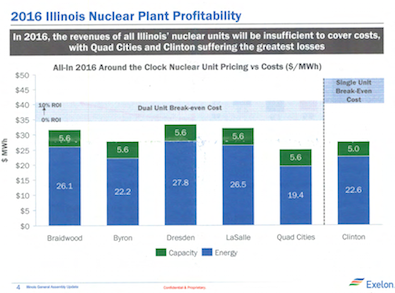
So, according to the flyer, none of Exelon’s nuke plants are profitable right now, which would appear to bolster its case that it has to shut down some plants without an intervention by the General Assembly.
* But as Crain’s reports, that’s not what they’re telling Wall Street…
Of course, Exelon’s nukes are essentially protected from spot 2016 prices. More than 90 percent of their output was sold well in advance at prices that were considerably higher a few years ago. […]
The charts Exelon distributed show each nuclear plant earning energy revenue from $19.40 per megawatt-hour to $27.80 per megawatt-hour.
In investor presentations, Exelon has shown that about 90 percent of its energy revenue in the Midwest is locked in at more than $34 due to previous hedges. Combine that with $5.60 per megawatt-hour in additional revenue per agreements to deliver during high-demand periods, and Exelon’s fleetwide revenue is about $40. Subtract a few dollars to cover the costs of congestion on the power grid, and the fleet (other than the smaller, higher-cost Clinton plant downstate) would seem to exceed the break-even cost of $35 per megawatt-hour Exelon has laid out.
So why didn’t Exelon say that to Illinois lawmakers?
“It’s not relevant,” Dominguez says. “From my perspective and the company’s perspective, the hedges aren’t repeatable.”
Yeah, but we don’t even know what their prices will be next year, right?
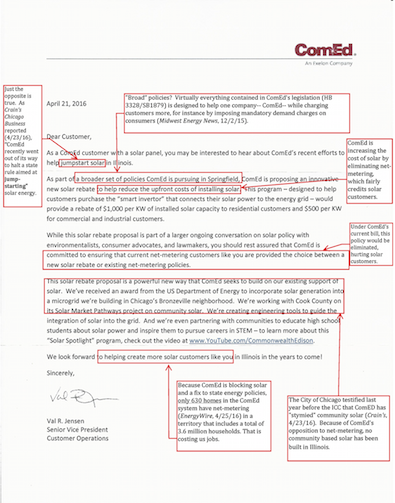
* Meanwhile, the Illinois Solar Energy Association eviscerates ComEd’s “small solar rebate for potential customers”…
ComEd’s announcement of the rebate does not distract from the fact that ComEd has spent years blocking reforms that would fix Illinois broken renewable portfolio standard (RPS), that would unshackle the potential of rooftop and community solar, creating thousands of new clean energy jobs.
ComEd’s announcement does nothing to change the fact that its bill includes many provisions that will hurt solar customers and workers. ComEd proposes to greatly reduce net metering, the foundational solar policy that is in place in over 40 states. Without net metering, the fledgling solar industry in Illinois would be devastated. But ComEd goes further and proposes a damaging rate change for residential customers that would limit homeowners’ ability to control their energy bills. This residential rate design is so extreme, it is not used by any other investor-owned utility in the country.
Ouch…
*** UPDATE *** Seems odd to me…
A deal that could have reopened Horseshoe Lake State Park fizzled because the park’s electricity provider wants the state to also get caught up on its bills at two other state parks.
Metro East Park and Recreation District, at the urging of local government leaders, has offered to pay the trash and electricity bills at Horseshoe Lake during the state’s budget impasse. But the electricity provider won’t restore service at Horseshoe Lake unless the state also gets caught up on its delinquent bills at Ramsey Lake State Recreation Area and Carlyle Lake State Fish and Wildlife Area.
The state Department of Natural Resources announced April 20 that it was closing Horseshoe Lake because electricity and trash service were being cut off. The electricity and trash vendors weren’t being paid due to the state’s budget stalemate. […]
The deal fell through because the electricity provider, Southwestern Electric Cooperative, said it wouldn’t restore electricity to Horseshoe Lake unless Southwestern also gets what it’s owed at two other state sites: Ramsey Lake and Carlyle Lake.