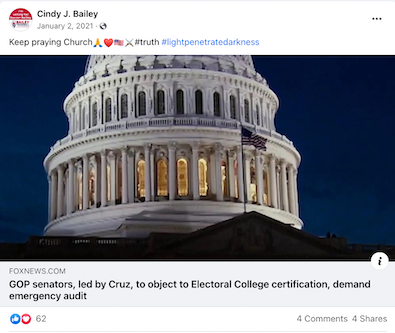
All up and down the Republican ballot, rural conservatives defeated establishment candidates. In the 15th Congressional District, U.S. representative Mary Miller, who earned Trump’s endorsement by objecting to the 2020 electoral count, beat fellow incumbent Rodney Davis, who voted to accept the results. Thomas DeVore of Greenville, who tattooed “Freedom” and “Liberty” on his forearms, won the nomination for attorney general over international business attorney Steve Kim of Deerfield.
This shift will pose a problem in November for state GOP candidates, particularly in Chicago’s outlying areas, says Jackson: “Republicans are going to have a very difficult time winning any of the constitutional offices. In some of these suburban districts, Bailey’s going to be a terrible drag on what could be competitive races and what could potentially be a big Republican year.”
Naturally, House Republican leader Jim Durkin, whose southwest suburban district runs from Hinsdale to Lockport, disagrees with that assessment. He is encouraging fellow GOP candidates to set aside hot-button social issues like abortion and gun control and run on “kitchen table” matters such as crime and inflation. “The economy is going to prevail as the single greatest issue in the suburbs and collar counties,” he says.
A moderate who voted to increase the gas tax, Durkin is the pro-Bailey crowd’s model of a RINO. “Much to the dislike of the far right, I don’t have flames coming out of my nose and mouth,” he says. Durkin supports the nominee, but as he sees it, Bailey won a primary, not the soul of the Illinois GOP. “The conservatives and the far left were the majority of voters who came out [for the primary];” in the general election, he says, it’s the middle that will determine outcomes. “I wholeheartedly believe there is a voice for moderates in the party. That’s what we see in the suburbs, and that’s what we need to compete statewide. I’m looking for legislators who are not going to be the party of no.”
That may still be true in the suburbs, but statewide, “the establishment is knocked back on its heels,” Jackson says. “The party from Jim Thompson to Jim Edgar to George Ryan has lost that control of the Republican Party.” And those Republicans will have to take their party back before Illinois elects another Republican governor.
* One of the local Republican Party ballot appointments last month…
Chicago City Wire recently had an opportunity to interview Patrycja Karlin, the Republican candidate for the Illinois 20th Senate District. […]
Q: Why did you decide to run for the state legislature?
Karlin: Illinois is drowning in crime, corruption and fiscal irresponsibility; it is killing the innocence of our children with impunity and depriving parents of any decision-making regarding their children. Businesses are running for cover in other states. Illinoisans are moving away in greater numbers than at any time in the history of Illinois. We can save Illinois! First by eliminating the Democratic Super Majority in the Illinois Congress. That does not happen by itself. District by district, seat by seat, Republicans can take the Illinois Legislature and start enacting laws that will protect all Illinoisans! We can make our state prosper again! It is possible! […]
Q: What’s the first bill you will sponsor in Springfield?
Karlin: I am extremely passionate about parental rights. The Chicago Public School system and the Chicago Teachers’ Union are taking away parents’ right to have a voice in what their children are taught. These progressive activists oversee our children’s education. I will propose legislation that will enshrine parents’ right to know what is taught in our local schools. I will work to keep the radical ideologies of gender ideology, and Critical Race Theory out of our schools. Given the opportunity, I will introduce the Illinois Bill of Parental Rights.
“Illinois Congress.” Her petitions have been challenged. She’s running against Sen. Cristina Pacione-Zayas (D-Chicago).
Why can’t Republicans just stand up and say what Darren Bailey said was wrong? Why can’t Darren Bailey just apologize? He’s twisted himself into knots first trying to explain what he said, then going back and saying he meant what he said. This is a guy who does not understand what it takes to be a leader of Illinois [who] frankly doesn’t understand he needs to apologize to the survivors of the Holocaust who are still among us in Illinois and to all of us who care about how the governor speaks about the choice, the very difficult choice that women need to make sometimes about their reproductive rights, and the awful, truly tragic, traumatic and one of the worst tragedies in the history of the US and that’s the Holocaust.
* Illinois Republican Party…
In light of the DOJ and FBI’s unprecedented decision to raid the home of the Former President of the United States, ILGOP Chairman Don Tracy issued the following statement:
“Although it has been two days since the raid on the home of the immediate past President of the United States, the American people have heard nothing from Attorney General Merrick Garland. In view of this unprecedented breach of tradition and heavy handed approach to an investigation of a former President, and the apparent double standard relative to investigations of Democrats similarly situated at the national level, Attorney General Garland should have already provided a thorough and immediate explanation.” Chairman Tracy added, “The American people deserve honesty and transparency from our Department of Justice, which is why I am calling on Attorney General Garland to immediately disclose the justification for this extraordinary use of legal power against a political opponent of the current administration of which he is a major part.”
Joe Biden is underwater in a new poll of IL-13 with an approval rating of just 43% and a 57% disapproval rating, with 50% strongly disapproving.
Reminder: This is a district Biden won by 11 points in 2020.
That’s bad news for political insider Nikki Budzinski, who helped implement President Biden’s reckless spending spree that led to record-high inflation.
NRCC Comment: “Illinois voters will hold Nikki Budzinski personally accountable for her role in implementing Joe Biden’s toxic agenda that’s cost them more for basic necessities.” – NRCC Spokeswoman Courtney Parella
It’s not exactly new. Some of the numbers are three weeks old and Biden may have clicked up a bit since then. Also, despite the Biden numbers, Budzinski still holds a narrow lead, albeit within the margin of error. Still, she should be much better known than Republican Regan Deerin.
U.S. Rep. Jesus “Chuy’ Garcia (D-Chicago) previously ran for mayor against Rahm Emanuel in 2015, and is leaving the door open to join the crowded field challenging Lori Lightfoot.
“I want to deliver for working families as my responsibility as a congressman, I’ve been working very hard for the past three and a half years, that is my top priority,” said Garcia said Wednesday. […[
“I’m getting a lot of calls, obviously from people across the city to consider it. I’m flattered by that,” Garcia said during a sit down interview in his southwest side congressional office.
He said he really enjoys being a congressman. But too much run for mayor again?
“I’m not shutting the door completely but I’ve gotta tell you, I’ve never been as challenged or rewarded as I have been over the past three and a half years as a member of the United States Congress,” Garcia said.
Lawrence “Larry” Stowe, who operated Stowe Biotherapy in downtown La Mesa for about five years, pleaded guilty to conspiracy to sell misbranded and unapproved drugs that he called cures for a variety of incurable diseases, according to U.S. Attorney Kenneth Magidson in Houston.
U.S. District Judge Gray Miller sentenced Stowe, 61, to a total sentence of 78 months in federal prison to be followed by three years of supervised release. Stowe had pleaded guilty Sept. 7, 2012.
In handing down the sentence Friday, Miller stressed that Stowe “took advantage of people dying and offered them hope.”
A man who was sentenced to more than six years in federal prison in a scheme to sell unlicensed drugs, claiming to treat or even cure the terminally ill, now is serving as a vice chairman for the Rock Island County GOP. […]
Stowe on Tuesday, speaking from GOP headquarters in Rock Island, said the federal judge threatened him with a 30-year sentence if he did not accept the plea.
“I never got the chance to defend myself,” he said. “It’s just like the people from January 6 (attack on the U.S. Capitol). Those people didn’t commit any crimes.” […]
Several members of the county party who reached out to a reporter about Stowe’s new position declined to comment on the record, saying they do not wish to inflict damage upon their party.
Um, the damage is done.
* But that’s not all the RICO GOP has done lately. This story is from 2018…
County Republicans have asked Glen Evans, state representative candidate for the 72nd District, to withdraw from the race. […]
Court records show Mr. Evans, of Rock Island, was charged with criminal trespass and criminal contempt after violating an order of protection in December 1997. The charges were dismissed in February 1998.
In addition, Marion County, Indiana records show an outstanding warrant for Mr. Evans in 2008 after he failed to appear for a probation hearing on a charge of violating an order of protection against his wife, Erica Evans. […]
Rock Island County Clerk Karen Kinney said Mr. Evans has previously run for office as a Democrat in about 18 different local races. He has lost every election with the exception of two precinct committeeman races. […]
According to the Illinois State Board of Elections, Mr. Evans has never filed a campaign fundraising report. […]
“I do know he has never voted in a Republican primary other than this last one,” [Rock Island County Republican Central Committee Chairman Drue Mielke] said. “He is still welcome in our party, but we’ve asked him to not run. It was a consensus among leadership. We just don’t feel we can support Mr. Evans. We needed to let him know.”
The University of Illinois Springfield has elected to discontinue its contract with the state’s Department of Children and Family Services to offer simulation training for DCFS investigators in a house on campus.
The university decided against renewal of the agreement because the state had not followed its best-practice recommendation that simulation be included throughout a five-week course rather than four and a half days, said Dr. Betsy Goulet, who founded and directs the simulations at UIS and is former DCFS investigator.
”We really think that we could do a much better job if we had them over the course of their foundation training, and we could intersperse the classroom content with the experiences in the SIM lab with different environments and different scenarios,” she said. […]
She said by doing the simulation, “They have a whole different idea of what it’s like to come into somebody’s home and ask difficult questions. I mean, they have to ask parents to take a baby’s clothing off. So they can, you know, see where there might be… you know, marks or bruises.”
“That’s hard to do. As a perfect stranger, you’d you come in and say, well, I need you to take a baby’s clothes off. You know, imagine the stress that comes with doing that. But it’s part of your procedure,” she said. “And so we train them to have those really challenging hard conversations, but we don’t give them enough time to practice. And that’s the frustration.” […]
A spokesman for the Department of Children and Family Services said the agency “is deeply committed to simulation training and continues to expand simulation training across the state with new university partners.”
What the heck?
*** UPDATE 1 *** Cook County Public Guardian Charles Golbert…
This is a cutting-edge, highly regarded program that has received high marks from investigators, advocates, and academics.
The UIS training academy is a flagship program and a national model. UIS researchers use data from the simulation exercises for research to improve child protection practice. In March, UIS was awarded $720,000 in federal funds to support the training academy. In announcing the funding, U.S. Senator Dick Durbin remarked, “The University of Illinois at Springfield has established itself as a leader in training front line child protection workers and first responders.”
Nine young children have died since December despite DCFS’s extensive involvement with the family. We posted about the most recent child, 3-year-old I’Kera Hill, just this morning. Moreover, investigator safety issues have been prominent in the headlines after the murder of DCFS investigator Deidre Silas during the course of an investigation in January. It’s inexplicable, reckless and irresponsible for DCFS to suddenly discontinue this outstanding, critical resource for training its investigators.
*** UPDATE 2 *** From DCFS Director of Communications Bill McCaffrey…
“These allegations are both wrong and ridiculous, and they denigrate the hard work that has gone into improving and expanding training. In fact, DCFS is so committed to simulation training for child welfare workers that we’ve increased our investment from $320,000 in 2018 to $2.3 million this year so that we can open new hubs across the state and workers can be trained closer to the communities they serve. UIS proposed that they be the sole provider rather than allowing other university partners across the state to provide simulation training for child protection workers. Rather than accepting this demand, DCFS opted to continue to invest in a multi-site, multi-university program.
“Additionally, UIS was on a corrective action plan, including for their failures to hire a pipeline of diverse staff for the actual simulations. This failure posed serious problems for meeting our goals to be equitable and provide inclusive training opportunities. We are moving forward with a new site in Springfield that will meet these needs and provide state-of-the-art training.”
Background
• New DCFS investigators go through a six week training in order to become certified to conduct child protection investigation. This is primarily classroom based training for four weeks, called “foundations”, followed by a fifth week in the field for on the job training, and a sixth where they conduct simulation training. The first simulation training was developed in collaboration with University of Illinois Springfield and conducted on their campus.
• In order to meet the statewide needs of investigator training, a new simulation lab was opened in Chicago at a DCFS site on the South side of Chicago. That simulation site is run in collaboration with the School of Social Work at the University of Illinois at Urbana-Champaign.
• DCFS has also expanded to include two additional simulation training sites and university partnerships. One is located at Northern Illinois University and is currently operational and training investigators. The other site is at Southern Illinois University, which is physically completed and will be operational by early 2023 once they are fully staffed and trained.
• DCFS is currently in the early stages of building out an additional simulation site in Springfield, that like the Chicago site, would be located on DCFS property. It would be staffed by DCFS employed trainers.
• DCFS has expanded our investment in simulation training from just $320,00 in fiscal year 2018 to $2.3 million in the current fiscal year.
Seems to me, if this is true, that DCFS should’ve said that from the beginning.
The end of DCFS’ ongoing relationship with the University of Illinois at Springfield to provide simulation training for investigators is depressing and dangerous. It is depressing to see the Department lose access to one of the few contract partners that was making a difference in improving investigations of alleged child abuse.
The Department claims there were issues with UIS’ performance on a “corrective action plan” for diversity – we don’t have knowledge of those circumstances. What we do know, though is that UIS developed the simulation training that Illinois pioneered and that now is viewed as a model worthy of implementation across the country.
It appears that the real schism between DCFS and UIS was that the Department could not accept – and integrate – the well-founded guidance of the UIS experts regarding how training should be delivered in order to be effective under the UIS model program. It may be that DCFS is using new partners for simulation training, but if that training does not track the UIS model, we lose the assurance that we currently have – that the training will be effective.
DCFS’ move is dangerous for children and for DCFS employees. The UIS program helped increase safety for DCFS employees who conduct home visits and the children they are seeking to protect. At a moment when we are all concerned about safety, the expertise and experience offered by this program should be honored and embraced, not truncated and parceled out to different providers.
* For a very long time, the “About” section of Cindy Bailey’s Facebook page has said she is the “chief consultant, strategist and cheerleader” for her spouse’s gubernatorial campaign. But that page has since been altered and then apparently taken down since Greg Hinz started looking around and asking questions. You can still Google the phrase, but here’s a screenshot…
She’s also listed as a “Board member” on Bailey’s D-1 filing with the State Board of Elections. And she is a regular on the campaign trail with Bailey and often acts as a surrogate for her husband’s campaign…
Just saw Stephanie W. Trussell running for Illinois Lieutenant Governor and Cindy Cindy J. Bailey, that’s the wife of Republican nominee Darren Bailey for Governor in Illinois at CPAC 2022 in Dallas. @DarrenBaileyIL@ReaganMom@Trussell4ILpic.twitter.com/tlmk9r5l3V
Speaking of Cindy Bailey, here she is posing with Kari Lake at CPAC four days ago. Lake is the GOP gubernatorial nominee from AZ, an election fraud/QAnon conspiracy theorist, and a Proud Boy fan. https://t.co/xNAd8fiIQKpic.twitter.com/2BK0QbpmM2
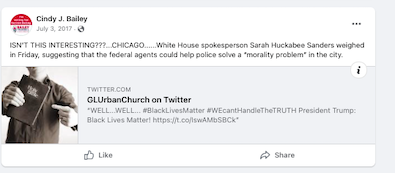
In one [post], she cited “amazing testimonies from ones who were once in the homosexual lifestyle!” In another, she called on “any red-blooded American” to drop their subscription to Netflix for “normalizing homosexuality” and other material she views as objectionable. “We are living in wicked days, just as in the time of Noah,” she stated.
* People on Twitter have been discussing this topic for a while now. A sampling..
Is this really who we want as the First Lady of IL. Do her morals and values represent all of us? Please make a plan to vote this November. #twillpic.twitter.com/GFDuAdARNh
Darren and Cindy Bailey aren't the best choice for the future of Illinois, they have both stated they think we're living in the "end times". In short they don't really see a longterm future for our state or country. pic.twitter.com/aKoSxQjzvY
JB Pritzker’s administration has been a disaster. Pritzker has raised taxes, attacked law enforcement and crime is skyrocketing on his watch. The Department of Children and Family Services is a criminal disaster under Pritzker’s Director Marc Smith. Families are suffering and kids are dying because Pritzker refuses to take ownership and fire his failed director. Friends, JB Pritzker hasn’t just failed working families, he’s downright abandoned every one of us.
Well now he’s more desperate than ever, and JB and his allies in the media shamelessly think that they can attack my wife Cindy and try to twist her words. Let me be clear, my wife is not on the ballot. I’m on the ballot and I speak for myself. So, JB, if you can fit it into your presidential campaign schedule and want to talk about someone in this race for governor and about the people of Illinois who are struggling under your watch, well I’m here in Illinois. And I’ll be waiting when you fly back. I’ll debate you anyplace anytime.
And if the media wants to look into spouses, well how about you find out what Pritzker’s pal Jennifer Thornley texted him and his wife after she stole money from taxpayers. The Pritzker/Thornley scandal stole over $700,000 from taxpayers because JB continues to scratch the backs of his cronies at the expense of working families.
Friends, people are being gunned down riding public transportation. Springfield corruption continues while families struggle to put gas in their cars and food on their tables. We have serious issues and I’m ready to get to work and restore Illinois.
Please pardon all transcription errors.
* The Question: Fair hit on Cindy Bailey or not? Make sure to explain your answer in comments, please.
*** UPDATE *** A commenter reminds us that Darren Bailey posted a false story on his Facebook page about the governor’s daughter…
Like I’ve been saying from the beginning, this is how you handle a lockdown!
#supportsmallbusiness
#restoreillinois
#firepritzker
Today, Comptroller Susana A. Mendoza announces the latest installment of $180 million into the state’s Rainy Day Fund, bringing the balance to a record level of $1.036 billion, the highest balance in the fund, also called the Budget Stabilization Fund, to date.
Comptroller Mendoza has been a vocal advocate for reviving the Rainy Day Fund, which serves as the state’s main savings account. It had been decimated during the 2015-2017 state budget impasse. In April 2018, the reserve account stood at just $48,327.53.
“We’re saving today to invest in tomorrow,” said Comptroller Mendoza. “This latest infusion proves that we are prioritizing paying down our debts, addressing the pension shortfall and not putting the problems of yesterday on the backs of future generations.”
The appropriation was supported by Gov. JB Pritzker and approved by the Illinois General Assembly earlier this year. With higher-than-anticipated revenues for the prior fiscal year, not only did the General Assembly and the Governor approve of a $1.8 billion tax-relief plan for taxpayers, but they also resisted to spend, as this $1 billion into the state’s Rainy Day Fund for fiscal year ’22 and ’23 makes clear. The most recent budget also includes paying an extra $500 million into the Pension Stabilization Fund, which will lower pension debt liabilities by $1.8 billion.
This latest deposit into the Rainy Day Fund this week is the final installment based on the appropriations per the most recently approved state budget. Starting next fiscal year, the legislature has agreed to put in an additional $45 million into the fund annually.
“Building a robust emergency reserve account is responsible. And the credit rating agencies agree. They cited the state’s infusion into reserves as one reason for recent upgrades. Better credit ratings mean better rates on bonds, and that means more savings for taxpayers and better finances for the state overall,” Comptroller Mendoza said.
Illinois has earned six credit upgrades from the credit rating agencies since June 29, 2021 – the first upgrades in over two decades.
While these welcomed infusions into the Rainy Day Fund and the Pension Stabilization Fund are certainly a great boost, Comptroller Mendoza continues to call for more regular automatic deposits into these funds during strong economies, without having to depend on one-time infusions of future legislatures.
During the fall veto session Comptroller Mendoza will ask the General Assembly to take up HB 4118, sponsored by State Rep. Michael Halpin, D-Rock Island. The proposal would require additional annual contributions to both the Rainy Day Fund and the Pension Stabilization Fund.
“Further saving and paying down our debts when the state can afford it will better prepare us for the next fiscal downtown or crisis, such as a recession, that may come through no fault of our own,” said Comptroller Mendoza.
…Adding… At the request of the comptroller’s office, I’ve corrected the designation of Rep. Halpin as being from Rock Island, not Rock City. I prefer Rock City, however…
I feel so good, I’m so alive
Hear my song playin’ on the radio