* This is the 15th state trooper struck by a motorist this year alone and the second who was killed…
An Illinois State Police Trooper is dead after being struck by a semi on U.S. 20.
Illinois State Police confirmed the Trooper was killed a little after 3 p.m.
The crash happened around 1 p.m. Thursday afternoon, just west of Highway 75. Details on the crash are unknown at this time, but the crash location is next to the Total Self Storage Facility on E. Currier Road.
At 3:10 p.m. the South Beloit Police Department posted the following message on Facebook:
“The South Beloit Police Department sends our deepest sympathies for the Illinois State Police District 16 Trooper who was killed this afternoon in a crash while on a traffic stop in Stephenson County. This Trooper had assisted our Department on several incidents over the years. Please keep the Trooper’s family and the Illinois State Police in your thoughts and prayers.”
* From the scene earlier today…
#BREAKING: Traffic is backed up in the westbound lanes of US 20 near the Rt. 75 Freeport exit for a serious crash. Illinois State Police are investigating and we have crews on the way. (Photo: Beth Surrarrer Hitz) pic.twitter.com/Uydo3DW0bT
— Eyewitness News WTVO/WQRF (@MyStateline) March 28, 2019
*** UPDATE *** ISP…
Illinois State Police (ISP) Acting Director Brendan F. Kelly regretfully announces the line-of-duty death of ISP District 16 (Pecatonica) Trooper Brooke Jones-Story.
This afternoon, March 28, 2019, at approximately 11:24 a.m., Trooper Brooke Jones-Story, #5966, was inspecting a commercial motor vehicle on United States Route 20 westbound, just west of Illinois Route 75 in Stephenson County. At approximately 12:20 p.m., Trooper Jones-Story was outside her squad car when she was struck and fatally wounded when a truck tractor semi-trailer combination struck her squad car and the semi Trooper Jones-Story was inspecting.
“Today is a dark day for the Illinois State Police family. This is the six-year anniversary of the death of another Trooper, and now another brave soul, Trooper Brooke Jones-Story, has made the ultimate sacrifice for people of this state. At this very moment, the men and women of the ISP are responding and focused on the job and mission, because that’s what Trooper Jones-Story would do,” stated Acting Director Kelly.
Trooper Jones-Story was a 12-year veteran of the Illinois State Police District 16 in Pecatonica.
Labor groups are pushing a proposed super minimum wage of sorts in Springfield—an early test of just how far a pro-union agenda will reach in a Capitol that has a Democratic governor and Democratic supermajorities in both the House and Senate.
Pending in the Senate is a bill, with amendments, that would require construction workers at “high-hazard facilities” not only to be qualified journeypersons who have received advanced safety training, but also would mandate they are “paid at least a rate equivalent to the prevailing (union) hourly wage rate for a journeyperson in the applicable occupation and locality.” […]
But business groups are lining up to oppose the bill, which reportedly stems from an organizing dispute at several Illinois oil refineries but which, according to the Illinois Manufacturers’ Association, would apply to workers at ethanol plants, chemical facilities and at least some other manufacturing plants. Similar measures stalled in prior Legislatures in recent years, perhaps because the state then had a Republican governor who would have vetoed it.
“This is all about organized labor using state government to mandate use of their services,” says Illinois Chamber of Commerce President Todd Maisch, who believes the bill could end up applying to many large manufacturing plants. “Along with some other issues, I think this raises the question of how many things Democrats are willing to cram down business’ throat.”
After House and Senate Democrats sent SB 1596 to Gov. J.B. Pritzker’s desk, the Illinois Chamber of Commerce is petitioning the governor to veto the Workers’ Compensation reform bill.
The chamber’s recent letter to Pritzker outlines a handful of potential adverse effects on small businesses and invokes Pritzker’s campaign promise to involve employers in any reform process.
“We urge you to veto SB 1596, as business interests were provided no opportunity to negotiate the provisions of SB 1596 and its provisions will have a profound impact on the workers’ compensation system” wrote Illinois Chamber president and CEO Todd Maisch. […]
Maisch wrote that the proposed law would erode liability protection for employers in workplace injury cases. Under current Workers Compensation (WC) and Occupational Disease (OD) law in Illinois, the letter noted, employees are limited in the amount of time they have to sue their employers. […]
“Exclusive remedy protection for Illinois employers [would be] eviscerated, creating significant new exposures to liability, including punitive damages, that far exceed the benefits provided by the WC or OD Acts …” Maisch wrote.
A proposed policy change that would allow the state to capture more revenue is being called “theft of services” by retailers. The idea Gov. J.B. Pritzker uses to balance his budget remains in a committee.
Pritzker hopes to get an additional $170 million from recreational pot licenses for his budget that starts this summer. He’s also banking on $212 million from sports betting licenses. Both ideas have yet to advance at the statehouse. Then there’s the “retailers discount” the governor hopes to change to bring in $75 million.
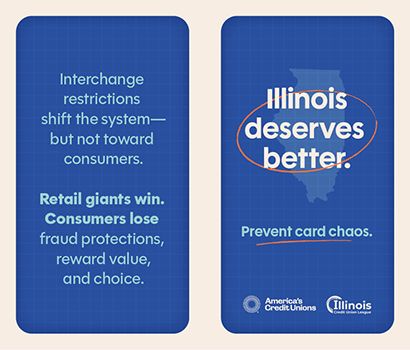
Retailers get to keep 1.75 percent of the overall state sales tax they collect for the state for acting as the state’s sales tax collector. Illinois Retail Merchants Association’s Rob Karr said that doesn’t even cover the processing fees for electronic transactions, which he said make up almost 70 percent of sales. Pritzker wants to cap that reimbursement at $1,000 a year per retailer, Karr said.
“We are subsidizing the state somewhere between four and five cents for every electronic transaction so clearly it is a reimbursement to us and to take it away frankly or reduce it truly amounts to theft of services,” Karr said.
…Adding… From the governor’s office…
Hi,
The INN piece on the retailer’s discount you have up is wrong. The governor’s proposal caps the retailer’s discount at $1,000 per month, not $1,000 per year. Under the Governor’s proposal more than 95 percent of retailers will see no change in their discount as taxable retail sales are highly concentrated among a small percentage of high-volume retailers.
In a sign of which way the political winds are blowing in Springfield, a major business group today came out in favor of a big increase in the state’s tax on gasoline and diesel fuel to pay for needed improvements in roads, bridges, transit and other transportation projects.
In a statement and interview—and in a piece of legislation introduced on its behalf—the Illinois Chamber of Commerce proposed a plan that would inject an additional $2 billion a year into the state budget for transportation, largely by raising the state’s motor-fuel tax from 19 cents a gallon now to 44 cents.
The measure sponsored by Rep. Andre Thapedi, D-Chicago, would partially compensate motorists by, over a five-year period, phasing out most of the state’s current 5 percent sales tax on sales, which has amounted to a tax on a tax. […]
Maisch said he has met with all four legislative caucuses and officials in Gov. J.B. Pritzker’s office, none of whom have endorsed any plan but all of which listened.
By my rough calculations (4.8 billion gallons sold a year, times $2.14 a gallon - which is the approximate price without all taxes - and calculating 5 percent of that), eliminating the state sales tax on gasoline would cost the annual GRF budget roughly $500 million.
* Measure allowing local gas tax on top of state gas tax approved in committee: “This bill gives an opportunity for the locals to impose a 3 cents a gallon motor fuel tax,” said state Rep. Mike Zalewski, D-Riverside. “I intend to have fuller discussions with the transit board and all interested stakeholders including labor.” The amendment passed without debate, 8 to 7. During the vote, state Rep. Margo McDermed, R-Moneka, explained her no vote. “I’m not sure why we’re doing this one off when we need an overall solution to revenue in this area, so I’m a ‘no’,” McDermed said.
The Illinois Petroleum Marketers Association (IPMA) and the Illinois Association of Convenience Stores (IACS) released the following statement pushing back against any increase in the state’s gas tax. The latest proposal would more than double the tax Illinois residents already pay for gasoline from 19 cents a gallon to 44 cents a gallon.
“Raising the state gas tax would push more customers to purchase gasoline and other goods outside of Illinois. Illinois already has the tenth highest gas tax in the nation and is one of eight states that also adds sales tax to the price of motor fuel,” said Bill Fleischli, executive vice president, IPMA-IACS. “Any increase would adversely impact low and middle-class families trying to get to work and school, as well as have devastating consequences on our local convenience stores, particularly those along the borders that are already competing for business with our surrounding states.”
A recent poll by AAA found that nearly 74 percent of Illinoisans do not support raising taxes to make improvements to infrastructure. Gas stations and convenience stores along the border have been hit especially hard by increased taxes. The state has already seen 700 gas stations close and a reduction of 9,000 employees in this industry in the last five years. The last time the motor fuel tax was increased, convenience stores and gas stations saw volume losses of 3 to 6 percent. Further, when consumers purchase gasoline in neighboring states, they purchase other goods as well, such as candy, beverages and food, which results in additional losses of 8 to 10 percent. This makes it harder for businesses to survive and results in lost revenue for the state.
Statewide, 97 percent of Illinois taxpayers will pay the same or less in state income taxes under Gov. JB Pritzker’s fair tax plan, with only 3 percent of taxpayers paying more. County-level data shows that in over half of the state’s 102 counties, less than 1 percent of filers will pay more.
The new county-level data illustrates how a vast majority of communities stand to do even better than the statewide average if the governor’s fair tax is adopted.
A few sample counties are below:
* Adams County (Quincy): 98.44% of taxpayers will pay the same or less while millionaires who make up only 0.15% of the county will pay the top rate.
* Champaign County (Champaign, Urbana): 98.12% of taxpayers will pay the same or less while millionaires who make up only 0.15% of the county will pay the top rate.
* Cook County (Chicago, Schaumburg): 96.78% of taxpayers will pay the same or less while millionaires who make up only 0.40% of the county will pay the top rate.
* Jackson County (Murphysboro, Carbondale): 98.87% of taxpayers will pay the same or less while millionaires who make up only 0.11% of the county will pay the top rate.
* Kane County (Aurora, Geneva): 97.13% of taxpayers will pay the same or less while millionaires who make up only 0.23% of the county will pay the top rate.
* Kankakee County (Kankakee, Manteno): 99.09% of taxpayers will pay the same or less while millionaires who make up only 0.07% of the county will pay the top rate.
* LaSalle County (Ottawa): 99.06% of taxpayers will pay the same or less while millionaires who make up 0.08% of the county will pay the top rate.
* Macon County (Decatur): 98.49% of taxpayers will pay the same or less while millionaires who make up 0.15% of the county will pay the top rate.
* Madison County (Edwardsville, Granite City): 98.72% of taxpayers will pay the same or less while millionaires who make up 0.10% of the county will pay the top rate.
* McHenry County (Crystal Lake, Woodstock): 97.59% of taxpayers will pay the same or less while millionaires who make up 0.19% of the county will pay the top rate.
* McLean County (Bloomington): 97.94% of taxpayers pay the same or less while millionaires who make up 0.18% of the county will pay the top rate.
* Peoria County (Peoria): 97.32% of taxpayers pay the same or less while millionaires who make up 0.22% of the county will pay the top rate.
* Rock Island County (Moline, Rock Island): 99.07% of taxpayers will pay the same or less while millionaires who make up 0.11% of the county will pay the top rate.
* Sangamon County (Springfield): 98.13% of taxpayers will pay the same or less while millionaires who make up 0.13% of the county will pay the top rate.
* St. Clair County (Belleville): 98.80% of taxpayers pay the same or less while millionaires who make up 0.10% of the county will pay the top rate.
* Vermillion County (Danville): 99.42% of taxpayers will pay the same or less while millionaires who make up 0.05% of the county will pay the top rate.
* Winnebago County (Rockford): 98.89% of taxpayers will pay the same or less while millionaires who make up 0.08% of the county will pay the top rate.
Of the over 5.68 million filers in tax year 2016, less than 18,000 millionaires will pay the top rate while 5.52 million taxpayers — 97 percent statewide — will pay the same or less in state income taxes.
* Meanwhile, remember how Think Big Illinois slammed Sen. Dan McConchie’s proposal to require a two-thirds super-majority to impose or raise taxes? McConchie responded and I didn’t get around to posting it. Oops. Here it is now…
Our initiative is to protect middle-income families. Now that the dark money group Think Big Illinois is voicing their opposition, it proves that people should be skeptical of the Governor’s proposed graduated income tax plan. They oppose a super-majority to raise taxes, which means we are unable to trust them to not raise taxes in the future. If it requires a super-majority to implement a graduated income tax in Illinois, then it should also require a super-majority to raise those tax rates. Otherwise, this is merely a place holder for a future tax increase on the people of Illinois.
…Adding… Rep. Tim Butler (R-Springfield)…
The question is not, and never will be, about what arbitrary rates Illinois Democrats are trying to sell to families and businesses. The question is, do taxpayers trust handing a blank check to lawmakers who have proven time and time again to be unable to rein in spending and offer real reforms to the state of Illinois?
* Six days out and she goes back up. Also, I have no info yet about the size of this buy. Press release…
Today, the campaign for Toni Preckwinkle released it’s next ad, “Troubling,” which will air on broadcast, cable and digital.
The ad exposes mayoral candidate Lori Lightfoot’s role, then serving as Chief of Staff in the Office of Emergency Management and Communications, in the botched response to a tragic West Side fire that resulted in the death of four children, and the ensuing cover up.
A judge ordered sanctions against Lightfoot for her “shockingly lax” and “cavalier” handling of the case, in which evidence was either withheld or destroyed.
The judge in the case called Lightfoot’s actions troubling, and questioned Lightfoot’s honesty with the court, to the point that he advised her that she might want to retain legal counsel.
A tragic fire made worse when the 9-1-1 call center run by Lori Lightfoot, allegedly botched the response, costing lives.
To cover it up, Lightfoot allegedly lied, and became extremely evasive. That’s not “bringing in the light.”
“Lori Lightfoot says she wants to bring in the light, but her actions tell a different story,” said Jessey Neves, campaign manager. “This tragic story sheds light on the fact that when Lori Lightfoot had the opportunity to show accountability and transparency, she led a troubling cover up.”
* I told subscribers about these dark money group ads earlier today, so I’ll just leave it at this press release…
Today, Ideas Illinois launched a campaign targeting state legislators calling on them to oppose the Pritzker-Madigan Jobs Tax on middle class families.
“The politicians in Springfield can stop this massive Jobs Tax now by simply not putting it on the ballot in 2020,” Ideas Illinois Chairman Greg Baise said. “Ideas Illinois is calling on legislators to protect the interests of middle class families in their districts rather than handing a blank check to Springfield insiders.”
Democratic Reps. Monica Bristow, Jonathon Carroll, Terra Costa Howard and Mary Edly-Allen are being targeted. Here’s one of the spots…
The group’s online ads say Springfield politicians have hiked taxes in the past and promised those tax increases would fix the state’s problems.
“Pritzker and Madigan want to change the constitution to allow a permanent jobs tax on middle class families,” it says. “It won’t say how much you’ll pay: a blank check for Springfield. Pritzker and Madigan want you to trust them to do the right thing. But they broke their promise before … and they’ll do it again, if we trust them again.”
The ads are supposedly online and TV, but they’re not yet on Facebook (I’m told they start tomorrow) and the other side says they haven’t seen any TV buys as of yet (I’m told they’re coming). Think Big Illinois started its own campaign two weeks ago, but its Facebook ads have stopped running.
…Adding… Think Big Illinois…
This is the latest in a string of attacks by some of the wealthiest Illinoisans who will do or say anything to avoid being forced to pay their fair share.
But the facts are clear – irresponsible governance and financial mismanagement have left Illinois with a $3.2 billion deficit. A fair tax will address this crisis, while only raising taxes on people making more than $250,000 a year and bringing in $3.4 billion a year in much-needed revenue that will go toward funding critical programs, including our schools.
As evidence mounts that Illinoisans across the state support a fair tax, we expect efforts by opponents to only grow more desperate as they fight to keep in place a system that benefits them and their bottom line.
DCFS Interim Director Debra Dyer-Webster said Gov. J.B. Pritzker’s budget request is intended to address many of the agency’s needs. It calls for total spending of $1.26 billion in the upcoming fiscal year, a $75 million increase over this year’s budget. That would be the largest single-year increase the agency has had in more than 20 years.
Much of the increase would be used to hire 126 additional investigators and case workers to ease the workloads on staff in local and regional offices around the state. […]
But Sen. Andy Manar, a Democrat from Bunker Hill, questioned whether the $75 million increase the administration wants would be enough to address the agency’s needs.
“The $75 million is the single biggest increase we’ve had in over 20 years, but it is only a first step,” said Royce Kirkpatrick, DCFS’s acting chief financial officer.
Lawmakers questioned why they didn’t ask for all the money that they needed.
“We recite the names of dead children in this committee hearing once a year,” Senator Andy Manar said. “So why didn’t the department walk in the door today with the request that is necessary to operate the department for the upcoming fiscal year?”
All agencies testify about the official budget request that comes directly from the governor. Manar knows this, of course, but he also has a valid point. Shouldn’t DCFS tell the General Assembly exactly what it needs? That might make the governor look bad for skimping, but the Illinois State Board of Education presents its own budget proposal every year. Yes, it’s a quasi independent body with its own board, but it’s still not a bad idea.
DCFS has huge problems. So, what do you really need?
* And we may know some answers to that question in six weeks or so. As I was writing all of that, this popped into my in-box…
Building on a strong team of diverse experts in their fields, Governor JB Pritzker announced that Marc D. Smith, the Executive Vice President of Foster Care and Intact Services at Aunt Martha’s Health & Wellness, will be his nominee to lead the Department of Children and Family Services.
Governor Pritzker has also expanded expert services that the University of Chicago’s Chapin Hall already provides to DCFS, asking them to conduct an independent and comprehensive review of how the agency’s Intact Family Services unit functions, and has asked for initial actionable recommendations in the next six weeks. This will ensure that respected independent experts with a deep understanding of DCFS operations and challenges can provide immediate input to the new director and administration.
“The most vulnerable people in Illinois are the children served by DCFS, and we must provide them the best services that our state can offer, which means assessing and implementing the recommendations of child welfare experts,” said Governor JB Pritzker. “Within six weeks, Chapin Hall will deliver a report to the new DCFS director with strategic recommendations for improving children’s safety and the quality of the services the agency is providing.”
Following the initial recommendations, Chapin Hall will also provide a more comprehensive review of policies, practices and procedures in the Intact Family Services Unit in order to make additional concrete recommendations for action. Chapin Hall will apply a comprehensive, multi-disciplinary systems approach and will survey several areas, including infrastructure supports like technology to determine if there are better ways to detect increased risk and prevent harm to children. A copy of their scope of work is attached.
Background
Marc D. Smith will serve as Director of the Illinois Department of Children and Family Services (DCFS). Since 2009, Smith has served as the Executive Vice President of Foster Care and Intact Services at Aunt Martha’s Health & Wellness, Illinois’ largest provider of services to families in crisis. In the role, he collaborates with child welfare leaders, professionals, and other stakeholders to implement family-centered systems and practices that protect and support vulnerable children and families. Smith came to his most recent role after working for more than two decades as a social worker, trainer, and leader in child welfare. From 2004 to 2009, he served as a program administrator and recovery coach at Treatment Alternatives for Safe Communities, where he managed the Child Welfare Division. Earlier in his career, Smith worked as a public service administrator for the Illinois Department of Children and Family Services from 1993 to 2000. Smith has served on numerous boards, committees, and work groups, helping to shape policies and inform best practices in leadership and in the field. He has also led the development of program models that have increased the likelihood of family reunification, increased adoptions, and significantly improved the ability of workers and agencies to connect people with substance abuse treatment, mental health care, and other supportive services. A licensed clinical social worker and certified trainer, the Joliet resident received his Bachelor of Science in Criminal Justice from Illinois State University and a Master’s in Social Work from the University of Illinois at Urbana-Champaign.
“The National Association of Social Workers, Illinois Chapter, is encouraged to hear that Governor J.B. Pritzker has selected Marc Smith, LCSW, for the role of director of the Illinois Department of Child and Family Services (DCFS). As a licensed clinical social worker and leader in foster care services, Mr. Smith brings a deep understanding of the system and how our contracted services work. DCFS has numerous challenges that need to be addressed, and we stand ready to work with the new appointment in improving the outcomes of youth in care and those who are now alumni.”
* ABATE withdrew its endorsement of Gov. Bruce Rauner last year after he issued an executive order allowing relatively easy access to roads by so-called “autonomous” cars and trucks. I received this ABATE release yesterday…
[Monday] at a press conference with the Illinois State Police raising awareness for Scott’s Law, Governor J.B. Pritzker responded to a question on driverless vehicles with remarks urging caution on the implementation and utilization of driverless vehicles. ABATE of Illinois agrees with Governor Pritzker’s remarks, especially with the admission that this technology is “not ready today”. A point so important that the Governor repeated it for emphasis. The Governor even went so far as to say “This is not something that we’re going to authorize sometime soon in the State of Illinois.”
Unfortunately, this unproven technology is currently allowed on Illinois roads with no oversight due to an executive order signed by former Governor Rauner in October of 2018. The order allows robot cars and semi-trucks on Illinois Roads simply by filing a letter with IDOT. ABATE of Illinois calls on Governor Pritzker to rescind that dangerous order, and return the issue of Autonomous Vehicles back to the General Assembly where stakeholders can work together to craft reasonable regulations that protect the safety of all road users in Illinois.
“We certainly need to be careful about the implementation, the utilization of driverless vehicles. They’re not ready today. They’re not ready today. And I know that the tests that I’ve seen have been imperfect at best. And so we’re going to have to wait and see. This is not something that we’re going to authorize sometime soon in the State of Illinois” - J.B. Pritzker, Governor of Illinois
* So, I checked in with the governor’s office. Here’s Jordan Abudayyeh…
The governor was clear in his comments [Monday] and is always open to reviewing proposals brought forth by advocates.
…Adding…A resolution sponsored by Sen. Tom Cullerton to disapprove Rauner’s EO was adopted 18-0 by the Senate Transportation Committee on March 5th. It’s now awaiting floor action.