*** UPDATED x1 *** Afternoon campaign notebook
Tuesday, May 24, 2022 - Posted by Rich Miller
* If you want to glimpse what could’ve been if NBC5 and WGN didn’t cave to the GOP gubernatorial candidates and move forward with holding two separate “debates” tonight, you should watch the Daily Herald editorial board’s virtual debate of all the candidates. There was some good back and forth and Richard Irvin held his own. Click here.
For instance, at one point Sen. Darren Bailey claimed that Caterpillar closed down its Aurora plant “because of regulations and taxes.” Irvin quickly countered that Caterpillar did not leave Aurora. It actually left nearby Montgomery. “So,” Irvin retorted, “you might want to get your facts straight.”
Bailey talked about how Irvin supported COVID mandates, but Irvin shot back that Bailey mandated mask-wearing on his megafarm. Bailey later claimed that, despite his son signing a federal pledge under oath to mandate masks, he didn’t actually do it.
Jesse Sullivan talked at one point about how he felt “betrayed” by former Gov. Bruce Rauner and noted that much of Irvin’s team ran Rauner’s 2014 campaign. Irvin replied that Sullivan was living in California at the time, so if he was betrayed by a governor, it was a whole different governor. Not a bad zinger. Irvin prevented Sullivan from responding immediately and then noted correctly that Rauner’s 2018 campaign was helmed by the same guy who’s at the top of Bailey’s campaign food chain. Bailey accused Irvin of lying, and Irvin said the response meant “You know how to tell a lie yourself,” and chuckled. Bailey eventually just smiled and laughed at that one.
And when Gary Rabine brought up a Crain’s Chicago Business story headlined “Aurora homeowners are taxed at the highest effective rate among 53 U.S. cities included in a new study,” Irvin claimed the Illinois Department of Revenue’s figures show Aurora isn’t even in the top 50 in Illinois.
Anyway, it’s worth a look. Bailey and Sullivan could’ve easily called Irvin’s bluff and appeared on the Channel 5 debate with the frontrunner. They didn’t, and that may have been for good reason.
* Politico…
Bailey says he wouldn’t support Richard Irvin if he won the Republican primary.
* On to the DGA…
A year ago today, Richard Irvin arrived at the scene of an arrest of his then-girlfriend, accused of hitting a security guard at a marijuana store. An Aurora police officer overheard Irvin say the charges against her “would be taken care of.” Later, Irvin reappointed his then-girlfriend to the City of Aurora’s Hispanic Heritage advisory board.
One year later, Irvin refuses to answer for his corrupt comments. Instead, he openly contested the police report, telling the Tribune the report was “actually incorrect” in its characterization of his comments.
Looks like the “law-and-order candidate” only backs the blue when it works for him.
“While Irvin parades around as the ‘law-and-order’ candidate who’s ‘tough on crime,’ the truth is clear: he only cares when it’s politically convenient,” said DGA Senior Communications Advisor Christina Amestoy. “Mayor Irvin’s corruption runs deep — and a Governor Irvin would be no different. Illinoisans deserve better.”
* Valencia…
Democratic Secretary of State candidate Anna Valencia announced today that she has earned the endorsement of the Illinois National Organization for Women (NOW) PAC, a major endorsement that highlights Valencia’s unwavering commitment to protecting and advancing women’s rights, especially access to abortion and reproductive justice. The endorsement comes as extreme politicians across the country are passing laws undermining a woman’s right to reproductive health and just weeks before a U.S. Supreme Court decision that is expected to undermine these rights in a significant way.
“Illinois NOW PAC is pleased to endorse Anna Valencia for Illinois Secretary of State,” said Laura Welch, President of IL NOW PAC. “Especially now, Illinois must elect leaders like Anna who fully support women and our rights to privacy. She has a proven track record of uplifting those most often disenfranchised in our state—women, people of color and people whose voices aren’t always heard by our elected officials.”
* CD1…
This evening at an Indivisible Chicago candidate forum, Karin Norington-Reaves condemned Jonathan Jackson’s support of defunding the police amid our city and nation’s crime epidemic.
Jackson touted his endorsement from “Our Revolution,” in a release just last week, an organization that supports defunding the police. “Jonathan checks all of the boxes,” an Our Revolution spokesperson confirmed of his positions being consistent with their priorities. Jackson said, “The issues the organization espouses… are in alignment with my beliefs about the type of policies that will deliver the best long-term benefits to the 1st Congressional District.”
“At a time when our District is grappling with almost unprecedented gun violence and crime, defunding the police is an incredibly dangerous proposition,” said Norington-Reaves spokeswoman Samantha Keitt. “We need candidates who will invest in real solutions to our crime problem, not create more opportunities for violence.”
* CD3…
Today, Alderman Gilbert Villegas received endorsements from Sheet Metal Workers Local 73 and IBEW Local 134 in his race for Illinois’ 3rd Congressional Seat.
President and Business Manager of Sheet Metal Workers Local 73, Raymond Suggs, expressed the union’s support for Villegas.
“The members of Sheet Workers Local 73 are proud to endorse a fellow brother Teamster who is running to represent working people in the US Congress. We are confident that Gil Villegas will serve the workers of this district and the country well, as he understand what it means to work hard and fight for fairness in the workplace,” said Raymond Suggs, President & Business Manager for Local 73.
Don Finn, Business Manager and Financial Secretary for IBEW Local 134, spoke in support of Alderman Villegas.
“Experience, leadership, professionalism and integrity are all important aspects in a candidate, but the shared values and dedication to protecting Workers’ Rights (including the right to collectively bargain conditions of employment, especially for those employees’ seeking representation in their workplace), preserving area standard wages, and ensuring workplace safety are what distinguishes his candidacy and solidifies our endorsement,” said Business Manager & Financial Secretary Don Finn.
Villegas reacted to the support.
“Driving a bakery truck as a Teamster was one of the proudest experiences of my life, and having support from two strong organizations of the Chicagoland labor movement is especially important to me. This campaign is about getting things done for ordinary working people and their families, and with this support, I know we’ll be successful in this race for Congress” said Alderman Gilbert Villegas.
…Adding… Pritzker campaign…
Tonight, the Republican candidates for governor will finally meet to answer questions from the public and reporters––but not on the same stage. Throughout the messy and divisive primary contest, the GOP candidates have lobbed brutal attacks at each other but have spent little time discussing their policies and records. Although the candidates are unwilling to actually meet on the same debate stage, tonight’s two “debates” will be a long-awaited opportunity to demand answers from those running for office who have spent the primary ducking, dodging, and running away from tough questions.
Voters are still waiting for answers to major questions such as:
• Do you support the nationwide abortion ban proposed by Republicans?
• Do you think Roe v. Wade should be overturned?
• Did you vote for Donald Trump?
• Will you support Donald Trump in 2024?
• Do you support background checks for gun purchases and the FOID card?
• Did Joe Biden win a free and fair election in 2020?
• Do you consider the Jan. 6 attack on the U.S. Capitol an insurrection?
• Do you support a $15 minimum wage?
• Do you support the Workers’ Rights Amendment?
• Do you support the Black Lives Matter movement?
• What would you do as governor to protect Illinoisans from the COVID-19 pandemic?
• Do you support LGBTQ+ Illinoisans’ constitutionally-protected right to marry?
During the 2018 primary, Governor JB Pritzker had already participated in more than 36 forums, six televised debates and 10 editorial board sessions with his Democratic primary opponents. Republicans have made it clear that political points and sneaky campaign tactics are more important than sharing the same debate stage to publicly discuss the issues most important to Illinois families.
*** UPDATE *** A new IE for Karin Norington-Reaves…
Forward Progress (5/24-6/06)
Chicago Cable - ~$161K
Cable Networks: BET,BRVO,CNN,ESPN,GSN,LMN,MNBC,OWN,TNT,TV1,VH1,WETV, ID, LIF, OXYG, ESPN2
OVERALL TOTAL: $161K
Click here for what appears to be the spot.
26 Comments  
|
* In May of 1997, after more than 20 years of Republican Illinois governors, the US Census Bureau laid out its predictions of the states that would have the highest net loss of population due to interstate migration in the 30-year period between 1995 and 2025 per 1,000 people…
California -4
Massachusetts -4
Illinois -5
New York -9
DC -10
* From that report…
While Americans frequently move among the states… Florida, Texas, and North Carolina will each gain 1 million or more persons over the 30-year period through net interstate migration, with Florida gaining nearly 4 million. Georgia and Washington will each gain slightly less than 1 million. Four states will have a net loss of at least 1 million persons to other states. New York will lose 5.0 million; California, 4.4 million; Illinois, 1.7 million; and Michigan, 1.1 million. Over the 1995-2025 period, nearly one-quarter billion people are projected to move from one state to another. […]
California is projected to add the largest number of international migrants (more than 8 million). … Other states projected to have gains of 1 million or more from immigration are New York, Florida, New Jersey, Illinois, and Texas.
International immigration slowed way down under President Trump and then because of COVID, which has obviously hurt Illinois, and that may have been partly why the 1997 projection was off by about a hundred thousand people when the Census estimated Illinois’ 2020 population to be 13.121 million. As you know, the latest corrected Census number has Illinois right around 13 million.
* Point being, the fundamentals have been against Illinois for a very long time. This ain’t a new issue. And maybe some folks in Massachusetts should take a look at that 1997 report as well.
*** UPDATE 1 *** From the governor’s office…
Governor Pritzker today urged President Joe Biden and the federal government to ensure that Illinois receives federal funding that reflects its growth of 250,000 residents, lifting the state’s population to more than 13 million for the first time in its history.
Illinois’s population was undercounted by roughly 2% in the 2020 census. The adjusted Census results show an increase in Illinois’ population as people move to the state in pursuit of expanded economic and employment opportunities.
“Illinois is growing, and our federal funding should reflect that reality,” said Governor JB Pritzker. “Nearly 250,000 Illinoisans—the majority of whom are from historically disenfranchised and underserved communities—were not represented in the Census results. That’s why I have urged President Biden and the federal government to ensure that the local communities of Illinois receive the federal dollars they are entitled to—and deserve. I thank the President for his commitment to an accurate Census count, and I look forward to working with him to guarantee that our state secures its fair share of federal funding.”
Governor Pritzker’s letter to President Biden calls for adjusted population counts to be considered when allocating over $1.5 trillion in federal funds for Medicare, affordable housing, homeland security, and other essential programs. Census undercounts often disservice Black, Latino, and minority residents who are historically underserved by federal resources such as these, making the correct appropriation of these funds even more important. The letter requests that President Biden support any efforts to factor the new data into equitable funding allocations.
The Census Bureau’s Post Enumeration Survey (PES) is a follow-up survey to the census count meant to examine the results for accuracy through additional statistical sampling. The original census count, which inaccurately showed a population decline, resulted in Illinois losing one congressional seat, making accurate appropriation of funds even more essential to ensure Illinoisans can access the resources they need over the next decade.
This updated count reflects Illinois’s rising status in the region and the country as a site of innovation and opportunity. Increased investment by the Pritzker administration in training and apprenticeship programs in manufacturing and aviation have created jobs and attracted new residents across the state.
*** UPDATE 2 *** Monique Garcia on behalf of the Illinois Municipal League…
Hi Rich,
As you continue to cover what the Census undercount means for Illinois, I wanted to bring your attention to this letter from the Illinois Municipal League to Gov. JB Pritzker seeking clarification about whether the administration intends to ensure municipalities are made whole for the purposes of state-shared revenues. The letter also raises the need to address the pending loss of population-established home rule authority in several communities across the state, which could be resolved if corrections to undercounts are made.
Thank you,
Monique
The letter is here.
15 Comments
|
Richard Irvin’s origin story
Tuesday, May 24, 2022 - Posted by Rich Miller
* From Rick Pearson’s profile of Richard Irvin…
But there is an early example of Irvin trying to be all things to everyone. It came in his successful 2017 run for the nonpartisan position of mayor of Aurora, through a pair of near identically designed mailings — one sent to Democrats and another sent to Republican households.
Each mailer is labeled, “The Choice is Yours” with the words appearing atop a donkey representing Democrats and an elephant representing Republicans.
In the mailer sent to Republicans, an arrow points to the donkey with the words, “Rick Guzman is endorsed by entrenched Chicago Democrats like Dick Durbin.” The arrow pointing to the elephant says, “Richard C. Irvin is endorsed by Local Elected Officials who actually have a stake in Aurora’s future.”
The reverse side touts GOP endorsements he received and says, “The reasons are clear. Richard C. Irvin has a solid conservative record.”
But in the mailer that went to Democrats, the arrow pointing to the elephant warns Guzman, a former mayoral chief of staff, is “endorsed by Tea Party Republicans.” Under the donkey arrow appear the words: “Richard C. Irvin is endorsed by Local Elected Officials who actually have a stake in Aurora’s future.”
On the opposite side, appears a list of Democratic elected officials and groups supporting him for mayor — but there was no mention of his “solid conservative record.”
…Adding… The latest Irvin campaign mailer…
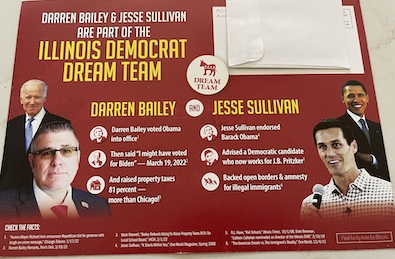
* Also, Irvin has now changed his story from March of 2020, when he claimed he had “spoken” with Gov. Pritzker. Now, he says he spoke to Pritzker’s staff because Pritzker wouldn’t return his calls.
When I asked, the governor’s spokesperson said Pritzker called Irvin around March 12, 2020 to check in and see how it was going in Aurora and to say his office was monitoring the situation and working to keep people safe. Then, I was told, Pritzker called Irin to check in on him in April when Irvin tested positive for the virus. And Pritzker talked to him again around the middle of July. The governor called Irvin again on November 14 and got his voicemail, but Irvin called him back. Pritzker called again on Dec. 10 and got Irvin’s voicemail. More documentation is here.
* But, to be fair, in the spring of 2020 just about everyone was on board the mitigation train. Even Darren Bailey was telling his Facebook followers on March 21 to stay safe...
Please just, just take this serious. I’m, as I compare what we’re doing here in Illinois, and then I watched President Trump with many of his recommendations. We just we really need to take this serious so we don’t get to the point where Italy and other countries are at. […]
We really need to take this serious so we don’t get to the point where italy and other countries are at. […]
And you know, there is reason to be concerned. So I am satisfied with what the governor is doing as we watch what he is suggesting and compare that with what President Trump is doing.
I wanted to ask everyone to please stay home from church tomorrow. If your church is considering having services, please call your pastor and, and talk about it, you know. For the next few weeks, we need to take this serious.
And then in May of 2020, Bailey offered up his own mitigation plan, including for places of worship…
Places of Worship
All staff and worship leaders shall have temperature checks when arriving to work.
Occupancy allowed at 25% capacity ensure not less than six feet distance between attendees
Distancing between family members is at their discretion
Avoid contact with common items (items open to use by all attendees)
Disposable hymn handouts
Avoid physical contact between attendees
No greeters/No physical contact
No Offering Baskets passed among attendees
No waiting area
All surfaces touched by attendees shall be sanitized between each use
Continued Virtual worship is recommended
Self-Contained communion practices are acceptable
Organized dismissal should be implemented
…Adding… Irvin says in the article that his support for mitigations waned over time, but he declared a special day for Dr. Ezike when she was in Aurora this past October for a vaccine event.
46 Comments
|
Morning campaign notebook
Tuesday, May 24, 2022 - Posted by Rich Miller
* Regarding Delia Ramirez via Kate Cuneo…
The leaked draft decision on Roe V. Wade sent a shockwave across our country, reminding us that elections have consequences, especially in the newly drawn 3rd Congressional District that is densely populated by Latinas, who will be severely impacted by Roe V. Wade being overturned. Alderman Gil Villegas’ record on abortion and reproductive rights has raised serious concerns about his ability to represent women and trans, nonbinary, and gender nonconforming people who seek abortion access and reproductive healthcare.
Below is a statement by one hundred women in the 3rd Congressional District, including State Senator Karina Villa, State Senator Cristina Pacione-Zayas, Representative Maura Hirschauer, and Alderwoman Rossana Rodriguez Sanchez, condemning Alderman Gil Villegas’ anti-abortion record and cautioning voters.
“This election is especially critical because the candidate we send to Congress has to be an unapologetic fighter for reproductive, abortion, and LGBTQ+ rights. Unfortunately, Alderman Gil Villegas has demonstrated that he is not a committed partner in protecting reproductive rights. His ties to anti-choice Republicans are troubling.
“In 2017, Alderman Gil Villegas voted to give $5.5 million of taxpayer’s money to subsidize clinics that banned women from obtaining abortions and access to birth control. It is reprehensible that he voted to use public dollars to fund inadequate healthcare access, knowing that Black and Brown women in the 3rd Congressional District would be severely impacted.
“Additionally, Alderman Gil Villegas has taken campaign contributions from anti-choice Republicans, including Gubernatorial Candidate Gary Rabine and Dan Cronin.
“The 3rd Congressional District can not afford to send a tepid Democrat to Congress when our freedoms are under attack by Republicans, so it is essential that we send someone to Congress who we trust will fight at all costs to ensure that Roe V. Wade is codified. We ask voters to support Delia Ramirez, a real progressive and champion for reproductive and abortion rights in this race.”
The full list of signatories is here.
* Another from Ramirez…
Today, IEA - NEA and SEIU Local 73 announced their endorsement of State Representative Delia Ramirez in her campaign for Congress in the newly drawn 3rd Congressional District of Illinois. Illinois Education Association represents 3,000 educators in the 3rd District; SEIU Local 73 represents more than 3,100 frontline, essential workers in the 3rd Congressional district.
“We are proud to endorse Delia Ramirez for Congress. As a state representative, Delia was instrumental in finally bringing an elected school board to the City of Chicago,” said Dian Palmer, President of SEIU Local 73. “Delia has dedicated her life and career advocating for working families. As an accomplished community leader and coalition
builder, we know we can count on her to fight for our members in Congress.”
“It is an honor to receive the endorsement of SEIU Local 73. Their commitment to fight for dignified, fair wages and working conditions for the thousands of frontline workers they represent is inspiring. I am proud to receive their support and look forward to working with them to continue this fight in Congress” stated Leader Ramirez.
Leader Ramirez is running in the newly drawn 3rd Congressional seat. The Democratic Primary takes place June 28th. She has been endorsed by Senator Elizabeth Warren, Congresswoman Schakowsky, Congressman Chuy Garcia, Congresswoman Lauren Underwood, SEIU Healthcare, Illinois Federation of Teachers, Congressional Progressive Caucus, PODER PAC, Mijente, End Citizens United, EMILY’s List and the United Working Families and Working Families Party.
* Judge Rochford…
Today, Teamsters Joint Council 25 announced its endorsement of Judge Elizabeth Rochford for the Illinois Supreme Court’s Second District. Teamsters Joint Council 25 represents over 100,000 working men and women in Illinois and Northwest Indiana. The endorsement builds on Judge Rochford’s strong labor support, including the Illinois State AFL-CIO, Local 881 UFCW, Plumbers Local Union 130 United Association (UA), and the Lake County and McHenry County Building & Construction Trades Councils and their affiliates, which together include 44 local affiliate trade unions. […]
Recently, the Illinois State Bar Association released their rating of Judge Rochford as “highly recommended.” Judge Rochford is the only candidate in the Democratic primary for the Second District seat to be rated “highly recommended.”
* Politico…
Judge overrules Cook County Electoral Board, says rival to Sheriff Tom Dart should be put back on ballot: “Carmen Navarro Gercone’s successful appeal of a decision by the Cook County Electoral Board comes with little more than a month to go before the June 28 primary. Dart’s campaign had argued that she was ineligible to run under a controversial new state law that requires sheriff’s candidates to be registered law enforcement officers,” by Tribune’s Jeremy Gorner. […]
— OPEN SEAT SCRAMBLE: The Democratic group VoteVets is launching a $360,000 buy supporting Chicago Ald. Gil Villegas in the open Democratic primary in IL-03. The ad, which will start airing today, highlights Villegas’ service in the Marines and his work on the city council. It is set to air for two weeks. The district is open after redistricting turned it into a Latino opportunity district in the city. […]
— Gov. JB Pritzker has endorsed Eileen Dordek in her bid for the 13th state House District seat now held by retiring Majority Leader Greg Harris. Four other Democrats, all men, are also in the race. […]
— Charise Williams has been endorsed by state Rep. Rita Mayfield and Dixmoor Mayor Fitzgerald Roberts in the IL-01 Democratic primary.
* Press release…
SEIU Healthcare Illinois is proud to announce the union’s endorsement of Illinois Senator Jacqueline Collins for the 1st Congressional Seat.
“The over 90,000 home care, child care, nursing home and hospital workers joined together in our union have benefitted from Jacqueline Collins’ dedicated advocacy on behalf of healthcare workers, care recipients and the communities within our state most in need of and dependent upon care,” said SEIU Healthcare Illinois President Greg Kelley. “Nearly 12,000 of our members live in the 1st Congressional District and would directly benefit from Collins’ advocacy in the nation’s capital. Additionally, her leadership in areas of concern to working families would have a positive impact for all the union’s membership, and for struggling low-wage earners across the state.
“Collins has shown exemplary leadership in Springfield standing up for nursing home reform—both in calling for safe staffing in long term care facilities backed by real consequences for owners who fall short and in advocating for living and sustainable wages and working conditions for workers.”
Frontline healthcare workers appreciate Collins’ grasp of the importance both of their work and of increased investment in wages and benefits. “Senator Collins gets that our working conditions are the care conditions of residents and patients,” said Francine Rico, a certified nursing assistant at Villa at Windsor Park, a long-term care facility. “She also understands that when we fight for higher wages and a voice on the job, we’re fighting for racial and gender equity. Like me, most nursing home and frontline care workers are women of color and our work has been devalued for too long.”
“Too often, our elected leaders will say the right thing when it comes to lifting wage and working standards but fail to act,” said Kelley. “But in Collins, we have a leader who has proven she has the courage and integrity to do the right thing, by fighting for real accountability for staffing levels in Illinois nursing homes—and for all of the issues that matter the most to working families. Her election to Congress would be a real win for frontline caregivers and for all those who receive care in the state and beyond.”
…Adding… Litesa Wallace…
First-term Galesburg Mayor Peter Schwartzman on Tuesday announced his endorsement of former state Rep. Litesa Wallace for the 17th Congressional District Democratic nomination, citing Wallace’s history of advocacy and willingness to stand up to the establishment on behalf of everyday Illinoisans.
Schwartzman said he did not easily give out endorsements, but was drawn to do so for Wallace after hearing her personal story, her record of progressive advocacy and seeing her intent to focus on “real challenges,” ones that face all of us.
In an endorsement statement Tuesday, Schwartzman, a Knox College environmental studies professor, said:
“I don’t give out endorsements lightly or frequently, but Litesa has impressed me with her background, with her personal history and with her values. She’s not part of the Democratic establishment, but she has a strong sense of the everyday things we should do for each other. She understands that economic growth is true when it includes everyone. She’s a real person with a very high level of integrity.”
“We need people like her who are fighting for us, and not just for the special interests. This is a very important race and we’re at risk of losing this seat, so we need to put forward the best candidate–and that’s why Litesa Wallace has my endorsement.”
Rep. Wallace previously served three terms in Springfield as the State Representative from Rockford’s 67th District. She gained national attention in 2018 when she ran for Lt. Governor alongside Daniel Biss in the Democratic primary for Governor.
She previously has been endorsed by Indivisible, Our Revolution Illinois, SEIU Illinois, Winnebago County Citizens for Choice, the Collective PAC, Democracy for America, and a long list of elected officials in the 17th District and across Illinois.
Rep. Wallace is running to represent the newly drawn 17th District, which includes most of Peoria, Rockford, Freeport, the Quad Cities, Bloomington-Normal, Macomb, and Galesburg.
15 Comments
|
|
 Support CapitolFax.com
Visit our advertisers...

 ...............
 ...............
 ...............


|
   
|
Hosted by MCS |
SUBSCRIBE to Capitol Fax |
Advertise Here |
Mobile Version |
Contact Rich Miller
|



