* Jordan Abudayyeh…
The Governor strongly supports the compromise presented in House Amendment 1 to SB1751 that will be filed this weekend. The amendment builds on the progress made in Senate Bill 18 by requiring a 100 percent reduction in carbon emissions for municipal coal by 2045 with the additional goal of reducing emissions by 45 percent by 2035. We know our planet cannot afford to wait more than two decades before significant progress at reducing carbon emissions is made, and this bill is a reasonable path forward. The administration looks forward to continuing discussions with our partners in the House.
The Senate sent a bill to the House this week which did not reduce carbon emissions on the two municipally owned plants until the 2045 closure date.
* ICJC…
Today, Illinois took another step toward an equitable clean energy future for all with the introduction of SB1751, House Amendment 1 which will take action on climate, protect communities from pollution, and launch a generation of new, good-paying jobs that lift up those who need it most.
In response, the Illinois Clean Jobs Coalition (ICJC) released the following statement:
“The Illinois Clean Jobs Coalition strongly supports SB1751, House Amendment 1. This language — which mirrors energy legislation passed by the Illinois Senate (SB18) on September 1 and includes an important new element — is the reasonable path forward to a true climate and equitable jobs bill.
“In addition to a specific timeline for the closure of coal plants, this bill as amended also includes interim carbon pollution reductions for the Prairie State coal plant and CWLP’s Dallman coal plant in Springfield. These critical reductions are in line with climate science and will protect the public health of Illinoisans during the decades it will take to decarbonize. It is our understanding that this is the bill Governor Pritzker will sign.
“We are proud to advocate alongside the Governor and legislative Green Caucus in support of this legislation that meaningfully addresses our climate crisis, takes bold action on creating equitable jobs across the state particularly in Black and Brown communities, and enacts tough utility accountability measures.
“An urgent and nation-leading opportunity is within our reach. We encourage lawmakers to take this comprehensive climate and equitable jobs bill across the finish line next week.”
The amendment is not yet posted online.
Awaiting response from Speaker Welch and Senate President Harmon.
*** UPDATE 1 *** Here’s the language. It doesn’t mandate closure, but permanent 100 percent carbon reduction would be the same thing…
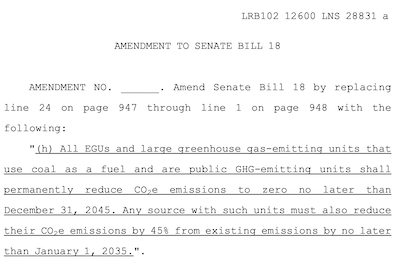
*** UPDATE 2 *** Speaker Welch…
I am confident Leaders Evans, Gabel, and Hoffman will continue to facilitate collaboration between all stakeholders and caucus members now that we have two proposals in bill language, and the House stands ready to act when consensus is reached.
Translation: When concensus is reached, a bill will move.
Comments Off  
|
Another cannabis muck up
Friday, Sep 3, 2021 - Posted by Rich Miller
* Sun-Times…
State officials on Friday announced that a fourth lottery for cannabis dispensary licenses will now be held to give six applicant groups a chance to win additional permits after they were wrongfully excluded from drawings in an earlier lottery.
The latest development in the convoluted and acrimonious pot shop licensing process came just before the Illinois Department of Financial and Professional Regulation announced the final list of winners of the next 185 permits, which still can’t formally be issued due to a Cook County judge’s order.
Toi Hutchinson, Gov. J.B. Pritzker’s senior adviser on cannabis control, explained in a call with reporters that a “clerical oversight” led to some groups having less chances than they deserved and others having more shots in the July 29 lottery. The errors affected the drawings for five of the 17 regions where the licenses are designated.
The new lottery aims to give the affected firms the same odds of winning they would have had in the initial drawings, although it wasn’t immediately made clear how those odds will be determined. Additional licenses will be issued to the winners, but officials didn’t say how many could be dished out.
* Tribune…
At each step on the way, as regulators discovered errors, they acted to correct them, Hutchinson said, describing the process as a marathon, not a sprint.
“It’s been painful to watch how long this has taken,” she said. “As we move forward. this could get better every single year.”
* From a state press release…
Only six applicants did not receive the correct number of entries. The additional lottery will not impact applicants who were selected for the opportunity to be issued a conditional license in the previously held lotteries.
…Adding… Center Square…
Cannabis sales for the month of August dipped $5.8 million from the month before, bucking a consistent trend, but the governor’s lead advisor for the industry said things will continue to evolve.
In July, nearly $128 million of adult-use cannabis was sold. The following month, $122 million was sold. The only other declines month to month were in February 2021 and 2020, and a slight decline from October to November 2020.
It’s unclear if demand has peaked. Before Augusts’ sales numbers were revealed, Toi Hutchinson, the senior advisor for cannabis control to Gov. J.B. Pritzker, said that is something the law she helped craft as a state Senator requires review.
“The biggest thing is we designed this to study at every step of the way so that we could try to make the best policy decisions we could make with no breadcrumbs from any other state,” she said.
She couldn’t say what the ceiling was for sales.
“I could not even begin to tell you,” Hutchison said. “I will tell you that in February we surpassed liquor tax money.”
10 Comments
|
* Press release…
As hospitals and schools work to implement additional COVID-19 testing programs and accountability measures, Governor JB Pritzker and Illinois Department of Public Health (IDPH) Director Dr. Ngozi Ezike today announced a two-week extension of vaccination requirements for individuals in high-risk settings.
All healthcare workers, including nursing home employees, all P-12 teachers and staff, as well as higher education personnel and students will now be required to receive an initial dose of the COVID-19 vaccine by September 19, 2021. The extended deadline came at the request of the Illinois Health and Hospital Association (IHA), as well as education leaders including the Illinois Education Association (IEA), Illinois Federation of Teachers (IFT), Illinois Association of School Administrators (IASA), and Illinois Principals Association (IPA), who best understand the localized needs of hospitals and schools implementing their own testing, vaccine and accountability protocols.
Entities continue to be permitted and encouraged to put in place more stringent vaccination requirements. The Executive Order does not prohibit any entity from implementing a requirement that personnel, contractors, students or other visitors be fully vaccinated without providing the alternative to test on a weekly basis consistent with applicable law.
“Vaccines remain our strongest tool to protect ourselves from COVID-19, the Delta variant, and most crucially, to maintain our healthcare system’s ability to care for anyone who walks through their doors in need of help,” said Governor JB Pritzker. “While hospitals and schools move forward in good faith, this extension ensures they are prepared to meet this requirement to better protect our most vulnerable residents and children who are not yet eligible to get vaccinated.”
“Even as our hospitals and schools are taking the necessary steps to ensure compliance with the testing and accountability measures mandated in Executive Order 2021-22, we recognize that some institutions will need additional time in which to establish procedures that will guarantee they are compliant,” said IDPH Director Dr. Ngozi Ezike. “Our primary goal is to make sure that healthcare workers, education employees and students are protected, along with their families and communities, and this extension will help us achieve that goal.”
To combat the more contagious Delta variant, on August 26, 2021, the Governor announced that all healthcare workers, P-12 teachers and staff, higher education personnel and students would be required to receive the COVID-19 vaccine or submit to regular testing requirements. With Executive Order 2021-22, workers and students in applicable settings must receive the first dose of a two-dose vaccination series or a single-dose vaccination by September 19, 2021. The two-week extension will allow for more schools and hospitals to implement the new accountability measures. The second doses of either two-dose vaccine must be received by 30 days after the first dose, as directed by vaccine providers.
“I deeply appreciate how hard schools are working to protect students and educators while offering the highest quality in-person learning experience,” said State Superintendent of Education Dr. Carmen I. Ayala. “Our school leaders said they needed more time to plan and communicate, and I thank Gov. Pritzker and Dr. Ezike for providing this extension. While testing is an option for all school personnel, vaccination is the safest and most effective defense against COVID-19. I encourage everyone who works with our students to use this extra time to get vaccinated.”
The extension will also allow for more time to put additional testing protocols in place, given that individuals who are unable or unwilling to receive the vaccine are required to get tested for COVID-19 at least once per week to prevent further spread. IDPH and the Illinois State Board of Education (ISBE) may require increased testing in the event of positive cases. Healthcare professionals, school workers, and higher education personnel and students who do not provide proof of vaccination will be required to follow the testing protocol in order to enter healthcare and educational facilities.
There’s more, but you get the idea. The EO is here.
…Adding… Illinois Education Association President Kathi Griffin…
“Today’s announcement of the two-week deadline extension on the governor’s Executive Order on vaccines is welcome news. We have said all along that the best place for students to be is in the classroom, as long as it’s safe. We believe the governor’s executive order – which encourages all education employees from preschool through college to be vaccinated and if they can’t, or won’t, then to be tested weekly – will help keep schools open and all those who work and learn inside them safe.
“Ultimately, keeping everyone safe and healthy while they are working and learning is the main goal. Extending the deadline will give school districts and higher education institutions more time to bargain the details and the impact of the order with employees, an important step that must take place to ensure that our members’ concerns are addressed. It will also give school leaders time to develop plans, secure testing and even offer vaccination clinics.
“We support public health strategies that work. Vaccines are the most effective way to ensure safety. And, vaccines combined with other known effective mitigation strategies, such as wearing masks, washing hands, keeping socially distanced, appropriate building ventilation and a vibrant testing program for students and staff will help all of us meet the goal of keeping doors open and everyone safe and healthy.”
4 Comments
|
* The House Executive Committee has just posted a hearing for next Thursday morning, September 9. The bill is SB18, the climate/energy measure which passed the Senate this week. Speaker Welch is the chief sponsor.
It’s a virtual hearing, so we don’t know yet whether the posting signals a return to Springfield that day or not.
I’ve reached out with questions, so you’ll know more when I know more.
…Adding… A House Democratic spokesperson said she was told the posting was done primarily to be meet posting requirements “in case we do come back.” So, we wait.
8 Comments
|
* I have yet to receive a single press release from an Illinois Republican politician praising the US Supreme Court’s ruling or the Texas law the high court allowed to stand. The Illinois House and Senate Republican leaders are both anti-abortion advocates, but they’ve been quiet. The Illinois Republican Party has been similarly mute. Heck, even US Rep. Mary Miller and Sen. Darren Bailey haven’t tweeted about it.
…Adding… US Rep. Miller and the rest of the state’s Republican delegation signed on to an amicus brief in late July asking the US Supreme Court to overturn Roe v. Wade.
Either the dog has finally caught the car and doesn’t know what to do with it, or they realize how unpopular the law is in Illinois with all-important suburban women, or both. The Democrats are not nearly so shy…
Illinois Gov. J.B. Pritzker said Thursday that he’s “very concerned” about the U.S. Supreme Court’s decision not to block a new Texas law banning most abortions in the state, and vowed Illinois would continue to welcome women from elsewhere who need reproductive health care.
“Shame on those Texas lawmakers for taking away, not just women’s rights, but women’s health,” Pritzker, a first-term Democrat, said at an unrelated news conference in Chicago. “Banning abortion does not keep women safe.”
A deeply divided high court allowed the Texas law to remain in force in the nation’s biggest abortion curb since the court legalized abortions nationwide almost half a century ago. The court voted 5-4 to deny an emergency appeal from abortion providers and others but also suggested that their order likely wasn’t the last word and that other challenges can be brought.
* NBC 5 takes a look at the Illinois impact…
Illinois has “very strong pro-reproductive rights laws,” said Carolyn Shapiro, professor of law and co-director of Chicago-Kent College of Law’s Institute on the Supreme Court of the United States.
So women’s rights in the state likely won’t be threatened by the Texas law “in the short term,” she said. […]
Shapiro noted that if Roe v. Wade is overturned and Congress debates the possibility of a nationwide abortion restriction, then the impacts could be felt in Illinois.
“If there are national efforts to change the law in Congress to impose different types of abortion bans - as Congress did with what they call the partial birth abortion ban, which the Supreme Court upheld - they could then… that would obviously have enormous effects here in Illinois and would be quite frightening.”
* Tribune…
Activists from both sides of the abortion debate believe Illinois will see an uptick in travel here for the procedure.
“I think we’re definitely going to be seeing higher abortion rates in Illinois,” Scheidler said. “That trend will continue as other states enact other pro-life measures, whether we’re talking about measures that have already been upheld by the Supreme Court or measures that are completely new like this Texas law.”
Thousands of women already travel to Illinois from other states each year to access abortions. In 2019, roughly 7,500 crossed state lines for the procedure, about 16% of all terminated pregnancies in Illinois that year. The number of out-of-state abortions has increased every year since 2014, according to Illinois Department of Public Health data.
While it’s impossible to know the reasons for each individual decision to travel for the procedure, many experts have attributed the overall rise to increasing restrictions in other states.
* Sun-Times editorial…
The Texas law actually bars state officials from enforcing the law. You won’t see Texas Rangers closing down abortion clinics that continue to perform abortions after six weeks. Instead, the law grants private individuals the authority to sue anybody — except the actual patient herself — who “aids and abets” such an abortion, including doctors, counselors and drivers.
The bounty is $10,000. That’s how much the State of Texas will pay if you sue and win. Plus, the state will pick up your legal bills. You don’t even have to have some connection to the abortion. You can live in Peoria and sue a stranger in Houston.
But what if you are the person who is sued and you win? Texas will not pay your legal fees. And the state sure as heck won’t fork over $10,000.
* AP…
A Missouri law that took effect last week allows citizens to sue local law enforcement agencies whose officers knowingly enforce any federal gun laws. Police and sheriff’s departments can face fines of up to $50,000 per occurrence. The law was backed by Republicans who fear Democratic President Joe Biden’s administration could enact restrictive gun policies.
In Kansas, a new law prompted by frustration over coronavirus restrictions allows residents to file lawsuits challenging mask mandates and limits on public gatherings imposed by counties. Last month, the Kansas Supreme Court allowed enforcement of the law to proceed while it considers an appeal of a lower court ruling that declared the law unconstitutional.
Utah also took a similar strategy on pornography last year, passing a law that allows citizens to sue websites that fail to display a warning about the effects of “obscene materials” on minors. Though adult-entertainment groups warned it was a violation of free speech, many sites have complied with the law to avoid the expense of a possible onslaught of legal challenges.
* Related…
* Texas abortion providers say they’ve been forced to turn away patients under new law: Rebecca Tong, who operates an abortion clinic in neighboring Oklahoma, said she’s become inundated with out-of-state calls. “The phones have just been ridiculous,” said Tong, co-executive director of Trust Women. “About two-thirds of our call volume right now is Texas people.”
* Texas’s new abortion law threatens women’s health and well-being: In 1947, for example, Chicago police captured eight women outside the building of a midwife-abortionist, put them in police cars and drove them to a medical office for internal pelvic examinations by a doctor searching for evidence of an abortion in progress. The state claimed that the police “escorted” the women, who “consented” to the exams and volunteered to testify. But there was nothing voluntary about the women’s role in this investigation; it was entirely coercive. Police had cursed at them, threatened to call a paddy wagon if they resisted and manhandled them into police cars.
88 Comments
|
* Tribune…
A voting advocacy group said Thursday state legislative district maps approved by Democrats earlier this week fail to maximize Black representation and would reduce the number of Black-majority districts in the state.
Illinois African Americans for Equitable Redistricting sent a letter to a panel of three federal judges overseeing legal challenges to the map asking them to use their “leverage” to approve a redistricting plan that “provides optimal opportunity for Black voters to exercise their right to elect candidates of their own choosing.”
Republicans and the Mexican American Legal Defense and Educational Fund have filed separate federal lawsuits over the maps. MALDEF, in a status hearing Wednesday, told the court panel it plans to challenge the latest map on federal Voting Rights Act grounds, contending it underrepresents a Latino population that grew by 15% over the last decade and reduced the number of legislative districts with a Latino voting-age majority.
* Press release…
Members of Illinois African Americans for Equitable Redistricting (IAAFR) have reviewed the Legislature’s final redistricting plan and they are not happy. “From what we can see, Black voters in the state of Illinois are worse off under the revised plan than we were under the plan enacted in June”, said Valerie F. Leonard, the group’s convener. “In fact, every redistricting plan the Legislature has come up with after 2011 has done progressively more harm to Black voters”.
In 2011, the redistricting plan was drawn with 16 majority Black Representative districts, and 8 majority Black Senate districts. This past spring UCCRO developed a redistricting proposal with 18 representative districts with 50% or more Black population. They also drew 9 Black Senate districts.
A recent review of the data that supports the maps enacted in June revealed that the Legislature drew 12 Black Representative districts and 6 Black Senate districts. The amended plan reduced the number of Black Representative districts from 12 to 8, and the number of Black Senate districts from 6 to 4. Black people made up 14% of Illinois population in 2011 and 14% of the state’s population in 2021. The latest redistricting plan drew fewer than 7% of the new districts as majority Black.
We know the Legislature can figure out a way to balance their political agenda with optimizing Black voting rights”, Leonard said. Speaker Madigan did this in 2011, and the data show that it is possible to do it again. For some reason, they decided not to go that route this time around.”
IAAFR shared their concerns in a letter to the Court overseeing the lawsuit brought by MALDEF and the Republican leaders.
The letter is here.
I asked the group’s convener Valerie Leonard if the group plans to sue. “We are exploring our options,” she replied.
Lots of districts are near to a Black majority, however. And voting history has shown that white folks in the state are willing to vote for Black candidates, which is one of the arguments the Democrats will likely make.
* Meanwhile…
As the Illinois House and Senate passed new redistricting maps on August 31, community members organized by the non-partisan United Congress of Community and Religious Organizations (UCCRO) urge Governor JB Pritzker to veto the maps and meet with UCCRO about its Unity Map proposal that protects the ability of communities of color to elect candidates of our choice. The passed maps weaken the voting power of Black and Latino community members and largely ignore Asian American and Arab American communities. The rushed and exclusionary mapping process has imposed significant challenges to Black and Brown communities who are trying to work together toward win-win outcomes.
WHO:
Rod Wilson, UCCRO
Reverend Robin Hood, UCCRO
Latino Policy Forum
IL Muslim Civic Coalition
Enlace Chicago
Coalition for a Better Chinese American Community (CBCAC)
Erica Knox, Chicago Lawyers’ Committee for Civil Rights
WHERE: Outside the James R. Thompson Center (100 W. Randolph Street, Chicago IL)
WHEN: 10:00 a.m. CT, Friday, September 3, 2021
*** UPDATE *** Henry Olsen at the Washington Post on the Illinois remap…
The new map is so brazen that progressive elections analyst Drew Savicki found it would create up to 85 districts expected to be Democratic in the 118-seat state House, even though only 69 Democrats would be elected in a map that fairly reflected the proportional strength of each party. So while Democrats would naturally win a majority because they dominate the state, the Democratic plan would net them nearly 80 percent of the seats from less than 60 percent of the votes.
That’s a ridiculous assumption based on the numbers I’ve seen.
* But, there’s no doubt the map is gerrymandered…
Calabrese estimated that House Democrats, who hold a 73-45 majority, will pick up at least five seats in the 2022 election. […]
On the Senate side, he suggested Democrats may lose a seat or two, putting a slight dent in their current 41-18 margin. Calabrese said Democrats decided to redraw Senate districts in a way that ensures virtually all of them will be overwhelmingly Republican or Democratic, impervious to a general election challenge.
Calabrese’s numbers that I’ve seen and published show at most (not at least) a five-seat gain for House Democrats, but those are just numbers on paper and I do not totally agree. Some Republicans, like Reps. Mark Batinick and Bradley Stephens, have proved to be quite adept at overcoming Democratic trends.
And I’m not yet convinced that the Senate Democrats will definitely lose two seats. Both districts he’s labeled as possible losses have been won by Democrats in the past even though the districts had more Republicans then than they have now.
30 Comments
|
|
 Support CapitolFax.com
Visit our advertisers...
  ...............
 ...............
 ...............
 ...............
 ...............
 ...............


|
   
|
Hosted by MCS |
SUBSCRIBE to Capitol Fax |
Advertise Here |
Mobile Version |
Contact Rich Miller
|




