In our capacities as the Senate Leader Designee and House Republican Leader, we are requesting a formal legal opinion from your office. As you know, Governor Bruce Rauner recently issued an amendatory veto of the 100th General Assembly’s Senate Bill 1, known as the Evidence-Based Funding for Student Success Act. As a result, the General Assembly faces the immediate prospect of a vote either to accept the Governor’s amendatory veto or to override it.
For the reasons explained below, we are concerned that an outright vote to override the Governor’s amendatory veto of SB1 may result in a law that cannot constitutionally become effective until June 1, 2018. We are therefore requesting an official legal opinion on the following two questions:
1. If the General Assembly votes to override the Governor’s amendatory veto of SB1, what will be the effective date of the bill under Article IV, Section 10 of the Illinois Constitution, given that the General Assembly chose not to pass SB1 until July 31, 2017?
2. If the General Assembly votes to accept the specific recommendations made by the Governor’s amendatory veto of SB1, what will be the effective date of the bill under Article IV, Section 10 of the Illinois Constitution?
Background:
By way of background, the General Assembly initially voted on Senate Bill 1 on May 31, 2017, with the House voting 60 to 52 and the Senate voting 35-22 to concur in two House amendments. However, Senator Donne Trotter on that same day filed a motion to reconsider in the Senate, which prevented SB1 from being passed out of that chamber and delayed starting the 30-day clock provided in Article IV, Section 9(a) of the Illinois Constitution for presentment to the Governor.
Sixty-one days later, Senator Trotter on July 31, 2017, withdrew his motion to reconsider. As a result, on the same day, SB1 passed both houses of the General Assembly and was sent to the Governor.
The Governor issued an amendatory veto of SB1 on August 1, 2017, pursuant to his power under Article IV, Section 9(e) of the Illinois Constitution. That amendatory veto revised several provisions of SB1.
Following the Governor’s action, the Senate, as the legislative body in which SB1 originated, placed the amendatory veto on its calendar on August 1, 2017. Pursuant to Article IV, Sections 9(c) and (e) of the Illinois Constitution, the Senate now has 15 calendar days, or until August 17, 2017, in which to either accept the Governor’s amendatory veto or attempt to override the veto outright. If either vote is successful, the House will then be required to take up the same issue within the 15 calendar days following that vote.
Interaction with the Effective Date of Laws Provision:
We raise the two questions listed above to understand the interaction of these procedures with another provision of the Illinois Constitution, Article IV, Section 10. That section is entitled “Effective Date of Laws” and provides in relevant part that “A bill passed after May 31 shall not become effective prior to June 1 of the next calendar year unless the General Assembly by the vote of three-fifths of the members elected to each house provides for an earlier effective date.”
Determining the date on which a bill is “passed” for purposes of determining the date on which it takes effect is governed by another statute and Illinois Supreme Court cases. These authorities distinguish between the effective date of a bill that becomes law following a vote to override a governor’s veto and a vote to adopt a governor’s recommendations made in an amendatory veto.
The law states that “[f]or purposes of determining the effective dates of laws, a bill is ‘passed’ at the time of its final legislative action prior to presentation to the Governor pursuant to paragraph (a) of Section 9 of Article IV of the Constitution.” That statute codifies longstanding Illinois Supreme Court precedent defining “the time when a bill is passed as the time of the last legislative act necessary so that the bill would become law upon its acceptance by the Governor without further action by the legislature.”
In the context of a vote to override a governor’s veto, courts have held that passage, or the “last legislative act necessary,” occurs at the time of initial passage prior to presentment to the governor, not upon the legislature’s vote to override. As one court explained, “[t]he override procedure can be distinguished from the procedures . . . which deal with the initial consideration and passage of a bill by the legislature.” Because “the action of the legislature in voting to override a veto culminates in the bill becoming law,” override is “no more an element of final ‘passage’ than the Governor’s signature. . . . the action of the legislature in overriding the Governor’s veto is not part of the ‘passage’ of a bill, as that term is used in [Article IV,] section 10” of the Illinois Constitution.
Based on this law, it appears that if the General Assembly votes to override the Governor’s veto of SB1 outright, the law will have been “passed” for purposes of determining its effective date as of July 31, 2017. That is the date on which the final legislative action prior to presentation to the Governor occurred. Based on that date, SB1 appears to require a three-fifths majority in both houses of the General Assembly to become effective before June 1, 2018. The House of Representatives vote of 60 to 52 provides just over 50% of the 118 members elected, and the Senate’s 35 to 22 vote provides just 59% of the 59 members elected. Both are less than the three-fifths constitutionally required for SB1 to become effective prior to June 1, 2018, and the veto override vote itself appears not to count for purposes of calculating that percentage.
An amendatory veto, however, appears to have a different passage date and therefore a different vote for purposes of calculating the three-fifths requirement. The Illinois Supreme Court has held “that a bill that is the subject of an amendatory veto under article IV, section 9(e), of the Illinois Constitution of 1970 is not ‘passed’ for purposes of determining its effective date until the final vote approving the Governor’s recommended changes is taken in the General Assembly.” That decision also cited a number of Illinois Attorney General Opinions reaching the same conclusion. This is because “[a] bill changed upon the Governor’s specific recommendation is no longer the same bill as initially ‘passed’ by the General Assembly[,] and the ‘final legislative action’ would not simply be a reaffirmation of the bill’s original language as in the situation involving an override of a non-amendatorily vetoed bill.”
Under an amendatory veto, then, the passage date depends on the date that the second house of the General Assembly adopts the Governor’s recommendations. In the case of SB1, that would be the date that the House of Representatives votes following the acceptance of SB1 by the Senate. In turn, so long as those votes meet the required three-fifths majority, the bill would be effective immediately by its own terms upon becoming law. In that instance, the evidence-based funding model in SB1 would be available to allow schools to open this fall.
Conclusion:
In conclusion, we are concerned that the General Assembly may jeopardize the date on which SB1 may constitutionally become effective if the General Assembly pursues an outright veto override motion. It appears that the decision to delay SB1’s passage until July 31, 2017, may prevent the General Assembly from making an SB1 veto effective before June 1, 2018. If that is the case, the evidence-based funding formula established by SB1 may only be used this August to distribute school funding to schools across the state if the legislature adopts the Governor’s amendatory veto by a three-fifths vote.
Please feel free to contact either … if you wish to discuss this request.
Sincerely,
Senate Republican Leader Designee Bill Brady
House Republican Leader Jim Durkin
OK, so the analysis is right except maybe for the highlighted text and whatever relates to that text.
* Where they may go wrong is claiming that the withdrawal of a motion to reconsider a vote is “legislative action.” I talked to some folks about this first, and from what I’ve been able to discern, “legislative action” is understood to be action that requires a vote. If you click here for the Senate rules, several things are deemed to be legislative action. The Senate President can set and even change deadline dates for those actions. Withdrawing a motion does not require any vote at all and the submission deadlines are set by rule and can only be changed if they change the rules.
So, withdrawing a motion is not an action, a lot like officially transmitting a bill to the governor is not considered an action.
So the last “legislative action” on SB1 was in May. At least, that’s how I look at it. We’ll see how the attorney general views this. Her office declined comment yesterday.
…Adding… From comments…
If the motion to reconsider is something that could delay the effective date of an Act that doesn’t get a 3/5 vote, wouldn’t immediate effect on any Bill that doesn’t get 3/5 be able to be scuttled by someone who opposes it (just by filing the motion and letting it sit past 5/31)?
That’s correct and no court is going to allow that.
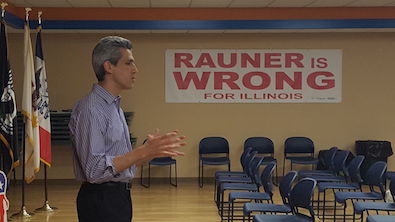
If elected governor, state Sen. Daniel Biss said Wednesday that he intends to help working class families by raising the minimum wage, getting rid of the flat income tax and fixing the pension system.
The Democratic gubernatorial candidate was introduced by Rock Island County Board member Kai Swanson during a town hall meeting at the Laborers’ Local Union 309, 2835 7th Ave., Wednesday night. […]
Sen. Biss told the crowd of more than 50 people that Gov. Bruce Rauner was to blame for much of the state’s dysfunction.
“Bruce Rauner is a dismal failure,” Sen. Biss said. “We’re supposed to be a blue state, but yet have one of the most aggressive tax codes in the nation. We can’t adequately fund our schools. We’ve had a broken system that hasn’t been working for decades.” […]
Sen. Biss said the state could begin fixing its pension crisis by requiring payments into the pension system.
I’m assuming he said “regressive” and not “aggressive,” but some might agree with “aggressive,” what with the new income tax hike, the new Cook County pop tax, etc.
* Anyway, maybe those alleged 50 attendees were on the other side of the room, or they left before this newspaper pic was taken?…
*** UPDATE *** The campaign tweeted this pic so you can see there were people at the event…
State Rep. Bill Mitchell, R-Forsyth, will be making an announcement Thursday regarding his future in the Illinois General Assembly.
Mitchell, an Assistant Republican Leader in the Illinois House, has represented his Central Illinois district since 1999.
Rep. Mitchell took huge heat when he voted to override the governor’s tax hike and budget vetoes last month. I’ll update this post when he makes an announcement.
Pretty sure we’ll be in double digits on retirees before too long.
Bill Mitchell, the Forsyth Republican who has represented Central Illinois for nearly 20 years, announced Thursday that he will not seek re-election in 2018.
“I can’t repay the people of Central Illinois what they’ve done for me, because they’ve allowed me to serve in a democratically elected body. For a citizen, there’s no greater honor,” said Mitchell, who represents the 101st House District and has served since 1999.
During a news conference in Clinton, Mitchell said he announced the move in August to give his potential successors plenty of time to start next month circulating petitions to get on the ballot.
“I have been privileged to serve alongside Bill Mitchell since he first came to the Illinois General Assembly in 1999. He has always been a passionate advocate for downstate Illinois, standing up for the priorities and values of his constituents. Bill’s advocacy was instrumental in helping keep the Clinton nuclear power plant open. As a member of my leadership team, Bill continues to provide me with a perspective that is much needed in the Capitol. More importantly, Bill Mitchell is my friend and someone whose opinion I’ve always respected. I wish him all the best as he looks forward to a well-deserved retirement at the completion of his term.”
Jeremy Yost, chief executive officer of Yost Enterprises and Yost Management Services, Inc., announced his candidacy for state representative of the 110th District on Thursday at the Lifespan Center, according to a press release.
A part of his platform includes not raising taxes, the release states. It stated that he spoke on “why raising taxes on the hard working people of Illinois is not the right path to get our state in the right direction.” […]
According to his website, Yost also is focused on business reforms and property tax reform. […]
The announcement of Yost’s candidacy came a day after incumbent Rep. Reggie Phillips told constituents at a budget forum that he would reveal more about his intentions on running for a third term in August.
When running for his second and current term, Phillips expressed that he’d hold to a two-term limit for himself, but that might have changed. Phillips acted more open to the idea of a third term this spring, noting that if he was needed he might stay.
PolitiFact Illinois and the Better Government Association, or BGA, have botched their fact-checking of Senate Bill 1, a bill that bails out Chicago Public Schools as part of a rewrite of Illinois’ education funding formula.
CPS gets to keep $200 million in block grant funding
Um, keeping what you currently have isn’t a bailout, it’s keeping what you have. You may not think CPS deserves it, but status quo funding isn’t a bailout.
SB 1 allows CPS to appear poorer than it actually is when applying for state aid, granting the district even more funding. No other district gets to do that.Currently, CPS contributes about $500 million annually to pay down its unfunded pension liability. The new funding formula allows CPS to deduct that $500 million from its local resources for education when it applies for state aid. That makes CPS look poorer and helps ensure the district gets more money from the state than it should.
I’ve seen numbers of up to $40 million in state costs for that, so it’s hardly a bailout. Also, the state picks up all legacy costs for suburban and Downstate teacher pensions, and that would of course continue. So, are those school districts being bailed out because they keep the largesse they currently have?
SB 1 allows Chicago to benefit from a set of rules that allow select school districts to undervalue their property wealth so they look poorer than they actually are.Districts whose revenues are affected by local property tax caps (Property Tax Extension Limitation Law, or PTELL) and special economic zones (tax increment financing, or TIF) are able to underreport their available property wealth when applying for state aid under the new SB 1 formula, just as they can under the current formula.
“Just as they can under the current formula,” according to the Institute. So, again, they keep what they have. How is that a bailout?
Chicago will also be a major beneficiary of SB 1’s “hold harmless” provision. This provision ensures that a district cannot receive less in state aid funds than it did the previous year. The provision protects a district’s state funding even if it experiences changes in demographics, such as a drop in student attendance that would have otherwise led to less state funding.
As we’ve already discussed today, 222 school districts lost students between FY15 and FY16. So, this is not an issue confined to one district.
In addition to all of the above, the state will begin paying CPS’ normal pension costs going forward. SB 1 requires state taxpayers to give the district at least $215 million for CPS’ “normal” pension and health care costs – the additional benefits Chicago teachers earn annually – every year going forward. This puts the district on par with other districts around the state.
And putting CPS on par with other districts in this one regard is a bailout? Gov. Rauner’s AV would achieve the same end by a different means. Is he bailing out Chicago too?
* Background is here. From the Illinois Republican Party…
“J.B. Pritzker’s new television ad is a deceptive attempt to cover up his family’s history of attacking the labor movement. Pritzker personally profits by exploiting union labor - just listen to what union protesters have to say about the billionaire family. Just like Mike Madigan, J.B. Pritzker is a politician with zero credibility who says one thing and does another.” – Illinois Republican Party Spokesman Steven Yaffe
In response to J.B. Pritzker’s new television ad lauding his insider endorsement of Madigan-backed labor groups, the Illinois Republican Party today released a digital video highlighting Pritzker’s true record on labor.
Pretty well done. The quote from the IFT’s leader is particularly impressive…
I want to thank the Pritzker family for uniting us all here today. It’s not enough for them to go after the workers in their hotels, they have to go after teachers.
*** UPDATE 1 *** From the IFT’s Dan Montgomery, who is featured in the above video…
“IFT members know that the Illinois Republican Party has become a wholly-owned subsidiary of Bruce Rauner, who has been leading the charge to rob workers and deny them a voice in the workplace. This six-year-old video clip is an attempt to distract attention from the Governor’s abysmal record and unpopular political demands that nearly drove Illinois off a fiscal cliff had members of his own party not stepped up to do the right thing. Rauner should focus less on campaigning and more on doing his job.”
*** UPDATE 2 *** From Chicago Federation of Labor President Jorge Ramirez…
“It’s clear that Bruce Rauner is leading the Illinois GOP and this attack on JB. For Rauner to pursue this line of attack after we’ve seen the way he treats public-sector workers across Illinois is hypocritical and laughable. He and his special-interest friends have tried to destroy our state’s labor movement and the public services that so many residents of Illinois rely on every day. Everything we care about is under assault by Bruce Rauner. There is no greater priority for us than defeating him in November and sending a leader like JB Pritzker to Springfield.”
*** UPDATE 3 *** Illinois AFL-CIO President Michael T. Carrigan…
“If it wasn’t so pathetic, it would be laughable that the Illinois Republicans levy an attack concerning union member and worker rights. Many Republican Party politicians in Illinois have followed blindly down Bruce Rauner’s path of destruction. His refusal to compromise on a budget hurt so many – all driven by his obsession to subvert wages, destroy unions and weaken protections for middle class Illinois families. If the Republican Party would like to take a stand with unions and working families of this state, they should start by standing up to their leader and chief benefactor.”
[ *** End Of Updates *** ]
* And the accompanying oppo dump…
During the recession, the Pritzker family faced mass protests from its workers over mistreatment and attempts to prevent unionization.
As Crain’s Chicago Business notes, “Hyatt fought efforts by Unite Here union to organize and secure raises for Hyatt workers.”
In one infamous incident, the Pritzkers turned heat lamps on picketing workers during a heat wave.
J.B. Pritzker personally profits from the family business, owning nearly 2% of Hyatt and acting as a key member of the majority voting block that controls the company. One of Pritzker’s cousins chairs the board of directors.
Pritzker even agreed to align his share’s vote with his cousins’, making him a critical part of their voting block and an enabler to all of their controversial decisions regarding employee mistreatment.
Pritzker even bragged about his role in Hyatt on his website – describing himself as a “principal owner”.
JB Pritzker Has Enabled And Supported Hyatt’s Management
JB Pritzker Currently Controls 1.9% Of The Total Voting Power For Hyatt Hotels Corporation. (Form SC 13D, Charles E. Dobrusin, SEC Accession No. 0001144204-17-001664, 1/10/2017)
When The Pritzkers Took Hyatt Public, The Family Controlled 80 Percent Of The Class B Shares, Which Have 10 Times The Voting Power Of Class A Shares. “Hyatt Hotels Corp. announced recently that the shares will be priced at $23 to $26. The offering is structured so the Pritzker family would own 80 percent of Hyatt’s Class B common stock, each share of which has 10 times the voting power of a Class A common share. The company’s initial public offering of 38 million Class A shares would raise between $874 million and $988 million.” (Julie Wernau, “Hyatt IPO Plan Draws Fire,” Chicago Tribune, 10/29/2009)
This “Super-Voting” Stock Allowed The Pritzkers To Maintain Control Over Hyatt Even If Their Ownership Of The Company’s Outstanding Shares Fell Below 50%. “Hyatt Hotels Corp. is likely to see “outsized profit growth” over the next decade, but the Pritzker family’s tightfisted control over the underachieving hotel chain should make investors wary of its initial public offering, a prominent real estate stock research firm said Wednesday. The proposed IPO could raise about $1 billion for Chicago-based Hyatt, the crown jewel of the billionaire family. Pritzker family trusts plan to sell 38 million shares for as much as $26 apiece, according to a filing last week with the Securities and Exchange Commission. But the family plans to retain its grip on the company through so-called “super-voting” stock, which would allow the Pritzkers to outvote other common shareholders even if the family’s stake falls to nearly 15%.” (Thomas Corfman, “Hyatt’s Corporate Structure Criticized In Report,” Crain’s Chicago Business, 10/29/2009)
JB Pritzker Agreed To Vote His Super Shares In Line With The Recommendations Of Hyatt’s Board Of Directors. “Until the later to occur of (i) January 1, 2015 and (ii) that date upon which more than 75% of the FD Stock is owned by Persons other than Pritzkers and Foreign Pritzkers, all Pritzkers (and their successors in interest, if applicable), but not the transferees by sale (other than Pritzkers or Foreign Pritzkers who purchase directly from other Pritzkers or Foreign Pritzkers) or by, or following, foreclosures as aforesaid, will vote all of their voting securities of Hyatt (and successor Companies) consistent with the recommendations of the board of directors of Hyatt with respect to all matters (assuming agreement as to any such matter by a majority of a minimum of three Independent directors or, in the case of transactions involving Hyatt and an Affiliate thereof, assuming agreement of all of such minimum of three Independent directors). All Pritzkers will cast and submit by proxy to Hyatt their votes in a manner consistent with this Section 3.1(c) at least five business days prior to the scheduled date of the Annual or Special Meeting of stockholders of Hyatt, as applicable.” (“Amended and Restated Global Hyatt Agreement,” Hyatt Hotels Corporation, 10/1/2009)
JB Pritzker’s Cousin, Thomas J. Pritzker, Is The Executive Chairman Of Hyatt’s Board Of Directors. (Board of Directors, Hyatt Hotels Corporation, Accessed 1/17/2017)
Jason Pritzker, Thomas Pritzker’s Son, Is Also On Hyatt’s Board Of Directors. (Board of Directors, Hyatt Hotels Corporation, Accessed 1/17/2017)
Penny Pritzker, JB Pritzker’s Sister, Served On Hyatt’s Board Of Directors Until She Was Appointed Commerce Secretary In 2013. “Chicago billionaire Penny Pritzker intends to resign from corporate boards, including that of Hyatt Hotels Corp., and reported that she received nearly $54 million in consulting fees last year from an offshore Bahamian trust, the Commerce Department secretary nominee said in documents released Wednesday.” (Melissa Harris and Katherine Skiba, “Pritzker Opens The Books On Finances,” Chicago Tribune, 5/16/2013)
Today, the JB Pritzker for Governor campaign released a new TV ad, “Enough.” The ad features working Illinoisans who are passionate about electing JB Pritzker and defeating Bruce Rauner next fall.
“Enough” highlights union members discussing Bruce Rauner’s attacks on working families and JB’s commitment to fighting for them in Springfield. The ad comes as labor support for JB continues to grow across the state, with recent endorsements coming from Illinois Painters District Councils, United Steelworkers, and the Illinois AFL-CIO. In total, JB has been endorsed by 17 individual unions so far.
“Working families across this state are ready for a real leader who fights for them in Springfield and that’s exactly what I’ll do as governor,” said JB Pritzker. “Together, we will defeat Bruce Rauner and end his attacks on the labor movement and working families. When I’m governor, the labor movement will once again have a seat at the table as we grow the economy, create jobs, and protect the rights that help workers thrive. I am grateful to have support from the labor movement across the state and I will always stand with working families as governor.”
JB will stand up for working families. And he’s focused on creating jobs.
JB’s the one we trust to beat Bruce Rauner.
To beat Bruce Rauner.
To get Illinois — to get Illinois back on track.
…Adding… Some of y’all in comments are a bit unclear on the concept. This is a TV ad for a Democratic primary. And unions are more popular overall than some of you realize. From a, October, 2016 Paul Simon Public Policy Institute poll…
Among the 1,000 Illinois registered voters surveyed, more than half (57 percent) say they have at least a somewhat favorable view of labor unions, more than 20 points ahead of the 36 percent who have an unfavorable view. […]
Self-described liberals (75 percent), Democrats (73 percent), and members of union households (75 percent) were most likely to have favorable views of unions. Only among conservatives and Republicans (37 percent each group) did fewer than half hold a favorable view.
Historically marginalized groups tend to desire that unions have more influence than they do today. Notably, 49 percent of African Americans want unions to have more influence compared to only 26 percent of whites.
Similarly, 40 percent of people with household incomes below $50,000 would like to see unions have more influence compared to only 24 percent of those with incomes over $100,000.