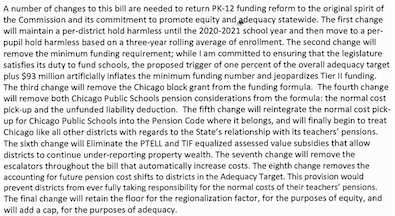
.@GovRauner's team has apparently taken down the site link to their ed funding spreadsheet as they wait for ISBE final score to publish. https://t.co/4t44GdCfmP
* The list is getting really long and it’s going to get longer…
State Representative Patti Bellock (R-Hinsdale) announced today that she will not seek re-election to the Illinois General Assembly in 2018. She will continue to focus on serving her constituents and continuing her work on improving access to quality health care for every Illinois family and strengthening the safety net for the state’s most vulnerable residents until the completion of her current term in January 2019.
“It has been an honor and a privilege to serve my community in the Illinois General Assembly,” Rep. Bellock said. “I would like to thank my family, friends and the residents of my district for their support over the years and to all those who suggested ideas for legislation that we were able to enact into public policy together. Making a positive difference in the lives of others has been the greatest reward in this job. Next year will be time to give someone else the opportunity to serve our community in the Illinois House of Representatives. Until then, I look forward to continuing to work with my constituents and my colleagues to make progress on many important issues until the end of my term in January 2019.”
Representative Bellock became the first woman in Illinois history to serve as Deputy Leader of a legislative caucus when she was appointed Deputy House Minority Leader in 2013, a position she continues to hold.
Her landmark legislation –the SMART Act reforming the Illinois Medicaid system and bills requiring mental health parity, MRSA infection control, grant transparency and reform, improving the Amber Alert system and strengthening child support in Illinois have been recognized on a national level. Currently Bellock serves as a budget negotiator for the House Republicans, Minority spokeswoman for the House Human Service and House Human Service Appropriations Committees, as well as being the co-chair of the Illinois Human Trafficking Task Force. She has been a strong advocate and voice for people with disabilities throughout Illinois.
Bellock has received state and national awards for her role in numerous community projects and serves on several local boards for groups addressing the issues of Taxes, Substance Abuse, Alzheimer’s, Autism, Human Services, Mental Health, Child Welfare, Domestic Violence and the Arts. The Illinois Manufacturer’s Association rated Bellock among the top five legislators because of her consistency on business issues. The Illinois Chamber of Commerce also recognized Representative Bellock’s support of state and local business by naming her a Champion of Free Enterprise for several years. In addition she has been named Legislator of the Year by over 20 associations. Her focus on women’s issues earned her the honor of “Illinois Women Making a Difference” from the State Treasurer’s office.
House Republican Leader Jim Durkin (R-Western Springs) released the following statement today on the retirement announcement of Deputy Leader Patti Bellock (R-Hinsdale):
“I have been privileged to serve alongside Patti Bellock since she first came to the Illinois General Assembly in 1999. Patti has brought the common-sense approach of a mother and grandmother to her public role, combining a keen understanding of how the law impacts people’s lives with a depth of knowledge and expertise in key policy areas unequaled among her peers. Patti’s unparalleled work ethic has been a tremendous asset to our caucus, particularly over the past four years in her role as our Deputy Leader, the first woman in Illinois history to serve in that post. Patti will long be remembered as an extraordinary leader and a tireless advocate for Illinois families; particularly on health care, disability and budget issues. Patti and I have been personal friends for many years, so I wish her and her family all the best as she looks forward to the next chapter in her life at the completion of her term.”
Leader Durkin appointed Representative Bellock to the position of Deputy House Republican Leader in October 2013. Leader Bellock also currently serves as a budget negotiator for the House Republican Caucus, Minority Spokeswoman for the House Human Services and Human Services Appropriations Committees, respectively, as well as being the co-chair of the Illinois Human Trafficking Task Force. She has been a member of the Illinois House of Representatives since 1999.
The Democrats insist that’s not true. After May 31st, upholding an amendatory veto on a bill that has an immediate effective date requires a three-fifths super-majority, just like any other piece of legislation with immediate effective dates. Click here and scroll to page 9.
So, where did he get that info? It’s a common mistake. Heck, I’ve made it, too. But the governor’s legal counsel certainly knew that answer. Maybe the governor was listening to someone else?
The General Assembly can agree with the recommendations made by the governor by a simple majority vote in each of the chambers. The bill then becomes law, as amended by the governor. However, should the governor issue the amendatory veto after May 31 and the changes have an immediate effective date, the recommendations require a three-fifths majority vote in both chambers in order to pass. If the effective date is the next fiscal year, the changes only require a simple majority to pass.
* So, now what happens? Well, the Senate has to return to session and then enter the veto into its journal. The Senate will likely hold a perfunctory session this afternoon at 2 o’clock to get that done, I’m told. Once the bill is “journalized,” the chamber has 15 calendar days to act or the bill dies.
…Adding… The governor’s office is now admitting that accepting the AV requires a three-fifths vote.
*** UPDATE 1 *** DGA…
“Today Bruce Rauner soared to new heights of irresponsibility,” said DGA Illinois Communications Director Sam Salustro. “Rauner vetoed a school funding bill for political reasons without even fully understanding the repercussions of his actions. Illinois families were just dragged through a two-year budget crisis exacerbated by Rauner’s veto of the state’s first budget in two years - a crisis was only resolved when Republicans and Democrats joined together to override his veto. Now Bruce Rauner’s failed leadership is putting Illinois schools at risk.”
*** UPDATE 2 *** Pritzker campaign…
“Bruce Rauner doesn’t understand his own school funding plan, can’t say where his numbers come from, and now doesn’t even know how many votes he needs to pass it,” said Pritzker campaign spokeswoman Jordan Abudayyeh. “This is what happens when a failed governor clings to crisis and surrounds himself with a team of radicals. Illinois schoolchildren should not have to pay the price for this embarrassment in Springfield.”
I propose a public health insurance option that would allow every Illinois resident the chance to buy low-cost health insurance. I will work with legislators and the health care community to design this public option to provide another choice in the health insurance marketplace, to lower the cost of premiums and mitigate market uncertainty – at no cost to taxpayers.
If the Affordable Care Act (ACA) remains the law of the land, my plan would provide an important avenue to expand access to affordable healthcare in Illinois. But if Republicans in Washington are successful in repealing ACA, IllinoisCares would become even more necessary and could give Illinois a path to expanded innovative healthcare coverage at the state level.
IllinoisCares would allow Illinois residents to buy into the state’s Medicaid system:
* Because Medicaid is individually administered by states, the program offers a unique opportunity for states to function as laboratories and lead in the creation of progressive healthcare policy.
* With the creation of IllinoisCares, Illinois would be the first state in the nation to expand Medicaid in this manner.
* Medicaid is a lower-cost option than private insurance, giving Illinoisans another choice when faced with rising premiums. It can be offered in every county, as opposed to the dwindling number of plans on the Affordable Care Act exchanges in many counties.
* Illinois currently spends about $3,350 per year per adult and $2,108 per child for Medicaid coverage.[1]While an actuarial analysis will have to be completed to set premiums and cost-sharing rates for the program, it is clear that IllinoisCares offers a lower cost option for families compared to those being offered in the private insurance market.
* As a Medicaid buy-in option, IllinoisCares would require Illinoisans who do not receive federal healthcare subsidies to pay premiums to cover the full cost of Medicaid coverage. As a result, there should be no additional cost to taxpayers for this program.
* Participants who qualify for ACA tax credits could use those to help pay for their premiums.
* IllinoisCares would be designed to encourage healthy young adults as well as older Americans who are not yet eligible for Medicare to participate and would help ensure a robust patient mix.
* IllinoisCares could allow for affordable deductibles and copays as well as open enrollment and special enrollment periods, which are all standard features that keep plans affordable and stable in the private insurance market.
In the event of full repeal of the ACA, I will work to make sure IllinoisCares gives all Illinoisans affordable health insurance, and will enact patient protections so that Illinoisans with pre-existing conditions will not be discriminated against in healthcare coverage.
*** UPDATE 1 *** Pawar campaign…
Ameya Pawar, 47th Ward alderman and Democratic candidate for Illinois governor, released the following statement after J.B. Pritzker suggested a policy proposal that would limit Illinoisans to a public option healthcare model:
“A public healthcare option for Illinois doesn’t go far enough to provide quality healthcare for everyone while lessening the burdens put on working families and small businesses. Illinois needs a single-payer healthcare system, and as Governor, I will take the steps to get us there.
“For far too long, government has perpetuated a culture of ‘deserving’ and ‘undeserving.’ Healthcare is a human right and single payer healthcare will deliver quality affordable care to every Illinoisan. Single-payer is about making our society a better place. It’s about putting people over profits. Single-payer is about doing the right thing.
“We need to elect more leaders who will advocate for a system that guarantees health care for all people, helps working families get the care they need while saving small businesses money that otherwise would be paid to big insurance companies.”
A single-payer system would allow healthcare providers to operate with far greater efficiency, meaning that more money is being spent on actual care than our current system allows. Medicare has a 2 percent overhead rate - that’s a remarkably efficient program, allowing significant savings that private insurance companies would be making in profit instead of passing along to the people. The total cost savings for Illinois under a single-payer system would amount to $17 billion annually, nearly two-thirds of our health care spending as a state, by eliminating private insurance providers and their administrative costs.
This issue has driven activism from a wide array of organizations, including social justice advocates, unions, physicians, health associations and religious institutions. But despite these efforts, the bills that lawmakers introduced in Springfield never made it out of committee.
Pawar’s campaign website has been mostly silent on this issue, however. Click here.
*** UPDATE 2 *** Sen. Daniel Biss…
“Health care is a human right, and I’m disappointed that J.B. considers it an option. We need a single-payer health care system in Illinois that covers everyone. I call on J.B. to put aside half-measures like optional care and embrace health care for everyone.”
Except, Pritzker does support a single-payer health care system. From part of Pritzker’s press release that I didn’t post…
I hope there continues to be conversation about how we can expand healthcare coverage across our country, including the consideration of a federal single payer system, which I support. But with Donald Trump in the White House and Republicans in control of the House and Senate, it’s now up to the states to innovate. That’s why I’m proposing a public option for Illinois, which would be the first in the nation leading in this way. [Emphasis added.]
…Adding… From the Biss campaign…
In the language you cite, JB states he supports a “federal” single-payer system. The criticism Daniel made of his plan, is that he doesn’t support a state level single payer system. Indeed, the fact that Trump and Republicans control Congress is all the more reason a single-payer system at the state level, as we’ve seen with efforts in CA, is needed. The larger point is, while it’s nice he supports a federal level system, he’s not running to be governor of Congress. He’s running to be governor of Illinois, and his position on single-payer for the state is what Democratic primary voters want to know.
That’s a critical distinction among Dem primary voters and among the candidates in this race. I’d hate for people to get the impression that he supports single-payer, writ large, as your piece implies. Because he doesn’t.
* I told subscribers this morning about the governor’s hope to pass a $100 million private school “scholarship” tax credit bill, which is backed by the Chicago Archdiocese, among others.
Gov. Rauner said today he’s “excited and hopeful that as part of a compromise… that that would include tuition tax credits.” He didn’t answer a question about whether he would require those credits as part of a final deal. (The proposal that’s currently on the table does not allow federal tax deductions on top of the state tax credits, I’m told.) Background on that potentially controversial issue is here.
…Adding… From the Catholic Conference of Illinois…
The Scholarship Tax Credit is an initiative that seeks to create scholarships for low- and middle-income students so they can attend Catholic and other private schools. The grants would be created from corporate and individual donations to scholarship-granting organizations. To encourage these donations, corporations and individuals would receive a dollar-for-dollar state income tax credit for their contributions.
So, if you donate $20,000, your state income tax would be lowered by $20,000. That seems a bit much.
* One of the things I’ve been telling subscribers is that the Democrats really wanted to avoid reopening the budget talks. Gov. Rauner confirmed to reporters today that his amendatory veto of SB1 would require “a new appropriation line” for Chicago pensions. That means a new approp bill, which would give him an avenue to reopen the budget if the AV was accepted, and it almost undoubtedly won’t be.
Several sources tell NBC 5 that Gov. Bruce Rauner had planned to sign the new Automatic Voter Registration bill last week during the Rainbow PUSH Coalition Convention, but at the last minute the event was cancelled.
The bill allows voters to automatically be registered to vote through an electronic process when applying for a driver’s license or state ID, unless they opt out.
Repeated questions to the governor’s communications team have not been answered, but those who support the bill expect him to sign it.
* Asked to address the possibility that lawmakers may not address his amendatory veto changes to SB1, Gov. Rauner told reporters this morning that he’s AV’d a number of pieces of legislation and the GA simply redrafted the bills to reflect his changes and re-passed them.
Gov. Rauner then pointed specifically to the automatic voter registration bill as an example of where this process has worked. Rauner, of course, hasn’t yet signed AVR, so that’s the best indication yet that he’ll go ahead and approve that piece of legislation.
*** UPDATE 2 *** Here’s the relevant excerpt from the AV…
*** UPDATE 3 *** Gov. Rauner told reporters today that the Senate and House could accept his amendatory veto with a “simple majority.” Not true, says the Senate. Since we’re past the May 31st deadline for simple majorities, an acceptance motion would require three-fifths in each chamber. The governor seemed surprised about this and dodged a follow-up question from a reporter who asked whether his staff should have known such a thing. Oops.
…Adding… The governor’s office is now admitting that accepting the AV requires a three-fifths vote.
*** UPDATE 4 *** Most react will be on the live coverage post. But this is from the Pritzker campaign…
In response to Bruce Rauner issuing an amendatory veto on Senate Bill 1, a bill that funds schools and ensures they open on time, JB Pritzker released the following statement:
“Apparently 736 days worth of damage done by Bruce Rauner wasn’t enough. Now he is holding school funding for Illinois children and families hostage and pitting communities against each other again by vetoing Senate Bill 1,” said JB Pritzker. “Bruce Rauner is so blinded by his crusade against Chicago’s children and families that he seems incapable of understanding a very simple fact: every child and every school district benefits under SB 1. Even though he supports 90% of the bill, Rauner and his new team of radicals once again chose to use our kids, parents, and teachers as leverage to try and score a political win.”
*** UPDATE 5 *** Kennedy campaign…
This is a stunning low point in the history of our state. SB1 is a product of the governor’s own School Funding Reform Commission and his characterization of the bill as a bailout for Chicago has been debunked by the BGA and Politifact. Yet, Bruce Rauner chose political games over our children.
We need fundamental change in Springfield, including ending our reliance on a property tax system that inadequately funds our public schools. Today’s veto proves that Springfield is broken and Rauner will not lead Illinois toward real change.
*** UPDATE 6 *** Press release…
House Speaker Michael J. Madigan issued the following statement Tuesday:
“Governor Rauner’s decision to pit one child against another is disappointing, especially as Republicans and Democrats in the House and Senate continue to meet and negotiate. The governor has yet again chosen crisis over compromise, but Democrats will continue to work with legislative Republicans in order to enact education funding that is fair to every student, every school and every community.”
Today, Gov. Bruce Rauner issued an amendatory veto to Senate Bill 1, the school funding bill. The matter now heads to the Illinois General Assembly, where the governor has respectfully requested that lawmakers uphold his changes. If these changes are upheld, Illinois will achieve historic education funding reform.
“It doesn’t matter where you come from or who your family is. With a great education, you can go anywhere in life and be whomever you want to be. You can grow up, get a good job and provide for your family. That’s why the changes I have made to the education funding bill are so important,” Gov. Rauner said. “With my changes, our state ensures that enough resources flow to children in the poorest and most disadvantaged school districts across the entire state. And my changes ensure that the education funding system in our state is fair and equitable to all students in Illinois.”
More than a year ago, Gov. Rauner established the Illinois School Funding Reform Commission. This group came together on a bipartisan basis to study the way Illinois funds its public schools, and to chart a path to a fairer and more equitable system.
“These changes included in my amendatory veto reflect years of hard work by our education reform commission and our ability to overcome our political differences for the good of our young people’s futures,” Gov. Rauner said. “I urge the General Assembly to act quickly to accept these changes and let our students start school on time.”
The governor’s amendatory veto makes the following changes to ensure an adequate and equitable school funding formula:
• Maintains a per-district hold harmless until the 2020-2021 school year, and then moves to a per-pupil hold harmless based on a three-year rolling average of enrollment.
• Removes the minimum funding requirement. While the governor is committed to ensuring that the legislature satisfies its duty to fund schools, the proposed trigger of one percent of the overall adequacy target plus $93 million artificially inflates the minimum funding number and jeopardizes Tier II funding.
• Removes the Chicago block grant from the funding formula.
• Removes both Chicago Public Schools pension considerations from the formula: the normal cost pick-up and the unfunded liability deduction.
• Reintegrates the normal cost pick-up for Chicago Public Schools into the Pension Code where it belongs, and finally begins to treat Chicago like all other districts with regards to the State’s relationship with its teachers’ pensions.
• Eliminates the PTELL and TIF equalized assessed value subsidies that allow districts to continue under-reporting property wealth.
• Removes the escalators throughout the bill that automatically increase costs.
• Retains the floor for the regionalization factor, for the purposes of equity, and adds a cap, for the purposes of adequacy.
The amendatory veto also removes the accounting for future pension cost shifts to districts in the Adequacy Target. This prevents districts from ever fully taking responsibility for the normal costs of their teachers’ pensions.
* Politifact looks at the governor’s contention that SB 1 is a Chicago “bailout”. Go read the whole thing, but here’s the conclusion…
Attempting to parse a political buzzword like “bailout” might be impossible if not for the clear direction provided by Rauner’s own Illinois Education Funding Reform Commission. It called for an “evidence-based” school funding formula but also recommended a “hold harmless” provision that would ensure no district received less this year than last.
By that dictate alone, CPS should not be in line this year for a cut in the size of its block grant. What’s more, SB1 does do away with the CPS block grant starting with the 2018-19 school year, poking a major hole in Rauner’s “bailout” claim.
The bill’s Chicago pension component can’t be called a “bailout” or even a perk because it only gives CPS what every other school district already has. And Rauner clearly had sought previously to bargain CPS pension help for other, statewide pension reforms. He got a major one in the budget lawmakers enacted July 6.
Numbers are sure to fly fast and furious as Rauner and lawmakers duke this out in Springfield in the days ahead, but we find Rauner’s generalization that SB 1 is a “bailout” for Chicago schools to be False.
Although we question the pension portion for Chicago, it’s not enough of a concern to diminish our support for the bill. Also, we’re a bit tired of Chicago, a world-class city that still attracts corporate headquarters, being cast as an evil entity. We want Chicago schoolchildren to succeed as much as we want students in other areas of the state to succeed and we think a new funding formula can help make that happen.
SB1 is the best shot Illinois has at reworking a financing system that has created huge disparities among school districts and does not help educate children. It’s a bill that has been revised several times since Sen. Andy Manar first proposed it a few years ago.
A study by The Education Trust in 2015 showed that Illinois school districts with the greatest number of students living in poverty received nearly 20 percent less state and local money than affluent districts. Your ZIP code should not determine the quality of education your child receives.
SB1 would give state money to the students and schools who need it most. That’s how schools should be funded.
The governor went on to point out that Springfield “loses half a million dollars” under the Democratic plan compared to his. Decatur, he said, “loses $1.6 million.” He called SB1 a “diversion of money” from the rest of the state to Chicago and even said his AV was “an improvement” for CPS school children.
Later, he referred back to the Politifact issue and called it “false spin,” and repeated himself. “That’s false,” he said. “We need the truth to be told to the people of Illinois, not political spin.”
As Senate Bill 1 heads to Governor Rauner’s desk, Do Your Job, Inc. is asking him to get a grip, do his job and sign the bill.
After decades of talks around reforming the state’s education formula, Senate Bill 1 is the only bill to have passed the legislature. The bill is endorsed by editorial boards, community partners, school districts and school superintendents across the state. By vetoing the bill, Governor Rauner will put the funding of our schools in jeopardy.
In the past, Governor Rauner has recognized the need for a more equitable education funding formula.
According the Illinois Policy Institute, Governor Rauner said the following in his 2017 State of the State Address:
For years, Illinois has provided the lowest percentage of education financial support from any state in the country. And we have the largest gap between funding for high income schools and low income schools in the country, both across the state and within the city of Chicago.
This June, the SJ-R ran a piece entitled “Purvis: Rauner likes 90% of school funding reform bill but will veto” where the lede was:
Gov. Bruce Rauner’s education adviser, Beth Purvis, said the governor supports 90 percent of the education funding reform bill that was passed by the legislature this spring, but would still veto it because it is too generous to Chicago Public Schools.
On July 17th, Governor Rauner reiterated the value of SB 1 on his twitter page:
Lawmakers should send education funding bill SB1 to my desk immediately. This helps public schools in IL get equitable and adequate funding.
But Governor Rauner’s actions have gotten even more bizarre during the Governor’s not-so-special session.
He hasn’t disclosed legislative language for the Illinois General Assembly to act on.
He’s refused to meet with Senate President Cullerton or Senate Bill 1’s sponsors in the House and Senate. In fact, he’s called the Senate President’s desire to negotiate an “outrageous” demand. (After all, Governor Rauner is on the record saying: Nobody tells me what my policies are, nobody.)
And a day later, in a move which we can only assume can be attributed to Rauner’s “unhealthy obsession with media and messaging” as a Sun-Times source called it, Rauner created a working group which has yet to produce a legislative alternative which can pass the General Assembly.
The ad, entitled “Lost It” will run on digital platforms and can be viewed here and contains the following narration:
Serious people are questioning whether Governor Rauner has lost it.
After a three-year budget crisis, Rauner alone wanted to take the state over the cliff.
Republicans and Democrats worked together to solve the problem without him.
Then, Rauner fired his professional staff and replaced them with some questionable characters.
And now he’s stoking a school crisis, threatening to veto a new funding formula educators support, and his own education secretary said has 90 percent of what Rauner likes.
Governor Rauner, get a grip. Do your job.
Do Your Job, Inc. is led by IL Sen. Mike E. Hastings of South Suburban Cook County, IL Rep. Lou Lang of Skokie and Illinois AFL-CIO President Michael T. Carrigan.
Speaker Michael J. Madigan issued the following statement Monday:
“House Democrats will continue to reach across the aisle and work with legislative Republicans in order to enact bipartisan education funding reform. Every child in Illinois deserves a great education, but too many are being held back by one of the most unfair funding formulas in the country, and the reform we need is being held back by a governor who is determined to pit one child against another for political gain.
“Democrats know that many legislative Republicans share our commitment to fair funding for all schools. We will work together on behalf of our children, our schools and our communities, even if the governor continues to choose chaos over compromise.”
*** UPDATE *** Press release…
A comprehensive overhaul of Illinois’ worst-in-the-nation school funding system was delivered to Gov. Bruce Rauner on Monday. The legislation (Senate Bill 1) is the product of years of work and months of intense negotiations. No school in Illinois loses funding under this plan.
Illinois Senate President John J. Cullerton issued the following statement.
“By merely signing his name the governor can deliver on his promise to overhaul the worst school funding system in the nation. This reform has been 20 years in the making. I encourage Governor Rauner to make it law. Students, parents, teachers and taxpayers have waited long enough. This is a chance to make a huge, meaningful change for Illinois. This is an opportunity to make Illinois more competitive and more compassionate. I hope the governor will seize the opportunity. Do the right thing, Mr. Governor, sign the bill.”
* The Senate has released the parliamentary hold on SB1. As I write this, however, it has not yet been officially sent to the governor. [ADDING: The bill has now been transmitted.]
[Sen. Andy Manar] asked whether the Republican negotiators would be willing to attend a meeting this afternoon where the Democrats would make an offer. He said that that offer would be a generous offer. And that it would be an offer that reflects the Democrats’ attempts to accommodate Republican priorities that help us bring an end to this impasse… When we attended that meeting, no offer was made. In fact, we spent nearly an hour doing nothing more than listening to the Democrats shuffle their papers and seemingly try to buy time so that they could continue this crisis that they have unnecessarily created. […]
The Democrats are notorious for claiming that there’s progress, when in fact in the actually negotiations they express no interest in actually moving the ball forward and coming to an agreement.
Sen. Manar said he wouldn’t even respond to that.
*** UPDATE 2 *** So, I bated Sen. Manar a little bit and he finally gave his side of the story, saying he wanted to be careful not to completely derail the talks.
Manar’s version is vastly different than Barickman’s. According to Manar, the Democrats have been moving toward one of the Republicans’ chief demands and the Democrats left the meeting promising language within a few hours designed to address the demands. Manar says he thought there’d be another meeting later today.
Instead, Barickman held a press conference to say the Democrats failed to make good on a promise to have language at the first afternoon meeting. Manar sounded stunned at this turn of events.
* From Rep. Pritchard’s press release, which he intended to send out tomorrow, but was instead leaked…
As the 2018 election cycle approaches, State Representative Bob Pritchard announces he will not seek re-election. “I have appreciated the opportunity to represent the residents of the 70th district over the past 14 years but feel the time has come for another to voice the interests of this district,” he said.
“Like our founding fathers, I do not believe serving in the legislature should be a career but rather long enough to learn the process, make contributions and then return to other activities,” Pritchard stated. He will serve out his term which ends in January of 2019 and continue to be activity engaged in the issues and events of the district. He looks forward to spending more time in the family farming operations, with his grandchildren and in various organizations.
Pritchard said some of the challenges facing our state are a result of representatives serving too long, being unwilling to compromise on difficult issues, and losing the perspective of the impact government has upon private citizens and businesses. “I think we have a better system of government when more citizens take time from their careers to run for public office, and experience the challenges of making public policy for their communities or for a state as diverse as Illinois,” the legislator added.
“I have enjoyed the opportunity to make new friends, listen to the ideas and concerns of residents, and participate in the life of each community in the district,” Pritchard added. “I have tried to keep people informed of the complex issues facing the legislature and our state, and encourage their participation in the process of creating public policies. My efforts would not have been possible without the able assistance of district director Jesse Sheehan, assistant Shelley Ziola, staff in Springfield, and numerous supporters. I deeply appreciate their efforts.”
Pritchard has served on numerous House committees and sponsored legislation on many important issues during his time in the legislature involving agriculture, education, veterans affairs, human services, healthcare, the environment and government operations. He is currently Republican spokesperson on several committees including education and state government administration, plus Co-Chair of the General Assembly Commission on Government Forecasting and Accountability.
Pritchard voted for the budget and tax hike but missed the override vote.
…Adding… This doesn’t include a few legislators who are running for other offices, like Sen. Daniel Biss, Rep. Scott Drury (both running for governor, at least for now), Rep. Laura Fine (running for Biss’ Senate seat) and Rep. Cynthia Soto (MWRD)…
By our count, 5 state reps and 2 state senators have resigned/announced they won’t run for re-election since the start of the 100th GA pic.twitter.com/ubPWfzZqFa
— IL Working Together (@IllinoisWorking) July 31, 2017
More to come.
…Adding More… Sen. McCarter is also not running again due to a self-imposed term limit.
In politics and government, just like business, it takes more than good ideas and adequate financing to succeed. A CEO needs the right team around him or her, and all parties have to trust each other, to believe that those with whom they work will have their back out there in the jungle. There’s a word for that: loyalty. And the recent tribulations of President Donald Trump and Gov. Bruce Rauner underline the perils of forgoing that trait.
In Trump’s case, the clearest example is the trial and informal impeachment of Attorney General Jeff Sessions, though the just-concluded cage match between top staffers Reince Priebus and Anthony Scaramucci was rooted in the same phenomenon. […]
Then there’s Rauner, now two weeks into his big purge and retreat to the comforting cocoon of ideological soul mates. If the governor wanted to change his staff, if he thought some of them weren’t performing, he had every right to bring in new lieutenants. But frog-marching loyal staff out the door without trying to find them other posts is just mean. No one who works for this governor now can know how long they’ll last.
That’s not just inside baseball, voters. It’s an indication of what this governor does when he’s cornered: He doesn’t grow and look for compromise; he calls in people who will tell him he’s right.
Both have used divisiveness. Rauner has repeatedly attempted to divide the state between Chicagoans and the “hard-working” people everywhere else. Trump points to illegal immigrants and Muslims as the root of our nation’s alleged decline.
Rauner’s policy vagueness during his campaign was legendary, and he still doesn’t like to get too deep into the weeds of substantive issues. Trump’s only specific proposals involve a “great wall” on the Mexican border and a ban on immigration from terrorist-prone countries. Otherwise, he’s not so keen on the details.
They’ve both promised miracles. Rauner claims his economic reforms will result in a dramatic turnaround for Illinois without offering much evidence. In his convention speech, Trump said, “Beginning on Jan. 20, 2017, safety will be restored.”
They both have their bogeymen. For Rauner, it’s always about Madigan, but he’s also referred to Illinois Supreme Court justices and Illinois Senate President John Cullerton as “corrupt.” For Trump, it’s Hillary Clinton—and anyone else who crosses him. […]
But like former Republican New York Mayor Michael Bloomberg said at the Democratic convention, in Illinois we need a “problem solver, not a bomb thrower,” who can bring people together to “get things done.”
On that, and on that alone, the two men are far too similar for my taste.
Illinois Rep. Luis Gutierrez is joining Illinois gubernatorial candidate J.B. Pritzker at Trump Tower in downtown Chicago to give a speech that, no surprise, links the Republican president to the Republican incumbent Bruce Rauner. Get there at 10:30 a.m. if you want to hear it live. But if not, here are some highlights:
On Trump: “Donald Trump’s legislative agenda threatens to wreak havoc on the lives of Illinois families. Trump is actively working to dismantle health care in the United States, stripping millions of families of their coverage and targeting those who need it most. He is waging war on science in his refusal to acknowledge climate change and his rejection of the policies that will preserve our future. Trump’s attacks on public education, immigrant families, and people of color are tearing communities apart, and undermining the principles that make this country strong. Every day, Trump is exploiting divisions and peddling hate.”
On Rauner: “Rauner is silent in the face of Trump’s attacks and refuses to put in place policies that will protect Illinois families. Worse, Rauner is actively working to force a special interest agenda on Illinois that will amplify Donald Trump’s destruction. After a 736-day budget crisis, with a state economy in turmoil, and with public schools at risk, Illinois simply can’t afford Trump’s agenda and Rauner’s failed leadership.”
A bit of a campaign reset, perhaps? We’ll see what his new TV ads say.
*** UPDATE *** Pritzker has released a “five-point plan to resist Trump”…
PROTECTING HEALTH CARE: JB will work to expand access to care, increase patient choice, and keep costs down by providing a public option health insurance plan. JB will also sign HB 40 into law and defend women’s health and the right to choose.
FUNDING EDUCATION: JB will invest in a public education system — from early childhood through higher education — that improves the well-being of every child and prepares them for the jobs of tomorrow. He will also oppose school vouchers and charter school expansion.
RESTORING OUR ENVIRONMENT: JB will ensure Illinois upholds the Paris Climate Agreement, expand clean energy production, and invest in green jobs. JB will also fully fund Illinois conservation programs and fight to maintain full funding for the Great Lakes Restoration Initiative.
FIGHTING FOR IMMIGRATION REFORM: JB will enhance funding for immigrant and refugee services, increase health care options for undocumented adults, improve the U-Visa certification process for victims of violent crimes, provide access to financial aid for undocumented students, and oppose a federal registry program based on race, religion, and country of origin. He will also sign the Illinois Trust Act.
STANDING UP TO INTOLERANCE: JB will expand access to capital for small business job growth in underserved communities, fully fund after-school and anti-violence programs, and declare that transgender individuals are welcome to serve their state as state troopers. He will also stand against LGBT bullying and intolerance in our schools.
* The QC Times is one of the most reliable editorial voices against House Speaker Michael Madigan, but it is turning on Gov. Rauner in a big way over SB1…
Rauner is scrambling and his agenda is a shambles. And his acts of desperation are making him more difficult to support and defend by the day.
This month’s veto override that ended a two-year budget impasse was a significant loss for Illinois’ Republican governor. The standoff accomplished nothing of value. That bipartisan rebuke of Rauner’s veto, in many ways, left Illinois back where it started prior to Rauner taking office. […]
There’s no doubt that much of Rauner’s consternation is about playing to his base. It’s easy to bang around downstate Illinois blasting Chicago fat cats. Parochialism is good politics in a state like Illinois. But it’s also an explosive chemical compound.
Divisive populist regionalism will never fix Illinois’ failing pension system. It’s a pointless attack on the symptom that does nothing to cure the disease.
More than two years of brinkmanship accomplished precisely zilch for Illinois. But, politically desperate, it appears Rauner is going all in as his 2018 re-election bid nears. After the budget defeat, he sacked his most senior staff. He replaced it with right-wing partisans from the Illinois Policy Institute. And now, he’s banging around the state scapegoating his state’s one major market.
Rauner’s rightward leap risks not only his political fortunes but the well-being of his state.
Indeed, the language leaping out of sleepy Sangamon County has been uncommonly colorful. A Republican governor who promised to veto part of SB1 should Democrats ever get around to sending it to him finds the latter’s behavior “unconscionable,” their stalling tactics “evil,” the minority’s efforts to take back control nothing short of a coming “revolution,” according to various reports. The Democrat Senate president, meanwhile, questions the governor’s “mental state” while inviting him to negotiate something more to his/their liking.
This a clearly furious governor finds “outrageous!” while continuing to demand that Democrats put SB1 “on my desk!” so that he can have his way with it. Curiously, this governor from Chicago has declared war on his Chicago — granted, no Republican gets much love from Chicago — characterizing this as a “bailout” for the city’s school pension system. He calls a special session, to which many legislators hardly pay attention, judging by the no-shows.
Gov. Bruce Rauner continues to berate House Speaker Michael Madigan as public enemy number one, even though it’s the Senate’s John Cullerton who’s sitting on the bill. Apparently he’s decided it’s more politically advantageous to have the monster that is state government wear Madigan’s face. Meantime, the governor doesn’t do his own cause many favors when he can’t quite say how he arrived at the numbers he insists make downstate schools big winners, or explain how the savings necessary to do that seem to be coming out of Chicago’s block grant rather than pensions, or be more specific about his promised veto. […]
But on which party will parents take out their wrath? That’s the gamble, isn’t it? We’re in a pox-on-all-their-houses sort of mood. They argue ad nauseam, but nothing gets done. Illinois on school funding reform, meet Congress on health care reform.
For Illinois households with school-age children, August is not simply a month on the calendar. It is closure and reset. Sleepovers taper off. Bedtimes get earlier. School shoes displace flip-flops. Wet bathing suits yield to pleated pants.
The sweet back-to-school ritual is unfolding across Illinois, even as lawmakers in Springfield jockey over legislation — a fight that could jam a shiv into the August calendar. Without agreement on an education funding bill, schools might not be able to open on time. Yes, parents, while you’ve been preoccupied with lemonade stands and summer camps, Democrats in Springfield have been jeopardizing the timely opening of schools.
Democrats and a handful of Republicans supported a budget in early July that tied money for schools to a controversial rewrite of the school funding formula, which they had approved May 31. On top of that gamble, the Senate refused to send the rewrite package to Gov. Bruce Rauner’s desk. Two months have passed with no action, only dueling press conferences and noisy insults.
Just when you think Senate President John Cullerton and House Speaker Michael Madigan couldn’t be more scheming, they prove you wrong. In this case, they’re jeopardizing the start of the school year. Brinkmanship at its worst. A game of chicken with school families trapped midfield.
*** UPDATE *** The ILGOP finds other supporting editorials…
Editorial boards this weekend slammed Mike Madigan, John Cullerton, and Democrats in Springfield for holding school funding hostage to their Chicago bailout demands.
The Chicago Tribune: Dear Illinois parents: You’re being played by Democrats in Springfield
Yes, parents, while you’ve been preoccupied with lemonade stands and summer camps, Democrats in Springfield have been jeopardizing the timely opening of schools.
… Just when you think Senate President John Cullerton and House Speaker Michael Madigan couldn’t be more scheming, they prove you wrong. In this case, they’re jeopardizing the start of the school year. Brinkmanship at its worst. A game of chicken with school families trapped midfield.
To emphasize, parents: August is here and your legislature has not agreed on how to send your state tax money to your schools. You’re being played. You’re supposed to panic and blame a governor who’s, yes, still waiting for that May 31 funding bill to arrive.
The Belleville News-Democrat: Illinois lawmakers set time bomb to get Rauner, hit students instead
Lawmakers couldn’t pass a budget for more than two years and were willing to owe other people $15 billion, but they sure got their paychecks on time. The rest of us don’t get paid if we don’t work.
So could it be that they realize the optics are bad on that issue? They fear facing voters in 2018 looking like a bunch of self-serving, ineffective louts? Do they think limiting the per diems would give them the ability to say, “See, we aren’t all about us”?
They got a chance to earn another $111 a day plus mileage this past week, when Rauner called lawmakers back into session to advance Senate Bill 1, the education funding bill. They failed to do so because Rauner promised an amendatory veto to remove a Chicago Public School pension bail-out. Big surprise, because they are likely doing all this to force an August showdown to get that Chicago money and hand Rauner another fanny-whoooping — at the cost of our students.
Herald & Review: Our view: We’re back where we started with Springfield
What’s the better solution? Remove the Chicago pension funding proviso from the legislation.
That would meet Rauner’s satisfaction while preserving the core mission to fix the backwards funding formula.
It’s easy for us to say, but Chicago pensions shouldn’t break this legislation. We must think of students statewide.
Remove the pension rule.
Sign the bill.
* Today is the day that the Senate plans to send SB1 to Gov. Rauner’s desk following a weekend of legislative negotiations. Follow all the twists and turns with ScribbleLive…
[This post has been bumped up from Friday to Monday for easier display and comments are now open.]
* Mostly true…
Democrats withdrawing from 2017 state fair. Madigan spokesman says "Focus will be on Chairmen's brunch" so "families can enjoy the fair." https://t.co/25oMhcRiva
* Democrat Day itself has not been canceled. Party members will still get their free tickets to the fair just like Republicans will on Governor’s Day. But the traditional noontime rally has been canceled.
Steve Brown told me part of the problem with Democrat Day over the years was that the same people make pretty much the same speeches at both the county party chairman’s brunch and then at the state fairgrounds rally a couple of hours or so later. It gets boring and repetitive and kinda pointless. It can be a real drag sitting in the hot sun listening to the same speech you just heard at brunch.
So, it looks like this could be the end of a very long era. I don’t know how far back the tradition goes, but it’s a very long time. Back in the day, the first Mayor Daley would send trainloads of people to the fair. It used to be a huge deal, but the rally crowds for both parties have seemed to taper off in recent years and I don’t think that Speaker Madigan likes doing it, either. Maybe it’ll restart if the Democrats elect a governor again, whenever that might be, because then Madigan won’t have to be in charge.
The Illinois State Fair’s “Director’s Lawn” is a tree-lined venue far from the corn dogs, grandstand concerts and beer tents.
The lawn spreads out in front of a rather dingy house used by the state’s director of agriculture, off a road marred by potholes and best accessed via a special gate that often is closed during the fair because there’s so little public parking. A million or so people attend the fair each year.
The grass on the lawn is trampled flat. But no events ever are as crowded as the annual Governor’s Day and the accompanying rally for the party out of power.
Even in this era of high-tech campaigns, the twin events unofficially kick off the governor’s race, despite the fairgrounds’ somewhat rundown appearance. Politicians high and low attend. The more important ones give speeches, the less important mill about and try to interest others in shaking their hands. Every major media outlet sends reporters.
There usually are four crowds. There’s the “true believers,” young men and women who work or volunteer for the candidates. They wear matching T-shirts, carry signs and fire up the crowds by cheering or shouting slogans on command.
Then there are the “older believers,” folks who aren’t nearly as youthful or fired up but still strongly support their candidates. They sit in the front section with a clear view of the stage.
The “space-fillers” mostly are bused in to increase the crowd. They sit where they can’t see the speakers, either behind the stands for the news media or off to the side under a canvas tent. They chat among themselves and enjoy the free food.
The fourth group is the “hacks in the back.” These are the political professionals, high-level campaign operatives, lobbyists and legislators. They’ve heard enough speeches, so they gossip at the rear of the lawn near the free beer.
No more free beer and hot dogs and politicking on the Director’s Lawn this year, at least for the Democrats.