*** UPDATE *** Governor’s office lawyers say that if the governor waits to take action on this bill until after June 30th, then an override won’t matter because the bill renews the Telecommunications Act and the Cable and Video statute. Those acts are set to automatically expire on June 30th. So, the GA couldn’t technically renew an act that had already expired with an override. And that’s why the governor is now demanding a “clean” bill.
[ *** End Of Update *** ]
* This bill passed the Senate 53-3 and cleared the House 81-27, way more than enough for an override if the Republicans stick to their guns…
From: Jason Heffley, Policy Advisor for Energy and Environment
To: Cindy Barbera-Brelle, Statewide 9-1-1 Administrator
Date: June 22, 2017
Re: Update on SB 1839
As you know, the House and Senate passed SB 1839 on May 31, 2017. The legislation combined several provisions including carrier of last resort (COLR) obligation relief for AT&T, Illinois State Police’s package of technical changes to the Emergency Telephone System Act, sunset extensions to Article XIII (Telecommunications) and Article XXI (Cable and Video) of the Public Utilities Act as well Emergency Telephone System Act, and 9-1-1 surcharge increases for the city of Chicago (from $3.90 to $5) and the rest of the state (from $.87 to $1.50).
While the Governor has yet to receive SB 1839 from the Senate for consideration, he has been very clear that the surcharge increases would be unacceptable. The city of Chicago has already received two significant increases in the last four years – from $1.25 to $2.50 in 2013 and from $2.50 to $3.90 in 2014. In fact, the Chicago Sun-Times ran a story the day after passage of the bill that touted the legislation as a 28% phone tax to bailout pensions. Additionally, the increase for the remainder of the state is significantly higher than the $1.05 that was recommended by the 9-1-1 Advisory Board that studied the issue for two years. The increase is especially concerning given the fact that the State’s consultant has not yet completed its assessment and made a recommendation, including cost projections, for moving the State towards a Next Generation 9-1-1 network solution, which would also include Chicago.
Since it is clear that the Governor will not sign this legislation as passed, I wanted to make sure you are aware of the potential impacts to other key provisions of the bill – specifically, the sunset provision for the Emergency Telephone System Act, which will repeal on July 1. Without an extension of the ETSA, carriers will no longer be able to collect surcharges from their customers and the State Police will no longer be able to distribute those surcharge monies to local 9-1-1 systems.
While there is nothing that will prohibit carriers from providing the 9-1-1 service if the Act sunsets and the State Police will be able to continue to disperse monies to the local operators through the lapse period in August, no new surcharge money may be collected as of July 1. It would be a decision of the local 9-1-1 service providers to continue to provide service without an extension, and the lack of monies being collected could have impacts in the long run on some local operators.
To be clear: the Governor absolutely supports 9-1-1 services across the state and strongly supports extension of the ETSA without delay. He supported a clean extension of the Act at the end of May and he continues to support one today. It is imperative that the General Assembly immediately take up and pass a clean bill to extend the sunset provision of the ETSA before June 30 to ensure there is no long term harm to Illinois’ 9-1-1 services.
The General Assembly should not put the 9-1-1 system at risk by sending the Governor legislation with poison pills knowing full well he will not sign them into law. There is time left to send the Governor a clean 9-1-1 bill prior to July 1. Please inform all local 9-1-1 operators of this potential danger and highlight the importance of passing a clean sunset extension by June 30.
Gov. Bruce Rauner has rejected a new offer from Chicago Mayor Rahm Emanuel to clear the way for construction of an enormous, 2 million-square-foot office tower where the aging Thompson Center now stands, sources close to the matter in both Chicago and Springfield are reporting.
Insiders say Rauner had two reasons: He wanted a free hand to sell the state-owned property for an even larger building, one approaching the size of the Willis Tower. And he was unwilling to grant Emanuel’s requests to, in exchange, sign a bill dealing with city pensions, arguing that the mayor instead needs to lean on House Speaker Michael Madigan to make concessions on broader statewide matters. […]
The deal would have allowed Rauner to dispose of the Thompson site, perhaps netting the $300 million the governor wants to shore up his budget, putting the Loop site back on the taxable property rolls. Emanuel would have won final approval of a plan designed to refinance and put on stronger footing two city pension funds that cover municipal workers and laborers.
But the deal didn’t get done—even though House GOP Leader Jim Durkin personally intervened in recent days in an effort to reach a compromise. And now, “not much is going to pass until” a broader deal on the budget, taxes and other structural changes Rauner wants is agreed upon, says one top state government insider.
The Rauner administration said Thursday the city’s offer wasn’t a “fair trade,” and they issued a counter-offer to instead encourage Senate Democrats to send over a gun bill that has been held since it was passed by both chambers last month.
The administration said sending over the gun bill would be a show of “good faith” and would benefit the city. The city said they’d get back to the Rauner administration about their offer.
So, why wouldn’t the city agree to release the gun bill that the mayor fought so hard to pass? Something doesn’t seem quite right here.
Congressional Republicans from Illinois have recommended four lawyers to the Trump White House for the U.S. Attorney post in Chicago, with one of them, Maggie Hickey, likely out of the running because Democrats don’t want Hickey — now a top official for GOP Gov. Bruce Rauner — in the spot, the Chicago Sun-Times has learned.
The other top potential nominees to replace former U.S. Attorney Zach Fardon in the Northern District of Illinois are attorneys John Lausch, Michael Scudder and Andrew Porter, sources said. In all, a pool of about a dozen names for the Chicago slot were sent to the White House, with Hickey, Lausch, Scudder and Porter flagged as frontrunners. […]
Hickey’s present position as a Rauner political appointee makes her viability as a contender to replace Fardon problematic: She has been Rauner’s Executive Inspector General since July 2015, winning confirmation for her post on May 23, 2016, on a 52-0 state Senate vote.
But that bi-partisan vote does not translate when it comes to the selection of Fardon’s replacement, with an entirely different set of politics for the high-stakes job.
According to the article, Hickey was recommended by the governor. But giving a Raunerite full federal prosecutorial powers is probably not something the Democrats in this state relish, to say the least. That’s nightmare city for them.
*** UPDATE *** From a senior GOP source…
We didn’t put Maggie forward… The article wasn’t right.
Plagued by the state’s budget impasse, the Integrated Bioprocessing Research Laboratory at the University of Illinois will shut down for the second time on July 1. Contractors have received written notifications from the Capital Development Board to prepare the site for demobilization.
Officials at U of I report that the budget for IBRL increased by nearly 30 percent after the previous yearlong stoppage. They are concerned that an extended delay at the present state of construction will result in much more extensive rework with unknown cost escalation to the $32-million project.
According to IBRL Director Vijay Singh, the building was scheduled to open for business in spring 2018.
“We’ve made great progress after recovering from the first shutdown. That momentum will be lost, as attention shifts to protecting the building rather than foundational project scoping,” Singh says. “Relationships that we’ve built with industrial partners will undoubtedly suffer major setbacks and exciting prospects for economic development related to bioprocessing and bio-products in Illinois and along the I-72 biocorridor will be delayed.”
Singh adds that federal and industrial research projects that were expected to begin in 2018 will be postponed or cancelled. Companies, which had set aside monies for projects, will likely look elsewhere for scale-up work.
The remaining days of June will be unproductive toward completion of the building as the work focus becomes securing it against weather and vandalism. Singh also notes that delays like this are compounded because contractors move on to other projects, disrupting the restart of the project.
IRBL is a part of the Department of Agricultural and Biological Engineering in the College of Agricultural, Consumer and Environmental Sciences. ACES Dean Kim Kidwell says this second halt on construction could have serious long-term consequences.
“It’s not just about a building,” Kidwell says. “Obviously, we’ll need to postpone hiring staff to operate the facility, but there is also the potential for the loss of very talented faculty and scientists as they consider other opportunities. Illinois will be challenged to retain and recruit talent working in the industrial biotech space. Enrollment in the Professional Science Masters (PSM) program in bioprocessing and other related majors may suffer from the lack of available facilities and faculty.”
Kidwell adds, “It is an ironic twist that the construction on this building, which is to be a catalyst for innovation, is stalled not once, but twice. It’s disappointing, not just for the College of ACES, but also for the state of Illinois’ efforts to be a leader in renewable bioprocessing technologies.”
An announcement during the week that the state is investing $26 million in the Integrated Bioprocessing Research Lab (IBRL) at the University of Illinois underscored the importance of pursuing projects that will make Illinois a destination for employers as a way to help the state grow its way out of the current budget mess. Funding for the IBRL, which will help Illinois compete for nearly 20,000 jobs in a new job sector, was secured by the stopgap budget signed into law on June 30.
Except now we’re finding out that, at least in this instance, we can’t grow our way out of this mess without a budget.
20,000 high-paying jobs could fly right out the window. Heckuva job, everybody.
On Day 1 Madigan Stalls, On Day 2…?
Madigan Blasted for Stall Tactics
The ball’s in Madigan’s court.
On Day 2 of the Special Session, what will Mike Madigan do? Will he show up and get to work? Or will he stall because he has no plan to fix Illinois?
Yesterday, he chose stalling.
Instead of working yesterday on a solution, Politico is reporting that Madigan wasted the first day of the special session.
Politico reports, “As the state crumbles awaiting a budget, the House speaker plans to use the second and third days of special session - on more hearings. Maybe Madigan’s ultimate strategy is to waste so much time that when lawmakers finally emerge from the Capitol, the state’s remaining residents will have dwindled to zero.”
The Chicago Tribune reports that instead of working with Republicans on a compromise budget and reform plan, Madigan “provided no details” and “needled Rauner via a statement”.
The Peoria Journal-Star Editorial Board writes that Democrats “got things off to a confidence-draining start on the first day of the special session by adjourning the House after 30 minutes, with senators meeting outside the public eye. The House under Speaker Michael Madigan has yet to even vote on a budget.”
WYMG called Madigan’s stalling schemes “a familiar tactic out of his toolbox”.
And NBC Chicago notes that, “House Speaker Mike Madigan is sounding his familiar themes as the special session begins.”
The one meeting that really needs to take place is between the governor, the speaker and other top legislative leaders. And that hasn’t happened. And until then there’s just a whole lot of talk and not much action.
The governor, of course, is responsible for calling leaders’ meetings.
Now, as I explained to subscribers today, there’s more going on here. But every special session I’ve ever covered has involved leaders’ meetings. And the governor has been on a “unity” kick this week, so you’d think he’d at least give it a try.
…Adding… From the Pritzker campaign…
On Tuesday, instead of acting to alleviate the widespread distress among families across the state, Bruce Rauner provided Illinoisans with a 3-minute sham “unity” address. Rauner called on legislators to support the Republican “Capitol Compromise,” a partisan budget written behind closed doors. 722 days later and Illinoisans are still getting the same political games and no results from their failed governor.
“While Illinois has gone a record 722 days without a budget, Bruce Rauner would rather fake compromise than bring legislators together to pass a fair budget,” said Pritzker campaign spokeswoman Jordan Abudayyeh. “Rauner talks a big game, but he doesn’t have the courage to face the budget crisis he’s inflicted on our state. Illinois needs a leader, not a coward in Springfield, and Illinois families deserve a real budget, not sham speeches and fake compromises.”
…Adding More… From the ILGOP…
It’s Day 2 of the special session, and time is ticking for Mike Madigan to propose a balanced budget and path forward for the State of Illinois.
Mike Madigan has yet to put forward any solution to the budget stalemate or agree to reforms needed to fix our state.
That’s why today, the Illinois Republican Party has updated BossMadigan.com to feature a countdown clock to remind the Speaker just how much time he has left to compromise and pass a budget and reform plan.
Mr. Speaker – there isn’t much time left. Get to work.
* It’s been a while, but Speaker Madigan talked to reporters for a few minutes after his caucus meeting ended today. There wasn’t much to it, but thanks to Greg Bishop for posting…
The speaker said budget talks are continuing, but said that the plan House Democrats are reviewing and the “compromise” plan Republicans favor are “not too far apart.”
“We have been working for several weeks through the [State Rep.] Greg Harris budget team. They have an outline of a spending plan. They’ve engaged with Republicans. They’ve engaged with the Senate Democrats. They’ll engage with anyone who wants to engage with them to fashion a spending plan that would be good for all Illinoisans,” Madigan said.
Asked about the lack of trust amid the historic budget impasse, Madigan pointed the finger elsewhere.
“People that have worked with me know that my word is good. There’s no problem with trusting me. If there’s some problem with trust around this building, it may be with somebody else,” Madigan said.
Harris, who was appointed lead budget negotiator by Madigan last year, said Democrats are working to incorporate the best parts of each plan.
House Speaker Michael J. Madigan will give workers injured on the job an opportunity to tell legislators how Gov. Bruce Rauner’s proposed changes to the workers’ compensation system will directly impact them at a committee of the whole hearing Thursday.
“The governor and his allies are determined to institute changes to workers’ compensation, but they have no desire to hear from the middle-class workers who will actually be impacted by their changes No one plans to be injured on the job, but every day workers are seriously hurt or even permanently disabled on the job through no fault of their own.” Madigan said. “Democrats have put legislation on the governor’s desk that will help employers cope with workers’ compensation insurance costs, without hurting middle-class families. As the governor insists on further changes, we owe it to the people directly affected by these changes to give them a seat at the table and a voice in the discussion, not just to hear from the corporate CEOs whispering in Governor Rauner’s ear.”
Madigan will call all members of the House to a committee of the whole hearing on Thursday, June 22 to discuss the governor’s workers’ compensation changes with workers previously injured on the job, and with medical professionals.
Democrats have already passed House Bill 2525, which will help ensure Illinois businesses see the benefits of reform by requiring insurance companies to pass savings on to local employers. The measure also takes steps to crack down on fraud and abuse, and includes additional measures to reduce costs without jeopardizing the health or economic security of workers.
On Friday, June 23, Madigan will convene another committee of the whole to discuss the governor’s proposed property tax freeze with local government officials and educators. Both hearings will convene at 2 p.m. in the House chamber.
He’s obviously not keen on either idea.
…Adding… Agreed…
I believe these are what @GovRauner called "sham" hearings — seems clear why, if it isn't in any way going to LEAD TO A BUDGET. https://t.co/rBoIQEPIPE
The first day of a special session on Illinois’ budget impasse is off to a slow start.
About half an hour after convening on Wednesday, the Illinois House adjourned until Thursday. House members will spend Wednesday meeting privately and holding public hearings. The Senate, which also convened Wednesday, will also meet privately.
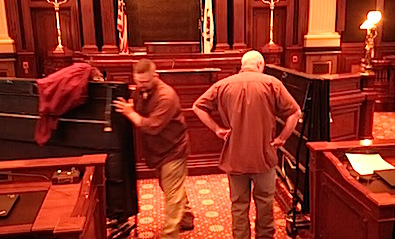
* It looks like workers are setting up for a Committee of the Whole in the House tomorrow…
…Adding… I tipped subscribers about this possibility earlier today…
Speaker Madigan spokesman Steve Brown confirms a Committee of the Whole scheduled for 2 p.m. Thursday about workers comp.
Republican lawmakers Wednesday laid resolution of the state’s budget impasse squarely at the feet of House Speaker Michael Madigan.
At a Statehouse news conference as a 10-day special session was about to begin, Republican lawmakers said the House Democrats are the only group that has yet to lay out a spending and revenue plan to end the nearly two-year budget stalemate.
“Speaker Madigan and the House Democrats will need Republican votes if they want to end this impasse,” said House Republican Leader Jim Durkin of Western Springs. “It is up to them. The time for just having vague, general discussions is over.”
Durkin was referring to the fact it now takes 71 votes in the House to pass bills, including a budget. Democrats hold 67 seats in the chamber.
The Republicans dodged repeated questions about why they won’t introduce their own tax hike bill.
* And Rep. Lou Lang delivered another one of his patented rants at the end of today’s session. Lang chastised the governor for spending “millions of dollars” on TV ads attacking Speaker Madigan and sending out as many as 15 mailers attacking individual House Democrats despite the call by House GOP Leader Jim Durkin for everyone to “lay down their arms” and work on a deal…
“We agree that it’s time to lay down our arms and our weaponry. And so I challenge Leader Durkin today to march down to Room 200 in this building and ask the governor to lay down his arms and his weaponry and do the business of the people of the state of Illinois. It will take even less than the three minutes and fifteen seconds he talked yesterday about the needs of the people of the state of Illinois.”
Rep. Dan Brady (R-Bloomington) then rose to say people on his side of the aisle will do everything they can to “make our time during the next ten days as bipartisan as possible to get something done of the people of Illinois.”
* Illinois Policy Institute: Republican plan perpetuates Illinois’ financial crisis - The Illinois Republicans’ budget proposal includes billions in tax hikes and has an ineffective spending “cap” that will likely result in deficit spending by 2020. The plan’s lack of reforms sets taxpayers up for a permanent tax hike in 2022.
Community groups call on Attorney General Lisa Madigan to investigate Assessor Berrios and for President Preckwinkle and the Cook County Board to fix our unfair property tax assessment system
Wednesday, June 21, Our Revolution Illinois/Chicago, Action Now, Network 49, Blacks in Green, and other community organizations will call for an investigation and a fix for Cook County’s unfair property tax system which illegally hurts working families and communities of color. We will call on key elected officials to do their job and ensure fairness in the system.
On June 10, the Chicago Tribune detailed how the property tax assessment system benefits wealthy homeowners but penalizes low income and working families. Cook County Assessor Joe Berrios has promised to implement new methods that would be fairer and more efficient but has not made good on those promises.
Our Revolution Illinois/Chicago seeks to continue the mission of Bernie Sanders’ campaign by advocating for essential reforms and supporting a new generation of progressive leaders. Our Revolution Illinois will fight to ensure the political and economic systems of the state are responsive to the needs of working families.
We write to respectfully request that the Illinois Attorney General’s Office launch an investigation into the Cook County Assessor’s Office, specifically to determine whether officials violated state or federal law, including the Civil Rights Act, through the assessment process in Cook County. The Chicago Tribune reported on June 10 that through the assessment process, the Cook County Assessor systematically “created an unequal burden on residents, handing huge financial breaks to homeowners who are well-off while punishing those who have the least, particularly people living in minority communities.” Many working families are already struggling to make ends meet. This only exacerbates their hardship.
It appears the faulty assessment process was implemented knowingly. A fairer, more accurate assessment model was developed by experts for the Assessor’s Office, yet it was discarded with no proper explanation, resulting in the continued practice of over- assessing homes in minority and low-income communities. The Tribune further reports that the Assessor relies heavily on a process called “hand checks” through which staff manually adjust the valuation of homes. This process is ripe for abuse and corruption. It may be used by the Assessor’s office to reward or punish particular property owners for political reasons. Yet no statistics are kept on hand checks, the Tribune reports.
This is particularly troubling given that Assessor Berrios has accepted millions of dollars in political contributions from property tax attorneys. The Tribune found that his three campaign funds “raised more than $5 million since 2009, more than half of which came from property tax attorneys and the businesses associated with them.” Some of these property tax attorneys almost exclusively donate to the Assessor and the Board of
Review. Since 2010, of all political contributions by the real estate law firm Weiss, Dubrock, and Doody, 95% were to Berrios and the Board of Review. Another real estate law firm, Flanagan Bilton, gave 81% of its contributions to Berrios and the Board of Review.
Yet when the Tribune sought documentation explaining how the hand check process works, Assessor Berrios refused, and the matter is currently in court. This begs the question as to what degree “pay-to-play” was involved when wealthy political donors sought reductions in assessments.
The rest is here. Their letter to President Preckwinkle is here.
* Also…
Cook Co. Commissioner @jesuschuygar calls for Assessor Joe Berrios to testify before board on property tax system, after Trib investigation
Rauner Releases Digital Ad – “The No. 1 Change”
Highlights Real Stories Behind the Need for a Property Tax Freeze
As lawmakers return to Springfield to work on passing a balanced budget with reforms to end the impasse, Rauner today released digital ads highlighting real stories of Illinoisans hurt by crippling high property taxes.
Property taxes are driving people and businesses out of their homes. That’s why Governor Rauner is pushing so hard for property tax relief in Springfield.
* Chris Kennedy is making two seemingly contradictory claims out on the campaign trail. He says he represents “radical” change, but also says he wants to bring stability and predictability back to state government. Radical change isn’t usually associated with stability, however. Just the opposite.
The only unifying thing Bruce Rauner is doing is bringing voters together to support radical change in Illinois… Compromise - real compromise - like the kind that happens before the session ends when lawmakers are debating the merits of their proposals, is not surrender.
Taken together, those two sentences don’t make any sense.
I’m sure these diametrically opposed messages both test well. I just wonder if or how long he can get away with saying both things.
…Adding… From comments…
Macron just won the French Presidency on this same message - Radical Centrism.
* Gov. Rauner loves the Wall St. Journal editorial page. That edit board is full of his class of like-minded folks. Back in the day, he would often send around clips from editorials to his pals with his own approving commentary.
The Illinois Capitulation - Gov. Bruce Rauner cries uncle on taxes and economic reform
Bruce Rauner spent a chunk of his personal fortune running for Governor in 2014 to save Illinois from its tax-and-spend political class. More than two years later it looks like the former private equity star has made better investments.
On Tuesday evening the Governor with the worst job in America explained why he and his fellow Republicans have offered to raise taxes for the sake of ending a multiyear budget impasse with Democrats. He said he’ll accept a four-year increase in the flat state income tax to 4.95% from the current 3.75%, expand the sales tax and implement a cable and satellite TV tax.
This is a political defeat by any definition since Mr. Rauner campaigned on lowering the income tax to 3%, not on restoring the rate close to what it was under the last Democratic Governor. The “temporary” 5% rate partially sunset in December 2014. Democrats who run the legislature refused to negotiate over a budget unless Mr. Rauner agreed to a tax increase, and now they’re refusing to make notable spending or economic reforms in return. […]
The Governor’s capitulation may have been triggered by the latest downgrade by Moody’s and Standard & Poor’s in the state bond rating to near junk status, with a warning that another downgrade could come this summer. Mr. Rauner doesn’t want to run for re-election next year as Governor Junk.
Oof.
They do make a good point about how he campaigned on lowering the rate to 3 percent by the end of his first term. He took his eye off that ball almost right away, however, and chose to fight a long, protracted war instead.
…Adding… Just as an aside, this could sting even more because the WSJ’s editorial page editor is Paul Gigot, who attended Dartmouth with Rauner.
…Adding More… The WSJ and Joe Walsh on the same day?…
At this point, as a Conservative Republican stuck in Illinois, I have no reason to vote for @BruceRauner.
Positive Headlines for Rauner’s Speech
Democrats Come Across as Petty – Attacking Speech Intended to Unite Around Compromise
While Governor Bruce Rauner addressed the people of Illinois directly, pleading for compromise and unity amid an historic budget impasse, Democratic candidates for Governor and allies of Speaker Mike Madigan publicly refused to accept the Governor’s call.
Instead of agreeing that it’s time to reform our state to end the budget impasse, Democrats attacked a plea to work together.
To everyone outside the rotunda bubble, it was petty.
But Governor Rauner’s message reached Illinoisans across the state. Check out these positive headlines in response to the Governor’s message.
State Journal-Register: Rauner calls for unity ahead of special session
“Failure to act is not an option,” Rauner said in the speech that lasted a little over three minutes. “Failure to act may cause permanent damage to our state that will take years to overcome.”
Rauner called for lawmakers to support a Republican budget plan released last week that would set state spending at $36 billion a year for the next four years. Rauner called it a “compromise budget plan that I can sign, one that we all can support.”
ABC 7 Chicago: Governor Rauner gives address focused on unity, budget
From behind the podium set up in the historic Old State Capital building, Rauner tried to bring an end to the historic budget impasse that has crippled Illinois during the three years there has been no balanced budget.
Chicago Tribune: Rauner calls for compromise in speech Democrats dismiss as empty rhetoric
“Our history reminds us of our state’s great capacity for change — and for our limitless potential when those elected by the people put the people’s interests ahead of all else,” Rauner said. “Right now, our state is in real crisis and the actions we take in the days ahead will determine how history remembers us.”
WTTW: Rauner Calls for Compromise Ahead of Special Session
As Illinois faces the unprecedented possibility of the third fiscal year in a row dawning without a budget in place and on the eve of a special session that’s lawmakers’ last chance to head off that harsh reality, Gov. Bruce Rauner gave a short – but highly publicized – speech.
“Right now, our state is in real crisis – and the actions we take in the days ahead will determine how history remembers us. We can all do better. We must all do better for the citizens of Illinois,” Rauner said Tuesday evening.
WCIA Springfield: Rauner urges ‘Capitol Compromise’
Standing on the second floor of the Old State Capitol, Rauner summoned the unifying powers of Abraham Lincoln, repeating the former president’s famous line, “a House divided against itself cannot stand.” Illinois remains deadlocked in the longest budget battle in state history.
WAND: Governor Rauner urging unity among state lawmakers
Governor Bruce Rauner appeared at the Old State Capitol in Springfield to urge lawmakers to put aside their differences and agree to state budget.
State lawmakers are being called back to Springfield starting Wednesday to participate in a special session, where Governor Rauner hopes a compromise on a state budget can be reached.