* John Miller’s bio…
John serves in a strategic role as the co-head of fixed income for Nuveen Asset Management, responsible for the investment process and performance of the firm’s municipal fixed income group. He is also the lead manager of the High Yield Municipal Bond Strategy, the California High Yield Municipal Bond Strategy, and related institutional portfolios. In addition, he co-manages the All-American Municipal Bond Strategy and the Strategic Municipal Opportunities Strategy and oversees a number of closed-end funds.
* John Miller’s prediction via the Bond Buyer’s Illinois reporter…
Miller (no relation) was speaking during an investors panel at a Bond Buyer conference.
*** UPDATE *** Well, that’s a little comforting…
Headline slightly altered to reflect the new info.
7 Comments  
|
* Reuters…
Illinois general obligation bond prices plummeted and yields soared in the U.S. municipal market on Thursday, a day after a federal judge ordered the cash-strapped state to find more money to pay Medicaid providers.
Yields on bonds due in 2024 climbed to 5.15 percent in secondary market trading, according to Municipal Market Data, while Illinois’ so-called credit spread over MMD’s benchmark triple-A scale jumped to as much as 380 basis points.
“It’s a real meltdown today,” MMD analyst Randy Smolik said.
He added that spreads over the scale widened by as much as 100 basis points for some bonds issued by Illinois, which already had the widest spreads among the 50 states.
*** UPDATE *** Press release…
With state bonds being downgraded twice last week and a federal court ordering Illinois to find money for Medicaid payments just yesterday, municipal bond analysts are shook over the state’s worsening fiscal crisis under Bruce Rauner’s failed leadership. One analyst was not mincing words about the tumult breaking out among investors, telling Reuters: “It’s a real meltdown today.”
This comes as the state has reached day 708 without a budget and the bill backlog is estimated to reach $16 billion by the end of the fiscal year on June 30. In the meantime, Rauner continues his media tour around the state to promote an agenda that even Republicans admit won’t help get our state back on track.
“It’s no surprise that our dire fiscal situation worsens each day under Bruce Rauner’s failed leadership,” said Pritzker campaign spokeswoman Jordan Abudayyeh. “While investors are panicked, Rauner remains unbothered as he tours the state to promote his teardown agenda that ultimately won’t solve our budget crisis. It’s clear Rauner’s priorities are with his special interest friends and wealthy corporations instead of the Illinoisans who will continue suffering because of his failures.”
30 Comments
|
* As I told subscribers the other day, Scott Drury has a built-in constituency of right-leaning pundits, editorial boards and talk radio hosts who all hate Speaker Madigan…
Thursday morning, Highwood State Representative and Gubernatorial candidate Scott Drury told “The Big John and Ray Show” that the tapes show Pritzker should not be Governor.
“Those tapes are very disturbing and I don’t think we know close to enough about the back story to those tapes. One of the biggest problems I saw in those tapes is that Pritzker clearly comes up with the idea on his own that he wants to be the Treasurer. Sure that’s fine. But later in the tapes he starts talking about how they’re going to pull the wool over the public’s eyes and make it look like the head of the Board of Trade and the Mercantile Exchange how the idea came from them. So you have Pritzker on tape already scheming with a corrupt Governor about how they’re going to make one fact look like it was different and that’s not the type of person we need running our state.”
Drury is a former Assistant U.S. Attorney. He is also one of the few Democrats to publicly oppose powerful Illinois Democratic House Speaker Michael Madigan. He told WLS that while he does not have the money of Pritzker, Democratic Candidate Chris Kennedy, or Governor Bruce Rauner, he can still win.
“What we all know is that money can’t buy character, money can’t buy judgement. Money can’t buy a good message. There is no one in this race until now, who has the scars that I have from actually fighting for the people of Illinois and giving people a voice. We’re gonna return Illinois to the people.”
We’re gonna see a whole lot more free publicity like this. Bet on it.
*** UPDATE *** Jim Dey got into the act, too…
Readers may recall previous stories in this space about Democratic state Rep. Scott Drury, the only member of House Speaker Michael Madigan’s caucus who wouldn’t back Madigan for another term running the House.
For that, Drury has been effectively banished from the club by Speaker Madigan. As persona non grata, Drury, among other things, lost a prestigious committee assignment.
This week, a Democrat in Drury’s suburban Chicago district announced he’ll challenge Drury for re-election in the March primary. That’s generally how Madigan rids himself of independent-minded Democrats.
But Drury had an announcement of his own — he’s entering the primary race for governor. Those who like Madigan, he said, should back one of his opponents, and those who don’t should vote for him.
“I like those odds,” Drury was quoted as saying.
21 Comments
|
* Press release…
Today, Illinois’ constitutional officers and other top elected officials are calling on Governor Bruce Rauner to join the United States Climate Alliance following President Donald Trump’s decision to withdraw from the Paris climate agreement.
“As governor, your decisions affect life within our borders and in the world at large, and many people throughout our state are looking for your leadership on this issue. To date, we have not heard your stand on this issue. We encourage you to join your peers from California, New York and Washington and lead in combating global warming, drought, stronger storms and other catastrophes that would decimate Illinois’ economy from Southern and Central Illinois farms to Chicago’s lakefront.”
The call to action came via a letter sent to Governor Rauner today outlining the benefits of joining this state and local government initiative. Illinois is the fifth-largest economy in the country.
California Gov. Jerry Brown, Washington Gov. Jay Inslee, New York Gov. Andrew Cuomo, Connecticut Gov. Daniel P. Malloy, Delaware Gov. John Carney, Massachusetts Gov. Charlie Baker, Minnesota Gov. Mark Dayton, Oregon Gov. Kate Brown, Puerto Rico Gov. Ricardo Rosselló, Rhode Island Gov. Gina M. Raimondo, Vermont Gov. Phil Scott and Virginia Gov. Terry McAuliffe have already joined the United States Climate Alliance.
In addition to the 12 Governors, 19 attorneys general, including Attorney General Lisa Madigan, numerous mayors, college and university leaders, and businesses across the country have joined the United States Climate Alliance in pledging support for a continuing commitment to fight climate change under the Paris Agreement as part of the “We Are Still In” Coalition.
The release was signed by Secretary of State Jesse White, Attorney General Lisa Madigan, Comptroller Susana Mendoza, Treasurer Michael Frerichs, Senate President John Cullerton and House Speaker Michael Madigan, along with these legislators…
Illinois State Senators:
Sen. Scott Bennett, Sen. Jennifer Bertino-Tarrant, Sen. Melinda Bush, Sen. Tom Cullerton, Sen. Linda Holmes, Sen. Mattie Hunter, Sen. Toi Hutchinson, Sen. David Koehler, Sen. Terry Link, Sen. Iris Martinez, Sen. Julie Morrison, Sen. Laura Murphy, Sen. Ira Silverstein, Sen. Heather Steans, Sen. Patricia Van Pelt
Illinois State Representatives:
Rep. Carol Ammons, Rep. Jaime Andrade, Rep. Kelly Burke, Rep. Kelly Cassidy, Rep. Linda Chapa LaVia, Rep. Deb Conroy, Rep. Barbara Flynn Currie, Rep. John D’Amico, Rep. Marcus Evans, Rep. Sara Feigenholtz, Rep. Laura Fine, Rep. Robyn Gabel, Rep. Will Guzzardi, Rep. Greg Harris, Rep. Stephanie Kifowit, Rep. Lou Lang, Rep. Camille Lilly, Rep. Natalie Manley, Rep. Rob Martwick, Rep. Rita Mayfield, Rep. Christian Mitchell, Rep. Michelle Mussman, Rep. Carol Sente, Rep. Silvana Tabares, Rep. Ann Williams, Rep. Sam Yingling
Bennett and Ammons are the only Downstaters on that list, but they represent Champaign-Urbana, which isn’t your usual Downstate town.
…Adding… Koehler also signed. I missed his name. Oops.
…Adding More… Rep. Juliana Stratton (D-Chicago) was not listed, but should have been.
16 Comments
|
* Second in the Tribune’s series…
Working with the Center for Municipal Finance at the University of Chicago’s Harris School of Public Policy, the Tribune examined appeals on more than 2.7 million residential parcels and found that, in every year from 2009 to 2015, the industry’s statistical measures of fairness got worse after the appeals process.
That inequity has placed a financial burden on those who can least afford to pay more, the U. of C. study found. On average, even after appeals, people who own homes in the bottom 25 percent of values paid nearly $500 more a year in property taxes than they would have if the system were fair, the research shows.
The reason: Wealthier neighborhoods appealed at much higher rates and regularly received significant assessment reductions even though homes in those areas were more likely to be undervalued. In poorer neighborhoods, homeowners not only are more likely to have their properties overvalued by the assessor, they are less likely to appeal. […]
As previously reported in this series, a Tribune analysis found that the county’s assessments have been riddled with errors. Berrios had a chance to improve the property tax system by implementing a new computer model that would produce more accurate assessments and reduce regressivity, or the tendency to overvalue low-priced homes and undervalue high-priced ones.
But he failed to do so — despite issuing a news release claiming he did.
…Adding… The full study is here.
*** UPDATE *** Press release…
The Cook County Assessor’s Office is again concerned about false statements, misleading claims and inaccurate information recently put forth about property assessment and taxes. Assessor Joseph Berrios has issued this statement:
“Having grown up in Cabrini Green and becoming the first minority ever to serve as Assessor, I would never allow this office to unfairly assess property and cause minorities to pay more taxes than they should.
It is important to respect all homeowners, especially those with homes at the lower end of the market. I have felt this way since I was the first Hispanic-American elected to County-wide office on the Board of Review and, before that, the first Hispanic-American to serve in the Illinois General Assembly.
The property assessment system is not ‘rigged,’ as a few have recently claimed. The appeal process is open and fair to all, contrary to the opinion of the Tribune. No one is required to use an attorney to appeal; in fact, the majority of appeals filed do not use attorneys. Still, the success rate for all appeals to my office is 50%.
We have done everything to encourage all people in Cook County to appeal their assessments. 77% of the community assessment and appeal seminars done by my office are in areas with lower-market homes.
The Tribune’s sales ratio study was not conducted by certified or otherwise experienced appraisal professionals.
In violation of industry standards, the Tribune included in its study countless non-fair-cash-value transactions such as estate sales, which drive down prices. But the Tribune didn’t even note their inclusion.
Court rulings state that sales ratio studies are not technical or scientific facts, but merely studies whose methodology and results are subject to interpretation.
The Tribune’s advocacy of the new Probit assessment model is in complete disagreement with internationally-recognized property assessment experts. Probit has proven highly unreliable.
This Office assesses property, not people. It does so accurately and practices equality.”
18 Comments
|
*** UPDATED x1 *** A basic impasse primer
Thursday, Jun 8, 2017 - Posted by Rich Miller
* A good friend of mine, who isn’t directly involved in politics beyond the precinct level (he’s a GOP precinct committeeman), still does a fairly decent job of keeping up with things.
Moments ago, he asked me something I’ve heard time and time again. Where’s all the money being spent without a budget?
* From the Tribune…
In an affidavit filed with the court before the ruling, Assistant Comptroller Kevin Schoeben said that 90 percent of the money that comes into the state’s main checking account is being spent on a “core priority category” that includes paying down state debt and making pension contributions, in addition to spending on elementary and high schools, paying state employee salaries and sending money to local governments. Debt payments, pension contributions and distributions to local governments are required under state law. A state court order requires state employee salaries to be paid in full and on time. Spending on elementary and high schools was approved by lawmakers and Gov. Bruce Rauner last year, but even those payments are behind by more than $1 billion.
The comptroller’s office tries to spread the remaining 10 percent around.
* Back in 2015, the last time we had a kinda/sorta real budget after Gov. Rauner and the Democratic leaders agreed to a patch, which they called a fix, Illinois brought in $35.9 billion (plus some transfers) while spending $35.4 billion. Click here.
But because revenues collapsed after the 2011 income tax hike partially rolled back, the following fiscal year Illinois brought in just $31.9 billion (click here). And because the state didn’t have a real budget, it was obligated to spend $36.6 billion on “auto-pilot.” See above for that explanation.
This fiscal year, which ends in a few weeks, Illinois will bring in $31.97 billion in revenues while auto-pilot spending obligations will rise to $38.2 billion. (Click here.)
Next fiscal year, which starts on July 1st, Illinois is projected to bring in $32.16 billion and be obligated to spend $39.8 billion. (Click here.)
When Gov. Rauner took office, Illinois was paying almost all of its bills within 30 days. However, it was still way behind on paying for state employee group healthcare. That payment cycle is now about two years for some categories. (Click here.)
* Anyway, by the end of June, Illinois is projected to rack up another $6.2 billion in bill backlogs, which will bring the total to $15 billion. If this nonsense continues another year, that backlog will increase by another $7.7 billion and the total backlog will be $22.651 billion. (Click here.)
And who is owed this money? Here’s a good chart from April…
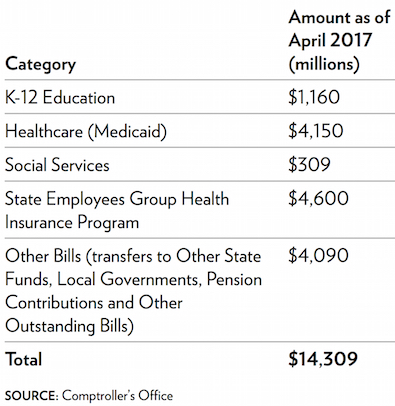
The average wait time to be paid by the state is now about 7 months. (Click here for a list of even more craziness deliberately caused by this impasse and click here for an historical chart of the backlog.)
* And that’s why the federal lawsuit over timely Medicaid payments (click here) is so critical. The state owes those folks $2 billion. But they demanded to be paid on time, the same as state workers, bond holders and government pension funds.
Failing that, they want a substantial amount of the money they’re owed and a federal judge agrees…
A federal judge Wednesday ordered Comptroller Susana Mendoza to make a “substantial” dent in a $2 billion backlog of bills owed to Medicaid providers in order to keep doctors and hospitals from cutting off care for the low-income families that rely on the program… The judge gave them until June 20 to reach a deal. She noted that the patients are not seeking immediate payment of the pile of unpaid bills, just payments that would be “sufficient to sustain the services to members of the classes.”
Except, as explained above, there is no money to do that. Illinois cannot print money like the federal government and borrowing for operating expenses is out of the question because we are literally one step above junk bond status.
* Any other questions?
*** UPDATE *** I didn’t notice that Mark Brown also tackled this very same question in the Sun-Times today. Click here to read it.
42 Comments
|
* From the end of session…
“Please, members of the General Assembly in the majority, do not travel around the state holding sham hearings about a balanced budget,” Rauner said. “Don’t go through a process of just trying to create phony headlines.”
* From yesterday…
The Bureau of Labor Statistics says $100 in 2005 is worth $128 today. So, not all that far off from 32 percent. And, therefore, not exactly outrageous.
* But it gets even better…
Concrete reforms to Illinois’ “brutally high” property tax rates are needed to encourage growth in the Land of Lincoln, Gov. Bruce Rauner said during a visit to a Peoria real estate agent’s home Wednesday. […]
Rauner’s administration noted in a news release that the family’s property tax bill has increased by more than $1,900 — more than one-third — since they bought their North Peoria home in 2005, which is borne out by county tax records.
The bulk of that increase came in the first three years they owned the home, with the taxes on it having gone up just over $200 — about 3 percent — since the turn of the decade, according to those same county records.
A $200 increase in 7 years? Not exactly “brutal.” That’s way below the inflation rate.
* Look, there’s no doubt that Illinois property taxes are a real problem. You will not get an argument from me. I have written repeatedly that the Democrats need to stop battling this freeze idea just because they despise the man who’s pushing it.
And he did have some good examples of high property taxes while he’s been out on on the campaign trail taxpayer-financed trip. But it’s really difficult to take the man seriously when he makes a “brutally high” mountain out of a mole hill, and particularly when he warned the General Assembly against doing the very same thing.
*** UPDATE *** Mayor Ardis is a Republican, by the way…
The governor says he’s willing to do a four-year freeze and allow people to control their property tax levy by voter referendum. But people like Peoria Mayor Jim Ardis say a property tax freeze doesn’t address the biggest issue.
“It polls really well. But the problem with it is, it doesn’t add a dime of revenue to the state revenue stream,” Ardis said. “It’s not going to anything to help them do anything to balance their budget, that is the worst one in the country.”
Ardis says the state might see new business growth if it could put as much emphasis on resolving the budget crisis as it is on property tax relief.
49 Comments
|
[Bumped up to Thursday for visibility.]
* This puts the comptroller in a pretty darned tough spot, making her choose between violating state statutes, state judicial orders or federal court orders…
A Chicago federal judge has stopped short, so far, of ordering the state of Illinois to place a premium on paying the health insurance organizations, hospitals and others the $2 billion it is estimated the state owes under unpaid Medicaid bills.
However, on Wednesday, the judge said the position taken by the so-called managed care organizations is “reasonable” and indicated she did not similarly find it reasonable for the state to skimp on Medicaid payments while fully funding its monthly payroll and debt repayments.
“…Compliance with a state statute does not excuse failure to comply with a federal consent decree,” U.S. District Judge Joan Lefkow wrote in her June 7 order. “Although the court means no disrespect to the Comptroller, who faces an unenviable situation, it finds that minimally funding the obligations of the decrees while fully funding other obligations fails to comply not only with the consent decrees, but also with this court’s previous orders.”
For now, however, the judge ordered the state and the MCOs to continue negotiating over the next two weeks to reach a payment agreement.
Should they fail to strike an acceptable deal by June 20, however, she said either party could return to court for further proceedings.
* From the legal team representing the plaintiffs…
The court noted that Illinois chose to prioritize certain core priority payments—including pension payments, debt services, K-12 education, safety net medical providers, and state employee salaries—that are paid in full each month. The plaintiffs argued that then, only if the state has dollars left, would it make payments to Medicaid, imperiling the entire program by putting access to care, provider enrollment, managed care participation, and the solvency of Illinois’s health care safety net at risk.
The order came after a court hearing on June 6, 2017 when attorneys from the Sargent Shriver National Center on Poverty, Legal Council for Health Justice, and Goldberg Kohn returned to federal court to hold the State of Illinois accountable to reimburse medical providers statewide for Medicaid-funded care.
Some medical providers in Illinois have been delaying payment of salaries, taking out additional business loans, and facing closure or staff layoffs. Thomas Yates, executive director for Legal Council for Health Justice says, “This ruling reaffirms the importance of Medicaid to more than three million Illinois residents, the majority of whom are children, elderly, disabled, or members of low-wage working households, who rely on this program for essential medical care.”
Shriver Center president John Bouman warns, “We are now seeing the very real threat to the vital functions of government caused by the failure to produce a budget. The policy disputes now blocking the budget should be fought out on some other battlefield. Carrying out and paying for the vital functions should be the first priority of governing.”
* From the comptroller…
In accordance with Judge Lefkow’s ruling, our attorneys will continue discussions with attorneys for the plaintiffs.
The lack of a budget for the last two years has created a situation in which we now have more court-ordered and state-mandated payments than we have revenues to cover them.
The real solution to this crisis is a comprehensive budget plan passed by the General Assembly and signed by the Governor. Now.
*** UPDATE *** Pritzker campaign…
“Bruce Rauner is the governor of this state and the courts should not have to do his job for him,” said JB Pritzker. “It is Bruce Rauner’s constitutional duty to propose a balanced budget, but for the past three years he has consistently refused to do so. As Rauner holds this state hostage, the backlog of bills continues to grow and the fiscal crisis deepens. Courts are left with no choice but to pick winners and losers of state resources. In reality, all Illinoisans are losing under our failed governor. This is a manufactured crisis and the people of Illinois deserve so much better. It is time for a governor with courage, who will sit at the negotiating table, bring people together, and get our state a balanced budget.”
39 Comments
|
* From an e-mail sent by the Commission on Government Forecasting and Accountability to Rep. Dave McSweeney…
See attached requested update of FY’17/18 estimated deficits. As shown, the FY17 estimated deficit is approx. $6.249 billion. It includes updated spending figures published in the Gov’s FY’18 budget book. We then updated the resource section with CGFA’s last official forecast of March 2017.
Similarly, updated FY’18 spending under the “maintenance” scenario per the Budget Book was combined with CGFA’s revenue estimate to yield a FY’18 deficit of $7.651 billion. When that figure is added to the Comptroller’s reported likely $15-16 billion end of FY’17 owed bills projection—the total end of FY’18 unpaid bills would approach $23 billion.
Click here for the attachment.
* Back in 2016, GOMB’s forecast for the unpaid bill backlog by the end of Fiscal Year 2018 was $19.9 billion. It’s been a widely used number ever since then. But COGFA’s new projection is a $22.7 billion mountain of bill backlogs by June of 2018 - almost $3 billion higher.
We weren’t supposed to hit a backlog like that until sometime in the spring of 2019.
To give you an illustration of how bad this is, if they don’t pass a real budget, then by the end of June, 2018 our unpaid bill backlog will equal 73 percent of state revenue collections.
*** UPDATE 1 *** Ugh…
* And…
Odds are greater than even that Illinois debt officially will be rated junk—and soon—if lawmakers do not resolve an impasse with Gov. Bruce Rauner and enact a new budget by the beginning of the state’s new fiscal year on July 1.
That was the word from S&P Global Ratings today as the New York financial firm turned up the pressure another notch in a political feud that shows no sign of breaking soon.
In a call with reporters, analysts at S&P, which on June 1 moved state debt to just one level above junk, said that without a budget, the state’s rating could drop more than one notch.
“We think (a further downgrade) is above one in two likelihood around the time” the fiscal year 2018 begins on July 1, said Gabriel Petek, a managing director and sector leader for the firm. “This situation definitely is moving quickly if they don’t have a budget.”
Passing a temporary stop-gap budget—something Rauner has vowed to veto without Democratic concessions—”would be helpful” if only because it would provide cash to some programs and units that now are totally without help. It also “might result in us having a less than one notch” downgrade. But without new revenue, too, “the fiscal situation could continue to erode,” he added.
*** UPDATE 2 *** Pritzker campaign…
“Bruce Rauner is stumbling from crisis to crisis as Illinois families pay the price for his failed leadership,” said JB Pritzker. “Rauner ran for office attacking the previous governor for downgrades and promising a turnaround. But all we’ve gotten under Rauner’s failed leadership is eight downgrades so far and ratings agencies essentially promising that there will be more. These agencies are confirming what so many Illinois families already know: Bruce Rauner’s manufactured budget crisis has wrecked our state’s economy. S&P, Moody’s, and Illinoisans across the state have had enough. We need a real leader in Springfield who can pass a budget and clean up Rauner’s fiscal mess.”
* Related…
* Press release: Social Workers Call For End To Stop-Gap Budgets
60 Comments
|
*** UPDATED x1 *** Open thread
Wednesday, Jun 7, 2017 - Posted by Rich Miller
* Oscar got a haircut today, so I have to go get him and will be back a bit later. Here’s a pic from the other day…

He loves that spot.
Stick to Illinois issues and be nice to each other. Thanks.
*** UPDATE *** Here’s the “after” pic…

33 Comments
|
* As we’ve already discussed, Rep. Chad Hays (R-Catlin) led the mini revolt that passed a 911 emergency call center fee hike last month. He talked to Tom Kacich…
“I came to the conclusion that my constituents weren’t that concerned with the amount that the people of Chicago paid and if Chicago legislators were comfortable with that amount, fine,” Hays said. “But what I was not willing to do was go home and tell my own constituents that when you dial 911 and on the other end of the line it says that this has been disconnected and people ask, ‘Why did this happen?’ I was totally uncomfortable with saying that the mayor of Chicago and the governor are in a wrestling match over something peripheral to your 911 service.” […]
“I suspect that with this subject matter, if the governor chooses to veto the bill, he will be overridden,” Hays declared.
The problem comes if Rauner chooses to use his amendatory veto powers and then Speaker Madigan does his usual thing and rules it out of compliance with the Constitution and the bill dies from inaction.
* Hays also talked about if that template could be used to break the impasse…
“In the House, it’s very difficult to get anything passed that the speaker doesn’t at least allow for a vote. That’s the inherent problem with the rules of engagement in the House of Representatives, that the speaker of the House has the rules screwed down so tight that if he doesn’t want to run a bill, it doesn’t run,” Hays said. “So going over the head of the speaker in the House of Representatives and doing what you just darn well please whether he likes it or not is nearly impossible. […]
But Hays insisted that “there are budget talks going on as we speak behind the scenes” and “people talking to ascertain if there is a deal to be made.”
“If that is the case,” he added, “I think you’ll be seeing some more concrete proposals coming in the next couple of days.”
Hays said again he’s prepared to vote to raise taxes and cut spending as part of a budget deal.
If anybody can get this done from the ground up it’s gonna be people like Chad Hays. There aren’t many of them in the House, but you takes what you can gets.
*** UPDATE *** I just talked to Rep. Hays, who said that while people are holding discussions to see if there’s a pathway to ending this impasse, he didn’t mean to imply that something was imminent.
* Related…
* Kansas legislature overrides Brownback’s veto of bill that rolls back his 2012 tax cuts: Lawmakers marshaled together a coalition of moderate Republicans, conservatives and Democrats to overcome the governor’s opposition to seeing his landmark tax cuts, which have in large part come to define his tenure in Topeka, fundamentally come to an end.
* Illinois owes billions to suburban non-profits, companies, government agencies: In the suburbs, that adds up to $2.2 billion owed to more than 5,100 health care providers, local government agencies, small businesses and other state vendors… The amount is roughly 15 percent of the $14.7 billion the state owes all vendors. Chicago-based vendors are owed close to $5.6 billion, according to the comptroller’s figures.
26 Comments
|
* Jason Grotto…
From North Lawndale and Little Village to Calumet City and Melrose Park, residents in working-class neighborhoods were more likely to receive property tax bills that assumed their homes were worth more than their true market value, the Tribune found.
Meanwhile, many living in the county’s wealthier and mostly white communities — including Winnetka, Glencoe, Lakeview and the Gold Coast — caught a break because property taxes weren’t based on the full value of their homes.
As a result, people living in poorer areas tended to pay more in taxes as a percentage of their home’s value than residents in more affluent communities. Known as the effective tax rate, the percentage should be roughly the same for everyone living in a single taxing district.
But the Tribune’s analysis shows the rates became skewed in favor of wealthier residents.
*** UPDATE *** ILGOP…
“What the Chicago Tribune has revealed today is nothing less than an illicit enterprise that runs right through the Speaker’s office. The Chicago political machine has manufactured a property tax system designed to punish the poor and extort millions from taxpayers for their own benefit. Democratic candidates for Governor – J.B. Pritzker and Chris Kennedy – have profited from this corrupt system. They all have some explaining to do.” – Illinois Republican Party Spokesman Steven Yaffe
A bombshell three-part series released by the Chicago Tribune this morning documents how the Chicago political machine – Mike Madigan, Joe Berrios, and others involved in the property tax appeals business – have manufactured a property tax system that targets the poor and puts millions in their own pockets.
Some Key Highlights:
Cook County Assessor Joseph Berrios has “resisted reforms and ignored industry standards”, creating a “staggering pattern of inequality.”
Berrios, whose “strongest allies” include Mike Madigan and Ald. Edward Burke, has “raised more than $5 million since 2009, more than have of which came from property tax attorneys and businesses associated with them” in his capacity as chairman of the Cook County Democratic Party.
“Some of the state’s most influential political families have been tied to the office or the industry of tax attorneys that has grown up around it; Madigan, Burke, Hynes and Cullerton are among the most prominent.”
They have created “a property tax system that harmed the poor and helped the rich.”
The Assessor’s office “would not say” what methodology is used to determine valuation adjustments.
Property tax appeals lawyer’s fees – lawyers like Mike Madigan and those used by J.B. Pritzker to get massive breaks on his “uninhabitable” mansion – have soared to $35 million per year.
The wealthy are able to get huge tax breaks through the appeals process and loopholes like those that claim properties are not inhabitable.
71 Comments
|
|
 Support CapitolFax.com
Visit our advertisers...
  ...............
 ...............
 ...............
 ...............
 ...............
 ...............


|
   
|
Hosted by MCS |
SUBSCRIBE to Capitol Fax |
Advertise Here |
Mobile Version |
Contact Rich Miller
|




