* The Sangamon County Republican Foundation’s chairman Andy Van Meter says Bill Cellini will continue serving as his group’s treasurer as long as Cellini wants, claiming that Cellini has mostly an honorary title anyway. Van Meter also chairs the Sangamon County Board. The SJ-R points to significant links to the foundation which go beyond a mere honorary affiliation…
* The foundation’s director is Janis Cellini, Bill’s sister;
* The administrative assistant of the political action committee, Robin Ellison, has the same title with the Illinois Asphalt Pavement Association, of which Bill Cellini remains executive director;
* In the three months ending Sept. 30, the foundation paid the asphalt group $397 in reimbursements for postage, copies and telephone use.
* And the offices of the foundation and the asphalt association are both in Near North Village, a building at Fifth and Jefferson streets that originally was developed by Cellini and other partners. The foundation paid $600 in rent to Near North Village over the same three-month period.
Asked about the connections, Van Meter said via email, “I can’t follow all this guilt by association.
The foundation raised less than $6,000 last quarter, but it had almost $300,000 in cash and investments. By comparison, the Sangamon County Republican Central Committee had just $31K in the bank.
Bill Cellini is highly respected in Springfield GOP circles, so I understand why his longtime friends don’t want to kick a man when he’s down. If this was a less serious conviction or a simple tax problem or whatever, I wouldn’t make a deal out of it. But he was convicted of two felonies relating directly to government and politics. Cellini should do Van Meter a favor and fall on his sword. Also, since the state GOP chairman has made a career out of slamming Democrats for their corruption, perhaps he ought to step in here.
* It is often said that the Lottery is a tax on the mathematically illiterate. With a hat tip to a commenter, much the same can be said of pay-to-vote online straw polls and Ron Paul supporters…
A strong internet presence pushed Ron Paul to the top in the Illinois Republican straw poll. The Texas congressman bested the other presidential candidates in the survey, which wrapped up on Saturday.
Casting a ballot in the straw poll cost $5, and the Illinois Republican Party said more than 3600 people participated. Three quarters of them did so online, which is how Ron Paul claimed more than 50 percent of the vote.
“I think what this does is it shows the relative strengths of the candidates,” said U.S. Sen. Mark Kirk at a press conference announcing the results. “Ron Paul is obviously a big online performer.”
Mr Paul won 66.5 per cent of the votes cast over the Internet and 8 per cent of those cast in person.
Former Massachusetts Governor Mitt Romney earned 7 per cent of the online votes cast and 35 per cent of the in-person votes, winning the most in-person votes cast at 22 locations, the party said.
* Romney did not come in second place overall, however. That spot went to Herman Cain…
Finishing behind Paul’s 1,907 votes was businessman Herman Cain with 670 votes or 18 percent; former Massachusetts Gov. Mitt Romney with 515 votes or 14 percent; former House Speaker Newt Gingrich with 332 votes or 9 percent; Texas Gov. Rick Perry with 87 votes or 2.5 percent; former Utah Gov. Jon Huntsman with 54 votes or 1.5 percent; former Pennsylvania Sen. Rick Santorum with 43 votes or 1.2 percent; and Minnesota Rep. Michelle Bachmann with 41 votes or 1.1 percent.
The poll — at least momentarily — had pivoted the conversation from the Iowa and New Hampshire primaries to Illinois, fueling races up and down the ticket with both enthusiasm and campaign cash.
That may be way too generous.
* A small blip occurred when 30 people tried to cast more than one vote. Mark Kirk blamed it on Tom Cross…
That apparently wasn’t clear to the House Republican Organization, a political group headed by state Rep. Tom Cross, the GOP leader in the Illinois House. An email to supporters said online participants “can vote multiple times to ‘run up the score’ for your favorite candidate.”
“Yeah - [Cross] was incorrect,” Kirk said when asked about the email, which was first written about on the website Republican News Watch. “And so, we did find 30 people that tried to vote twice and they were eliminated.”
Republicans trying to block a Democratic-drawn congressional redistricting map have told a federal court panel that documents show a concerted effort from Springfield to Washington to “get more Democratic pick-ups” at the expense of GOP members in the Illinois delegation.
Republicans are using the documents involving the Democratic Congressional Campaign Committee, the staffs of Illinois House Speaker Michael Madigan and Illinois Senate President John Cullerton of Chicago, and others to bolster their contention that the new map is unconstitutional because it is politically gerrymandered and dilutes Latino representation.
In the request for a permanent injunction, filed late Friday night with a three-judge federal court panel, Republicans cite correspondence in which Ian Russell, the DCCC’s Midwest political director, thanks a member of Cullerton’s staff for guidance on how to “advance our goal — more Democratic pick-ups.”
The Democrats freely admit that politics played a major role in the remap process. The GOP allegations amount to a legal longshot, however…
Trying to get a court to reverse a map based on political decisions has historically been difficult.
That’s an understatement.
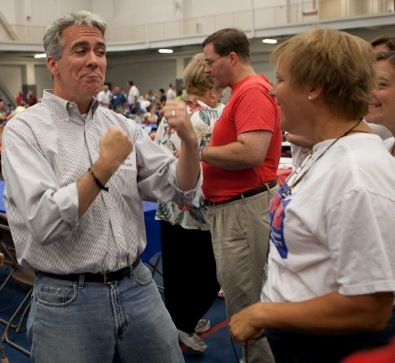
* And let’s conclude our GOP roundup with a GOP caption contest. Here’s Congressman Joe Walsh…
Take it easy in comments, people. Don’t get carried away with violent imagery. I don’t like it. Thanks.
In an exclusive interview last week, CME Group Executive Chairman Terry Duffy said he’s more than ready to leave Illinois if he doesn’t get what he believes is a “fair” tax deal from the General Assembly.
The company owns the Chicago Board of Trade and several other firms. It’s a very big wheel in this state and leaving would be the worst sort of news for Democrats who raised taxes this year.
Duffy has been under intense pressure all year from Wall Street to reduce expenses. State taxes are listed as expenses on corporate books, so Duffy has been publicly fuming about his company’s $150 million a year state tax burden since corporate tax rates were increased.
Duffy claims CME pays 6 percent of all corporate income taxes here, and pays more than any other company. “I don’t know another company in the world that pays 6 percent of another state’s taxes.”
As recently as four years ago, the vast majority of CME’s trades were physically handled on the floor of his exchanges like the Chicago Board of Trade. Now, almost 90 percent of trades are performed electronically, and Duffy says that difference means CME shouldn’t be paying taxes on trades which are obviously originating in other states and other countries. Trouble is, he won’t (and insists he can’t) reveal exactly where those trades are originating, so state negotiators instead decided to reduce his tax burden by roughly two-thirds, which means $100 million a year less in state income taxes paid by CME.
Duffy said he’d talked to at least half of the General Assembly’s members in the past several days, many of whom said they wanted something else in exchange for helping his company, like tax breaks for other industries.
“I really think these people don’t believe that I have an alternative,” a defiant Duffy said, pointing to very generous offers from other states.
The executive chairman claimed he’s been offered as much as $600 million to move Aurora’s high tech center and mentioned a report about how Indiana Gov. Mitch Daniels had offered CME $150 million a year in tax relief — CME’s entire state tax burden. When reminded that Gov. Daniels had denied the offer was made, Duffy said “The governor denied the number, but he didn’t deny the discussions. My shareholders heard it. They’re going to say, ‘What the hell did you do that (stay in Illinois) for? We care about us.’ ”
I’ve criticized Duffy for waiting until after his taxes went up to complain about how his company had historically been mistreated by the state’s tax code. This year’s tax hike cost CME $50 million, but Duffy wants double that amount to stay put. Since he didn’t seem to care about his taxes until January, why should the state give him anything beyond what the tax hike cost the company? Duffy claimed he’d been working on the situation for at least two years. He said he didn’t think he needed to make anything public until he was forced to when he was asked about the tax hike during a shareholders’ meeting.
However, Duffy said he hadn’t met with the governor or anyone else here before the tax hike. “Why work with Illinois when other states have a more business friendly approach?” he asked.
And as to why CME refuses to offer anything tangible in return for its tax deal, like all other companies seeking tax relief have to do, Duffy said he doubted the legality of those agreements. If Motorola broke its subsidy deal, Duffy said, it’s doubtful there’d be any real legal ramifications. “We’ve been here 163 years,” Duffy said. “We think we’ve demonstrated that we’re good corporate citizens. I can’t tie my shareholders’ hands like that.”
But if CME is such a good corporate citizen, why demand all that cash when Duffy knows the state budget is still so tight? I mentioned a recent $4.6 million state cut to homeless services which has resulted in tens of thousands of people being turned away from shelters. “I’m not asking the state for $100 million,” Duffy said, “I’m asking to give me a rule to say this is what I think is being traded in Illinois and here’s what I’ll pay, whatever the tax rate will be.”
CME, Duffy said, has averaged 19 percent growth for 30 years. “I pay people and they pay taxes and that money can go to the homeless shelters.”
He didn’t make it sound as harsh as it looks, but it’s an argument he has to deal with.
* It wasn’t covered by the media, but the CME tax cut and the company’s Chicago TIF money were a major focus of Occupy Chicago’s interruption of Wisconsin Gov. Scott Walker’s Union League Club speech last week. Watch…
The “mic check” is necessary in New York because the city bans megaphones on public streets. It’s kinda creepy and weird when the occupiers use it when they don’t have to. The call and repeat sounds almost cultish to my ears. But, tactically, it works well when you’re trying to shout down somebody who has a “real” microphone.
Oberhelman shared a story of a recent Asian business summit in China. Two Chinese businessmen asked why Caterpillar maintains its business presence in Illinois, with the state’s well-documented corruption and high business costs.
The question angered Oberhelman. When he returned to the U.S., he said he fired off a letter to Gov. Pat Quinn. To this point, it hasn’t done any good.
“Our biggest, most important plants are rooted here,” he said when an audience member pressed him on why Caterpillar does stay in Illinois. “From a corporate standpoint, it would be hard to uproot 4,000 engineers from our Peoria headquarters.”
He paused a moment and added, “But that doesn’t mean it’s forever.”
It hasn’t done any good at all? Really? The workers’ comp reforms this year weren’t completely to Cat’s liking, but the Illinois Manufacturers’ Association was in full support, as were other business groups and most Senate Republicans. It’s done some good. And what about all those kind words Oberhelman had for Illinois this past spring?…
“We’ve got a lot of good things going for us in Illinois,” [Oberhelman] said.
While Oberhelman’s letter informed Quinn of offers by four other states that sought to lure Caterpillar from Illinois, the CEO reaffirmed his commitment to the state. “Cat is here to stay. We’ve got 23,000 manufacturing jobs in this state.” [..]
Regarding the increase in the state income tax that Caterpillar said would cost its employees $40 million this year, Oberhelman called the increase “inevitable” since the state’s “(economic) hole is so deep.”
Business interests played a key role in the most significant restructuring of the corporate income tax code of the past decade or so, when the state restricted the tax to profit stemming from in-state sales and eliminated property value and payroll size from the formula.
The move cut tax bills of Illinois-based manufacturing giants and other multinationals, whose sales are spread worldwide. The cost to the state has been an estimated $100 million annually, [House Majority Leader Barbara Flynn Currie] said.
Proponents had projected the change would spur 285,000 new manufacturing jobs. Instead, the sector’s employment shrank to about 600,000, down from as many as 800,000 when the legislation took effect.
Cat was the number one cheerleader behind that change to the single-sales factor, which cut the company’s state tax burden down to almost nothing. Instead of adding workers like it promised, though, the company has cut back here and created new jobs in union-hostile states and in China. All Illinois really did was essentially subsidize Cat’s gradual move out.
* CME’s boss is angry, Cat’s boss is angry and the occupiers are angry about the taxpayer help already given to CME and Cat. Heck, even Mother Tribune is sounding a little occupyish these days…
Through what tortured logic, then, was it necessary for taxpayers to gift the Sox with a steakhouse? The sports authority spent $7 million to build and equip Bacardi at the Park, adjacent to the stadium. The Sox get the proceeds. Why? Because nobody at the table was looking after the taxpayers.
“We said to Jerry, ‘Jerry, can we have part of the profits?’” Thompson told the Tribune’s Jared S. Hopkins. “And he said no. We said OK.”
Think about that a minute. In 1988, Reinsdorf got his way by saying or else. This time all he had to say was no. […]
Gov. Pat Quinn has already replaced the board members who serve as his appointments. Mayor Rahm Emanuel ought to do the same. It’s time we stacked that board with people who don’t have trouble remembering whose interests they’re supposed to represent. Hint: It’s not Jerry Reinsdorf.
* Related…
* Saving jobs focus of brewing Illinois tax deal: “If you’re going to see broad-based changes, it’s going to take a lot of work and a lot of time,” said Todd Maisch, vice president of government affairs for the business representative group, the Illinois Chamber of Commerce. Maisch said lawmakers are expected to vote on the CME tax package next week during the final week of the fall veto session, but he said he doesn’t believe the legislators will begin working on major tax reform until 2013. Until then, Maisch said, Illinois businesses are going to have to live with the reality that the state’s tax code does play favorites. “If you’re a dry cleaner and a third of your customers work at Sears, you are happy with this (package)” Maisch said. “If you have a cleaning contract with CME, then you are happy about this. But if you’re a small business that is not directly tied in, then you are feeling jilted. No doubt about it.”
* Time for a level-headed approach to business, taxes: “One of the problems in economics is the seen versus the unseen,” the Tax Foundation’s Robyn said. “We see a big corporation leave our state and take 1,000 jobs, and that’s very visible and we say, ‘We’ve got to keep those jobs here.’ But what you don’t see is when those 1,000 jobs leave, what other opportunities open up in the state or, more importantly, if you buy them off and give them all this money to stay, what you don’t see is the opportunity you lost with that revenue. You could have used that money for something else.”