But with Illinois not yet luring big facilities such as those recently announced in Michigan, Indiana, Ohio and other states, Illinois could use a big deal-closing fund, Pritzker said—essentially a pot of money the governor is empowered to dip into to sweeten economic development deals when the competition with other states is tight. “Michigan has, I believe, a $1 billion fund. They can just write a check,” he said. “It would be great if we had a closing fund in Illinois.”
Pritzker’s apparent reference was to Michigan’s Strategic Outreach & Attraction Reserve Fund, which can provide grants or loans for “infrastructure improvements, capital investments, acquisition of machinery and job training.” Officials there say the fund has been a major success.
Asked if he’ll ask Illinois lawmakers to authorize such a fund—Texas created such a program decades ago—Pritzker suggested it would depend on whether the state has an available budget surplus.
State law has long provided that when a constitutional amendment is on the ballot, the secretary of state is to send out a pamphlet explaining the proposal. This is the Illinois Constitutional Amendment Act (5 ILCS 20/0.01).
Among the requirements under the law are that the Secretary of State publish a pamphlet with the proposal along with an explanation of the amendment. Important, too, is a requirement that the pamphlet include arguments both for and against the amendment to better inform voters.
State law also requires the Secretary of State to mail the pamphlet to every mailing address in the state. Yes, the official pamphlet itself. […]
Illinois law was amended (5 ILCS 20/2(f)) to provide that for any proposed constitutional amendment appearing on the Nov. 8 ballot that the pamphlet would not be sent out. Instead, the Secretary of State was directed to instead mail a postcard advising that “a proposed constitutional amendment” will be considered. A URL (or for the non-techie, a Uniform Resource Locator) to a state website then is provided to access the pamphlet.
This special provision was tucked in the FY2023 Budget Implementation Act (Public Act 102-699). The bill was 544 pages long. This only applies to the upcoming election. […]
The postcard doesn’t even say that the amendment relates to our Bill of Rights. It only says “a proposed constitutional amendment” will be voted upon.
With a hat tip to a reader, the person on the left is Grundy County Sheriff Kenneth Briley. The Anti-Defamation League analyzed a large list of Oath Keepers members and Briley turned up on that list. From the Rockford Register-Star…
According to the U.S. Department of Justice, “the Oath Keepers are a large but loosely organized collection of individuals, some of whom are associated with militias. Though the Oath Keepers will accept anyone as members, they explicitly focus on recruiting current and former military, law enforcement and first-responder personnel.”
Oath Keepers were among the individuals and groups who forcibly entered the U.S. Capitol on Jan. 6, 2021. […]
For the time being, the ADL is only releasing the names of public officials. Other public Illinois officials named include Lewistown Mayor Doug Lafary and Grundy County Sheriff Kenneth Briley.
Data compiled by the ADL showed Illinois has 883 Oath Keeper members.
* Statewide vote by mail totals…
The @illinoissbe has updated early vote totals (10/12/22): Total VBM requested: 684,021 Total VBM returned: 64,363 Total VBM outstanding: 619,658 Return Rate: 9% Total Early Vote: 24,773 Total Grace Period: 6 Total Already Voted: 89,142https://t.co/44ga6AOUdY
Early Vote and Vote By Mail totals in Chicago, night of Tuesday, October 11, 2022.
The Early Vote total stands at 1,050 ballots cast.
Additionally, 3,712 Vote By Mail ballots have been returned to the Board – total VBM applications stands at 166,151.
The grand total is 4,762 ballots cast so far in Chicago for the November 8th General Election.
That means Chicago VBM is just 5.8 percent of the statewide total. Not a great start.
* We already knew the Gannett thing, but James Norman comes up with another tidbit…
Gannett, the largest newspaper publisher in the United States, has taken on as a client a group of controversial conservative publications run by Republican insider Dan Proft, a few weeks after the publications lost their previous printing deal. […]
Postage permits printed on some recent LGIS publications also show The Mail House Inc., out of Mount Prospect, sent some out, a USPS spokesman wrote in an email. An official with The Mail House Inc. on Tuesday said they had no comment.
The last thing the news industry needs is to have its biggest print publisher, Gannett, participate in the actual production of fake news. In Illinois, Gannett is accepting money to publish fake newspapers that manufacture coverage helping GOP candidates. The fake newspapers carry names like the “West Cook News” and “Chicago City Wire.” They appear to be the handiwork of a Florida-based right-wing activist, Dan Proft, who has taken particular aim at incumbent Democratic Gov. J.B. Pritzker and Chicago Mayor Lori Lightfoot. Proft was an Illinois Republican gubernatorial candidate in 2010 and has a current talk show on a conservative radio network. […]
Gannett, which also publishes the non-trustworthy Epoch Times, remains silent about such printing contracts. Profiting off operations that help undermine real journalism is abhorrent, no matter how much Gannett needs the money.
* The Republican nominee for DuPage County Board Chair on abortion, via WBBM Radio…
Greg Hart, the Republican candidate for DuPage County Board, said there’s very little the board can do involving abortions, and he downplayed the issue. Democratic rival and state Rep. Deb Conroy, though, said the Supreme Court’s decision on Roe v. Wade has driven many people to the polls.
“[Roe v. Wade] being overturned by the federal Supreme Court has really triggered people in DuPage County because in Illinois, we are a bastion for being able to trust women to make their own health care decisions,” [The Democratic nominee Rep. Deb Conroy] said.
Still, she agreed the county doesn’t directly drive policy on abortion.
Hart, a current board member, refused to let himself be lumped together with the more conservative members of his party on this issue. He said as the father of a daughter, he has concerns about rolling back any rights, and added that he would not stand in the way of women’s health care.
“There is nothing I will do as county board chairman to restrict a woman’s right to choose, and I’ll always support women’s health initiatives,” Hart said.
But, as the far-right Illinois Family Action points out, this has not always been the case…
In fact, as recently as 2018, chameleon Hart responded to a survey from Illinois Right to Life Action that he opposed the legal right of women to choose to have their sons and daughters killed in their wombs. Was Hart lying then, or has he devolved?
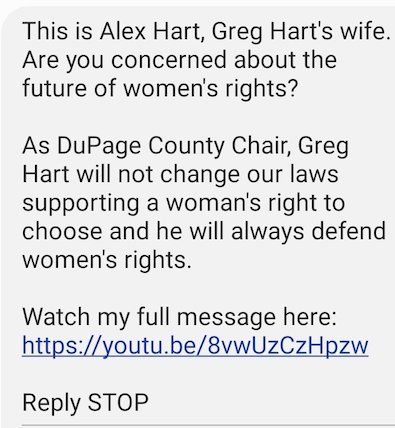
Hart, meanwhile, is sending out campaign text messages from his spouse…
Q: I want to pin you down on this business about you can’t, you’re not even allowed to look at somebody’s history in terms of whether they actually show up when they’re supposed to be at a court hearing. … You’re not allowed to look at that when determining whether they’re a flight risk…
(Text of Section after amendment by P.A. 101-652)
Sec. 110-5. Determining the amount of bail and conditions of release.
(a) In determining which conditions of pretrial release, if any, will reasonably assure the appearance of a defendant as required or the safety of any other person or the community and the likelihood of compliance by the defendant with all the conditions of pretrial release, the court shall, on the basis of available information, take into account such matters as: […]
(3) the history and characteristics of the eligible defendant, including:
(A) the eligible defendant’s character, physical and mental condition, family ties, employment, financial resources, length of residence in the community, community ties, past relating to drug or alcohol abuse, conduct, history criminal history, and record concerning appearance at court proceedings;
…Adding… But there is this part of the statute that the questioner was trying to get at…
“Willful flight” means planning or attempting to intentionally evade prosecution by concealing oneself. Simple past non-appearance in court alone is not evidence of future intent to evade prosecution.
* More state’s attorneys and sheriffs are suing over the SAFE-T Act. WICS…
This time it is Douglas County State’s Attorney Kate Watson and Douglas County Sheriff Nathan Chaplin. […]
In their statement, they argue that the lawsuit seeks injunctive relief based upon the act violating the Illinois Constitution; violating the single-subject law; violating the separation of powers; being unconstitutionally vague, and violating the three-readings requirement.
“Risk to innocent civilians would no longer be a reason for a judge to detain someone who’s charged for the first time offense of kidnapping, or for the first time offense of burglary; even second degree murder, arson,” said Watson.
“It is my sworn duty as Douglas County Sheriff to protect the people of Douglas County,“ said Chaplin. “Criminal justice reform should not be at the expense of public safety. The SAFE T Act was forced through at the 11th hour in a lame duck session (in January 2021). Police and prosecutors were excluded from any type of negotiations. They forced this thing through and now we’re left with the fallout.”
Several state’s attorneys in Illinois have filed lawsuits against the controversial SAFE-T Act, Including those in Mercer, Knox and Jo Daviess Counties. […]
Jo Daviess County State’s Attorney Chris Allendorf said cash bail is ingrained in the Illinois Constitution. […]
On the federal level, Knox County State’s Attorney Jeremy Karlin said it could violate the 14th Amendment. […]
Meanwhile, Karlin agrees that cash bail should be eliminated, but he disagrees with the SAFE-T Act’s implementation. He said the way it is currently written, it restricts his office’s ability to get defendants treatment prior to their trial.
Sangamon County State’s Attorney Dan Wright and Sangamon County Sheriff Jack Campbell are filing a lawsuit over the SAFE-T Act.
The two are suing over the elimination of cash bail, also known as the Pre-Trial Fairness Act.
The lawsuit names Governor JB Pritzker, House Speaker Chris Welch, and Senate President Don Harmon as defendants.
“Litigation of good faith constitutional questions raised by the Act as written, while absolutely necessary to support and defend the Illinois Constitution, does not indicate categorical rebuke of criminal justice reform and many of the public policy objectives underlying the Act,” Wright wrote in a release. “To the contrary, as I have previously stated, the Act includes many provisions that will bring positive reform. The need for meaningful legislative changes to achieve a responsible balance between the rights of criminal defendants and the safety of law-abiding citizens should not continue to be an entrenched “us vs. them” issue hijacked by social media hysteria and election season posturing. Getting criminal justice reform right for all citizens of Illinois is too important to allow our public discourse to devolve into hyperbole divorced from the plain language of the Act, our Constitution, and common sense.”
Add Tazewell County’s top prosecutor and sheriff to a growing list of law enforcement officials around Illinois suing to block full implementation and ultimately overturn a criminal justice reform bill signed into law nearly two years ago.
Tazewell County State’s Attorney Kevin Johnson and Sheriff Jeff Lower filed suit Wednesday in Tazewell County Circuit Court arguing the law is unconstitutional on several levels. They’re also seeking a preliminary injunction on the law’s implementation pending an outcome in the suit.
The two officials are Republicans. They are suing Gov. JB Pritzker, Attorney General Kwame Raoul, House Speaker Chris Welch, and Senate President Don Harmon - all Democrats. […]
Johnson and Lower argue the law will lead to increased staff workloads, delays in court cases, and make it harder to compel a defendant’s appearance in court.
McLean County State’s Attorney Erika Reynolds and Sheriff Jon Sandage are the latest law enforcement officials to go to court in an effort to stop a major criminal justice reform bill from being implemented next year.
They filed a lawsuit in McLean County civil court asks the court to declare the SAFE-T Act unconstitutional. […]
Reynolds and Sandage, both Republicans, said law enforcement officials want to help negotiate changes to the measure they claim will threaten public safety.
They argue a judge’s ability to hold a defendant based on a “high likelihood of willful flight” for an array of violent offenses is too narrowly defined under the law, and makes it unlikely those defendants would be detained. They cite aggravated assault with a firearm, aggravated drunk driving, concealment of a death and certain hate crimes as examples of offenses in which a state’s attorney could not petition the court to hold the defendant in custody prior to trial.
WGN News invited two top prosecutors who belong to the same political party but have vastly different views of the SAFE-T Act for a discussion. Kane County State’s Attorney Jamie Mosser and Lake County State’s Attorney Eric Rinehart joined the WGN Evening News Tuesday.
In the regular [Peoria] city meeting, there was a presentation on the SAFE-T Act to offer clarity for council members about the act. Some council members had questions about how the SAFE-T Act will affect the operation of the Peoria Police Department. Chief Eric Echevarria said he believes major changes will impact state’s attorneys as opposed to local law enforcement.
“Quite frankly, this doesn’t change how we’re procedurally going to do our job. We are going to continue to follow the law. We’re going to continue to make the arrests we need to make,” said Echevarria.
Republican candidate Paul Santucci and Democratic state Sen. Linda Holmes, who are running for the 42nd state Senate District seat, agree the controversial SAFE-T Act criminal-justice reform law needs fixing. […]
“Quite frankly, it is a complicated piece of legislation,” Holmes said. There are aspects of it police and prosecutors support, she added, such as the body cameras and the idea that people accused of violent crimes should not be able to be freed pretrial just because they can afford to post bond.
“If I was in office I would have voted ‘no,’” Santucci said. “I feel that the form it is in now needs to be repealed.” But, he added, there were parts of it he does support, including provisions addressing police abuse of power.
“I would not say, ‘All of it is garbage and must go,’ but there are issues that must be addressed before we are comfortable with the law,” Santucci said.
* Related…
* BND: No, the jail doors won’t open Jan. 1. Here’s what to know about end of cash bail in IL
Today, the independent expenditure committee All for Justice (AFJ) placed its second buy for the General Election Cycle with the ad “Oath.”
The ad highlights the risk Republican Supreme Court candidates Justice Michael Burke and Mark Curran’s pose to all Illinoisians from a doctor’s perspective. This buy builds off the previous ad, “One Seat,” highlighting the horrific records of Burke and Curran on abortion.
“Rochford and O’Brien are right for Illinois. It is the goal of All for Justice to ensure that voters know the distinct differences between them and these two men. We have the resources to set the record straight in both districts and intend to over the final weeks,” said Luke Casson, Chairman of All for Justice.
Justice Michael Burke faces Justice Mary Kay O’Brien in the 3rd District, which includes DuPage, Will, Grundy, LaSalle, Bureau, Livingston, Iroquois, and Kankakee Counties. Mark Curran faces Judge Elizabeth Rochford in the 2nd District, which includes Lake, McHenry, Kane, Kendall, and DeKalb counties.
Pregnancies are complicated and every situation is different. My job is to do what’s best for my patients.
But Mark Curran and Michael Burke want to criminalize abortion in Illinois, and they’ll get that chance if they’re elected to the State Supreme Court.
Criminalizing abortion will put women’s lives at risk. To think that I could be put in jail, that women could be put in jail for making their own medical decisions. Where does this end? Mark Curran and Michael Burke are too extreme for the Illinois Supreme Court.
…Adding… We’ll just have to wait and see if they file suit. ILGOP…
Statement from ILGOP Executive Director Shaun McCabe on false and defamatory “All for Justice” TV Ad:
“The latest false TV ad from ‘All for Justice’ is even more defamatory than their first false ad. This Madigan Machine-backed group is lying about Michael Burke and Mark Curran because they’re attempting to cover up Mary K. O’Brien’s and Elizabeth Rochford’s ties to the Madigan Machine. Don’t be fooled, Illinois voters. If elected to the Supreme Court, Madigan Machine judges O’Brien and Rochford will put their political cronies before the people of Illinois.”
Former state legislator Jim Nowlan is part of the Judicial Fairness Project, and was involved with the effort to oust Kilbride after he and “his fellow Democrats sullied their robes in 2016 with a preposterous decision that knocked off the ballot a citizen’s initiative to put an independent mapping question before the voters.”
Nowlan said Democrats drew the judicial map to favor their party back in the ’60s.
“Since then, continuously, Democrats have had a majority on the Illinois Supreme Court and they have used that majority reliably to back the positions of (Chicago Ald.) Ed Burke and (former Illinois House Speaker) Mike Madigan on redistricting, term limits, pensions,” Nowlan said. “And so, it’s time for a change.”
For the first time, Illinois’ Democratic-controlled legislature and Democratic Gov. J.B. Pritzker last year redrew the Illinois Supreme Court districts, in a manner that Nowlan said will make it more difficult — but not impossible — for Republicans to win them.
He adds that the Dobbs decision overturning Roe v. Wade has changed the landscape and made it more difficult for the GOP judicial candidates.
Some Republican groups and donors that had been expected to come through with heavy funding backed away after Curran, who has never been a judge, won the primary instead of the party’s establishment-backed Lake County Judge Daniel Shanes.
They didn’t back away because he’s never been a judge, but whatevs.
Officials from different Illinois judiciary groups across the state have introduced a Declaration of Judicial Independence to inform the public of the threat of misinformation before the election.
The Illinois Judges Association, representing 1,250 sitting and retired judges in Illinois, introduced the declaration on Tuesday during a virtual meeting about the document.
The document’s purpose is to provide voters with accurate information on judicial candidates ahead of the November election.
Chicago Bar Association President Timothy Tomasik said it is an issue that has been going on for years.
“We are so concerned about the reckless and sometimes ruthless number of politically motivated attacks that have been occurring on our judiciary over the past several years,” Tomasik said.
The Chicago and Illinois Bar Associations are urging voters to consult their evaluations of the candidates, which claim to be non-partisan.
“They are not asked are you Republican or Democrat, do you like the current president or the past president, do you believe in the death penalty or not believe in the death penalty — there is nothing political about the judicial evaluation process,” Tomasik said.
A leader of the pro-abortion rights group, Personal PAC, pushed back. Terry Cosgrove said television advertising focused on what a judge has said or done about the abortion issue, including outside the courtroom, is appropriate.
* Related…
* Illinois Chief Justice Anne Burke Discusses 40-Year Legal Career as She Nears Retirement: Burke also addressed controversy surrounding her husband, Chicago Ald. Ed Burke, who is facing a federal corruption trial next year. She says that the trial “absolutely did not” influence her decision to retire. “My decision was my decision,” she says. “We’ve been married for 54 years and as I always said, for better or worse, but not for lunch. We have to figure out how to do lunch now!” When asked about how well she did in fulfilling her promise to keep her work separate from her husband’s, Burke says “perfectly. Well, not perfectly, but the best I could.”
Most registered voters no longer have traditional television subscriptions, prompting a need for campaigns to increasingly shift advertising to streaming, according to a new Samba TV-HarrisX survey.
The poll found that only 49 percent of registered voters nationwide have traditional TV subscriptions, and the figure falls to 39 percent in 10 key battleground states.
But more than 80 percent of registered voters nationally and in key battleground states indicated they stream television. […]
“The data points very clearly that the future king of political ad spending will be streaming. Voter eyeballs are more likely to be present there by a factor of almost two to one,” said Dritan Nesho, founder and CEO of HarrisX.
* The Question: Where do you generally see the most political advertising? Explain.
* A whole lot of folks need to read this, not because it’s full of scary right-wing stuff, but because it’s chock full of very practical information for candidates…
Seems legit. Either way, there’s a lot of good, basic stuff in there for all candidates. Looks like pretty effective how-to training https://t.co/tXi9BGYu2O
The other side better be prepared, because the Awake IL types are getting some decent training for school board elections. And Dan Proft, who is sitting on a giant mound of money, has said he wants to get involved in school board races. From July…
Following the end of his congressional campaign in Illinois’ 14th congressional district, Mike Koolidge has been hired as the Communications Director and Chief Spokesman for People Who Play By The Rules PAC, effective immediately. The “PBR” PAC is a political action committee whose mission is to support gubernatorial candidates and candidates for local offices, particularly school boards, committed to ending the fleecing of people who play by the rules and are gamed by a political system they finance.
Proft was reportedly at that Awake IL training session. Again, go read it.
Attorney General Kwame Raoul accused his Republican challenger Thomas DeVore of making “dangerous” remarks, while DeVore accused the Democratic incumbent of failing the state’s school students by not challenging Gov. JB Pritzker’s COVID-19 mitigations.
The charges and countercharges came during a nearly hourlong debate organized by the Illinois Associated Press Media Editors and Capitol News Illinois that was conducted Monday via Zoom. […]
“I think one of the things we’ve learned over the course of the last couple of years is that there was a fair question to be asked about the extent of the governor’s ability to issue some of those mandates,” DeVore said. “You know, you have some on one side of the conversation say he could absolutely do it. You had some that said he absolutely couldn’t. But I think we would all agree as intellectual people there was a fair question.”
Raoul, however, defended his decisions, and his support for Pritzker’s executive orders, saying the state was in the midst of a deadly pandemic and that he, himself, lost friends to the disease.
“I will agree with Mr. DeVore. It was a fair question to ask,” Raoul said. “But how many times you ask it is a fair question too. It was asked and answered multiple times in multiple lawsuits. And the courts’ resources should not have been abused as they were.”
Q: The Attorney General said that some of these [”stop the steal”] lawsuits, challenges we’ve seen in other states undermine democracy. Do you agree with that?
DeVore: I’m willing to go that far because again,we’re not dealing with propaganda here to create fodder for to me what doesn’t matter, which is our state. You know, if there’s people filing lawsuits and other states, I’ve heard about them, are they trying to undermine democracy or whether they have specific articulable facts? I don’t know. Maybe Mr. Raoul knows, but I’m certainly not going to discredit people bringing forth causes of action trying to make a point in a court of law if it’s not a meritorious case, the courts will dispose of those in short order.
Q: Okay, Mr. Devore. On the topic of lawsuits, what happens to your private practice if you are elected Attorney General? Do you completely step aside? I’m not even sure if there’s prohibitions on maintaining that office while serving as AG. But also on the topic of lawsuits, you sued the governor for calling you a grifter. You sued the mother of your girlfriend for allegedly criticizing you. And then about five years ago, you sued a special education teacher for criticizing your characterization of some students as window lickers, alleged characterization maybe. So is the lawsuit a tool you’re using to maybe quash public criticisms and should we expect that level of private litigation from you if you are elected Attorney General?
DeVore: A lot of different questions in one statement there and I’m not sure which ones to deal with. But look, let’s talk about the governor’s comments. He never at one time said that what he called me, which is a fee for all intents and purposes, wasn’t defamatory. He raised the argument that as the governor he can defame people all at once and go about saying whatever he likes, and he has that immunity. That was his argument. As to these other causes of action, those are personal issues. To the extent those persons are trying to say those things, but in general, I’ll say merely because you know how many people are stifled to run for office because they’re scared that they’re going to be absolutely taken to task on their whole manner of things that exceed the office a lot. You know what? Governor Pritzker just sent a letter through his law firm to a news organization in the north saying that what you’re doing is defamatory to me, please stop. So when it rises to the level of it’s not just political talk, and it’s accusing people of committing crimes, and saying other things that impugn their ability to do their job, they have an absolute right to defend themselves. Me, the governor, Mr. Raoul and anybody, and to suggest that it has some ulterior motives other than defending your character I take issue with that, because that’s what it’s about. The governor had the right to send that letter when he sent it. Just as much as I have the right to defend myself. And if someone says something like that to Mr. Raoul, I would hope he would do the same thing.
Q: What do you do with your private practice if you become elected Attorney General?
DeVore: There’s a lot of other lawyers in our office that are already handling most of those cases, and would continue to handle those cases as well.
Q: Would you accept any income from that?
DeVore: I will not be, whether I would or wouldn’t I can tell you the answer is no. I’ve already made that clear to them that it’s again, I’ve not even looked into the details of that Mr. Raoul may know. But I know my decision that I made is not something that has to be vetted because I won’t get any income from it. I won’t be a part of it. I’ll be completely disconnected and have nothing to do with the financial part of it.
Q: And should we expect these level of private lawsuits from you to continue if you’re elected Attorney General?
DeVore: You mean you’re asking me if somebody is going to defame me in the future?
Q: Are you going to plan on suing people who speak ill of you as attorney general?
DeVore: You know, whoever asked that question, I put them in the category of people that need to stick to reporting. If someone defamed me anytime in the future, am I going to defend myself? Absolutely. But to suggest that that means you’re going to go out and just start filing lawsuits against people at will it’s a poor choice of words and completely irresponsible for whoever asked that question. Of course, I’m going to defend myself if I need to no more than Attorney General Raoul would defend himself and Governor Pritzker currently defends himself, so it’s not unique to me.
Raoul: I think a lot of questions speak to something that we as lawyers and certainly as attorney general, have to have respect for, is and that’s of course resources. You know, lawyers, whether they’re attorney general or independently, can be sanctioned for abuse of filing non-meritorious lawsuits. As we talk about the defamation lawsuits that were referenced before, including one against a special ed teacher for objecting to Mr. DeVore referring to some kids as window lickers. First off, I don’t think we want the courts to be used to stop teachers from being protective of students when somebody’s gonna do something that I think is just unconscionable. And then, the other thing that’s important to look at is the outcome of those lawsuits. That lawsuit was eventually dismissed, right? And so, it’s one thing to file a lawsuit if you really try to follow a meritorious lawsuit, carry it out to the point where you know it has merit and you can prevail. The number one defense to defamation is truth.
DeVore: Yeah, Attorney General Raoul, well, let me just say what you just said on this camera is defamatory because you weren’t there. You don’t know anything about it. It was not anything to do with special needs kids. It didn’t have anything to do with a special ed teacher. None of that.
Raoul: I didn’t say anything about special needs kids.
DeVore: Yes you did.
Raoul: I said kids.
DeVore: You said, disabled kid. But I dropped the case because the young man who made those defamatory statements was scared to death. And so why should I put him through more than I already went through. So don’t talk about things you don’t know what you’re talking about. I mean, how many special needs kids have suffered tremendously for your failure to defend them against the governor’s tyrannical behavior? Thousands and thousands of special needs kids have lost their learning that they’ll never recover in their lifetime. That’s true. And that’s on you, sir. So please don’t talk to me about some alleged defamatory issue from five years ago, when the kids of this state will never recover from your failure to defend them against the governor. Please don’t go there with me sir.
Raoul: Thank you for your comments, Mr. Devore. If you take time to re-watch the tape you will find out that I did not say special. I said kids, and I think what you said about kids whether special needs or not is despicable.
1) DeVore would certainly know about courts tossing out lawsuits.
2) DeVore implies he sued the governor because too many people are scared of being “taken to task” when they contemplate running for office, and then said he dropped his window lickers lawsuit “because the young man who made those defamatory statements was scared to death.” OK.
3) Raoul did not say “disabled kid” despite DeVore’s instance. So, is that defamatory? /s
All right, happy Columbus Day. Yes, Columbus Day, not indigenous people day. Coming to you from the site of the former Christopher Columbus statue in Grant Park. That should be backed up there. That’s a whole story in and of itself, that some civic leaders and some political leaders in this city are going to have to answer for in the coming months during election season. For their decision naively to believe the mayor that this was a temporary thing. Because here we are, two years later, still gone. Disgusting. But they allowed it. She should pay the price for having it done to begin with.
You notice they’ve never, ever hijacked any other ethnic holiday. It’s for some other purposes. Why Christopher Columbus Day? Why don’t they just create a new day for indigenous people? Christopher Columbus is supposedly responsible for the slaughter of thousands, if not more, Indians. Because he came to America, while coming to America definitely resulted in some bloodshed, no doubt. But why does Columbus get the blame for all of that? It’s ridiculous. Number one.
Number two, Christopher Columbus brought Christianity to United States. There’s no disputing that he did. Where are the religious leaders sticking up for civil and religious liberties thanks to Christopher Columbus? Nowhere to be found.
Or the Christian leaders. Where is the Cardinal? Where’s the Pope? Nowhere to be found. They’re all hypocrites. Just like the mayor and political leaders who thought it was a good idea to take these statues down. The same people who blamed Christopher Columbus for all these atrocities that were supposedly committed on behalf of modernization are the same ones that enjoy these newfound freedoms with modern civilized society.
I don’t see any of these politicians selling their houses to live in teepees, hunt buffalo or raise crops in their back yards like the Indians did. But they all want to say ‘Oh, the poor Indians.’ Okay, great. Create a day separately. You don’t have to steal someone else’s holiday to create another one. But that’s just the sad reality we’re living in today.
Otherwise, you wouldn’t be getting the freedoms, like shopping in a 24-hour Walgreens, or buying cases of Modelo in the middle of the night. But those are freedoms afforded to you, in part thanks to the civilization that Christopher Columbus helped bring to this country. Shame on you all. There will be repercussions in the elections coming forth. These hypocrites need to be accounted for and basically removed from office.
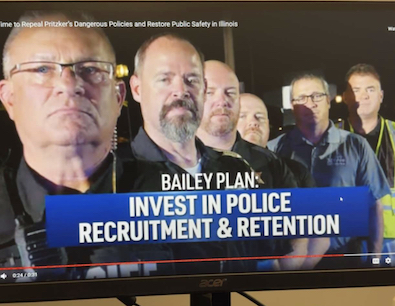
* Republican Darren Bailey’s first TV ad of general election campaign focuses on crime: While other TV ads critical of Pritzker have been airing since Bailey won the six-man GOP primary race, those ads were paid for by a political action committee aligned with Bailey’s campaign. The new TV ad is the first to be broadcast and paid for by Bailey’s campaign. … The ad buy for the 30-second spot totals $534,000, campaign spokesman Joe DeBose said, and will include being broadcast in the expensive Chicago-area TV market. DeBose said the ad is slated to debut Wednesday or Thursday.
* Darren Bailey’s gubernatorial party nomination signals a rightward shift in Illinois GOP, experts say: Bailey has built his political platform around criticizing Pritzker’s COVID-19 response, making headlines in 2020 for refusing to wear a mask during a legislative session and suing the governor over his stay-at-home order. Chicago crime has also been a focus of Bailey’s gubernatorial campaign. In 2019, he co-sponsored a resolution in the Illinois House to separate Chicago from the rest of the state and has frequently referred to the city as a “hellhole.”
* With Jesse White off statewide ballot for first time in nearly a quarter century, voters faced with fresh choices for Illinois secretary of state: Republican Dan Brady, 61, of Bloomington, is a veteran state legislator who touts his record of bipartisanship and promises to expand staffing to reduce wait times at secretary of state facilities. Democrat Alexi Giannoulias, 46, is attempting a political comeback after losing a 2010 U.S. Senate race following a single term as state treasurer. He says that if elected he will lean heavily on technology to make the office more consumer-friendly.
* Illinois attorney general race: Raoul, DeVore interview with IAPME: A joint interview with candidates for Illinois attorney general, Democratic incumbent Kwame Raoul and Republican Tom DeVore, conducted by the Illinois Associated Press Media Editors Association.
* State Senate 26th District candidates differ on variety of issues: State Sen. Dan McConchie, R-Hawthorn Woods, who serves as the Senate minority leader, said as he talks to voters this election season he hears concerns about inflation more than any other topic. […] Maria Peterson, a North Barrington resident and McConchie’s Democratic challenger in this fall’s election, said as she communicates with people while she campaigns, concerns about gun violence are a frequent topic.
* Former corrections officer running for Illinois’ 72nd House District: A lifelong resident of Rock Island County, Johnson says his life experience has prepared him well for this position. After working for the Illinois Department of Corrections, Johnson says he has firsthand experience advocating for various issues in Springfield. And if elected, he would focus on improving mental health care in Illinois and encouraging young people and families to continue living in the state.
* Martens running for Illinois’ 72nd House District: A Rock Island native and mechanic at Rock Island Electric Motor Repair, Martens says working full-time helps him understand his constituents better than his oponents. And if elected, Martens would focus on voting security and cutting taxes. Martens says if Illinois doesn’t cut spending it will become bankrupt. Because of this, he believes a change of leadership is needed in Illinois.
…Adding… Pritzker campaign…
After months of being propped up by notorious grifter Dan Proft, Darren Bailey is finally up with his first TV ad of the general election and, as expected, it is full of misleading information.
Darren Bailey’s newest ad falsely claims he supports investments in police retention efforts, when his actual voting record shows he voted against millions of dollars for local law enforcement retention grants.
At every opportunity, Bailey voted against bolstering funding to support law enforcement and improve public safety. The governor’s Fiscal Year 2023 budget, which Bailey voted NO on, included the single largest dollar investment to expand cadet classes in Illinois history, $10 million for local law enforcement retention grants, and $8 million for equipment replacements and upgrades at the Illinois State Police.
Additionally, Bailey voted against:
-Providing tens of millions of dollars for police body cameras, retention grants, and mental health screenings
-Strengthening the Illinois State Police Division of Forensic Services
-Strengthening safety for first responders on state highways
-Installing hundreds of highway cameras and doubling state police presence on Chicago-area interstates in response to on-road violence
-Building new, state-of-the-art forensics labs to provide law enforcement with the resources to solve crimes
-Pumping $30 million into multi-jurisdictional task forces to catch and crack down on carjackers
“No amount of false advertising can paint a rosy picture of Darren Bailey’s disastrous voting record thwarting public safety,” said JB for Governor Press Secretary Eliza Glezer. “Bailey had his chance to vote for police recruitment and retention efforts and, instead, voted NO.”