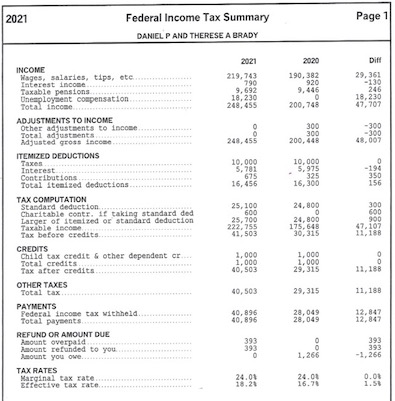
Dan Brady, the Republican nominee for Illinois Secretary of State, has released a summary of his tax returns for calendar years 2020 and 2021 and has called on his opponent to do the same.
“The Secretary of State’s office regulates the offer and sale of securities and the people who provide those services, so it’s crucial that voters know if candidates for the office have any potential conflicts of interest,” Brady said. “That’s why I’m releasing this summary of my tax returns so voters can see for themselves that I have no such conflicts. I call on my opponent to do the same thing, but so far he has steadfastly refused to do so. I wonder why.”
According to the Secretary of State’s website, the Illinois Securities Department regulates the offer and sale of securities pursuant to the Illinois Securities Law of 1953. The department registers securities offerings, broker-dealers, investment advisers and their sales-persons and representatives, loan brokers, business brokers and those who offer and sell business opportunities.
Brady is an Associate Director at the firm of Kibler Brady Ruestman Memorial Home and a part-time legislator. He submitted his Statement of Economic Interest form as required by law on March 7, 2022. Brady’s opponent, Alexi Giannoulias, filed the same form on March 14, 2022 with numerous attachments. To date, Giannoulias has refused to follow Brady’s lead and release his income tax information as well.
Brady’s tax summary reflects the fact that his wife Teri was without work for a period of time following a corporate layoff and drew the unemployment benefits to which she was entitled.
During a recent interview with the Illinois Associated Press Media Editors, Giannoulias blamed his wife for not disclosing their taxes. “My wife and I have some…ah…some things that she wants to keep…ah…private,” Giannoulias said. This is not the first time Giannoulias has refused to release his taxes.
The link to the Illinois Associated Press Media Editors interview is here: https://youtu.be/egv-XE-d_uo.
In a news segment posted on Facebook on May 19, 2022 by ABC 7 Chicago, Giannoulias refused to release his taxes. While being questioned in the Illinois Associated Press Media Editors interview about conflict of interests in investments Giannoulias said, “I think the only investments I have are just passive.”
The link to the ABC 7 interview is here: https://www.facebook.com/abc7chicago/videos/2935946843369210/.
Giannoulias has a history of questionable financial actions. Broadway Bank gave approximately $20 million to Russian mobsters while Giannoulias was a senior loan officer, and the bank was later seized by federal regulators. As Illinois State Treasurer, Giannoulias’ college savings fund, Bright Start, lost $150 million.
“The Secretary of State has a fiduciary duty to manage the state’s security division without impropriety,” Brady said. “Giannoulias can’t have it both ways. He needs to be truthful with voters.”
* Brady’s income summary is just that, and it’s sparse…
* The Question: Should the state mandate that all candidates, state and local, disclose at least part of their income tax returns? Explain.
He’s running for the highest seat in Illinois government, but Republican candidate Darren Bailey says he’d be powerless to change abortion laws if elected.
“Nothing’s going to change when I’m governor. I couldn’t change them if I could [sic],” Bailey said at the debate Thursday night.
Anti-abortion groups have backed Bailey since the primary. His apparent side step of the issue Thursday did not shake their faith in their candidate.
“Bailey is unapologetically pro-life and he will work to undo some of the extremism that we have in our state right now.” Amy Gehrke, the executive director of Illinois Right to Life said. […]
“If elected, I’m going to work to make sure abortion becomes unnecessary day one,” he said at a campaign event the day before the primary.
…Adding… Bailey’s running mate is not so reserved…
Vowing that this is just the beginning, about 100 anti-abortion activists gathered outside a planned abortion clinic at 611 Auburn St. on Monday to pray and hear from Stephanie Trussell, the former conservative radio personality turned Republican candidate for lieutenant governor. […]
“They talk about the violence in some of these communities but more violence is happening right there in an abortion clinic,” Trussell said. “We expect people to value life, but we’re not valuing babies.”
Stumping for votes in conservative southern Illinois, Republican governor hopeful Darren Bailey took the same stage as Donald Trump Jr. on Saturday night, with the former president’s son encouraging those in attendance to back Bailey while Bailey stuck to his campaign speech and didn’t publicly acknowledge the younger Trump’s presence.
The scene was markedly different from the one that unfolded in the waning days of the GOP primary this summer, when former President Donald Trump endorsed Bailey. Since that endorsement, however, Bailey has slowly tried to distance himself from Trump as Bailey faces a general electorate in Illinois that twice rejected the former president by a 17% margin.
(I)n the 2022 general election at least 22 Illinoisans of Asian descent are running for office in November, from county commissioner to state representative to U.S. senator.
That could herald the state’s largest Asian American caucus ever and reflects a national trend of Asian Americans getting elected to public office. […]
Jue has also consulted for Hoan Huynh, who’s running to represent portions of the North Side in the Illinois House and who would be the legislature’s first Vietnamese American representative if elected.
Jue and others who spoke with the Tribune said the current wave of Asian Americans engaged in politics is decades in the making and speaks to the organizing prowess of their community leaders. They also noted recent topics in the news — such as the rise in anti-Asian attacks and 2020 U.S. census figures showing Asians are the fastest-growing racial group in Chicago, Illinois and the country — demonstrate the urgency for more political representation. […]
[Hoan Huynh’s] Democratic primary opponents included Eileen Dordek, the former board chair of the pro-abortion rights Personal PAC who was endorsed by heavy hitters such as Gov. J.B. Pritzker, U.S. Sen. Dick Durbin and a slew of other Democrats. The only elected official willing to support Huynh back then was state Rep. Theresa Mah, the first Asian American elected to the General Assembly in 2016. […]
Down in the slower paced, more homogenous towns of central Illinois, Sharon Chung didn’t plan on drawing attention to her Korean ancestry when she took office in 2018 as the first Asian American elected to the McLean County Board. In some ways, that’s still the case when she’s campaigning as the Democratic nominee for the Illinois House’s new 91st District, an open seat that was redrawn this year to bring together more Democratic-leaning voters.
* On a somewhat related note, WGN TV’s Lourdes Duarte has a good piece on the growing influence of Latinas in Illinois politics. Take some time to watch it…
* Clem Balanoff was very involved in campaigns during the 1994 GOP landslide. He has seen the wild swings in off-year elections up close and personal, so when he talks about the open-seat races in the 13th and 17th congressional districts with Politico, you should listen…
Balanoff, the Illinois operative, expects voter interest to continue shifting before November.
“If the election were held today, I think Democrats would win both seats. But it’s two more months, and that’s an eternity,” he said at the time, adding what would be a prescient comment. “One bad break and things change dramatically. What if OPEC said they were to cut production and prices go up? You just never know.”
Kwame Raoul is pandering for votes talking about his futile efforts to try and pass a 50-year old amendment to the constitution regarding equal women’s rights that none of you have likely ever heard about. A lot has changed since 1972 such as biological males trying to take over women’s sports & tampon dispensers in boys locker rooms. The list goes on. I have two 19-year old daughters whose rights I’ll fight for at every step and if Kwame really cared about my daughters rights, he’d address these real issues facing women today and not an out of date constitutional amendment that has little practical relevance five decades after the fact.
Also from DeVore…
.@RealCandaceO PayPal took $15,000 from me and won’t return it. I’m the Attorney General candidate in Illinois so just think how they treat everyday people. This company is so corrupt I have to sue them to get my money back.
New voters have until today, Oct. 11, to postmark their mail-in application to register to vote in the Nov. 8 midterm election.
Should Illinois voters submit their application online, they have until Sunday, Oct. 23 at midnight. Additionally, Illinoisans should double-check their voter registration in order to update or correct any appropriate information, said Jay Young, Common Cause Illinois’ executive director.
“The right to vote is the foundation of our government, and elections — both generals and primaries — are a key element of that foundation,” Young said. “Please encourage your friends, family, and community to spend a few minutes ensuring their right to vote is intact and ready for Nov. 8 by registering to vote.”
Illinoisans can register to vote online and make any needed changes to existing voter registrations at https://ova.elections.il.gov/.
If Illinoisans miss the Oct. 11 or 23 deadline, they can still register through Same Day registration on Election Day at designated voter locations.
Other important election-related dates for voters:
• Now - Nov. 7: Voters can request absentee or vote-by-mail ballots. If they request by mail, the request must be received by Nov. 3.
• Now - Nov. 7: Early voting period. Check with your election authority for details.
• Nov. 8: Absentee/mail-in ballots must be returned, either in person or by mail and postmarked by Nov. 8.
• Nov. 8, Election Day: Polls are open from 6 a.m. to 7 p.m.
* Roundup from Isabel…
* ADDED: Press release: After closely aligning himself with Awake Illinois—named a “hate group” by Equality Illinois—anti-choice Republican Keith Pekau has announced plans to campaign with election-denying Congressman Jack Bergman (R-MI), a far-right Republican best known for supporting legislation to ban abortions in every case, with no exceptions for rape, incest or life of the mother. Bergman wants to go even further and create a criminal penalty for doctors who perform an abortion. Bergman is a former lobbyist for a non-profit that was forced to pay nearly one hundred million dollars to the Department of Justice for scamming veterans. He also voted against certifying the 2020 election and coordinated with local officials to attempt to overturn the results. “From accepting an award from Awake Illinois to jeopardizing the health of his constituents for cheap political points to campaigning with a radical, anti-choice insurrectionist who helped scam veterans, Keith Pekau has shown us who he is,” says Trevor Nyland, spokesperson for Casten for Congress. “It’s time that the voters of IL-06 believe him.”
* Lawsuits looking to block SAFE-T Act stacking up as Pritzker signals changes ahead: Last week, Sangamon County State’s Attorney Dan Wright filed a lawsuit challenging the act’s constitutionality for various reasons. Wright said in a statement the law set to take effect Jan. 1 “contains confusing and inconsistent provisions likely resulting in divergent interpretations and disparate outcomes” across the state. Other measures are clear, but raise “sincerely-held public safety concerns,” Wright said.
* Gun violence is dropping in Chicago as police credit new tactics, community investment: While shootings like those that killed Zastro and wounded Barr continue, the violence does seem to be ebbing: An ABC News/Gun Violence Archives analysis of the nation’s 50 largest cities shows homicides are down nearly 5% from last year after two years of pandemic-era increases.
* Candidates for Illinois governor offer ideas for gun control: There are several pending lawsuits in state and federal courts challenging a variety of Illinois’ gun laws, including the Firearm Owner’s Identification Card Act. During the first gubernatorial debate last week, Gov. J.B. Pritzker defended the FOID card system and an option to submit fingerprints.
* Illinois political expert weighs in on first gubernatorial debate: Springfield political observer Kent Redfield said Monday that the debate likely didn’t help people who are undecided between Gov. JB Pritzker and Sen. Darren Bailey (R-Xenia). The professor emeritus of political science at the University of Illinois-Springfield said Pritzker and Bailey were able to use their greatest hits with talking points about abortion, crime and the state’s economy.
* Political expert: first governor’s debate won’t sway many voters: “There was nothing there that was a huge gaffe, a huge breakout,” Kent Redfield, political science professor emeritus of University of Illinois Springfield, said. “There’s nothing that’s going to be, you know, in the history books about what you should do right, or should do wrong in a debate.”
* Pritzker, Bailey refuse to get specific in some important areas: For the governor, that was when he wouldn’t say what changes he’d make to the Pretrial Fairness Act provision of the SAFE-T Act criminal justice reform that will end cash bail on Jan. 1. For the governor, that was when he wouldn’t say what changes he’d make to the Pretrial Fairness Act provision of the SAFE-T Act criminal justice reform that will end cash bail on Jan. 1.
* Supreme Court 3rd District: Burke, O’Brien vie for open seat: If Burke wins his race and Republicans also claim the newly redrawn 2nd District, the court’s majority would flip to the GOP. But Burke and O’Brien each downplayed the role partisanship plays on the court.
* Daily Herald: Giannoulias endorsed for Secretary of State: Brady has a similar approach to providing tech upgrades, but we’re impressed by how well Giannoulias has laid his out. Giannoulias’ experience on the Chicago Public Library board — at a time when book banning is all the rage, is important as well. Giannoulias is endorsed.
* Daily Herald Endorsement: Mendoza for Illinois comptroller: Mendoza’s record, her previous experience as a Chicago city clerk and Illinois state legislator and her seemingly boundless energy make her an exceptional fit for state comptroller. She easily wins our endorsement.
* Illinois FOP State Lodge endorses Deering: “Regan Deering has earned our endorsement because she steadfastly supports the law enforcement officers who protect our communities, unlike many politicians, including her opponent, who favor anti-police and pro-criminal laws,” said Illinois FOP State Lodge President Chris Southwood. “Regan will be the strong voice we need in Congress to return sanity to our government and safety to our neighborhoods.”
* Budzinski endorsement by AFFI: Today, Nikki Budzinski, candidate for Congress in Illinois’ 13th Congressional District, highlighted her endorsement from the Associated Fire Fighters of Illinois (AFFI). The AFFI organizes, supports, advocates, and promotes the interests of professional union firefighters and EMS providers in Illinois. … “Twenty-four hours a day, seven days a week, fire fighters are on-call to keep us safe. And when emergencies arise, they risk their lives to protect us. I was proud to advocate for firefighters and EMS workers at the International Association of Fire Fighters – and I’m proud to have the endorsement of Associated Fire Fighters of Illinois as I run to serve Central and Southern Illinois in Congress. I’ll always work to ensure our first responders have the resources they need to stay safe as they serve our communities.”
* Illinois Black Caucus director stands at the forefront of change: The Illinois Black Legislative Caucus Foundation is dedicated to advancing the lives of Black citizens in the state. The foundation has opened doors to opportunities for many families through student scholarship funding, weekly forums on how to become politically engaged, and securing a seat at the table to facilitate change. The executive director of the Illinois Black Legislative Caucus Foundation, Tiffany Hightower, takes pride in ensuring that African American citizens are equally represented in legislative processes.
* Opinion | More or Les: An open letter to secretary of state candidates: I think most of the time being secretary of state is a pretty good and non-controversial role: overseeing everything from what most of the rest of the world calls the department of motor vehicles to organ donor registries and working with non-profits. However, I have a couple of beefs with the last few incumbents of Illinois’ secretary of state office.
* Mike Matejka: Amendment acts on basic protections: By voting yes, these fundamental workplace rights become more than law in Illinois, they are constitutionally protecting. Workers’ Rights Amendment opponents have raised the weak and false issue of increased taxes. There is nothing in this amendment that impacts taxes directly. This is a long-used fear tactic to evade the real issue, which is giving average working people a voice.
TV shows like ‘The Walking Dead’ and ‘iZombie’ have shown us that although it’s unlikely, you should always consider the possibility of a zombie apocalypse. […]
Estimations for this study are based on a sample of 369,240 globally geolocated cemeteries and graves acquired from an established public database of cemetery records. The total number of zombies is synonymous to the number of graves in the area.
With a whopping 12,691,919 potential living dead roaming the streets, New York is the worst US state to be in, should a zombie apocalypse occur. The Big Apple is also home to 9,730 cemeteries, which we recommend avoiding!
The second most dangerous state to live in during a zombie apocalypse is Pennsylvania, with 12,505,514 potential walking dead.
In third place is Ohio, with the chance to host 10,361,999 zombies during doomsday - 15% more walking dead than California which comes in fourth place with 8,732,358.
Texas comes in fifth place (8,624,922 potential zombies), followed by Illinois (8,235,259), Indiana (5,979,766) and Missouri (5,970,345). […]
Residents in Alaska might not notice there is a zombie apocalypse, with just 72,849 potential creatures roaming the streets during doomsday. The same can be said for Wyoming, the second least affected state, with only 295,117 potential zombies roaming the streets.
The third least dangerous place to live during a zombie apocalypse is Nevada (333,326 potential zombies), followed by Hawaii (343,193) and Delaware (446,313).
If you fear the walking dead, then your best strategy for avoiding getting bit would be to shelter in place.
Surprisingly, the Midwest is the smart choice for a hideout. The Kansas City metro area, the Twin Cities, and Chicago suburb Naperville, Illinois, are all good places to invest in a home before the apocalypse. Properties in the Midwest region are not only generous in square footage, but they also commonly come with basements that you can convert into bunkers.
* If you want to look at the rankings, here you go
* Related…
* From 2017, Being prepared for zombies is now a real thing in Illinois: The legislature has declared October “Zombie Preparedness Month.” Why? Because, as House ResoIution 0030 says, “If the citizens of Illinois are prepared for zombies, than [sic] they are prepared for any natural disaster.”
* The Pentagon has an actual plan for the zombie apocalypse: The strategy, known as “CONPLAN 8888,” is an unclassified document that lays out how the military would best respond to a potential zombie apocalypse. The plan’s overall purpose is for the military to undertake operations to “preserve ‘non-zombie’ humans from the threats posed by a zombie horde.”
[Note from Rich: This post mysteriously disappeared from the site, so I put it back. Not sure what happened there.]
* Photo taken today by a Democratic state legislator in Lisle, across the street from a high school. “Paid for” just says “Sponsored Backspace,” and, no, I don’t know what that means…
Under JB Pritzker and Lori Lightfoot, crime is out of control. I’m Darren Bailey. I’ll end Pritzker’s no cash bail policy that’s putting violent criminals back on our streets. I’ll increase police recruitment and retention to put more officers in our neighborhoods. I’m Darren Bailey and your safety will always be my priority.
*** UPDATE 1 *** $355K would be a small broadcast buy…
#ILPol: Darren Bailey has just placed his first ad buy for the #ILGov general. So far we've seen him spend $355K.
*** UPDATE 2 *** A half mil still ain’t much. Tribune…
The ad buy for the 30-second spot totals $534,000, campaign spokesman Joe DeBose said, and will include being broadcast in the expensive Chicago-area TV market. DeBose said the ad is slated to debut Wednesday or Thursday.
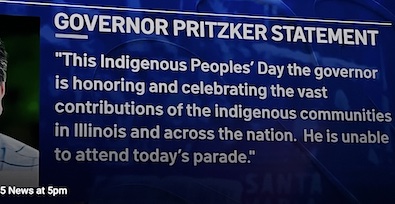
The city of Chicago marked both Indigenous Peoples Day and held its 70th annual Columbus Day parade Monday. But the controversy over Christopher Columbus’ legacy kept some elected leaders away.
He didn’t actually attend any events, but did have “a full day of meetings and interviews,” according to his campaign. Pritzker didn’t post anything on Twitter except that he was “celebrating”…
On Indigenous Peoples’ Day, we recognize and honor the history, culture, and traditions of Indigenous communities in Illinois among us and before us.
I’m celebrating their strength and resilience today and recommitting to a brighter future for us all.
For parade organizers, there was a sense of disappointment with those politicians who were not there - particularly if it’s out of concern about the controversy.
“Any elected official who’s not here today, I feel bad for them because they’re not really standing up for people they’re standing up for themselves,” said Ron Onesti, president of the Joint Civic Committee of Italian Americans.
“If that’s why they’re staying away, then they’re cowards, that’s what I would say,” 38th Ward Ald. Nick Sposato said. […]
“I think it’s an absolute shame that Governor Pritzker and Lori Lightfoot choose to diminish the accomplishments that Italians have made to our society,” Bailey said. “So no, I want to celebrate this, this is what America is about right here.”
The powers that be should figure something out. We ought to be honoring Italian-Americans.
* I reached out to the governor’s office about this topic and here’s what I was sent…
Our strength as a country and state come from our diversity – and no matter where we came from, our contributions have made America the greatest nation in the world. But we are also strong because of our willingness to confront the ugly sins of our past; and the genocide and abuse of Native Americans is a stain upon our collective conscience. It is appropriate for us as a state to recognize both the good and the bad, and I am committed to working with all people of goodwill to continue to recognize the contributions of Italian Americans while also telling honest stories about the lives, history and contributions of our nation’s Native Americans.
Maybe something can be done.
Your thoughts?
* More…
* Native Americans want recognition of Indigenous Peoples Day as Columbus Day celebration parades downtown: “Why can we have Juneteenth, but we can’t get Indigenous Peoples Day?” [Ald. Maria Hadden] said. … “We’re not going anywhere,” Onesti told the Tribune. “There’s over 500,000 of us in the Chicagoland area, and we’re here celebrating and flying the green, white and red of our flag today.” … “We want the Indigenous people to have their day,” Onesti said. “We want to celebrate with them. But there’s 364 other opportunities. Let us have our day.”
* Chicago’s Columbus statues remain hidden as another Columbus Day arrives: But Onesti said Italian Americans are “very hurt, very furious” that Lightfoot ignored the demand to return the Columbus statues to their pedestals in time for Monday’s celebration of the Columbus Day holiday that his community holds dear. “If this was any other ethnic group involved, this would have been taken care of a long time ago. For some reason, she feels that Italian Americans are easy to push around and easy to manhandle,” Onesti said. … “If you read history and you read his own journals, you’ll see how he abused Native women and girls … and the cruelties and atrocities that he committed against Native people. He … took them back to Europe as slaves,” [Les Begay, one of the founders of the Indigenous Peoples’ Day Coalition of Illinois] said. “It’s very much like keeping Confederate statues up. There’s no difference between the two. Columbus triggers Native people just like Confederate statues trigger other groups.”
The disturbing 911 call began with sounds of a struggle, then a voice that sounded like a child’s cried out, “Let me go.” When the police dispatcher in the rural southern Illinois community announced herself, no one responded.
She heard other voices, laughing and taunting, then a female voice said, “You want me to break your other finger?” […]
With the audio recording in hand, the Illinois State Police launched an investigation. They learned that the call was made as Choate employees attempted to restrain a patient: A smart watch jostled in the struggle had accidentally dialed emergency services. They discovered that the voice heard pleading for help belonged to Alijah Luellen, who has Prader-Willi syndrome, a genetic condition that can cause severe childhood obesity, intellectual disability and behavioral problems. They also discovered that the other voices belonged to the employees paid to care for him.
Nonetheless, such incriminating evidence was not enough to hold anyone accountable.
Some more background on Choate’s timeline of abuse is here.
Reporting by Lee Enterprises Midwest, Capitol News Illinois and ProPublica reveals a culture of cover-ups that makes it harder to reform the 270-bed developmental center for people with intellectual and developmental disabilities and mental illnesses. In dozens of cases, records show that Choate employees have lied to state police and to investigators with IDHS’ Office of the Inspector General; walked out of interviews, plotted to cover up or obfuscate alleged abuse and neglect; and failed to follow policies intended to protect the integrity of investigations. […]
Yet they all claimed they couldn’t recognize the voice of the worker who threatened the patient on the 911 call.
In addition, two employees cut their interviews with investigators short and walked out. (Law enforcement cannot compel employees to answer questions, according to state police; IDHS said that employees’ participation in criminal investigations is not mandated as a condition of employment.) Another employee, in internal paperwork, initially stated he assisted in the restraint. He later told police he had falsified the paperwork and wasn’t actually in the room, according to the police report.
Between 2015 and 2021, the Office of the Inspector General for the Illinois Department of Human Services received 1,180 allegations of abuse and neglect at Choate. But late reporting, uncooperative employees, lack of video evidence, conflicting witness accounts and other investigatory missteps can result in the OIG being unable to obtain enough evidence to substantiate an allegation — even when there are unexplained patient injuries.
We requested these records, but OIG refused to send them all, citing state law that prohibits the release of details from unsubstantiated cases. They did send a stack of information from that same time period regarding substantiated cases, along with records from 184 cases in which the OIG identified problems and asked Choate administrators to respond with their plans for remedying the situation. These are cases in which OIG flagged serious issues, although they may not have had enough evidence to support the allegation.
The files they sent are a record of Choate’s required responses. Most of them were heavily redacted, but they offered a window into some of the problems OIG investigators face at Choate:
• In 29 cases, Choate administrators acknowledged that employees failed to follow department policy concerning the reporting and investigation of abuse and neglect.
• In 11 instances, Choate employees failed to report an allegation of abuse or neglect within four hours of discovery, as the law requires.
• In nine cases, the OIG found that employees lied or provided false statements to investigators.
• In more than one-third of the 184 cases where the OIG asked for a response, the only recommendation from Choate officials was to “retrain” employees.
• In 14 cases, employees were discharged, terminated or suspended.
People Who Play By The Rules PAC has launched a new ad, “Born On Third” featuring former ABC 7 political reporter Charles Thomas. It is available on YouTube, the PBR PAC Facebook Page and will run on statewide media this week.
For 25 years, ABC 7 political reporter Charles Thomas gave you the straight news. Now he’s giving you real talk on the governor’s race.
Charles Thomas: JB Pritzker? What’s he ever done outside of being born on third base and telling the world he hit a triple? JB Pritzker and his people called Darren Bailey an extremist. He’s an expert at growing food. What’s JB Pritzker an expert at doing?
Say whatever you want about him, but Pritzker was central to kickstarting the tech industry in Chicago via the 1871 incubator…
The efforts to create 1871 began with J.B Pritzker. He forged a partnership between the public and private sector and was able to get the State of Illinois to provide $2.5 M to fund the construction.
That incubator has so far created about 14,500 jobs and raised $3.5 billion in venture capital.
With voting already started, Republican megadonor Richard Uihlein poured another $13.9 million into his quest to defeat Democratic Gov. J.B. Pritzker, with the cash to the anti-Pritzker People Who Play By the Rules PAC coming as state campaign finance records show lackluster fundraising by GOP nominee Darren Bailey.
Uihlein inherited part of the Schlitz beer fortune.
Since the 2020 general election, Uihlein has made more than $57.5 million in donations to GOP candidates and causes. Besides his contributions to the Proft PAC and Bailey, he has given more than $2.6 million to Illinois Senate Republican leader Dan McConchie of Hawthorn Woods, records show.
Uihlein also has given $1 million to a group opposing a proposed state constitutional amendment on the ballot that is backed by unions and would enshrine collective bargaining rights in the state’s governing document.
“If we didn’t pass something, we wouldn’t have gotten anything from law enforcement. We wouldn’t have gotten a serious conversation,” claimed state Rep. La Shawn Ford, D-Chicago, recently about why the SAFE-T Act was originally written and passed the way it was.
Ford was speaking about the cash bail provisions within the SAFE-T Act during a public event in suburban Forest Park, according to the Forest Park Review.
Lots of folks on the other side of the negotiations were taking a hard “no” position, so a decision was essentially made to jam the bill through to eventually force the other side to the bargaining table.
The cash bail provision is the most discussed aspect of the law. But the original legislation also prevented police officers from using their body camera footage to write reports. The provision wasn’t designed to be permanent but was specifically inserted to make the other side adopt a good faith position at the bargaining table. It worked, and the provision was removed in a subsequent trailer bill.
The difference between these two topics, of course, is the end of cash bail has caused big public relations headaches for the Democratic Party in the lead-up to the general election, as state’s attorneys, sheriffs, police chiefs and others have denounced the law in a way that has put the majority party on the defensive.
But the Democrats have such large supermajorities with a new and more favorable legislative district map they apparently believed they could assume the risk.
Ford and others have said privately and publicly that some components of the law will have to be changed. But they are sticking with the overall concepts. And with less than three months before the elimination of cash bail and other provisions of the law take effect, maybe the gambit will work.
But it hasn’t come without political trouble for people like Gov. J.B. Pritzker.
I saw Pritzker at an event not long after he refused to answer a question from my associate Isabel Miller about what specific changes he would like to make to the SAFE-T Act. I warned him that, since he agreed the law needed to be changed, Isabel’s question wasn’t going away.
Well, the governor dodged the same question again and again during and after last week’s televised gubernatorial debate, saying only he wants unspecified “clarifications” to the law.
The governor likely didn’t want to insult the Black Caucus or have any sort of negative impact on the trailer bill discussions by publicly negotiating against his own side. He probably also didn’t want to cave to pressure from disingenuous actors and instead wanted to tough it out through the election and then deal with the issue in the post-election veto session.
Even so, campaigns ought to be about the exchange of ideas, and the governor’s refusal to engage deserved to be called out.
Besides, this shouldn’t be that difficult. For example, some are making wild claims about the law’s trespassing language.
Hinsdale Village President Tom Cauley recently said, according to the Hinsdale Patch, “I guarantee you that we’re going to find ourselves with people just camped out in parks, and we cannot ask them to leave. They may be in your backyard or in your shed living there.”
Nonsense.
The Illinois Supreme Court’s Implementation Task Force has officially advised law enforcement they “do have discretion to remove the person from the location of the alleged criminal activity, and then cite and release the person from another location.” Repeated refusals to comply could then easily be interpreted as being a threat, which would allow an arrest.
It just seems to me that tightening up the law’s language to fully reflect the task force’s guidance and resulting inference about arrests would be a no-brainer response to the question about changes he wants to make.
The list of forcible felonies that trigger provisions to hold people without bail could and should also be expanded, which even some proponents are saying behind the scenes.
And so, not long after I challenged Pritzker in my subscriber newsletter to step up, he did finally tell reporters on Friday he thought former prosecutor and now-state Sen. Scott Bennett’s, D-Champaign, proposed changes were worth a look but stopped short of endorsing any specifics in the Downstate Democrat’s bill.
Baby steps, I guess.
*** UPDATE *** Pritzker was asked again on KMOV what he’d like to see changed…
Some of the Republicans and the State’s Attorneys are misinforming people, I think for political reasons. And as a result I think we need to clarify in the law so that those State’s Attorneys don’t let people out of jail. That in fact, they should be kept in jail. And that there are no such things as non-detainable offenses. That’s just not a thing. It’s not accurate to say that it is in the SAFE-T Act. It’s not. But I think we can clarify it more so that the State’s Attorneys aren’t using this as a political ploy, and instead it’s just plain English for people to understand.
When he was elected governor of Illinois in 2018, J.B. Pritzker was blissfully unaware of the COVID-19 crisis that would dominate his first term. As anyone with a loved one in a retirement home knows, the state’s response was far from perfect, and history will judge that Illinois public schools were kept closed for too long, given the impact on learning.
But those issues were pervasive across the country and Pritzker worked hard in the heat of the crisis to keep Illinois humming, to clearly communicate his policy decisions and intentions, and to keep its residents safe. […]
Those who do not support Pritzker, such as his nemesis Ken Griffin, argue in general that he has a blind spot on crime and its impact on so many Illinoisans. They say his national ambitions mean that he is unwilling to take any stand against union excesses, socialist-influenced legislation cloaked with words like “equity of outcomes” (as distinct from equality of opportunity) and other third rails of national Democratic Party policies, including, in Illinois, the notorious Amendment One, which we do not support. […]
And we note a certain ruthless political tinge to some of his actions on the campaign trail, including a refusal to meet with us (he complained of consistently unfair treatment, the Tribune reported, which is absurd) and, more importantly, a truly cynical decision earlier this year to use his resources to quietly fund ads supporting the Darren Bailey campaign because his operatives decided he would be easier to beat than Bailey’s rival in the Republican primary, Richard Irvin. That was pure old-school sleaze from a candidate who claims to stand above such tactics.
They actually gave both candidates some TV ad fodder there.