* No central committee members on this release, but a pretty strong show of support…
Latinx leaders back State Senator Cristina Castro to lead the State Democratic Party
Dear State Central Committeepersons:
Our bloc of Latinx elected officials wholly endorse and stand with Senator Cristina Castro to be the next Chair of the Democratic Party of Illinois.
The Democratic Party of Illinois is undergoing a generational transformation. The party needs new consensus leadership that can unite party members across the state. Senator Castro is in the best position to be the consensus leader that Democratic leaders across the state yearn for.
Despite population shifts in parts of Illinois, Senator Castro hails from the areas experiencing the highest growth. This growth, centered around suburban Cook County and collar counties, is spearheaded by the Latinx community. Last year Census estimates reported that the state’s population had declined for the sixth year in a row. Notwithstanding, the Latinx population in Illinois grew by nearly 10% over the last decade, making the group the second largest in the state. Furthemore, there are a substantial number of Latinx residents poised to become new voters, both becoming of voting age and via naturalization initiatives.
Failure to incorporate Latinx growth into party leadership would be overlooking a very important and growing constituency. The party must commit to investing in Latinx communities to secure the future of the State of Illinois. We urge the State Central Committee to elect Senator Cristina Castro to Chair the Democratic of Illinois.
Sincerely,
Aarón M. Ortíz, State Representative (1st District)
Elizabeth Hernandez, State Representative (24th District)
Karina Villa, State Senator (25th District)
Celina Villanueva, State Senator (11th District)
Edgar Gonzalez Jr, State Representative (21st District)
Barbara Hernandez, State Representative (83rd District)
Dagmara Avelar, State Representative (85th District)
Alma E. Anaya, Cook County Commissioner (7th District)
George Cardenas, Alderman City of Chicago (12th Ward)
Michael D. Rodríguez, Alderman City of Chicago (22nd Ward)
18 Comments  
|
* Letter to DPI central committee members…
February 25, 2021
Fellow Committee Members:
In my conversations with you all, I’ve emphasized transparency, inclusivity, and accountability. These are our shared values, and that is why one of the first things I would do is call for a full audit of the Democratic Party of Illinois’ finances. Our bylaws state the Chair may call for “an annual audit of the funds of the Central Committee by a Certified Public Accountant and make available a full financial statement including income and expenditures to the members of the Central Committee.” Rules of the Democratic State Central Committee, Art. VI.22 (“Annual Financial Statement”). I will make sure we do that - and more.
In that regard, it has just come to my attention our Democratic Party of Illinois’ (DPI) transferred $2,000,000 on February 19, 2021 from our federal and non-federal ($1,000,000 from each) accounts to the Democratic Majority. On February 22, 2021, Democratic Majority transferred $2,000,000 back to DPI.
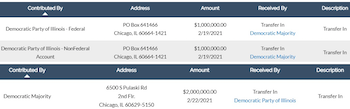
On first review, it would appear that $1,000,000 from DPI’s federal account — “hard” money that is raised under stricter, smaller contribution amounts — has now been converted to “soft” non-federal dollars after the transfer back from Dem Majority.
If this is the case, it presents serious questions as to why DPI would have converted funds that are more difficult to raise into state-level funds. Whatever the answer may be, I pledge to you if I am fortunate enough to be elected Chair, I will keep State Central Committee Members informed of the party’s financial decisions — especially ones of this magnitude.
Please do not hesitate to reach out to me on this issue or others. I want the Democratic Party of Illinois to be inclusive, transparent, and a place where we share ideas and information.
Sincerely,
Rep. Robin Kelly (IL-2)
& State Central Committeewoman
Those were some odd transfers, which happened before Speaker Welch took over Democratic Majority. I’ve asked for an explanation.
18 Comments
|
* S&P looks at the governor’s budget, but won’t yet evaluate its credit rating, so the question it asks isn’t really answered…
S&P Global Ratings acknowledges that this is only a budget proposal and there is uncertainty about the pace of economic recovery and prospects for additional federal stimulus. Future credit direction will be evaluated as greater clarity is available on these key issues.
* Key takeaways…
- Although Illinois ‘proposed fiscal 2022 general fund operating budget is slightly smaller than the previous year’s proposal, and balanced in terms of current-year obligations, we do not view it as structurally balanced due to the treatment of pension obligations.
- Pension contributions are budgeted to fully meet increasing statutorily set amounts but are still less than actuarially determined amounts.
- The state expects to close fiscal 2021 with a small surplus, after prepaying the next fiscal year’s municipal liquidity fund’s debt service.
- Illinois has a bill backlog, limiting flexibility, but this is markedly reduced from this time last year.
- The COVID-19 pandemic continues to affect state economic activity with unemployment through December 2020 above the national average, with 2021 activity improving employment conditions.
* Potential risks…
Federal uncertainty: The budget does not rely on additional federal aid, but educational enhancements and further efforts to retire MLF borrowing obligations early could be aided by further stimulus. Should additional aid materialize, the state could adjust budget expectations.
Pensions remain a high fixed cost: Included in the budget is $9.4 billion for general fund contributions to the state’s various pension systems. This is a $739 million increase over the previous budget contribution. The statutory contributions are forecast to continue to increase, but the state projects its share of the budget will remain at about 25% of expenditures through 2045.
Challenge in changing tax structure: The fiscal 2022 budget relies on changing business tax provisions to generate an estimated $932 million in additional revenues. Legislative scrutiny of the tax-structure proposal could limit change and revenue projections.
Prolonged economic disruption: Outside the timing of vaccine distributions, any long-term permanent changes in business, travel, or consumer patterns in and around Chicago will likely have a material effect on the state’s economic recovery.
* Capital program debt…
We view Illinois’ general obligation (GO) debt burden positively. With more than 75% of GO debt retired in 10 years and the state in the third year of a long-term $45 billion Rebuild Illinois capital improvement plan, it is expected to maintain debt ratios at similar levels. As of Feb. 1, 2021, the state has $27.2 billion of fixed-rate GO debt outstanding and $2.845 billion of GO MLF debt, equating to debt per capita of about $2,375, which we consider moderate.
*** UPDATE *** Something weird is going on. Check out this press release, which doesn’t seem to be written by the same people who wrote the actual report…
Illinois’ Proposed Fiscal 2022 Budget Could Signal The State Is Turning The Corner, Report Says
BOSTON (S&P Global Ratings) Feb. 25, 2021—The Illinois governor’s proposed fiscal 2022 general fund operating budget could be a small step toward putting the state on firmer financial footing, S&P Global Ratings said today in a report titled “Is Fiscal Stabilization On The Horizon For Illinois?”.
The $41.7 billion general fund budget is slightly smaller than the initial $42 billion budget proposed last year before the COVID-19 pandemic began, and $1.8 billion or 4.2% less than the estimated final spend in fiscal 2021. The introduced budget is designed to generate a $120 million surplus.
However, the state still faces fiscal challenges, including a significant bill backlog, underfunded pension plans, and the ongoing effects of the pandemic.
“Although Illinois’ proposed fiscal 2022 general fund operating budget is slightly smaller than the previous year’s proposal, and balanced in terms of current-year obligations, we do not view it as structurally balanced due to the treatment of pension obligations,” said S&P Global Ratings credit analyst Geoff Buswick.
8 Comments
|
* Still bad…
Weekly unemployment claims fell far more than expected last week, as the labor market recovery took a stride forward even as harsh winter weather compounded with the coronavirus pandemic over the past several weeks.
The Department of Labor released its weekly report on new jobless claims Thursday at 8:30 a.m. ET. Here were the main metrics from the report, compared to consensus data compiled by Bloomberg:
Initial jobless claims, week ended February 20: 730,000 vs. 825,000 expected and revised 841,000 during prior week
Continuing claims, week ended February 13: 4.419 million vs. 4.460 million expected and revised 4.520 million during prior week
* CBS 2…
The Illinois Department of Employment Security (IDES) reported 68,383 new unemployment claims were filed during the week of Feb. 15, a nearly 10% increase from the previous week, when 62,369 people filed.
CBS 2 is tracking over 3.1 million total claims filed since early March.
There were 40,008 new unemployment claims were filed during the week of Feb. 1 in Illinois.
There were 95,481 new unemployment claims filed during the week of Jan. 18 in Illinois.
There were 95,472 new unemployment claims filed during the week of Jan. 11 in Illinois.
7 Comments
|
Darned if you do, darned if you don’t
Thursday, Feb 25, 2021 - Posted by Rich Miller
* Herald & Review…
The cost of Tuesday’s Decatur City Council primary election has not yet been determined, but Macon County Clerk Josh Tanner said one thing is certain.
“It is a lot of money per vote, I will tell you that, because the fixed costs are always the same,” he said.
From the $150 owed to each election judge to the printing of election materials to the cost of voting machines, there was a high cost for an election that only brought out about 7% of registered voters in Decatur.
* Press release…
With the appointment of Angelica Guerrero Cuellar to state representative of the 22nd District, the Coalition for Change IL3 once again denounces the undemocratic process that left out community voices. […]
We urge Rep. Guerrero Cuellar to commit to systemic change to this undemocratic appointment process. We need to enact a statute to clearly define how the appointment process works in the short-term, and change the Illinois Constitution to shift to special elections after resignations in the long-term.
9 Comments
|
* Press release…
The Illinois Department of Public Health (IDPH) today reported 1,884 new confirmed and probable cases of coronavirus disease (COVID-19) in Illinois, including 32 additional deaths.
- Adams County: 1 female 80s
- Christian County: 1 female 80s
- Cook County: 1 male 20s, 1 male 50s, 2 males 60s, 4 males 70s, 2 females 80s
- DeKalb County: 1 male 60s
- DuPage County: 1 male 80s
- Jersey County: 1 male 70s
- Kane County: 1 male 60s, 1 male 80s
- Kankakee County: 1 male 80s
- Lake County: 1 male 90s
- Logan County: 1 female 80s
- Madison County: 1 female 30s, 1 male 80s
- Monroe County: 2 females 80s
- Pike County: 1 male 80s
- Randolph County: 1 female 50s
- Rock Island County: 1 female 90s
- Whiteside County: 1 male 80s
- Will County: 1 male 60s, 1 male 90s
- Winnebago County: 1 male 70s, 1 male 80s
Currently, IDPH is reporting a total of 1,181,226 cases, including 20,406 deaths, in 102 counties in Illinois. The age of cases ranges from younger than one to older than 100 years. Within the past 24 hours, laboratories have reported 91,292 specimens for a total of 17,895,829. As of last night, 1,463 individuals in Illinois were reported to be in the hospital with COVID-19. Of those, 334 patients were in the ICU and 168 patients with COVID-19 were on ventilators.
The preliminary seven-day statewide positivity for cases as a percent of total test from February 18–24, 2021 is 2.5%. The preliminary seven-day statewide test positivity from February 18–24, 2021 is 2.7%.
A total of doses of 2,693,345 vaccine have been delivered to providers in Illinois, including Chicago. In addition, approximately 445,200 doses total have been allocated to the federal government’s Pharmacy Partnership Program for long-term care facilities. This brings the total Illinois doses to 3,138,545. A total of 2,440,950 vaccines have been administered in Illinois as of last midnight, including 295,909 for long-term care facilities. The 7-day rolling average of vaccines administered daily is 66,274 doses. Yesterday, 130,021 doses were administered in Illinois, marking the highest reported amount of vaccines administered to date.
*All data are provisional and will change. In order to rapidly report COVID-19 information to the public, data are being reported in real-time. Information is constantly being entered into an electronic system and the number of cases and deaths can change as additional information is gathered. For health questions about COVID-19, call the hotline at 1-800-889-3931 or email dph.sick@illinois.gov.
* Meanwhile…
A Chicago gym spurred an outbreak of at least 55 COVID-19 cases over the summer after infected people attended indoor high-intensity exercise classes — including several who had already tested positive for the virus, according to a Centers for Disease Control and Prevention report released Wednesday.
Infrequent mask use also likely contributed to the superspreader event, which occurred over about a week of multiple group classes, said the report, which was done by the CDC and the Chicago Department of Public Health.
Two of the patrons who caught COVID-19 visited the emergency room, and one was hospitalized for eight days. No deaths were reported from any of the cases linked to the gym. […]
Three people attended these exercise classes “on the same day or after they received a positive test result,” the report said; others attended an exercise class on the day symptoms began or after.
You’re only as secure as the nearest covidiot.
11 Comments
|
* Background is here if you need it. ILGOP press release…
ICYMI: Speaker Welch’s first priority is a tax hike
Just one month into the job, new Speaker of the House Chris Welch has proposed that Illinois Democrats should try again to pass a constitutional amendment implementing a progressive income tax.
Chicago Tribune…
“We have to tell the voters what we’re going to do with that money,” Welch said during a virtual event hosted by the Economic Club of Chicago. “I certainly think tying that new revenue to pensions would be a winner.”
ILGOP Spokesman Joe Hackler responded, saying, “What the new Speaker doesn’t understand is that the people of Illinois did not reject the Madigan-Pritzker tax hike amendment because they were confused on what the revenue would be used for. They rejected the tax hike amendment because new revenue would be sent to Springfield to be squandered by the same corrupt politicians and Democratic party that got us into this financial crisis in the first place.”
Speaker Welch’s ill-conceived proposal not only shows a lack of judgment, but it also reveals his true priority: paying off those inside state government while the rest of us pick up the tab.
As more and more former elected officials and insiders are indicted as part of former Speaker Madigan’s corruption scheme (including just last night), Democrats in Springfield continue to plead for more money. The reality is that the Madigan-Pritzker tax hike amendment was defeated overwhelmingly last year because Illinoisans don’t trust the corrupt insider system that has controlled state government for years.
Sometimes, it takes a while before new leaders fully appreciate how every word they say will be examined and even twisted. Welch never said it was his first priority, for instance, but he walked right into this.
Even so, the ILGOP appears to prefer magic fairy dust to actual solutions. “Just make it go away and never bother us again” is not a constitutional option here.
*** UPDATE *** Sean Anderson on behalf of Speaker Welch…
As usual on this subject, Illinois Republicans have nothing constructive to offer because their only solution is to cut programs and services for underserved populations and communities of color. They can send their little press releases to play petty politics, but the Speaker is focused on having serious conversations to find solutions that benefit working class people across the state.
39 Comments
|
* Michelle Harris press release…
Over the past few days since announcing my intention to seek the nomination for Chair of the Democratic Party of Illinois, I have had dozens of conversations with members of the State Central Committee seeking their support. Today I am proud to announce the endorsement of a regionally diverse group of IL State Central Committee members:
Hon. Bobby Rush, CD-1
Hon. John Cullerton, CD-5
Hon. Cynthia Santos, CD-5
Hon. Danny Davis, CD-7
Hon. Karen Yarbrough, CD-7
Hon. Jerry Costello, CD-12
Hon. Kathy West, CD-12
Hon. Brandon Phelps, CD-15
I am honored to have the support of this group of Illinois State Central Committee members from around the state. These individuals, many of whom are current or former public servants, work every day to make the Democratic Party in Illinois more inclusive and welcoming to people all across the state. My reason for running to become Chair is because I want to build a party that works for every Democrat in all 102 counties, and the ideas and activism of all my colleagues on the State Central Committee will help me ensure we hit the ground running to accomplish that goal.
* Meanwhile…
February 25, 2021
Dear State Central Committeepersons:
We are proud to endorse Congresswoman Robin Kelly for Chair of the Democratic Party of Illinois.
There is an urgent need for a leader of the Democratic Party with the experience and dedication to elect Democrats up and down the ballot from every corner of the state.
Robin’s experience as a State Representative, Chief of Staff of the Illinois Treasurer’s Office, and as a United States Congresswoman is what the party needs. Her integrity is unmatched, and can help build the bench from the ground up.
Democrats have made unprecedented gains in Lake County in recent years, and we know that Robin is the right partner to solidify our progress and help us continue to elect strong candidates at all levels of government.
We urge the State Central Committee to pass the baton to U.S. Congresswoman Robin Kelly.
Sincerely,
Illinois State Representative Daniel Didech (59th District)
Illinois State Representative Rita Mayfield (60th District)
Illinois State Representative Bob Morgan (58th District)
Illinois State Representative Sam Yingling (62nd District)
No Senators on that list of people who are not on the central committee.
* Also…
Illinois House Speaker Emanuel “Chris” Welch on Wednesday declined to weigh in on who should replace Mike Madigan as state Democratic Party leader, downplayed his contact with Madigan’s short-lived House successor and defended allowing party officials to take another crack at filling the vacancy.
“If there’s a vacancy they have a right to do that,” Welch said of the Democratic leaders legally charged with making such appointments. “I do believe that different committeepeople do different things, and we could probably encourage and hope that they would do things in a more open and transparent manner.” […]
He steered clear of the “inner-party squabbles” that Madigan’s resignation as chair of the Democratic Party of Illinois sparked, saying he’s going to “support the Democrat — whoever wins that race, I think, will be someone with the ability to lead our party.”
“I want that person who is leading the party to work with me to help get Democrats elected to the Illinois House, and I’m confident that any of those people … will help us get Democrats elected,” Welch said. “I think the best thing for me to do is to sit back and let that thing resolve itself.”
20 Comments
|
* The Democratic committeepersons of the 22nd House District appointed Angie Guerrero Cuellar to the open seat this morning without debate. Cuellar was supported by Ald. Silvana Tabares at Sunday’s meeting. 13th Ward Democratic Committeeperson Mike Madigan announced yesterday he would also be supporting her after the abrupt resignation of his own candidate, three-day apppointed state Rep. Ed Kodatt. After the meeting, Madigan spoke briefly with reporters…
Q: Was it a lack of vetting?
A: The events developed as they developed. The action of the committee taken on Sunday was nullified because of the resignation, creating a vacancy, and so today we fill the vacancy. I don’t plan to speak to background questions. I don’t plan to speak to the background questions.
Q: You’re normally very meticulous…
A: I think that proper questions were asked, proper questions were asked.
Q: Proper questions were asked or weren’t?
A: They were, the answer is yes. As I said, the events developed, Mr. Kodatt resigned creating the vacancy, today we filled the vacancy. I’m interested in moving forward with Angie Guerrero Cuellar. She’s been anchored in the community. As you can read from her resume, she’s worked with various community organizations in the Southwest Side of Chicago. Therefore, she’s had good experience and understanding of the needs and the desires of the people of the Southwest Side.
Q: People have a certain social media life that some of us older folks don’t. Is that something you’ve neglected to look at, their social media and what might have been evident had his name been put out there ahead of time, a little more vetting.
A: His name was put out in advance like everybody else. It was a complete circulation of resumes. Every resume that was submitted…
Q: That morning. It wasn’t until that morning. It wasn’t enough time for folks to really take a look at who he was.
Q: So, when you say questions were asked, does that mean the answers were not true.
A: See, I’m not going to get into that. I’m just not going to speak about…
Q: When did you first learn about the…
A: A little bit ago. A little bit ago.
Q: Was it after he was named, though?
A: Yes.
Q: People like Pritzker and Sen. Durbin, they blame you for the failure of the Fair Tax or Democrats have a disappointing election day…
A: I’m not going there. I’m not going there. I’m not going there.
Q: Why not?
A: Because I don’t want to?
Q: Is what happened to Mr. Kodatt another manifestation of the cancel culture? Are you concerned about that?
A: What culture?
Q: Cancel culture.
A: Uh-huh. Really. [Looks puzzled at the question.]
Q: The new chairman is going to be selected. Do you have a preference of who that would be?
A: You know what, I’m anxious to move out of here and wish all of you a good day. [Walks away.]
Subscribers know more about why and how the questions were asked and what happened after they were asked.
Cuellar is a resident of the 13th Ward.
…Adding… Bill Wheelhouse recently wrote about his experience covering Madigan at the Statehouse…
He appeared unflappable. I never witnessed a heated exchange with a reporter. He might make a wry comment about a news outlet with a smile on his face. At most, his anger might lead him to ignore a question. He was honest in answering the questions he did answer, but what would sound like a good answer to a question, was, upon further reflection, often an answer that could be interpreted more than one way, which made it hard to determine if he flipped on an issue or was dishonest. […]
One evening, I was lucky enough to catch Madigan alone walking back to his office, asking about some controversial legislation. It was an adversarial but polite exchange. He kept walking at the same pace. He was not trying to run away like many others seem to do when questioned by a reporter. Yet he never directly answered the question. We got to his office door, and he calmly, matter-of-factly, shut it in my face. That is what it was like to cover Madigan.
20 Comments
|
The tone police should maybe watch its own tone
Thursday, Feb 25, 2021 - Posted by Rich Miller
* Center Square…
Springfield Alderman Chuck Redpath had a different take. As someone with a law enforcement background, he said the new law makes him sick to his stomach and is a “slap in the face” for law enforcement.
“I saw the picture this morning of the governor touting how much he’s going to fix racism in police departments and surrounded by all these people from Chicago, the most corrupt city in not just the state of Illinois but probably the country and they’re going to tell us how to reform our police departments,” Redpath said. “Are you serious?”
Um, you mean pics like this Chuck?…
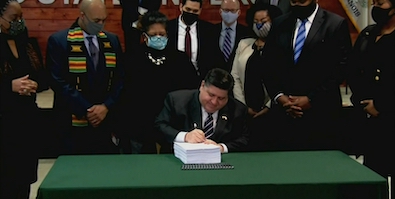
Gee, I wonder what my alderman could’ve been talking about.
* And while opponents have said they want changes, they apparently haven’t yet offered any…
[Illinois Association of Chiefs of Police] Executive Director Ed Wojcicki called the bill the “anti-police bill” in a statement Monday but noted law enforcement was already working with the bill’s supporters “to fix the most serious problems.”
[Sen. Elgie Sims], however, said despite months of pushback he has yet to see what language opponents of the bill would rather see in the law.
“I have heard from and talked to a number of organizations related to different parts of the new law,” he said. “Like others, I am still waiting for specific proposals.”
Wojcicki, however, has been called out by some of his own members…
In a statement earlier this month, Wojcicki referenced a “powerful” conversation he had with Black senior law enforcement personnel, and noted it was “painful to hear” their experience of being mistreated because of their race.
“They think that our association and I should acknowledge that the bill did not emerge from nowhere. It emerged from festering frustration from the black community about personal negative experiences with the police during their lives,” he said in the statement, while praising their ability to shape the conversation in a way that will build trust between law enforcement and the communities they serve.
And yet, he went on to claim the legislation was “anti-police” and whined about the governor’s tone.
* The pearl-clutching over the governor’s push-back is quite something to behold, particularly considering some of the things they’ve said…
“This is a very devastating piece of legislation for law enforcement and the communities that we serve,” said Lower, who serves on the Illinois Sheriffs Association’s legislative committee, to WCBU. “It will basically gut law enforcement. It takes away all of law enforcement’s ability to do our job.”
No hyperbole there.
Media coverage of this bill has been mainly regurgitating law enforcement talking points.
* But, give Pritzker credit. Instead of just waiting in silence for the heat to blow over, the governor went on a Downstate barn-storming tour with Black Caucus members and others yesterday, including those who didn’t start out supporting some of the bill’s provisions…
State Sen. Scott Bennett, D-Champaign, said he initially opposed ending cash bail, but eventually came around to supporting it.
“What I’ve learned … is that cash bail doesn’t keep anybody safer,” he said. While judges may think they’re sending a message with a high bond, that doesn’t work if the suspect has access to money, he added.
“The next thing you know, no matter how high the bond was set, they were out and the witnesses and the victims were very scared,” Bennett said. “If you’re not a violent offender, you should have a chance to prove you’re willing to come to court the next time, until you prove that you’re not going to take that seriously.”
* However, you have to read to the end of this story to see a single substantive argument from the prevailing side…
During the more than hour-long news conference at Proctor Center, legislators lauded the new law. Among them was Rep. Jehan Gordon-Booth of Peoria, who adamantly objected to the notion that the new law makes communities less safe.
“That’s simply not true,” she said. “They will tell you that … there are victims out there who are now going to be in danger. That too, ladies and gentlemen, is not true.”
Gordon-Booth’s own family has been traumatized by violent crime. Her stepson Derrick Booth Jr. was fatally shot in the spring of 2015.
“My family’s story is like so many families’ stories across this country. Families from communities like this, they are the most harmed, they are the least served. And the fact of the matter is that victims’ voices have been leveraged to create an industrialized prison system that does not make communities more safe. Those policies have actually made communities far less safe,” said Gordon-Booth.
22 Comments
|
* Tribune…
A longtime political operative at the center of the investigation into former Ald. Daniel Solis has been charged in a scheme to steer a massive Chicago Public Schools contract to a Cleveland-based company in exchange for donations to Solis’ campaign.
In addition to the alleged contract fraud, Roberto Caldero was also accused in an indictment filed in U.S. District Court with offering $100,000 in bribes from a suburban business owner to Solis in exchange for the alderman’s help securing an honorary street name for the businessman’s father and renaming a city park after his grandfather.
Solis was already cooperating with the FBI at the time and helped keep the ruses going for investigators, including pushing the street renaming in the City Council, according to the 20-page indictment.
Caldero, 68, was charged in the eight-count indictment made public late Wednesday with wire fraud, federal program bribery and facilitating bribery. An arraignment date had not been set.
* Sun-Times…
Caldero’s name came to light in a bombshell federal court affidavit first obtained by the Sun-Times in January 2019. Among other things, it alleged that Solis and Caldero had made plans to exchange Viagra or visit massage parlors.
Solis helped prosecutors build their case against Burke, and Burke’s defense lawyers have said in court filings that Solis struck what’s known as a deferred-prosecution agreement with the feds. That deal was also allegedly made in January 2019.
The indictment against Caldero alleges he offered Soto jobs, champagne and admission to an annual museum benefit for his help landing the CPS contract for the Ohio company, GCA Educational Services Central States Inc. As part of the scheme, Soto allegedly joined an evaluation committee considering the bids and then gave “non-public” and confidential information to Caldero in 2016 and 2017.
* Unlike most people who are indicted, Caldero told reporters he did nothing wrong. WBEZ…
Caldero told WBEZ he vehemently denied all the charges in the eight-count, federal grand jury indictment.
“I never bribed any elected official,” Caldero said Wednesday evening, soon after the case against him was unsealed in U.S. District Court in Chicago. “I never once made a statement to any government official or elected official that I would give them something in return for something. Never, ever, OK?
Caldero noted his vast experience in government and his long relationships with a wide range of local political leaders.
“I’ve dealt with commissioners and elected officials since Harold Washington days,” he said, referring to the Chicago mayor from the 1980s. “I’ve had very close friends who were commissioners — city, state, county and all over the place. Nobody ever said I went to them and offered them a bribe. It’s not my style. It’s not something I would even think of doing.”
Caldero acknowledged supporting Solis, but he said he did not do that as part of any quid pro quo arrangement.
“I went to every fundraiser for Danny Solis for 20 years,” Caldero said. “I’ve raised probably $100,000 for Danny, if not more. But I never did a donation or raised money for him and said, ‘But you got to do this for me.’ If I did something like that inadvertently or whatever, it’s something I know nothing about at the moment.”
* Meanwhile, here’s CBS 2…
Former Illinois state Rep. Edward Acevedo was indicted on tax charges Wednesday.
Acevedo was first elected to the Illinois House in 1997, representing several South and Southwest Side neighborhoods, and served until 2017. He was also a Cook County correctional officer and a Chicago Police officer, and was connected to former House Speaker Mike Madigan.
The indictment said in 2017, Acevedo received a gross income of $130,775, including about $82,533 from a company named only as Company A. On the gross income, he owed $19,582, the indictment said.
But Acevedo did not file a 2017 Form 1040 with the IRS before Oct. 15, 2018 as required by law, the indictment said. The indictment accused him of receiving payments in cash so as to conceal his gross income, making cash deposits into his personal bank account to conceal the source of the payments, directly depositing checks into his own bank account for services rendered by Company A, and avoiding the creation of business and accounting records.
* Tribune…
Alex Acevedo, who failed in his own attempt to win a legislative seat, was charged with two counts, both alleging he understated his gross income for 2017 and 2018.
Michael Acevedo faces four counts, with prosecutors alleging that he understated his income in 2015 and didn’t file tax returns in 2016, 2017 and 2018.
All three family members have at various times been registered lobbyists of state government.
Eddie Acevedo previously told the Tribune he had worked as a consultant paid by former state Rep. John Bradley, a Democrat from Downstate Marion and a onetime contract lobbyist for ComEd. Acevdeo said he had been paid as much as $5,000 a month by Bradley.
11 Comments
|
* WMBD…
Governor J.B. Pritzker praises Peoria County’s vaccination efforts while visiting the area on Wednesday.
While touring a vaccination clinic at Heddington Oaks in West Peoria, Governor Pritzker called Peoria County a leader in administering vaccines.
“If Peoria County were a state, it would be number 2 in the nation for total number of doses administered per 100,000 residents,” Pritzker said.
* PJStar…
Pritzker’s announcement came on the same day the county received continued good news about the coronavirus. It was the second straight day local health officials reported no deaths.
More than 80% of Peoria County’s residents over age 65 and around 55% of those eligible for a vaccine under 65 have already gotten at least one dose, Pritzker said in a tweet.
19 Comments
|
|
 Support CapitolFax.com
Visit our advertisers...

 ...............
 ...............
 ...............


|
   
|
Hosted by MCS |
SUBSCRIBE to Capitol Fax |
Advertise Here |
Mobile Version |
Contact Rich Miller
|