* I tipped subscribers to the possibility of some of this happening earlier today, but I’m told it came down to the wire…
The House and Senate Redistricting Committees today released updated Cook County Judicial Subcircuit boundaries that reflect suggestions gathered during the public hearing in December. Additionally, the Committees released proposed redrawn subcircuits for the 16th and 19th Circuits, as well as the proposed creation of subcircuits in the 3rd, 7th, 17th and 18th Circuits to allow for greater opportunities for diversity on the bench. Redrawn subcircuits for the 12th and 22nd Circuits will be forthcoming.
Noteworthy revisions to the Cook County boundaries include consolidating Niles Township and extending greater Chinatown further south down to Pershing Road. These improvements, offered through public testimony, will better reflect the population and demographics in these communities.
The creation of new subcircuits in DuPage, Sangamon and Madison counties will give minority communities a better opportunity to elect candidates of their choice and influence elections. These new subcircuits will help improve the diversity of opinion and background of judges, while giving everyone a voice in electing a bench of judges they feel best represent their communities.
The proposed drawing of subcircuits will not impact the tenure of current circuit court judges.
Members of the public may provide testimony or offer suggestions through email at redistrictingcommittee@hds.ilga.gov and redistrictingcommittee@senatedem.ilga.gov. If anyone wishes to submit their own proposals, they may do so through the online map portal located on the House and Senate redistricting websites. For that tool and to view the proposed maps, visit www.ilhousedems.com/redistricting or www.ilsenateredistricting.com.
The 3rd includes Madison (click here and here to see how they’ve divvied it up), 7th includes Sangamon (click here and here, 17th includes Winnebago (here and here) and the 18th is Dupage (here and here). There was a push for Champaign and Peoria as well, but those apparently didn’t make the cut
Legislative Democrats have released proposed maps that would carve the Seventh Judicial Circuit, which includes Sangamon and several neighboring counties, into three subcircuits… one made up of Springfield’s inner city, the second comprised of the rest of Sangamon County, and the third that consists of the remaining counties in the circuit. Democrats say the creation of an urban subcircuit will improve chances for minority representation on the bench.
But GOP Representative Tim Butler thinks it’s a move to “pack the courts” with Democratic judges, and wants more details on the plan, including how much extra it would cost to implement.
Rep. Bobby Rush, D-Ill., the former Black Panther, ex-Chicago alderman, member of Congress and a minister, told the Chicago Sun-Times on Monday that he will not seek another term.
Rush, first elected to Congress in 1992, said in an interview he intends to stay active in his ministry and find ways to use his remarkable life story — a trajectory from a 1960s radical to House member — to inspire younger generations. […]
Rush told me he finalized his decision not to seek another term in the last several weeks and it came after a conversation with a grandson, Jonathan, 19, who said he wanted to hear more about his grandfather.
“I don’t want my grandchildren . . . to know me from a television news clip or something they read in a newspaper,” Rush said.
…Adding… Also, as I told subscribers this morning, be wary of stories like this one which float endless names of people who may or may not actually be interested. It’s not news. It’s pure speculation, particularly about those who would have to give up their gigs to run in a potentially crowded primary.
Illinois State Senator Robert Peters (D-Chicago), who shares his district with U.S. Rep. Bobby Rush (D-Chicago), released the following statement in response to Congressman Rush’s announcement today that he will not seek re-election:
“As a kid on Chicago’s South Side, I had the privilege of growing up with Bobby Rush as an example of a fearless and righteous leader who helped make our city and our country a better place for everyone.
“Congressman Rush – and his impact on advancing racial justice – will endure far beyond his nearly 40 years in public office. He helped found the movement that’s made a half century of progress toward civil rights possible – a movement that has grown across communities, at all levels of government, and continues today.
“With this news, we can all benefit from starting the new year by taking a step back to reflect on – and find inspiration from – Congressman Rush’s lifetime of work toward fairness, and equity. We know the work isn’t done, but Bobby Rush has shown us there’s nothing that we collectively cannot do.”
…Adding… DPI…
Democratic Party of Illinois Chair Rep. Robin Kelly released the following statement regarding the announcement that Rep. Bobby Rush will not run for re-election:
“Bobby Rush has dedicated his entire life to serving his community. An instrumental figure in the civil rights movement, his passion and determination in the fight for justice serves as an inspiration to us all. As a 15-term congressman, Rep. Rush has worked selflessly for the people of the South Side of Chicago and beyond, passing numerous pieces of critical legislation to strengthen public safety and promote equality in American society. On behalf of all Democrats in Illinois, I thank him for his years of service and wish him well as he begins his next chapter later this year.”
Illinois state Sen. Kimberly Lightford and her husband were carjacked Tuesday night in suburban Broadview, police said.
No one was hurt, but at least one of the suspects fired gunshots at Lightford’s husband, according to police.
Lightford, a Democrat from Maywood, and her husband were in a black Mercedes SUV and were in the near west suburb to drop off a friend, according to Broadview police Chief Thomas Mills.
Three masked individuals in a Dodge Durango SUV blocked the couple’s Mercedes in the 2000 block of South 20th Avenue about 9:45 p.m. The suspects ordered Lightford and her husband, who was driving, out of the Mercedes, said Mills.
“I begged them not to shoot my husband, not to shoot me,” Lightford told reporters Thursday morning at a Christmas present giveaway for children in Proviso Township. “They took everything off me that I had of value.”
Lightford said her husband gave the carjackers the keys to the car.
“They had separated me and my husband,” she said on WGN-TV. “After they got the guns off of us, my husband told me to run. I ran, reluctantly, because I didn’t want to leave him there. And it was a scary run because now shots are being fired. I thought for sure they were going to shoot me.”
Lightford said her husband is a concealed-carry permit holder. He fired at the carjackers, she said.
At an event on Thursday, Lightford, a Maywood Democrat who has been in the state legislature since 1998, said she was “doing much better today” and that she “didn’t realize what a traumatic event could do in an adult.”
* Meanwhile, Sun-Times crime reporter Frank Main recently interviewed a West Side, 30-something carjacker…
Q. To your knowledge, is this generally a random crime? Or is there a lot of planning that goes into this?
A. Mostly a random crime.
Q. Is there somebody that everybody knows in a particular neighborhood that you can sell [stolen car parts to]?
A. Through social media, you’ll hear where people want car parts. People know that’s where to take the cars.
Q. What’s your impression of [Cook County State’s Attorney] Kim Foxx and whether [prosecutors] are lenient or tough on this crime?
A. They’re not playing on carjackings. They are not being lenient on this crime.
Q. So it sounds to me that you’re saying you don’t believe that this giant increase in carjackings has to do [with] prosecutors or police going easy on carjackers or that the criminal justice system is going easy on people who commit these crimes. Is that right?
A. True.
* Maya Dukmasova at the Chicago Reader pointed to her own research earlier this year to back up this claim…
When it comes to the felony carjacking charges—for which, according to [Chief of Detectives Brendan] Deenihan’s presentation, only 178 people were arrested [in 2020] —the State’s Attorney’s Office seems to be functioning as expected. In 2020, according to the office, felony carjacking charges for adults were approved 97 percent of the time, and resulted in convictions 93 percent of the time. For juveniles, the State’s Attorney’s Office approved charges 89 percent of the time and convictions resulted in 90 percent of cases.
* But while the carjacker claims that fast, expensive vehicles are mainly targeted, Dukmasova found that the numbers show otherwise…
Though there’s been much speculation about the types of cars being targeted—in particular popular Dodge Chargers and Challengers because of anecdotal reports that they can be hacked—CPD’s data showed that most often carjacked cars are the most common economy vehicle makes: Toyota, Ford, Nissan, Honda, and Chevrolet.
A Cook County judge was carjacked at gunpoint along with her 3-year-old son late Thursday in Humboldt Park.
Judge Anna Loftus was robbed of her 2018 Subaru Crosstrek, her purse and a cellphone, according to a memo shared with 14th District Chicago police officers. No one was physically hurt.
The toddler was in the back seat as the 52-year-old pulled the vehicle into a residential garage about 11:30 p.m., according to police news affairs.
That’s when two males walked up, and one of them, carrying a gun, ordered her and the boy out of the car.
As much as people may complain about lawlessness today, 1974 remains Chicago’s official benchmark for the most murders in an annual period.
This is not to be confused with “murder rate,” a calculation comparing crime data with a city’s population. Chicago’s worst “per capita” homicide year was 1992, when 940 people were slain but when the city had 600,000 fewer residents. The murder rate then was 34 victims per 100,000 people.
If you are talking about sheer volume of homicides, 1974 is it.
“More killings here than Belfast,” a pessimistic Sun-Times editorial headline read in late December, after police officer Harl Gene Meister was killed in a robbery attempt that left his 8-year-old son seriously wounded. Meister was off-duty and doing some last-minute Christmas shopping when he and the boy were confronted by a group of juveniles in a store parking lot on the Southwest Side. […]
Officials of the day blamed the usual suspects for so many killings: easy access to firearms, including the cheap but lethal “Saturday Night Special,” and a court system that critics said treated offenders too leniently.
James Rochford, Chicago’s $34,500-a-year police superintendent, complained that thousands of suspects his officers arrested in the past year were out on bond for similar crimes. He said the average hardened offender was wise to this revolving-door system.
* I was exposed to covid twice over the two-week break. I had mild symptoms that went away quickly both times. I’ve been tested three times so far (both rapid and PCR) and all came back negative. That was great news for me, but the experiences gave me an up close and personal look at the national testing shortage and it’s bad. Really, really bad. I was also kinda grumpy because I had to isolate Christmas eve and New Year’s eve.
The whole world saw how fast this omicron variant was spreading. “Everybody has it,” was a constant refrain I heard from friends all over the state last month - and these are people who generally try to be careful about their behavior.
And since so many people seem to have it, even more are getting tested far more often as they either feel symptoms or learn that someone they’ve been in contact with has tested positive.
So, basic arithmetic dictates that as this virus inevitably spreads ever wider, many more tests are going to be needed. The 500 million tests promised by President Biden will be too little and very likely way too late to deal with this need. To say the feds dropped the ball bigtime would be a massive understatement. I ordered four rapid tests through the mail early on, used two, gave one to a friend and have just one left. I’m hoarding that one.
* I happen to believe that fully vaccinated and boosted people (like myself) should not have to suffer consequences for following the rules. Unfortunately, a small and stubborn and ignorant minority is jamming up our local hospitals to the breaking point. From the governor’s office…
From the end of November to end of December about 91 percent of hospital admissions for COVID were those who are not fully vaccinated.
"Hospitals cannot end this pandemic on their own. They need the continuing help and support of the public. The best way to support your hospitals is to get vaccinated." AJ Wilhelmi, IHA President & CEO. https://t.co/SEWikto586
* And while we’re on the topic of those who “reject all of the measures to reduce this disease,” here’s a Champaign News-Gazette editorial…
State Sen. Darren Bailey, a leading Republican candidate for governor of Illinois, thinks Gov. J.B. Pritzker should stop haranguing Illinoisans to get vaccinated.
State Sen. Darren Bailey, a Republican candidate for governor from Clay County, thinks Gov. J.B. Pritzker’s “rhetoric is abhorrent and has no place in any civil discussion.”
Pritzker’s sin? He urged Illinoisans who are unvaccinated to get the COVID-19 vaccine so that they don’t take up a hospital bed that could be used by a cancer or heart attack patient.
“The role of government is not to coerce and control residents, but to educate them and provide them with resources to make the best decisions for themselves and their families,” Bailey charged.
Which is exactly what Pritzker, health care professionals and even other Republican governors are doing.
Thousands of COVID tests for Chicago Public Schools students and staff members have been deemed “invalid” as the district prepares for a return to classrooms following the winter break.
With cases across the state and within the district surging, CPS reported 35,590 tests were completed between Dec. 26 and Jan. 1, but 24,843 were ruled “invalid,” according to data posted on the district’s website.
According to the Chicago Teachers Union, many parents received emails from the company handling the tests saying some samples were deemed “unsatisfactory” after being delayed in transit to the lab because of holiday shipping issues and weather.
“Delays between sampling and actually processing those samples ended up spoiling test results,” the union said in a release.
* Some of us talked about this on Twitter over the weekend…
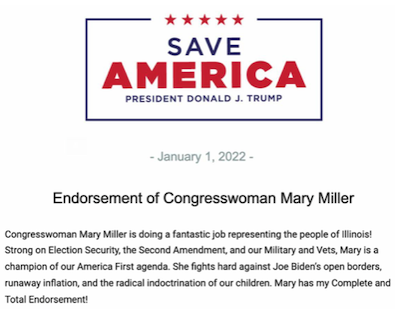
* Mary Miller then announced that she’ll run against fellow Republican Rodney Davis in the 15th Congressional District…
“President Donald Trump inspired me to run in 2020 because our country needs principled conservatives in Congress who always put America First,” said Congresswoman Miller.
“Today, President Trump is endorsing me because I am a conservative fighter who is not afraid to take on the DC swamp.”
“I am not a career politician, and running for office is not my life’s ambition,” said Miller. “My life is spent in the real world, on my small family farm with my husband Chris, where we were blessed to raise our seven children and welcome our seventeen grandchildren. I bring those values to Washington, not the other way around.”
Elected in 2020 with President Trump’s support as an America First conservative, Congresswoman Mary Miller received 73.4% of the vote in the 15th District. She has been a strong supporter of President Trump and opposed efforts by Nancy Pelosi, Adam Kinzinger, and Liz Cheney to attack President Trump through the political “witch hunt” January 6th Commission.
“I voted against Joe Biden’s red-flag gun confiscation efforts, which violate the Second Amendment rights of American citizens,” said Miller, who has the most conservative voting record of any member from Illinois. “I was endorsed by the NRA in 2020 and I’m the only member from Illinois with an A rating from the Gun Owners of America for always supporting the Second Amendment.”
“I’m proud to be the only member of Congress from Illinois who is fighting to impeach Joe Biden and the lawless Biden Cabinet for leaving our border exposed to an invasion of illegal immigration,” said Miller. “I am the only member from Illinois who has fought every effort by Joe Biden to use COVID vaccine mandates to fire Americans from their jobs and I opposed funding COVID vaccine databases that share information with the federal government.”
As a Pro-Life mother and grandmother, Congresswoman Miller serves as an advocate for the unborn, giving a voice to the voiceless in the womb. “When Democrats pushed for taxpayer-funded chemical abortion, I led the fight to ban taxpayer-funded chemical abortion with the Protecting Life on College Campus Act,” said Miller.
Congresswoman Miller is in a strong position to win re-election in the new 15th Congressional District, which gave President Trump 68 percent of the vote in 2020.
“I won’t allow corrupt Democrats like JB Pritzker to cut backroom deals to draw me out of the district I represent, because conservative voters who stand with President Trump deserve a Pro-Second Amendment, Pro-Life, America First voice in Congress,” said Miller.
“With hard work, prayer, and faith in our country, conservatives will take back the House and Make America Great Again.”
* There were some problems with some of her claims. For instance…
Mary Miller is claiming she's the "only Republican from Illinois" to vote against red flag laws for military members. Except even the NRA says that never became law, and the bill Reps. Davis, Bost, LaHood, and Kinzinger voted for on 12/7 did not include it. https://t.co/ozqagryrNa
* Anyway, Rep. Davis seemed to be ready for this and fired off a blistering response…
Rodney Davis’ campaign for Congress released the following statement after Mary Miller announced she’s running for Congress in the 15th District. The statement is attributed to Davis campaign spokesperson Aaron DeGroot:
“Mary Miller is only an outsider in the sense that she doesn’t live in the 15th District. She’s a carpetbagger and Chicagoland native. Miller is so desperate to stay in Congress she’s running in a district she doesn’t live in, just like her husband. The Millers are taking a page out of the Springfield political insider playbook. Politics is their family business.
“Even worse, Miller supports the Never Trump ticket for Illinois Governor and refused to vote against Nancy Pelosi’s sham, partisan 1/6 Select Committee. All Mary Miller has to show for her time in Congress is quoting Hitler and voting with Democrats like AOC and the far left squad to defund our military and block a pay raise for our troops. That’s shameful. It’s clear that Mary Miller is all talk, no action.
“Rodney Davis is a conservative who gets things done. He’s already been hard at work highlighting his conservative accomplishments and work with President Trump during his time in office. That’s why he’s earned support from countless grassroots Republican leaders in the district. Our campaign looks forward to educating voters on how Rodney is an effective conservative member of Congress and Mary is not.”
Um, Rodney has been involved in Illinois/US politics most of his adult life. Politics is definitely his business. And what’s he gonna do in the fall if the “Never Trump ticket” of Darren Bailey and Stephanie Trussell wins the primary? One campaign at a time, I suppose.
A “conservative who gets things done” with the endorsement of almost every major elected official in his new district means he’s going to run a traditional Illinois Republican race. He’ll work it hard. She has Trump. Should be interesting to watch.
* News media roundup…
* Controversial Downstate freshman GOP Rep. Mary Miller to primary veteran Republican U.S. Rep. Rodney Davis after Trump endorsement: Davis has already been endorsed by 32 of the 35 GOP county chairmen in the new 15th District, as well as by two of his neighboring Illinois Republican congressional colleagues, Darin LaHood of Peoria and Bost, and more than a dozen GOP state lawmakers in the new district. Davis also has been a strong supporter of Trump and co-chaired his 2020 reelection campaign in Illinois. Davis also has backed House Republican leadership under Kevin McCarthy of California.
* Trump endorses Rep. Mary Miller against Rep. Rodney Davis despite pleas from leadership not to get involved in primary: Miller, a member of the hardline House Freedom Caucus, recently caused a stir within the Republican conference for spreading misinformation about a vaccine records bill and an annual defense policy bill that many House Republicans voted for. As CNN first reported last month, Rep. Marjorie Taylor Greene — another controversial firebrand who is close with Miller — had been lobbying Trump to throw his weight behind Miller, while House Minority Leader Kevin McCarthy had urged Trump not to get involved, concerned it could make things even messier for party leaders.
* Trump endorses Illinois Rep. Mary Miller over Rep. Rodney Davis: Trump’s move comes as he is looking to spark intra-party primaries in order to increase the numbers of Trump-loyal MAGA Republicans in the House in advance of his anticipated 2024 White House comeback bid.
Matt Chapman, a self-described data nerd who runs a not-for-profit group called “Free Our Data,” recently filed Freedom of Information Act requests with Mayor Lori Lightfoot’s office. He wanted everything received by the Chicago Tribune this year via their FOIA requests.
Chapman’s trove included text messages sent back and forth between Lightfoot and state leaders, including Gov. J.B. Pritzker.
Most of the conversations were innocuous or polite. The governor thanked the mayor for sending him a bottle of tequila, for example.
But some of the conversations are revealing. On July 14 of last year, Lightfoot informed the governor that the city was “toying with a mandatory mask order for Chicago.”
The governor responded: “Just want you to know we already have a statewide mandatory mask order. It is the law right now during the emergency.”
Pritzker had, indeed, issued a mask order more than two months before Lightfoot was kicking the idea around.
I thought that was weird, but then last week Lightfoot introduced a city ordinance that was basically a copy-and-paste of a bill Pritzker had recently signed into law. Oops.
In August of 2020, during violence and looting, Pritzker sent Lightfoot a text message saying the two should talk about the situation. An hour later, Pritzker sent her another text saying, “I’m hearing reports of activity downtown and want to reiterate my offer of assistance of state police tonight.”
There was no reply. Billionaire Ken Griffin has heaped scorn on Pritzker for not intervening in the city’s violence, but that message shows he was at least trying to convince the mayor to accept state help on one occasion.
In late September, Pritzker told Lightfoot that the state police and the National Guard were “coordinating closely” with the Chicago Police Department through the weekend. “Hopefully we are all over-prepared,” he wrote. “Thanks so much for your leadership,” she told the governor. “I hear from lots of folks that they like to see us working together. Gives them confidence.”
“Agree and also I like working on the same page with you. So there’s that.” Pritzker wrote.
In January of this year, before vaccinations became widespread, Chicago resident Pritzker sent the mayor a Block Club Chicago story about a massive indoor party in the Old Town neighborhood. “How brazen?” he wrote. “This looks ripe for a visit by CPD. !!!”
“On it,” Lightfoot replied.
But there were clearly moments of tension. “Just hearing from one of my city council chairmen that your team is trying to move something on [the sale of the] Thompson Center without presenting a plan to me and my team,” Lightfoot told Pritzker. “We should discuss because that will not happen.”
Instead of replying to Lightfoot’s text, Pritzker sent a link to an online opinion piece written by a political enemy that trashed both him and Illinois Department of Public Health Director Ngozi Ezike. The piece was believed at the time to have been generated by Lightfoot or her allies because it also heaped praise on Lightfoot’s public health director.
“Thank you,” was all Pritzker wrote. There was no reply.
Organized labor worked last spring to kill a proposal by Pritzker and the Illinois Retail Merchants Association for a statewide mandated paid sick leave law. Lightfoot was also opposed, and she made that known in a text to the governor in late May. “I would like to talk about the paid sick leave bill. We strongly oppose. Let me know when you can talk.” There was no recorded reply.
Senate President Don Harmon often didn’t reply to the mayor’s texts, although that doesn’t mean he didn’t pick up the phone or talk to others.
Lightfoot sent several terse but one-way text messages to Harmon this year, including these in January of 2021: “Don, my folks are bringing me comments that are concerning. If there is no personal issue, you want to address, then let’s have the discussion. … Correction: if there is a personal issue that is of concern, let’s put it on the table.”
A few days later: “A courtesy call regarding the fire pension bill would have been helpful, particularly since there is no funding for it. When that pension fund collapses, I will be talking a lot about this vote.”
And then in May: “It is important that we talk early. The direction things are going is totally inconsistent with what you committed to.”
All of Lightfoot’s texts with House Speaker Chris Welch were cordial. Former House Speaker Michael Madigan didn’t do texts.
In spring 2020, for instance, Lightfoot texted Pritzker a news report analyzing tensions between their administrations as the city was negotiating for a Chicago casino and criticized his employees.
“Gov, this is petty and unnecessary and why we have serious issues with your staff,” Lightfoot texted. “Not smart.”
The next morning, Pritzker responded, “I woke up and saw your text. Texting probably not the best way to communicate. You should call me when you can.”
A day later, Lightfoot texted Pritzker a Sun-Times opinion piece with the headline, “Mayor’s gaffes won’t help Chicago get a lift from Pritzker and Springfield.”
“Super helpful,” she wrote.
Pritzker responded: “Mayor. I didn’t write this nor did I foster it. I get bad press too. Call when you would like.”
* Dan Petrella and Jeremy Gorner at the Tribune have a very comprehensive and well-researched preview of the coming legislative session…
With elections looming and another coronavirus surge underway, Illinois lawmakers are due to return to Springfield Wednesday with the goal of crafting next year’s state budget and wrapping up much of their other work for the year by early April — nearly two months ahead of the usual schedule.
Whether the Democratic-controlled legislature will be able to meet that deadline remains to be seen, as the skyrocketing number of COVID-19 cases forced the General Assembly to cancel the other session days during the first week of the new year and likely the entire second week. But with primaries set for June 28 and all 177 seats in the Illinois House and Senate up for election in 2022, lawmakers will be eager to avoid controversial issues and get back home to campaign. […]
House Speaker Emanuel “Chris” Welch of Hillside, who along with Senate President Don Harmon of Oak Park controls the legislative calendar, says the schedule for the upcoming spring session is not shortened but condensed. Lawmakers were originally slated to be at the Capitol for roughly the same number of days as in a typical year, but it’s unclear if that will happen with the big surge in COVID-19 cases. […]
Senate GOP leader Dan McConchie of Hawthorn Woods expressed similar frustrations with his caucus’s superminority role, noting that members introduced several anti-crime proposals in the fall that were ignored by Democrats.
“At the end of the day, the biggest question is whether we’re going to have robust debate in an election year on key issues that the public seems concerned about,” McConchie said.
There will likely be a very robust debate about that issue, but it’ll likely be confined to private Democratic caucus meetings.
Anyway, go read the rest. They clearly put a lot of work into it.
* From Politico, but with a big caveat that the petition filing deadline was already shortened to March 14 last May…
“We’ve proven an ability to use remote hearings in particular for committees, which much of the front end of the session will likely be,” Senate President Don Harmon told Playbook. “I’m confident we’ll be able to get our work done. But I would not be at all surprised if much of the committee work happens virtually.”
On Wednesday, lawmakers are expected to adjust language on legislation that would change the deadline for getting petitions signed for the state’s June primary. Democratic lawmakers who control both houses and the governor’s office want to allow for 60 days to acquire signatures instead of 90 days. The filing deadline would be March 14. […]
For Gov. JB Pritzker, the “No. 1 priority” of the session “is balancing our budget, making sure that we’re doing the right thing to put our state on firm fiscal footing, to continue to get credit upgrades as we have, and to make sure that we’re providing the services that people need,” he told reporters at last week.
House Speaker Emanuel “Chris” Welch echoed that in an interview with Playbook, saying, “We want to build on last year’s success.” Lawmakers this year will also weigh how best to spend another portion of federal American Rescue Plan dollars “to help people deal with the everyday issues that they’re facing, like paying rent, paying mortgages and keeping a roof over their heads or saving their businesses,” he said.
The goal is to avoid creating new programs that will then be unfunded after the federal money runs out. Instead, Democrats want to see federal monies available over the next three years to be spent on “one-time expenditures that can help bend the curve on a complicated, difficult issue or bolster our economic fundamentals,” Harmon said.