* We sure had our ups and downs this year. It’s depressing that we’re ending the year on such a negative note as far as the virus goes. But with new treatments just over the horizon and the greatest scientists this world has ever seen, maybe we really can return to some semblance of normalcy in 2022. I hope we can all recharge ahead of the new year and what’s likely to be a grinding “spring” session.
* The 2021 Golden Horseshoe Award for Best State Agency Director goes to Alicia Tate-Nadeau…
IEMA has had to do a ton of work on COVID and vaccinations, and while IDPH has been more the public face of the response…well, that’s how IEMA would prefer it, and a testament to the fact that they’ve screwed up very little. As a bonus, I thought the response to the tornadoes last week was textbook how state government is supposed to do it.
Dr. Ezike should probably own this award, but Tate-Nadeau received some really strong nominations, including that one.
* The 2021 Golden Horseshoe Award for Best Spokesperson goes to Jordan Abudayyeh…
Jordan is a force and beyond that you can count on her to solve just about any problem, not even just a communications one. She works around the clock, always has a cynical joke ready and truly understands the inner workings of everything she deals with on a daily basis. JB is lucky to have her in his corner because I would not want her on the opposite team.
* The 2021 Wordslinger Golden Horseshoe Award for Best CapitolFax.Com Commenter goes to Candy Dogood…
She’s engaging, thought provoking, and always has a little gem to throw in at the end to make you think.
Oswego Willy got a lot of nominations, but he also nominated Candy Dogood, so that tipped the scale.
He’s taking a giant pile of institutional knowledge with him that will take decades to replicate. I’d also consider his leadership during the Speakership transition to be really underrated right now. There was a real threat that the caucus would turn into Lord of the Flies and he stepped up as an honest broker. That remarkable display of leadership capped a lifetime of it.
* Congratulations to everyone who won this year…
Best Legislative Assistant/District Office Manager - House Republicans: Cheri Hermes
Best Legislative Assistant/District Office Manager - House Democrats: Mika Baugher
Best Legislative Assistant/District Office Manager - Senate Democrats: Mavilen Silva
Best Legislative Assistant/District Office Manager - Senate Republicans: Tracy Weiters
Best House Democratic Campaign Staffer: Jon Maxson
Best Senate Democratic Campaign Staffer: Magen Ryan
Best House Republican Campaign Staffer: Ryan Tozer
Best Senate Republican Campaign Staffer: Roxanne Owens
Best Senate Republican Non-Campaign Staffer: Whitney Barnes
Best House Republican Non-Campaign Staffer: Joe Sculley
Best Senate Democratic Non-Campaign Staffer: Mary Hanahan
Best House Democratic Non-Campaign Staffer: Erik Lowder
Best House Democrat: House Speaker Chris Welch
Best House Republican: Rep. Seth Lewis
Best Senate Democrat: Sens. Elgie Sims and Rob Martwick
Best Senate Republican: Sen. Don DeWitte
Best Contract Lobbyist: Bukola Bello
Best In-House Lobbyist: Adrienne Alexander
Best Do-Gooder Lobbyist: Khadine Bennett
Best Legislative Liaison: Laura Vaught
Best Statewide Staffer: HW Devlin
Best State Agency Director: Alicia Tate-Nadeau
Best Spokesperson: Jordan Abudayyeh
Best CapitolFax.com Commenter: Candy Dogood
Lifetime Achievement: House Majority Leader Greg Harris
Building on efforts to make Illinois a national leader in safeguarding reproductive rights, Governor JB Pritzker signed House Bill 370, repealing the harmful Parental Notification Act (PNA). Rescinding the PNA ensures that while a pregnant minor can choose to involve a family member or legal guardian in their decision to have or not have an abortion, vulnerable youth – such as victims of rape, incest, and domestic abuse – are not compelled to do so under the law.
“With reproductive rights under attack across the nation, Illinois is once again establishing itself as a leader in ensuring access to healthcare services,” said Governor JB Pritzker. “This repeal was essential, because it was the most vulnerable pregnant minors who were punished by this law: victims of rape and physical abuse in unsafe homes. I thank Representative Anna Moeller, Senator Elgie Sims and the lawmakers and advocates who have fiercely fought to repeal this law and keep vulnerable young people safe. I’m proud that Illinois continues to be a national leader in protecting reproductive rights.”
The Parental Notification Act of 1995 required doctors to notify a pregnant minor’s parent within 48 hours prior to an abortion procedure. This obstruction harmed the state’s most vulnerable youth, including victims of rape and domestic abuse, by preventing young people from accessing all of their healthcare options without fear.
“With reproductive rights under attack around the country, today we are once again affirming that in Illinois, access to reproductive healthcare will be available to those who need it,” said State Representative Anna Moeller (D-Elgin). “With the signing of the Youth Health and Safety Act, we are protecting the most vulnerable young people in our state- young people who live in such dangerous family situations that they fear abuse, homelessness or forced pregnancy and marriage when they face an unplanned pregnancy and need to access reproductive healthcare. I am grateful to Governor Pritzker for signing this legislation, my colleagues in the Illinois House who voted for this bill, House Speaker Chris Welch, House Chief of Staff Tiffany Moy and Brigid Leahy at Planned Parenthood, Khadine Bennett at the ACLU and Terry Cosgrove at Personal Pac for their tireless advocacy on this issue.”
“While several states are denying women access to reproductive health care, Illinois has again stepped forward to protect that right,” said State Senator Elgie R. Sims (D-Chicago). “Current law causes harm by placing barriers to care for young women in unsafe family situations. Personal decisions about reproductive health care will now rightfully be up to individuals and their health care providers.”
“After years of work, the Youth Health and Safety Act successfully repeals the last anti-abortion law on the books in Illinois,” said Speaker Emanuel “Chris” Welch (D-Hillside). “With the Governor’s signature, we are ensuring that everyone, regardless of age, has bodily autonomy and can choose who they involve in their most private and personal health decisions. I want to congratulate Reps. Anna Moeller and Kelly Cassidy for their tenacious advocacy, working alongside organizations like Planned Parenthood, ACLU and many more to ensure Illinois sends the very clear message that we will always protect the right to safe reproductive health care.”
“Access to sexual and reproductive health care starting at a young age is crucial,” said State Senator Melinda Bush (D-Grayslake). “By providing resources and education, we are giving young girls vital information to allow for free expression and bodily autonomy. The signing of House Bill 370 signals to young women that we are prioritizing them today and for generations to come.”
“When the Texas legislature, aided by the United States Supreme Court, declared open season on people seeking reproductive health care, it became very clear to me that our state is in a unique position to reach out our hands and offer a safe haven to people from Texas and other states that seek to restrict reproductive rights,” said State Representative Kelly Cassidy (D-Chicago). “By repealing the Parental Notice Act, we can ensure that the most vulnerable among us are able to safely make the best decision for their own health and safety.”
To ensure lasting change, the bill also creates the Youth Health and Safety Advisory Working Group to identify laws and policies that impact parenting and pregnant youth under the age of 18. Under the purview of the Illinois Department of Public Health (IDPH), the group will focus on reproductive safety for pregnant and parenting youth as well as preventing human trafficking. The working group will discuss topics around consent to medical care, treatment, pregnancy and post-pregnancy, and healthcare provisions. The Governor will appoint four members with at least two members under the age of 18. The advisory group is required to present a report and any recommendations by July 1, 2023.
“The Parental Notice of Abortion was designed to restrict access to abortion without regard for the harm suffered when essential health care is denied,” said Colleen K. Connell, executive director of the ACLU of Illinois. “We saw that unnecessary harm PNA inflicted on young people, including young people forced to parent, kicked out of their homes, fearing physical and verbal abuse and losing the opportunity to finish high school or go to college. Over the past eight years, we have represented hundreds of young people forced to go to court and share the most personal aspects of their lives with a stranger. Repealing PNA at this critical moment continues the effort in Illinois to ensure that all people have the ability to make their own reproductive health care decisions. With courageous champions the House and Senate – and leadership in the Governor’s office – Illinois can continue to be a beacon for reproductive freedom across the country.”
“As a volunteer judicial bypass attorney who has represented more than 35 young women who face violence, physical and emotional abuse, sexual assault, and devastating trauma in their homes, Governor Pritzker has my deepest appreciation for signing this repeal and putting an end to this dangerous and unjust law,” said Melissa Widen, Personal PAC Board Member. “We should all be proud of Illinois’ leadership in protecting, rather than harming, the health and lives of our young people.”
“Thank you Governor Pritzker for signing the Youth Health and Safety Act into law,” said Jennifer Welch, President and CEO of Planned Parenthood Illinois Action. “Together, we’re ensuring that young people can involve whomever they trust in their health care decisions, protecting them from harmful domestic situations and unnecessary judicial interactions. At a time when reproductive rights are hanging by a thread across the country, today’s bill signing means that in Illinois, regardless of age, people now have the full legal autonomy to make reproductive health care decisions that are best for their bodies.”
“It takes a village to make a movement like this,” said the Illinois Caucus for Adolescent Health. “Youth especially were the game changers every step of the way as a necessary voice and for constantly reminding adult accomplices that to #TrustYouth is to advocate WITH and FOR youth. Illinois Caucus for Adolescent Health cannot thank youth organizers enough for putting in the work to get us to this point and believing in us to achieve this repeal. We especially need to give a shoutout and thank you to ICAH Youth Leaders Hannah and Taylor who testified!”
“Thank you, Governor Pritzker, and all of the incredible representatives of Illinois who worked so hard to make this happen,” said the Chicago Abortion Fund. “Having the Youth Health and Safety Act signed into law will be transformative for the young people who call the Chicago Abortion Fund helpline and allow them to have full autonomy over their reproductive decisions. We trust youth! Illinois trusts youth! The repeal of PNA represents an essential step forward in an increasingly hostile abortion care landscape in the United States. Illinois must continue to be a model for abortion access across the nation - so many futures depend on it.”
This legislation builds upon the administration’s commitment to ensure all residents have access to basic health care and family planning with the freedom to make their own choices. In 2019, Illinois established in state law a fundamental right to reproductive healthcare, including abortion and maternity care, through the Reproductive Health Act. In July of 2021, Illinois became the second state in the Midwest to require birth control be available through a pharmacist, without a doctor’s visit.
Amid a wave of legislation and court action across the nation restricting a woman’s right to choose, more out-of-state patients are now traveling to Illinois to receive reproductive care. According to the most recent data from the Illinois Department of Public Health,
7,534 nonresidents received abortions in Illinois in 2019, compared with 2,970 in 2014 and 5,528 in 2017.
HB 370 is effective January 1, 2024.
* Press release…
Below is a statement from State Representative Avery Bourne (R- Morrisonville) on Governor JB Pritzker’s repeal of the Parental Notification Act, a change that will strip parents of the right to be informed when minor children receive abortions:
“Today’s bill signing by the Governor strips parents of their basic right to know what is happening in their minor daughter’s life. Even more concerning, removing this common sense protection will increase the likelihood of sexual abuse, exploitation and allow the trafficking of minor girls to continue unchecked.
This significant change in our law is out of touch with a majority of Illinoisans and puts girls in Illinois—and across the Midwest—in danger. Parents deserve the right to know if their minor child is seeking any major medical procedure, especially one like an abortion where there can be serious short and long term consequences. Instead, today the Democrat majority has chosen to recklessly push those rights to the wayside.”
…Adding… Eric J. Scheidler with the Pro-Life Action League…
J. B. Pritzker has betrayed Illinois parents today by repealing our state’s Parental Notice of Abortion Act, which has saved thousands of young women from making the horrible choice to abort their children. Sexual predators will celebrate, as it will now be easier to have evidence of their crimes swept away by the abortionist. Adding insult to injury, Pritzker signed this bill late on a Friday, just a week before Christmas, avoiding any public protest. Illinois parents will not forget this act of cowardice and injustice in next year’s gubernatorial election.
* Sen. Rezin…
Senate Republican Deputy Leader Sue Rezin (R-Morris) issued the following statement after the Governor signed House Bill 370 into law, which officially repeals the Parental Notice of Abortion (PNA) Act of 1995:
“By signing the repeal of Parental Notice of Abortion Act, the Governor has made it clear to the parents of our state that he doesn’t care about their rights.
“It’s the obligation of parents to provide for the physical and mental health as well as the safety of their children. This repeal will undoubtedly impede parents’ ability to uphold those obligations and will leave young girls throughout the state without the care and support they need during a critical time in their lives.
“As a mother of two daughters, there aren’t enough words to truly express the anger and disappointment I feel about the Governor’s decision to erode the rights of parents who only wish to be a support system for their daughters.”
…Adding… Leader McConchie…
“I believe parents matter,” said Illinois Senate Republican Leader Dan McConchie (R-Hawthorn Woods). “Legislation that removes parental involvement declares they don’t. This is just another example of the governor’s overreach into the lives of Illinois families to remind them that he, rather than they, knows what is best for their kids.”
* Gary Rabine…
Today, in yet another blow to parental rights, JB Pritzker repealed the parental notification law requiring parents be informed when their child seeks an abortion. Your underage kid can’t get an aspirin at school without parental consent but thanks to JB they can now get an abortion without you knowing. Under Pritzker’s rule, Illinois is now the most pro-abortion state in the country.
This is yet another way JB Pritzker is continuing to limit Illinois parents’ ability to make decisions on how they raise their children. Like losing Democratic Governor candidate Terry McAuliffe of Virginia, who said parents should not be involved in their kids’ educations, JB Pritzker believes parents should be removed from decisions regarding their childrens’ physical and mental health.
Much attention has been paid to Illinois’ enrollment losses during the pandemic and why almost 70,000 public school students left their districts. Less has been paid to students who stay but don’t attend school regularly — a pattern that can cause them to fall behind, miss learning, struggle to catch up, and possibly drop out of school. […]
Statewide chronic absenteeism rose to 21.2% in 2021, up almost 5 percentage points from 2019, when it stood at 16.5%. Students are considered chronically absent when they miss 18 to 20 days of the school year — an average about two days a month — with or without a valid excuse for being absent.
Regulators on Thursday turned down Arlington International Racecourse’s request to operate off-track betting parlors in Illinois next year, citing its shutdown of live horse racing at the track.
The Illinois Racing Board voted 5-5 on whether to issue Arlington a license to operate OTB facilities, meaning that the request was rejected.
The former Illinois State Police Merit Board financial officer charged with theft and forgery for allegedly falsifying overtime reports is now being accused of falsely listing the agency’s top lawyer as her treasurer in a campaign for a local office in Springfield.
Dan Dykstra, the board’s chief legal counsel, asked the Illinois State Board of Elections this month to strike his name as treasurer from political action committee records filed by Jenny Thornley in her unsuccessful 2019 run for a seat on the Springfield convention center board.
Though his signature is on the Thornley campaign paperwork, Dykstra wrote in a letter to the elections board that “it appears Ms. Thornley used a signature stamp to affix my signature to the form.”
Watch for former Lt. Gov. Evelyn Sanguinetti to announce she’s running for DuPage County clerk. […]
Planned Parenthood Action Fund is hedging its bets and endorsing both Reps. Sean Casten and Marie Newman in their bids for the 6th Congressional District.
State Rep. Will Davis (30th) is running for the 2nd Congressional District Democratic State Central Committee seat that opened up when state Rep. Al Riley announced last month he wouldn’t seek re-election for the position.
Controlling the growth of the contagion is critical, making universal vaccination a moral imperative. Receiving the full series of vaccination injections, as well as considering boosters that could augment our protection against the latest variant, is not just about protecting oneself from this scourge. It is also about protecting others from the virus. It is about each of us doing our part to stop helping the virus mutate, and to ensure that this disease will not paralyze our health care systems.
Illinois Secretary of State Jesse White announced Friday that the expiration dates for driver’s licenses and ID cards have been extended an additional three months from Jan. 1, 2022, to March 31, 2022. This extension does not apply to commercial driver’s licenses (CDL) and CDL learner’s permits. White noted this will be the final extension.
Another name that could pop up is former radio host Mancow Muller. He floated the idea on YouTube, where he said he’ll announce his intention early next month.
“One of the main reasons I got out of radio was to run for governor because I can’t do both,” Muller said. “If elections are fair, I will be the next governor and you will for the first time in your life have freedom.”
U.S. Rep. Rodney Davis (R-Ill) today announced that the U.S. Department of Justice (DOJ) has awarded more than $4 million to three state agencies to reduce the DNA processing backlog, combat internet crimes against children, and improve adult reentry programs. The Illinois State Police will receive $2,596,295 to reduce the DNA processing backlog. The Illinois Attorney General’s Office will receive $550,852 to combat internet crimes against children. The Illinois Department of Corrections will receive $899,941 to improve adult reentry programs
“These funds will be used to make our communities safer by solving crimes, proactively protecting our children, and reducing the amount of repeat offenders,” said Davis. “It is important we continue to adequately fund our law enforcement and give them the tools they need to do what they do best - protect and serve.”
Project Details
Recipient: Illinois State Police
Amount: $2,596,295
Project Title: Illinois State Police BJA FY21 DNA Capacity Enhancement for Backlog (CEBR) Program […]
Recipient: Illinois Attorney General’s Office
Amount: $550,852
Project Title: Illinois Attorney General’s Office ICAC Task Force Program […]
Recipient: Illinois Department of Corrections
Amount: $899,941
Project Title: Expanding Literacy Attainment and Special Education Opportunities in the Illinois Department of Corrections
* I asked the governor’s office whether Davis had anything to do with this money. Jordan Abudayyeh…
These were competitive federal grants that our agencies applied for. Ya know, the agencies that Rodney Davis claims Gov. Pritzker isn’t running effectively.
Today, President Joe Biden announced that he has appointed the following individuals to serve in key regional leadership roles at the United States Department of Agriculture (USDA) […]
Betsy Dirksen Londrigan, USDA State Director, Rural Development, Illinois
Betsy Dirksen Londrigan is a graduate of the University of Illinois Urbana-Champaign and former Director at the University of Illinois Springfield. She brings over 20 years of experience in the nonprofit sector, working with community, regional and state leaders to effect positive change. She is a lifelong resident of Springfield, Illinois and is proud that her family members still own and operate the centennial farm in Central Illinois where her grandmother was raised. Dirksen Londrigan is committed to working with rural communities to bring investments to every corner of Illinois to support local and regional initiatives to power economic development and grow local economies.
Commonwealth Edison has proposed giving consumers $21.1 million in refunds through credits on their bills to address Illinois Commerce Commission probes into the bribery scandal that led to ex-Speaker Michael Madigan’s ouster.
The amount of the refunds is mostly tied to pay and benefits received by former ComEd executives whose misconduct was outlined in the deal struck with federal prosecutors last year in which the company agreed to pay a $200 million fine.
But utility watchdog Abe Scarr of Illinois PIRG called the proposed refund “chump change” for a utility that is soon expected to rake in $1 billion a year in profits and may not offer the credit until the spring of 2023.
* Cases are up about 10K over last week, deaths are up by 50, hospitalizations have increased by 500, ICU usage has increased by around 120 and ventilator usage has increased by over 50….
The Illinois Department of Public Health (IDPH) today reported 59,312 new confirmed and probable cases of coronavirus disease (COVID-19) in Illinois, including an increase of 316 deaths since December 10, 2021.
Currently, IDPH is reporting a total of 1,944,056 cases, including 27,117 deaths, in 102 counties in Illinois. The age of cases ranges from younger than one to older than 100 years. Since Friday, December 10, 2021, laboratories have reported 1,222,722 specimens for a total of 42,033,355. As of last night, 3,783 individuals in Illinois were reported to be in the hospital with COVID-19. Of those, 787 patients were in the ICU and 353 patients with COVID-19 were on ventilators.
The preliminary seven-day statewide positivity for cases as a percent of total test from December 10-16, 2021 is 4.9%. The preliminary seven-day statewide test positivity from December 10-16, 2021 is 6.2%.
A total of 18,475,621 vaccines have been administered in Illinois as of last midnight. The seven-day rolling average of vaccines administered daily is 66,816 doses. Since Friday, December 10, 2021, 467,715 doses were reported administered in Illinois. Of Illinois’ total population, more than 70% has received at least one COVID-19 vaccine dose and more than 63% of Illinois’ total population is fully vaccinated according to data from the Centers for Disease Control and Prevention (CDC).
Yesterday, CDC endorsed its Advisory Committee on Immunization Practices (ACIP) recommendation expressing a clinical preference for individuals to receive an mRNA COVID-19 vaccine (Moderna or Pfizer-BioNTech) over Johnson & Johnson’s (J&J) vaccine. ACIP’s unanimous recommendation followed a discussion of the latest evidence on vaccine effectiveness, vaccine safety and rare adverse events, and the abundant U.S. vaccine supply. ACIP reaffirmed that receiving any vaccine is better than being unvaccinated.
All data are provisional and will change. Additional information and COVID-19 data can be found at https://dph.illinois.gov/covid19.html.
Vaccination is the key to ending this pandemic. To find a COVID-19 vaccination location near you, go to www.vaccines.gov.
The most intriguing unknown—the one in which we might like to place our hopes—is whether Omicron could be milder than Delta. But a milder, more transmissible virus can easily sicken so many people that it ends up increasing hospitalizations and deaths on the whole. Here is some simple math to explain the danger: Suppose we have two viruses, one that is twice as transmissible as the other. (For the record, Omicron is currently three to five times as transmissible as Delta in the U.K.—though that number is likely to fall over time.) And suppose it takes five days between a person’s getting infected and their infecting others. After 30 days, the more transmissible virus is now causing 26, or 64, times as many new cases as the less transmissible one. Exponentials are one hell of a growth hack. If we are banking on the idea that Omicron is more mild to get us through winter, then we had better hope that it’s really, really mild.
Vaccines will lower the proportion of hospitalizations quite a bit in those extra cases, especially because Omicron is infecting lots of vaccinated people. But it’s a long climb down that exponential curve. Moreover, when so many cases pile up all at once, their effects start spilling over into the lives of those who aren’t sick. If Omicron runs through a workplace it may present a temporary inconvenience. But if that workplace is a school, then the school will have to close, disrupting the lives of every child and parent. If that workplace is a hospital, then doctors and nurses are unable to work. This has been an issue in South Africa, where Omicron is already dominant and nearly 20 percent of the health-care staff have COVID. Even if most of these cases are mild, huge numbers of people getting sick all at once will alter everyday reality.
* None of the lobbyist nomination tallies were even close this year. The 2021 Golden Horseshoe Award for Best Contract Lobbyist goes to Bukola Bello…
Bukola got the midwife bill passed after years of work, and made what other contract lobbyists weren’t able to get make happen, possible. She’s kind, determined, dependable and a joy to be around. She has a vast array of relationships across the aisle and both chambers. She works hard for her clients, no matter their budget.
Honorable mentions go to Liz Brown-Reeves and Dave Sullivan.
* The 2021 Golden Horseshoe Award for Best In-House Lobbyist goes to Adrienne Alexander…
(I)n the past session she helped win a badly needed wage increase for direct-service personnel who serve people with developmental disabilities in community agencies, successfully navigated both criminal justice reform and the budget, and did all that while also winning the biggest investment in a decade in public mental health services in the City of Chicago budget, staying on top of Cook County issues, and proving instrumental in assisting with political and legislative relations adjacent to organizing new members such as at the Niles and Oak Lawn libraries and the Art Institute of Chicago. She did all that by being brilliant, trusted and respected, and a tireless worker who’s always on. Those qualities enabled her to tackle the sizable challenges of the past year of lobbying virtually, which often meant monitoring hearings via Zoom and talking to legislators and staff by phone and text. Finally, while many people are familiar with Dri’s authoritative Twitter persona, those lucky enough to know her IRL respect her devotion to her family and friends, her faith and her union. Adrienne not only deserves all the awards she is an inspiration.
Honorable mention to Litesa Wallace.
* The 2021 Golden Horseshoe Award for Best Do-Gooder Lobbyist goes to Khadine Bennett…
(A)n incredibly hard, focused worker. She works on a range of issues and doesn’t stop until the bills cross the finish line. One of the big bills she got done this session was the PNA repeal bill that didn’t make it over the finish line until veto. She never gave up and kept working it until the vote, including on the sex ed bill. She works well with opposition and allies alike.
Honorable mentions to Randy Witter and Mike Ziri.
* The 2021 Golden Horseshoe Award for Best Legislative Liaison goes to Laura Vaught…
I don’t wish working at IDPH during a pandemic on anyone, and having to be the main point person with legislators during that time is basically impossible, but Laura has handled it wonderfully. She’s pleasant to work with and is somehow responsive even in the midst of the craziness.
Honorable mention to Ashley Wright.
* The 2021 Golden Horseshoe Award for Best Statewide Staffer goes to HW Devlin…
Always helpful and kind to everybody. Very responsive and seems to really care about public service. SOS will be going through a change in the near future and I bet it will be a smooth transition because of staffers like HW who will make sure we don’t miss a beat and keep SOS heading in the right direction.
Honorable mention to Sydney Holman.
* OK, on to today’s final categories…
Lifetime Achievement
Best CapitolFax.com Commenter
Make sure to nominate in both categories. Also, make sure to explain your nominations. Lifetime Achievement is open to anyone connected to state government and politics. Thanks!
And keep in mind that I’m shutting things down at 4:30 today for the holidays. So, let’s get on it.
* Darren Bailey does a Facebook Live broadcast just about every morning. From today’s…
I’ve just got to one word of wisdom to the people out there who who, you know, the names that are being mentioned, Mr. Griffin and others: You guys are smart. You’ve worked hard for your money. You’ve got common sense. And I know you know all about taking risks. And I’m here to tell you that I’m a farmer. I won’t give up. I’m a hard worker. I have common sense. I’ve been the only one standing up for the state of Illinois and the people there and our friends in Chicago are realizing the same thing. So I hope you don’t waste your money and you put it to good work and that would only obviously be behind me.
So how’s that for a sales pitch because I know you’re watching.
I think he said that knowing he had no chance of success, but to make sure his followers knew he’d at least tried.
The head of a dark money group that helped defeat last year’s graduated income tax measure is behind a campaign to elect a Republican candidate to run against Gov. JB Pritzker in 2022. And the money behind the effort will come from billionaire Ken Griffin.
Mike Zolnierowicz, who was former Gov. Bruce Rauner’s first chief of staff, is working the levers of this operation, according to two Playbook sources. The former governor, however, is not involved. Zolnierowicz, or Mike Z, did not return a request for comment.
Interviews with potential candidates have been held in secrecy with Zolnierowicz. Word got out, however, that there’s interest in Aurora Mayor Richard Irvin to run for governor and state Rep. Avery Bourne to join the ticket as lieutenant governor. Neither returned requests for comment.
It’s part of a plan for Griffin to bankroll a slate of GOP candidates, reports Lee Enterprises’ Brenden Moore.
A source familiar confirmed that Irvin is among multiple candidates being considered for the top of the ticket, but no final decisions have been made.
Griffin, who is Illinois’ wealthiest person, denied that he has settled on a specific gubernatorial candidate to take on Pritzker, whom he has pledged to go “all in” to defeat next year.
“We have real problems in Illinois with violence, corruption and profligate spending and I look forward to supporting candidates — be it Republican or Democrat — who will address these issues that plague our state,” Griffin said in a statement.
A source close to Griffin said that “the field for next year’s election hasn’t fully formed yet and Ken hasn’t made a decision” and reiterated that “there is also no spending number as there is no candidate.”
Besides Irvin, who was elected as Aurora’s first Black mayor in 2017, the tentative ticket also includes state Rep. Avery Bourne as lieutenant governor. Bourne, 29, a three-term lawmaker from Downstate Morrisonville, is widely viewed as a future star in the party. […]
But some Republicans are questioning the strategy of a Griffin-backed slate being pushed through a cash-hungry state GOP.
“These Griffin people behind the curtain, we don’t know. Is it like the Wizard of Oz?” said one prominent Republican who asked not to be identified because he didn’t want to anger Griffin.
“I’m not saying they don’t have any credibility, but it’s a little bold to say to the Republican State Central Committee, ‘OK boys and girls, line up. This is what we’re going to do,’“ the source said.
The Republican said he also didn’t see the existing candidates for governor dropping out of the race, opening the door to further divisions within the state GOP.
It isn’t really all that bold. The state party has no money, no real organizational ability and little credibility with Republicans on the ground. They’ll do what they’re told. And the division already exists. That’s what open primaries do.
Irvin was raised by a single mother in Aurora’s public housing, according to a bio on the city’s website. The East Aurora High School grad enlisted in the Army and served in Operations Desert Shield and Desert Storm.
He was also an assistant state’s attorney in the office of the Cook County State’s Attorney and a prosecutor in the Kane County State’s Attorney’s Office.
Should he decide to enter the Republican gubernatorial field he’ll likely be made to answer for his voting history.
His voting record shows he’s pulled Democratic ballots for the 2014, 2016 and 2020 primaries, according to Kane County officials. Irvin requested a Republican ballot in 2018 when then-Gov. Bruce Rauner was facing a challenge from then-state Rep. Jeanne Ives.
* Natalie Edelstein at the Pritzker campaign…
Ken Griffin’s insistence on bringing Bruce Rauner’s failed style of leadership back to the governor’s office is a disservice to working families everywhere. Mr. Griffin has been transparent about his desire to install someone in Springfield that will do his bidding, and this latest announcement is further proof that Ken will stop at nothing to push his pawns in this radical, out of touch game of GOP chess.
Governor Pritzker is focused on putting working families first and will always have their backs, no matter what.
A federal judge has tossed a lawsuit from an Oak Lawn school board member and Republican congressional candidate who sought to overturn Gov. JB Pritzker’s mandate on masks inside school buildings.
Rob Cruz, who sits on the board of Oak Lawn Community High School District 229, is a Republican primary candidate for Illinois Sixth Congressional District, a seat held by Rep. Sean Casten, D-Downers Grove. On Aug. 19, Cruz and another parent, Scot Jones, sued Gov. JB Pritzker and Illinois State Board of Education Director Carmen Ayala, as well as his own school board, challenging an Aug. 4 executive order requiring masks for anyone older than 2 years, inside an Illinois school, regardless of COVID-19 vaccination status.
The state moved to dismiss the complaint, which argued the mask mandate violates the 14th Amendment’s due process clause as well as parents’ “fundamental liberty interest in the care, custody, education and control of their children.”
In an opinion issued Dec. 14, U.S. District Judge Sharon Coleman agreed to dismiss the complaint.
In essence, plaintiffs argue that their liberty interest in raising their children and making medically-related decisions for them extends to the context of mask mandates during the COVID- 19 global pandemic. “To allege a viable substantive due process claim, [plaintiffs] would need to allege conduct under color of state law that ‘violated a fundamental right or liberty” and was so ‘arbitrary and irrational’ as to ‘shock the conscience.’” Nelson v. City of Chicago
Here, plaintiffs have failed to plausibly allege that the mask mandate in schools, which was enacted to prevent the spread of the deadly coronavirus among students, teachers, faculty, and visitors, is so egregious and outrageous as to shock the conscience. Indeed, the Court would be hard-pressed to conclude that the Governor’s executive order, which is intended to save lives during an ongoing public health crisis that has taken at least 800,000 American lives, amounts to egregious or outrageous conduct. The Court is not alone in this conclusion. […]
In Count II, plaintiffs seek injunctive relief arguing that Governor Pritzker exceeded the emergency powers granted to him under the Illinois Constitution and IEMAA when he enacted EO21-18. Because the “Eleventh Amendment immunizes state officers from federal injunctions based on state law,” plaintiffs cannot seek to enjoin Governor Pritzker for allegedly misusing his emergency powers.
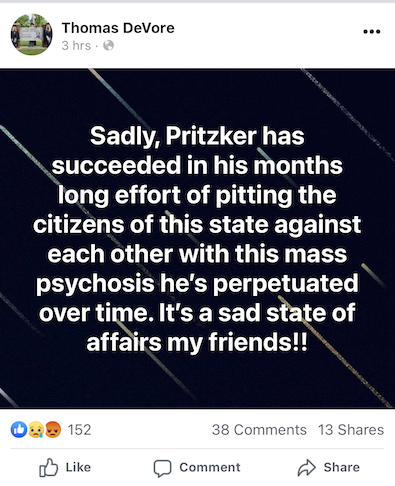
Cruz was represented by an attorney at appellate court candidate Tom DeVore’s firm, Silver Lake Legal Group.
Despite the chilly weather and winds reminiscent of those that damaged the Midwest the previous night, approximately 60 individuals gathered Saturday afternoon at the courthouse bandstand in Waterloo for We the People of Southern Illinois’ “Mental Health and Constitution” rally.
Six speakers addressed the crowd, including U.S. Senate candidate Peggy Hubbard of Belleville and attorney Thomas DeVore, who has challenged the legality of schools’ masking mandates in several courts across the state.
Judging from his lawsuit failure rate and his vitriolic outbursts, I’m not sure he knows much about either mental health or the Constitution.
Before attending Stanford and Oxford, Sullivan attended St. Louis University, where he founded a controversial, Anti-Israeli magazine called “One World.” […]
Most troubling though, are the multiple pieces of Anti-Israeli propaganda published during his tenure as Editor and CEO, including an article he wrote personally.
The third issue of One World was published in spring of 2007, while Sullivan was a Senior at the school, and Editor-In-Chief of the magazine.
The issue included photographs of The West Bank in Israel that had been taken By Brendan Kottenstette, from “SLU Solidarity With Palestine.”
One caption says: “The Wall Has Completely Cut Some Off From Their School. For Others, The Many Hours At The 316 Checkpoints In The West Bank Has Become An Obstacle That They Cannot Overcome. Some Even Lose Entire Semesters Because Of Absences Due To Checkpoint Closures.”
Another caption says Israelis view all Palestinians as terrorists: “On Their Side Of This Wall, As Their Entire Lives Are Controlled By Martial Law, All The Palestinians See Of Israel Are The Soldiers, Tanks And Guns… All The Israelis See Are Terrorists.”
The magazine viciously attacked Israel yet again In Spring 2009, when One World published an article titled “Obstructing Freedom In The Occupied Territories,” by Saint Louis University student Sharifa Barakat.
Barakat attacked Israel’s “occupation” of Palestine, and called for boycott and divestment campaigns targeting Israel.
I mean, he was basically a kid when he founded that magazine. But, man, it has sure proved to be target-rich.