* Gregory Pratt at the Tribune…
Chicago Mayor Lori Lightfoot privately called an official a “dumb, dumb person of color.”
Ald. Jason Ervin, she texted, was “full of crap.” She told Ald. Brendan Reilly he was “bush league,” and referred to Ald. Byron Sigcho-Lopez as a “jackass” in a text to another council member.
Lightfoot’s brusque style is no secret. But a trove of text messages, recently obtained by the Tribune, further reveals the extent to which the mayor — who campaigned as a reformer aiming to unite the city — at times resorts to name-calling and shaming of her perceived enemies as she governs the city.
The Tribune obtained more than 2½ years of Lightfoot’s text messages with aldermen through a series of Freedom of Information Act requests with which her staff failed to comply until the state attorney general admonished them and the Tribune threatened a lawsuit.
Lots of stuff in there, so go read the rest.
27 Comments  
|
Fair hit or not?
Thursday, Dec 9, 2021 - Posted by Rich Miller
* 2019…
Latest data show exhaust from cars, trucks and planes has overtaken coal plants as Illinois’ single-biggest source of carbon dioxide emissions, the largest contributing factor to climate change.
* With that in mind…
Thoughts?
62 Comments
|
IRMA chief goes off on Lightfoot over crime
Thursday, Dec 9, 2021 - Posted by Rich Miller
* Rob Karr, like his predecessor, is about the chillest person in this business. He’s got the skills and demeanor of a seasoned diplomat. So, seeing these quotes was a surprise and should be a wake-up call for everyone. Here’s Fran Spielman…
Mayor Lori Lightfoot was accused Thursday of abdicating responsibility for the retail crime wave sweeping Chicago and, instead, pressuring merchants to implement their own costly and unworkable security measures.
Twice in the last month — and as recently as this week — Lightfoot urged Magnificent Mile merchants victimized repeatedly by smash-and-grab robberies to follow the lead of their counterparts in Milan, London, Paris, Rome and along Hollywood’s Rodeo Drive.
She specifically mentioned security guards at the door, entrance cameras, merchandise “either chained and roped or put behind glass” and customers being “buzzed into” stores.
On Thursday, Illinois Retail Merchants Association President Rob Karr flatly rejected all of the mayor’s ideas.
He branded the suggestions “extraordinarily disheartening,” “misinformed” and “false”—yet another example of how Lightfoot “continues to point fingers and play the blame game.”
…Adding… Ken Griffin has been complaining loudly about the city’s crime…
The head of President Joe Biden’s security detail is retiring and taking a job with Citadel, billionaire Ken Griffin’s hedge fund.
David Cho has been with the United States Secret Service for more than 25 years and is the first Korean American to become special agent in charge of the service’s Presidential Protective Division. He’ll start at $43 billion Citadel on Jan. 3 as deputy head of security, according to a spokesman for the firm.
51 Comments
|
* From Rep. Jonathan Carroll…
Due to the unintended divisive nature of HB4259, I’ve decided not to pursue this legislation. Based on feedback and further reflection, we need to heal as a country and work together on common-sense solutions to put the pandemic behind us. Since taking office, I’ve always tried to have civil discourse with those who’ve disagreed with me. However, violent threats made against me, my family and my staff are reprehensible. I hope we can return to a more positive discourse on public health, especially when it comes to this pandemic that has tired us all.
Carroll said they received “several” threats. As we have discussed before, the bill would’ve violated federal law.
…Adding… Rep. Carroll is saying now that he didn’t intend to be divisive, but here’s what he told the Sun-Times…
(I)t all boils down to frustration between those who have “been following the science and … trying to do the right thing” and those who are “choosing not to get vaccinated, who are able to, for whatever they choose.”
“I think it’s time that we say ‘You choose not to get vaccinated, then you’re also going to assume the risk that if you do catch COVID, and you get sick, the responsibility is on you,’” Carroll said.
48 Comments
|
* We had nearly unanimous winners this year. The 2021 Golden Horseshoe Award for Best House Democratic Campaign Staffer goes to Jon Maxson…
He is a tireless worker and an excellent example of a legislative staffer. This year Jon not only was the leader for the House redistricting effort, but also was one of the people who helped transition the House Dem political operation to Speaker Welch. No matter what you think of redistricting, an honest person will admit that it is a difficult, complex process that involves high stakes and a lot of competing personalities and interests. Jon, with a calm but direct demeanor, managed the incredibly difficult task of getting not one, but two legislative maps passed in the midst of a pandemic in which the Census itself was mismanaged and delayed by the previous administration in Washington. Let’s not forget that this cycle is just the second time in the modern era that the legislature has passed a legislative redistricting map that has been enacted by a governor. That’s no small feat.
Prior to redistricting, Jon led the House Dem communications team, helping shape not only talking points and issue messaging, but also helping newer staffers develop and improve their writing skills and better understand the members they work with. On the campaign side, Jon has led opposition research and direct mail. Campaigns are zero sum and Jon is not afraid to throw the punches necessary for a point to make an impact with voters. He also worked with lots of candidates, many of them first time candidates, to develop their skills talking to the media and talking to voters.
* The 2021 Golden Horseshoe Award for Best Senate Democratic Campaign Staffer goes to Magen Ryan…
Magen Ryan is the rockstar of the Senate’s campaign operation. She guided them through a very difficult redistricting and oversaw the efforts to begin preparations for 2022. Her year may not have been as traumatic as Mary’s, but a redistricting year is never easy for the campaign people who have to deal with the legislative side of the shop.
Congrats to both.
* On to today’s categories…
* Best House Republican Campaign Staffer
* Best Senate Republican Campaign Staffer
Make sure to explain your votes or they won’t count. And, please, do your best to nominate in both categories. Thanks.
Also, the good folks at Lutheran Social Services of Illinois told me that they’re trying to raise $60,000 to buy Christmas presents for foster kids plus gift cards for the urgent needs of foster families. We’re at about $19,000 right now, and I think it would be great if we could push that to $20K and account for a third of LSSI’s fundraising goal. So, if you haven’t yet, please click here and donate. Thanks!
18 Comments
|
* Dan Petrella has a long and quite good story about the new state law banning dark and out of state money from judicial campaigns…
While he isn’t aware of other states having attempted an outright ban on dark money contributions to judicial candidates, [Douglas Keith, counsel for the Brennan Center’s democracy program] said some recent court decisions have cast doubt on a state’s ability to limit campaign contributions from outside its borders.
For example, a federal appeals court earlier this year struck down a prohibition on candidates in Alaska accepting more than $3,000 in out-of-state contributions in a year.
But the U.S. Supreme Court appears to have left some room for states to treat those seeking a seat on the bench differently than candidates for other offices.
In 2015, the court upheld a Florida law prohibiting judges and judicial candidates from soliciting campaign contributions.
When dealing with campaign finance laws, the court generally weighs First Amendment rights against a state’s interest in combating corruption, Keith said.
As an example of that alleged corruption, the article points to the lawsuit charging State Farm with funneling money to Lloyd Karmeier’s Supreme Court bid ahead of the company’s appeal of a $1 billion judgment. It’s a good read.
2 Comments
|
* Lynn Sweet…
Alexi Giannoulias, in a four-way Democratic primary for secretary of state, picked up the endorsement of Rep. Jan Schakowsky, D-Ill., on Wednesday, the second member of the House delegation to support his bid. […]
Earlier, Rep. Jesus “Chuy” Garcia, D-Ill., and former Rep. Luis Gutierrez, D-Ill., announced endorsements for Giannoulias. […]
“This election is critically important as Republican Secretaries of States across the country are implementing extreme right-wing policies that amount to the worst voter suppression effort since Jim Crow,” Schakowsky said in a statement.
“These underhanded tactics are solely aimed at suppressing the vote, particularly among voters of color, and restricting access to the ballot box.”
The only connection the SoS has to voting is the motor voter program.
* A couple of more from Politico…
— Congressman Sean Casten (IL-06) announced the endorsements of 40-plus Illinois elected officials and community leaders for his re-election campaign. This slate of endorsements includes state senators, state representatives, county elected officials, school board members, village trustees, mayors, and community activists. […]
— Anna Valencia has been endorsed by the International Association of Heat and Frost Insulators and Allied Workers Local 1 in her bid for secretary of state.
Casten’s list is here.
* Subscribers were told about this the other day…
Cook County sheriff’s official Becky Levin plans to kick off her campaign to seek the Illinois House seat of outgoing Majority Leader Greg Harris on Thursday, calling herself “a crime fighter and a public health expert, who has a proven record of results.”
The first candidate to officially enter next year’s race to fill the North Side Democrat’s House seat, Levin grew up in northwest suburban Des Plaines and has lived in Uptown for the last 10 years, describing herself as a “proud” policy wonk and nerd.
After more than two decades in health care, she has served as the executive director of public policy for Cook County Sheriff Tom Dart since January 2020. Levin pointed to her background and “breadth of experience” as the main reasons why she should succeed Harris.
This person as well…
* Press release…
Candidate for State Representative in Illinois’s 51st House District, Nabeela Syed, announced this morning she has been endorsed by State Representative Theresa Mah.
Rep. Mah shared the following statement with her endorsement: “Nabeela is a driven community organizer who has helped shape winning movements for progressive issues on local and national scales. She has a track record of mobilizing voters, especially young voters and voters of color, which will be critical for our party in 2022. I am proud to give her my endorsement.”
“Representative Mah is a tireless advocate for Illinois families in Springfield and has been a champion on issues including education, economic opportunity, and immigrant rights,” said Syed. “I’m proud and honored to have her support.”
Rep. Mah joins Sen. Ram Villivalam in endorsing Nabeela Syed’s campaign for State House.
*** UPDATE *** Not unexpected…
The Illinois AFL-CIO, representing nearly 900,000 workers and their families across the state, today has thrown its political support behind Nikki Budzinski for Congress in the 2022 election.
The AFL-CIO’s Executive Board voted today to strongly support Budzinski, who has announced her intention to run for the Democratic nomination for the 13th District seat in Congress stretching across central and southern Illinois earlier this summer.
Budzinski, a native of Peoria, has devoted her professional life to fighting for working families and the middle class since graduating from the University of Illinois at Urbana-Champaign. Her grandfather was a union painter, and her grandmother was a public school teacher. She interned for former Congressman Dick Gephardt, former U.S. Sen. Paul Simon, and for Planned Parenthood.
Budzinski has served as Political Representative for the International Association of Fire Fighters, Associate Director for Legislative and Political Action for the United Food and Commercial Workers Union and as senior advisor to Gov. J.B. Pritzker on labor issues. She left her role as chief of staff to President Joe Biden’s budget office earlier this year to run for Congress.
She has lined up an impressive list of endorsements for the 13th District seat in short order, from unions representing electrical and communications workers, transit workers and firefighters to U.S. Sen. Dick Durbin, and a number of Illinois federal and state elected officials.
Budzinski promises to put working families first in Congress, through a $15 an hour federal minimum wage, a federal tax credit for families with children, and stronger health care, prescription drug and job training programs.
The new 13th District, reconstructed after the 2020 Census and recently approved by the state Legislature, is expected to stretch from the Metro East near St. Louis along Interstate 55 through parts of Springfield, then east through Decatur and to Champaign in central Illinois.
“This was an easy decision for our board because Nikki Budzinski is a true, proven champion for working families,” said Tim Drea, Illinois AFL-CIO President. “At a time when our nation’s politics are so polarized, we know Nikki will put working and middle-class families first and always be a voice for investing in the workforce that drives our country’s success. We look forward to supporting her candidacy in 2022 and working closely with her to put Illinois on the right track in Washington.”
Budzinski said the AFL-CIO endorsement is a major boost to her efforts to put working families first in Congress.
“I am truly honored to be endorsed by the Illinois AFL-CIO in my campaign for Illinois’ 13th Congressional district. I am proud to have spent my career working on behalf of working people; fighting for a $15 minimum wage, paid sick time, safe working conditions and retirement security. The labor movement built the middle class and that is why in Congress I will proudly support the Pro Act, to strengthen a worker’s right to have a voice in the workplace. I look forward to partnering with the Illinois AFL-CIO to deliver results for working families when I am elected to Congress,” Budzinski said.
20 Comments
|
* COGFA special pension report…
(A) significant drop in unfunded liability was recorded in FY 2021, largely thanks to exceptionally strong investment performances by all the five systems. This allowed the combined unfunded liability to decrease by $14.3 billion, a 9.9% decline from the previous year, to $130.0 billion. During the recent 15- year period, there were only three times that the unfunded liability decreased from the previous year: in FY 2011 (-2.9%), FY 2017 (-0.5%) and FY 2021.
* Chart…

* Crain’s with some caveats…
One, the COGFA figures are based on the market value of pension-fund assets. In other words, they’re not blended or otherwise averaged over five years, as often is the case with such reporting.
Caveat two is that, just like almost any other investor with half a brain, the state funds enjoyed “exceptional” returns on invested capital in fiscal 2021, earning 22.9% to 25.2%. That’s way, way above their assumed rate or return of 6.5% to 7%.
Beyond that, some years in the recent past had unusual bumps, making the new figures look relatively good in comparison. And even with the booming return on investment, the state still is contributing roughly $2 billion a year less than the amount it is actuarially required to reach its eventual full funding.
Ergo, concludes Civic Federation President Lauarence Msall, the new COGFA figures “are not a trend. It’s a data point in the market.”
He continues, “It’s not bad news. But it’s only one data point.”
It may not be a trend, it may be just one data point, it may be a complete fluke, but you gotta take what you can get in this world, so I’ll take it.
41 Comments
|
More Jesse Sullivan oppo emerges
Thursday, Dec 9, 2021 - Posted by Rich Miller
* Publications like the Free Beacon are known for taking oppo that others probably don’t want. But considering the claims made by Darren Bailey this week more than just implying that Jesse Sullivan is a Democratic plant, well, it’s at least worth a look before it becomes a regular primary campaign talking point…
A venture capitalist running in Illinois’s Republican gubernatorial primary is a relative newcomer to the right. Fifteen years ago, Jesse Sullivan founded a self-described “social justice” magazine that has defended riots and abortion.
Sullivan, a political neophyte who ran a San Francisco-based nonprofit before launching his gubernatorial bid in early September, founded the magazine One World in 2006 while a student at St. Louis University. The publication had financial support from left-wing groups like the Center for American Progress, whose Goal Was To “counter the growing influence of right-wing groups on campus.” In the years that followed, One World published articles Dismissing riots in Ferguson, Mo., as the work of “a few troublemakers” amid “an entire crowd.” Four years later, in 2018, the magazine Expressed Support for the “legal right to choose” to have an abortion. […]
A Sullivan campaign spokesman told the Washington Free Beacon that the Illinois Republican founded the publication “when he was in college doing humanitarian work,” though Sullivan remained on One World‘s masthead as the magazine’s “visionary” long after his graduation. His campaign says that role came with “zero involvement or editorial oversight.” At the same time, Sullivan appears to have remained involved with the magazine, headlining its 10-year anniversary celebration in 2016. A campaign spokesman said he spoke at the event “as a courtesy.”
“The suggestion that Jesse agrees with the viewpoints of a magazine he has had nothing to do with, is laughable,” Sullivan’s campaign said in a statement. “Let’s get back to the issues at hand and leave the cancel culture to the liberals and political hacks.”
His problem is he’s an unknown quantity who kicked off his campaign by fudging his “military” background. I dunno what to believe now. Also, there’s this from Sullivan’s LinkedIn page…
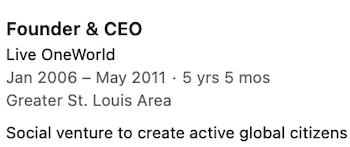
So, he claims to have been the CEO for five years. Yeah, OK, but he was in college when he founded it and it’s been ten years since he left the group. I dunno.
* Jim Swift is quite dubious of the life change…
Who is Jesse Sullivan? A guy I went to college with wants to become Governor of Illinois. He’s got the look. He’s got money from the tech bros. But what he doesn’t have is a pedigree in being a Republican.
It’s like he was kidnapped and transformed into a GOP Manchurian candidate out of central casting in Ripon, Wisconsin.
Thankfully, those of us who knew him back when aren’t alone. Jesse Sullivan, social justice warrior king of St. Louis U. as a Republican? I would have known him if he were a Republican. I helped run the College Republicans on campus and in the state. This transformation is about as legitimate if Shoeless Joe Jackson walked out of a [expletive deleted] cornfield wearing a Red Sox uniform.
Maybe tech money does corrupt. Ask JD Vance.
Perhaps somebody in Illinois should ask him about his views on Donald Trump? Or Mitt Romney? Or John McCain?
Beware of posers. Jesse Sullivan is a poser.
…Adding… Gary Rabine…
Republican Governor candidate Jesse Sullivan needs to answer the growing number of questions about his Republican credentials as he seeks to be head of the Illinois Republican Party. In the last several days it has surfaced that until recently he has been aligned a with far-left publication, politically active in Democratic campaigns and has not voted or supported the Party’s presidential nominee since at least 2004. (voted for Obama, but not Trump). Crashing your parent’s car is something you can blame on youth–aligning with the socialist elements of the Democratic Party until right before you decide to run for the Republican nomination for Governor is something else. We don’t need a fake Republican as our nominee.
55 Comments
|
*** LIVE COVERAGE ***
Thursday, Dec 9, 2021 - Posted by Rich Miller
* If you’ve contributed to Lutheran Social Services of Illinois during our December fundraising drive, thanks. If not, please click here. Follow along with ScribbleLive…
Comments Off
|
|
 Support CapitolFax.com
Visit our advertisers...

 ...............
 ...............
 ...............


|
   
|
Hosted by MCS |
SUBSCRIBE to Capitol Fax |
Advertise Here |
Mobile Version |
Contact Rich Miller
|



