Chicago’s longest-serving U.S. Attorney leaving office June 30
CHICAGO — Patrick J. Fitzgerald, the United States Attorney for the Northern District of Illinois for more than a decade, today announced that he is stepping down as U.S. Attorney effective June 30, 2012. Mr. Fitzgerald notified the White House, Attorney General Eric Holder, and U.S. Sens. Richard Durbin and Mark Kirk this morning of his decision to step down from the presidentially appointed post that he has held since Sept. 1, 2001, making him the longest-serving U.S. Attorney ever in Chicago.
Mr. Fitzgerald, 51, has no future employment plans and will take time off this summer before considering career options. Including his tenure as an Assistant U.S. Attorney in New York, Mr. Fitzgerald is leaving the Justice Department after nearly 24 years.
“When I was selected for this position in 2001, I said that it was one of the greatest opportunities that one could ever hope for, and I believe that even more now after having the privilege of working alongside hundreds of dedicated prosecutors and agents. I have tried not to get in their way. I extend my deepest appreciation to the attorneys and staff for their determined commitment to public service. This was a great office when I arrived, and I have no doubt that it will continue to be a great office,” Mr. Fitzgerald said.
He plans to hold a press conference tomorrow.
*** UPDATE *** From a press release…
STATEMENT OF THE ATTORNEY GENERAL ON RESIGNATION OF
U.S. ATTORNEY FOR THE NORTHERN DISTRICT OF ILLINOIS
PATRICK FITZGERALD
WASHINGTON – Attorney General Eric Holder issued the following statement today on the resignation of U.S. Attorney for the Northern District of Illinois Patrick Fitzgerald:
“Throughout his distinguished career as a prosecutor, United States Attorney Patrick Fitzgerald has served the American people and the citizens of Illinois with the utmost integrity and a steadfast commitment to the cause of justice.
“From his early consequential years in New York City confronting the terrorist threat to his strong leadership of the U.S. Attorney’s Office for the Northern District of Illinois, Pat has rightly earned a reputation over these last 24 years as a prosecutor’s prosecutor, overseeing significant cases involving public corruption, international terrorism and terrorism financing, corporate fraud, organized crime, and violent crime.
“A hallmark of Pat’s tenure has been his personal commitment to the Department’s mission and his willingness to accept the call of duty – whenever it came and whatever it required. In 2003, he was appointed as special counsel in the investigation into the disclosure of the identity of a covert employee of the Central Intelligence Agency that resulted in the indictment of I. Lewis “Scooter” Libby, then chief of staff and national security advisor to the Vice President. He also served as lead counsel in the trial, which resulted in Mr. Libby’s conviction on charges of perjury and obstruction of justice. In 2010, I appointed Pat as Special Attorney to supervise the investigation that resulted in the pending indictment, in the Eastern District of Virginia, of former CIA officer John Kiriakou for allegedly repeatedly disclosing classified information, including the name of a covert CIA officer and information revealing the role of another CIA employee in classified activities.
“Over the years, he has gained the trust of two presidents and the unwavering confidence of four Attorneys General, and I am deeply grateful to him for his service and his friendship over the years.”
* As I told you yesterday, Gov. Pat Quinn spent part of Tuesday speaking to a class of 8th Graders. From that appearance…
During his hour long talk, Quinn told students that with little more than a week to go before the spring Legislative session is scheduled to adjourn, it was time for lawmakers to get cranking.
“They’re like you, they’ve got to get their homework done,” he said.
Yes, they do. No quarrel with that. But so does the governor. And taking questions like this doesn’t move the ball forward…
At one point, an eighth-grader asked, “What’s a pension?”
* What a total waste of time, unless the governor’s intent was to get his mug on Chicago TV again while continuing his way-too-early victory lap at the very moment that things were falling apart in Springfield…
Legislation restructuring Illinois’ Medicaid system was put on ice Tuesday as legislative leaders attempted to figure out what pieces of the package to pass first and whether to tax tobacco products other than cigarettes.
Feigenholtz said a portion of the legislation that would clear the way for Cook County to take on more Medicaid patients might be removed. The provision would roll back a state mandate against Medicaid growth to allow Cook County to add to the Medicaid rolls 100,000 people who would become eligible in 2014 under the Affordable Care Act. The move to add more enrollees would let Cook County receive federal matching funds for patients who are currently getting free treatment at county hospitals. The measure would not be paid for with tax dollars from outside of the county.
* The reason for removing that provision, which costs state government nothing, is because the Right wing is getting all worked up over it…
Gov. Rick Perry in Texas and Gov. Chris Christie in New Jersey supported similar waivers in their states, and here Tom Cross expressed his support, which of course sent off alarms among the national Republican mullahs.
“The Republican leader of the Illinois state house is on the verge of voting to speed up the implementation of Obamacare’s Medicaid expansion in the state nearly two years early,” the National Review gasped.
“Illinois Liberty PAC will be monitoring the votes of Republican lawmakers. Republican legislators who vote to raise taxes, increase spending, grow the Medicaid rolls and—incredibly—implement Obamacare when Republicans across the rest of the nation are smartly resisting the siren song of federal largesse, will be targeted for replacement in the 2014 primary election season.”
* The Tribune rebuts…
Now, about the Cook County provision. Some conservatives argue that it will expand Medicaid coverage, costing the state money. Reality: It will allow Cook County to capture federal dollars for care that county taxpayers provide now. It will save local taxpayers a lot of money. Republican leaders negotiating the deal are confident that this won’t create new costs or obligations for the state. Proponents point to a similar program crafted last year by Republican Gov. Chris Christie of New Jersey.
A Medicaid package could come to a vote in the next few days, if there is a final agreement. Pension reform is still the most essential element to saving the state from fiscal ruin. Anyone who has been around Springfield knows how easily the whole grand bargain could collapse.
Yes, it could collapse, and the governor really needs to be here in town, not gallivanting around the state on a media tour.
* But there are more troubles than just right wing pressure on Republicans…
State Rep. Sara Feigenholtz, D-Chicago, a House sponsor of Senate Bill 2840, said there is more work to do on the legislation, while state Sen. Heather Steans, D-Chicago, the bill’s Senate sponsor, said there was talk about whether to broaden a $1-per-pack cigarette tax increase and hike taxes on all tobacco products, including pipe tobacco.
Doing so could bring in $825 million instead of the estimated $725 million take from a higher tax on cigarettes only. That revenue is from both tax revenue and federal matching funds. Gov. Pat Quinn has called for the legislature to cut Medicaid spending or find new money to cover some of a projected $2.7 billion increase in program expenses for fiscal year 2013, which starts July 1.
The dynamics of changing the massive program, which provides health care for the poor and is paid for by state and federal funds, are difficult.
Discuss.
* Related and a roundup…
* Our view: Illinois General Assembly must act now on fiscal reform
Campante and Do used a sophisticated statistical model to determine which capitals are the most isolated from their states’ population centers. They compared that measure of isolation with a database of convictions on federal corruption charges between 1976 and 2002. (Using federal convictions avoids the problem that some states may have more corruption convictions simply because local prosecutors are more aggressive. In addition, a long time period minimizes possible partisan bias).
The results showed an impressive effect, they wrote: “more isolated capital cities are associated with more corruption.”
The graph illustrates their findings. The states with the highest number of corruption convictions relative to their population size are at the top of the chart. Those with the most geographically isolated capitals are at the left-hand side.
The most corrupt state capitals – Jackson, Miss., Baton Rouge, La., Nashville, Tenn., Pierre, S.D., Springfield, Ill., and Albany, N.Y., for example – are all more isolated than average. Nashville is the least so, being a major city in its own right although distant from other population centers in the state. Springfield and Pierre rank as the two most isolated on the list. The less isolated the capital (the further to the right), the more likely it is to rank low on corruption.
Isolation doesn’t explain everything, of course. Some states, such as Oregon, Washington and Vermont, have unusually low levels of corruption. But the impact of isolation appears strong.
Correlation does not equal causation. Keep in mind that most people are busted for corruption in this state outside Springfield. Rod Blagojevich was recorded cutting crooked deals in his Chicago campaign office. The overwhelming number of people indicted by the feds are low-level types out in secretary of state offices or whatever scattered throughout Illinois.
If Springfield’s alleged isolation was the reason for corruption, you’d expect to see more busts at the Capitol. Hasn’t happened.
Also, Springfield may be a few hours away from the population center, but it’s hardly isolated. Peoria, St. Louis and other mid-sized cities are nearby. Pierre, on the other hand, is literally out in the middle of freaking nowhere. But that capital is almost completely empty when they’re not in session - far more so than our own.
What might cause the relationship between isolation and corruption, the researchers asked. One possibility was that newspapers, which provide most coverage of state governments, may be less likely to cover the capital when it is further from their circulation areas. So they examined the content of 436 U.S. newspapers, searching for references to state government. Sure enough, “in states where the population is more concentrated around the capital,” the study found “more intense media coverage of state politics, and therefore greater accountability.”
Yes, the Chicago newspapers do tend to play up local politics over Springfield, but they’ve done some excellent work as well and have top notch reporters assigned to the Statehouse.
* Under current Illinois law, taking this video of a “Black Bloc” surge against a Chicago Police Department line is a felony punishable by up to 15 years in prison. Actually, I could be charged with a felony just for showing it here. Let’s hope that doesn’t happen. The unprovoked surge by the moronic “anarchists” starts at about the 25 second mark…
Months after its initial proposal and just a day after the NATO summit that made the law a national issue, a plan to allow citizens to take video recordings of police officers was approved by the Illinois House.
The proposal would allow citizens to record on-duty police officers in a public place. The House approved it by a 71-45 vote Tuesday, and it will be sent to the Senate for further debate.
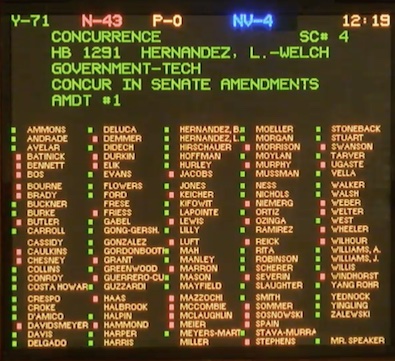
* There were a bunch of “No” votes on the big board, though…
State Rep. Dena Carli, D-Chicago, opposed the revised bill, saying she fears people may get too close to dangerous situations to get audible sound.
[The Senate] on Tuesday sent Gov. Pat Quinn a separate eavesdropping measure aimed at helping police record drug deals faster. The legislation would allow law enforcement officials to make audio recordings of drug deals with only the permission of a state’s attorney instead of a judge.
“By that time, the drug dealers are gone,” said Democratic Sen. William Haine, a former Madison County state’s attorney.
Democratic Sen. Tony Munoz, a Chicago police officer, said the measure would better protect undercover police. He dismissed constitutional questions raised in debate, saying the courts can review the law. “But if we can save an officer’s life, I think it’s worth it,” Munoz said.
* The Senate came one vote short of passing a new anti-bullying bill. The AP has some info…
The bill would have required anti-bullying policies to include a definition of bullying and a statement saying it was against the law. The policies would have spelled out how allegations could be submitted anonymously and how they would be investigated. Policies also would have been required to describe what could happen to students who bully others, such as counseling or community service.
Some conservatives feared the bill would be used as cover to indoctrinate students. The Illinois Family Institute lobbied for an “opt out” provision that would let students and teachers skip any lessons or events that violated their religious beliefs.
“There are some programs that are not just against bullying in general. Some of them tend to have an agenda of being pro-homosexual,” said Sen. Kyle McCarter, R-Lebanon.
The legislation would not require schools to offer programs on bullying or homosexuality, but McCarter said it would be a step toward such a mandate.
A step toward such a mandate? Really? The far Right Illinois Family Institute claims the bill does pretty much nothing…
Cassidy stated that this additional law is needed because 3 school districts (out of over 900) have no policy and 20 do not have “adequate” bullying policy. What she failed to make clear during floor debates is that the 3 school districts that don’t have bullying policy are already in violation of existing law, so HB 5290 is unnecessary.
Furthermore, HB 5290, which mandates nothing, would do nothing about the 20 school districts that have — in Cassidy’s view — inadequate policy. If these 20 districts have bullying policy, they are in compliance with existing law.
Each school district and non-public, non-sectarian elementary or secondary school shall create, and maintain, and implement a policy on bullying, which policy must be filed with the State Board of Education.
It would require implementation, not just having a policy.
McCarter and other opponents wanted an addition to the bill that would allow students to opt out of any anti-bullying programs or activities that clashed with their personal or religious beliefs. Supporters said federal law already gave students that right.
* An amendment was introduced yesterday on this very topic by Sen Kirk Dillard…
No student or school employee shall be required to attend or participate in any bullying program, activity, assembly, or event that may infringe upon his or her free expression or contradict his or her personal, moral, or religious beliefs.”.
Dillard is creating chits for another statewide bid, so naturally he introduced the amendment. Why do I say that? Compare Dillard’s amendment to to the language already in the bill…
Nothing in this Section is intended to infringe upon any right to exercise free expression or the free exercise of religion or religiously based views protected under the First Amendment to the United States Constitution or under Section 3 or 4 of Article 1 of the Illinois Constitution.
Equality Illinois, which promotes gay rights, was among the supporters of the bill. Spokesman Randy Hannig stressed that the legislation wasn’t specific to homosexual bullying victims. “This is not a bill about gay and lesbian kids. It’s a bill about ending bullying.”
But Hannig speculated that the group’s backing of the bill alone may have prompted others to oppose it. He slammed critics for “trying to hijack this bill for their own political agenda.”
Equality Illinois is a homosexual activist organization. The Illinois Safe Schools Alliance is a homosexual activist organization that was once part of the Gay, Lesbian and Straight Education Network (GLSEN). The ACLU is an organization as committed to normalizing homosexuality and gender confusion as GLSEN, Equality Illinois, and the Illinois Safe Schools Alliance. And State Representative Kelly Cassidy (D-Chicago) is openly homosexual.
Yeah. It’s all a liberal gay plot to indoctrinate our children and take over the world.
the Carol Stream-based Illinois Family Institute fears the law would silence certain students whose views might be unpopular. For instance, they say, a student who does nothing more than share his opinion that homosexuality is immoral could be labeled a bully and put through anti-bullying lessons that say his religion is wrong.
The group is correct that freedom of expression never should be taken for granted, and the right of students to assert their religious beliefs must always be protected. But this legislation not only protects such students from being falsely labeled as bullies; it also helps assure that they won’t be bullied themselves.
The anti-bullying proposal clearly states that the law is not meant to “infringe upon any right to exercise free expression or the free exercise of religion or religiously based views.” It contains no read-between-the-lines encroachment on any students’ freedoms. It simply provides another tool to prevent the hurt and even tragedy that vicious teasing and pranks can cause.
We urge the Senate to reconsider and for school officials to be vigilant in ensuring that both free speech and students’ well-being are protected.
West Side Democratic leaders were unable to reach consensus Tuesday on a challenger to indicted Rep. Derrick Smith, but among the finalists is the girlfriend of 28th Ward Ald. Jason Ervin. […]
But several committee members questioned the integrity of the process, saying Ervin, who sits on the selection panel, admitted during private deliberations that Conyears was his girlfriend. The relationship was not disclosed during the public portion of the meeting. […]
[Secretary of State Jesse White] said that while the relationship revelation was troubling, Conyears was selected as a finalist because she spoke knowledgeably about Springfield’s budget problems and how she would fix them.
After the problems with appointing a hack like Derrick Smith to the House last year, these committeemen now think it’s OK to consider an alderman’s girlfriend? OK, fine, she “spoke knowledgeably about Springfield’s budget problems.” But what the heck? From WBEZ…
Asked if he was romantically involved with Conyears, the alderman replied, “I don’t think that has any bearing on the decision that’s being made.”
And if they are - hypothetically - involved, does Ervin think that would impact how he’d vote?
“No,” he said.
Reached by phone, Conyears would only say she and Ervin are “friends.” She said she sees no conflict for the alderman.
Indicted state Rep. Derrick Smith will likely get a respite from his House colleagues through the end of the Legislature’s spring session.
Several members of the House Special Investigative Committee looking into federal bribery allegations against the Chicago Democrat said chances of the committee meeting before the spring session ends May 31 are slim.
“As you can imagine, things are a little hectic around here right now,” said state Rep. Elaine Nekritz, D-Northbrook, chairwoman of the investigative committee. “My time is very limited by the whole pension thing. Everyone else’s time is taken up by the end-of-session crunch.”
Rep. Nekritz, you’ve had since the primary to take care of this matter. This latest delay is just ridiculous.
Gov. Pat Quinn Tuesday called indicted state Rep. Derrick Smith’s decision to award nearly $185,000 worth of tuition waivers last week “very disappointing” and reiterated plans to sign legislation to abolish what he has called a “political scholarship” program. […]
The group of students whose names Smith initially submitted for tuition waivers for the 2011-2012 school year included two students who didn’t live in his district — as state law requires for the scholarships.
The Illinois State Board of Education rejected those two because the students lived in the neighboring legislative district of Rep. La Shawn Ford (D-Chicago).
Ugh.
The unconscionable delays by the House Special Investigating Committee led directly to this scholarship mess.
Wednesday, May 23, 2012 - Posted by Advertising Department
[The following is a paid advertisement.]
At a time of tough choices, the single largest job-creation plan in decades is now before the General Assembly.
SB 1849 is a gaming solution that would create more than 20,000 jobs and bring in $200 million in new annual revenue to Illinois. It would be an economic shot in the arm for our state, and we can’t afford to pass it up.
Illinois workers need a jobs plan. Unemployment in the state stands at 9 percent, families are struggling to make ends meet and the effects of the recession have further endangered thousands of already existing jobs, like the more than 30,000 statewide agricultural jobs that SB 1849 will save.
The job creation boost SB 1849 would provide is why major voices from Illinois’ organized labor community support this gaming solution. Supporters include Illinois AFL‐CIO, Chicago Federation of Labor, IBEW Local 134, SEIU Local 1, and UNITE HERE Local 1.
These labor groups and over 80 members of the Illinois Revenue & Jobs Alliance know this bill would be a “win” for the state of Illinois and its residents. Legislators ought to pass SB 1849 – and start putting workers back on the job.
* What’s next, the Girl Scouts? From a press release…
Governor Quinn Talks Pension and Medicaid Reform with Students
Hosts Town Hall About Illinois’ Future at Julian Middle School
OAK PARK – May 22, 2012. Governor Pat Quinn today hosted a town hall meeting with students at Julian Middle School about the urgent need for pension and Medicaid reform. With just 9 days left before the end of spring legislative session, the governor continued his push to stabilize Illinois’ Medicaid and pension systems and educate the public about our fiscal challenges. During the visit, Governor Quinn took questions from 8th graders about their stake in what happens in Springfield this session and the impact that these two issues have on the future of Illinois.
“At its core, this battle to resolve our fiscal challenges is about the future of our children,” Governor Quinn said. “If we want to educate our kids and ensure they are ready for the workforce, our moment is now. We must assume responsibility to build a better future for our children. We must work together to get these vital reforms done.”
For crying out loud, governor, get back to Springfield and stop doing silly press pops near your house. You told reporters yesterday that you wanted to see “an epic 10 days” at the Capitol and wanted legislators to avoid all distractions, and now you’re spending time taking questions from 8th Graders?
Then again, some might say that Quinn is doing more good by getting outta town so he can’t screw things up.
* I received an e-mail from AFSCME yesterday saying they had over 400 people at the Statehouse lobbying “for a fair solution to the pension problem that can be supported by all parties.” The union plans to bring 1,000 people per day through Thursday.
* The Question: Should AFSCME “pull a Wisconsin” and try to flood the Capitol with thousands of protesters? Take the poll and then explain your answer in comments, please.
* Things got a bit heated on the House floor yesterday when one member accused another of playing to the press box on the bill abolishing legislative scholarships…
State Rep. Ken Dunkin (D-Chicago) accused the sponsor, State Rep. Fred Crespo (D-Hoffman Estates) of simply trying for a “press pop” and of trying to impugn the integrity of lawmakers who, as Dunkin indicated he does, use an impartial committee to make the awards. Supporters of the bill, which passed by more than a two-to-one margin in the House, say the program has taken on too much scandal to survive.
In January, the Sun-Times and the BGA revealed that state Rep. Robert Rita (D-Blue Island) awarded a $37,000 tuition waiver to the daughter of Ald. Anthony Beale (9th), a political ally who endorsed Rita for the statehouse and whose wife was employed by Rita as a $400-a-month staffer until he recently fired her after the Sun-Times reported on a probe focusing on her past employment in the secretary of state’s office.
Crespo credited the reporting for prompting action after years of debate.
“Kudos to you, the Sun-Times and the BGA, for sticking to it almost like a pit bull,” Crespo said. “That was a key. It would pop up in the past, then go away, but you guys did a very good job of keeping it alive.”
I received an e-mail from the Better Government Association this morning highlighting that quote and claiming they’ll be invited to the bill signing ceremony.
* Yes, this was indeed a major press pop. But that scholarship program was rife with problems and it had to be killed. So, sometimes good media is actually good government. I’m not sure how the Tribune is gonna feel about Crespo after that gushing praise for the Sun-Times, however. It’s gotta sting a little.
* The State Journal-Register published an op-ed today by Stephen Kaufman, a retired university professor…
And business as usual is expensive for the people of Illinois. In his discussion of the [Illinois Reform Commission’s] findings, [commission chairman Patrick Collins] stated unambiguously that corruption and inefficiency in Illinois’ government cost the people of Illinois up to $10 billion annually.
Yes, that’s 10 billion dollars. In the absence of substantive government reform and in a tight economic climate, the people of Illinois are being asked to make extraordinary sacrifices: a major increase in state income tax, decreased state resources for education and health care, and serious erosion of pension benefits are among the many thus far imposed and more are under consideration. Instead of demanding and fighting for meaningful and cost-saving government reform, institutions, businesses and individuals are capitulating to the greed and corruption-driven practices of Illinois state government. [Emphasis added.]
Wow. $10 billion in Illinois state government corruption? That’s a heck of a lot of money - almost a third of General Revenue Fund spending.
* But I didn’t remember Collins actually saying that. So I Googled it. This is what I came up with…
The Illinois Reform Commission has gathered testimony from some experts who peg the “corruption tax” at more than 5 percent of every public contract.
That would easily equate to hundreds of millions of dollars, if not billions, a year, says commission chair Patrick Collins, a former federal prosecutor who helped put Ryan in prison.
Hoffman estimates there is about $10 billion alone worth of state contracts that are subject to political manipulation that ultimately could mean higher costs and worse service.
Oops.
* Kaufman’s bio…
Stephen Kaufman, emeritus professor at the University of Illinois, taught immunology and cell biology at the university for 32 years. His research focused on skeletal muscle development and diseases including muscular dystrophy. He is the author of more than 75 scientific papers.
Maybe somebody with more experience ought to be writing op-eds for major Illinois newspapers.
* Illinois State Board of Education Chairman Gery Chico has been working editorial boards across the state lately, decrying a possible cut to education funding. The work has paid off. Here’s the Southern Illinoisan…
It’s the wrong time to be looking at cuts in education. Illinois State Board of Education Chairman Gery Chico said $650 million in funding already has been cut from school districts since 2009. Chico said plans that would seek another $250 million to $750 million in cuts could be devastating in a state that already ranks near the bottom nationally in funding public education.
In just one example, looking at the potentially deepest cut of $750 million from education, funding for Murphysboro Community School District 186 would be cut from a projected $8.26 million to $6.75 million. Chico said such cuts would force local schools to cut programs, eliminate teaching jobs or raise taxes.
This is no idle threat. The Illinois House of Representatives has approved spending caps for the coming fiscal year that would cut education by nearly $260 million — even if the state successfully cuts $2.7 billion from Medicaid. The other, more-dire possibilities could see education cut by $500 million or $750 million in a state already ranked near the bottom for funding education.
“If that happens, I just think it’s devastating to school systems,” Chico said. “This is going to mean that if we continue to cut education in the state of Illinois, it’s going to reach laughable levels.”
But we believe every citizen in the state should be concerned at the damage that could be inflicted on public schools statewide under a 2013 budget plan backed by the Illinois House that strips from Quinn’s plan some $258 million from education spending. We admire the goal, which is to use $800 million in 2013 tax receipts to pay off some of the state’s bill backlog, which stands at $5 billion. We question whether jeopardizing public education and endangering celebrated reforms is a worthy trade-off.
“We have to have sanity in the way we look at affecting the finances of our school system,” Illinois State Board of Education Chairman Gery Chico told The State Journal-Register editorial board last week. “That ($258 million) is real money. That means you’re either letting go teachers, cutting back programs or you’re raising taxes. Those are all the options. So it’s dramatic, it’s drastic.”
For the Springfield School District, it would mean a loss of $5.7 million. School districts simply can’t absorb cuts that size without effects that are felt in classrooms.
And all that teacher accountability? It can’t happen without an assessment program in place, and that doesn’t happen without funding.
“We had a few million dollars put in there (for assessments) and some people in the House now are talking about striking that line item,” Chico said. “I don’t know why we’re getting applause for passing one thing and then the resources for getting it done are taken out.”
The state has a huge mountain of overdue, unpaid bills to schools. The school funding cuts are supposed to be used to pare down that and other debts.
…Adding… The comptroller’s office says that the current bill backlog to schools is $561 million.
* Despite Chairman Chico’s strong opposition, some are defending the cuts…
If the cuts go through, almost every district in the Stateline would feel the effects. Belvidere could lose 300-thousand dollars for the year, Winnebago over 600-thousand dollars, and Rockford would lose close to 8-millon dollars for fiscal year 2012.
“It’s not going to be pretty, but there’s really no other way,” said state senator Dave Syverson.
Syverson says out of control spending has left lawmakers will little options.
“We can’t do that anymore,” said Syverson. “You need to be honest with schools, with healthcare providers.”
And while lawmakers are still looking at other options to fill a near 3.5 billion dollar hole, Syverson says the education system in the state will likely take a hit.
“You have to cut into both when you have this big of a debt,” said Syverson.
* But the Senate Democrats’ budget plan contains no education cuts, which they believe is the right way to go. Even so, things got a bit testy in the approp committee yesterday…
But Senate Republicans said Democrats should be considering cuts instead of tapping into other funds. They said they could not support the proposal because it does not put the state on a path to security after the recent income tax increase begins to roll back in 2015. “I believed that we shared brief, shining moment of optimism in the beginning of our talks,” said Sen. Pamela Althoff, a McHenry Republican. “Unfortunately as we tried to progress, we really broke down. Our conversations, they stalled over one basic staunch principle, and that was a promise of the Republican caucus to always craft a spending plan that put the state of Illinois on a trajectory to eliminate the tax increase on schedule. And what we see before us now makes [our] support of this proposal impossible, as we cannot meet that principle.” […]
Democrats said Republicans are stalling and being obstructive. Steans said that any time an agreement seemed close in negotiations, Republicans “moved the goalpost.”
Another potential sticking point is facility closures. The proposal calls for the closure of the Dwight Correctional Center, the Murray Developmental Center in Centralia, the Jacksonville Developmental Center and the Tinley Park Mental Health Center. While no Republicans spoke out adamantly against the closures at today’s hearings, Republicans on the Commission for Government Forecasting and Accountability, which takes advisory votes on facility closures, have general opposed closing downstate facilities.
* The Medicaid restructuring bill popped up yesterday…
The measure, filed as a House amendment to Senate Bill 2840, includes $240 million in payment rate cuts to hospitals and nursing homes. But it spares doctors from rate cuts, along with 51 rural community hospitals and about 20 urban hospitals that care for poor patients.
The legislation eliminates most dental care for adults, but keeps emergency dental care. It limits adult eyeglasses to one pair every two years, pays the same amount for cesarean sections as for vaginal deliveries — unless the C-section is medically necessary — and limits podiatry care to people with diabetes.
The bill would eliminate Illinois Cares Rx, a program that helps nearly 200,000 seniors get prescription drugs, which concerns the AARP. […]
Medicaid payments to many hospitals would be cut by 3.5 percent, but the bill exempts rural community hospitals and safety-net hospitals from the cuts. Association of Safety-Net Hospitals spokeswoman Julie Sznewajs said Latino and black caucus members are “standing strong for their communities” by supporting the exception.
* Eliminate coverage for group therapy for nursing home residents, chiropractic care for adults and in-patient detoxification programs.
* Eliminate the Illinois Cares Rx program, which helps seniors pay for prescription drugs.
* Require a $2 copay for prescription drugs
* Cap hearing, speech, occupational and physical therapy at 20 sessions. Eliminate adult dental care except for in emergency situations.
* Limit patients to four prescriptions per month. Three of the prescriptions can be brand name drugs. Limit patients to one pair of eyeglasses every two years ,.
* Require prior approval for the repair or replacement of equipment, such as prostheses and wheelchairs
* The dollar a pack cigarette tax hike is crucial to the plan, but it will be run on a separate bill…
Feigenholtz and Steans said the plan relies on the approval of a cigarette tax. “If the cigarette tax doesn’t pass, we are going to have to go back to the drawing board and cut a lot of human services things that are very important to us, like taking care of the elderly [and] child care. It is going to blow a massive hole into the human services budget.” The proposed $1-a-pack increase is not in Senate Bill 2840. Steans, a Chicago Democrat, said she expects the tax legislation to surface in the next few days. Backers of the proposal also hope to rework the hospital assessment — which is an accounting practice that the state uses to leverage federal funds — to bring in $100 million more next fiscal year, which begins July 1. Steans said she hopes to have the whole plan approved by the end of the week, so lawmakers can move on to considering the budget. “The goal is to do it this week or try to finish it up by the end of this week. We have to turn over the budget by the [May] 31st deadline.”
* The overall Medicaid package has broad support, but there are some holdouts…
Some House Republicans are supporting a proposal from the Illinois Policy Institute, a think tank dedicated to “supporting free market principles,” which they say can cut the Medicaid liability by $2.7 billion without rate reductions or a tax increase. “The governor and the members of the House and the Senate agreed that it was imperative to find $2.7 billion in Medicaid savings. The plan that is being proposed and discussed by lawmakers unfortunately fails to live up to that promise. Instead, tax hikes and rate cuts are being substituted for reform,” Sen. Kyle McCarter, a Republican from Lebanon, said today at a news conference to promote the plan.
Some of the Policy Institute’s proposals are pretty good, but many of their more high-dollar ideas can’t be implemented right away to save enough money in the coming fiscal year. For example…
Implement data analytics and transparency tools. Utilize services to steer beneficiaries to low global-cost providers for all non-emergency, elective inpatient and outpatient services. The state should begin this program on a voluntary participation basis, providing clients with incentives to use the service, while seeking federal approval for mandatory participation in the program.
Potential Savings: $185.0 million
* Pat Quinn has been the king of distractions. The governor is infamous for bouncing around all over the place during negotiations. So this is more than a little ironic…
Rebuffing talk of new legislation that would expand gambling in Illinois, Gov. Pat Quinn urged the legislature Monday to pass bills to restructure the state’s Medicaid and pension programs, two of the largest drains on Illinois’ budget.
“I’m not going to get distracted by that subject. Sometimes, down here, shiny objects can distract people,” Quinn said. “We don’t want any of that this week.”
Look, I understand why he wants to get Medicaid and pensions done first. And it’s laudable that he now wants everyone to stay focused on those goals. It’s just kinda funny to hear him talk about bright, shiny objects when he’s constantly chased squirrels all his life.
Tuesday, May 22, 2012 - Posted by Advertising Department
[The following is a paid advertisement.]
In a slow economic recovery, we should be doing more, not less, to spur job growth and economic development. That’s why the International Union of Operating Engineers urges lawmakers to oppose HB3881.
The claim that this is a “green” bill just masks what it really is – special legislation pushed at the last minute by one anti-union company that kills current and future jobs in Cook County.
The IUOE has hundreds of members working in Illinois communities to ensure that waste is disposed of and managed in the most environmentally responsible way we know how. We are proud to do the job because we know how vital a service it is to communities.
The bill will effectively export all of Cook County’s garbage to other counties and other states. But with the trash also goes the jobs and economic benefits. Everyone says jobs are a priority. Yet, HB3881 will shift jobs out of the Chicago area and out of state.
As an organization comprised of 23,000 hard working members, we are urging lawmakers to vote no on HB3881.
Jim Sweeney — International Union of Operating Engineers
* I’m a huge, committed believer in the right to protest and to peacefully assemble. But these self-described “anarchists” who cause trouble at demonstrations throughout the country have got to be stopped. So, welcome to Chicago, morons…
Several thousand protesters spent five hours peacefully chanting, singing and marching against war. At the end, nearly 40 young veterans dramatically took their military medals and hurled them toward McCormick Place, where world leaders met behind closed doors.
It was supposed to end there — at Michigan and Cermak.
But a “Black Bloc” of about 100 anarchists wanted something else. The group, which chanted “What do we want? Dead cops!” as it left Grant Park at 2 p.m., surged to the front of the protest crowd and tried to break through the imposing line of Chicago cops in riot gear blocking its path.
Then, in a scene Chicagoans feared ever since the city learned it would host the NATO Summit, the two sides violently clashed on live TV, with police nightsticks flailing and protesters unleashing a volley of sticks, bottles and at least one rock.
The battle at Michigan and Cermak flared and then slowed, and then flared again in bursts between 5 and 6:30 p.m. By then, much of the Black Bloc had slipped away, leaving behind a scene of bloodied protesters and four injured cops, including one stabbed in the leg.
* It would help, though, if the city understood what they were dealing with in advance…
Prosecutors say the three men charged Saturday with plotting to attack President Barack Obama’s campaign headquarters, Mayor Rahm Emanuel’s home, police stations and squad cars were anarchists and “members of the ‘Black Bloc’ group.”
But a black bloc isn’t an organization. Rather, it’s a tactic for marches.
Participants wear black clothes, bandanas, masks and anything else to conceal their identities from police.
Black blocs first drew the attention of mainstream America in 1999 during demonstrations against the World Trade Organization in Seattle. A black bloc went on the offensive, bashing windows of many businesses in downtown Seattle including Starbucks, Gap and other businesses with a global reach.
Black bloc vandals also damaged property during the 2010 G-20 meeting in Toronto.
Black bloc participants say they conceal their identities for fear of reprisals from police, who often infiltrate black blocs during demonstrations to identify those committing crimes.
The Black Bloc was also believed to be involved in another incident that took place during the march, an Associated Press report indicated that police and protesters clashed during the middle of the parade. The protesters, dressed in black, allegedly surged toward police and threw objects at officers. Police fought back with batons.
Those protesters ran away, but reconvened with the main crowd near the parade’s end at Cermak and Michigan Avenue and are believed to be part of the later clash with police, who beefed up security around that area — and officers showed up in full riot gear.
When police surged forward a second time — shouting “move” and using their clubs as barricades to shove protesters — many at the front of the crowd could not move fast enough. Several fell to the ground and were trampled by other protesters also being shoved back by police.
As reporters and protesters in the center of the melee screamed “There’s nowhere to go — stop!” the police line stopped just in time to prevent a disaster.
A good rule of thumb is that when reporters feel their safety has been threatened, you’re gonna see harsh coverage. The Sun-Times article was quite balanced, considering.
As someone who walked the entire parade route with the NATO protestors, from the Petrillo Band Shell to the corner of Michigan and Cermak, I can tell you there were two groups no one wanted to come in contact with: the police, and the Black Bloc.
From the outset, it was clear that the march’s organizers were not enthusiastic about the appearance of the Black Bloc, a gang of black-clad anarchists who believe that no protest is complete without a punch-up or a broken window. Marshals in orange vests ordered them to move further back in the crowd. They didn’t want the Black Bloc in the vanguard, as the face of the anti-NATO protests.
And yes, they were all dressed in black: black hoodies, black bandannas, black masks, black jeans, black boots. One Black Bloc member even brought along a black dog. Only the police, in their riot helmets and body armor, must have been hotter on that 85-degree day. Seeing themselves as the purest element of protest, the Black Bloc even tried to intimidate peaceful marchers, who they considered insufficiently radical. […]
At the corner of Michigan and Cermak, the march ended with speeches by veterans of Iraq and Afghanistan, who apologized for their roles in those wars and tossed their medals into the trees behind. After that ceremony ended, the police ordered protestors to “Move West” — toward the Cermak/Chinatown Red Line stop. Almost all the protesters complied. But not the Black Bloc. They’d come for a fight, and they weren’t going to leave without a cut or a bruise they could point to and boast, “Police brutality.” McCormick Place was in sight, beyond a line of mounted police officers.
“NATO is east!” the hardcore Black Bloc shouted. “NATO is east!”
They didn’t put up much of a struggle. Nobody got past the police lines. I hadn’t expected them to triumph in a conflict with the cops. None of them looked very big, very fit, or even very tough.
The Black Bloc didn’t storm McCormick Place, but they got more attention than the thousands and thousands of peaceful protestors surrounding them. That may have been their real mission on Sunday.
Their real mission is fighting with cops and causing trouble. They’re basically just punks who think they’re cool because they dig violence. They’re no different than European soccer hooligans, except their venue of choice is otherwise peaceful protests instead of sporting events.
A tense and often confrontational meeting over gambling expansion last week ended with Gov. Pat Quinn being evasive but not explicitly saying “no” to adding slot machines at horse racing tracks.
That might be the beginning of a reversal on the gambling issue for Quinn, who has adamantly opposed allowing tracks to offer slots.
Installing slots at the horse tracks is viewed as essential to passage of the gambling package that was stymied twice last year, once when Quinn adamantly opposed the concept and never was sent the bill to sign. The plan is to add five casinos, including one in Chicago and the south suburbs, in addition to allowing the tracks to offer slots.
There’s been a push on for months to get Quinn to change his mind. The key here is apparently Quinn’s demand for a ban on campaign contributions from gambling interests.
It’s widely believed that Quinn has opposed slots at tracks and wants the contribution ban at least partly because of heavy Republican contributions by Craig Duchossois in the 2010 campaign, including several to Quinn’s GOP opponent. Duchossois is the son of Arlington International Racecourse chairman Dick Duchossois.
The meeting last week was apparently quite contentious at times.
“I felt like I almost missed Rod,” cracked one participant afterward.
The governor patronizingly attempted to explain to Senate President John Cullerton (D-Chicago), Rep. Lou Lang (D-Skokie) and Sen. Terry Link (D-Waukegan), who have a combined legislative tenure of 73 years, how to pass a bill. Quinn doesn’t exactly have the greatest track record of passing bills, so that advice didn’t go down too well.
Quinn also angrily told Lang that he would “crush” the legislator if Lang attempted to move a bill without a campaign contribution ban.
The meeting apparently took place because proponents managed to build a roll call that showed 67 House members supporting gambling expansion. That’s four votes shy of overriding a gubernatorial veto, but it’s enough to perhaps make the governor think he might eventually lose.
At one point during the meeting, Link reportedly became fed up with the direction and tone and tried to get things back on track. If, Link said, the General Assembly agreed to a campaign contribution ban from casinos, racetracks, etc., would Quinn agree to slots at tracks?
The governor’s response, according to multiple sources, was that Gary Hannig would be working with them on that. Hannig is Quinn’s chief legislative liaison.
Link then repeated his question. If the Legislature agreed to a contribution ban would Quinn agree to slots at tracks? The governor angrily repeated that Hannig would be working with them on the issue.
Despite his deliberate evasiveness, people at the meeting did make note of the fact that the governor was no longer saying that he flatly rejected slots at tracks.
Hannig was then reportedly told by Lang not to bring him a draft bill that didn’t contain slots at tracks. A majority just doesn’t exist for gaming expansion without help for tracks. Hannig’s response was that he’d try to deliver something the next day.
Well, that day came and went, and no Hannig draft arrived.
But then the House left town for a few days, so the governor’s office still has some time to come up with a plan, even though Lang appeared to be growing restless last week. He’d rather have a negotiated agreement, but there is a strong sense among participants that Quinn wants to delay this issue until after the Nov. 6 election, so they’d better do something soon, either with him or without him.
The theory is that Quinn wants to pass a budget this month without using gaming revenue. Patching budget holes with gambling money could be seen as unseemly, and Quinn is attempting to revive his public image these days.
A new gaming law could also dent Quinn’s image when he’s attempting to be viewed as the man who saved pensions and Medicaid and got the budget back on track. Simply put, gaming would taint Quinn’s upcoming victory lap.
The second part of the theory is that Quinn will announce big problems with the budget before the fall veto session and use those “unforeseen” problems to justify gambling expansion, including a flip-flop on slots at tracks. The flip-flop would pale in comparison to the problems he could fix with a lot more gambling revenue.
Gambling expansion bills have never become law in the past unless all four legislative leaders and the governor were working together. This one probably won’t be any different.
* Here are a few stories about the Senate Democrats’ budget proposal, which they unveiled Friday afternoon…
* State Senate Dems set budget goal higher than House’s: Illinois Senate Democrats on Friday outlined a budget plan that spends less than Gov. Pat Quinn wanted, but more than the House declared earlier that it is prepared to spend next year. The Senate plan would keep education spending at the same level as this year, but does assume the state will have to close facilities and cut jobs next year. Democrats declined to offer specifics of those reductions.
* Senate Democrats’ spending plan offers deeper cuts than Quinn proposed: However, a top Senate Republican was not convinced the Democrats’ math was correct, saying the amount of cuts to the state’s Medicaid program isn’t large enough and assumes new revenue from a $1 per pack cigarette tax increase.
The Senate Democrats’ proposal would draw money from areas of the state’s budget outside of the General Revenue Fund. In addition to the money being set aside to pay down the backlog, Senate Democrats are calling for more than $400 million be taken from special funds to pay overdue bills. Democrats say the fund sweeps they are proposing would be a one-time move to pay off old bills and would leave enough money in the funds to ensure that they are operational for their original purposes.
Fund sweeps works by taking unspent money in dedicated funds — such as the Cycle Rider Safety Training Fund, which is supposed to support classes on motorcycle safety — and using it for general spending. The Senate Democrats would use about $400 million in fund sweeps to pay down some of the state’s $8.5 billion overdue bills.
“There’s $8 billion sitting in multiple piggy banks, 500 piggy banks, at one time. We’re hoarding money in these little banks,” state Sen. Donne Trotter, D-Chicago, said at a news conference Friday.
The Illinois Supreme Court recently gave the state the green light to sweep these funds, as long as they’re not federal money. Gov. Pat Quinn, however, has only supported borrowing money from the funds. The SDems want to take the cash.
* The Question: Do you support one-time sweeps of these special state funds or just borrowing from them? Take the poll and then explain your answer in comments, please.
* The Sunlight Foundation just released its new analysis detailing the grade level at which members of Congress speak.
The report uses the Flesch-Kincaid test to conduct the analysis, which awards a higher-grade level for using longer words and more complex sentences. The foundation’s results reveal that the vocabulary and spoken sentence structure of Congressmen has slowly been declining over the course of the nation’s history…
Today’s Congress speaks at about a 10.6 grade level, down from a high of 11.5 in 2005. By comparison, the U.S. Constitution is written at a 17.8 grade level, the Federalist Papers at a 17.1 grade level and the Declaration of Independence at a 15.1 grade level.
* So how do our Congressmen rank? The average Illinoisan member of Congress speaks at an 11.34 grade level- almost a grade above the Congressional average. Here’s a descending list (highest speaking grade level to lowest) of where the analysis had Illinois’ delegation…
Rep. Danny Davis (D) 13.81
Rep. Daniel Lipinski (D) 13.49
Sen. Mark Kirk (R) 12.9
Rep. Tim Johnson (R) 12.43
Rep. Jerry Costello (D) 12.38
Rep. Jesse Jackson (D) 11.95
Rep. Mike Quigley (D) 11.79
Rep. Bobby Rush (D) 11.74
Rep. Bobby Schilling (R) 11.72
Rep. Luis Guitierrez (D) 11.63
Rep. Aarron Schock (R) 11.53
Rep. Randy Hultgren (R) 11.44
Rep. Peter Roskam (R) 11.35
Rep. Judy Biggert (R) 11.31
Rep. Jan Schakowsky (D) 11.23
Rep. Robert Dold (R) 10.43
Sen. Dick Durbin (D) 9.87
Rep. John Shimkus (R) 9.67
Rep. Don Manzullo (R) 9.61
Rep. Adam Kinzinger (R) 8.99
Rep. Joe Walsh (R) 8.9
* Some other findings…
Controlling for other factors, it is generally the most moderate members of both parties who speak at the highest grade levels, and the most extreme members who speak at the lowest grade levels. This pattern is most pronounced among freshmen and sophomore members.
Prior to 2005, Republicans on average spoke at a slightly higher grade level than Democrats. Since then, Democrats have spoken on average at a slightly higher grade level than Republicans.
Some of the decline in grade level since 2005 is because junior members speak at a lower grade level than senior members, and some of it is because senior members have simplified their speech patterns over time.
On average, the more words individual members speak on the floors of Congress, the simpler their speech tends to be.
The Supreme Court will not hear a challenge to redistricting in Illinois despite complaints from the League of Women Voters of Illinois that the new congressional and legislative lines are unconstitutional.
The high court on Monday turned away the lawsuit that complained the new congressional and legislative maps are unconstitutional because they assign voters to districts based on their political views and voting histories. A federal court threw out the group’s lawsuit last year.
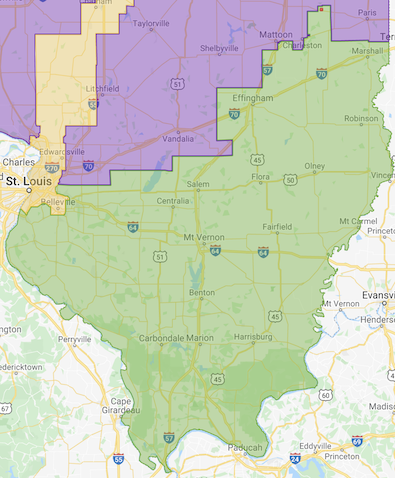
* I’ve known Rodney Davis for quite a long while. He’s a decent, hard-working young man and he’s now the Republican candidate in the 13th Congressional District…
Davis was chosen Saturday morning by the 14 Republican chairs of the 13th district to replace U.S. Rep. Tim Johnson, R-Urbana, on the November ballot. McLean County Republican Party Chair John Parrott said the leaders felt Davis, a former aide to U.S. Rep. John Shimkus, R-Collinsville, has done well with fundraising.
“He has helped the party out by raising a considerable amount of money to help the party,” Parrott said. “He has worked and gotten a lot of experience working with Congressman Shimkus, and they felt he has the qualifications to hit the ground running and serve in the 13th Congressional District.”
* The final vote was unanimous, but it apparently took three ballots…
Champaign County Republican Party Chairman Habeeb Habeeb declined to say how the vote went but said it took three ballots and that he proudly stuck with Harold through all three as did McLean County Republican Party Chairman John Parrott.
Despite their differences, local party officials appear to be united behind Davis…
Macon County Chairman Bruce Pillsbury would not reveal which candidate he voted for but said all the chairmen now stand behind Davis.
“He has done an excellent job of representing the state party over the years,” Pillsbury said. “He’s well-versed with the issues that we’re concerned with here in the state and our 13th Congressional District and very familiar with working with and around Washington also.”
McLean County Chairman John Parrott said he voted for Harold. But he said going forward, the party is united and he looks forward to having Davis meet McLean County voters.
* Party leaders had promised an open and transparent process, and Chairman Parrott said it was…
“This was as open, as fair of a process as I’ve ever been in,” he said. “I think most of them have been very fair, but this has been the most open process that I’ve ever seen.”
Party leaders from counties with territory in the redrawn district met behind closed at a Springfield hotel for two hours Saturday morning and cast multiple ballots before giving Davis the nod. Their votes were weighted based on the number of Republican primary ballots cast in their counties. […]
The chairmen were mum on what gave Davis the edge over the three other finalists.
Secret Backroom Deal Produces Failed Career Politician & Party Insider Congressional Candidate Rodney Davis
First Congressman Tim Johnson rigs the political process by retiring after the March primary to ensure Republican Party insiders chose his successor for IL- 13 instead of Illinois voters. Now after weeks of secret deals, it should come as no surprise that Republican chairmen chose one of their own: Party insider and career political hack Rodney Davis. Despite reports of Davis fundraising impropriety and a record as a failed career politician, Davis will have to convince Illinois families who supported President Obama in 2008 that he’s not part of the problem.
“Illinois voters didn’t have a say in choosing the Republican 13th Congressional candidate, but they will in November when they reject handpicked, party insider and failed career politician Rodney Davis,” said Haley Morris of the Democratic Congressional Campaign Committee. “Davis may have his reward for serving Republican Party insiders as a career political hack and failed candidate, but at what price? Illinois families deserve better than secret backroom deals that devalue the core of our democratic process and a handpicked candidate who represents everything wrong with Washington’s culture of special privileges. There’s no doubt that Davis will be a loyal vote for Congressional Republicans’ out of touch agenda that protects tax breaks for billionaires and corporate outsourcers, but cuts Medicare so seniors have to pay $6,000 more for the same care.”
Then again, we saw no such press release when the Democrats pulled a similar stunt for Bill Lipinski’s kid.
[Gill] also said that Davis is also a former executive director of the Illinois Republican Party and has been involved in some of the party’s recent questionable fundraising practices to skirt Illinois’ new campaign finance limits.
* And rather than run from his past as a career political operative, Davis is embracing it…
Davis said even though his experience working for Shimkus has largely been in the district, that experience would make for a smooth transition to Washington.
“I’m not going to be in awe of the process, in awe of the city. I’m going to have a pretty small learning curve when I get out there. I want to be effective from day one,” Davis said.
Davis added that the new 13th Congressional District has much of the Central Illinois territory that is presently in the 19th district that Shimkus serves.
“It can be a competitive district, but it’s a district I am very familiar with,” Davis said. “Mr. Shimkus used to represent many of these counties. My career has taken me into many of these counties where I’ve gotten to know the local leaders and the residents.”
“In a seat that favors Republicans, the Democrats are also faced with the daunting task of backing a flawed candidate in David Gill as he attempts his fourth run for a congressional seat. The odds against David Gill are only magnified as the Democrats’ agenda of spending, taxing and borrowing continues to hurt Illinois families.”
Another week, another series of demonstrations against cuts to state spending.
Actually, it’s not demonstrations against all cuts in spending, just state spending that benefits the demonstrators.
One of those was organized by the Service Employees International Union so seniors and people with disabilities could protest cuts to Medicaid programs. They wanted no reductions in Medicaid. Gov. PAT QUINN has proposed about $1.4 billion in cuts to Medicaid programs to help close a $2.7 billion deficit.
To their credit, the group proposed alternative funding, something usually missing from these protests. To their discredit, the alternative included “fair tax legislation that would cause the wealthy to pay their fair share.”
That’s code for a graduated income tax. A graduated income tax is not allowed by the state constitution. It would have to be amended for that to happen.
A graduated income tax amendment will probably never appear on the ballot, but more specifically, the deadline to get such an amendment on the ballot this year is past. It will be another two years before the opportunity comes around again
The problem is the $2.7 billion Medicaid problem exists right now and must be dealt with right now. Not sure that dangling a pain-free solution in front of people that has no prospect of happening does anything to help resolve the issue. [Emphasis added.]