Rod and Rosti *** UPDATED x1 ***
Thursday, May 22, 2008 - Posted by Rich Miller
* I don’t know how we missed this story from Monday…
llinois’ first lady wouldn’t rule out her husband as a candidate to replace U.S. Sen. Barack Obama in Congress if Obama wins the Oval Office in November.
Patti Blagojevich was answering questions during a mock press conference with a group of fourth-graders from Harristown Elementary School on Monday when she was asked: “If Senator Obama resigns his Senate seat, is Governor Blagojevich interested in his position?”
The first lady wouldn’t say no.
“That’s an interesting question. What happens is if Senator Obama becomes president of the United States, then he can no longer be a senator,” Mrs. Blagojevich told the class. “I think picking that person alone is going to be a tough job. It will only come after really careful thought over who will be the best person for the job and who will be the best person to serve Illinois.”.
Please, spare us this indignity.
* National Journal columnist John Mercurio had this take today…
With the Illinois governor about as popular as President Bush, it wouldn’t hurt McCain to publicize Mrs. Blago’s musings.
There are only so many messages a candidate can use at once, but tying Obama to his “political godfather,” who is pushing another legislative pay raise yet regularly borrows money interest free from his campaign fund, and to a horrifically unpopular and scandal-plagued governor who might wind up in the Senate might be a fun theme to develop.
* Meanwhile, speaking of corrupt Northwest Side politicians, the Illlinois GOP just sent out this press release…
Congressional candidate Dan Seals this week invited former congressman and convicted felon Dan Rostenkowski to lecture to night school students about federal policymaking and then took money from Rostenkowski in front of the class, according to student reports.
Seals, who was hired as an instructor to facilitate 10 night school classes this spring at Northwestern’s School of Continuing Studies, invited Rostenkowski to teach students Tuesday night. According to students in the class, after Rostenkowski’s presentation, the convicted felon handed Seals an envelope and said he hoped the contents would help Seals’ campaign. […]
“Dan Seals should be ashamed for taking dirty money from one of the most corrupt members of Congress in American history in front of innocent students,” said Lance Trover, spokesman for the Illinois Republican Party. “Dan Seals has a track record of unethical campaign practices and should go back to school for a class in personal ethics,”
Rosti was nowhere near “one of the most corrupt members of Congress in American history,” but whatever.
…Adding… Seals has a new campaign gimmick…
With gas prices topping $4 per gallon, Democratic congressional candidate Dan Seals of Wilmette is offering motorists in Lincolnshire the opportunity to buy gasoline at $1.85 a gallon at a service station on Milwaukee Avenue from noon to 1 p.m. today.
Seals says he’ll use money from his campaign fund to reimburse motorists the difference between the current price of gas and $1.85 per gallon for purchases of up to 10 gallons—all in an effort to highlight the rising price of gas since Republican U.S. Rep. Mark Kirk became the 10th District representative on the North Shore.
*** UPDATE *** Kirk claims Seals is violating the law…
“The Dan Seals campaign may risk violating federal law by reimbursing voters’ gasoline expenses in an effort to influence their votes,” Kirk’s office said in a news release. “On its face, his action violates Title 18, Section 597 of U.S. Code.”
The law in question calls for a fine of $10,000 and/or a year in prison for offering to “make an expenditure to any person, either to vote or withhold his vote, or to vote for or against any candidate,” according to a Kirk campaign news release.
72 Comments  
|
|
Enter your password to view comments
|
Big fed bust in Chicago *** UPDATED x1 ***
Thursday, May 22, 2008 - Posted by Rich Miller
* From a press release…
Patrick J. Fitzgerald, United States Attorney for the Northern District of Illinois; Thomas P. Brady, Postal Inspector-in-Charge of the U.S. Postal Inspection Service; Robert D. Grant, Special Agent-in-Charge of the Chicago Office of the Federal Bureau of Investigation; and David Hoffman, Inspector General for the City of Chicago, will hold a press conference at 2 p.m. today, Thursday May 22, 2008, to announce federal public corruption charges against 15 defendants, including developers, contractors and seven City of Chicago inspectors or other employees, who were arrested yesterday and today for allegedly receiving and paying bribes regarding City building, zoning and construction permits. […]
The defendants will appear 3 p.m. today before U.S. Magistrate Judge Martin Ashman in U.S. District Court in Chicago. [emphasis added]
* Tribune…
The case includes developers, contractors and City of Chicago inspectors or other employees who were arrested yesterday and today for allegedly receiving and paying bribes regarding City building, zoning and construction permits, the U.S. attorney’s office announced. […]
The investigation targeted employees who allegedly took money to influence zoning applications or alter building plans, authorities said. It was not immediately clear when those charged would make their first appearances at the Dirksen U.S. Courthouse.
* Sun-Times…
An $87,108-a-year city plumbing inspector was picked up by federal agents this morning, touching off a new round of charges involving allegations of corruption and bribery in the city of Chicago’s Building and Zoning Departments.
Mario Olivella, a 10-year city employee, was one of 15 people — including seven city employees — arrested Wednesday and today in the latest chapter of a joint investigation between Inspector General David Hoffman’s office and the federal government.
*** UPDATE *** Fitzgerald’s office has just released the names. Read the press release by clicking here.
* From the release…
Dumitru Curescu, 46, his wife, Lavinia Curescu, 42, both of Skokie;
Vasile Fofiu, 57, of Skokie; Beny Garneata, 43,of Lincolnwood; Mario Olivella, 40, of Chicago; Teofil Scorte, 27, of Morton Grove; and William Wellhausen, 50, of Chicago – were charged with conspiracy to bribe City officials between June and December 2007 regarding a condominium conversion project […]
Two defendants – Ronald Piekarz, 47, of Chicago, and MacArthur Milam, 56, of Chicago, were charged with conspiring with Garneata, Phyllis Mendenhall, an inquiry aide in the Buildings Department, and others to commit bribery between October and December 2007. […]
Phyllis Mendenhall, 54, of Chicago, a city employee since 1979 and an inquiry aide in the Buildings Department, was charged with bribery […]
Petru Cladovan, 48, of Prospect Heights, a contractor and developer who owns ABC Construction & Plumbing, was the owner and developer of two properties – one located at 2754 West Washington Blvd., and the other located at 2734 North Fairfield. He was charged with paying bribes through CW1 to city officials […]
Anthony Valentino, 65,of Chicago, a city employee since 2001 and an investigator in the Zoning Department, was charged with bribery for allegedly accepting three $500 cash payments from CW1 in June and August 2007 […]
Thomas Ziroli, about to turn 62, of Chicago, a city employe since 1997 and a ventilation and furnace inspector in the Buildings Department, was charged with bribery for allegedly accepting a $500 cash bribe from CW1 on Aug. 8, 2007 […]
Louis Burns, 52, of Chicago, a city employee since 2005 and a clerk in the former Department of Construction and Permits (DCAP) until it merged this year with the Buildings Department where he now works, was charged with bribery for allegedly accepting bribe payments of $250 and $150, respectively, on July 11, 2007 and Aug. 7, 2007, from CW1 […]
Lucian Muresan, 34, of Chicago, a general contractor who owned two buildings located at 857 and 859 North Hermitage Ave., was charged with bribery for allegedly paying bribes through CW1 to city officials, believing that CW1 was passing the payments to a zoning inspector
23 Comments
|
Question of the day
Thursday, May 22, 2008 - Posted by Rich Miller
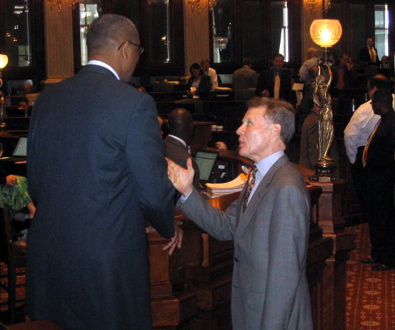
Former Chicago Bulls center Bill Cartwright is in Springfield this week. John Patterson asked his readers yesterday for captions to this photo of Cartwright and Speaker Madigan. I decided to steal his photo and his idea for our question of the day. Hope he doesn’t mind…
47 Comments
|
Tax debate rages while drivers fume
Thursday, May 22, 2008 - Posted by Rich Miller
* Kristen McQueary is fed up with the pandering about a gasoline sales tax holiday…
Bending to consumer outcry, a group of House Republicans in Springfield called for suspending the state’s gasoline tax until Labor Day.
Supporters estimated the tax break would save motorists about $45 total during the next few months. Sounds like a good idea. Put a little more money in your pocket, right?
Wrong.
Suspending the gas tax is a political gimmick that purports to be consumer friendly while allowing politicians to mask their inattentiveness to our 40-year increasingly dependent relationship on foreign oil.
While blame falls largely to our national leaders who failed to make sound, progressive energy policy a top priority, lawmakers in Springfield could be adopting more forward-thinking proposals as well. A short-term gas tax holiday is the unimaginative solution of knee-jerk politicians who want to soak up 30-second sound bites and a little newspaper ink and then go back to shuffling around the Statehouse.
* McQueary has an innovative solution: Personal responsibility…
Saving $45 during the next three months easily could be achieved simply by driving less and driving smarter.
* CBS 2 took a more populist approach with its story…
Tired of seeing the price at the pump jump every time you need to buy gasoline? Well, the record-high price of gasoline in the Chicago area is linked to a record-high rate of taxation: nearly 20 percent of the Chicago price.
As CBS 2 Political Editor Mike Flannery reports, tax refugees wait in long lines on Indianapolis Boulevard in Northwest Indiana. They jockey for position at a pump, lured by prices that are 20 cents a gallon or more cheaper than just a few blocks away back in Illinois.
“It was $4.20. I can come over here and get it for $3.93,” said Tikvah Wadley, one of the many fleeing Illinois taxes.
Thoughts?
…Adding… The State Journal-Register’s editorial board is a bit confused…
With gasoline now having topped $4 a gallon, we still think suspending the state sales tax on gasoline is a bad idea. […]
FIRST, the gas tax pays for the roads we drive on. As the cost of gasoline and diesel fuel rises, so does the cost of road maintenance. Given the ongoing impasse in the General Assembly over the state’s budget, this is hardly the time to cut off a guaranteed revenue stream for a function so vital.
The state’s share of the sales tax on gasoline is deposited into the General Revenue Fund, not the Road Fund. There’s a separate tax on gas (charged by the gallon) that goes into the Road Fund. Thanks to a commenter for pointing me to the editorial.
73 Comments
|
Budget roundup *** UPDATED x1 ***
Thursday, May 22, 2008 - Posted by Rich Miller
* The House was first out of the gate…
Using only Democratic votes, the House approved two state budgets contained in more than two dozen bills. One version keeps state funding for the fiscal year that begins July 1 essentially the same as this year. The other version — dubbed a “Christmas tree budget” because of all of the goodies in it — greatly expands funding for education, health care and other programs.
* Actually, there are several different budget combinations in those bills passed by the House yesterday, all on party lines…
“Today was an exercise in futility or a farce or a scam or whatever you want to call it,” said House Minority Leader Tom Cross, R-Oswego. “It’s a budget at the end of the day that’s $3 billion out of whack.”
* That’s true, but the House’s budget plan would allow the Senate and the governor to pick and choose what they wanted to keep. And Speaker Madigan had this to say to the Republicans yesterday…
“You had your opportunity. You had your choice. What’s the complaint? There’s never been, since 1991, so much participation in budget making as there has been over the last several weeks,” [Madigan] said.
The “opening up” of the process, however, could also generate election year ammunition to hurt vulnerable Republicans. By forcing them to reject the menu of budget options crafted exclusively by Democrats, their opponents could argue they failed to vote for any budget.
Also true.
* Meanwhile, the Senate was putting together its own, more modest proposal in the traditional manner…
In a role reversal, the Senate Democrats focused on holding down spending growth, as demonstrated by a move to largely use a $200 million boost in education funding—far less than last year’s $550 million increase—to simply make sure no schools get less next year. Senate Democrats are calling for a $1.3 billion spending increase. Nearly half of that would address the spiraling costs in the Medicaid and FamilyCare programs. But they would not support Blagojevich’s desire to expand state subsidized health-care programs. That includes rejecting the governor’s request to double the breast and cervical cancer screening program to $10 million.
* There appears room for compromise…
[Senate Democratic budget negotiator Donne Trotter] said the more austere House budget is in line with what Senate Democrats think is affordable.
“It’s 80 percent to 85 percent like ours,” Trotter said. “There’s plenty of time (before May 31) to reconcile the rest.”
* But not all is well…
Rep. Frank Mautino (D-Spring Valley) said outlines of the Senate plan sounded “pretty decent.” But Mautino, a budget expert, questioned whether the House would approve the pension bond proposal.
* And the governor is hanging over their heads…
[Blagojevich] could try to keep lawmakers in town if they don’t approve key items he wants, such as $16 billion in borrowing to pay down massive pension fund debt and a new statewide construction plan.
* And…
Blagojevich’s office would only say [yesterday] that it is still reviewing the House budget bills. The governor could veto a budget that isn’t to his liking, forcing lawmakers to return to Springfield to possibly overturn the veto.
Or, he could use reduction and line item vetoes and they won’t have to come back until after the November election. Nobody knows for sure what he’ll do.
* Considering the opposition to an overtime session by Senate Democrats, there is an expectation that Gov. Blagojevich won’t call members in for an overtime session. Plus, there’s this factor…
The federal corruption trial of Tony Rezko, one of Gov. Rod Blagojevich’s political inner circle, may prompt the governor to be open to negotiating a deal, said state Rep. Patrick Verschoore, D-Milan.
“He’s got his problems and I don’t think he wants to call an overtime session,” he said.
* Yesterday’s one high point…
One of the few things both sides of the aisle could agree upon Wednesday was to take a break when former Bulls center Bill Cartwright stopped by to regale them with the olden days of glory when the championship teams also had a guy named Michael Jordan.
* Related…
* Blagojevich tells high court to lobby lawmakers for construction money
* Gov. meets with lawmakers to push infrastructure expansion plan
* Push for Slots Continues in Illinois
* Vote on levee tax likely in July; new sales tax gets gov’s signature
* While IDOT employees picket, governor’s office takes little action
*** UPDATE *** Ray Long has some Senate budget details…
Trotter, the Senate Democratic budget point man, said the Senate is looking at increasing spending in next year’s budget by $1.3 billion.
Along with the $300 million increase for pensions, he said, the rest of the increases would be distributed like this:
–$600 million into Medicaid and FamilyCare programs to address the rising costs of health care programs already in place. It would not pay for expansions in health care that Blagojevich has long sought. A Senate committee has already rejected the governor’s proposal for doubling the funding for breast and cervical cancer screenings.
–$200 million for boosts in cost-of-living increases for workers caring for patients with developmental disabilities and for residents in nursing homes.
–$200 million more for schools. A huge portion of this would be used to make sure no schools would get less money next school year. It’s a significantly lower increase than last year’s exceptional $550 million increase in school funding, but Trotter said the lower increase this year is a result of economic times and the “extraordinary” boost last year.
The budget proposal does not include increases for union workers covered by the American Federation of State, County and Municipal Employees, which is bargaining a contract with the administration, Trotter said.
That includes the pension obligation bond. Without it, the pension contribution rises to $800 million.
14 Comments
|
Jones loans himself cash
Thursday, May 22, 2008 - Posted by Rich Miller
* Illinois law bans politicians from dipping into their campaign funds for personal use. But there is a loophole. They can loan themselves cash…
Before championing a big legislative pay increase, Illinois Senate President Emil Jones provided himself with tens of thousands of dollars in interest-free loans from his campaign fund.
* According to the Sun-Times, just two other legislators loaned themselves money from their funds during the last six-month filing period, which ended December 31st. Jones wisecracked just a few days ago that he needed a pay raises and food stamps, but the Sun-Times found this in Jones’ campaign reports…
Since 1989, the South Side Democrat has taken out $120,528 in personal loans from his political fund and repaid $96,900 of that amount — leaving nearly $25,000 unaccounted for.
Just last year, Jones withdrew $5,800 from his fund in 20 separate loans of $200 or $300 each between July and December.
In October alone, he had eight disbursements of $300 apiece over a 23-day period.
* And the paper had this reaction from a goo-goo…
“It absolutely looks like a slush fund,” says Cindi Canary, director of the Illinois Campaign for Political Reform. “He is living under a whole set of rules that no one else in the public is.” […]
As chairman of his political fund, Jones decides the loan terms — and whether the loans ever need to be repaid.
Jones’ spokesperson declined comment to the Sun-Times. I had asked about this a few months ago and was told that Jones took out the loans for personal items during session last year.
27 Comments
|
Morning Shorts
Thursday, May 22, 2008 - Posted by Rich Miller
* Sneed: U.S. Rep Jan Schakowsky and others might be surprised to hear Gov. Blagojevich, who would pick Obama’s replacement, is eyeing Illinois Department of Veterans Affairs Director Tammy Duckworth.
* Ward: My dinner with a wiser and humbler Oberweis
I really wanted to know what he’d learned from the losses. Jim said, “You can’t do it by yourself. I’ve made mistakes and I’m trying to correct them. I need to have more confidence in my own beliefs and opinions and then make the right decisions.” He repeated the upcoming campaign would be only about the issues. In fact, Jim told me even if Foster continues to go negative, he won’t!
* March special election drained county budgets
* Private Funding Uneven in Public Schools
* Illinois Board of Trustees to vote on next year’s budget
* Bill pushes funding boost for ambulance services
* Illinoisans to Lose Wine Shipping Rights June 1
* Utility soon can’t use customer money for ads
* Botterman award honors activists
* Fioretti and Daley often part ways
* Editorial: Beaux-arts, not faux arts: Protect historic ’streetwall’
* Spielman: Chicago Police detectives — other than those assigned to the FBI’s violent crimes task force — will no longer respond to bank robberies in Chicago, under a policy change unveiled this week that rankled the police union.
* Editorial: Get the lead out
* The Watchdogs: After eight months, Michigan authorities now say their first inclination was right: Orlando Jones — godson of the late County Board President John Stroger and business partner of indicted political figure Tony Rezko — killed himself.
16 Comments
|
|
Comments Off
|
|
 Support CapitolFax.com
Visit our advertisers...

 ...............
 ...............
 ...............


|
   
|
Hosted by MCS |
SUBSCRIBE to Capitol Fax |
Advertise Here |
Mobile Version |
Contact Rich Miller
|



