* As most of you know by now, Rep. Rich Myers passed away last night. Here are the arrangements…
The Myers family will receive friends at a visitation for State Representative Rich Myers from 3 p.m. to 7 p.m. Saturday, December 4 at the Scotland Trinity Presbyterian Church, 14950 North 900th Road in Macomb.
A Memorial Service will be held Sunday at 2 p.m. at the University Union Grand Ballroom on the Campus of Western Illinois University.
Burial will follow at Mt. Auburn Cemetery in Colchester. Mt. Auburn Cemetery is located in the north side of Colchester on the west side of the road to Argyle Lake.
Memorials can be made to Scotland Trinity Presbyterian Church, the McDonough District Hospital, and the Representative Rich Myers Agricultural Scholarship at Western Illinois University.
Those wishing to send flowers should have them delivered to the Scotland Trinity Presbyterian Church.
Rep. Myers’ obituary is here. Gov. Pat Quinn’s comments are here.
* The House wasn’t in session today, but Sen. John Sullivan delivered a heartfelt eulogy for Rep. Myers on the Senate floor…
* Like the headline says, Thursday was an emotional, sad day in the Senate. Sen. Mike Jacobs also rose to memorialize the late Joel Brunsvold…
* Sens. Willie Delgado and Mattie Hunter spoke about Rep. Myers, former Rep. Brunsvold and their own recent losses and gave thanks to their colleagues for their support during difficult times…
Gary Dahl abruptly resigned his seat in the Illinois Senate on Thursday.
The Granville Republican, who turns 70 on Sunday, leaves a two-year unexpired term that will be filled by appointment.
“I’m at a stage of my life where I’m thinking it’s time to spend more time with family and my business (Double D Express),” Dahl said. “After six years of serving in the state Senate (I was hoping) things would change down there but nothing has. I just feel it’s time to move on.”
Dahl said he’d contemplated resignation for some time but limited the discussion to family and staff. None of his peers were apprised of the decision prior to Thursday’s announcement. The decision, he said, was reinforced recently with the news that several lawmakers had passed away.
* Whether or not you agree with the civil unions bill that passed this week, you have to agree that Illinois will finally be known for something other than Rod Blagojevich - at least for a while. For that, I’m grateful.
But we still have this little $13 billion budget deficit problem to work out.
* I’m no fan of the idea that the General Assembly should focus solely on the budget and not bother with anything else at all until that problem is solved. Coming up with solutions will take time and there is plenty of other work to do. So, while I don’t necessarily agree with the sentiment behind Sen. John O. Jones’ remarks during the civil unions debate yesterday, he made a good point about how the governor was contacting members on behalf of civil unions, but hadn’t called anybody about the budget or the economy. Watch…
* During yesterday’s post-civil unions passage press conference, I asked Gov. Pat Quinn when he was going to start working on passing his income tax hike. Watch…
Yeah, I wasn’t thrilled with his answers, either, but one can only ask so many questions during a brief avail.
* You may or may not be a proponent of gaming expansion, but the governor didn’t seem to be all that interested in the proposal passed by the Senate yesterday…
A planned $3.5 billion clean-coal technology plant for Taylorville hit another snag Wednesday that will delay a vote on the plant until January.
A Senate committee was scheduled Wednesday to hold a hearing on a bill authorizing the plant that was approved in the House a day earlier. However, just as the hearing was about to begin, an announcement was made that the committee would not hold the hearing on the bill after all.
“I was told we didn’t have enough votes to get (the bill) out of committee,” said Sen. Deanna Demuzio, D-Carlinville. “I was told it would be best to hold it.”
The two advertisers on this blog have vastly different opinions about what that bill would do. But we’re talking a bunch of jobs and investment, so perhaps the governor could inject himself and help find an acceptable compromise.
* As you all know by now, a Statehouse legend is retiring later this month. Yesterday, the Illinois House paid tribute to Rep. Bill Black (R-Danville)…
House members gave Black, one of the senior members of the chamber, an extraordinarily warm and lengthy tribute. More than 30 of his colleagues, Republicans and Democrats, spoke and offered praise and thanks to the lawmaker known for his sometimes-bombastic, sometimes-eloquent speeches and for his playfulness.
“I hope you know how much I love this place, how much I love the process,” Black said in a 23-minute-long response to all the accolades from his colleagues . “Look around here. Look where you work. There are few people who ever get this privilege. This ain’t exactly a 6-foot by 6-foot cubicle. This is a phenomenally beautiful, historic building that has been well-maintained. And you should always consider it an honor and a privilege to sit in this chamber.” […]
Rep. Suzana Mendoza, D-Chicago, said she once heard a tape of Black tearing into another House member during floor debate.
“It was just horrifying. I couldn’t even make out the words because it was all screaming and yelling,” she said. “I thought, oh my God, people actually comport themselves in this chamber that way. I’m so scared of who that guy is.
“And then I met you. And how can you be so scared of Bill Black? I mean, you’re so awesomely cute.”
* The Question: What’s your favorite memory of Bill Black?
Also, I know I don’t have to say this, but let’s all be kind, please.
Springfield Catholic Bishop Thomas Paprocki on Wednesday challenged Gov. Pat Quinn’s support for legalization of civil unions. Quinn said Tuesday that his faith – Quinn was raised a Catholic — had inspired him to support civil unions.
“He did not say what religious faith that would be, but it certainly is not the Catholic faith,” Paprocki said in a statement. “If the governor wishes to pursue a secular agenda for political purposes, that is his prerogative for which he is accountable to the voters. But if he wishes to speak as a Catholic, then he is accountable to Catholic authority, and the Catholic Church does not support civil unions or other measures that are contrary to the natural moral law.”
Asked about the bishop’s statement, Quinn said, “I follow my conscience. My conscience is not kicking me in the shins today.”
David E. Smith, executive director of the Illinois Family Institute, said he’s talking to lawyers and “exploring options” to see if a lawsuit is possible. None is planned immediately, he said. “There’s no recourse that we can see,” Smith said.
* The one Senate Republican “Yes” vote was Sen. Dan Rutherford. Here’s his quietly eloquent floor speech…
* 10:43 am - A revised “fumigation” plan just passed the Senate unanimously.
HB 5057 would require the governor to submit names to the Senate for hundreds of agency directors, executive directors, their top aides and board and commission members whose terms have expired. If the governor doesn’t submit replacements, or doesn’t resubmit current occupants for confirmation, they’ll be automatically terminated.
* From Senate President Cullerton’s office…
The Illinois Senate today passed legislation that would push Governor Pat Quinn to start his first full term with a clean slate of new appointees. HB 5057 would cut off nearly 700 holdovers and vacancies 30 days after the law takes effect and require new nominations be forwarded to the Senate for public confirmation hearings.
“This bill isn’t about penalizing any individual public servant, it’s about preserving the checks and balances mandated by our state constitution,” said President Cullerton. “The beginning of a new General Assembly and Governor Quinn’s first full term can be a fresh start. It’s the right time to restore institutional practices that have fallen apart in Illinois over the last 10 years.”
The Senate confirmation process is one of the rare opportunities for the Senate and the public to review the work performance of top officials. However, hundreds of government appointees have continued in their state posts even though their terms long ago expired. A list supplied by President Cullerton’s office includes names of top officials from the Blagojevich and Ryan administrations that have remained in their positions for years without confirmation hearings.
Following the Senate President’s introduction of this bill, Governor Quinn reiterated his call for his cabinet members to resign as part of a reorganization of the administration. Nothing in the legislation prohibits those officials from being re-appointed for the jobs they’ve held. However, they would not be able to continue in their positions after 30 days if a new nomination is not sent to the Senate.
* Illinois paid a pretty high price for its tobacco bond sale yesterday…
Illinois drew robust investor interest for a $1.51 billion tobacco bond, but at a price: it offered a yield above 6% for its longest maturing debt, more than a full percentage point over other recent muni offerings.
The state agency selling the bond increased the size by about $50 million and shaved the yield 0.15 percentage point from its original starting point Tuesday, as the deal’s hefty return and conservative structure offset worries about Illinois’ finances and falling cigarette sales. Citigroup was the senior manager on the sale; Barclays Capital was the co-manager.
Most of that $1.3 billion the state will get up front will be used to pay off overdue state bills, which means we’re exchanging soft debt for hard, Wall Street debt. That’s risky business, but the state is so freaking broke it basically has no choice. We’re borrowing long-term for current operations. Scary stuff.
Some of the money, $47 million, will go to continue subsidizing the 26,000 jobs created by the formerly federally financed Put Illinois to Work Program. The federal subsidy expired during the campaign and the governor unilaterally extended the program with state money, but didn’t have a specific revenue source. So, now the state will be spending borrowed money to pay for this program.
The governor really needs to find a “real” revenue stream if he wants to keep this program alive. Ralph Martire makes a good point…
But not everyone thinks the sale of the bonds was a wise decision. Ralph Martire is executive director at the Center for Tax and Budget Accountability.
He said if the state is going to sell the bond, they should use the money to pay down the deficit.
“I think a pretty solid argument could be made that every penny of that $1.2 billion ought to be used to expend towards reducing the state’s current deficit,” he said.
“And frankly to spend that over $6 billion in past due bills we owe to providers that have to make their payroll and/or fire people and they’ve already delivered services. So there’s jobs on the line there, too.”
It shouldn’t have to be “either, or,” but there ought to be revenues out of existing funds to pay for this program.
* The price the state paid for the bonds wasn’t all the state’s fault, however…
Tobacco bonds are under particular scrutiny because Standard & Poor’s downgraded about $22 billion of them to junk status this month, citing a decline in cigarette sales, among other reasons. In August, a prominent analyst, Dick Larkin of Herbert J. Sims & Co., warned of possible tobacco-bond defaults by 2030, saying that assumptions about future tobacco sales were overly optimistic.
The state agency selling the bonds—Railsplitter Tobacco Settlement Authority—addressed such concerns with conservative revenue assumptions. Bondholders will still get paid even if cigarette consumption falls as much as 10% each year, compared with an average annual decline closer to 3% in the past decade, Mr. Sinsheimer said.
The state is pledging roughly twice the amount of cash flow needed to pay off the bonds over the next 17 years, which means cigarette consumption can decline 10% a year before cash flow gets close to the amount needed for debt service. While smoking declined 9.3% last year, the average decline has been 4% a year since 1998, according to Mr. Larkin.
If smoking declines by 4% a year over the next 17 years, the state will receive a total of about $4.9 billion in tobacco settlement payments and need about $2.2 billion for debt service, according to the prospectus for the bonds. The state will keep whatever amount is left each year after making payments on the bonds. […]
Essentially, the deal gives the state about $1.3 billion upfront after expenses and reserves, while shifting the risk that smoking will decline from the state to bondholders, with a very healthy cushion to minimize that risk.
“If smoking declines greater than 10%, then Illinois made a very smart move,” Mr. Larkin said. “It’s possible, but unlikely. I’m a smoker myself and I know how hard it is to quit.”
*** UPDATE 1 *** From Senate GOP Leader Christine Radogno…
– Senate Republican Leader Christine Radogno (R-Lemont) is asking Gov. Pat Quinn to provide lawmakers with more information on the recent extension of his taxpayer-subsidized “Put Illinois to Work” program. Radogno is questioning the $47 million extension at a time when Illinois owes approximately $9 billion in overdue bills and faces a massive deficit, some estimate at roughly $15 billion.
“I don’t doubt the program’s intentions, but when the state is facing a $15 billion deficit and owes billions more in bonding and pension debt, we have an obligation to ask, ‘Is this program the most effective way to create the good-paying, permanent jobs that Illinois needs,” Radogno said.
“Not only is it a waste of taxpayer dollars to expand the program piece-by-piece without any plan or requirement that participants will ultimately see permanent employment, it’s cruel to the men and women who believe they’re working towards a long-term position.”
Radogno found it particularly troublesome that Quinn intends to use funds drawn from a recent tobacco settlement to cover the cost of the expansion. She noted that the Governor’s plan to use the recent bond sale proceeds to extend the program maybe be a violation of both the letter and intent of the law enacted authorizing the securitization of tobacco settlement funds to reduce the state’s bill backlog. Radogno also noted that the six-week extension will cost taxpayers for the next 18 years, at a ratio of more than 145 days of debt for every one day of the program.
In a letter sent to Thursday to Gov. Quinn, Radogno asked for information on the following:
• Of the 26,000 program participants, how many have transitioned to permanent, non-taxpayer-subsidized jobs with their “Put Illinois to Work” employers;
• How many participating employers have committed to offer permanent employment to these workers when the program concludes;
• What, if any, system of means testing has been implement to assure participating employers do not have the ability to pay employees’ wages, and are not using the program to increase profits, inflate stock values, reduce costs or delay hiring permanent workers; and
• What legal authority does the Governor have to use these bond proceeds to expand a new program, contrary to the purpose of the borrowing stated in the authorizing legislation.
“The answers to these questions are necessary to evaluate the effectiveness of the program, but I also consider Governor Quinn’s response to be an indicator of his ability to address the overarching fiscal challenges facing Illinois,” Radogno said.
*** UPDATE 2 *** Budget director Dave Vaught talks about the tobacco bond sale…
* Related…
* Tax-Exempt Securities Extend Rally as Investors Seek Safety:
* No surprise. The Cubs’ Wrigley Field proposal is dead, at least for now…
The Cubs’ plan to use 35 years’ worth of amusement-tax growth to finance a $200 million renovation of Wrigley Field — and back-stop the bonds with a 2 percent hotel tax — is dead, sources said Wednesday.
The setback for a plan the Cubs had hoped to ram through the state Legislature’s fall veto session has sent team officials back to the drawing board to search for alternatives that might include creating a tax-increment-financing (TIF) district around Wrigley.
Another possibility is to broaden the boundaries of a 1 percent tax on downtown restaurant meals used to finance McCormick Place. That tax currently extends as far north as Diversey. […]
John Patterson, a spokesman for Senate President John Cullerton (D-Chicago), added, ‘’Bond counsel has had technical issues with the financing of the backup plan. … If that issue can be resolved in the coming weeks, it could be called in January. If not, it will be revisited as we head into the new session.'’ […]
Another source said legislative leaders have told the Cubs to ‘’come back with a plan with a different backup that does not include the hotel tax. … It may involve a combination of things,'’ including a historic preservation tax credit.
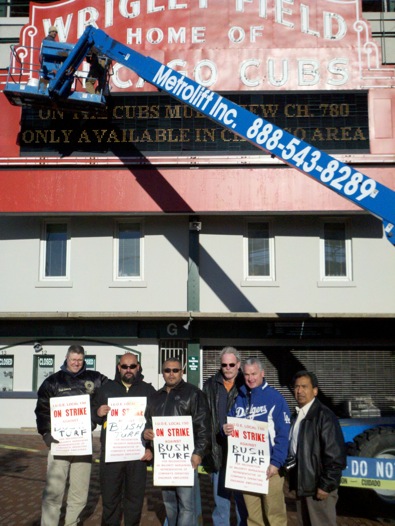
* Things just haven’t been going well for the Ricketts family these days. Operating Engineers Local 150 set up a picket line recently to bring attention to the team’s use of non-union labor…
* Remember this comment by Sen. Rickey Hendon during the campaign?…
“I’ve never served with such an idiotic, racist, sexist, homophobic person in my life,” Hendon said before introducing Gov. Quinn. “If you think that the minimum wage needs to be three dollars an hour, vote for Bill Brady. If you think that women have no rights whatsoever, except to have his children, vote for Bill Brady. If you think gay and lesbian people need to be locked up and shot in the head, vote for Bill Brady.”
* Well, during the debate on the civil unions bill yesterday, Hendon claimed that he had attempted to apologize to Sen. Brady and was rebuffed. Watch…
“He just said I want to apologize, and I said, ‘Rickey, you know, you can’t apologize for that,’ ” Brady said. “That’s not something you apologize your way out of.”
Classless or justified?
* Sen. Hendon’s full floor speech on the civil unions bill is getting mad hits on YouTube. Watch…
We’ll have more videos a bit later.
* Brady, by the way, has not shied away from criticizing Gov. Pat Quinn. From Medill Reports…
Quinn “talks about cutting spending, but we have yet to see him do it,” Brady said in an interview in his Bloomington office. “His tax increases, I think, are going to further erode the economic job environment. He’s got some policies that aren’t going to help Illinois’s economy.”
Brady, who was sharply critical of Quinn’s leadership abilities during the campaign, said he doubts that Quinn has the muscle or moxie to manage tense relations with Senate President John Cullerton (D) and House Speaker Michael Madigan (D).
“The infighting has put our state in a bad position the past couple years,” Brady said. “Governor Quinn has yet proven to have the skill to… lead. So it will be interesting to see.” […]
Three weeks after the election, Brady and Quinn met for lunch at Manny’s Deli in the South Loop.
Among the topics, Brady said, was “the backlog of unpaid bills. The governor’s got to lead on fiscal discipline. He can’t let legislature do it and talk about making Illinois’ business climate conducive for job growth.”
Brady also said he would run for reelection in two years, then consider another bid for governor. He also admitted that Scott Lee Cohen may have cost him the election by taking protest votes away from him.
* Related…
* Hendon pledges to tone down after hypertension diagnosis