Thursday, May 26, 2011 - Posted by Advertising Department
[The following is a paid advertisement.]
Much of the attention around grid modernization legislation has focused on regulatory reform. But the bill also creates more energy efficiency programs and boosts investment in clean energy resources. Here are some of the ways:
• Allows ICC to approve energy efficiency measures above and beyond those they can approve now.
• Creates Incentives for Small-Scale Renewable Energy Systems: Owners of small-scale solar generating systems are often too small to bid their credits into the IPA’s annual renewable energy auction. SB 1652 carves out 1% of the existing 6% solar requirement in the RPS statute for customer owned, behind the meter, solar installations. This, in turn, improves the economics of small-scale renewable generation.
• Requires the utilities to contribute $15 million for the start up (and $5 million per year thereafter) for the creation of Science and Energy Innovation Trust, which supports green energy efficiency-based technology start up companies.
* I’ve set the ScribbleLive program to automatically follow Natasha Korecki (Sun-Times) and Stacy St. Clair (Tribune), who are in the Blagojevich courtroom, and I’ve added a few more Tweets as background. I’ll add others to the live feed while I write my Sun-Times column for tomorrow. As of 1:40, the court was still on break after Blagojevich choked up on the stand, but it’ll resume soon…
* Natasha Korecki’s web updates through the crying break…
* Tribune live web coverage is here. Ward Room’s tweets are here. Susan Berger’s Tweets are here (my ScribbleLive package only allows me to follow two Tweeters at a time) , and her web coverage is here. Her morning wrapup…
We heard about his first job as a shoe shine boy. How it taught him “life lessons to get ahead and do good.” And how he flunked drafting.
It took 25 minutes of this for us just to get to 1974. Then we heard how his dad worked on the Alaskan Pipeline as janitor. And we heard an emotional Rod as he said his parents would do anything for him. He too went to Alaska in 1976 to make money for college. And he pointed out how years later - the week after his arrest he would meet Sarah Palin and talk about his experience in her neck of the woods. We heard too how Rod’s dad “was someone who lost everything”. How he fought the Nazis and was a prisoner of war.
We heard a choked up Rod say that his dad never lived to see him elected. And how his mother was ahead of her time suggesting he read books about powerful women like Claire Barton and Florence Nightingale.
We heard how he liked college. Was an A student. And the most significant day? August 16, 1977- the day Elvis died. We learned too about his Aunt Helen. That he really liked her. She was his mother’s sister. And also about Ms. Dibble - his teacher that taught Shakespeare. She died of breast cancer or uterine cancer. He was sad about that. And he said a prayer for her.
The House Personnel and Pensions Committee voted 6-2-1 to advance the bill to the floor of the House. State Rep. Raymond Poe, R-Springfield, voted “no,” as did Rep. Karen May, D-Highland Park. Rep. Daniel Biss, D-Evanston, voted “present.”
The committee did not attach an amendment that would include judges in the bill. House Minority Leader Tom Cross, R-Oswego, said he planned to offer that amendment, which he says is supported by Republicans and Democrats, when the bill reaches the floor. Cross said he is unsure whether the measure has the votes to pass the House.
A tentative deal on workers’ compensation reform has been reached on Thursday, according to a coalition of Illinois employers.
The deal comes less than 18 hours after a bill to abolish the workers’ compensation system in Illinois passed out of a House committee.
The Illinois Department of Insurance claims the deal will result in savings of more than $500 million annually for businesses, according to a document signed by a number of business interests, including the Illinois Manufacturers’ Association, the Illinois Retail Merchants Association, Navistar and Mitsubishi.
* Meanwhile the House and Senate Republicans have unveiled their own remap proposal. The GOPs say the amendment has been drafted and sent to LRB. From a press release…
“We took into consideration as much as we could the public’s requests and observations while complying with all of the rules,” said Rep. Mike Fortner (R-West Chicago). “We worked closely with minority groups such as the Mexican American Legal Defense and Educational Fund (MALDEF) to give Latinos in our state a better opportunity to elect candidates of their choice than what was proposed by the democrats. The Latino population grew the most in the last ten years and that should be reflected in the map.”
The Fair Map does creates nine Latino districts with voting age populations (VAP) of 60 percent or more. That’s in sharp contrast to the Democrat map that created only four districts with VAPs of 60 percent or more.
Compared to the Democrat map, the Fair Map plan also creates an additional majority Latino district and enhances and equalizes Latino voters in other districts. At the same time, it does not retrogress African-American districts. In fact, it creates two more majority African-American districts than the proposed Democrat map.
“It became clear in analyzing the Democrat map that partisan political advantage was given a higher priority than the rights of Latinos and African-Americans,” said Sen. Dale Righter (R-Mattoon).
“In the Fair Map, as you can see, neither party was spared from the pairings. This is an indication that we did not take into account incumbency when drawing the lines,” said Fortner.
In the Fair Map, 17 incumbent Republicans were paired in the House and 17 Democrats were paired.
The Democrat proposal pairs 19 House Republicans and only 6 House Democrats despite the fact the majority of the population loss occurred in Democrat areas.
In addition, at many of the hearings—community members asked the legislators to respect county and municipal boundaries whenever possible when drawing districts.
The Fair Map maintains the integrity of more counties. The House Democrat plan splits 36% more counties than does the Fair Map.
…Democrats advanced a plan that would require Senate confirmation of Democratic Gov. Pat Quinn’s budget chief, David Vaught. The measure was sponsored by Senate President John Cullerton, D-Chicago, who denied it was a shot at Quinn’s budget chief but more about raising accountability over the architect of the state budget.
Opponents say the governor ought to be able to pick whomever he wants to run the budget office. Then again, he doesn’t just run a budget office. It’s called the Governor’s Office of Management and Budget. And the federal OMB director is subject to US Senate confirmation.
* The Question: Should the GOMB director be confirmed by the Illinois Senate? Take the poll and then explain your answer in comments, please.
At the heart of the matter was the wording of the strike provision in this spring’s previously approved education package that would allow Chicago to lengthen its school days, make it harder for Chicago teachers to strike and make it easier throughout Illinois to fire bad teachers.
The original legislation, which is awaiting Gov. Pat Quinn’s signature, would require a 75 percent vote for Chicago teachers to strike, but teachers maintained the provision was written too broadly. Chicago union officials said only the teachers eligible to vote in union elections, for example, should be allowed to vote on whether to strike.
Sponsoring Sen. Kimberly Lightford said the follow-up measure makes it clear that only the roughly 26,000 eligible teacher union members would be allowed to cast votes on whether to strike.
Lightford told the Senate Education Committee the new legislation would not allow teachers to cast votes on whether to strike if they have opted out of union activities and make so-called “fair share” dues-like payments to the union. That group of about 2,600 workers does not vote in union elections, she said.
* That seems quite reasonable to me. Mayor Emanuel and the other education reform groups signed off on it as well…
“The mayor’s position hasn’t changed at all,” Lightford said. “He’s very pleased with the bill. He still has the opportunity to increase the length of the school day.”
“I think it’s the right outcome,” added Robin Steans, executive director of Advance Illinois, an education reform organization that was involved in writing the bill. “This is not a backward step. Seventy-five percent is still a high bar.”
* But the Tribune editorial board, convinced there was some secret plot to weaken the school reform bill, demanded that no changes be made just a few days ago…
The impressive education reform bill passed recently by the Illinois Legislature hasn’t been signed yet by Gov. Pat Quinn, but there is already a furious campaign to weaken it. This can’t be allowed to happen. […]
Don’t delay, governor. And please don’t hold the reform bill hostage to try to wrest some concessions on the Chicago strike provision.
That goes for everyone else who was involved in crafting and passing this excellent bill. You risk undermining your own efforts, and shorting the credit you deserve, if you turn right around and weaken the bill.
Sex education instructors would be required to teach the use of contraceptives under a measure that barely passed the Illinois Senate [yesterday].
Currently, sex ed teachers are only required to teach students abstinence to prevent unwanted pregnancies and sexually transmitted diseases. The legislation would require any sex education class offered between grades 6 and 12 to teach students about both abstinence and contraceptives.
The bill would not force schools that currently do not teach sex education to do so. It also includes a provision that would allow parents and guardians to review course materials ahead of time to determine whether they would want their child to take the class.
Sen. Dan Duffy, R-Lake Barrington, argued that teaching students anything more than abstinence would encourage them to engage in sex. He pointed to California’s comprehensive sex education policy, which requires students to learn about contraceptives, and said students there have a higher pregnancy rate than their Illinois counterparts.
“There’s been some suggestion that perhaps this isn’t needed, that there’s not a problem. Well, I’d like to give you the facts that suggest very much why this bill is needed,” said Democratic Sen. Heather Steans of Chicago, who sponsored the bill.
Steans argued the measure is needed because significant numbers of Illinois high school students are having unprotected sex.
The bill calls for “age appropriate” and “medically accurate” materials that emphasize not only abstinence but also contraception to avoid pregnancy and sexually transmitted diseases in sex education classes in grades six through 12. The legislation passed 30-28 and now goes to the Illinois House.
* Outlines of a budget deal are beginning to emerge. I had my own story for subscribers today, but here are a couple of other reports. SJ-R…
Illinois Senate Democrats will accept House revenue projections and craft a 2011-12 budget that cuts nearly $1 billion from the Senate’s earlier spending plan.
Senate President John Cullerton, D-Chicago, said Wednesday he’s been in talks with House Speaker Michael Madigan, D-Chicago, and the focus will be to reach a compromise based on the significantly lower revenue estimates for the next budget year put out by the House.
“That’s what the goal is,” Cullerton said Wednesday. “I think we can do that. That’s what we are going to be negotiating.” […]
The House placed the revenue estimate next year at about $33.3 billion while the Senate determined it would be about $34.3 billion. The Senate said its number was based on estimates produced by the General Assembly’s Commission on Government Forecasting and Accountability.
That all depends on how you define “revenue projections.”
[Rep. Fred Crespo] says the House might cut even further parts of its general services budget - stuff like the Department of Commerce and Economic Opportunity or the Illinois Environmental Protection Agency.
That stuff, by comparison, is politically easier to cut. Then, that money they save on general services could go to human services - stuff like care for the disabled, poor and elderly.
That stuff, by comparison, is politically tough to cut.
* Meanwhile, this objection to long-term borrowing to pay off old bills needs to be flagged…
“My problem with this is, if we borrow again, it’s going to get better?” asked Sen. David Luechtefeld, R-Okawville, during a meeting of the Senate Executive Committee. “How long will it take for those bills to go back up?”
As I’ve tried to explain time and time again, the income tax increase wiped out most of the state’s structural deficit. But there wasn’t enough money in that tax hike to also meet the one-time cost of paying off the past-due bills which were created by that deficit. Ergo, the borrowing, payments for which were actually built into the income tax law.
* Whatever the case, this latest borrowing plan is going nowhere. Republican votes are needed, and none are willing to support it…
Republicans said the state should instead slash spending and pay off bills with those savings. They attempted to amend Sullivan’s bills to place tighter spending caps on the state budget, which they said would allow the state to pay off its bills in cash in roughly 18 months. That effort failed.
“Have you laid out a budget that actually identifies where those cuts are going to come?” Sullivan asked state Sen. Matt Murphy, R-Palatine, who introduced the spending caps.
“We put out a plan that has specific cuts in it and a piece of legislation which has a cap,” Murphy responded.
“File the amendments. We’d love to see it,” Sullivan said.
The Illinois Legislature wouldn’t be thrilled if Congress suddenly decided to seize a chunk of state revenues on the grounds that Washington needs the money more than Springfield does.
But that’s what Springfield is talking about doing to municipalities and counties across the state. To close the state’s gaping budget gap, legislators are discussing siphoning off tax revenues that traditionally have gone to local government.
The state has, indeed, lost a ton of federal money since the stimulus expired, and it is about to lose even more.
* Related…
* Mautino: ‘Mark will be fine’: The relocation of Hartney to Mark was of great benefit to the village. Records show that before 2003, Mark only received about $10,000 a year in sales tax revenue. After Hartney came to town, the village’s total sales tax receipts climbed, and in 2007, Hartney paid more than $3 million in sales tax receipts.
* Illinois Capitol police short-handed due to budget, attrition
Republicans, who were shut out of the process since Democrats hold a majority in the House and Senate, had considered offering their own proposed changes to the map but were leaning against it. With a Democratic governor and legislature, Republicans instead were looking for grounds in federal court to mount a legal challenge to block a new map.
Each legislative caucus was given $750,000 for remap work. Republicans have spent most of their cash on attorneys.
Sources familiar with the map making process but not authorized to speak about it said the new plan would boost districts with Latino voting age majorities up from 50 percent and above to 60 percent in three areas on the North Side and five on the Southwest Side.
One of those 60 percent Latino districts would be that of House Speaker Michael Madigan, the 40-year Southwest Side lawmaker who also is the state’s longest serving speaker and is state Democratic chairman.
MALDEF officials said the Democrats’ map “does not create a sufficient number of Latino opportunity districts” to meet the federal Voting Rights Act.
And former Sen. Miguel del Valle of Chicago said the proposed map “worries me quite a bit” because the presumed Hispanic districts include many undocumented residents who cannot vote.
“Given that the Hispanic community has a large number of individuals who are not eligible to register to vote — they are voting age but because they are permanent residents or they are undocumented they are not eligible to vote, and so while they are counted in the census the fact of the matter is that they cannot participate — I ask you to take the next few days to amend this proposal and improve the percentages in these districts,” he said.
Political maps for the state House and state Senate released this past week dilutes the black vote in Illinois, some minority interest groups say.
Under the proposed map, the House draws eight seats and the Senate five seats in areas where blacks make up at least 55 percent of the population. Compared to the current map, that means 10 fewer House seats and three fewer Senate seats, according to the United Congress of Community and Religious Organizations or United Congress, a grassroots organization that represents about 50 groups advocating for more representation for minority communities in the new legislative maps.
For districts with populations of more than 50 percent black, the total majority-minority districts get bumped up to 16 House seats and seven Senate seats. But Josina Morita, executive coordinator for United Congress, said that’s not enough to get a minority-backed candidate elected.
“Take into account the percentage of turnout in African-American communities; 50 percent alone doesn’t mean that you’ll be the majority of those who actually vote,” Morita said.
As I’ve explained before, the massive population loss recorded by the Census Bureau was mainly centered in black legislative districts. The Black Caucus decided they’d rather keep the same number of African-American seats than drawing a bunch of districts with super-majority black populations. Also, Chicago black voter turnout is usually quite high, so I have to disagree with Morita there.
* A Lake County blogger wonders aloud why Rep. Ed Sullivan got such a sweet new map…
[The new district] features a swath of Ed Sullivan’s District 51 Democrats (all of downtown Mundelein) herded into a narrow peninsula and given to next-door Rep. Carol Sente in District 59. The loss of those Democrats makes it almost impossible for Rep. Ed Sullivan to ever lose his seat, except in a primary to a fellow Republican or when he retires 75 years from now.
Hmmm. We wonder what Eddie Sullivan did to earn such a wet, sloppy kiss from King Madigan. Luck o’ the Irish?
Nope. The reality is, unless they have to move, many Republicans love this remap (as minority party members often do) because they lost Democratic turf to bolster a neighboring Dem and gained that neighbor’s Republican turf. Sullivan didn’t have to do anything for this “favor.” It’s just the way the big dogs always draw maps.
* Schneider announces bid for 10th CD: A second resident announced campaign plans to run against Republican Robert Dold in the 10th Congressional District.
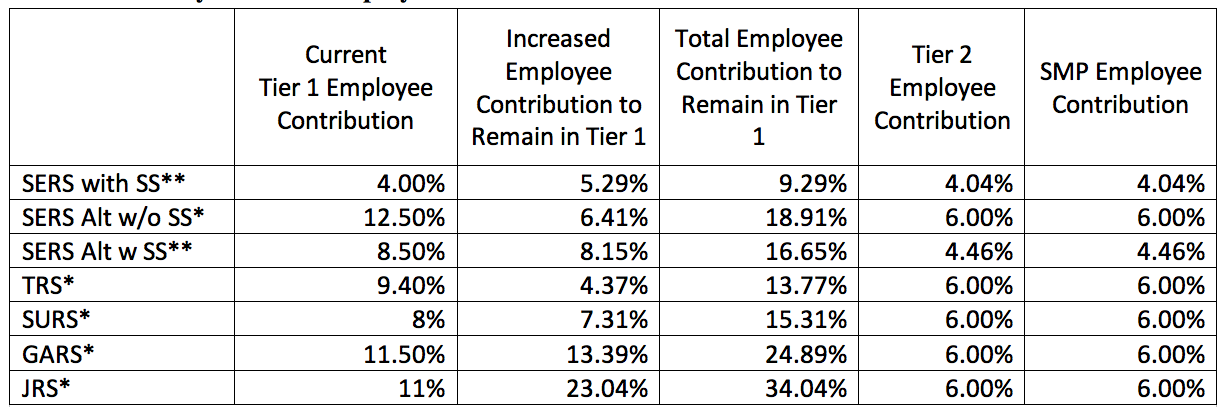
The plan, endorsed by the top Democrat and the top Republican in the Illinois House, would require many state employees to pay about 13.8 percent of their salaries into the pension system to keep their current benefits. Or they could keep more of their money but receive lower benefits at retirement. A third option would be a new 401(k)-style investment plan.
Officials said the savings will depend on which options employees choose. But the amount will be billions of dollars over the years to come, with employees contributing hundreds of millions of dollars more, said Sara Wojcicki, spokeswoman for House Minority Leader Tom Cross, an Oswego Republican.
The American Federation of State, County and Municipal Employees complained that the plan would “slash” the pensions of employees or cut deep into their paychecks.
The union said the average pension is just $32,000 a year, which could be their sole retirement income because many public employees do not get Social Security. AFSCME argues that government employees always contribute their share to retirement systems, while state officials have often failed to meet their obligations.
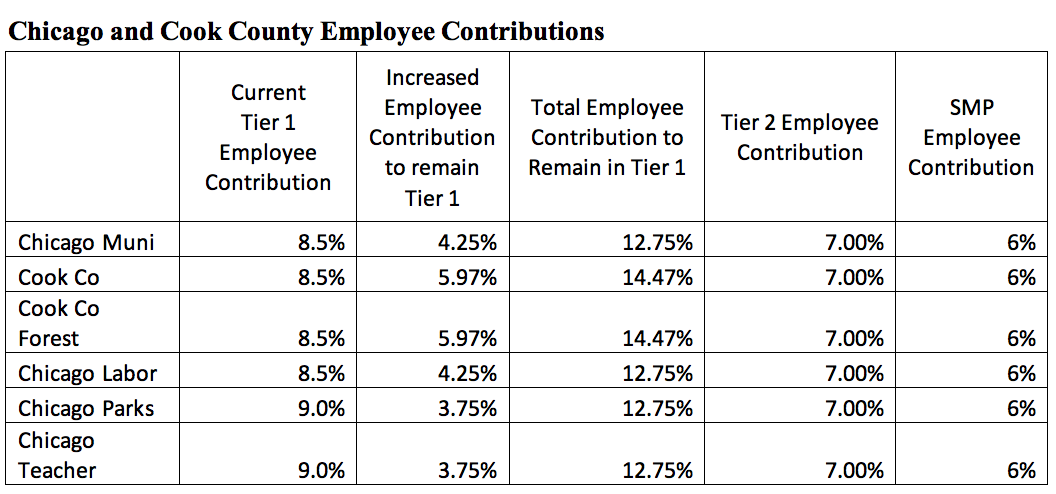
* Click here for Leader Cross’ fact sheet. Click here to read the proposal itself. These are the current employee contribution levels, proposed Tier 1 increases and final proposed contribution rates. Click the pic for a larger image and alternative system contribution rates…
The Tier 1 contribution rates are subject to revision after the first three years and every three years thereafter. If the contributions become too burdensome, an employee can move down to Tier 2 or Tier 3 but never back up.
In other words, those numbers you see above aren’t final by any means. The contributions will automatically be recalculated every three years, and those contributions could very well be recalculated upwards as people leave the system. That scenario is a huge political nightmare for many, many legislators.
Cross plans to put the state’s judges, who initially were excluded from the latest pension bill, back in this morning via an amendment. Under new contribution levels for public employees who started work before Jan. 1, judges would have to pay 34 percent of their salaries, instead of the current 11 percent, to keep their current benefits.
“Some of our members felt strongly that all of the state systems should be included in the bill,” said Cross spokeswoman Sara Wojcicki when asked why the judges are to be included.
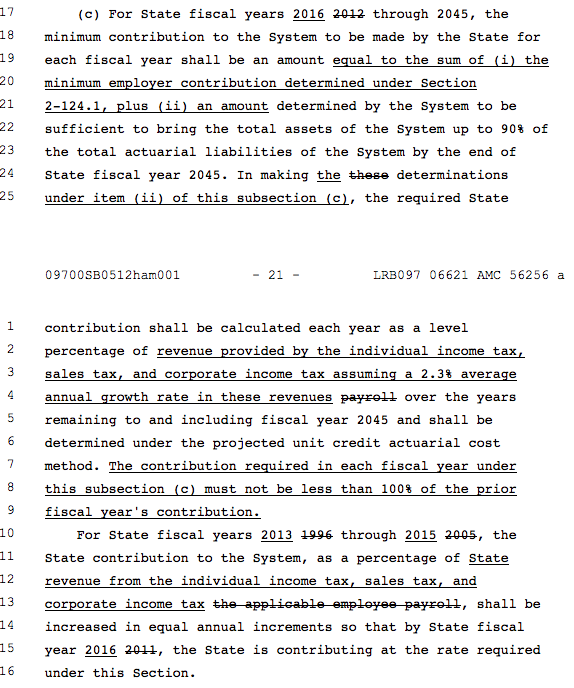
Each year the state will contribute an amount equal to 6% of the total pensionable salary for
employees. Further, the state will contribute a level percentage of the “big 3 revenues” (sales tax, personal income tax, and corporate income tax) to reach a level of 90% funded by 2045. For FY13-15, there will be a “step up” period to ensure a level percentage of revenue from FY16 until FY45. State revenue is assumed to grow at 2.3% per year, and in no case shall the state contribute less than 100% of the prior year’s contribution.
If the changes are made, Schmitz predicted, the game plan for getting the state’s pension systems funded at a 90 percent level would be achieved by 2045. Further, he said, the state’s pension payment in 2045 would drop from a projected $20 billion to $12 billion if the steps are taken.
A House panel Wednesday dumped an 11th-hour bid to expand gambling in Illinois.
The measure, which would have added five casinos and allowed horse racing tracks to offer slot machines, failed to receive enough votes to emerge from the House Executive Committee.
The loss came just days after Gov. Pat Quinn said he didn’t support a massive expansion of gambling, despite the lure of as much as $1.5 billion in added revenue for the cash-strapped state.
The plan would have used the proceeds to pay down the state’s lengthy list of unpaid bills.
Lang blamed the downfall on a provision requiring tracks to reach peace agreements with organized labor. Republicans on the panel all voted against it.
The labor provision was opposed by Arlington Park Racecourse, which is attempting to reach a compromise with food-service workers over representation of additional workers that would be required for turning the racetrack into a “racino.” Arlington had long sought the OK to bring slot machines to the racetrack, but said it would oppose the bill mandating such agreements.
Lang said labor peace agreements had already been worked out among the rest of the state’s horse racing tracks. He said he would either work to encourage a labor settlement or seek other changes in the bill to allow it to advance before the legislature’s scheduled adjournment at month’s end.
A “labor peace agreement” is an agreement in which the labor organization waives the rights of itself and its members to strike, picket, or otherwise boycott the operation for at least 3 years.
Anyway, that language will likely be pulled from the legislation today and reintroduced. Expect Mayor Emanuel to become more involved if and/or when this bill advances to the floor…
“Mayor Emanuel has been upfront about his support for gaming,” Lang said. “I think he’s prepared to convince some fence-sitting legislators it’s the right thing to do.”
The measure would have allowed casinos in Chicago, Danville, Rockford, Park City in Lake County and a yet-undetermined location in the southern suburbs.
It also would have permitted slot machines at racetracks, including a new track and slot machines at the Illinois State Fairgrounds in Springfield.
Slot machine gambling would not be allowed year-round in Springfield, Lang said. It was to be legal only during the three to nine months of the year when horse racing would have taken place.
Slots at Chicago airports behind the security perimeters are also in the bill.
* Meanwhile, McPier has shot down a suggestion that it temporarily host a new Chicago casino in its McCormick Place East Building…
“Lakeside Center is definitely not the place for a casino,” MPEA Trustee Jim Reilly said in a statement. “Our trade show customers do not want their attendees leaving the show floor during show hours.”
* Supporters, utilities try again with smart grid: Ameren and ComEd customers will pay about $3 more per month for the Smart Grid upgrades. Pramaggiore said ComEd customers would see a flat $36 per year increase. Ameren customers would see their bills rise quite a bit more. The monthly $3.40 charge would double each year, so that at the end of the 10-year Smart Grid program, Ameren customers would be paying $34 a month more.
* ComEd smart grid plan adds consumer protections: But Attorney General Lisa Madigan said the changes still allow ComEd to take advantage of customers. “Today, their legion of lobbyists continue to push legislation that will require consumers to fund billions more in guaranteed profits,” Madigan said. “This new proposal is just more of the same: a plan that hits consumers where it hurts the most — their wallets.”
* Measure would dismantle workers compensation system in Illinois
* State House committee wants to abolish workers’ comp: “Sometimes it’s easier to start from scratch than to try to fix something that’s so broken,” Bradley said. “We are continuing to work. There could be an announcement in the next matter of days, you know, or hours. But in the meantime, until we feel confident and comfortable doing that, we’re going to continue to move this into place.”
* Local leaders sign letter in support of bringing casino to Rockford: But Rep. Joe Sosnowski, R-Rockford, does not support a gaming expansion or a Rockford casino, saying the benefits are overstated. A casino may be an immediate benefit to the city, he said, but he doubts that there would be much benefit to the region.