Question of the day
Tuesday, Sep 20, 2011 - Posted by Rich Miller
* From the Tribune…
Illinois Senate President John Cullerton said Monday that he’s open to reducing the number of gaming positions in a pending casino measure to try to address Gov. Pat Quinn’s concerns that it expands gambling too much.
The North Side Democrat also said he’s willing to scrap plans for year-round horse racing with slot machines at the state fairgrounds in Springfield. But Cullerton said he wants to keep the five new casinos, including one in Chicago. And the lawmaker discounted the idea of getting rid of slot machines at other horse tracks, saying it would jeopardize support for the package at the Capitol. […]
The Senate president also said he wants to work with Quinn on other issues the governor has raised, including fears the measure would erode oversight of the gambling industry and concerns that proposed changes to the way casinos are taxed would mean less money for schools.
* But the photo the Trib used with its piece is what most interests me. Here’s Cullerton speaking with ComEd Chairman and CEO Frank Clark and Exelon CEO John Rowe at a gym dedication for the Rowe-Clark Math and Science Academy…
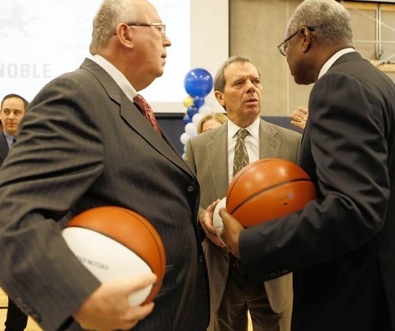
* The Question: Caption?
58 Comments  
|
It’s tough to handle this fortune and fame
Tuesday, Sep 20, 2011 - Posted by Rich Miller
* The University of Minnesota’s “Smart Politics” blog analyzed Lexis/Nexis news transcripts from ABC, CBS, CNN, FOX, MSNBC, and NPR since January and looked for mentions of new US House freshmen.
As might be expected, Republican Joe Walsh was interviewed or mentioned the second-most times among all freshmen. Walsh was interviewed or mentioned on 148 broadcasts, for 12 percent of the total. Top finisher was Allen West of Florida, who was interviewed or mentioned in 222 programs, for 17.9 of the total. There was a huge dropoff between Walsh and third place finisher Tim Scott of South Carolina, who was interviewed or mentioned just 45 times.
The rest of Illinois’ freshmen class isn’t even close…
8th - Adam Kinzinger - 22 broadcasts - 1.8 percent
29th - Bobby Schilling - 11 broadcasts - 0.9 percent
59th - Randy Hultgren - 5 broadcasts - 0.4 percent
66th - Robert Dold - 4 broadcasts - 0.3 percent
Hultgren starts this campaign with a serious PR deficit against Walsh. Then again, he’s not accused of cheating his kids out of over $100,000 in child support, so there’s that.
* As part of their legal challenge to the new Democratic map, incumbent congressional Republicans have privately agreed not to formally announce campaigns or even actively campaign in their new districts until the court battle ends. But the clock is ticking and some folks can’t wait…
Political sources who would know say that U.S. Rep. Judy Biggert, R-Hinsdale, has begun circulating nomination petitions to run in the 11th, which includes portions of Aurora, Joliet and central DuPage County.
Ms. Biggert also is circulating petitions in a different, somewhat friendlier district drafted by Republicans who are challenging the Democrat-drawn map in federal court. But that challenge is considered a long shot — meaning that Ms. Biggert is likely to end up running in the new 11th.
The Democrats put Ms. Biggert’s home in a new 5th District dominated by Chicago Democrat Mike Quigley. She’d have no real chance to win there, ergo the move.
If she does run in the new 11th, Ms.Biggert’s Democratic opponent likely will be former Congressman Bill Foster, who lost his seat in the far west suburban 14th District in the GOP’s 2010 election rout.
The problem with waiting is that the other side is given an advantage. That’s a big reason why Tim Johnson decided not to go along with his party and started campaigning immediately. Most others are still publicly hedging…
If re-elected in 2012, U. S. Rep. Adam Kinzinger, R-Manteno, will continue to represent La Salle County.
However, which district he will run in is still in question.
Kinzinger told The Times Friday he will run for re-election in either the 11th or the 16th Congressional Districts, depending on the unlikely success of a Republican-backed lawsuit now in the courts, which challenges the new Democratic drawn redistricting map sanctioned by Gov. Pat Quinn in June.
“If the Republican (revised) map wins in the courts, I’ll run in the 11th District,” said Kinzinger. “If not, I’ll run in the 16th District. Either way, Ottawa and La Salle County (which lies in both versions) will be included in my re-election campaign.”
Should the freshman congressman run in the 16th District, he may face longtime incumbent Rep. Don Muzullo, R-Egan, in a GOP primary face-off next spring.
* Johnson, meanwhile, will officially have another Democratic opponent tomorrow…
Jay Hoffman, who served in the state House for 22 years and narrowly lost a race for Congress in 1996, said Sunday he will run for the Democratic nomination in the 13th Congressional District.
Hoffman, who lives in Collinsville, said he will formally announce his candidacy at various stops throughout the sprawling new district on Wednesday, Thursday and Friday, starting Wednesday in Edwardsville. He’ll be at the Illini Union at 11:30 a.m. Thursday.
Hoffman, 49, already has two Democratic foes, Bloomington emergency room physician David Gill, who has run and lost for Congress three times, and retired Litchfield educator James A. Gray. A fourth potential candidate, Green County State’s Attorney Matt Goetten, said he expects to make a decision later this month.
There are two Republican contenders in the district, six-term incumbent Rep. Tim Johnson, R-Urbana, and Springfield truck driver Sam Spradlin.
Spradlin ain’t gonna be much of a primary opponent, however…
Court records show that Spradlin took out bank accounts in someone else’s name and wrote checks on those accounts. The five checks yielding the charges included one to an auto service center, three to stores and one to a bank. The largest was $200, and the total was $540.
He wrote and signed a statement at the time saying he was “deeply in debt” when he came out of the service in 1983, and that he talked to a minister about it and wanted to confess but was scared of violence from people close to the person whose name he had used.
* And I’m not sure this means much of anything…
Rep. Danny Davis (D) is backing former Illinois Deputy Treasurer Raja Krishnamoorthi Monday in the hotly contested Democratic primary for the new 8th district. Davis will also host a fundraiser for Krishnamoorthi on Sept. 30 in Illinois.
Davis’ support puts him on the opposite side of at least one of his home-state colleagues, Sen. Dick Durbin (D), who endorsed Iraq War veteran Tammy Duckworth earlier this year.
The new 8th District has an African-American voting age population of just 4.2 percent. And Davis hasn’t exactly been a major fundraiser in the past.
…Adding… This, however, is starting to look like a trend. From a press release…
Cook County Board President Toni Preckwinkle announced today that she will host a fundraiser for Democratic Congressional candidate Raja Krishnamoorthi on October 12, 2011. In explaining her strong support for Raja, President Preckwinkle cited Raja’s progressive solutions to problems facing the people of Cook County and Illinois.
President Preckwinkle said, “Raja’s focus on empowering small businesses is the exact type of economic policy we need right now. Raja knows that small businesses are the key to economic prosperity and middle class job creation.” Raja’s focus on strengthening small businesses so they begin to create jobs is a key component of his campaign. President Preckwinkle also noted that Raja will be a strong leader and a key partner on these issues if elected to Congress.
Raja Krishnamoorthi raised more than $412,000 in his first five weeks of fundraising in the 2nd quarter and support continues to pour in during the current 3rd quarter. President Preckwinkle’s fundraiser in October will provide even more momentum and resources to fuel the campaign.
* Related…
* Numerous battles haven’t slowed Rep. Bobby Rush
* Tea Party Invites Presidential Candidates to Schaumburg
* Cook County GOP has new leader
* Alderman Fioretti looted own law firm for campaign cash, suit claims
* The Masters of Hispanic Destiny: “Democrats are so intent on making Hispanics the next victimized minority seeking entitlement programs and all that, that the Republicans are starting to believe it!” exclaims [Juan Rangel, CEO of Chicago’s United Neighborhood Organization]. “And they’re wrong on both ends. This is a great community that’s poised to do great things—but you gotta challenge it. Don’t pander to it.”
46 Comments
|
* Was this really necessary?…
This summer, the office of Illinois Treasurer Dan Rutherford sent a glossy summary of “successes” to a select 850 state residents — a majority of whom happen to be major campaign donors to the Pontiac Republican.
Rutherford, who party insiders say is strongly mulling a bid for governor, says it is “merely a coincidence” that nearly two-thirds of the recipients of the slick mailer are also donors to his political campaign.
Rutherford sent out the 11-page full-color booklet titled “No More Debt” on June 1. “Paid for by the state of Illinois. 850 copies,” it reads in small print on the back. […]
According to information obtained through the Freedom of Information Act and cross-checked against campaign disclosure data filed with the State Board of Elections, 566 of the original 850 recipients were Rutherford campaign donors, contributing a total of $1.6 million to the former lawmaker’s war chest over the last 16 years.
You do a mailer to a tiny list of bigtime honchos? It makes zero governmental sense, but lots of political sense.
*** UPDATE *** Sorry, Dan, but I’m not quite buying this explanation yet about the Daily Herald story...
State Treasurer Dan Rutherford said Tuesday that he did nothing wrong when he used treasurer’s office funds to pay for a brochure that went largely to campaign contributors and other supporters of the Republican Party.
Rutherford called it a coincidence and said the 11-page mailer was targeted to people who had request more information about state pensions, borrowing and debt.
“I get a smile out of it because the suggestion is (the recipients) were largely Republicans. Well, that happens to be the larger number of people who expressed interest in the concern of where we are on state debt and where we need to change the state public pension system,” Rutherford said.
So, Jim Thompson, Craig Duchossois, Goldman Sachs investment banker Muneer Satter and Jimmy Johns founder James Liautaud had “requested more information about state pensions, borrowing and debt”? Huh.
[ *** End Of Update *** ]
* And we most certainly know that this isn’t necessary…
Illinois may be swimming in red ink, but that hasn’t stopped lawmakers and other public officials from using state tax dollars to print and distribute coloring books.
Along with offering kids the opportunity to color things like the official state snack - popcorn - and the official state prairie grass - Big Bluestem - the booklets also prominently feature the name, contact information and picture of the lawmaker or state official.
In some instances, children can even color in a likeness of their local legislator.
Lawmakers defend the coloring books, saying they help familiarize young people with state government.
“It’s not to raise the name awareness of the legislators. There is educational value and governmental value to providing constituents helpful information about state programs and educate our kids about state government,” said state Rep. Chris Nybo, R-Elmhurst, who co-sponsored a law last spring barring politicians from promoting themselves by placing their names on state highway signs or taxpayer-financed billboards.
* As with the Rutherford mailer, the tiny cost is beside the point…
State Sen. Mike Jacobs called Thursday to register his disappointment about a story I wrote last week highlighting the little-known practice that allows lawmakers to hand out coloring books featuring their names and pictures.
Jacobs, D-East Moline, is among those who say the coloring books are educational and can help kids learn about Illinois. Plus, he said, they only cost about 19-cents apiece to print.
“I print a thousand a year. That’s $190 a year,” Jacobs said.
If every lawmaker printed and distributed 1,000 coloring books that would come to about $33,600 annually. Given the fact the state spends more than $33 billion annually, that’s not a lot of money.
But it’s not just about the cash.
It’s about whether it’s proper for lawmakers to use taxpayer dollars to promote themselves. If these were just straight up Illinois coloring books, that would be one thing. But these are emblazoned with the name, picture and address of the legislator.
33 Comments
|
* Here we go again…
A key state senator said he will try to push legislation during the upcoming veto session that would require retired state employees to pay premiums for their state health insurance.
Sen. Jeff Schoenberg, D-Evanston, said he is still working on details of the plan, but he wants to have something he can give lawmakers to study before the veto session starts Oct. 25.
“We can’t sustain the existing situation where more than 90 percent of retirees pay absolutely nothing for premiums,” Schoenberg said. “If we don’t do something now, then inevitably everyone’s current benefit levels will be jeopardized and co-payments for everyone will inevitably rise.” […]
“There are retiree chapters already preparing to make their voices heard in the coming weeks if affordable health care is threatened in the veto session,” AFSCME spokesman Anders Lindall said. “Retired state employees have very modest, fixed incomes. They already pay a significant cost for their health care, and those costs are subject to collective bargaining.”
* I’m hoping to get the Illinois version of a recent national poll, but Doug Schoen’s latest survey found this related nugget…
However, there is a clear distinction in voters’ minds between what current public employees should be asked to contribute and what retired public employees should be asked to contribute. Sixty-nine percent say retirees should “not have to” contribute more towards their health-care benefits or take a reduced pension because of state and local government budget problems.
More…
Further, by 48% to 40%, voters say that public employees’ salaries should be “frozen,” and they should be required to contribute more towards their benefits when states face the type of crises they are now facing. Close to two-thirds (64%) say they would not be willing to have their taxes raised as a means of keeping salaries and benefits of current employees at current levels. […]
One of the reasons voters feel so strongly about reducing the level of compensation for state employees is that they believe that they are earning disproportionately high wages relative to those in the private sector.
There is a clear belief that public employees are better compensated than those in the private sector: 41% of voters think “the salaries and benefits of most public employees are too high for the work they do,” while 32% think they’re “about right” and 13% think they’re “too low.”
* A new study by the Center for State and Local Government Excellence took yet another stab at comparing wages and benefits between private sector workers and state and local government employees. The full study is here. The overall conclusion…
* State and local workers have a wage penalty of 9.5 percent.
* Pension contributions and retiree health insurance help close the gap.
* Total compensation for public sector workers is about 4 percent less than that in the private sector.
* Meanwhile, I wrote about this a while ago, but didn’t identify the legislator. I figured he probably already had enough problems, and, besides, he wasn’t really too upset about it. In fact, when Rep. Harris confirmed the story, he laughed about the whole thing…
While lobbying this spring for lawmakers to support a change in pensions for city workers, Emanuel called Democratic state Rep. Greg Harris, a longtime acquaintance who represents Emanuel’s North Side neighborhood. Harris opposed the legislation, which never got traction in Springfield.
Emanuel pressed Harris to change his mind, and, according to several lawmakers who heard the story, began swearing at him and threatening to burn down his house if he didn’t.
Harris didn’t dispute the story but declined to provide details of the conversation.
“It was a really heated exchange, but that’s fine, that’s politics,” Harris said. “People are passionate about their positions, and sometimes things get intense. … I also have a temper, and I know bad words too.”
I talked to Harris over the weekend about the Trib piece and he chuckled again, then got a bit peevish that the media was focusing on stuff like this and not the bigger problems at hand.
By the way, I’m pretty sure he’s still a “No” on the pension bill.
* Related…
* Editorial: Some hope remains for Tinley mental health facility survival
* School day debate is getting ugly - CPS, teachers union accusing each other of pressure tactics
* Emanuel, labor find common ground on health plan
* Editorial: Crowd-sourcing the budget
* Ald. Cardenas Calls for Police, Fire Closures
* Police mull closing district stations
* Some county commissioners say furlough days are for union workers, not them
* Looming fight over Cook County health system budget
* Editorial: CHA: Don’t toss out good eggs with bad
61 Comments
|
Cross proposes $500 million tax cut
Tuesday, Sep 20, 2011 - Posted by Rich Miller
* House Republican Leader Tom Cross was in Peoria and Decatur yesterday to tout his “jobs” package, which was mainly comprised of a $379 million reinstatement of the net operating loss deduction, which disappeared this year. The list of proposals got a great reception in the Peoria paper…
Peoria-area companies would see significant benefit from an extension of the research credits, “with about $1 billion of research done every year” in the area, said state Rep. David Leitch, R-Peoria.
That proposal drew plaudits from Caterpillar Inc., which operates its main research and development facility in Mossville.
“Companies like Caterpillar . . . typically don’t do business planning on a short-term cycle,” company spokesman Jim Dugan said, noting the benefits of “a stable tax climate and predictability” when making decisions for the future. “A permanent R&D tax credit in this state is exactly the kind of thing that can help provide that stability.”
There’s no doubt that the R&D credit is helpful. But restoring that credit is only $25 million out of the entire plan.
* Cross also wants to increase the inheritance tax exemption to $5 million, from the current $2 million. From his proposal…
The estate tax falls heavily upon family farms and their owners and heirs. The current price of Illinois farmland means that Illinois farmers who try to bequeath their land to their children, following the traditional pathway through which a farm is moved from parent to child, must pay a heavy “death tax” that is so heavy that the next generation must either mortgage the land or leave the farm.
Farmland is now pushing $10,000 an acre here in Illinois. So, only the first 200 acres would be tax-free upon a farmer’s death, and that doesn’t include all the equipment and buildings. Job creation, however, may be tangential to this. Cross has a lot of very wealthy campaign contributors who would certainly benefit. Total cost to the state with this proposed: $88 million a year.
* Cross also wants to extend the life of all existing enterprise zones for 20 years, even though both legislative chambers are now examining whether some of those zones ought to be eliminated.
* So, how does he intend to pay for it? Well, he says, it’ll pay for itself, although he doesn’t exactly say how…
Cross said the plan, estimated to cost the state just shy of $500 million to implement, has been projected to generate between $600 million and $700 million in revenue - making it a net money-gainer for state coffers - and create as many as 60,000 jobs if it were fully implemented. That could lower the overall unemployment rate by as much as a full percentage point.
More on that point…
“When more people are working and re-investing in our communities, our economy is stronger. For every point we reduce our unemployment rate, the state generates around $600 million in new revenue to fund state programs and services. We can’t afford not to enact these proposals,” said Cross.
* The bill itself is here. Why didn’t he go even bigger?…
“We picked five things we think the Democrats might be open to doing because there have been discussions about these in the past,” said Cross. “I would love to do that, I don’t run the place.”
Discuss.
20 Comments
|
GOP legislator predicts ComEd veto override
Tuesday, Sep 20, 2011 - Posted by Rich Miller
* ComEd has been saying for weeks that they will have enough votes to override Gov. Pat Quinn’s veto of their bill. But this is still somewhat of a surprising admission…
In the midst of the company’s ongoing mea culpa tour of the suburbs over summer power outages, representatives from ComEd met with Des Plaines residents to “clear some of the myths and misconceptions” about the legislation to increase electric rates that Gov. Pat Quinn vetoed last week.
To that end, Mike McMahan, ComEd vice president of smart grid and technology, explained the breakdown of what he described as a $2.6 billion, 10-year plan that designates about $1 billion for infrastructure and about $1.6 billion for the smart grid.
The legislation would cost ComEd customers on average an additional $3 per month, McMahan said Saturday. […]
State Rep. Rosemary Mulligan, who held the community meeting at the Des Plaines Library at which ComEd representatives spoke, said legislators may vote to override the governor’s veto during next month’s veto session.
“More than likely it will pass,” said Mulligan, who voted against the legislation last time in part because of lobbying by her senior constituents, but who said she may vote for the override. “I don’t think this bill was explained well,” said Mulligan, adding that she thought it could benefit the area.
The idea is to override the bill then pass a trailer bill which can be signed into law. But what if that is vetoed as well? Then legislators will have to suck it up and approve the trailer on their own. That’s a whole lot of unpopular votes, man. A whole lot.
* And the company will have to avoid stupid mistakes like this one…
ComEd, of course, put out a statement expressing disappointment in the veto. The company also issued the names and contact numbers of “potential spokespeople who can speak to the benefits” of the bill.
For example, one name on the list was Rep. Kevin McCarthy, D-Orland Park. That’s a logical choice since McCarthy was the House sponsor of the legislation.
Then there was Sen. Don Harmon, D-Oak Park. That was truly a curious choice since Harmon voted against the bill. In fact, he’s been designated as the guy who’s supposed to come up with modifications to the original bill that may make it more palatable to its critics. And he’s made it clear he’s not going to coddle utility interests.
Word was Harmon was none too pleased to learn ComEd listed him as someone available to extol the virtues of a bill he voted against.
Oops.
* An interesting take from a Downstate mayor…
While I understand the importance of efficient energy production and distribution, this bill would make it virtually impossible for municipalities to ask local citizens to contribute to a municipal utility tax, making a difficult fiscal environment even worse.
* And here’s my weekly syndicated newspaper column…
Gov. Pat Quinn recently vetoed a “smart grid” bill that was pushed through the General Assembly this spring by ComEd and Ameren, the two biggest electric utilities in the state.
Politically, this veto was a no-brainer for the populist Quinn. The governor never tires of recounting how he helped start the Citizens Utility Board, and that dovetails nicely with his repeated claims that the utility proposal “locks in” corporate profits.
ComEd’s severe, weather-related outage problems in the Chicago area this summer have seriously hurt the company’s already-damaged image, both in its territory and at the Illinois Statehouse. Add those outages to the possibility of legislative-approved rate hikes and then mix that in with an electorate already inflamed by the income tax hike and the seeming inability of the state government to get its act together, and it’s obvious why this thing never had a chance with Quinn.
That’s not to say there wasn’t an effort to come to an agreement. ComEd did bow to a Quinn demand to insert language allocating $50 million to help seniors and the poor. However, that money was included in the company’s original plan and was only pulled at the last moment during the spring legislative session.
Quinn’s administration and others, including AARP and the attorney general, never really believed that the company was negotiating in good faith this summer. For example, ComEd wants to use a form from the Federal Energy Regulatory Commission to report costs and expenditures instead of continuing to use the Illinois Commerce Commission’s form.
There are only minor differences between the two forms, but the governor’s office and its allies are convinced that ComEd wants the change for nefarious purposes. The company reportedly wants the change because it fears the ICC, which opposes the smart grid bill, will exact its revenge by changing the form.
The company’s opponents say the smart grid stuff is just a ploy to increase profits on other aspects of the company’s business. A statement earlier this year by the chief executive of Exelon, ComEd’s parent corporation, seemed to disparage the smart grid by consigning it to pilot project status. Company officials now say that a recent pilot project was so encouraging that it is firmly behind the technology.
Despite all the political problems, ComEd executives firmly believe they can override the governor’s veto. They have a list of companies that will expand in Illinois if the smart grid program moves ahead and have offered to spend $150 million to prevent outages.
The company claims that it’s close to a three-fifths majority in both the House and Senate. After the veto is overridden, ComEd wants to pass a “trailer bill” to address what it considers to be legitimate concerns by legislators, including Senate President John Cullerton (D-Chicago).
Quinn reportedly will use his bully pulpit and meetings with legislators to prevent an override, in much the same way he blocked passage of the concealed-carry bill earlier this year.
Senate President Pro Tem Don Harmon (D-Oak Park) is in charge of crafting the trailer bill and said he wants a legislative solution, not necessarily a ComEd solution. That’s encouraging. The bill’s two legislative sponsors last spring were far too close to the utility for comfort’s sake. One has a father who lobbies for ComEd, and the other is widely rumored to be planning a career as a lobbyist.
I have supported the smart grid for a very long time. Upgrading our infrastructure gives our businesses a competitive advantage over other states and other countries, and the electric grid is a hugely integral component of our infrastructure.
But I totally understand why people don’t trust ComEd. There’s a good reason why it has to hire a battalion of lobbyists every time it tries to pass a bill. Yet opposition shouldn’t be totally knee-jerk. Denying the company a decent return on its legitimate investments won’t help us move forward.
Harmon needs to wrest control of this process away from both ComEd and grandstanders like Quinn to come up with a bill that’s good for all of Illinois. Everybody should have input, but nobody should dictate the outcome. We need to accept the hard fact that infrastructure improvements aren’t free, but we shouldn’t just be padding corporate bottom lines without specific, hard guarantees that our state will be moved significantly forward.
* Related…
* Bill to raise electric rates may override Gov. Quinn veto: [Rep. Robert Pritchard (R-Hinckley)] said the rate increases are warranted because ComEd is putting $3 billion of its own money into the bill.
* Press Release: New Poll Reveals Illinois Residents Support Strong Lighting and Appliance Efficiency Standards: Voters strongly support the federal government setting minimum energy efficiency standards for various household products with 68 percent in favor for appliances to only 22 percent opposed; and 69 percent in favor for light bulbs to only 25 percent against.
* GridWeek: Reactions to Smart Grid Veto in Illinois
* Editorial: Share cost
of smart grid: Instead of seeking to round up four more votes in the Illinois House and five more in the Senate to override Quinn’s veto, the utilities should work to come up with a plan that calls for them to accept a fairer share of the risk inherent in such a large project. It also should reflect the reality that improved infrastructure should be part of any multibillion-dollar upgrade to the system.
* ComEd reps seek to clarify vetoed rate-hike plan
* ComEd officials get an earful at forum: “You’re treating us like Cubs fans,” said James Toler, a resident of the village’s northeast side, analogizing ComEd service to Cubs management: promising to do better each year, but coming up short.
* Elmhurst Aldermen Consider Hiring Outside Expert to Assess Power Grid - Task force, legislators ask for more direction.
* Problem Solver: ComEd bill, service both register zero - South suburban resident says electric company ignored pleas to fix her broken meter
* Power out for several hours after driver hits Aurora pole
* A Marshall Plan to Build a Smart Grid — in China
8 Comments
|
ICC Alternative to SB 1652 doesn’t add up
Tuesday, Sep 20, 2011 - Posted by Advertising Department
[The following is a paid advertisement.]
Chicago Tribune editorial (September 13, 2011)
“[The ICC proposal] would wrap grid modernization in a familiar ball of red tape. It wouldn’t give utilities an incentive to invest in major technology upgrades. It’s pretty much a nonstarter.”
If that doesn’t say it all, there’s more
The ICC proposal only addresses half of the costs of grid modernization.
This means…
Consumers pay more.
The proposal keeps utilities stuck in the stop-and-start process that’s prevented efficient, long-term grid modernization.
The jobs benefit is virtually lost
Job creation requires long-term infrastructure planning.
Reliability benefits are gutted.
Reliability gains mandated in SB 1652 will be gone for lack of multi-year planning.
Accountability is removed.
Utilities can’t commit to performance standards without more predictable cost recovery.
SB 1652 is a better policy.
• It creates the most progressive, accountability-based regulatory model in the country, protecting consumers in ways the current law does not.
• It’s supported by a diverse cross-section of business groups, labor unions, environmental organizations and high-tech advocates.
• Independent policy experts support the bill, including Ray Romero, former ICC commissioner; Ken Costello, former ICC economist; and John Kelly, Galvin Electricity Initiative.
For more information, visit www.SmartEnergyIL.com.
Comments Off
|
It’s not what you think
Tuesday, Sep 20, 2011 - Posted by Rich Miller
* Gov. Pat Quinn yesterday announced a big “new” Illinois wind project…
During his visit to Beijing today, Governor Quinn announced that Goldwind, one of the largest wind turbine manufacturers in the world, will build a $200 million wind farm in Lee County, Illinois. The company will break ground on the Shady Oaks project later this fall. Once online, the project will provide 109.5 megawatts (MW) of power, and create more than 100 construction and a dozen permanent maintenance jobs in Illinois. According to the American Wind Energy Association, one megawatt of wind energy can provide enough electricity to meet the needs of 225-300 households. Therefore, 109.5 MW can provide the electricity needs of approximately 25,000 homes.
OK, so maybe the official ground breaking will occur later this fall, but according to the LaSalle NewsTribune the project has been underway since 2005, and construction began in earnest last spring…
Englehart, Zimmerman and her brother, Alan, are among landowners that signed on to the project back in 2005 when GSG Wind Energy of Sublette started the development. The project was then sold to Mainstream Renewables which in turn partnered with Goldwind USA late last year. The project was then fully acquired by Goldwind, a company that got its start by constructing wind turbines in China. The 120-megawatt Lee County wind farm is the first large-scale project undertaken by the company following a 4.5-megawatt pilot project in Minnesota.
There have been quite a few complaints about what the wind farm is doing to local farmland, but the company is obligated to compensate farmers for any losses, and nobody was ordered to sign those contracts.
* And the governor’s gross exaggeration doesn’t mean the trip isn’t worthwhile…
Among those going with the governor is Rockford Mayor Larry Morrissey. Quinn said the trade mission will encourage companies such as Wanxiang America Corp, which recently opened a $12.5 million, 40,000-square-foot plant that makes solar panels in Rockford, to bring more business to Illinois. Wanxiang is one of the top 500 companies in China and its Rockford plant is the largest solar panel manufacturer in the Midwest.
“They are investing strongly in creating jobs in solar technology, and we want to encourage that,” Quinn said.
Also, keep in mind that Indiana’s governor and/or his lt. governor have traveled to China every year for a number of years. Illinois can’t afford to just sit back here.
* Meanwhile, an online survey of just over 300 people is getting some big media play…
llinois now ranks among the states with the worst business climates, according to a survey of business executives and site-selection consultants.
Illinois comes in third from the bottom, before California and New York, in the survey of more than 300 respondents by Development Counsellors International, a New York-based consulting firm that specializes in economic development.
Illinois was not among the worst states three years ago. But its business climate took a hit this year when Gov. Pat Quinn approved an increase in the state’s tax on corporations, to 9% from 6.8%, moving past Michigan, New Jersey and Massachusetts to the bottom of the pile.
Actually, only 72 corporate executives took the online survey, and almost 20 percent of those weren’t “C-Level.” The rest were location advisors/consultants…
The survey was conducted completely online. Respondents were contacted via email and invited to participate in the survey. A hyperlink to access the online questionnaire was provided and the choice of a $10 Starbucks Card or a $10 iTunes Card was offered for participation.
* And despite what the stories are telling you, the respondents were asked for their “perceptions” of best and worst state climates…
It is important to note this survey, and all preceding “Winning Strategies” surveys, are studies of perceptions. A perception is an attitude, belief or impression and not necessarily a reflection of reality. Business executives have certain identifiable opinions and beliefs about doing business in the United States and throughout the world. Some of these perceptions may be accurate and some may be genuine misperceptions.
Look, there’s no doubt that Illinois has real problems. But if a CEO makes a siting decision based on “perceptions” alone, then that CEO is pretty darned stupid. And considering how many corporations are actually headquartered in these bottom five states, there’s a real problem with how this survey was both conducted and portrayed…
The Top Five
1. Texas 49.4%
2. North Carolina 27.8%
3. South Carolina 14.3%
4. Tennessee 13.9%
5. Florida 13.5%
The Bottom Five
50. California 70.5%
49. New York 46.5%
48. Illinois 24.4%
47. New Jersey 23.5%
46. Michigan 16.1%
* It also appears that media habits are driving those “perceptions”…
* The Wall Street Journal (both the print publication and WSJ.com) and the Fox News network ranked among the top news sources for the survey audience.
Both of those media outlets have regularly pummeled Illinois, and as long as Democrats are in control here, there’s little hope that the beatings will ever stop.
* In other news, this infighting between states is getting way out of hand. Check out a story from today’s New York Times…
Pearson Education could teach someone a few things about how to play one state off against another.
The educational media company, a division of the corporation, based in London, that publishes The Financial Times, said Monday that it would move about 650 jobs to Manhattan from suburban offices in New Jersey and Westchester County. Some of the cost of moving will be offset by at least $13.5 million, and possibly as much as $50 million, in tax breaks and other incentives offered by city and state agencies in New York.
City officials framed the arrangement as a victory over New Jersey officials, who have been offering large packages of financial incentives to attract and retain big employers. But just last week, New Jersey agreed to provide $82 million in cost savings to Pearson, which plans to take more than 1,200 jobs out of Upper Saddle River, N.J., by 2014 and send more than 600 of them to Hoboken, N.J. One of the stated reasons for New Jersey’s largess was to keep all those jobs from going to Manhattan.
So, to recap: Pearson could receive as much as $132 million in incentives for deciding to move half its Upper Saddle River jobs to Manhattan and the other half to Hoboken. But the net gain in jobs for the New York metropolitan area would be close to zero. And still, officials on both sides of the Hudson River seemed quite pleased with the deals they had struck.
Sheesh.
* Related…
* Illinois Leads A+ Debt Poised to Rally on Widening Yield Gap
* China calls on U.S. to create better environment for business cooperation: Wang made the remark during a meeting with Pat Quinn, the governor of Illinois, a U.S. state that has many cooperative programs with China. “The governments of both countries should help solve problems related to local cooperation through practical action and create a good environment for substantial cooperation between companies, as this will promote employment and economic growth in both countries,” Wang said.
* Finke: Even vocal critics keep quiet about Quinn’s China trip
* Editorial: Good luck, governor, on trade mission<
* Motorola hunting for office space in Chicago: “I do believe a healthy Chicago makes for a better business environment. And I do believe in Rahm. He’s an action-oriented guy who swings. He doesn’t study. He’s relentless and evangelical in his determination to make Chicago more relevant and more current.”
23 Comments
|
|
Comments Off
|
|
Comments Off
|
|
 Support CapitolFax.com
Visit our advertisers...

 ...............
 ...............
 ...............


|
   
|
Hosted by MCS |
SUBSCRIBE to Capitol Fax |
Advertise Here |
Mobile Version |
Contact Rich Miller
|



