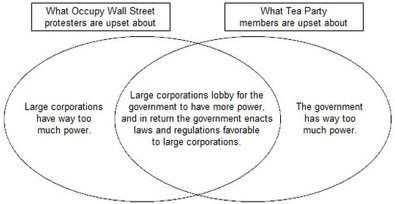
The problem, and I suppose this was inevitable, is that Occupy Wall Street is being portrayed as some kind of anti-Tea Party. Left vs. right, blue vs. red, rock vs. country, et cetera—it’s the only way we know how to draw battle lines anymore. But how are the two movements meaningfully different? I sure as hell can’t figure it out. There are plenty of minor differences, mostly concerning priorities and demographics, but the similarities are much more substantial. Both are popular uprisings against powerful-but-nebulous entities believed to be responsible for America’s economic struggles. Both are defined not by easily-identified leaders, but by the sum total of countless unique viewpoints, and thus are not capable of articulating their goals with any cohesiveness or specificity (nor should they be expected to). And both movements, to borrow the classification scheme created by Bill O’Reilly, are teeming with both pinheads and patriots. […]
We should pay less attention to the individual lunatics, and more attention to what a movement is really about. Occupy Wall Street, at its core, is a reaction to the increasing power and influence of large corporations. The Tea Party, at its core, is a reaction to the government’s constant interference with private enterprise. But wait a minute—aren’t those things connected?
* As expected, House Speaker Michael Madigan will block a vote on Gov. Pat Quinn’s amendatory veto of a legislative scholarship reform bill. Quinn rewrote the bill to abolish the program in its entirety. The Speaker’s spokesman was not kind…
It’s not in compliance with the constitution as it relates to the use of the amendatory veto. That’s very clear,” Madigan spokesman Steve Brown said. “This is something the speaker has worked on for two decades in terms of keeping the coequal branches of government intact.”
Referring to Quinn, Brown said, “You can’t sit around in one little place, one office, and say, ‘Here’s what I think the legislation should be.’ You have to engage in the legislative process. You can’t decide in the summer this is the bill I want. That’s not the way it was designed. There are three equal branches of government, regardless of the topic.”
A Quinn aide said the governor is intent on getting rid of what one aide repeatedly characterized as the “political scholarship program.”
“Obviously the governor doesn’t agree,” Quinn spokeswoman Brooke Anderson said when told of Brown’s comments regarding the governor’s use of the amendatory veto.
As I’ve said before, the scholarships should be abolished. But I have always been uncomfortable with the way governors try to stretch their amendatory veto powers.
* The Northwest Municipal Conference has proposed some changes to the way ComEd responds to storms, including forcing the company to set up regional 24-hour operations centers to inform customers what’s going on. The company’s response reputation is horrid, for good reason…
“I would receive messages from them that they had a crew on site, on scene, working on the repair, not realizing apparently that I was physically standing at the scene, watching the fact that there was nobody there, no work was being done,” said Wilmette Village Manager Tim Frenzer. “And in fact, the work wouldn’t be done for days.”
Busted. Cold.
* The super-intense storms last summer knocked out power for thousands of people. Without a smart grid, power outages cannot be contained and can become wider blackouts. Also, no smart grid means the company has to rely on customers to tell them when their power is out. But the company was clearly overwhelmed and residents had a right to be angry. And now, nobody wants to listen to the company’s ideas. This suburban editorial sums up a lot of the baby with the bathwater anger…
Until ComEd can get service returned quickly in the wake of power outages, residents should not be saddled with the bells-and-whistles-filled smart grid.
Too many people lost too much food in the last string of outages to reward ComEd with its coveted prize. Too many people suffered through days without air conditioning and nights with lights to give the power company a new gadget and higher electric rates. Too many traffic signals were dark, creating dangerous intersections, and too much emergency manpower was needed to baby-sit downed wires for state lawmakers to hand the power company yet another golden egg.
No one is saying that ComEd’s equipment should have withstood the powerful storms that rolled through the region this summer, but for residents in the northern suburbs to be without power for two, three and four days in the storms’ aftermath is simply unacceptable. Not being able to get power restored in a timely manner has to have consequences.
Keeping the smart grid from ComEd is not punishment, it is practicality. It is like your teen-age son asking for a Mercedes after he gets his driver’s license when he hasn’t mastered driving the 10-year-old mini-van yet. Any smart grid talk has to wait until ComEd proves itself worthy of the upgrade.
The editorial completely ignores the fact that we need both upgrades. The old grid needs to be shored up and the smart grid added to provide extra protection. But, ComEd is so unpopular that people just don’t want to listen. I can’t really blame them.
ComEd would probably be wise to go back to the drawing board, come up with a very big “dumb grid” and service upgrade and use that to justify the smart grid. And it should drop all that other crud about executive salaries and the like out of its bid to get around the Illinois Commerce Commission. If it doesn’t and its bill doesn’t pass, Illinois will be missing out on a chance to bring itself into the 21st Century.
ComEd’s new president said recently that Alexander Graham Bell wouldn’t recognize the telephone today, but Thomas Edison would be quite familiar with our existing 19th Century power grid. Enough with the games, already. And the AARP ought to back off the silliness about how “dangerous” smart meters are. It’s like the fluoridated water goofiness all over again.
* Craig Clausen penned a rah-rah op-ed for the Tribune today. Despite the exuberance, he makes good points…
In other states, smart meters are set to become the smartphones of the electricity business. Your current home electric meter knows one trick — dial spinning. If a human doesn’t read it each month, you end up receiving an estimated bill that may take months to reconcile to your actual usage. A smart meter is electronic, not mechanical. It can accurately bill you each month, week or day — your choice. It allows you to buy market-priced power at any given moment and even at tomorrow’s likely price.
A smart meter can tell you how much power each appliance is using and what your carbon footprint is. Want to ask your appliances how they’re feeling and whether the fridge might be headed for a motor failure? There’ll be an app for that.
Those inconvenient power outages we all endure will shorten because ComEd will instantly know who has power and who doesn’t. Crews can go to exactly the place they can do the most good. If a squirrel has his last meal chomping into your power connection, the meter can tell ComEd to restore service before you get home. You’ll know about it because the meter contacted you too. There’ll be an app for that.
Working late? Send your meter a message to save hours of cooling time if you want. There’ll be an app for that too.
Electric vehicles need smart meters to make sure that battery recharges are done during the wee hours of the night when prices are low. That app could come free from Ford or GM.
A law on the books for more than a decade sounds like it might have helped people like Sheldon Langer, who last year lost $600 of groceries after five days without power. And the village of Glenview, which spent tens of thousands of dollars in overtime this summer for firefighters and police officers who baby-sat downed wires and helped open emergency cooling centers.
The law was intended to compensate victims by holding Commonwealth Edison financially accountable for extreme outages, defined as those that leave more than 30,000 customers without power for at least four hours and could have been prevented.
But 14 years after the law’s passage, ComEd has never had to pay out for such losses.
ComEd simply found a way around the law. It’s a very crafty company, that one. And that’s why it shouldn’t be allowed to draft legislation like this smart grid thing.
* Exelon: Good for shareholders, not always customers: Sunday’s column was about why the Maryland Public Service Commission should reject Exelon Corp.’s applicaiton to take over Constellation Energy and BGE. One reason is what knowledgeable people describe as Exelon’s and utility ComEd’s unstated motivation to close their Zion Station nuclear plant: to decrease the supply and increase the price of electricity.
* Mike Boland is dropping out of the congressional race and will run for state Senate. This will be one of the most-watched primaries of the year…
Former state Rep. Mike Boland is dropping out of the Democratic primary in Illinois’ 17th district and will pursue a challenge against state Sen. Mike Jacobs.
The state Senate race would pit two longtime rivals against one another. And it would also pare the already lengthy slate of Democrats seeking to unseat U.S. Rep. Bobby Schilling, R-Ill. […]
Boland acknowledged he hasn’t done much fundraising, and he said he’d only raised about $6,000, far less than what some of his rivals are expected to report. Still, he said it wasn’t lack of money that is behind his exit.
He said he is challenging Jacobs because he’s unhappy with his record, particularly his sponsorship of a bill to let utilities raise rates to improve the electrical grid.
The feud between Boland and the Jacobs family goes back decades. He and Mike’s father despised each other, and the enmity continued when the son got the seat. Attempts were made in the past to dislodge Boland by both parties, but he’s always held on. He’s not all that popular at the Statehouse, but he was popular back in the district.
However, Boland has no money in his state campaign account. He drained it during his feckless bid for lt. governor last year, but he raised only a few thousand dollars for that campaign. Most of his money came from loans made by himself and his wife. Sen. Jacobs had $88K in the bank at the end of June and has raised about $48K since then.
Jacobs sponsored the much-hated “Smart Grid” bill. Jacobs’ father lobbies for ComEd. There’s plenty of fodder for Boland if he can run even a half-real campaign.
“I’m surprised,” Sen. Jacobs said. “He announced he was dropping out of the (Illinois) House where he had served 20 years to spend time with his grandkids. Then he ran for lieutenant governor and finished fifth. Then he ran for a Black Hawk College trustee position and then he announced a campaign for Congress.
“Now he’s going to drop out of the congressional race to run for (state) Senate. He makes me wonder if he knows what he wants to be when he grows up. I feel sorry for him. He has some issues.”
Sen. Jacobs said he doesn’t know Mr. Boland very well, but questions his motivation to run for the Illinois Senate.
“I don’t know what he could possibly offer the folks,” Sen. Jacobs said. “He hasn’t been very effective. … Thirty years ago, Boland ran against my father (for state Senate) and lost and endorsed a Republican after my father (Denny Jacobs) beat him. I don’t know what his motivation is. But anyone can run. It’s America.”
* Meanwhile, Democratic state Rep. Tom Holbrook has taken himself out of the race to replace retiring Democratic Congressman Jerry Costello. Others aren’t exactly climbing over each other to run, either…
St. Clair County State’s Sttorney Brendan Kelly and state Rep. Jerry Costello II, the congressman’s son, have told the News-Democrat they don’t plan to run for the seat Costello is giving up.
St. Clair County Board C hairmanMark Kern also has decided not to run for the 12th District seat, according to the St. Louis Post-Dispatch. Kern couldn’t be reached for comment. […]
Holbrook predicted “There’ll be a Democrat running.”
As to who that Democrat would be, “I would have to refer you to the party chairs,” he said.
* In other campaign news, there’s been a lot of talk about House Republican Leader Tom Cross thinking about endorsing Rick Perry’s presidential campaign. But Cross’ political godfather has just endorsed Mitt Romney…
“During my years in the House, I was an advocate for balanced budgets and low taxes,” Hastert said in a statement. “Mitt Romney stands up for these principles….From his success in the private sector, Mitt Romney understands how to create jobs and turn around this economy.”
* Everybody knows that Congresswoman Jan Schakowsky is intensely hated by the right wing. This post by Rebel Pundit is no exception…
#OccupyChicago: thousands of anarchists, union members, and Democrats–and not one American flag.
Just like the Tea Party!
Rep. Jan Schakowsky (D-IL) was on hand. She addressed a mob outside the Hyatt Regency Chicago, where some activists apparently attempted to disrupt a meeting of the Mortgage Bankers Association. She then led them in one of five feeder marchers that combined into a sea of pot-smoking, bongo-drumming, flea-infested dreadlock lunacy outside the Art Institute of Chicago.
We caught up with Jan, and asked for her thoughts on the patriotism of the protest, since we could not find one American flag in her parade of nearly 1000 liberal loons.
* Elk Grove Mayor Won’t Run For Congress: “I have no desire to run for Congress or state senate, as long as you give me the privilege, nothing makes me prouder than to say I’m the mayor of Elk Grove,” said Mayor Craig Johnson at Tuesday night’s village board meeting, putting to rest talk he might mount a run as a Republican in the newly remapped 8th Congressional Dist.
* Resident to Biggert: ‘I am Seething‘ About Job Cuts - Protesters came to Rep. Judy Biggert’s office in Willowbrook to encourage her to support the jobs bill that was before the U.S. Senate Tuesday.
Calling it a “misguided attempt” to exploit his new position as a member of Congress, Joe Walsh says his ex-wife is lying about not receiving some of the $117,437 in missing child support funds she says she’s owed.
In fact, he says he paid extra from November 2005 to June 2007.
The McHenry Tea Partyer, however, admits he did not pay child support from March 2008 to December 2010, but says he and his former wife had a verbal understanding that they would divide the children’s expenses but neither would pay the other child support. The couple’s children are ages 24, 20, and 16.
In the 31-page filing submitted to the Cook County circuit court’s Domestic Relations Division Tuesday afternoon, Walsh, the freshman who in the last eight months has catapulted onto a national stage with his charismatic candor and caustic rhetoric decrying government spending, argues that he’s been “pummeled by the media” since allegations he owed years of child support first broke in July.
* Mr. Walsh was able to prove (backed up with checks cashed by Laura Walsh) that he did in fact make years of payments at a time in which Laura Walsh claimed she received no payments from Mr. Walsh.
* Mr. Walsh did in fact pay his share of the education costs for all of his Children to attend Catholic school; despite the claim that Laura Walsh claims she incurred all of the costs.
* By blatantly and knowingly submitting false information in her pleading Laura Walsh and her attorney’s not only broke Illinois state law, but it is clear that the only point in submitting these allegations was an attempt to tarnish the Congressman’s reputation.
From 2007 on, the children lived with Mr. Walsh half the time.
* Over a five year period, Mr. Walsh and his wife agreed to both increases and decreases in child support changes, without modifying them in court.
* In fact for almost a full year while Laura Walsh was making $140,000 a year and living in another state, Mr. Walsh provided full time residential custodial care for his youngest son, despite making significantly less money than Laura Walsh.
* At no time did Mr. Walsh ever ask Laura Walsh for child support despite her high salary and the fact that he was the full time care giver of their only remaining dependent child. […]
I have unfairly endured two months of media ridicule as a “deadbeat dad.” My children have had to endure this as well. Yesterday’s pleading proves this charge is unfounded and shows that I have been a loving, supportive, involved Dad from the beginning. I understand that politics is a rough business and I have been an outspoken member of Congress who has clearly become a target. But to lie about me, especially my worth as a Father just isn’t right and I won’t put up with it.”
* The attorney for the former Mrs. Walsh denied there was a verbal agreement and added…
Laura Walsh’s attorney, Jack Coladarci, said his client stands behind everything she said in her December pleaading, which they began working on back when Walsh was largely unknown.
After years of not trying to collect money from Walsh, Laura Walsh went to her attorneys after she saw that the then-candidate had lent his campaign $34,000, Coladarci said.
“Last year, when she came to us, nobody thought he was going to win that race,” Coladarci said. “This wasn’t going after a congressman — it was about a guy who had enough money to donate to his campaign.”
* These stories about union leaders taking advantage of their positions and an obscure state law continue to make me sick to my stomach…
Among those in line to reap multiple pensions with the blessing of city pension fund officials is Liberato “Al” Naimoli, president of Cement Workers Local 76.
Naimoli retired in 2010 from a $15,000-a-year city job that he hadn’t worked at in a quarter-century. He now receives a city pension, based on his union salary, that pays him about $158,000 a year, more than any other annuitant in the city laborers’ pension fund.
In order to get that inflated city pension, Naimoli signed an application in 2009 that stated he was not receiving credit in any local union pension plan. Yet information obtained by the Tribune and WGN-TV shows that the local has been sending pension contributions on his behalf to the union fund since 1977. He is now eligible to receive about $60,000 a year.
His second pension will come from the Laborers’ Pension Fund for Chicago and Vicinity, a plan established by hundreds of private employers as well as the Construction and General Laborers District Council of Chicago and Vicinity. The council is an umbrella group composed of nearly two dozen Chicago-area unions affiliated with the Laborers’ International Union of North America, or LIUNA.
Naimoli’s continued participation in the union pension plan has the blessing of Heiss and of James Capasso Jr., executive director of the city laborers’ pension fund. Years ago, Capasso was booted from another LIUNA affiliate for receiving contributions to the district council pension fund despite never holding a paid job with a union.
James Capasso Jr. walked into a union pension fund office in 2002, announced he was retiring from Laborers’ Local 1001 and applied for a pension.
The request was curious, considering Capasso had never held a paying job with Local 1001. In fact, he had been making more than $100,000 a year working full time as executive director of the Laborers’ Annuity and Benefit Fund of Chicago, a city pension plan with more than $1 billion in assets.
It turned out that dues from union members had been set aside for Capasso with the Laborers’ Pension Fund for Chicago and Vicinity as if he had been working for the local 30 hours a week for 18 years, union documents show.
The union pension fund eventually rejected Capasso’s pension request. But the episode raises serious questions about how a college dropout with no prior experience became the executive director of a city pension fund — and why he was allowed to keep that job after the laborers union threw him out for attempting to collect a pension he was not entitled to receive.
At the city pension fund, Capasso is the official who allowed employees of Local 1001 and other unions affiliated with the Construction and General Laborers’ District Council of Chicago and Vicinity to land inflated city pensions on top of their union pensions.
Ugh.
* From a press release…
As the Chicago Tribune and WGN-TV continue to uncover gross abuses in the Chicago’s pension funds, Illinois House Minority Leader Tom Cross (R-Oswego) filed legislation today to ensure that Chicago union officials cannot collect multiple pensions, one through the City of Chicago and one through other labor organizations for pension credit earned for the same period of service.
Rep. Cross filed House Bill 3832 to strengthen current law, because according to the news reports, some top union officials circumvented the law to allow double dipping in the Chicago Municipal Pension Fund and the Chicago Laborers’ Pension Fund.
“This is double-dipping on steroids—and it was meant to be illegal. Unfortunately, top union officials used a questionable interpretation of the pension law that allowed them to use a loophole in to grab two or sometimes three pensions,” said Cross. “This is a disgrace—and must be remedied immediately.”
The reports are slightly different than what were in the news last month when the Chicago Tribune and WGN reported that city of Chicago union bosses were double dipping a city pension with a union pension by falsifying their City pension applications—stating they were only receiving one pension, but were collecting both.
Current State law provides that the deliberate falsification of documents in an attempt to defraud a public pension system is a Class 3 felony, and a conviction for this type of fraud will disqualify the individual from receiving municipal pensions.
Even though Illinois law was violated, the union officials were allowed to keep their inflated City of Chicago pension as long as they disclaimed the union pension they had also been receiving. It was a decision by the Executive Director of the Chicago Municipal Fund to not go after the violators of the current statute.
* Mayor Rahm Emanuel began rolling out his budget yesterday. Best line of the day…
“If you think you’re gonna balance a budget with a $637 million deficit that’s about 20 percent out of whack and you’re … gonna do it without controversy, call me. I’m really interested in the idea,” Emanuel said facetiously.
Emanuel made that comment at a press conference to announce that Accenture Financial Services is adding 500 new Chicago jobs. Those new jobs may help take a bit of the sting out of all the bad news.
If Mayor Rahm Emanuel gets his way and closes three police districts, the people who live in those communities will be short-changed, Fraternal Order of Police President Mike Shields said Tuesday night.
Under the mayor’s budget proposal, first reported Tuesday afternoon by the Chicago Sun-Times, three of the oldest stations — Belmont, Wood and Prairie — would be closed and its personnel consolidated into adjacent buildings.
“There’s going to be longer response time on 911 calls. There’s going to be less police officers in those neighborhoods, and it’s going to happen over time,” said Shields.
Some neighbors who live in the affected 13th District also challenge the plan.
“It’s an absolutely terrible idea,” said one resident.
* Explaining this won’t be easy, but they’re trying…
Sources said the stations were chosen because of their relatively low crime statistics and the ability of nearby stations with similarly low numbers to absorb the operations.
Chicago has 25 police districts, each with its own station. O.W. Wilson, the city’s first civilian superintendent, bit the bullet in 1960 and closed several stations, leaving only 20. Five more have been added since then.
For every station closed, McCarthy estimated that 20 officers could be made available for street duty. The move would also free scores of additional officers now assigned to police areas who support those district operations.
“At the end of the day, the consolidated districts will have the largest police forces — meaning by district manpower,” the mayor said.
“As it relates to libraries, you should know two things: I know what other cities are doing is closing them. I know the important role that libraries play in the educational and cultural life of our city, and I’m going to stay committed to the goal of libraries in our communities so our kids have an opportunity to go and to learn — not just in school, but at home and at their libraries.”
Even the city’s libraries would be impacted. They’re currently open just 8 hours a day. Those hours could be shortened again. “No! Not here. It’s used too much. It’s always busy,’ said Arlene Rosado, library user.
* The city’s hotel tax will jump from 3.5% to 4.5%, putting Chicago “on an equal level with other major cities,” according to mayoral aides. But look for big squawks from the hotel industry, because the overall tax (including levies by the state and other governments) will jump to a lofty 16.4%.
* A “congestion fee” — a higher tax on certain central area parking lots during certain portions of the day — will be imposed. Team Rahm isn’t yet saying how much the levy will be, but is reporting that funds will be used to rebuild two downtown el stations and pay for an express bus system known as bus rapid transit. […]
* The city’s “condo rebate fee,” a $75-a-unit annual payment used to compensate owner-occupied condo residents for the cost of private garbage collection, will be abolished. That likely will pass, but only over the opposition of lakefront aldermen.
Reported projected annual savings are $10 million.
* Not-for-profit institutions, from churches to schools, will lose free water. The only partial exception will be hospitals which primarily serve the poor, which will get a 20% discount on their water bill.
After initially rejecting the idea, Emanuel now will tap some surplus TIF dollars to help balance the city budget and also fund Chicago Public Schools and other local taxing districts, sources told the CNC. […]
Emanuel had said he preferred to avoid one-time fixes for deficits and instead would enact long-term changes.
“The TIFS are one time,” the mayor said in August.” “They don’t solve the problem. They don’t deal with the problem. Next year, we’d be back at it like Groundhog Day.”
Country music fan Gov. Pat Quinn is welcoming singer Martina McBride to Chicago.
Quinn will be at Union Station on Wednesday morning to greet McBride. The crooner is on an 11-city, cross-country train tour promoting her new album, “Eleven.”
* So, the Republicans believe 17,000 Illinoisans [typo fixed] are gonna pay $5 each to vote in a straw poll? Good luck…
Illinois Republicans hope to raise at least $85,000 via a presidential straw poll that gets under way later this month.
The state party’s first-ever straw poll — modeled on similar GOP fundraisers in other states — will allow voters to cast their unofficial ballots online beginning Oct. 29 at IllinoisStrawPoll.com.
Voters wanting to cast actual physical ballots will have to wait until Nov. 5. The in-person paper voting, run by county party organizations wishing to participate, will take place from 9 a.m. to 7 p.m. that day.
The cost to cast a ballot: $5, payable at the voting sites or via a credit card if voting online. […]
Blessing said he is not sure how many people might participate in the poll, but he hopes Illinois can surpass totals set in Iowa this summer, in which nearly 17,000 Republicans cast ballots and gave Bachman an early boost.
It’ll be one heckuva feat if they meet their goal.
Rainbow PUSH joined with Attorney General Lisa Madigan to expose the targeting and steering of Blacks and people of color into sub-prime loans, and to demand appropriate remedies from Countrywide and other banks that engaged in discriminatory lending practices.
What Rev. Jackson forgot to mention is that he opposed a state predatory lender law back in early 2007, before all heck broke loose. Jackson said back then that the law, which targeted areas hardest hit by the scammers, had “the smell of apartheid.”