Senate votes to legalize cannabis 38-17-2
Wednesday, May 29, 2019 - Posted by Rich Miller
* Senate Democrats voting “No” were Bertino-Tarrant and Crowe…
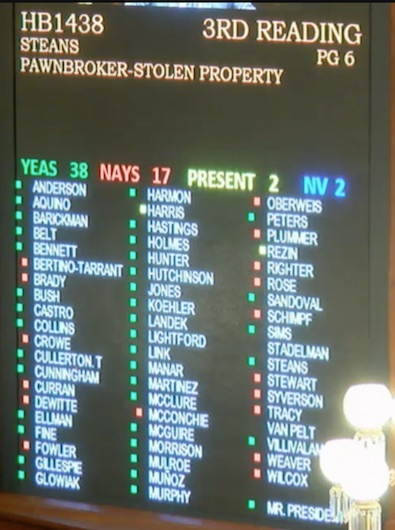
Republicans voting “Yes” were Anderson, Barickman and McClure.
Democratic Sen. Harris voted “Present” and Sens. Stadelman and Van Pelt didn’t vote.
The bill now moves to the House. Its fate in that chamber is still uncertain.
42 Comments  
|
House passes “Fix the FOID” bill 62-52
Wednesday, May 29, 2019 - Posted by Rich Miller
* ISRA…
Exercising Constitutional rights in America should not cost money, but under new legislation approved in the Illinois House today the cost of gun ownership in Illinois will dramatically increase.
The House approved Senate Bill 1966 62-52. The legislation would substantially the increase cost of a FOID card and complicate the process by mandating fingerprinting as a requirement to obtain/renew a FOID card with a maximum cost of $30 for the service. The legislation also raises the FOID card renewals to $20 every 5 years (currently $10 for a 10-year license). Finally, it also requires private firearm sales/transfers go through a licensed dealer.
“This legislation is an affront to every gun owner in this state,” said Richard Pearson, executive director of the Illinois State Rifle Association. “You should not have to pay money to exercise your Constitutional rights. We have a guaranteed right to own a firearm under the Constitution, but here in Illinois to exercise that right, you must jump through all kinds of hoops and pay all kinds of money to the state. There are few things you can count on in life, but one of them is that Illinois State Rifle Association will keep fighting this in the Legislature and will be challenging this terrible legislation in court should it be signed into law.”
* GPAC…
Today, the Illinois House passed the Fix the FOID Act (SB 1966), that address loopholes in the state’s existing gun licensing system that were brought to light following the tragic shooting that took five lives on February 15, 2019 in Aurora, Illinois. With days to go before the end of the Illinois legislative session, the Senate must call for a vote before the bill can head to the Governor’s desk.
“We are grateful to chief sponsor Representative Kathleen Willis and proud of the Illinois House for working to close the gaps in our gun laws to ensure that those who are prohibited from gun possession, are not able to easily evade the law and arm themselves,” said Kathleen Sances, president and CEO of G-PAC. “We urge the Illinois Senate to take this critical legislation over the finish line by voting yes to fixing the FOID.”
“People are looking for action to prevent gun violence, and Springfield is listening,” said Tanja Radakovich Murray, a volunteer with the Illinois chapter of Moms Demand Action for Gun Sense in America. “Closing deadly gaps in our gun laws is a matter of public safety, and the Senate should act quickly to send this important legislation to the Governor’s desk.”
“People prohibited from owning a gun shouldn’t be able to get their hands on one,” said Nico Bocour, state legislative director at Giffords, the gun violence prevention organization founded by former Representative Gabrielle Giffords and her husband, Captain Mark Kelly. “Gaps in Illinois’s strong laws have allowed dangerous individuals to use a firearm to cause devastating tragedies like the shooting in Aurora, Illinois. But state lawmakers didn’t just offer thoughts and prayers. They acted to make sure Illinoisans are safe from gun violence at work and in their communities. The Fix the FOID Act closes dangerous loopholes so only law-abiding citizens can buy a gun. We applaud Rep. Willis and Sen. Morrison for their leadership in sponsoring this legislation and look forward to Governor Pritzker signing the Fix the FOID Act into law.”
Under current Illinois law, individuals seeking to buy a gun must first obtain a Firearm Owners Identification (FOID) Card from the Department of State Police. The Fix the FOID Act would make the following key provisions to the current FOID system:
Require a point-of-sale background check for all gun sales, including those by an unlicensed seller.
Require applicants for FOID Cards to submit fingerprints as part of their application.
Reduce the FOID Card duration from 10 years to five years.
Require action by the State Police to remove guns once a FOID Card is revoked.
An investigation by the Chicago Tribune published last week found that as many as 30,000 guns may still be in the possession of Illinois residents deemed too dangerous to have them, while the Chicago Sun-Times editoralized in favor of Fix the FOID. In the editorial, the Sun-Times writes: “none of the modest measures being proposed in this legislation would impose an undue burden on anybody’s Second Amendment rights. But they might have saved the lives of five people in Aurora on Feb. 15, 2010.”
Support for the bill is growing across district and party lines. A recently released poll finds that two-thirds of Illinois voters support the Fix the FOID Act including roughly three-quarters of voters in suburban Cook County and the “collar counties” of DuPage, Kane, Lake, McHenry and Will and almost half of voters in Downstate Illinois.
The measure passed out of the House by a margin of 62-52.
The roll call is here. Democratic Reps. Bristow, Greenwood, Halpin, Hoffman, Kifowit, Reitz, Scherer, Stuart and Yednock voted “No.”
Reps. DeLuca and Mayfield did not vote. Rep. Mason was excused.
67 Comments
|
Sen. Hastings tables bill tied to ALEC
Wednesday, May 29, 2019 - Posted by Rich Miller
* Background is here. The bill was amended and then passed the House, but has stalled in the Senate. Press release…
In response to Sen. Michael Hastings, sponsor of the Illinois critical infrastructure bill HB 1633, tabling his anti-protest bill, Greenpeace USA Executive Director Annie Leonard said:
“HB 1633 was a completely unnecessary attempt by the fossil fuel industry and secretive groups like ALEC to divide the progressive movement at the exact moment when we most need to mobilize quickly toward real solutions to climate change. Over 50 civil rights organizations, labor unions, and grassroots groups worked together to defeat this bill. Nearly 6,000 witness slips opposing the bill were submitted compared to a paltry 215 by the bill’s proponents. Our collective message was clear: Illinois does not need such a harmful and unnecessary law on the books. We are pleased Sen. Hastings listened to our concerns and wisely chose to table this bill.
“We need elected officials who are champions for people and the planet. We need our lawmakers fearless in the face of oil and gas money in politics. We need them believing the science, telling the truth, and speaking out for their constituents over corporations. Sen. Hastings did the right thing by tabling HB 1633, not just for the state, but as an example that shows that we the people need a healthy democracy to protect our planet.”
One of organized labor’s few defeats this year. But, hey, maybe it’ll pop up elsewhere. I asked Sen. Hastings why he tabled the bill and he didn’t respond.
…Adding… From Sen. Hastings…
Rich -
Given the text of the original House Bill 1633 & its sweeping passage in the Illinois House of Representatives (77 Yes, 28 No), I had serious concerns as to some of the provisions contained in the bill.
Understanding that, I proposed an amendment that would bring the legislation in compliance with the Senate Clear Committee. Unfortunately, due to the limited amount of time left in the legislative session, I chose to table the bill in order to bring all interested parties together over the summer.
12 Comments
|
|
Comments Off
|
*** UPDATED x1 *** Question of the day
Wednesday, May 29, 2019 - Posted by Rich Miller
* I’m about 99 percent sure I know the answer to this question, but I ain’t talking…
* The Question: Your best guesses?
*** UPDATE *** She’s right…
91 Comments
|
It’s just a bill
Wednesday, May 29, 2019 - Posted by Rich Miller
* Sun-Times…
Money to support McCormick Place expansion would be raised by expanding a 1% tax on restaurant meals and drinks under legislation advancing Wednesday in the Illinois Senate.
The proposal, which has strong backing from trade unions, would enlarge the part of Chicago’s central business district in which the tax is collected. The Senate Executive Committee approved the measure 12-1, with one member voting present, during a hearing Wednesday. The bill could go to the full Senate later Wednesday.
The revenue would allow the Metropolitan Pier and Exposition Authority, which runs McCormick Place, to borrow an additional $600 million, increasing its bonding limit to $3.45 billion. The agency plans to build a new convention hall over King Drive and tear down the above-ground portion of the Lakeside Center, widely viewed as outmoded convention space.
An earlier proposal to fund the expansion with a $1-a-ride tax on Uber and Lyft has been dropped amid opposition from those companies.
* The enviros were able to pass this bill partly by attracting the support of a union…
[Yesterday] the Illinois Legislature passed SB9, The Coal Ash Pollution Prevention Act, which now heads to the Governor’s desk. The groundbreaking bill addresses the many waste pits filled with coal ash, the toxic byproduct of burning coal, located all over the state. Illinois is now the third state in the country to pass legislation providing significant coal ash protections above and beyond federal requirements.
The legislation creates a regulatory framework to ensure polluters, not taxpayers, pay for needed closure and cleanup, guarantees public participation and transparency around cleanups for affected communities, and provides Illinois EPA the funds it needs to properly oversee closure and cleanup. It also requires Illinois to put in place standards for coal ash impoundments that are at least as protective as federal coal ash rule requirements, with additional protections against dust and water pollution. […]
Illinois has the highest concentration of coal ash impoundments in the country. The Illinois EPA has found groundwater contamination from coal ash waste sites dating back to 2009. A 2018 report from environmental groups Environmental Integrity Project, Earthjustice, Prairie Rivers Network and Sierra Club analyzing data collected by ash dump owners under the federal coal ash rule found that 22 of 24 of Illinois’ reporting coal ash dumpsites have unsafe levels of toxic pollutants in the groundwater. Illinois joins Virginia and North Carolina in addressing coal ash through state level legislation.
* Jim Dey…
One of Champaign County’s most partisan elected officials has joined forces with Democratic House Speaker Michael Madigan in a bid to elect more Democrats to judicial offices here.
On Monday, state Rep. Carol Ammons, D-Urbana, proposed an amendment to a legislative shell bill — HB97 — to remove Champaign County from its current six-county judicial circuit and make it a circuit of its own.
The legislation was passed on an 8-5 party-line vote Tuesday by the House Executive Committee and sent to the House floor for further action. […]
Ammons declined to discuss the legislation but issued a brief statement.
“Judicial reform is needed in Champaign County to bring balance and access to the bench; ensuring diverse candidates by gender, race and party affiliation. Champaign County judges should be elected by the people of Champaign County,” she said.
That is not — and likely won’t ever be — the case. The county judiciary is staffed by six circuit judges — three of whom are resident judges and run only in Champaign County. In addition to the circuit judges, the county has five associate judges who are appointed by the circuit judges for a specific term in office.
Ammons told me yesterday there is only one woman circuit judge, no minorities and no Democrats.
* Greg Bishop…
Illinois House Republicans sporting buttons with fingerprints crossed out as they prepare to debate bill to mandate fingerprints for gun owners.
The button…

The House floor debate has begun. Check the live coverage post for updates.
* Other stuff…
* Illinois Lawmakers Tackle Teacher Shortage By Taking Aim At Licensing Test: In Illinois now, student teachers have to videotape themselves in the classroom as part of a mandatory test to become certified. But some educators say the edTPA test is too onerous, not an effective indicator of a quality teacher and discourages some would-be teachers.
* Illinois bill to stop some driver’s license suspensions put on hold [UPDATE: The bill passed committee and is now on short debate in the House.]
* Bill would ban e-cigs in public indoor places: The proposal was approved by the Senate Public Health Committee, but only after Sen. Patricia Van Pelt, D-Chicago, changed her vote to get the issue to the Senate floor. She did not pledge to support it during a floor vote, though.
20 Comments
|
Today’s quotable
Wednesday, May 29, 2019 - Posted by Rich Miller
* The Illinois AFL-CIO is misidentified here, but I’m more interested in Link’s quote…
One of the state’s largest labor unions urged lawmakers to pass an expanded gambling bill in the waning days of the 2019 session, saying it would not only create new jobs in Illinois but would provide needed funding for a multi-billion-dollar capital improvements plan.
“Illinois is recovering from the trauma of four years of budget impasse, starving out vital services, and a public works stagnation,” Michael Carrigan, president of the Illinois AFL-CIO, said during a Statehouse news conference Tuesday. “An expansion of gaming will help fund much-needed infrastructure construction and be a shot in the arm for revenue for this state.”
The biggest obstacle to passing a gambling measure this year, however, is that with only three days left in the regular session, the bill still hasn’t been written.
“We have 80 hours to go. What are you worried about?” quipped Sen. Terry Link, D-Indian Creek, one of the lead supporters of expanded gambling in the Senate. “The bill is being drafted. It’s not like this is all new concepts. We’re working off of bills we’ve done in the past. We’re tweaking. We’re changing them around a lot.”
What, me worry?
* Related…
* Gambling expansion pieces still coming together, but supporters bet on passage
* Some Lawmakers and Union Members Advocate for Walker’s Bluff Resort
16 Comments
|
* Jake Griffin…
Illinois residents making $1.5 million a year [currently] pay less in income taxes than their counterparts in all but eight of the 41 states with such a tax.
But for people making $60,000 a year, it’s a different story. In 24 of the states, those taxpayers pay less than in Illinois.
But that would change if the governor’s graduated income tax plan is approved, Griffin found…
• Illinois filers with incomes over $1.5 million would move from the ninth lowest income taxes among the 41 states to the 35th lowest, meaning their income taxes would become among the highest.
• Those with incomes of $500,000 would move from 11th lowest to 26th lowest.
• Residents with incomes of $150,000 would move in the other direction, from 15th lowest to 13th lowest.
• And those with incomes of $60,000 would move from 24th lowest to 21st lowest.
* Related…
* Property tax task force, relief fund bills pass House committee
* Mark Brown: When it comes to property taxes, Democrats can spell relief — but that’s about it
30 Comments
|
* I’ve been trying to delete as many anonymous comments as I can lately because I’ve found that the people who won’t bother to take two seconds to come up with a screen name are usually (not always) trolls of the worst sort.
I received this e-mail last night…
Your deleting of anonymous postings has caused me to delete your web site from my book marks. Goodbye and good riddance!
I’d like to tell you what my response was, but I’d have to ban myself if I did.
Anyway, the deletions will continue unabated.
74 Comments
|
It is time to #PasstheRHA
Wednesday, May 29, 2019 - Posted by Advertising Department
[The following is a paid advertisement.]
The women of Illinois are waiting.
They’re waiting for lawmakers in Springfield to show that they fully support women’s reproductive rights, free of meddling interference from government.
They’re waiting, and watching, as conservative legislators elsewhere target Roe v. Wade with draconian anti-abortion laws passed by conservative lawmakers who hope to someday get rid of Roe v. Wade.
Some of those laws ban abortions even in cases of rape or incest. Others allow women or their doctors to be prosecuted for undergoing or performing abortions.
Illinois is solidly pro-choice, but we must ensure protections for future generations of women. Should one of those medieval laws land before a conservative Supreme Court that is eager to overturn Roe, it would threaten abortion rights here and elsewhere.
Lawmakers in Illinois need not allow that chance.
They can safeguard the reproductive rights of women in Illinois by moving quickly to pass … the Reproductive Health Act. The bill would keep abortion and reproductive care safe and accessible by repealing decades-old laws that restrict, and in some cases criminalize, abortion.
Chicago Sun Times editorial board
May 21, 2019
For more information on #PasstheRHA click here.
Comments Off
|
* I’m told the Senate will recess for an Executive Committee hearing at around 2 o’clock this afternoon. The committee will take up the cannabis legalization bill (Senate Amendment 2 to House Bill 1438) at that hearing.
The Senate will reconvene at about 5:30 this afternoon. The plan is to run the cannabis bill on the floor after a few warmup bills.
* Hannah Meisel…
Republicans on Tuesday said they will likely provide “a handful” of votes to legalize marijuana now that a new amendment to SB 7 establishes a different path to expunge the records of those convicted of cannabis-related offenses — the governor’s pardon power.
A week ago Republican leaders told The Daily Line no member of their caucus would vote for to the long-running effort to legalize marijuana.
State Sen. Toi Hutchinson (D-Olympia Fields) told The Daily Line that she backed the change to the bill’s original language of automatic expungement of records via legislation to gubernatorial action.
In Illinois, a governor has the ability to pardon with “permission to expunge.” If a person is granted a pardon, with permission to expunge, he or she can then file a petition to expunge the pardoned offense, according to state guidelines.
“The expungement piece…we boosted the constitutionality of what it is we’re attempting to do and that was a significant concern for the Republican caucus and that brings folks back on board,” Hutchinson said. “That was one of the biggest sticking points.”
The original language in SB 7 dropped on May 4, and the Republicans who had been negotiating the bill for months — including State Sen. Jason Barickman (R-Bloomington) — began saying both privately and in the media that they could no longer support the bill. […]
“This is about to be the single-biggest piece of criminal justice reform in one piece of legislation in the country, and I would daresay the world,” Hutchinson said. “This is big, this is big, and I didn’t think this was going to happen. And I’m really proud of it. And nothing would make me happier than to see — if we actually make it to a bipartisan roll call because we tried and because it worked, that’s a good thing.”
This thing has legs, campers.
…Adding… Press release…
Americans for Prosperity-Illinois (AFP-IL) and the Reason Foundation issued a letter to lawmakers in support of the expungement reforms included in Senate Bill 7, which would allow for the legal cultivation, sale, and possession of cannabis in regulated amounts statewide. The groups also recommended needed reforms to the legislation in order for it the best achieve its goals. AFP-IL believes any effort to legalize recreational marijuana should enhance public safety, remove barriers to help individuals get a second chance, and be free of cronyism and overregulation.
The letter is here. There will be no amendments after Senate action barring a disastrous drafting error, however. The language is a Senate amendment to a House bill. Once the Senate passes it, the House has to either concur or non-concur.
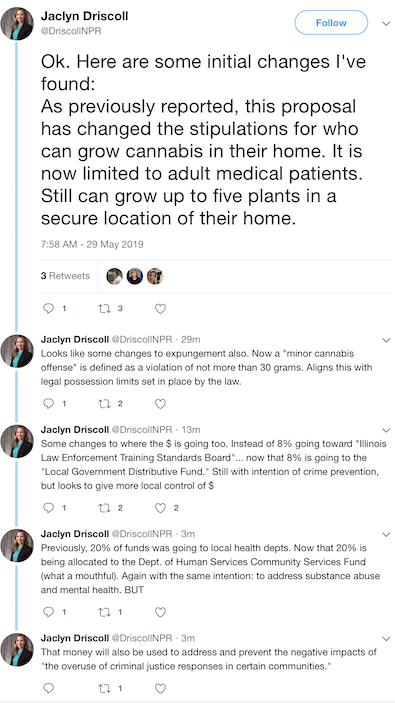
…Adding… Some deets…
…Adding… Press release…
Legalize Illinois praised Clergy for a New Drug Policy today for a letter it issued calling on the Illinois General Assembly immediately to legalize recreational cannabis for adult use. The letter, signed by 58 members of the clergy, cites the social justice and public safety aspects of the bill currently under consideration as the most urgent to support it.
“As clergy, we care deeply about social justice. The criminalization of cannabis, even for simple possession, has crippled the lives of people of color disproportionately for more than four decades. This is why we – the undersigned – believe it is time to move to a system of legal, regulated and taxed adult-use cannabis in Illinois,” the letter states.
“Current cannabis laws, fines, and arrests are carried out with staggering racial bias. The illicit market, which prohibition makes inevitable, continues to breed violence in our poorest communities all across Illinois,” the clergy members wrote.
The letter also notes that “regulation would make Illinois a safer state. It would allow us to educate adults, informing them about what a product contains and enabling them to make informed decisions. Banning sales by law to those under 21 would help to limit access to our youth. Under prohibition, these measures are not possible.”
Clergy for a New Drug Policy, led by Executive Director Rev. Alexander Sharp, also cited the bill’s provisions that would provide expungement of past low-level cannabis arrests and convictions while allocating “funds to communities ravaged by the War on Drugs.”
“We cannot wait any longer to make this the law of the land in Illinois. We urge you to vote yes on a regulatory system that works for all of Illinois,” the letter concludes.
*** UPDATE 1 *** Good…
*** UPDATE 2 *** Here we go…
*** UPDATE 3 *** Republican Sen. Jason Barickman…
I believe that the people of Illinois want our government to give individuals freedom over their life decisions. Cannabis use is largely a personal choice and the primary role of government should be to adopt appropriate safeguards to protect minors and the public when an individual’s use puts others in harm’s way. This legislation puts those safeguards in place.
Barickman and GOP Sen. Neil Anderson have signed on as hyphenated co-sponsors.
143 Comments
|
*** UPDATED x2 *** RHA roundup
Wednesday, May 29, 2019 - Posted by Rich Miller
*** UPDATE 1 *** Press release…
In response to Personal PAC President and CEO Terry Cosgrove’s comment during a recent press conference that Assistant House Republican Leader Avery Bourne was a used as a “prop” during the abortion bill debate on Tuesday, the women of the House Republican Caucus have issued this joint statement:
“At a time when Democrats talk about the importance of empowering women and acknowledging their value in leadership roles, Terry Cosgrove’s efforts to degrade Assistant Leader Avery Bourne’s importance as a spokesperson for our caucus is indefensible. Avery is one of our caucus’ most outspoken advocates on the protection of unborn life, and any attempts to diminish the credibility of her voice is appalling.”
Rep. Terri Bryant (R-Murphysboro)
Rep. Amy Grant (R-Wheaton)
Rep. Norine Hammond (R-Macomb)
Rep. Deanne Mazzochi (R-Elmhurst)
Rep. Tony McCombie (R-Havanna)
Rep. Margo McDermed (R-Mokena)
Rep. Lindsey Parkhurst (R-Kankakee)
*** UPDATE 2 *** Terry Cosgrove…
I want to apologize to Representative Avery Bourne publicly and completely. This morning, I cast an unfair and inappropriate aspersion on Representative Bourne’s passionate advocacy on the floor of the Illinois House, asserting that it was a “cheap political stunt.” That was just wrong. It not only was offensive to Representative Bourne personally, it also rudely ignored the heartfelt, passionate way in which Representative Bourne expressed herself in Committee on Sunday evening and yesterday in the full House. She may disagree with the position embraced by Personal PAC, but she did not deserve to be subjected to such an insult.
This was an unnecessary, harmful distraction to Representative Bourne as she attempts to complete her work in the waning days of session. She deserves this respect and recognition for her work, not the flippant response of someone who should know better. In the coming hours, my intent is to communicate this apology directly to Representative Bourne.
[ *** End Of Updates *** ]
* Amanda Vinicky…
As other states, including neighboring Missouri, have passed laws that are tantamount to abortion bans, Illinois is moving in the opposite direction.
After an emotional, but by and large respectful debate, the Illinois House on Tuesday voted 64 to 50 to enshrine in state law a woman’s fundamental right to have an abortion.
“Since Roe v. Wade was decided in 1973, efforts to undermine reproductive rights have been constant. We have seen in recent days and weeks these attacks have increased dramatically. They are focused and strategic and aimed at undermining our right to bodily autonomy and self-determination,” sponsoring Rep. Kelly Cassidy, D-Chicago, said. “Not on my watch.”
Cassidy repeatedly said the measure will merely codify in state statue what is already common practice.
The measure, Senate Bill 25, repeals the Illinois Abortion Law, which could punish doctors for performing abortions – law that has technically been on the books since the ‘70s but is not in practice due to court injunctions and decrees.
* Jamie Munks…
The bill, called the Reproductive Health Act, would also repeal the state’s partial birth abortion ban, which affects later-stage pregnancies. Partial-birth abortions are not allowed under federal law, unless it’s used as a means to save the mother’s life when it’s in jeopardy.
* Rebecca Anzel…
It designates access to contraception, pregnancy benefits, abortion procedures, diagnostic testing and other related health care as a fundamental right, banning government from impairing that access for women and men. […]
During floor debate Tuesday, Cassidy had a scripted back-and-forth with Rep. Robyn Gabel, D-Evanston. It covered topics ranging from whether the Reproductive Health Act would allow abortions to occur at any point during a pregnancy for any reason — in short, no, Cassidy answered — to who can perform an abortion — only doctors can carry out a surgical one, but physician assistants and advanced-practice registered nurses can prescribe medications. […]
[Cassidy] went on to answer questions from lawmakers from both parties for nearly two hours. There were two phrases she repeated frequently: The Reproductive Health Act “does not change the current standard of practice” and “doctors are required to adhere to accepted standards of clinical practice.” […]
In addition, the measure repeals several aspects of current law that courts have blocked, including criminal penalties for doctors and spousal consent.
* Dana Vollmer…
In an unusual move, Republicans deferred almost all their time to one colleague: state Rep. Avery Bourne, from Raymond, who’s pregnant. She went back and forth with the legislation‘s sponsor, state Rep. Kelly Cassidy, a Democrat from Chicago.
“How broad do we intend for this to be?” Bourne asked.
“A doctor will make a decision based on the accepted standards of medical care,” Cassidy said.
“Could you give me any parameters that we’re asking this doctor to make?” Bourne asked.
“I am not a doctor,“ Cassidy replied. “Doctors decide. And doctors decide based on the accepted standards of clinical care.”
* Tina Sfondeles…
For about 45 minutes, Bourne questioned Cassidy on everything from the meaning of a “fundamental right” to parental notification to what an “extraordinary medical measure” is.
Bourne offered examples, such as whether a baby at 36-weeks could be terminated if an ultrasound shows a “hole in their heart.” She also described whether a sick baby being flown to a neo-natal intensive care unit would be considered an “extraordinary medical measure.”
“This broadens their ability to make that decision,” Bourne said.
Cassidy said legislators “can’t and should not be hearing hypotheticals.”
“Lawmakers are not doctors. Doctors need to use the accepted standard of clinical care and to make their decision to the best of their knowledge,” Cassidy said.
Putting Rep. Bourne out front helped give the Republicans a strong visual image since she’s so very pregnant. But it also kept their more, um, vocal members quiet and in the background.
* Cassie Buchman…
The debate became emotional at times, including when Rep. Avery Bourne, R-Raymond, asked Cassidy a series of questions about the language in the bill. Several Republican House members gave up their time to talk about the bill so Bourne could speak long beyond the five minutes allotted to each lawmaker.
Bourne’s voice cracked as she talked about what she said is the “most expansive” abortion bill in the state and country.
“This bill is not about keeping abortion legal in Illinois,” Bourne said. “This is about a massive expansion that will impact viable babies. And that is wrong.” […]
Bishop Thomas John Paprocki, of the Diocese of Springfield, issued a statement condemning the “gravely immoral” action of the House in passing the bill.
“Christians have rejected the practice of abortion from the earliest days of the Church,” he said. “Children are a gift from God, no matter the circumstances of their conception. They not only have a right to life, but we as a society have a moral obligation to protect them from harm. Legislation that deprives children of legal protection before they are born, allowing for the murder of children at any stage in the womb, even up to the moment of birth, is evil.”
* Rachel Droze…
But Bourne said doing this is wrong.
“This is an expansion of abortion unlike states around us and I think it certainly makes us an outlier in the country,” Bourne said after the debate. “We are legislating for what is happening right now and in the state of Illinois. For them to use what other states are doing to justify their expansion of abortion, I think, is irresponsible legislating.”
Bourne led the opposition debate against SB25 on the House floor.
Each time she spoke, all Republican representatives stood to listen to the 33-weeks-pregnant mom-to-be.
“This bill will mean that for a person at my stage of pregnancy, where the baby responds to his dad’s voice as he reads him books at night, the woman could go to the facility — the baby is perfectly healthy — but if that woman says based on my familial health this is medically necessary, that is allowed,” Bourne said during the debate on the House floor.
* Greg Bishop…
Republican state Rep. Avery Bourne, who’s pregnant, took issue with several parts of the bill, which she said was too expansive.
“So you are taking out the prohibition on sex-selective abortions and you think that’s the appropriate thing for the state to do?” Bourne said.
“I think that it is appropriate to codify current practice,” Cassidy said.
Bourne also took issue with what she said was the measure’s language removing rights from an unborn fetus. She worried the law would not allow someone to be held accountable for an attack against a pregnant woman that harmed or kills a fetus in the womb. Cassidy said existing law on that issue would stand.
Bourne and other Republicans were also concerned about a lack of requirements to report to the state why an abortion was performed, and even restrictions they said would keep a coroner from investigating botched abortions.
The coroner thing was a bit interesting because the only medically related death that has to be reported to a county coroner is abortion. This legislation would treat abortion like every other death after a medical treatment or procedure.
* Jack Crowe…
The bill’s proponents have argued that the legislation codifies existing practice and is necessary in light of the recent passage of restrictive abortion laws in a number of Republican-controlled states, as well as the conservative majority on the Supreme Court, which many pro-choice activists are concerned might overturn Roe v. Wade.
“RHA codifies our existing practices and — and this is critical — treats abortion care just like any other health care, because it is,” said the bill’s sponsor, state representative Kelly Cassidy (D., Chicago).
* Joe Bustos…
Passsage of the RHA in the House came on the same day as the Planned Parenthood clinic in St. Louis says it may lose its license to perform abortions. The St. Louis Planned Parenthood location is the only clinic in Missouri that provides abortions.
That news may lead to more women coming to Illinois for an abortion, officials at Hope Clinic in Granite City said.
About half of Hope Clinic’s patients are from Missouri, with 40 to 45 percent from Illinois, and 5 to 10 percent from elsewhere, said Alison Dreith, the clinic’s deputy director.
Dreith said after Missouri instituted a 72-hour mandatory waiting period for abortion in 2014, more and more people came to Hope Clinic, especially in the last two years.
* Rep. Darren Bailey (R-Xenia)…
“All you have to do is look at the tally board to see where the votes came from…..from up north. I am looking forward to the days of truth and justice for the babies in the womb.”
* One more…
33 Comments
|
* Background is here. This post came after a long and acrimonious Twitter exchange between Maxwell and the Illinois Policy Institute…
Looks like the purge didn’t work.
56 Comments
|
|
Comments Off
|
|
Comments Off
|
|
 Support CapitolFax.com
Visit our advertisers...

 ...............
 ...............
 ...............


|
   
|
Hosted by MCS |
SUBSCRIBE to Capitol Fax |
Advertise Here |
Mobile Version |
Contact Rich Miller
|



