Last Thursday, Walsh told constituents at a townhall that he plans to “privately and legally” fight his ex-wife’s claims that he owes more than $100,000 in child support, which he called “wildly inaccurate.” A recent Chicago Sun-Times article reported that his ex-wife is suing him for $117,000 in unpaid support.
Yet, even if Walsh owes just $10,000 in unpaid child support, he could face the added headache of House Ethics Committee scrutiny. Walsh, who was elected in 2010 in a narrow victory over former Rep. Melissa Bean (D-IL) in the Tea Party-induced wave, does not list any child support debt on his financial disclosure form, as required for any liability worth more than $10,000.
“Rep. Walsh is required both by law and by congressional ethics rules to list debts in excess of $10,000 on his financial disclosure forms, including child support back payments,” said Public Citizen’s Craig Holman.
“Technically, he could be taken to task by the Ethics Committee or even the Justice Department for failure to file proper disclosure forms, but in all likelihood the Ethics Committee and Justice would be satisfied if Walsh were to file amended forms,” Holman explained.
But Walsh is in a bit of a bind. Filing an amended form would require him to admit to owing at least $10,000 in back child support, what would amount to an ugly political liability that could knock him out of his role as one of the top spokesmen for the Tea Party GOP freshmen class.
* The Question: Is this alleged failure to pay child support issue relevant or should the media downplay it? Explain.
For the first time, a federal judge has ruled former Mayor Richard M. Daley can be sued as a defendant for his alleged role in what plaintiffs claim is a citywide conspiracy to cover up police torture.
And Daley could be deposed by lawyers representing alleged victims, all African American, who charge their abuse came at the hands of a small band of predominantly white police officers under the command of former Chicago Police Cmdr. Jon Burge. […]
Michael Tillman spent 23 years in prison for murder. He confessed, said Taylor, because he was suffocated and beaten by Chicago Police officers. “They used a form of waterboarding, pouring 7-Up up his nose,” Taylor said. “That’s the kind of torture they used over a four-day period with Michael Tillman.”
When he was released in 2010, Cook County special prosecutors concluded there was no reliable evidence against him. Tillman received a certificate of innocence from the chief judge of the Criminal Courts of Cook County.
In his civil lawsuit, Tillman alleges the city conspired to cover up torture cases.
Burge, 63, already has been deposed by Taylor at the federal prison in North Carolina, where he is serving his sentence. During the deposition, Burge, seen for the first time wearing a khaki prison uniform, repeatedly took the Fifth Amendment.
This case just makes me sick. And Daley has never been held accountable.
Daley has been named in three other brutality lawsuits stemming from the torture and abuse that Burge is believed to have perpetrated years ago on dozens of African American men in Chicago — many of whom gave coerced confessions. But as they did in the Tillman case, the city moved to remove Daley from the lawsuits.
Fifteen incarcerated men who claim they were sent to prison by confessions that were beaten, burned and tortured out of them by convicted Chicago police Lt. Jon Burge and his officers are getting some high-profile help - including from a former Illinois governor.
In a friend-of-the-court brief to be filed Wednesday with the Illinois Supreme Court, ex-Gov. Jim Thompson and more than 60 current and former prosecutors, judges and lawmakers are asking for new evidentiary hearings for inmates who say their convictions were based on coerced confessions. […]
The brief “gives the Illinois Supreme Court the opportunity to finally and firmly repudiate the Burge era of the Chicago Police Department,” said Thompson, a former Republican Illinois governor and U.S. attorney.
Lawyers are filing the brief in the case of Stanley Wrice, an inmate who has been claiming since 1982 that he falsely confessed to a brutal sexual assault only after Burge’s officers beat him in the face and groin with a flashlight and a piece of rubber.
Wrice, 57, is serving a 100-year sentence. Attorneys say he’s one of the longest-serving inmates with a Burge torture claim.
* From a press release…
Wrice, who remains in prison, was granted a hearing into the torture claims by the Illinois Appellate Court in 2010. In appealing that ruling to the Supreme Court, prosecutors argue that the admission of Wrice’s tortured confession was “harmless error,” because there was enough other evidence to support his conviction.
In their brief, the group of legal luminaries forcefully condemned this argument, writing:
“It is simply intolerable that any person should languish in prison as a result of conviction that rests even in part on a confession that Burge and his men are credibly claimed to have tortured into being. Our commitment to that position cannot be half-hearted – where, for instance, the use of tortured evidence might be rationalized after the fact as not having mattered to the outcome of the case. Instead, we believe Burge’s torture is so profoundly antithetical to our notions of justice and fair play that it cannot be permitted to taint any conviction, no matter the strength of the other evidence against the defendant.”
The group asks the Supreme Court to:
· Direct the Office of the Special Prosecutor to identify every case where a current Illinois prisoner claims his conviction rested at least in part on a false confession submitted under the duress of torture.
· Order the Chief Judge of the Cook County Circuit Court to conduct hearings into evidence of torture and determine, in each case, whether torture occurred.
· Void any convictions that are ruled to rest in whole or in part on confessions obtained illegally through torture.
* Alexi Giannoulias is back and has a new part-time, unpaid job…
Gov. Quinn on Wednesday will name Alexi Giannoulias chairman of the Illinois Community College Board.
Quinn regularly plugs Illinois’ network of 48 community colleges — the country’s third-largest community college system. For every student at at a public four-year-college in Illinois, two attend a community college, Quinn notes.
Giannoulias, 35, served as state treasurer and narrowly lost a race for U.S. Senate last year to Republican Mark Kirk. Giannoulias ran just two percentage points behind his Democratic ticket-mate, Quinn.
Since losing, Giannoulias has been putting together a political science class he will teach at Northwestern University this fall called “Campaigning versus governing.” He said Tuesday he plans to announce next month a full-time job he’ll be taking.
The federal government is requiring Illinois police to report illegal immigrants who are arrested on any charge from public intoxication to murder, in spite of Gov. Pat Quinn’s opposition.
On Friday, the U.S. Immigration and Customs Enforcement agency, or ICE, canceled contracts with the 39 states participating in Secure Communities — a program in which local and state law enforcement officials share fingerprints with the federal government.
ICE, the investigative arm of the U.S. Department of Homeland Security, or DHS, did not cancel the contracts to end the program, but rather to assert that ICE doesn’t need a state’s permission, in this case via a contract, to operate the deportation program. […]
ICE’s action came three months after Quinn ended Illinois’ timid two-year participation in Secure Communities. Since the program started in November 2009, 76 of Illinois’ 102 counties abstained from participating, the most notable being Cook County, home to Chicago.
“Illinois remains concerned that the program can have the opposite effect of its state purpose,” Brie Callahan, a spokeswoman for Quinn’s office, said. “Instead of making our communities safer, the program’s flawed implementation may divide communities (and) families.”
The federal program, created under Republican President George W. Bush, was engineered to deport illegal immigrants who’ve been convicted of a felony or at least three misdemeanors in the same year in the United States or a previous crime in their home country.
Please, take it easy in comments. I have a lot of stuff to do today and won’t be able to monitor the blog all the time. This topic can bring out the worst in people. Don’t let that happen. Thanks.
* Other stuff…
* Doctors’ detailed histories to go online - Patients can check whether physicians have been fired, convicted of a crime or made a malpractice payment in the last five years
* Illinois horse tracks, owners gets $141M windfall after long court fight
* Gov. Pat Quinn used his State of the State/Budget speech this past spring to call for the abolition of the legislative scholarship program. He was roundly booed by members. Quinn vetoed a reform bill last year because, he said, he didn’t think reform was enough. Abolition, he said, was the only way to go. Legislators passed another reform bill this year, which would bar legislators from handing out the scholarships to relatives and allowing them to turn over their scholarships to the Student Assistance Commission.
Quinn was asked about the program yesterday by reporters in the wake of revelations that former legislator Bob Molaro’s scholarship records have been subpoenaed by the feds. It sounds like he may use his amendatory veto powers to abolish the program this week…
“The essence of the bill on my desk is that it does not abolish the program, and that’s really what I think we have to do,” Quinn said. “I do want to make it clear that there’s no bigger supporter of scholarships than I am. I believe that we need to enhance our scholarship programs in Illinois, but I think having a program that’s had sort of a cloud of scandal around it for decades is not the way to do that.”
Quinn’s comments follow revelations that a federal grand jury has subpoenaed documents related to scholarships former Rep. Robert Molaro gave to children of longtime supporter Phillip Bruno. The Tribune reported last year that Bruno’s children received more than $94,000 in tuition waivers in recent years despite questions about their residence eligibility.
Even the bill’s chief sponsor wants Quinn to do an AV…
The legislation’s chief Senate sponsor, Sen. Kirk Dillard (R-Hinsdale), urged Quinn Tuesday to tweak the legislation to provide for an outright abolition of the program — something that the governor has called for repeatedly but that has never gained legislative traction over the years.
“Rep. Molaro is the latest in a long string of questionable practices of a program that should have been abolished previously. He’s just one more in a string of abuses,” Dillard said.
“The governor, with his amendatory veto power, can rewrite the bill to end the controversial General Assembly scholarship program. Procedurally, we could kill this program in one day during the veto session,” Dillard said.
[Molaro] previously told the Chicago Sun-Times that there was nothing wrong with the scholarships he awarded.
An April 26 subpoena to the Illinois State Board of Education from U.S. Attorney Patrick Fitzgerald seeks application forms, nomination forms and other documents related to legislative scholarships granted to four children of a Molaro campaign donor.
A July 20 subpoena to the board of education asks for “all documents relating to the Illinois General Assembly Legislative Scholarships nominated/issued” from Molaro.
The Chicago Tribune reported last year that the Molaro supporter’s four children may not have been eligible for the scholarships because of questions about whether they lived in Molaro’s district.
* I asked the spokespeople for both Senate President John Cullerton and House Speaker Michael Madigan if their respective bosses believe the program should now be abolished.
From Cullerton’s spokesperson Rikeesha Phelon…
Senate President Cullerton has supported efforts to reform the system by specifically addressing the abuses, rather than abolishing a program that has provided educational opportunities for hardworking students in need of financial support.
So, count Cullerton as a “No.”
From Madigan’s spokesman Steve Brown…
I think if you check the roll calls the Speaker has voted to abolish the GA scholarships repeatedly.
* I’m not generally a big fan of creating new laws designed to address a once in a millennia event. But, you had to figure that this was going to happen…
Illinois lawmakers have joined a growing stampede to tighten state laws for parents who fail to report missing children.
At least three legislative measures introduced in the Capitol in recent days are part of a national reaction to the high-profile acquittal of Casey Anthony in connection with the death of her daughter, Caylee.
“There is a groundswell of anger over the tragedy,” said state Rep. David Leitch, R-Peoria, who said his office received 400 emails calling for action after Anthony was set free.
Illinois joins Nebraska, Florida, Maryland, New Hampshire, Wisconsin and Ohio in looking for a legal way to punish parents who fail to report a missing child within a reasonable amount of time.
Creates the offense of failure to report the disappearance of a child to a law enforcement agency. Provides that a person commits the offense when he or she, as a parent, guardian, or other person having physical custody or control of a child under 13 years of age, willfully or by culpable negligence fails to make contact with or otherwise verify the whereabouts and safety of that child for a period of 24 hours and to immediately report the child as missing to a law enforcement agency after this 24-hour period expires without contact. Provides that a violation is a Class 4 felony.
Creates the offense of failure to report the death of a child. Provides that a person commits the offense when he or she, as a parent, guardian, or other person having physical custody or control of a child under 18 years of age reasonably believes that the child has died and fails within one hour of forming that reasonable belief, or as soon thereafter as reasonably practicable if compliance within one hour is impracticable, to: (1) notify a law enforcement agency of the child’s apparent death and the location of the child; or (2) seek medical attention on the child’s behalf. Provides that failure to report the death of a child is a Class 4 felony.
* HB3801, sponsored by Democrats, contains everything in both the above bills, but adds an exemption…
Provides that a person does not violate this provision when he or she fails to report due to an act of God, act of war, or inability of a law enforcement agency to receive a report of a child’s death or the location of a child’s corpse.
* The Question: On a scale of one to ten, with one being the worst and ten being the best, how would you rate Mayor Rahm Emanuel’s job performance since his inauguration? Take the poll and then explain your answer in comments, please.
* Late yesterday, I linked this story from the Sun-Times…
Speculation is that, if S&P downgrades the 50 states’ ratings, Illinois overall rating would drop to A2-Minus, which could mean a one-half of 1 percentage point increase in interest rate payments on future bond issues. For a $2 billion to $3 billion capital plan bond issue such as the state is planning this fall, such an increase would cost hundreds of millions more in interest.
Having to pay higher interest rates on future state bond issues – possibly ½ of 1 percent — is a possibility, said Kelly Kraft, spokeswoman for Gov. Pat Quinn’s Office of Management and Budget.
“However, at this time Illinois has not been downgraded, and we are not issuing bonds until September, which allows the market to digest the situation,” Kraft said in a statement. “If we were downgraded as a result of S&P’s downgrade of federal debt, the other 49 states would be downgraded as well. Therefore, until S&P indicates how states will be affected, offering more specifics on the ripple effect would not be prudent.”
Kraft said the state expects to issue $2 billion to $3 billion in general obligation bonds in September.
Scott Pattison, executive director of the National Association of State Budget Officers, said he had been talking with state financial officers throughout the day Monday and there was no consensus about how the S&P action would affect states.
A state’s reliance on federal assistance “would be a factor to consider” for a rating agency, but Pattison said some states might be able to offset those concerns by showing they have a strong rainy day fund or have been willing to make spending cuts to keep their budgets in line with dwindling tax revenue.
“The downgrade is certainly not good news. But on the other hand, we’re really uncertain at this moment as to the direct effect, whether it will have a direct effect or not,” Pattison said. “I think it’s going to be a case-by-case basis.”
* But, as subscribers know, S&P offered up a bit of clarity late last night…
While the worldwide markets continue to decline in a vortex, Standard & Poor’s offers a nugget of good news for U.S. states and municipalities.
Despite S&P’s August 5 downgrade of the long-term U.S. sovereign debt, some state and local governments will maintain or even achieve AAA ratings, according to Standard & Poor’s. That’s in contrast to a slew of entities and companies, including Fannie Mae, Freddie Mac, several private insurers, such as New York Life and Northwestern Mutual, who were downgraded Monday in the aftermath of the government downgrade.
A S&P press release cites a report, “State And Local Government Ratings Are Not Directly Constrained By That Of The U.S. Sovereign,” which explains the factors that allow for this situation to occasionally occur.
“The report notes that many U.S. state and local governments function with a high level of revenue, treasury, finance, and debt management independence compared to their global counterparts,” the press release stated.
The report said much more than that, and some of it certainly applied to states like Illinois which don’t have AAA ratings, but you’ll have to subscribe to find out what that was.
* The biggest problem, however, is not so much the impact of the S&P federal rating on Illinois, but what happens with the economy. And the future ain’t too bright right now…
But the bigger cloud hanging over the municipal bond market is the prospect of evaporating federal support to states and cities at a time when another economic swoon is possible, observers say.
In the current political climate, observers say states cannot count on another stimulus package, for instance, if tax receipts begin to plummet again. For fiscally wobbly states, such as Illinois, a deepening squeeze can translate into higher borrowing costs.
“The market is worried about whether the economy will slip into another recession in 2012,” said bond expert Richard Ciccarone, managing director at McDonnell Investment Management LLC. “That is causing some skittishness, more so than the rating downgrade.”
What we’ve got is a real conundrum, caused mainly by national partisan politics. The economists and business types I’ve been reading are saying that we need a short term stimulus to keep the country on track and long term cuts to prevent real problems down the road. This is from Terry Belton, the head of fixed income strategy for JP Morgan Chase…
“I think, on the fiscal side, what we need — and we have sort of missed the boat here — a little bit of the opposite of what we got. We need long-term reform. We need to deal with entitlements reform and tax reform. That lowers the deficit in the long run. But we actually need stimulus now.
“We’re almost getting the opposite. Coming in to next year, we’re going to have quite a fiscal drag kick in as the 2011 tax cuts run off. That’s going to hurt growth a lot next year.”
What Belton (and loads of other like-minded folks) said makes a lot of sense, but it’s not easily sold in the excruciatingly loud and divisive DC echo chamber. “You want to spend more and cut more? Ridiculous!” Also, try cutting the long term growth of Medicare and see how far that gets you in politics. It ain’t just liberals who will beat you over the head.
* And now a warning: Do not drag your goofy DC talking points into the comment section. I will not be kind to mindless rehashing.
* Related…
* Durbin struggles to find bipartisan solution to financial crisis
* VIDEO: Dick Durbin Refuses to Play the Blame Game - The senior senator from Illinois wouldn’t fault either party directly for the credit downgrade.
* IL lawmakers react to nation’s credit downgrade: “The one that I would blame is Standard & Poor. I think it’s a political ploy by them. They didn’t recognize the crisis that we had with the mortgage bank securities. I think they’re making up for that,” Biggert said.
* Finally, somebody in the mainstream media caught on to some of the crazier hype about the gaming expansion bill. Kristen McQueary at the Chicago News Cooperative decided to take a look at what the bill actually says and then compared it to the fear-mongering…
Former Chicago Police Supt. Jody Weis joined the chorus of opposition to the state’s gambling expansion bill last week, warning that if it is implemented, “political corruption and crime syndicate infiltration will follow.”
Yet the concerns of Weis and other critics are largely addressed in the actual text of the legislation, a Chicago News Cooperative analysis of claims about the 400-page bill found.
Weis, who is now deputy director of the Chicago Crime Commission, called the bill “critically flawed due to lack of regulatory safeguards” and said it was “beyond my comprehension how the Illinois legislature passed this bill.” Chicago Crime Commission Executive Vice President Art Bilek said the bill is a “quagmire of gambling sinkholes and hidden reductions of regulatory control.” Members of the mob would be “standing in line” to apply for licenses, he warned.
Jaffe has said the separate oversight creates a dangerous situation by dividing regulatory authority.
But the bill calls for the following checks and balances:
* The five Chicago Casino Development Board members who would oversee development of a casino would be subject to background checks and approval by the Illinois Gaming Board. They could be removed at any time by the mayor or the gaming board if they failed to execute their duties appropriately. Strict rules require them to report any communication between themselves and any entity that could be construed as a conflict of interest.
* An executive director overseeing the Chicago casino would undergo background checks and also must be approved by the Illinois Gaming Board.
Former state Rep. Robert Molaro is facing an investigation into legislative scholarships he awarded to a longtime supporter’s family following a Tribune report on how he doled out the publicly funded tuition waivers.
Newly released records and interviews reveal a federal grand jury has subpoenaed the Illinois State Board of Education and at least one university for documents related to scholarships Molaro awarded to Phillip Bruno’s four children.
The newspaper reported last year that Bruno’s family members had more than $94,000 in college tuition waived in recent years despite questions about the children’s eligibility.
The controversial scholarships came with just one legal requirement: that the students lived in Molaro’s Southwest Side district. The Bruno siblings signed notarized documents stating they resided within the representative’s boundaries, while other public records — including the addresses registered with their universities — indicated they lived with their mother in Oak Lawn, outside Molaro’s district. Their father didn’t live in the district either.
* Other stuff…
* Hundreds of cops could be punished for not filing ethics statements: sources
* Peoria newspaper columnist Phil Luciano is bummed out that Illinois has no state rock song. Luciano is planning to meet with the governor this week to talk about this hole in our state soul…
I floated this idea by Gov. Pat Quinn’s people Monday. Turns out he’ll be in Peoria later this week. And he is to meet with me to talk about the official state rock song.
Yes, I’m serious. Call it The Rock Summit.
After running through several Illinois bands, Luciano chose “Surrender” by Rockfordians Cheap Trick…
Frantic drums intro and then support whamming guitar chords. And the melody urgently bangs away, start to finish.
You can analyze the teen-angst references that wrestle throughout: mommy, daddy, Kiss, sex, drugs. But two lines resonate: “Surrender, surrender, but don’t give yourself away” - as in (sort of, at any age), bend but don’t break; and “We’re all all right,” a delightful chant, especially in concert.
The song is as playful as it is powerful, just as much now as in 1978. It stands the test of time: I mean, do you turn this off when it comes on the radio?
The desecrated Grant Park looks like a rock ‘n’ roll battlefield — the fields are muddy and bare, waste is strewn about and a stench of stagnant water and stale beer lingers in the air.
With Sunday thunderstorms flooding the last day of Lollapalooza, it will be weeks — and tens of thousands of dollars — before the aftermath of the festival is repaired, officials said.
“This is probably one of the worst [aftermaths],” said Bob O’Neill, president of the Grant Park Conservancy. “The turf damage is substantial, bushes were trampled … there’s a little bit of damage to some gardens.”
Last year, the restoration process cost more than $200,000. This year, repairing Hutchinson Field alone, where the Foo Fighters played Sunday night, could cost up to $80,000, O’Neill said.
* I try to ignore national politics no matter what, but this is a fascinating story…
Benchmark 10-year Treasury note yields fell to their lowest levels since February 2009 on Monday, after a U.S. credit dowgrade sparked broad risk aversion and added to the appeal of U.S. government debt.
The notes rose more than 2 points in price, with yields falling as low as 2.33 percent, the lowest rate in 2 1/2 years.
Translation: S&P downgraded US government debt on Friday. Supposedly in reaction, the stock market fell hard on Monday and spooked investors rushed to put their money in… US government debt.
Maybe Illinois should ask S&P to downgrade its bonds again. Just kidding… kinda.
The state of Illinois has not yet been told of any change in its rating, said Kelly Kraft, Gov. Quinn’s budget spokeswoman. Illinois’ current rating from S&P is an A-Plus with a negative outlook.
Speculation is that, if S&P downgrades the 50 states’ ratings, Illinois overall rating would drop to A2-Minus, which could mean a one-half of 1 percentage point increase in interest rate payments on future bond issues. For a $2 billion to $3 billion capital plan bond issue such as the state is planning this fall, such an increase would cost hundreds of millions more in interest.
* The horse racing industry has wanted slots at tracks for a very long time, so Jim Edgar’s involvement isn’t really much of a surprise…
Gov. Pat Quinn was lobbied Friday by a man who once walked in his shoes.
Former Gov. Jim Edgar, an avowed horseman, was among a group of horse racing officials urging Quinn to sign a massive expansion of gambling.
Edgar couldn’t be reached for comment after the meeting, but a Quinn spokeswoman said the message from Edgar and the others was clear.
“It was a group of proponents of the bill,” said Brooke Anderson.
* Totally unsurprising. From a press release…
Former State Representative and current Black Hawk College Trustee Mike Boland will make his official announcement of his campaign for election to Congress from the 17th Congressional District of Illinois. Boland will cite his lifetime of service to the people of Illinois and promote solutions to the issues facing our nation and specifically the needs of our region of Illinois.
* The headline is surprising, “ComEd: Smart meters could save customers nearly $3 billion,” but the story shows what an unsurprising exaggeration the claim really is…
Commonwealth Edison says customers could save $2.8 billion over 20 years if the utility installs “smart meters” that use digital technology to give homeowners details about their electric use and pricing, a study it commissioned shows. [Emphasis added for obvious reasons.]
* And while this may surprise some of you, it didn’t surprise me…
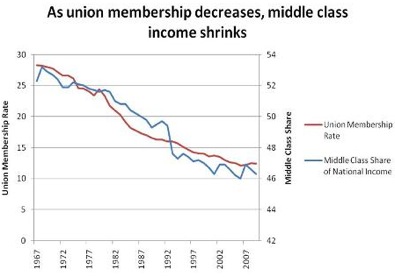
As the chart below demonstrates, the sharp decline over the past 40 years in the percentage of workers organized in unions has been associated with an equally sharp drop in the share of the nation’s income going to the middle class — those in the second, third and forth income quintiles
The chart…
* Roundup…
* ADDED: IRS: Nearly 1,500 millionaires paid no federal income tax in 2009
* Attorney general ordered to pay legal fees in FOIA lawsuit
* Illinois proves an amendment doesn’t guarantee balanced budget
* Power-Upgrade Plans Spark Illinois Storm - State Leaders, Consumer Advocates Say Proposed Changes to Prevent Outages Would Be Too Lucrative for Two Utilities
* On Friday, I asked you to rate Gov. Pat Quinn’s job performance on a scale of 1 to ten, with 1 being the worst and ten the best. He didn’t do too well.
Today, how about we rate House Speaker Michael Madigan’s job performance this year? Take the poll and then explain your answer in comments, please.
* My weekly syndicated newspaper column is about redistricting…
Redistricting is a time for stock-taking; for looking back and looking ahead.
State legislators who’ve been around a while are suddenly faced with the often stark reality of signing on for another ten years. They add a decade to their current age and wonder if they want to be in the game that much longer.
Some decide to stick with it for just one more election so they can make extra sure their party holds their seat.
Some decide to retire right away, figuring their party has drawn the map solidly enough to ensure a suitable replacement.
Legislators in the minority party are far more likely to be mapped in with fellow party members and then discover that they don’t want to face the prospect of running in a primary, so they retire.
Others decide to use the opportunity to move up the political ladder. The congressional districts were redrawn, which gave state Sen. Dave Koehler (D-Peoria) a possible opening. He took it.
If history is any guide, we’re likely to see a raft of retirement announcements in the next few days, weeks, months and even years.
The numbers so far have been impressive. Republican Sen. Larry Bomke and GOP Reps. David Winters and Franco Coladipietro have already announced that they aren’t running again. Democratic Rep. Dan Reitz resigned last month and was replaced by Congressman Jerry Costello’s son, Jerry Costello, II. Some didn’t even wait for the new map to be finished, like Sens. Rickey Hendon, Brad Burzynski, Dale Risinger, Lou Viverito and Gary Dahl. The rumor mill is ablaze with speculation about other impending retirements, resignations and people moving up the ladder.
There are those who think that the players never change in Springfield. Not true. And the remap years are a major reason people move on.
I started writing about Illinois politics in 1990. Not a single incumbent state Senator from that year is still serving today. Senate President John Cullerton was around, but he was in the House in 1990.
And while Michael Madigan was elected House Speaker before I was legally able to drink alcohol, only a small handful of House members from 1990 are still around. Madigan started out in 1971. House Majority Leader Barb Currie’s first year was 1979. Rep. David Harris started in 1983, but was beaten in 1992 and then came back this year. Reps. Mary Flowers and Ron Stephens were sworn into office in 1985 and Rep. Lou Lang and Monique Davis came along two years later. Rep. David Leitch was first appointed to the Senate in 1986 and started his House service in 1989. That’s just eight people out of 118 seats — or less than 7 percent.
Donne Trotter (1988), Jeff Schoenberg (1990) and, of course, Cullerton (1979) were also in the House back in 1990, but they’re now in the Senate.
The point is, I’m never truly surprised when a legislator announces his or her retirement. But despite all that history, I was a bit taken aback when Sen. Susan Garrett (D-Lake Forest) announced last month that she wouldn’t run again.
Garrett, who turned 61 last February, is one of those people you figure would never go away. Although she represents the tony North Shore, she seemed to thrive on the bare-knuckled aspect of day-to-day politics.
But Garrett said last month that she came to the conclusion that she “didn’t want to be a career politician.”
I was also a little shocked when Rep. Ron Stephens (R-Greenville) abruptly resigned last week. Except for two years in exile when he lost his seat in 1990 and won it back when the Republicans gave him a new district in the 1991 remap, Stephens has been around for what seems like forever.
The Democrats mapped Stephens into the same district as Rep. John Cavaletto (R-Salem). Stephens, however, could’ve moved into a neighboring, GOP district and likely have run opposed.
Then again, the economy is not all that conducive to selling real estate these days — a problem which is weighing far more heavily on Republican incumbents than ever before during past remap games.
Despite the perception, legislators as a group are not wealthy people. Most are facing the same problems as everyone else. Many of their homes are practically unsellable in the current economy or are “underwater,” or both. Purchasing or renting another home in a new district is simply not an option for many pols these days.
The bottom line is change is coming. Or, at least lots of new faces.
* Related…
* GOP remap would split Champaign, Vermilion counties: The plan places Johnson in the same congressional district as freshman Rep. Adam Kinzinger, R-Manteno. Further, it splits Champaign and Vermilion counties approximately in half, with the district lines running just south of Champaign-Urbana.
* Republicans say Democrats’ plan tears apart the Southland
* Dissatisfaction + redistricting = huge turnover in Congress
Longer lines, shorter hours and fewer services at pharmacies will be the result of a proposal by Gov. Pat Quinn’s administration to slash the reimbursement rate for Medicaid patients’ prescriptions, according to a new group formed to fight the rate cuts.
But officials at the Department of Healthcare and Family Services say Illinois’ debt-riddled state government needs to save money, and the proposed rates are in line with what the private sector pays.
The department proposed the new rates, which would cut reimbursement rates for Medicaid patients’ prescription drugs by 4 percent, on July 29. The public has 45 days to comment on the rates to the General Assembly’s Joint Committee on Administrative Rules. JCAR could vote on the new rates in October.
The state estimates it will save $42 million out of roughly $1.5 billion in Medicaid prescription costs per year. Pharmacists say that while the cut appears small in the context of how much Illinois spends on Medicaid prescriptions, their profit margins are small – often as low as 2 percent.
“All of a sudden, you’re taking all of our profit,” said David Vite, president of the Illinois Retail Merchants Association, a member of the new coalition, which is called Pharmacy Choice and Access Now.
It’s been over a year since the governor issued an order calling for the sale of surplus state property as a way to raise money during the fiscal meltdown. At the time, we compared it to a big garage sale.
So, what did the state sell and how much was raised?
Actually, the net effect of Quinn’s edict thus far has been a bill that will cost the state $750,000 in the end.
That’s because the Illinois Department of Central Management Services, which oversees state property, has hired a consultant, Jones Lang LaSalle, to study the situation and then recommend what property to sell, when to sell it and how much to sell it for.
Over a nine-year period ending in 2009, the Illinois State Fair cut its annual loss nearly in half.
But according to the most recent audit available of fair finances, the 10-day event still lost nearly $2.8 million two years ago. Some officials question that expense at a time when state government continues to struggle with paying its bills and just enacted a budget that makes cuts to dozens of human-service programs.
The 2011 state fair begins Friday.
“I love the state fair, and I’ll be back again, but you have to be running it in a revenue-neutral way,” said Sen. Matt Murphy of Palatine, the Senate Republicans’ point man on the state budget.
* We should probably expect a “solution” to this wholly manufactured (by the governor) crisis sometime this week…
Illinois’ regional superintendents of schools agreed this past week to continue working, more than a month after Gov. Pat Quinn eliminated their salaries from the state budget.
But Robert A. Daiber, superintendent of the Madison County Regional Office of Education and president of the Illinois Association of Regional Superintendents of Schools, said he’s not sure how long that agreement will last. And, he said, he’s not sure what effect that could have on the start of the new school year.
“Is there going to be a statewide shutdown? I can’t say. Will they say at Labor Day, ‘I’ve had enough?’ I don’t know,” Daiber said. “There are people very, very disgruntled about missing a third paycheck.”
Federal investigators have opened a criminal probe into legislative scholarships that lobbyist and former state Rep. Robert Molaro awarded as a lawmaker, the Chicago Sun-Times has learned.
Two rounds of subpoenas related to Molaro’s scholarships have been delivered to the Illinois State Board of Education since April, one as recently as July 20, records show.
The first subpoena from U.S. Attorney Patrick Fitzgerald’s office, dated April 26, sought paperwork concerning tuition waivers worth more than $94,000 that Molaro awarded to four children of his campaign contributor Phil Bruno, an Oak Lawn real estate broker.
The subpoena from two weeks ago casts a broader net, seeking “all documents relating to the Illinois General Assembly Legislative Scholarships nominated/issued from former State Representative Robert S. Molaro.”
* Venture capitalist Bruce Rauner made some noises about running for governor in 2010. The Sun-Times apparently believes he is more serious about the next governor’s election, which is more than three years away…
Bruce Rauner, the venture capitalist who helped make Mayor Rahm Emanuel a millionaire, is edging toward a run for governor of Illinois as a Republican, prominent Illinois Republicans tell the Sun-Times.
Rauner, 55, is senior principal and chairman of Chicago-based GTCR Golder Rauner LLC, a Chicago-based private equity firm.
He recently garnered attention as a prime mover of the education reform legislation that passed Springfield, smashing teachers’ right to strike and paving the way for longer school days in Chicago.
Rauner has been testing the waters and telling other Republicans he is gearing up to run, senior elected Republicans and Republican campaign veterans told the Sun-Times. Rauner did not return a call seeking comment.
Other Republicans looking at the 2014 race are Sens. Bill Brady and Kirk Dillard, Treasurer Dan Rutherford and possibly even Congressman Aaron Schock.
* Rauner has contributed over a million dollars to state and local campaign funds over the years. The biggest recipient of his largesse was Forrest Claypool, who received three big contributions totaling $250,000 in 2001, 2005 and 2006. Former Mayor Daley received $200,000. The Illinois Republican Party and the House Republicans were also major beneficiaries. George Ryan got a check in 1998.
* Last year, Rauner floated an idea to raise a pile of money to lease vacant public school buildings for charter schools. Rauner has his own charter school. He was also heavily involved in Stand for Children Illinois’ major push into Illinois politics last year. His name was floated as a possible Chicago schools CEO and Rauner said he “cried both times” he saw the movie “Waiting for Superman.”
His firm does a lot of work with the outsourcing industry, which could prove to be a valuable mining opportunity for opponents.
* Related…
* Illinois Treasurer Fears Credit Downgrade could Affect State
* Maximum property tax hike sought for Chicago public schools