At a school in Rockford Wednesday morning, Rauner fielded questions from an audience of school children. One question concerned Illinois’ crime problem.
“For young people not to be drawn into the gang life, it’s very important that we help every young person see that they can have a great education, and have every school in every community have the proper support, so teachers can really be properly helped to help every student,” Rauner said. “And we need every young person to see a good future for themselves so being drawn into a gang is not very appealing.”
While the governor complimented the children on their tough questions, suggesting they have a future in journalism, the real reporters were given an opportunity to question the governor and declined.
Rauner would not have gone unchallenged in Chicago or Springfield. [Emphasis added.]
I don’t think I’ve ever seen that happen or heard of it happening anywhere. No questions?
* The attorney general’s office just called to say they have a hearing set in St. Clair County on their motion to vacate the order to pay state employee salaries without an appropriation.
The hearing will be held February 16th at 1:30 in the afternoon.
* By the way, if you watch the Tribune interview video, Gov. Rauner shook his head “yes” when asked if state employees should be paid without an appropriation and without a court order to do so.
Those are some very dangerous waters.
Rauner wasn’t asked, however, whether social service providers should be paid without an appropriation even though they have signed state contracts in hand.
*** UPDATE *** The governor’s office has now responded to the competing legislative proposals by House Democrats and House Republicans to pay state workers…
“It is only right that state employees are paid for the work they do, which is why we were so disappointed by the Attorney General’s motion. We are reviewing the proposals but appreciate that lawmakers on both sides of the aisle are working on solutions.”
* From a CBS 2 story on the Illinois Policy Institute’s budget proposal…
State Rep. Jeanne Ives (R-Wheaton) said she thinks the public will press for approval of the IPI budget plan.
“That four-person family where the dad’s working his tail off, and maybe has a second job, and they know that they’re funding the Medicare for an able-bodied single adult who doesn’t want to get a job; I’ll tell you what, they’re all in on this plan, sir. All in,” she said.
Um, Medicare is federal. Medicaid is state. But way to go on the class division stuff.
Also, if that four-person family has a kid in college, I’m not so sure they’ll be loving a billion dollar cut to higher education. But, hey, maybe they’ll just send their kid to an out of state college.
Democrats are moving urgently to harness the wave of grass-roots protests that have greeted President Trump in his first weeks in office to reclaim the House majority in next year’s midterm elections.
As of this week, the Democratic Congressional Campaign Committee is hiring full-time operatives to do political organizing work in 20 key Republican-held districts — an unusually early investment in House races that do not even have declared candidates yet.
Rep. Ben Ray Luján (D-N.M.), the committee’s chairman, called the move “unprecedented” for Democrats, who need to pick up two dozen GOP-held seats to win the majority. […]
The 20 targets include many of the districts where Democrats hoped to unseat Republicans last year — including suburban districts in California, Minnesota, Pennsylvania and Colorado. But they are also going into districts represented by veteran GOP lawmakers — such as Reps. John Abney Culberson (Tex.), Peter J. Roskam (Ill.), Edward R. Royce (Calif.) and Pete Sessions (Tex.) — who did not face a strong 2016 challenge but where Democratic presidential nominee Hillary Clinton ended up beating Trump.
I dunno about Roskam. Do you think he’ll be vulnerable?
A group of 16 constituents that arranged to meet with staff members at the West Chicago district office of U.S. Rep. Peter Roskam (R-Wheaton) Wednesday about their concerns with a repeal of the Affordable Care Act were abruptly told they would have to reschedule after staff realized a member of the press was present.
Sandra Alexander said she scheduled the meeting weeks ago and was stunned that they were turned away. “We are going to be respectful and see if they will change their minds,” Alexander said. […]
“He just ran off,” Alexander said. “They never told me that the media could not be here, and the reporter was willing to leave so that we could have our meeting,” she said.
* The DCCC might also want to look at Rodney Davis’ district, which is the home to something like ten universities and colleges, including UIUC and ISU. And speaking of ISU…
Josh Knight of Normal said he brought his 8-year-old son to a Not In Our Town Bloomington-Normal rally Wednesday night in Bloomington to show him how to be an American.
“I wanted to show him that we treat all people equally and that we instill in him the values of American culture that we believe in and that is freedom for all people and to be an open and welcoming person,” said Knight. […]
They were among about 1,200 people who filled the Bloomington Center for the Performing Arts auditorium to capacity in a show of support for their immigrant neighbors and to protest President Donald Trump’s executive order on immigration, making the rally one of the largest in recent memory in the Twin Cities.
1,200 people turned out for a pro-immigration rally in Bloomington? Something’s up.
The problem with that idea, however, is the district is so spread out. Bloomington and Urbana aren’t far away geographically, but they are worlds apart in many other ways. The campuses appear to dominate the district on paper, but people on those campuses almost never work together. Also, I think about 40 percent of the district is in the St. Louis media market. It’s all over the place.
*** UPDATE *** Many thanks to a commenter who pointed us to this DCCC memo, which reveals that Congressman Davis is on the DCCC’s target list, along with Congressman Randy Hultgren (which may be a bit of a stretch). From the memo…
History Isn’t On Their Side:
* Since 1900, there are only three examples of the president’s party gaining seats in the first midterm: 2002 (George W. Bush), 1934 (Franklin D. Roosevelt) and 1902 (Teddy Roosevelt).
* In modern history- since 1982- the president’s party has lost an average 28 seats in the first midterm election, even accounting for Republican gains in 2002 under President Bush.
President Trump’s Historic Unpopularity:
* In all midterms over last 23 years, the sitting president has needed a net-positive job approval in the double-digits in order to stave off losses.
* According to a new Quinnipiac University Poll conducted over Donald Trump’s first five days as President, only 36% of voters approve of his job performance.
* Trump has reached majority disapproval (Gallup Poll) in a record-shattering 8 days.
Deeply Unpopular Agenda:
* On policy, House Republicans are taking the wrong lessons from 2016: kowtowing to Trump’s most divisive policies like his border wall, while opposing him on popular plans to preserve Medicare or action on trade.
* The Republican plan to repeal the Affordable Care Act is deeply unpopular, and will continue to create political backlash across the country.
* Republican attacks on Medicare, Social Security and Planned Parenthood, and efforts to gut ethics and transparency safeguards will have repercussions at the ballot box.
The governing body of the Chicago Teachers Union called for the “immediate resignation” of schools chief Forrest Claypool on Wednesday, a symbolic gesture that also denounced budget cuts and layoffs implemented by the city amid ongoing budget turmoil.
Mayor Rahm Emanuel, who appointed Claypool to lead Chicago Public Schools in 2015, responded by saying he had “complete confidence” in the former mayoral chief of staff and Chicago Transit Authority chief.
Chicago Public Schools CEO Forrest Claypool should resign immediately “for his efforts to dismantle and sabotage” Chicago’s public schools, the leaders of the Chicago Teachers Union said.
The resolution, adopted Wednesday evening by the union’s House of Delegates, came in advance of the first of four unpaid days for teachers ordered by Claypool to save $35 million to help fill a $215 million hole in the school district’s budget caused by the state budget impasse. […]
The resolution adopted by the union’s House of Delegates, accuses Claypool and the Chicago Board of Education — all appointed by Mayor Rahm Emanuel — of “frivolously lining the pockets of wealthy investors” while students suffer the effects of deep cuts to school budgets.
OK, but how is Claypool allegedly lining those pockets and why?
WHEREAS, the efficiency measures proposed by Chicago Public Schools and imposed by the Chicago Board of Education have led to mass privatization, costly contracts, program cuts, mass layoffs, and an increased inefficiency of our public school services all while frivolously lining the pockets of wealthy investors
RESOLVED that the Chicago Teachers Union calls for the immediate resignation of CEO Forrest Claypool and a member vote of no confidence for his efforts to dismantle and sabotage the Chicago Public Schools; and be it further
So, basically what the CTU is talking about here are the CPS privatization programs. Coincidentally, part of the Senate’s grand bargain would expand those very same Chicago Public Schools privatization standards to the rest of the state.
The CTU probably should’ve been more specific, citing dollar amounts or specific privatization failures. This is, after all, a hot topic. But it’s not just some empty personality fight over who should resign.
One of Chicago Mayor Rahm Emanuel’s campaign contributors is in line to get more business from the city’s school system.
The Chicago Board of Education will vote Wednesday on three new contracts — worth around $500 million over three years — that will further privatize the management of school building engineers. One of the two companies listed on the board report is SodexoMAGIC, a company that NBA-star-turned-businessman Earvin “Magic” Johnson has a stake in.
Johnson donated $250,000 to Emanuel’s 2015 reelection bid through an organization he established called Inner City Youth Empowerment, LLC. If approved by the board, the new contract would expand a pair of contracts awarded in 2014 worth $340 million.
When SodexoMAGIC and Aramark began overseeing the cleaning and management of school facilities, principals complained about dirty classrooms and a lack of communication.
Students at a West Side Chicago public high school were surprised to find something extra in their breakfast Wednesday morning - mold.
CPS is now investigating what went wrong after a box of expired breakfast snacks was served at the West Town Academy.
“I opened the package and once I opened it I noticed the corner had mold on it,” said student Janiah Dean. […]
CPS has launched an investigation and Aramark, it’s vendor that supplies food to the school, says: “Unfortunately, at West Town Academy today a student received (food) that did not meet our high quality standards. Out of an abundance of caution, we immediately removed the product line and are working to determine how this happened. The incident appears to be isolated and did not pose a health risk to students.”
“Illinois government encourages local governments to spend more, sending billions of dollars to thousands of local governments each year,” Dabrowski said. “All this does is allow governments to spend it on things that their constituencies would never approve of. We end that charade.”
Really? Local governments are spending that revenue sharing money on stuff their own constituents wouldn’t approve of?
In addition to funding everyday core services to Illinois citizens, LGDF distributions play a role in keeping the local tax burden low.
“This idea is ridiculous,” Mayor Frank Saverino, Village of Carol Stream said.
“Municipalities like Carol Stream rely on the Local Government Distributive Fund to repair potholes, plow our roads in the winter and provide area residents with basic services. We wouldn’t be able to serve the people of Carol Stream without this essential fund.”
* The Pew Charitable Trusts took its annual look at the fiscal conditions of all 50 states. Illinois is a mess, of course.
Since the the Great Recession began at the end of the fourth quarter of 2007, Illinois ranks 49th in personal income growth - a mere 0.9 percent. Sheesh.
Illinois did a bit better in that same time period, 38th, in percentage change of employment rates - a 1.5 percent reduction.
Illinois is third highest, after Alaska and Hawaii, for debt and unfunded retirement costs as a share of state personal income - 31.7 percent.
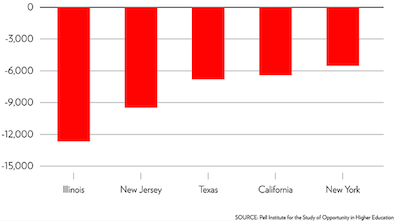
Illinois has bled more students than it’s brought in for a while, but the trend has accelerated in the past couple of years as the state’s budget woes have exacted a toll on the University of Illinois and other public schools. In 2014—the most recent year for which data are available—Illinois saw a net emigration of 12,700 students, a 70 percent increase over a decade.
The big repercussion is that talented students may never return. “It’s a serious brain drain,” says William Morrison, a college counselor at Highland Park High School. It’s common for students to stay put after graduation: Almost half of the Urbana alumni who are alive still reside in Illinois.
At the root of all this are cuts in state funding that have forced Illinois schools to raise base tuition and fees. At Urbana, in-state rates rose 59 percent over the past 10 years, to a minimum of $15,700 and a maximum of $20,700 (not including room and board), depending on the major. At the same time, financial aid through the state’s Monetary Award Program, which provides need-based grants to residents, doesn’t go as far as it used to. It’s not even clear from term to term whether funds will be available: In a survey released in December by the Illinois Student Assistance Commission, 47 percent of Illinois schools said they couldn’t guarantee that students would continue to receive in the spring semester awards they got in the fall. […]
Illinois had the highest net migration of college freshmen to other states’ public schools in 2014 (the latest year for which figures are available). While 3,300 students came to Illinois from elsewhere, almost 16,000 fled. California lost about as many students but saw a bigger influx—9,500.
The governor’s school funding reform commission completed its work on deadline today, but fair and adequate education funding remains out of reach for too many children across Illinois, Senator Andy Manar said.
“If we can get a bill in front of lawmakers this spring, then that will be the true measure of success for the governor’s commission,” said Manar, a longtime advocate for school funding reform and the Senate’s point person on the issue. “But forgive me if I’m not ready to unfurl the mission accomplished banner just yet.”
During the summer, Gov. Bruce Rauner appointed a 25-member commission tasked with studying Illinois worst-in-the-nation school funding formula, which creates winners and losers among students and school districts across Illinois because of its overreliance on local property taxes to fund schools.
The commission met 18 times between August and today. Its final recommendations include moving Illinois to a new funding formula, a hold-harmless clause to prevent districts from losing state funds, more local control and greater transparency about spending, mandate relief for school districts, additional money for English learners and low-income students and more.
The bipartisan commission also recommended an increase of at least $3.5 billion for school funding.
“The commission should be commended for its work the past six months. I am pleased that we have a new level of awareness of the state’s school funding crisis because of this bipartisan, bicameral discussion,” Manar said.
“But in terms of a product, that work yielded another report on Illinois’ already well-documented school funding reform problems. We have a loose framework – a guide – for moving forward. What we do not have today is a piece of legislation to debate in the General Assembly. That has to be the next step.”
Manar commended Beth Purvis, Rauner’s secretary of education, for her leadership role with the commission and said he looks forward to the governor’s staff translating the recommendations into a bill that will be introduced in the Legislature this spring.
“The commission’s work was substantial, but what happens now is up to Gov. Rauner,” Manar said. “The goal has always been and should continue to be permanent reform that guarantees fair funding for all Illinois schools.”
* You should really click here and watch all of Gov. Rauner’s interview at the Chicago Tribune editorial board. It’s very interesting.
With that in mind, the governor again said yesterday that he has zero involvement with the Illinois GOP’s attacks on Speaker Madigan. This passage is from the Tribune’s coverage, with emphasis added by me…
Asked whether the attacks on Madigan could undercut efforts to reach a compromise to end the stalemate, Rauner said, “I don’t think it matters one way or the other.”
“This is the life we’ve chosen. We all live in a world — I take incoming every day. … I couldn’t care less. Say what you want,” he said.
“That’s one of the best advices Rich Daley ever gave me: He said, ‘Don’t read any press about you and don’t watch any of the ads’ and I never have, I never have. And you know what? Life is good. Just spell my name right. I don’t really care. And anybody on the other side thinks, ‘Oh, I’m a politician but you can’t say anything mean about me otherwise I won’t negotiate?’ Oh come on. Grow up. I mean, we’re not in third grade,” he said.
* From another part of that Tribune interview when the governor was asked about his veto of the Chicago teacher pension subsidy and its impact on CPS employment as transcribed by me with emphasis added…
“Well, this is one of the ways I’ve been disappointed in you guys, but this is the media. Chicago has been responsible for its own teacher pension for a hundred years, OK? Allright, so let’s not think this is some, you know, a hundred years. And Chicago has received $250 million extra since at least the mid 90s, I’d have to go back and get you the exact year. $250 million in our school funding formula. A block grant that no other district gets. It’s above and beyond any of the standard stuff because they cover their own teachers pension. They have not been at a financial disadvantage. They claim that this is wrong, they’re abused, they’re treated different, and they are different because they fund teacher pensions and they get extra money because of that. There’s been a deal, there’s been an understanding. […]
“So, the headline is: ‘Bruce Rauner caused furlough days in CPS.’ No. No.”
In 2015, Rauner offered a budget that contained a $2.2 billion hole because of proposed pension savings that the governor eventually acknowledged might not pass constitutional muster. Last year, he offered lawmakers the choice of working with him to cut the budget or letting him do it himself. He did not spell out how he would close a hole of at least $3.5 billion.
Republican Gov. Bruce Rauner said Wednesday that he will offer state lawmakers this month a budget proposal in the same format that the Democratic-led General Assembly rejected last year — either work with him on crafting a balanced spending plan or give him more power to make cuts on his own. […]
Rauner’s decision last year to present a spending plan that included the option of letting lawmakers give him the power to make massive cuts was never really considered by Democrats in the General Assembly. They said Rauner needed to specify where he intended to cut spending.
“Either the General Assembly authorizes me to make cuts, not my first choice but I’ll do that, or let’s work together to do a balanced budget with cuts and, what I prefer is, a balance of cuts, some revenues and major structural change. The real important thing is the structural change,” Rauner said [to the Tribune yesterday]. […]
“I think a deal is more likely to happen if it’s organic, coming from the rank-and-file members of the General Assembly, and the important thing is to get a good compromise. I’ve been very clear. I mean, the good news and bad news is nobody’s wondering what I think is the right thing to do,” he said.
That last line was probably intended as a joke, but it is close to being true. And if it is true, that’s a pretty sad commentary on the governor’s tenure.
Sneed hears powerful Illinois Senate President John Cullerton (D-6th) has told some of his closest Senate colleagues he is so frustrated with the budget logjam, he is thinking about not running for re-election when his term is up in two years, according to two sources.
“Cullerton is stressed and frustrated by all the nonsense going on in Springfield and the ability to get things done,” said a source who spoke to Cullerton.
“He indicated he is not going to pull the plug now, but he did say he was considering not running for re-election,” said a state senator who asked to remain anonymous. […]
“The budget logjam is frustrating — personally, professionally and politically. That’s no secret,” [Cullerton] said. “As for my future? I’ll decide that at the appropriate time. But that time isn’t now. Right now the only priority is getting a budget for the state of Illinois.” […]
“If I want to run for re-election as a state senator, I’ll need to make that decision by the end of the year. Right now, we’ve got problems to solve. I’ll deal with the other stuff later,” Cullerton said.
Dating back to the recession that began in 2008, statistics reveal that the Chicago area is up by 110,000 jobs while the rest of the state has lost 42,000 jobs.
Over the past year, state job data show, Illinois has added 30,800 jobs, a total reached by adding the 33,500 jobs Chicago gained and subtracting the 2,700 jobs lost in the rest of the state.
Gov. Bruce Rauner on Wednesday called Trump’s executive order on immigration and curbing refugee resettlement “overly broad and a little bit hurried.” […]
“Emotion is guiding too much of the conversation,” he said. “The system is not working and we shouldn’t try to deal with it on a piecemeal basis.”
Sometimes in politics, emotions get involved. Gov. Bruce Rauner on Wednesday brought up emotions when discussing his December veto of legislation that would have provided $215 million for Chicago Public Schools.
“You know, I’m a human being, I get a little emotional sometimes,” Rauner said at an appearance before the Chicago Tribune Editorial Board.
Rauner was explaining his abrupt veto of a plan that had been part of a larger deal he struck over the summer with the Democrats who control the General Assembly — House Speaker Michael Madigan and Senate President John Cullerton.
* By the way, Senate President Cullerton’s spokesman John Patterson explained his boss’ side of the veto story a while back…
Cullerton’s aide suggested it was understood that pension reform was to be deferred because of the election. On June 30, a motion filed to reconsider the bill was passed to extend the 30-day deadline to send SB 2822 to Rauner because the Illinois General Assembly would not be able to discuss pension reform until after the November election, according to Patterson.
According to a transcript of Senate Minority Leader Christine Radogno at the Senate on June 30 provided by Patterson, the senator of the 41st District said the agreement was to pass the legislation and return to the issue of pension reform at another time when the General Assembly was in session.
According to Patterson, on the same day Rauner vetoed the bill, reporters asked Cullerton whether there was an agreement after a meeting between the two, and he said no, in reference to pension reform.
Patterson said the interview was live streamed on the internet and speculated that it was seen by Rauner or an aide of his, who interpreted it to refer to the entirety of the agreement. Patterson thinks this led to the bill’s veto by Rauner and that there needs to be stronger communication between legislative leaders and the governor.
Yeah. About those gubernatorial emotions. Maybe control them?
HIV Providers in Illinois have been feeling the drastic, statewide effects of the budget impasse for some time now.
• From July - December 2015, grantee HIV testing from the Quality of Life Fund decreased 62%, resulting in a 68% decrease in the number of positives found;
• Direct grant testing decreased 59%, with a 66% reduction in positives found;
• Regional Grant testing decreased 35% with a 70% reduction in positives found, all compared to the same period in 2014;
• In March 2016, the Families and Children’s AIDS Network stopped providing prevention services in Regions 2, 7, and 8;
• Central Illinois Friends of PWA stopped implementing Effective Behavioral HIV Prevention Interventions;
• Sisters and Brothers laid off both its Deputy Director and its Interventions Manager, impacting service delivery in several regions, and cut their Region 5 services to just one day per week;
• Fifth Street Renaissance in Springfield laid off four full-time and 3 part-time positions and reduced services;
• Jefferson County laid off two staff, reduced service hours, and have indicated they may need to close their HIV prevention program;
• Bethany Place’s (Belleville) Prevention Coordinator and entire prevention staff resigned due to non- payment;
• Macoupin County laid off their main prevention staff;
• Outreach and testing that is geared and targeted towards populations with the highest rate of new HIV infections have been significantly reduced, due largely to agencies not having the resources to conduct thoughtful, strategic targeting. As a result, suburban Cook County has seen a significant reduction in the amount of newly identified HIV-positive individuals;
Even with passage of the 2016 stopgap spending plan, which is detailed below, some HIV service providers will only receive 65% of their funding.
• HIV tests in suburban Cook County have fallen by 35% since the start of the budget impasse;
• The Jackson County Health Department has ceased providing HIV testing to recently released inmates in downstate Illinois;
• PrEP 4 Illinois, a program that was intended to cover costs of PrEP for those who required financial assistance, was appropriated $1 million in the FY 15 budget; however, that program was ultimately zeroed out by the incoming Rauner administration. Canceling the PrEP4Illinois program deprived Illinoisans of financial assistance to access this game-changing HIV prevention medication;
• The AIDS Drug Assistance Program (ADAP) has been forced to rely solely on federal funds to operate;
• In June 2016, Center on Halsted, Illinois’ largest provider of state-funded HIV testing, had received no state payment for HIV testing. The organization was uncertain if they would be able to continue to provide services without a budget in place […]
Here in Illinois, funding for the HIV Lump Sum, which includes the AIDS Drug Assistance Program (ADAP) and HIV prevention, treatment and education services, has been funded at roughly the same level since FY 2011, with the amount wavering between $25 and $29 million. Since Governor Rauner came into office, he has proposed merely $20 million for FY 16 and $18 million for FY 17. Every new HIV case prevented saves the state nearly $400,000 per person in lifetime medical costs , so this drastic cut to preventive and treatment services has the potential to make the situation worse.
We are at a unique time in the HIV epidemic following the advent of biomedical interventions like PrEP, which can prevent new infections. But effective means of HIV prevention requires a commitment from the state, and Illinois has not included funding for PrEP4Illinois program in proposed budgets since Governor Rauner used his executive authority to remove $1 million in PrEP assistance from the FY 15 budget.
*** UPDATE 1 *** From Catherine Kelly in the governor’s office…
“Fitch’s action further demonstrates the importance of reaching bipartisan agreement on a truly balanced budget and changes that will grow our economy and bring new jobs to our state.”
*** UPDATE 2 *** From John Patterson, spokesman for Illinois Senate President John Cullerton…
While unfortunate, this was expected.
The looming threat was among the many reasons why the Senate is working on a comprehensive budget and reform plan. The goal is to end the nearly two-year impasse and restore financial stability.
If there’s a silver lining, it would be that hopefully this adds to the growing urgency to pass the Senate’s plan and get a comprehensive budget for the state.
*** UPDATE 3 *** Treasurer Michael Frerichs…
“Our credit rating suffers because the leaders in the General Assembly and the Governor will not negotiate an honest budget,” Frerichs said. “This singular focus on non-budgetary items is silently ripping money out of the pockets of everyone who lives in this state.”
“Borrowing costs money. Borrowing without a budget costs even more money. We know a budget will bring down our borrowing costs and yet we still have a leadership team that chooses not to negotiate. We can do better.”
“Bruce Rauner’s failed governorship continues to hurt Illinois jobs and cost Illinois families,” said DGA Communications Director Jared Leopold. “Over and over again, Governor Rauner has sacrificed Illinois’s economy to protect his special interest friends. Today, Illinois families and business are paying
* And from Illinois Working Together Campaign Director Jake Lewis…
“To borrow a phrase from Fitch Ratings, Bruce Rauner has been an ‘unprecedented failure’ as the governor of Illinois. Today’s downgrade, the sixth under Gov. Rauner, is yet another indicator of the damage the governor has inflicted on Illinois and its people during his time in office. According to Fitch, the budget impasse has ‘fundamentally weakened’ the state. It will take years for Illinois to recover from Rauner.
“As residents and college students flee Illinois in record numbers, it is time for the governor to do something he has failed to do in his first two years in office: listen. The governor must drop his extreme political agenda for good and work to pass a responsible, fully-funded budget.”
Fitch Ratings has downgraded the following ratings of the state of Illinois:
–Issuer Default Rating (IDR) to ‘BBB’ from ‘BBB+;
–$25.9 billion in outstanding general obligation (GO) bonds to ‘BBB’ from ‘BBB+’;
–$431 million Illinois Sports Facilities Authority sports facilities bonds (state tax supported) to ‘BBB-’from ‘BBB’;
–$2.6 billion Metropolitan Pier and Exposition Authority McCormick Place expansion project bonds to ‘BBB-’ from ‘BBB’;
–$267.8 million city of Chicago motor fuel tax revenue bonds to ‘BBB-’ from ‘BBB’.
The Rating Watch Negative is maintained.
Fitch warned it would downgrade the ratings if the state didn’t have a budget by the end of January.
The downgrade of Illinois’s IDR and related ratings reflects the unprecedented failure of the state to enact a full budget for two consecutive years and the financial implications of spending far in excess of available revenues, which has resulted in increased accumulated liabilities and reduced financial flexibility. Even if the current attempts at a resolution to the extended impasse prove successful, Fitch believes that the failure to act to date has fundamentally weakened the state’s financial profile.
The Negative Watch reflects Fitch’s expectation that the state’s implementation of a solution, whether temporary or permanent, will be a challenge in the current political environment and that in the interim the state will continue to delay and defer payments in lieu of balancing the budget. While Fitch acknowledges that there is a plan being developed in the state Senate that contains elements that could ultimately resolve the impasse, its passage is uncertain and the timing of implementing solutions is unknown. Fitch expects to resolve the Rating Watch within the next six months based on an assessment of the state’s fiscal trajectory as it starts fiscal 2018. If the state continues on the current path, a further downgrade would be warranted.
Illinois has failed to capitalize on the economic growth of recent years to bolster its financial position. Rather, the decision to allow temporary tax increases to expire and the subsequent failure to develop a budget that aligns revenues with expenditures have resulted in a marked deterioration in the state’s finances during this time of recovery. Once again, the state has displayed an unwillingness to utilize its extensive control over revenues and spending to address numerous fiscal challenges.
* Fitch projects revenue performance will “continue to track slow economic growth,” and claims it is “unlikely that reductions in state spending alone would be sufficient to achieve budgetary balance given the magnitude of the current budget gap.”
Illinois’ operating performance, both during the great recession and in this subsequent period of economic growth, has been very weak. The failure to address a long-standing structural budget gap with permanent and comprehensive solutions, whether revenue or expenditure, has left the state with an gaping hole in its operating budget and increasing budgetary liabilities.
The state Senate has put forth a series of bills that have the potential to lead to a compromise that will resolve the impasse. The Senate bills include raising the state income tax and other revenue measures, debt issuance to reduce accumulated budgetary liabilities, pension reforms, aid to Chicago public schools, and non-budgetary reforms sought by the governor, including a freeze on property taxes, workers compensation reform, and some form of term limits. These proposals, if they proceed through the full legislature and are signed by the governor, have the potential to meet the requirements to stabilize the Illinois IDR and related ratings. However, their passage is uncertain as is the timing of the implementation of any solutions.
RATING SENSITIVITIES
BUDGET SOLUTIONS: Failure to enact a balanced budget for fiscal 2018 would result in a further downgrade. Successful implementation of measures to enact a structurally balanced budget and reduce accumulated budget liabilities would stabilize the credit.
LIQUIDITY: The rating is sensitive to a material reduction in the state’s ability to manage within available revenues through discretionary payment deferrals. Furthermore, failure of the state to make its statutorily required debt service transfers as scheduled, 12 months in advance on a rolling basis, would result in an immediate downgrade of the rating to below investment grade because it would suggest that the state’s liquidity pressures are presenting a risk to bondholder interests that has not been evidenced to date.
Governor Bruce Rauner’s Illinois School Funding Reform Commission today approved a framework that allows members of the General Assembly to create a new school funding formula.
“Illinois is another step closer to fixing our broken school funding system,” Governor Rauner said. “I applaud the Commission members for putting politics aside to advance a bipartisan framework that can serve as an immediate roadmap for legislation. The framework ensures all public school children in Illinois receive equitable funding, no matter where they live. We look forward to working with members of the General Assembly to quickly resolve the outstanding issues identified in the report with the hope of enacting a bipartisan school funding reform package as soon as possible.”
The 25 commission members, comprised of five members from each party in each chamber and five members appointed by the Governor, met for over 75 hours in the last six months to reform the school funding formula. The framework will better focus resources on the needs of the students and districts. Through this framework, new funding will first go to schools who are farthest away from their adequacy targets, serving the most vulnerable students. This measure will address inequity within districts, not just among districts, and also ensure all public school children, including those who attend charter schools, receive equitable treatment.
“This has been a robust, bipartisan and bicameral process,” said Illinois Secretary of Education Dr. Beth Purvis. “I am incredibly thankful that these really dedicated members of the General Assembly and the Governor’s appointees were able to come and have substantive conversations in which children were at the center of the decision-making.”
Three mechanisms have been discussed that could be used to increase funding to districts with high concentrations of poverty. First, elements could provide increased funding for low-income students and students living in concentrated poverty. Second, using enrollment instead of average daily attendance may increase funding to schools with large low-income student populations or populations of students in concentrated poverty. Third, the distribution formula could direct additional funds to districts based on poverty concentration. In addition, funding alone is unlikely to be sufficient to close the gap; new service delivery approaches will also be needed. ISBE is working to build a model in which the separate and cumulative effect of these factors can be assessed so as to best ensure that this point of consensus is reflected accurately in the data.
So, no consensus apparently on how to distribute funds, which was kind of the point.
Elements will be written into statute; however, it is important to the members of the Commission that there be flexibility in their implementation so that districts can implement strategies that will lead to the best academic and socio-emotional outcomes for their students. Within three years of the initial implementation, ISBE should suggest changes, if warranted.
At the time of writing this report, the amount of additional state money needed for all districts in Illinois to be at or above their adequacy target is estimated to be a minimum of $3.5 billion over the next decade. It should be noted that this figure makes several assumptions and will fluctuate over time as adequacy targets and local capacity change. In fact, for the state to take an increasingly larger share of responsibility for education funding (e.g., 51%), this figure is projected to rise by at least $2.5 billion. However, how the rate at which we achieve that goal has not been decided. Furthermore, this figure does not account for additional capital needs of the districts.
Commissioners agree that consolidation in certain areas of the state is important but that the solution to this problem should not be reached through funding formula reform.
There was also no consensus on mandate relief and private school tax credits.
* We talked briefly about this guy on Monday. Here’s WMAQ TV’s take…
As the Democratic field for the 2018 gubernatorial election continues to take shape, a little-known candidate from Chicago’s northern suburbs has already thrown his hat in the ring.
Alex Paterakis, a 29-year-old Skokie native, said he decided to run for governor in October as a response to the nation’s increasingly polarized political landscape.
“I was getting sick of how politics were being done, how things were being run, partisan politics being everyone against everyone else with no one actually listening to other people’s opinions,” Paterakis told Ward Room Tuesday.
The political newcomer is campaigning on a progressive platform that includes a minimum wage hike, marijuana legalization, and an agenda to oppose President Donald Trump. Paterakis, who owns a pair of small online retail businesses, hopes his campaign will appeal to middle class Illinoisans.
“I think people are really reflecting the message, which a lot of Democrats have forgotten, which is the middle class,” Paterakis said. “They lost the middle class to Donald Trump.”
PS: I have a ton of errands to run today, so I’m not sure when I’ll be back. It’ll likely be a very light early afternoon around here, so make the most of what you’ve got.
At a meeting Wednesday with members of the African American community, President Donald Trump again talked about Chicago violence saying if city officials don’t take steps,”we’re going to solve the problem for them.”
“Because we’re going to have to do something… What’s happening in Chicago should not be happening in this country,” Trump said.
Trump said violence in the city was ‘totally out of control.” […]
[Darrell Scott, an Ohio pastor who campaigned for Trump] said he was talking to members of “top gangs” in Chicago – he did not identify who – who wanted a “sit down” to discuss how to “get that body count down” in return for “social programs.”
“It’s a great idea,” Trump said about a possible meeting involving gang leaders and social programs.
* With all the talk of the Senate’s grand plan and the attorney general’s legal motion on employee pay, we may be forgetting that the governor’s budget address is just two weeks from today. So, this excerpt from a Tribune story today is worth posting…
In 2015, Rauner offered a budget that contained a $2.2 billion hole because of proposed pension savings that the governor eventually acknowledged might not pass constitutional muster. Last year, he offered lawmakers the choice of working with him to cut the budget or letting him do it himself. He did not spell out how he would close a hole of at least $3.5 billion.
* I, for one, believe that we should take the Illinois Policy Institute’s budget plan seriously. For too long, way too many Illinoisans have believed that the undefined “they” could simply cut governmental waste to balance the state’s budget. So, the “Institute,” in some ways, is doing us all a service by showing what will really happen if the budget is balanced without a tax hike, like tossing 600,000 people off Medicaid, or whacking university funding by a billion dollars and forcing school districts to pay a billion dollars a year in higher pension costs, etc.
A [property tax] freeze, coupled with stripping municipalities of the 9-cents per dollar they’ve received since Illinois first implemented an income tax, would further strip localities of another key funding source. The IPI says it’s taking away a “subsidy,” but head of the Illinois Municipal League Brad Cole says that’s a misnomer.
“For many small communities, it’s the only source of income they have, so it provides for the health, safety and welfare of their residents,” Cole said. “It’s not as simple as saying ‘let’s cut the LGDF (Local Government Distributive Fund).’ I mean, that would abandon the entire state, whether it’s Cairo or Chicago.”
Additionally, the IPI wants to make it harder for units of local government to look to raise taxes in the future, by requiring referenda pass with a two-thirds majority before any hikes. […]
That would be a “heavy burden” and is “overly restrictive,” Cole said.
“What if a water treatment facility doesn’t get expanded, then the community can’t grow, or keep up to date with EPA (Environmental Protection Agency) regulation,” he said, as a hypothetical.
Cole needs to up his game, but at least it’s a start. Local reporters ought to call their mayors, school board chairs and university/college presidents to hear what they have to say, as well. And, you know, maybe talk to some people who got into Medicaid because of Obamacare and who would be facing a life without affordable or any health insurance.
People have seen what the impasse has done. But they have to understand that solving this problem is no easy or painless matter.
research suggests that these cuts would also have a devastating effect on the state’s economy. Partly, that’s because they would directly lead to thousands of lost jobs, as schools and colleges laid off teachers, janitors, counselors, and other employees. (To get a sense of the magnitude, $200 million in cuts led to 1,400 layoffs in the Chicago Public Schools in 2015; Chicago State University laid off 300 employees to save $24 million in 2016. Scaled up to the full statewide cuts, that would total nearly 20,000 lost jobs as a direct results of cuts in the education sector alone).
But education, in particular, drives Illinois’ economy in ways beyond the people that schools directly employ. In fact, economists have estimated that for each dollar invested in an institute of higher education, $2.286 is generated in the state economy, as students, professors, and other employees patronize local businesses, support families, and contribute to a vital local economy. That means that IPI’s proposed $950 million cut to higher education could result in over $2.17 billion in losses to the state economy.
More broadly, CTBA’s recent report on higher education funding highlighted research showing that over the last generation, investing in residents’ educational attainment has been crucial to robust state economies.
Additionally, copious independent studies have found that the Medicaid expansion under Obamacare has been a net positive for state economies. A study in Kentucky found that Medicaid expansion in that state generated 40,000 jobs; another study found that Medicaid expansion created 31,000 jobs in Colorado. Blending these estimates and adjusting for Illinois’ population, that suggests that IPI’s proposal on Medicaid alone could eliminate more than 95,000 jobs.
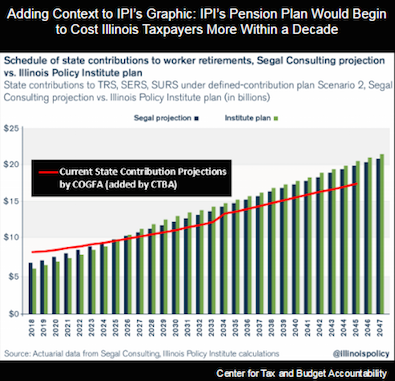
* The CTBA also looked at the “Institute’s” pension plan and discovered this…
While IPI’s plan costs less in the first few years — in part thanks to artificially lowered state payments from delaying the full implementation of changes to actuarial assumptions — within a decade or so, it actually becomes a net drag on the state budget, and continues to add billions of dollars in additional payments through the 2040s.
U.S. Senators Dick Durbin (D-IL) and Tammy Duckworth (D-IL) today urged Illinois Governor Bruce Rauner to stand on the side of Illinoisans and oppose repeal of our health care system. Repealing health care without a replacement would have immediate and harmful impacts on hardworking Illinois families – including those with employer based insurance – such as reducing insurance coverage, increasing out-of-pocket costs, reducing the quality of health care coverage, burdening providers, killing jobs and harming Illinois’ economy. They also called for his concrete recommendations on how to improve the health care system for Illinoisans state-wide.
“Independent analyses paint a very grim picture of the health care environment that Illinois would face if Republican ‘repeal without replace’ efforts are successful. For instance, the Illinois Health and Hospital Association (IHA) has expressed concerns that ‘people will not be able to get the care they need; local economies will suffer; and jobs will be lost.’ In our state alone, the IHA estimates that Congressional Republican plans to repeal the ACA without replacing it would result in ‘potential losses of $11.6 billion to $13.1 billion in annual economic activity, which translates to a potential job loss of 84,000 to 95,000 jobs,’” wrote the senators in a letter to Gov. Rauner. “We strongly urge you to reconsider your position towards these destructive Republican plans, and to stand firmly with Illinoisans against efforts to repeal the ACA without an adequate replacement plan in place to protect the coverage gains, affordability, benefits, and consumer protections that Illinoisans currently enjoy. Further, we would welcome your thoughts on how best to improve the ACA for Illinoisans state-wide.”
Durbin on Monday told the Sun-Times that governors across the country should be standing up against a repeal.
“Governors like [John] Kasich of Ohio are stepping up and saying eliminating Medicaid coverage is a disaster because that is compensation for providers that will go away. What we do know from the Illinois Hospital Association is that many downstate hospitals will be threatened if they lose this Medicaid infusion,” Durbin said. “We also know that when these hospitals in downstate communities start facing closure or they’re going to restrict construction and lay off people with the best paying jobs in town. So it is a devastating impact.”
In a statement regarding the senators’ letter, the Rauner administration on Tuesday noted Durbin was a lead proponent of Obamacare, which they said “resulted in skyrocketing health care costs on millions of Americans.”
“As Senators Durbin and Duckworth well know, our administration has urged Congress to take a thoughtful approach to any new health care changes,” spokeswoman Catherine Kelly said. “As always, the governor will continue to advocate for the best interests of the people of Illinois.”
The senators’ letter also criticized a Rauner administration response to House Republicans earlier this month, saying it failed to provide information about the potential fallout or benefit from appealing the act.
A political organization aligned with House GOP leaders unveiled a $1.3 million ad campaign on Tuesday that targets Democrats representing districts won by President Trump to urge support for repealing and replacing ObamaCare.
American Action Network’s campaign includes local ads in a total of 24 districts, as well as national TV ads on CNN and MSNBC. The ads focus on eight Democrats in Trump-country districts and 16 Republicans mostly representing swing seats.
The group’s advertising campaign in support of repealing the healthcare law will total $5.2 million for the month of January.
Yeah, it will most definitely mess with the governor’s messaging if it happens. How can Team Rauner say King Madigan is trying to shut down the government via his daughter’s legal motion in St. Clair County if the House puts this one on the big board?
Not to mention that the Illinois Policy Institute has already proposed doing the exact same thing.
On the other hand, how do lots of House members vote for this bill if it doesn’t include money for social service programs, higher education, etc.? And what does the Senate do? They’ve got their own proposal, after all.
So, possibly more positioning, but probably little actual progress - which is pretty much par for the course in the Illinois House.
Democratic members of House leadership received an email from Speaker Mike Madigan’s office Wednesday morning telling them to expect a bill that would appropriate funds for tens of thousands of employees. It could be voted on next week. […]
With such a bill, however, comes an interesting set of questions for lawmakers with various priorities, including those who would question paying state workers before paying social service providers or funding MAP grants for needy students. That likely means additional items are added to the bill. The proposed legislation would not negate the court battle, which could prove to take months, but would act as a stopgap, giving the Illinois Comptroller authority to pay certain bills on time.
*** UPDATE 2 *** The House Republicans are out with their own proposal…
- State Representative Avery Bourne (R-Raymond) filed House Bill 1787 today that would make state workers’ salary payments a continuing appropriation, guaranteeing payment during a budget impasse. This measure would keep workers paid and prevent a government shutdown.
This has become a particularly urgent issue due to Attorney General Lisa Madigan filing a motion in court to end payment to state employees beginning February 28th, 2017. In response, there has been talk of a similar bill that would provide for a short term appropriation for state worker salaries. However, a stop gap appropriation would be a temporary fix and would leave state worker pay vulnerable to future attacks. This proposal is a long-term solution to the problem of state worker pay being held hostage in a larger political fight.
“This legislation will prevent state worker pay from being used as a political pawn. Families across Illinois rely on the vital services provided by our state agencies. Before I arrived in the General Assembly, legislators chose to make their pay a continuing appropriation which guaranteed their pay with or without a budget. However, those legislators did not afford those protections to state employees. This legislation will keep state worker pay out of the political games that are too often played in Springfield.”
If enacted, this legislation would be effective immediately. Bourne previously co-sponsored similar legislation in the 99th General Assembly that was not allowed a committee hearing. Representative Bourne and her colleagues are calling on the House of Representatives to take up this issue as soon as they return to the Capitol next week.
* Greg Hinz on the Illinois Policy Institute’s budget proposal…
So, what’s in the institute’s secret sauce?
Just a few minor things: slashing the state’s Medicaid rolls by 600,000 people, allowing local governments to declare bankruptcy and impose rather than bargain pay and benefits, keeping $1.75 billion a year in revenue that the state now shares with municipalities for its own needs, and enacting workers’ compensation changes that Springfield Democrats have vigorously resisted.
Among other things.
Piece of cake, right?
Policy Institute chief John Tillman urged reporters not to be “cynical” about the plan, not at a time when the state is losing jobs and residents.
“Politicians have not earned the right to ask Illinoisans for more money,” Tillman said, accompanied by state Reps. Jeanne Ives, R-Wheaton, and Allen Skillicorn, R-Crystal Lake. “Our plan, unlike every other budget plan being discussed, ensures that taxpayers are respected and treated fairly rather than being treated like an ATM.”
The other things include a half billion dollar cut to higher education, which is supposed to “eliminate administrative bloat,” but that could mean the General Assembly would have to take over their spending line by line to enforce something like that.
Higher ed would also be saddled with $450 million in additional pension costs and school districts would be whacked with almost a billion dollars in higher pension costs.
Next on the proposal is a revised state pension plan. The Illinois Policy Institute says the state could save $1.65 billion next year by offering some self-managed 401K accounts instead.
The plan would also streamline Medicaid spending and reform higher education.
Also, they have a big university right down the road from that station and yet they refer to a billion dollars in cuts and added costs a year as “reform.” Maybe check a dictionary.
“Raising taxes will not fix Illinois. We must reform the way Illinois does business,” Illinois Policy Institute CEO John Tillman said. “We must reform the way it actually spends the taxpayers’ money. We must slow the growth of spending to a rate below the growth in revenues. It is that simple. Spending must rise more slowly than revenues. That is the only solution.”
Agreed, but a lot of this plan isn’t about slowing state government growth, it’s about taking state money away from local governments, schools and universities and plowing it back into state coffers.
Meanwhile, the Illinois Policy Institute, a free-market think tank, released its own budget proposal on Tuesday — a plan that would impose no new taxes. It would alleviate the budget crisis by encouraging state workers to transition to cheaper pension plans; ease collective bargaining restrictions placed on local governments while reducing the revenue they get from the state; cut Medicaid rolls by limiting eligibility to only the most disadvantaged; and provide local property tax relief with a five-year freeze.
Some of the institute’s ideas have seen bipartisan support at the Capitol. But with a Republican governor and a Democrat-controlled legislature, policy differences create a frustrating divide between what is needed and what is doable.
The “Institute” couldn’t have written that editorial better themselves. The Trib makes a radical proposal look so… mild.
But, hey, look on the bright side. Two years in and they’re finally conceding that “doable” is a real life concept. Back in 2015, you may recall, the ivory tower sneered at folks like Jim Edgar who had the audacity to suggest that the governor ought to try cutting a doable deal. The Mother Ship also referred to those who wanted to work out a compromise as the “Surrender Illinois Caucus.”
* Anyway, it would be interesting to see this proposal put into bill form. Let’s hear from the mayors, the university presidents, the school superintendents and the nursing home residents who rely on Medicaid, among others. And then let’s hear the sponsors and proponents defend it during committee hearings and floor debate. That’s what democracy looks like, not a press conference with a couple of legislators and a snazzy packet.
Much of Caterpillar’s relocation rationale revolves around better international transportation options in Chicago. That’s a bit of a red herring. It can take as long to drive from, say, Naperville to O’Hare International Airport as it can to fly there from Peoria. And Caterpillar can and has use private aircraft to fly from Peoria to anywhere on earth.
Perhaps Caterpillar’s seventh floor is leaving Peoria for a more simple, personal reason, at least in part: [Cat CEO Jim Umpleby] and other executives want to live somewhere else.
Granted, we are speculating. But after talks with plenty of well-connected people the past few days, we believe this theory deserves at least some consideration.
Umpleby is a Caterpillar veteran, with more than 30 years of service. But it appears little of that time has been spent at a Peoria base.
The Chicago-area native worked for Caterpillar all over the country and world, including Malaysia, San Diego and Singapore. How you gonna keep them down on the farm after they’ve seen Kuala Lumpur?
Such personal-preference moves might not be unprecedented. In 2015, ConAgra Foods announced it was moving its world headquarters from Omaha, Neb., to Chicago. The new ConAgra CEO was residing in the Chicago suburbs.
Some commenters here made many of those same points yesterday.