The Oregon Department of Consumer and Business Services has released its bi-annual analysis of workers’ compensation premiums across the country and it is good news for Illinois.
For several years our high ranking in the Oregon Premium Rate Survey - which ranks states based on how much employers pay for workers’ comp insurance -has been used by the business community and lawmakers as a reason Illinois needs to enact further reforms in the workers’ compensation system.
However, according to the recently released 2018 Oregon Premium Rate Ranking Summary, Illinois has now moved from 8th highest in 2016 to 22nd highest in 2018, which is one of the largest drops in the country.
Illinois now ranks in the middle of the pack compared to other states – which was the goal of lawmakers when bipartisan majorities approved the last workers’ compensation overhaul back in 2011.
This substantial drop in the rankings for Illinois further illustrates that the changes made to the laws in 2011 are producing lower costs for insurers and employers – which, as we predicted, have not been passed on to employers in the form of premium reductions.
More here. Wisconsin was eighth highest, Ohio was 36th highest, Michigan was 37th highest, Massachusetts (which has a program that Gov. Rauner wanted to follow) was 38th and Indiana ranked second lowest.
* I asked Representative-elect Anne Stava-Murray (D-Naperville) if she spoke with Speaker Madigan during his Sunday night dinner with new House Democrats. Stava-Murray, of course, has said she will not vote for Madigan for another term and has called on him to step down. Here’s her response…
I will respectfully dissent to tomorrow’s caucus call for unanimous support of the current Speaker. It’s important to not only keep my word to my constituents but also honor survivors of workplace harassment in this vote of conscience.
I am grateful to the brave advocates and colleagues of mine who have spoken out far before I arrived to the capital. They have led the charge on changing the workplace culture, enacting with boots on the ground the Speaker’s commitment to change. I look forward to joining them and making work environments safer.
I also brought up many Illinoisans’ priority to strengthen our democracy among other issues of importance to my constituents. We are committed to working with the many passionate Democrats, both new and seasoned, as well as Representatives from across the aisle to fix the pressing problems plaguing our state.
I was thankful for the Speaker taking time out of an extremely busy day to hear my concerns, even when he knew he would not have my vote. I am certain together we will disprove the notion that a person cannot speak their district’s truth and be an effective Springfield legislator.
Well, I guess we’re about to find out.
* Meanwhile, this is from state Sen. Patricia Van Pelt-Scott’s (D-Chicago) Facebook page…
I’m teaching people how to get started in the Multi-B..B..Billion ???? $$$ Cannabis Stock ???? Explosion!
????
Interested? Inbox Me Now!
Petition filing for the February municipal election in Chicago, a process that is painful and costly for candidates and confusing for voters, ended Monday. But it’s only the beginning of a very expensive month of litigation around voters’ signatures.
In May of this year, after once again experiencing an expensive and frustrating ballot access fight during the primary, I released a set of proposals to make determining who will be on the ballot easier for candidates, voters and election administrators. I am reissuing those proposals today.
The Chicago Sun-Times, for one, supported our proposals after we visited with their editorial board. The proposals were turned into legislation in Springfield, as well. If they can’t get through veto session, these reforms should be a priority for the next legislature and governor. Each day for the next six weeks we’ll hear about who is or isn’t going to be on the ballot, who did or did not demonstrate the levels of support by gathering signatures. And while the airwaves will be full of talk about process, they will not be full of candidates talking about safety, health care, policing and the future of our great city and metropolitan area. Chicago, Cook County, and Illinois deserve better. Though I am leaving elected office, I hope those that remain continue to reform the way we do business keeping voters at the center.
My office has pushed to consolidate and professionalize the administration of electoral boards for years. And while we have achieved some important reforms, like moving many small local boards to the jurisdiction of the County Clerk, more changes need to be made. We believe we can make these changes in part by harnessing the power of other election officials’ innovations to further expand access to the ballot.
Below are three modest reforms to the candidate filing and electoral board process that will help ensure that voters, administrators and candidates are best positioned to play their part in democracy. Through these efforts, we can increase the efficiency of the process for candidates and administrators, lower the burden on candidates and give the courts adequate time to sort through all issues.
Increase Process Efficiency – In Denver and D.C., the petition process has moved from paper forms to tablets and we are ready here to allow petition circulating to be conducted in person, but with digital tools. The Denver Elections product, called eSign, is ready for Cook County.
Like Election Day Registration, this can be piloted in Cook County so we can refine it for all of Illinois. We advocate making it available for candidates running for Cook County offices and local schools, parks, libraries and other districts wholly within suburban Cook County.
eSign is a mobile application that enables candidates to gather signatures in person, but digitally, with real time feedback on whether the voter is registered or lives in the political district – and it allows signers to update their voter registrations on the spot. In Denver’s 2015 municipal election, 97 percent of eSign signatures collected were accepted. That’s up from about half that are usually considered good after adjudication here in Cook County. This is a huge win for candidates, for election administrators, and most importantly, for voters.
Lower the Burden on Candidates, Save Time and Money – It’s time to lower the filing requirements for countywide offices in Cook County. It is not necessary to require more signatures for Water Commissioner or Clerk than we require for the Governor of our entire state. We call for a limit on the minimum number of signatures required for any countywide to be equal to the minimum required for Governor. I also call for a cap on the total number of signatures a candidate can file to three times the minimum – similar to candidates for state office.
Currently for all countywide offices in Cook, petitions must be signed by at least .5% of the vote cast for the candidate of his/her party who received the highest number of votes in the county at the 2016 General Election. For Cook County Clerk, for example, that meant a Democratic candidate must have collected at least 8,200 signatures. In comparison, to run for Illinois Governor, candidates needed only 5,000. Our change would mean that Countywide candidates would need 5,000 good signatures and could file no more than 15,000.
This would lower the burden of collection and shift the burden of proof to campaigns, prior to filing. This saves campaigns time and saves taxpayers and election officials money. It also helps ensure that when it’s time to vote, voters are presented with the final ballot, free of notices.
Change the Calendar & Move the Primary Date – I am calling for an increase in time by two weeks between filing and Primary Election Day. This change, coupled with the others should ensure that courts have adequate time to give due process to candidates contesting electoral board decisions. It also helps ensure that administrators can safely remove or replace candidates on the ballot without relying on notices.
This calendar change is best coupled with a move of the Primary Election to May or later. The election calendar is already too long – it promotes what are effectively endless campaigns. With the current calendar design, interested challengers must have made a decision, built a campaign and fundraised at least 15 months in advance of the actual election. This is not good for our democracy.
Today, Governor-elect JB Pritzker announced the formation and members of the transition’s Educational Success Committee at Genevieve Melody STEM Elementary School in the West Garfield Park neighborhood of Chicago.
The committee is the seventh of several working groups of the transition made up of subject-matter experts who will advise and guide the incoming Pritzker-Stratton administration. The Educational Success Committee will be chaired by state Sen. Andy Manar, state Rep. Emanuel “Chris” Welch, Chicago Public Schools CEO Dr. Janice Jackson, and Illinois Education Association President Kathi Griffin and consist of 35 members.
“Every child in this state deserves a quality education – regardless of the color of their skin, the zip code they come from, or the income of their parents,” said Governor-elect JB Pritzker. “The transition’s Educational Success Committee will confront the challenges students, parents, and teachers face head on and with fierce urgency. If we want to put Springfield back on the side of working families, we must give every student the opportunities they deserve.”
“Educating our children is a foundational obligation of state government, and that’s why I led the charge to update our antiquated K-12 school funding formula to make it equitable for every child,” said state Sen. Andy Manar. “We must build on that progress, and that’s exactly what this committee will do. JB and Juliana are laying the groundwork for a cradle to career success network for every Illinoisan.”
“As chairman of the House Committee on Higher Education, I’ve seen the challenges facing students and educators in our state colleges and universities,” said state Rep. Emanuel “Chris” Welch. “This committee is a sign of new hope for those vital institutions, and for our children’s futures. Together, we’re going to delve into the root issues and present possible solutions for this new administration so they can hit the ground running.”
“JB and Juliana are committed to making sure kids succeed throughout the education pipeline,” said Chicago Public Schools CEO Dr. Janice Jackson. “The state must step up to ensure every child can thrive from cradle to career, and this committee will work every day to make sure JB and Juliana are ready to do that on day one.”
“Serving on this committee means more than 135,000 educators and educational support professionals across the state have a seat at the table,” said Illinois Education Association President Kathi Griffin. “The incoming administration has shown a strong commitment to funding K-12 education, a promise to invest in higher education, and a pledge to protect collective bargaining rights. It’s the kind of agenda Illinois needs to get back on track, for the sake of our students and teachers.”
EDUCATIONAL SUCCESS COMMITTEE MEMBERS
State Sen. Andy Manar co-chairs the transition’s Educational Success Committee and represents the 48th senate district. Before being elected to the senate, he was Macoupin County Board chairman, mayor of Bunker Hill and a Bunker Hill city councilman. Manar was the driving force behind the successful movement to reform Illinois’ worst-in-the-nation school funding formula. Since he became a state senator, he has been a tireless advocate for fair and adequate school funding that doesn’t treat students differently based on zip codes. Manar serves on the education, agriculture, labor and executive appointments committees in the state senate.
State Rep. Chris Welch co-chairs the transition’s Educational Success Committee and has represented the 7th district since 2013. Welch chairs the House Higher Education Committee and serves on several key House Committees including Cities and Villages, Judiciary-Civil, Elementary and Secondary Education Appropriations, Higher Education Appropriations, Revenue, and Executive. As state representative, Welch has focused on improving classroom education, creating jobs, helping the most vulnerable, and streamlining government. Welch has been the chief sponsor of several pieces of historic legislation including the law bringing cursive writing back to our schools and the Historic Illinois Trust Act, the law making Illinois a welcoming state for immigrants.
Dr. Janice Jackson co-chairs the transition’s Educational Success Committee and is the CEO of Chicago Public Schools. Jackson was a CPS student from Head Start through 12th grade, then began her teaching career at Chicago’s South Shore High School. Since that time, Dr. Jackson has served as a principal, a Network Chief, the Chief Education Officer, and now, as Chief Executive Officer for CPS, the third largest school district in the country. Jackson was also the driving force behind GoCPS, the District’s first common application for all CPS and charter high schools. Launched in October 2017, this application system has dramatically simplified the high school application process while improving access and equity for all CPS high school students.
Kathi Griffin co-chairs the transition’s Educational Success Committee and is the President of the Illinois Education Association, which at 135,000 members strong, is the largest union in Illinois. Griffin started her career as a teacher in Schaumburg and worked there for 30 years. During her time with Schaumburg School District 54, she taught kindergarten through sixth grade students. She also served six years as president of her local union. Prior to becoming the President of the IEA, she was Vice President of the IEA and was a member of the National Education Association’s Board of Directors. Griffin is a member of the state’s Professional Review Panel. She co-chaired former Senator Mark Kirk’s education advisory board and was a member of Tammy Duckworth’s 8th Congressional District education advisory board when Senator Duckworth was a member of the U.S. House of Representatives.
Dr. Michael Amiridis, Chancellor, University of Illinois at Chicago
Dr. Carmen Ayala, Superintendent, Berwyn North SD 98
Christine Benson, Retired Superintendent, Mendota High School
Jennifer Bertino-Tarrant, State Senator, Illinois General Assembly
Dr. Dale Chapman, President, Lewis and Clark Community College
Dr. Brent Clark, Executive Director, Illinois Association of School Administrators
Fred Crespo, State Representative, Illinois General Assembly
Will Davis, State Representative, Illinois General Assembly
Dr. Larry Dietz, President, Illinois State University
Dr. Kenneth Ender, President, Harper College
Dr. Jennifer Garrison, Superintendent, Vandalia 203
Phyllis Glink, Executive Director, Irving B. Harris Foundation
Dr. James Heckman, Professor, University of Chicago
Dr. Ed Hightower, Executive Director, Mannie Jackson Center for the Humanities Foundation
Kimberly Lightford, State Senator, Illinois General Assembly
John Miller, Vice President, Illinois Federation of Teachers
Mary Morten, Board Chair, Safe Schools Alliance
Zena Naiditch, President and CEO, Equip for Equality
Back before the U.S. and Europe started slapping tariffs on each other, Paul Hletko was benefiting from the Old World’s growing passion for bourbon, pulling in six figures’ worth of orders at his small-batch distillery in the first half of the year.
Those days are over. Bourbon exports for Hletko’s Few Spirits, based in Evanston, “dropped to zero” from 15 percent of revenue last year, he said. The European Union’s 25 percent tariff on bourbon, implemented in June, wiped out demand for his product, which retails for $51 a bottle in the U.S.
“Every U.K. buyer backed off,” Hletko said. “They may want to buy it, but if they can’t sell it at the right price, that’s not doing us any favors.”
Small distillers cite the drought as proof their fears of a global trade war are coming to fruition. Europe had been blossoming as a source of new revenue — but this market has been effectively cut off for producers that lack the clout or brand recognition of titans like Brown-Forman Corp., Diageo Plc and Chicago’s Beam Suntory. Now they’ve been sent back to square one.
The tariffs, which target U.S. goods such as Levi Strauss & Co. blue jeans and Harley Davidson Inc. motorcycles, are the EU’s retaliation to President Trump’s duties on foreign steel and aluminum.
“I can tell you that the day they announced the tariff, we lost $20 an acre on our farm, and that was not the full impact of the tariff,” said Doug Schroeder, vice chairman of the Illinois Soybean Association and owner of a 4,000-acre soybean and corn farm near Mahomet, Illinois.
“It is really tough. Twenty-five percent of Illinois soybeans used to go to China, and now virtually none of them do,” he said.
Farmers are scrambling to find storage space for the soybeans they can’t sell, which is creating more challenges and raising costs.
“It’s really been devastating,” said Schroeder. “There hasn’t been a demand for the beans to go anywhere, so they just pile up.”
While Illinois soybean farmers are still selling their harvest to Indonesia, Taiwan and Mexico, the demand just isn’t there for what is expected to be a record soybean crop this year.
America’s farmers have been shut out of foreign markets, hit with retaliatory tariffs and lost lucrative contracts in the face of President Trump’s trade war. But a $12 billion bailout program Mr. Trump created to “make it up” to farmers has done little to cushion the blow, with red tape and long waiting periods resulting in few payouts so far.
According to the Department of Agriculture, just $838 million has been paid out to farmers since the first $6 billion pot of money was made available in September. Another pool of up to $6 billion is expected to become available next month. The government is unlikely to offer additional money beyond the $12 billion, according to Sonny Perdue, the agriculture secretary.
* Related…
* Trump’s steel tariffs create big profits but few new jobs: At Nucor’s plant in Sedalia, by contrast, 225 people will make steel with a high-tech furnace that shoots electricity through scrap metal to melt it into new products. That technology is now used to produce nearly 70 percent of U.S. steel — with a third less labor and energy, according to Charles Bradford, president of Bradford Research Inc.
* We’ve talked a lot about the Democrats’ gains in DuPage and Lake counties. Greg Hinz takes a look at them plus these others…
In Will County, Democrats swept the countywide spots, taking control of the clerk’s job for the first time in 80 years. They also picked up four spots on the county board and now have a majority. […]
Republicans did better in Kane County, retaining the clerk’s and treasurer’s slots but losing to a Democrat for sheriff. Democrats, though, won seven of the 13 county board seats up for election. And former Democratic state Sen. Mike Noland defeated County Circuit Court Clerk (and former Kane County GOP Chairman) Thomas Hartwell for a Circuit Court judgeship.
If Republicans have a stronghold left in suburbia, it’s in McHenry County, which still is largely rural.
Rauner won there by better than 10 percentage points, and Erika Harold, the GOP nominee for attorney general, led Raoul by more than 8. Republicans won all of the countywide positions up for a vote by a wide margin. But even there, Casten and Underwood got more votes than incumbent GOP Reps. Peter Roskam and Randy Hultgren, respectively. And Democrats won a third of the 12 seats up for a vote on the county board.
One of the most dramatic turnarounds in the region was in McHenry County, where Democrats went from earning 40 percent of the House vote in 2016 to 51 percent this year.
Tuesday, Nov 27, 2018 - Posted by Advertising Department
[The following is a paid advertisement.]
With transportation expenses on the rise, Illinoisans are looking to car sharing to help them earn extra income and save costs on transportation.
Yet, legislation that lawmakers are considering, SB 2641, would deny Illinoisans from an opportunity to make money while their cars sit idle and unfairly double tax car owners.
Car sharing is not the same as car rental, and the two industries cannot be treated the same. With car sharing, car owners can benefit financially while they aren’t using their cars. When regular Illinoisans buy a car, they pay sales tax. Rental car companies don’t because they have a sales tax waiver. But, this bill would force a car owner who has already paid sales tax to pay twice if they want to earn extra money sharing their car.
Legislators should VOTE NO on the SB 2641 override.
Comptroller Susana A. Mendoza’s office today released a report shedding light on a program that has allowed private companies to buy more than $5 billion in state liabilities and claim hundreds of millions in late payment interest penalties originally owed to vendors who have done business with Illinois.
The monthly report is required under bipartisan legislation Comptroller Mendoza championed to open the books on the Vendor Payment Program (VPP).
“Lenders in this program are making hundreds of millions of dollars off the state’s fiscal calamity. Before my legislation was passed, this program wasn’t codified in state law or subject to even a basic level of transparency,” Mendoza said. “This monthly report will, for the first time, give taxpayers and policymakers an accounting of this $5-billion program.”
VPP was created to assist struggling vendors as Illinois’ backlog of unpaid bills grew. It allows state-approved third-party lenders, known as qualified purchasers, to pay a portion of the state’s unpaid bills owed to vendors up-front. In exchange, the qualified purchasers get the late payment interest penalties when they are ultimately paid by the state.
The qualified purchasers played an important role in keeping vendors afloat, a challenge worsened during the two-year budget crisis suffered during the Rauner administration. But before the passage of Comptroller Mendoza’s legislation, little information was made public about their financial interests or how much state debt they have purchased through VPP.
In addition to revealing to the public for the first time that more than $5 billion of state liabilities have been purchased through VPP, qualified purchasers reported that nearly $275 million in late payment interest penalties have been paid to them to date. Another nearly $327 million in late payment interest penalties are still owed to qualified purchasers.
A companion report, also published today, includes information about qualified purchasers and those who hold interests in these entities. Monthly reports going forward will focus on the liabilities and late payment interest penalties that fall under the program. Any new qualified purchasers who apply to participate in VPP are now required to file disclosure statements, and all qualified purchasers are now required to file a disclosure statement once a year.
Senate Bill 3560 passed unanimously in the state Senate and 109-7 in the House of Representatives. It was sponsored by Representative John Connor, D-Lockport, and Senator Omar Aquino, D-Chicago. Under the new law, VPP will be audited by the Illinois Auditor General.
The monthly reports are here and the financial backer disclosures are here.
It started with $40,000 appropriated by the supervisors of Champaign and Urbana townships and Griggs’ decision to travel most of the state (everywhere but Jacksonville, Lincoln and Bloomington), meet with other state representatives and build support for Champaign-Urbana.
In five weeks, he said, he interviewed 40 House members and gained pledges from 15 of them.
Next, he met with the governor and lieutenant governor and with the chairmen of the state Republican and Democratic parties. In those conversations he learned that the postwar Legislature would be occupied with a number of special interests.
Southern Illinois wanted a prison; Peoria and Springfield were fighting over which would be the state capital; and Chicago wanted to deepen the Chicago River and develop a system of parks and boulevards. Such knowledge would be important in future vote-trading.
When the Legislature went into session in January 1867, the Champaign County Committee moved into Springfield’s Leland Hotel, where for the next three months it held the principal reception room and a suite of parlors and bedrooms. The rooms were used to entertain legislators and their constituents with either drinks, light refreshments or sumptuous dinners of oysters or quail. Lawmakers were supplied with cigars and theater tickets. Late in the session, Griggs arranged for a special train to take legislators to Champaign-Urbana.
None of the other communities seeking the university had a similar arrangement.
Inside the House Chambers, Griggs showed his skill by running for speaker.
For two days, the House was tied up in endless voting. On the night after the second day, an intermediary visited Griggs and asked what it would take to get him to drop out of the race. Griggs wanted the chairmanship of the Committee on Agriculture and Mechanic Arts — the committee that would hear all the bills about locating the university — and the right to choose its members. He got it, dropped out of the race for speaker and thus was able to control the legislation.
Case in point, over the past decade or so the state has lost out on piles of grant money for one of two reasons. First, cash was in short supply, so matching funds for projects weren’t always available. Second, staff cuts were so deep there was no one to write the grant proposals. […]
Granted, the agency is no longer on life support as it was several years ago, but staffing levels are unacceptable. Some site superintendents are managing 8-12 sites – that serves no one well. Some state parks are without a single full-time employee.
Tuesday, Nov 27, 2018 - Posted by Advertising Department
[The following is a paid advertisement.]
In the heart of Chicago’s Uptown neighborhood sat a collection of cars owned by “Michael O.” — the city’s most successful auto lender on car-sharing platform Turo.
According to The Daily Line, Michael Oates owns as many as 40 vehicles that he rents out using Turo, a Silicon Valley-based company that promotes itself as the future of the car rental industry. Oates’ fleet has caused major parking headaches in Uptown, where he once parked a portion of his 40 vehicles on a residential street near the Aragon Ballroom and the Riviera Theatre.*
Would you want 40 extra cars parked on your street?
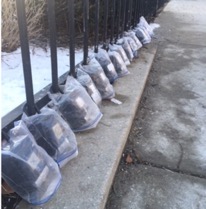
Car key lockboxes in Uptown. Operated by Turo renter.
Ald. James Cappleman told The Daily Line that he’s received numerous complaints about Oates’ cars, but attempts to resolve the issue stalled after the city’s law department said the legislature would first have to pass a bill regulating the car-sharing industry.
Rep. Art Turner, D-Chicago, said his bill could address “nuisance situations” like Oates’ Turo business.
“As it stands right now, there’s nothing the city or police or local law enforcement can do to even address the situation,” Turner said.*
A PICTURE IS WORTH 1,000 WORDS
VOTE YES ON SB 2641
* Excerpts from Daily Line story from November 13, 2018
According to a preliminary list compiled by the Chicago Board of Election Commissioners, 21 candidates filed to run for mayor for the upcoming election on Feb. 26 (a runoff between the top two vote-getters is set for April 2):
Willie Wilson
Toni Preckwinkle
Paul Vallas
Jerry Joyce
Catherine Brown D’Tycoon
Conrien Hykes Clark
William M. Daley
Garry McCarthy
Dorothy Brown
Gery Chico
Sandra Mallory
Susana Mendoza
Amara Enyia
La Shawn Ford
Neal Sales-Griffin
Lori Lightfoot
John Kozlar
Bob Fioretti
Ja’Mal Green
Roger Washington
Richard Mayers
Candidates will spend the next month or more trying to knock others out of the race. They will cite charges ranging from forgery and fraud to more minor technicalities to argue their competitors didn’t collect the necessary number of signatures from registered Chicago voters to appear on the ballot.
That process, argued by attorneys before city election officials, is certain to narrow the final list of candidates put before voters. By how much remains to be seen. […]
Chico, Lightfoot, Joyce and Brown all stressed they had checked their signatures carefully and were confident they had enough valid ones to weather any attempts to get them booted from the ballot. Mendoza only submitting a little more than twice the required amount raised some eyebrows around City Hall, given her status as a statewide officeholder and an establishment Democrat.
Mendoza sought to downplay the number of signatures she filed, saying they only had been collected in the last three weeks since she announced her mayoral bid after winning re-election as comptroller. A “draft” movement, however, began collecting signatures for Mendoza in early September, and her campaign later confirmed that her nominating petitions included those signatures collected over the last three months.
Qualified signatures can come only from registered Chicago voters. Perhaps even more important this year, only the first signature will count for those who signed petitions for multiple candidates. Squabbling over which signature came “first” and related matters is likely to generate much legal jockeying, noted political consultant Tom Bowen. “It is a hell of a mess to knock someone off the ballot in this environment,” he said.
When the week-long filing period closed Monday, 21 candidates had submitted petitions for the mayoral race. That’s one more than eight years ago — the last time the mayor’s office was up for grabs. In that race, to succeed retiring Mayor Richard M. Daley, 20 men and women had filed for mayor at the close of the filing period. But only six wound up on the ballot after challenges and candidate withdrawals.
Former City official and Community Activist Amara Enyia has run for mayor before; she said she’s learned a lot since then and is ready to make her voice heard among several contenders. She filed 62,000 signatures, no doubt in part because of Chance the Rapper and Kanye West’s help in supporting her campaign.
“We have done a good job of organizing across the city so it is not just me as a candidate but it is the people of this city,” Enyia said.
Mayoral candidate Gery Chico on Monday took the gloves off and pummeled the only other Hispanic candidate in the race: state Comptroller Susana Mendoza.
Chico charged that Mendoza proved herself “unfit for the job or the responsibilities that come with being the mayor of Chicago” because she “can’t even decide which job she wants” and proved it again by being evasive and duplicitous.
In a statement released by his campaign just as Mendoza was filing her nominating petitions, Chico pointed to Mendoza’s refusal to say whether she would remove or retain Police Supt. Eddie Johnson. […]
“Susana has played political games by refusing to come clean with voters about running for mayor, and now that she’s openly running for mayor she refuses to come clean with voters on where she stands on important issues. She can’t be trusted to be the strong leader Chicagoans can count on,” Chico said.
State lawmakers return to Springfield on Tuesday for what could be their last clash with Gov. Bruce Rauner, as they consider overriding dozens of the governor’s vetoes less than two months before he leaves office. […]
Two weeks ago, Republicans joined Democrats to vote to override the GOP governor’s vetoes more than three dozen times. Democratic state Rep. Emanuel “Chris” Welch of Hillside said Republicans were “relieved” after years of largely voting with Rauner.
“When the governor first came in the office, he was intimidating and, for lack of a better term, a bully,” Welch said on WGN-AM 720 on Sunday.
But the House has to agree with Senate votes to override Rauner and vice versa if any are to stick.
The focus this week is on the House. It is poised to take override action on vetoed legislation which the Senate voted to reverse two weeks ago.
The list includes a measure vetoed by Republican Gov. Bruce Rauner to set a deadline for local police to sign paperwork to help immigrant victims of crime . Victims of certain violent crimes who cooperate with police qualify for visas to let them stay in the country. The legislation requires police to act within 90 days to sign necessary paperwork.
Other vetoes awaiting House action are on legislation prohibiting tobacco sales to those under 21 and requiring online vehicle-sharing services to meet rental-car company safety standards.
Sen. Andy Manar, D-Bunker Hill, said he’s not giving up on the idea of increasing the minimum salary that every school district in the state will have to pay their teachers.
“There have been ongoing conversations that haven’t stopped since going back to May, when we passed the bill,” Manar said. “Those are going to continue. I would expect to re-file, if not a bill that’s exactly the same, something that’s very similar to what was filed and already passed in the General Assembly.” […]
Twice lawmakers approved a bill that prohibits employers from asking the salary history of an applicant. Twice Rauner used his amendatory veto powers to make changes to it.
Both times, there were not enough votes in the Legislature to override Rauner’s changes, but supporters didn’t want to accept his changes. Consequently, the bills died.
Rep. Anna Moeller, D-Elgin, said she’s probably going to try again, only this time with someone in the Governor’s Mansion who supports the idea.
The Senate was able to get enough votes to pass a bill to ban anyone under 21 from getting tobacco and vaping products, but there might not be enough votes in the House to get the bill passed over the governor’s veto. […]
State Rep. Robert Martwick, one of the cosponsors of the bill in the House, said it initially passed with 61 votes. Lawmakers need 71 votes to override.
“I hope that we can garner the votes, but I think it’s a stretch to think we can pick up another ten,” Martwick said.
Roughly 42,000 customers in northern Illinois still were without electricity as of 4:30 a.m. Tuesday because of the snow that hit Chicago and the suburbs.
Sunday’s storm featured blizzardlike conditions with up to 13 inches of wet, heavy snow and wind gusts up to 50 mph in some areas that snapped tree limbs and downed power lines.
Officials said about 350,000 ComEd customers lost power, but service has been restored to many of them.
Arlington Heights officials said the village was the second-hardest hit after Chicago and that ComEd could not say when more than 5,000 without power would get service back.
Today, Governor-elect JB Pritzker and Lieutenant Governor-elect Juliana Stratton announced the formation and members of the transition’s Powering Illinois’ Future Committee.
The committee is the sixth of several working groups of the transition made up of subject-matter experts who will advise and guide the incoming Pritzker-Stratton administration. The Powering Illinois’ Future Committee will be chaired by Illinois Environmental Council Executive Director Jennifer Walling, Exelon Utilities CEO Anne Pramaggiore, and IBEW Local 51 Business Manager John Johnson and consist of 30 members.
“Investing in infrastructure will be a top priority in our administration,” said Lieutenant Governor-elect Juliana Stratton. “We must identify opportunities to invest in a clean energy economy, and this committee will bring both advocacy and industry stakeholders together to put our state on a path toward mutually agreed upon projects that move us toward a clean energy economy.”
“IEC and our advocacy partners know our environment will be protected under the incoming Pritzker-Stratton administration, and we’re excited to work on this committee to make investing in clean water infrastructure and expanding energy efficiency efforts a top priority in Illinois,” said Illinois Environmental Council Executive Director Jennifer Walling.
“Under Governor-elect Pritzker’s vision, Illinois is poised to assume a leadership role in our country’s clean energy future. Making this transformation in our energy sector is critical to our economy and to quality of life in our state. I am enthusiastic about the ability of the diverse group of stakeholders convened by our new Governor to generate ideas that add real value to Illinois,” said Exelon Utilities CEO Anne Pramaggiore.
“This committee will be the first step in making sure the labor movement is an integral part of moving Illinois to a clean energy economy and reinforces JB and Juliana’s commitment to putting Springfield back on the side of working families,” said IBEW Local 51 Business Manager John Johnson.
POWERING ILLINOIS’ FUTURE COMMITTEE MEMBERS
Jennifer Walling co-chairs the transition’s Powering Illinois’ Future Committee and is the executive director of the Illinois Environmental Council. IEC represents over 80 environmental organizations on policy issues. Walling has been involved with the negotiation and passage of many major environmental initiatives including the Future Energy Jobs Act, Lead in Drinking Water Prevention Act, Illinois’ ban on microbeads in personal care products, funding for the Illinois Department of Natural Resources, recreation liability protection for landowners, numerous bills on recycling and composting, and many other statewide policies.
Anne Pramaggiore co-chairs the transition’s Powering Illinois’ Future Committee and is the CEO of Exelon Utilities. In that role, she oversees and manages the six utilities that make up the portfolio of Exelon Utilities, including ComEd. Pramaggiore served as CEO of Commonwealth Edison for over six years and, during that time, oversaw the company’s smart grid modernization program as set forth under the 2011 Illinois Energy Infrastructure Modernization Act. This legislation and ComEd’s work has earned Illinois national recognition for having one of the most advanced power systems in the country (Gridwise Alliance Modernization Index) and has placed ComEd among the leaders in the industry for reliability (EEI Index). Also, she oversaw the company’s efforts under the 2016 Illinois’ Future Energy Jobs Act, which further modernizes the power system, creating a pathway for 3000 MW of solar power and some of the largest and most impactful energy efficiency programs in the country. She joined Commonwealth Edison in 1998 (from McDermott, Will and Emery) as a lawyer and worked on the company’s efforts to restructure the electric industry under Illinois’ Customer Choice Act. Pramaggiore also served as Commonwealth Edison COO and President from 2009 to 2012.
John Johnson co-chairs the transition’s Powering Illinois’ Future Committee and is the business manager of International Brotherhood of Electrical Workers Local 51. Johnson has worked in the Illinois energy field for over 42 years. He was first employed by Illinois Power at its Baldwin Power Station in downstate Randolph County. In 1994, he was appointed as a Business Representative for IBEW Local 51 later becoming the Assistant Business Manager. Johnson has represented nearly 3,500 Illinois workers primarily employed in the public utility industry in downstate Illinois. He has represented employees working for electric and gas utilities; nuclear, coal, and natural gas generating operators; rural electric cooperatives; contractors constructing electric distribution, electric transmission and renewable energy facilities; and telecommunication employers. While working for Local 51, he has participated in various legislative and regulatory efforts, most recently with the Future Energy Jobs Act. Johnson was appointed by organized labor to the Midwest Governors Greenhouse Gas Accord working group.
Steve Andersson, State Representative, Illinois General Assembly
Andrew Barbeau, President, The Accelerate Group
Dick Breckenridge, Illinois Regional Program Manager, BlueGreen Alliance
Jon Carson, CEO, Trajectory Energy Partners
Jim Connolly, Business Manager, LIUNA Chicago Laborers’ District Council
Jack Darin, Executive Director, Sierra Club Illinois Chapter
Naomi Davis, Founder, Blacks in Green
Joseph Dominguez, CEO, ComEd
Robyn Gabel, State Representative, Illinois General Assembly
Jacky Grimshaw, Vice President of Government Affairs, Center for Neighborhood Technology
Carol Hays, Executive Director, Prairie Rivers Network
Ronnie Huff, Union Representative, Union Mine Workers of America
Paul Kearns, Lab Director, US Department of Energy’s Argonne National Laboratory
Dave Koehler, State Senator, Illinois General Assembly
Howard Learner, President and Executive Director, Environmental Law and Policy Center
Richard Mark, CEO, Ameren Illinois
Iris Martinez, State Senator, General Assembly
Charles Matthews, CEO, Peoples Gas
Michael Polsky, Founder and CEO, Invenergy
Susan Satter, Public Utilities Counsel, Office of the Illinois Attorney General Lisa Madigan
Debra Shore, Commissioner, Metropolitan Water Reclamation District of Greater Chicago
Jim Sweeney, President-Business Manager, International Union of Operating Engineers Local 150
Rick Tervin, Jr., Legislative and Political Director, Illinois Pipe Trades Association
Mary Vandevord, President and CEO, HeartLands Conservancy
Kim Wasserman-Nieto, Executive Director, Little Village Environmental Justice Organization
Ann Williams, State Representative, Illinois General Assembly
Melvin Williams, President, Nicor Gas
That’s not a bad combination of business, labor, greens and legislators with experience getting things done. The people running this transition are impressing me. But transition committees are usually just window dressing. We’ll have to wait and see if the actual governing has this balanced approach.
In 2013, the first year Illinois lawmakers allowed for video gaming, almost 8,000 machines did $121 million in business. Just five years later, almost 30,000 machines did $1.4 billion in business. That’s enough gambling machines to fill 24 full-sized casinos.
* That $1.4 billion is called Net Terminal Income. It’s the difference between what is bet and what is won. Of the NTI, 30 percent is taxed by the state, with one-sixth of the state’s take going to the municipalities.
The rest, close to $1 billion in this instance, is split equally between the video gaming establishments (bars, truck stops, etc.) and the video gaming terminal operators. Terminal operators own the machines, place them, service them, collect the money, etc. They have significant overhead, but I can’t imagine it’s anywhere near a half a billion dollars a year.
If we’re looking for capital plan money, then increasing the state’s tax rate on that pot of terminal operators gold might be worth looking at, along with increasing the rate on establishments that have more than a couple/tree locations. Leave the mom and pop neighborhood spots alone. Focus on the big chain establishments and the major terminal operators.
Then again, they’ll be the ones with the most lobbyists.
* Let this sink in: Next year, Sen. John Curran of Downers Grove will be the only Republican Senator who will reside in the former GOP bastion of DuPage County. Sen. Curran was appointed to the Senate last year when Sen. Christine Radogno retired. Pate Philip would be spinning in his grave if he was dead (thankfully, he’s not)…
Now that the last contested legislative races are settled, it’s clear the composition of the 101st Illinois General Assembly to be seated in January will be decidedly more Democratic. The Dem margin over Republicans in the House will be 74-44 and 40-19 in the Senate.
The 74-44 Democratic House supermajority represents the most House Dems since Michael Madigan rose to power as speaker in 1982. It also is the highest percentage of Democrats in the chamber since 1964.
The 40-19 Democratic supermajority in the Senate matches the number of Senate Dems in 2012. The 40 seats is a record number of Democrats going back to at least 1836. Additionally, the number of women in the newly composed Senate will total 20, most in Illinois’ 200-year history.
For context, 1964 was the “bedsheet ballot” year, when the Democrats won two-thirds of all House seats. The old three-member district process limited parties to no more than two members per district, so each party slated 118 candidates for 177 seats and they all ran on one statewide ballot after a redistricting standoff during LBJ’s massive Democratic landslide.
The House Democrats will hold about 63 percent of all House seats come January.
* Some of the last legislative races that were decided…
* Related…
* ‘Blue tsunami’ should be wake-up call for Lake County GOP: In a clean sweep, Democrat candidates won the sheriff, treasurer and county clerk’s office. Democrats flipped five Lake County Board seats held by Republicans and now control the County Board for the first time in history.
* Democrat Hebreard edges Republican Cantore in tight race for DuPage County forest preserve president: Hebreard’s victory extended the blue wave that swept traditionally Republican DuPage this fall and that already had resulted in Democrats winning seven seats on the 18-member county board and capturing both the county clerk’s office and, for the first time, a circuit court judge’s seat. Democrats had held only one county board seat before the Nov. 6 election.
* FINAL TALLY: Democrat Tony Brown wins Macon County sheriff’s race by 1 vote
* Democrat Edly-Allen defeats Republican Miller Walsh in 51st House District: “From the bottom of my heart, I want to extend a sincere thank you to the thousands of voters who have chosen to place their trust in me, as well as the hundreds of dedicated volunteers who helped me get my message out to the community and stood by my side as we fought to ensure every vote was counted,” Edly-Allen said. “Across the county, state and country, this election demonstrated not only that every vote counts, but most importantly, that the divisive rhetoric advanced by extreme politicians like Donald Trump will not go unchallenged.”
Monday, Nov 26, 2018 - Posted by Advertising Department
[The following is a paid advertisement.]
Illinois’ clean energy economy is here but there’s still more we can, and must, do.
In 2016, the Illinois Clean Jobs Coalition championed passage of the bipartisan Future Energy Jobs Act (FEJA), the biggest clean energy breakthrough in the state’s history. From Carbondale to Peoria to Chicago and everywhere in between, FEJA is already building a new economy and reshaping Illinois’ energy landscape by reducing pollution, keeping energy bills affordable, and creating new jobs.
But there’s still more the General Assembly can do to make Illinois a leader in clean energy. That’s why earlier this year, the Illinois Clean Jobs Coalition launched “Listen. Lead. Share. A Conversation About Winning a Clean, Equitable Energy Future.”
Over the last 10 months, local residents, community leaders and businesses participated in 58 Listen. Lead. Share. events across Illinois to discuss how Illinois can:
• Put Illinois on a path to 100% renewable energy by 2050
• Achieve a carbon-free power sector by 2030
• Create sustainable and equitable job growth
• Reduce pollution from the transportation sector
The time to act is now, and together we must work exhaustively on economic policies that build on the success of FEJA, lift up all of Illinois, enact much-needed climate and health protections, and spur investment and job creation in the communities where they’re needed most.
Cash is pouring into both sides of a car-sharing bill that’s being considered by the state House for override this week. The Senate already did. Enterprise has donated to the campaign funds of more than 30 state lawmakers, including a few who stood up recently to call for an override of the bill that would regulate online car-sharing startups. Companies that support the veto have also donated tens of thousands of dollars to lawmakers.
The bill would put more restrictions and regulation on companies like Turo, which operates similar to an Airbnb but for your car. Those companies say the bill stifles free enterprise. Turo also takes issue that it was never allowed a seat at the table—there were no public hearings on the issue. (In other states, the company has worked with legislators and rental car companies on the language of the bills.)
Supporters of the Illinois measure say it’s a matter of fairness, that people who rent out their cars should be taxed and regulated the way big rental-car companies are.
State Rep. Grant Wehrli (R-Naperville) and state Sen. Sue Rezin (R-Peru) and other lawmakers joined Enterprise VP Jeff Wilder for a press conference recently in Springfield, where they urged fellow lawmakers to override Gov. Bruce Rauner’s veto. Enterprise also donated to their campaigns. Most of those donations ranged from $1,000 to $1,500. But state Sen. John Cullerton’s campaign was given $10,000, and so was the state Democratic Party. Companies on the other side, including lobbyists for Turo, have also donated money—even to Cullerton. Those firms are Freeborn & Peters, $75,000; All-Circo: $36,500; Leinenweber, Baroni & Daffada Consulting, $61,821; and Thomson Weir, $33,250.
* OK, whenever you see stories like this (and I’m not trying to single this one out because these pieces are very common), you should ask yourself two questions: 1) How many other clients do these lobbying firms have? 2) How far back do these contributions go?
Freeborn & Peters lists 16 Statehouse clients, including several with veto session issues. So, the contributions are not focused on one issue. It’s contributed $77,650 to lots of campaigns and committees (including the Lake County Republican Federation) since March 27 of 2017. That’s way before this car-sharing thing popped up late last spring. It’s contributed about $38K since this past March. Not much.
* As far as Enterprise goes, it has contributed $71,200 to 37 legislative campaign committees (counting the $6K to Sen. Kwame Raoul since he’ll be around for veto session) since March, for an average contribution of about $1,900.
Bottom line: I don’t think this thing has proved to be a contribution gusher.
The Senate overturned Rauner’s veto Nov. 14 and the House is supposed to follow suit this week.
Meanwhile, Republican state Rep. David Welter of Morris just floated a bill offering a variety of compromises, which could be a game-changer.
I reached out to a Turo spokesperson to see if he knew about Rep. Welter’s “compromise” bill and he sent me a summary. Click here to read it.
Proponents of the original bill are calling this proposal a last-minute attempt by Turo to derail the override vote in the House. The bill received 78 votes in May, so the Turo folks have their work cut out for them and, at the moment, the Welter bill doesn’t look much like a “game-changer.” It will only be viable if the company can pull 8 votes off the bill and force a compromise. We’ll see.
“The tax implications are very tough and would drive Turo out of the market,” said Republican state Rep. Allen Skillicorn, who rents out his Prius with the HyreCar app.
Because Skillicorn rents out his Prius and has a conflict of interest, he voted “Present” in May.
This case takes us deep into the internal workings of the Illinois State Senate. After Senate Minority Leader William E. Brady (a Republican) decided to oust William (“Sam”) McCann from the Illinois Senate Republican Caucus and thereby to deny certain resources to McCann, McCann and one of his constituents, Bruce Mcdaniel, sued Brady under 42 U.S.C. § 1983 for alleged deprivations of their rights under the First Amendment and the Equal Protection Clause of the federal Constitution. Brady responded with a motion to dismiss on the basis of legislative immunity. The district court agreed that this doctrine blocks all of McCann and Mcdaniels’s theories and dismissed the case. We affirm. […]
The question here is whether Minority Leader Brady’s decisions about who is included within the Minority or Republican Caucus, and how to allocate resources to those people, are protected by the privilege. We conclude that they are. Simply to list the resources is to show how intimately they are tied to the legislative process. Recalling from Gravel that aides are protected by the privilege, we conclude that the minority staff analyses of bills are a valuable input into the legislative process. As Minority Leader, Senator Brady was attempting to use his party’s resources as effectively as possible in furthering the party’s legislative agenda. Setting legislative priorities for the minority party, including when to schedule bills, how to ensure that senators are ready to vote on them, is also quintessentially legislative activity. Drafting assistance is likewise legislative. […]
Extra help in the form of staff resources is part of the leader’s toolkit for managing his troops. We see no objective standard that we could use to second-guess the leadership’s judgment about how and to whom those resources should be distributed. […]
Imagining what would happen if we were to adopt McCann’s position demonstrates why legislative immunity must apply here. McCann would have the federal courts micro-manage exactly which resources, and in what amount, the legislative leaders of the two major political parties dole out to their members. This is emphatically not our job.
* Could be the most important question of the entire mayoral election…
After filing to run for Mayor, former top cop Garry McCarthy tells reporters he is against “dibs.” Rivals Gery Chico and Dorothy Brown support people saving their snow-shoveled spots. Bill Daley was noncommittal, but would not outlaw dibs. pic.twitter.com/ZxmEKNKpAc
* The Transportation Research Board, a division of the National Research Council, found that Chicago drivers spent an additional 45,000 hours on the road because of this change by the IEPA…
About two years ago, state environmental regulators announced a controversial move to close the last two vehicle emissions testing facilities in Chicago, along with two other testing sites in the suburbs.
Officials with the Illinois Environmental Protection Agency said the closures stemmed from a new seven-year contract with the Chicago-based company Applus Technologies to conduct vehicle emission tests for the state starting in November 2016. The agreement, officials said, would save the state agency $100 million over the course of the contract, reducing the cost of each emissions test from $6.95 to $2.85.
But a new analysis shows that the move came at a cost to hundreds of thousands of Chicagoans, with the biggest impact on low-income and minority drivers. The decision also had a negative impact on area roadways and the environment.
City vehicle owners traveled an estimated additional 1.9 million miles over the past two years as a result of the two Chicago testing sites closing, according to a recently published study. The additional travel amounts to an increase of nearly 768,000 kilograms of carbon dioxide emissions. Put another way, those extra 1.9 million miles produced the same amount of carbon dioxide emissions as that produced by the electricity used in 115 homes in a single year, according to the EPA’s Greenhouse Gas Equivalencies Calculator.
The study is based on state emissions testing data from 2014-15 for more than 380,000 vehicles tested at the two now-closed Chicago facilities. Illinois EPA did not provide researchers with data for the Tinley Park and Elk Grove Village testing sites that closed in 2016.
While defending her criminal justice record, Mendoza said she was “the deciding vote on abolishing the death penalty in the state of Illinois.”
Before making that claim, she accurately described her change of heart on the issue that led her to support the 2011 abolition measure after long backing capital punishment.
And Mendoza is technically correct that the measure would have sunk had she voted the other way. By that standard, however, any one of the 59 other House members who supported the bill on final passage could make the same claim.
Even with Mendoza’s support, the measure came up short on an initial vote. When the sponsor opted for a re-do later that day, a different lawmaker who’d opposed it on the first try switched his vote, securing its passage. In the end, it clearly didn’t come down to Mendoza.
Rising temperatures in the Midwest are projected to be the largest contributing factor to declines in U.S. agricultural productivity, with extreme heat wilting crops and posing a threat to livestock, according to a sweeping federal report on climate change released Friday.
Midwest farmers will be increasingly challenged by warmer, wetter and more humid conditions from climate change, which also will lead to greater incidence of crop disease and more pests and will diminish the quality of stored grain. During the growing season, temperatures are projected to climb more in the Midwest than in any other region of the U.S., the report says.
Without technological advances in agriculture, the onslaught of high-rainfall events and higher temperatures could reduce the Midwest agricultural economy to levels last seen during the economic downturn for farmers in the 1980s.
Overall, yields from major U.S crops are expected to fall, the reports says. To adapt to the rising temperatures, substantial investments will be required, which will in turn will hurt farmers’ bottom lines.
These are some of the findings of the report released by the National Oceanic and Atmospheric Administration. The 1,600-page report — vetted by 13 government agencies and written collectively with the help of 300 scientists — is perhaps the most authoritative and comprehensive statement on the risks of climate change, which has contributed to extreme weather that has cost the U.S. nearly $400 billion since 2015, the authors found.
According to the report, the threat to Midwestern agriculture is just one potential blow to the region.
The report concluded that rising temperatures, rising sea levels, and changes in extreme events are expected to “increasingly disrupt” and “critically damage” infrastructure and labor productivity, affecting import and export prices.
Extreme climate disasters could hinder factory production in both the United States and abroad, resulting in price increases in products and crops. According to the report, American businesses rely so heavily on production and supply chains overseas that there wouldn’t be an industry that goes unaffected.
The Midwest region is expected to be hit the hardest, with higher temperatures, drought and flooding contributing to a decline in soybeans and corn — two of the Midwest’s main commodities, the report said. As a result, the region could potentially produce less than 75 percent of the corn it currently produces, and lose more than 25 percent of its soybean yield.
Climate change will hit the Corn Belt particularly hard. Under a high-emissions scenario, the Midwest will see greater increases in warm-season temperatures than anywhere else in the country, with the frost-free season projected to increase by an average of 10 days from 2016 to 2045.
A rise in temperatures in the Midwest is “projected to be the largest contributing factor to declines in the productivity of U.S. agriculture,” the report says. Agricultural productivity could drop to 1980s levels by 2050, the report said, essentially wiping out gains made in recent decades from improved technologies.
There will be more mosquito- and tickborne diseases like Zika, dengue and chikungunya. West Nile cases are expected to more than double by 2050 due to increasing temperatures. […]
Energy systems will be taxed, meaning more blackouts and power failures, and the potential loss in some sectors could reach hundreds of billions of dollars per year by the end of the century, the report said.
The number of days over 100 degrees Fahrenheit will multiply; Chicago, where these days are rare, could start to resemble Phoenix or Las Vegas, with up to two months worth of these scorching-hot days.
The difference between weather and climate is a measure of time. Weather is what conditions of the atmosphere are over a short period of time, and climate is how the atmosphere “behaves” over relatively long periods of time.
Like an actor in a Greek drama or a Shakespearean character, Gov. Bruce Rauner will leave office as a tragic figure, felled by his overriding hubris — excessive pride or self-confidence, arrogance — that led to his political downfall.
The private equity investor never seemed to grasp — or was not willing to accept — that he no longer was someone who could say “Jump” and his minions would respond “How high?”
Instead, he was now the head of most of one of three co-equal branches of Illinois government, and thus needed to work cooperatively with the other two branches, especially his legislative peers, Senate President John Cullerton and House Speaker Michael Madigan. A savvier politician — for that matter, anyone who knows how a bill becomes a law — would have realized that any legislative initiative would need the help of the Democratic majority to become law. Nor can a governor enact a budget by executive order.
Similarly, plain common sense would suggest that finding common ground with negotiating partners probably wouldn’t be made easier by repeatedly calling them “corrupt,” as he referred to Madigan almost nonstop for the past five years or more, in increasingly harsh terms as election day neared. At least he was an equal opportunity insulter — Illinois Supreme Court justices also are part of a “corrupt system,” he told a newspaper editorial board a few months after taking office.
But one suspects Rauner may not have been seeking compromises, but rather intended to impose his will on lawmakers, especially with respect to his overarching goal- - hamstringing public employee unions, notably the detested “Af-scammy,” as he derisively referred to AFSCME, the state’s largest.
He imposed his will on the General Assembly with help from enablers like the Chicago Tribune editorial board until the GA finally had enough and then imposed its will on him. And the tragedy isn’t about what happened to the governor and his political career. The tragedy is what happened to this state in the process of Rauner’s long downfall.
College in Illinois is becoming more expensive on average, and fewer students are graduating from the state’s large public universities. That’s according to a decade’s-worth of federal education data. […]
The strain, as the data shows, has mostly fallen on Illinois’ public universities. Schools such as Northern, Southern and Western Illinois universities were among the hardest hit when the state legislature failed to pass a budget for nearly three years.
[Peter D’Amato of education news outlet The Hechinger Report] says Illinois’ budget woes and under-funding of higher education for years have led to enrollment dips and price hikes at some of Illinois’ largest public universities. Since the 2009-2010 school year, those price hikes have amounted to double-digit percentage increases across student income brackets in some cases. At times, prices have climbed higher than the rate of inflation.
“If states are cutting or not fully funding need-based programs and other grant programs,” D’Amato explained, “they’re gonna see the net prices go up or stay flat for some of these students in specific income brackets.”
Amid charges of deep staff cuts at the Illinois Environmental Protection Agency, it has referred far fewer cases to the Office of the Attorney General for enforcement under Gov. Bruce Rauner.
According to data provided by Attorney General Lisa Madigan’s office, the IEPA averaged 143 case referrals a year seeking enforcement of environmental laws in the second term of Rauner’s predecessor, Gov. Pat Quinn, but has averaged just 80 a year since Rauner took office in 2015.
In fact, IEPA typically referred between 200 and 300 cases a year to the state attorney general under Gov. George Ryan and in the first years of Gov. Rod Blagojevich’s first term. That fell below 200 under Blogojevich and his successor, Quinn. But under Rauner case referrals have dropped below 100 each year. Through September of this year, the IEPA had referred just 59 cases to the attorney general for enforcement. […]
With the state in longterm financial distress, the IEPA has been one of the government agencies that have suffered most. According to a story earlier this year from the Midwest Center for Investigative Reporting, staff has been cut in half over the last 15 years, from 1,260 down to 635 last year, and 190 full-time staffers have been cut under Rauner. According to that story, the agency is budgeted for 768 positions, but remains “significantly understaffed.”
* Sometimes, government makes it tough on providers. Chalkbeat…
At the end of three hours of briefings Monday on advancing care for Illinois’ tiniest residents, an on-the-ground provider’s 3-minute plea shook awake a gathering of the state’s top early childhood leaders and reminded them why they were there.
“We are in a crisis and unable to get help,” said Carla Holtz, who in seven years has cycled through 147 staff members at her two day care centers in south central Effingham.
Turnover in that time among her 35 employees has been enough to staff the two centers more than four times over.
Speaking to the early learning council that directs how the state funds services for children from birth to age 5, Holtz said half of those departing sought better-paying jobs in other fields. Others headed to public school districts that pay better. Some she let go.
“Down here in the trenches, those of us who are cleaning the poop and plunging the toilets — we’re the ones who are not making it,” said Holtz, ticking off how well-intentioned Illinois directives make it tough to run a childcare business. She listed state policies like raising degree requirements for jobs that pay $8.50 to $10.25 an hour in her area, an endless stream of “health and safety” trainings, and lead and radon tests that cost her $1,000 apiece.
In a meeting that focused mainly on future ambitions, Holtz redirected attention to a present hazard: a critical shortage of qualified staffers to work in infant centers, daycare programs, and community-based preschools.
The issue threatens to undercut any sort of universal pre-K program, which governor-elect J.B. Pritzker pledged to pursue as a candidate.
* And sometimes it’s just disgustingly short-sighted. Tribune editorial…
Imagine you get robbed at gunpoint by someone you recognize. You go to the police, report the crime and provide the name of the criminal. And the officer says, “Please come back in 285 days, and we’ll arrest him.”
It would be crazy. But it wouldn’t be much different from what happens to rape victims who undergo forensic exams that provide DNA evidence from their rapists.
The rape kits are an invaluable tool in identifying attackers and bringing them to justice. But in Illinois, the average time it takes to process DNA evidence in crimes is 285 days — more than nine months. That’s 285 days that a particular rapist is free to savage more women; 285 days before the police can even start looking for him. If that doesn’t sound like a lot, start counting to 285 and see if you finish.
A crime-solving instrument is useful if it’s actually used. And in the case of rape kits, no one is using them for months after they become available. The delays are a callous affront to the women who have submitted to lengthy, intrusive forensic exams in the aftermath of their attacks — and a favor to their attackers.
Blizzard warnings were canceled in the Chicago area Monday morning after one of the largest November storms on record dumped as much as 13 inches of snow, jamming the morning commute, canceling more than 460 flights at the city’s airports, shutting hundreds of schools and knocking power out to more than 300,000 homes and businesses.
As of 7 a.m., 7.4 inches of snow was recorded at O’Hare International Airport, the city’s official measuring station. Crystal Lake got 7.6 inches and some areas of McHenry County got 13.1 inches, according to the National Weather Service. Lindenhurst got 9 inches and Downers Grove 4.1 inches.
The north suburbs and southern Wisconsin bore the brunt of the storm. A winter storm warning remains in effect after blizzard warnings issued Sunday night expired early Monday morning.
As much as a foot of snow is expected to have blanketed much of Winnebago County by early Monday. […]
By 6 p.m., 7 inches of snow had fallen in Rockford, said National Weather Service meteorologist Ricky Castro. “There’s a heavy snow band from Central Illinois to Winnebago County, and it’s just sitting there. You guys could get up to a foot before it moves to the east.
* OK, that’s it for me. I’ll have something for subscribers either tonight or tomorrow morning, but otherwise I’m done for the week unless something truly weird happens. I hope all of you have a relaxing and joyful Thanksgiving break.
I want to take this opportunity to thank everyone who supported my campaign. While Election night ended with us hopeful, we soon learned in the 3 days that followed that 14,000 absentee ballots arrived at the DuPage Election Commission that still needed to be counted. Unfortunately, with those votes now counted, we are going to come up short. I congratulate my opponent and her supporters. I am proud of the campaign we’ve run, and I am forever grateful for the honor to represent the 21st Senate District. Thank you again, and may each and every one of you have a Happy Thanksgiving holiday.
Connelly (R-Lisle) lost to Laura Ellman (D-Naperville).
The Senate Democrats picked up three seats. They now have a 40-19 advantage.
And to be clear about how big this Connelly pickup is, the two House members in his district are Jeanne Ives and Grant Wehrli.
* As we discussed earlier, the City Club invited three people (Pat Brady, Dan Proft and Kristen McQueary) to discuss the future of the Illinois Republican Party.
* The Question: What names would you have suggested instead? No snark, please and don’t forget to explain your answer.
The Illinois Governor’s Office of Management and Budget (GOMB) has released its five-year budget projections. The forecast, not surprisingly, is alarming. Spending continues to outpace revenues by a large margin.
Despite last year’s 32 percent tax hike ($5 billion yearly), GOMB expects Illinois to maintain average budget deficits of about $3 billion over the next five years.
* A couple of caveats before beginning. This is the economic forecast used for the revenue estimates…
The pessimistic forecast assumes economic growth grows to 3.1 percent to 2019, before contracting by 0.7 percent in 2020, with a recession from fourth quarter 2019 to second quarter 2020.
Barring the passage of meaningful economic and political structural changes, Illinois’ anemic employment and economic growth is expected to continue to underperform the nation over the next five years.
Does that “meaningful economic and political structural changes” phrase mean “right to work and term limits”?
* Despite the governor’s repeated claims during the campaign that the first budget he signed into law is balanced, his GOMB is projecting a deficit at the end of this fiscal year of $546 million, plus maybe another $500 million more if Rauner loses his AFSCME step increase case.
The projection for FY20 (Pritzker’s first full fiscal year) includes an overall resources decrease of about $100 million, due mainly to a $400 million disappearance of interfund borrowing and a super-anemic projected state tax revenue increase of just $331 million (1 percent). GOMB projects a spending increase of about $2 billion, driven mainly by pensions ($1.1 billion), K-12 education ($400 million) and healthcare ($400 million).
* Looking more long-term, of that grand total of $16 billion or so in projected structural budget deficits racked up over the next five fiscal years, about $2.3 billion of that is due to pensions. Another $1.8 billion is for K-12 education, $1.3 billion for AFSCME step increases, $1.1 billion for healthcare, $459 million for human services, $334 million for employee group health insurance and $181 million for public safety.
Not to mention that the state’s projected bill backlog at the end of the current fiscal year is $7.8 billion.
Illinois Attorney General-elect Kwame Raoul announced the transition committee for his office today. The group will assist in transitioning the functions of the office from Attorney General Lisa Madigan to Raoul, who was elected to the office earlier this month.
“I am pleased to be working with this team of accomplished legal and policy professionals as I prepare to serve Illinois’ diverse communities as attorney general,” Raoul said. “As the transition proceeds, I will continue to engage perspectives from throughout the state, including through issue-specific working groups.”
* Committee members…
Kimberly M. Foxx is the first African American woman to lead the Cook County State’s Attorney’s Office. She was elected in 2016 with a vision for transforming the office into a fairer, more forward-thinking agency. In her first year in office, Foxx undertook substantial reforms, such as revamping the Conviction Integrity Unit, leading bond reform efforts, and prioritizing resources away from low-level offenses. Prior to being elected state’s attorney, Foxx served as an Assistant State’s Attorney for 12 years and as a guardian ad litem advocating for children navigating the child welfare system. She also served as chief of staff for the Cook County Board President. Foxx is a graduate of Southern Illinois University, where she earned a B.A. in Political Science and a J.D. from the SIU School of Law.
Nancy Rotering was elected mayor of Highland Park in 2011 and re-elected in 2015. She began her career on the General Motors Treasurer’s staff. In 1990, she joined McDermott Will & Emery as a health law attorney. She shifted her focus to government work in 2008, joining the staff of state Representative Karen May. In 2015, she founded the Highland Park-Highwood Legal Aid Clinic. Rotering earned a Bachelor’s degree in economics from Stanford University, an MBA from Northwestern University and a law degree from the University of Chicago.
Bob Berlin serves as state’s attorney for DuPage County and president of the Illinois State’s Attorneys Association. A prosecutor for more than 30 years, Berlin worked for the Cook County and Kane County state’s attorneys before moving to the DuPage County State’s Attorney’s Office. Berlin held supervisory roles in the Juvenile, Felony Trial and Criminal divisions before becoming the county’s state’s attorney in 2010. Berlin has since been elected to the position twice as a Republican. He is well-known for his expertise in criminal justice reform and policy issues surrounding opioid abuse. Berlin received his J.D. from Washington University School of Law in St. Louis and his undergraduate degree from Dickinson College.
Andrea Zopp is president and CEO of World Business Chicago, leading a mission of inclusive economic growth, supporting businesses, and promoting Chicago as a leading global city. Most recently, she served as Deputy Mayor, Chief Neighborhood Development Officer for the City of Chicago. She also served in the United States Attorney’s Office and was the first woman and African American to serve as the First Assistant in the Cook County State’s Attorney’s Office. Zopp has held executive leadership positions at several Fortune 500 companies, including Sara Lee, Sears Holdings and Exelon, and she previously led the Chicago Urban League. She has served on the Chicago Board of Education and the Cook County Health and Hospital System Board. Zopp is a graduate of Harvard College and Law School.
Renato Mariotti, an experienced trial lawyer and former prosecutor, is a partner at Thompson Coburn, LLP, where he represents clients in high-stakes litigation. As a federal prosecutor, Mariotti was best known for leading the first-ever indictment and prosecution of a high-frequency trader under the anti-spoofing provision of the Dodd-Frank Act, a major case that signaled a sea change in the government’s ability to enforce securities regulations in the era of computer-aided trading. In addition to his legal work, he is a CNN Legal Analyst and an advocate for the rule of law and for protecting electoral systems from attack. Mariotti is a graduate of Yale Law School and the University of Chicago.
Brendan Kelly has served as state’s attorney for St. Clair County for eight years, focusing on violent crime and public integrity. A graduate of Notre Dame and Saint Louis University of Law, Kelly served in the Middle East in the U.S. Navy, conducting research on joint Israeli-Palestinian police patrols. He served as President of the Illinois State’s Attorneys Association and on the Illinois Juvenile Justice Commission, the Illinois Criminal Justice and Sentencing Reform Commission, and the Attorney General’s Sexual Assault Task Force Law Enforcement Working Group. As state’s attorney, he has been a strong supporter of innovative law enforcement work on opioids and juvenile justice, reducing violent crime by 41% during his tenure.
Kathryn Bocanegra, AM, LCSW, ABD is a National Institute of Justice Graduate Research Fellow and doctoral candidate at the University of Chicago examining the intersection of communities and criminal justice interventions and how to develop localized strategies to enhance public safety and heal from traumatic exposure. Bocanegra has directed community violence prevention programming such as street intervention, school-based mentoring and trauma-informed family interventions. She has over 10 years of experience running support groups for families of homicide victims and trains community groups on working with crime survivors. Bocanegra is a member of the Illinois Sentencing Policy Advisory Council and served on the Illinois Governor’s Commission on Criminal Justice and Sentencing Reform.
Zachary Fardon, a former federal prosecutor, is Managing Partner and Head of Litigation at King & Spalding LLP, and a partner in the firm’s Special Matters and Government Investigations practice. As United States Attorney in Chicago, Fardon oversaw successful investigations and prosecutions in the areas of financial crime, corporate misconduct, fraud, public corruption, gangs and terrorism. His 25-year career in the private and public sectors has focused on high-stakes litigation of criminal and civil matters. Fardon earned law and undergraduate degrees from Vanderbilt University.
Alan King is a partner in Drinker, Biddle & Reath LLP, representing clients in the areas of employment litigation and counseling. He is vice chair of the firm’s Labor and Employment Group. He has extensive experience on behalf of private and public employers in individual and class-action cases in federal and state court, and he has participated in more than 100 mediations and settlement conferences. King was named one of 40 Illinois Attorneys Under 40 to Watch by the Law Bulletin Publishing Company in 2003. He has served on the boards of many civic and professional organizations, including the Children First Fund, the Ounce of Prevention Fund, the Chicago Chapter of the Federal Bar Association and the Chicago Committee on Minorities in Large Law Firms. King earned his J.D. from the University of Illinois and his B.A. from Augustana College.
Kathryn Saltmarsh is the Executive Director of the Sentencing Policy Advisory Council (SPAC), an independent commission tasked with providing system-wide fiscal impact analysis for sentencing policy as well as facilitating the use of research and analysis to support implementation of evidence-based practices. Attorney General-Elect Raoul has served as Vice-Chair of SPAC since its inception in 2009. Saltmarsh previously served as Legislative Affairs Bureau Chief for the Office of the Illinois Attorney General and an assistant defender with the Supreme Court Unit of the Office of the State Appellate Defender. Kathy currently serves on the Budgeting for Results Commission, the Criminal Justice Information Authority Board, and the Board for the Center for State Policy & Leadership at the University of Illinois Springfield.
At least one Republican, some former primary opponents, a former US Attorney and a Downstate prosecutor who ran a decent congressional campaign (good candidate, wrong district).
* Staff…
Kim Janas has worked in a variety of positions in state government, including as Secretary of the Illinois Workers’ Compensation Commission. Formerly, she was an Associate Counsel at the Office of Illinois Senate President John J. Cullerton, where she advised the Senate Judiciary and Insurance Committees. Janas was also an Assistant Attorney General in the General Law Bureau under Attorney General Madigan and a Staff Attorney at the Legislative Reference Bureau. Most recently, Janas was the General Counsel for the Illinois State Medical Society and ISMIE Mutual Insurance Company. She is a graduate of the University of Illinois College of Law and the University of Illinois Urbana-Champaign.
Adam Braun is Of Counsel at Greenberg Traurig LLP, where he has been a member of the Government Law & Policy group since 2012. At Greenberg Traurig he has represented clients before State agencies and the General Assembly. Previously, he served as Deputy Legislative Director and Legislative Counsel to Governor Pat Quinn. Earlier in his career, he worked as Staff Attorney in the Office of the Illinois State Treasurer. Braun chaired the Illinois Holocaust and Genocide Commission from 2011-2014 and was appointed to chair the State Workers Compensation Advisory Board in 2011. He earned his J.D. from Loyola University Chicago School of Law and undergraduate degrees from Columbia University and Jewish Theological Seminary.
Joe Duffy served as Raoul’s campaign manager, leading all statewide efforts through a competitive eight-way primary and general election for attorney general. Previously, Duffy worked with Everytown for Gun Safety in Nevada, where he managed a successful ballot initiative to require background checks on all gun sales. In 2014, he directed Iowa’s Democratic Party coordinated campaign. Duffy has also served as Executive Director of the Missouri Democratic party and worked for President Barack Obama’s 2008 campaign, Missouri Governor Jay Nixon’s reelection, and Organizing for America. A native of Northbrook, Illinois, Duffy holds a Bachelor’s degree in political science from Illinois State University.
Katharine P. Eastvold served as press secretary to Raoul’s campaign for attorney general. Previously, she worked at the Illinois General Assembly in the Office of the Senate President. She has also been a senior account executive at Frontline, an association management firm, serving as the Illinois HomeCare & Hospice Council’s Director of Regulatory and Government Affairs. Eastvold is a graduate of Princeton University and currently attends Loyola University Chicago School of Law.
Those interested in a position with the Office of the Attorney General or in contacting the transition team should email transition@kwameraoul.com.
Two weeks after Election Day, it’s still one of the closest countywide contests in DuPage’s recent history — and it may not be decided any time soon.
Unofficially, just 116 votes separate Democratic challenger Daniel Hebreard and Republican incumbent Joseph Cantore in the race for president of the Forest Preserve District of DuPage County.
On the night of the election, unofficial results showed Cantore ahead by more than 3,400 votes. But Hebreard has gained ground since vote-by-mail ballots began coming in, leaving the final result in doubt.
As of Monday night, Hebreard clung to a 116-vote lead with 177,185 votes, around 50.02 percent of the unofficial total. Cantore had 177,069 votes, around 49.98 percent of the unofficial total.
The DuPage County Election Commission counted nearly 300 vote-by-mail ballots on Monday. Suzanne Fahnestock, the commission’s executive director, said Tuesday is the deadline for additional vote-by-mail ballots to arrive.
Also on Tuesday, the commission will complete its review of roughly 1,800 provisional ballots, Fahnestock said. Provisional ballots that are found to be valid then will be counted. [Emphasis added.]
The overwhelming success of the Democrats’ vote-by-mail program is one of the least-covered stories of this election year.
In 1994, the Democrats lost 13 House seats by something like 2,000 votes. Lots of races are won and lost at the margins and the Democrats essentially had the vote-by-mail field to themselves.
So, as the Republicans talk about what they can do differently in 2020, a solid VBM program should be at or near the top of their list.
*** UPDATE *** The Democrat Hebreard ended up winning by 702 votes. County Board Chairman Dan Cronin, by the way, won with just 51.02 percent of the vote.
Creates the Firearms Restraining Order Act. Provides that a petitioner may request an emergency firearms restraining order by filing an affidavit or verified pleading alleging that the respondent poses an immediate and present danger of causing personal injury to himself, herself, or another by having in his or her custody or control, purchasing, possessing, or receiving a firearm. Provides that the petition shall also describe the type and location of any firearms presently believed by the petitioner to be possessed or controlled by the respondent. Provides that the petitioner may be a family member of the respondent or a law enforcement officer, who files a petition alleging that the respondent poses a danger of causing personal injury to himself, herself, or another by having in his or her custody or control, purchasing, possessing, or receiving a firearm.
Juan Lopez had threatened women before Monday’s shooting at Mercy Hospital but he never faced criminal charges, according to a review of court records by WGN Investigates.
Lopez’ ex-wife citied “constant infidelity and abuse” when she sought a dissolution of marriage roughly four years ago. “I fear that my safety is in jeopardy” the ex-wife said in a hand-written request for an emergency order of protection. […]
Court records reveal Lopez’ ex-wife was fearful as their marriage ended. “In the last month [Lopez] has slept with pistol under his pillow,” she wrote. She said she was fearful their young child would get his hands on the gun. She also described Lopez pulling a gun on a realtor. In December 2014, she wrote: “He began sending threats via text message to come to my job and cause a scene.” Their marriage ended in 2015.
Nearly five years ago, colleagues said Lopez threatened to shoot-up the Chicago Fire Department training academy after he was fired for “improper conduct,” according to the Chicago Tribune. “He was accused of aggressive and improper conduct toward females at the academy,” Chicago Fire Department spokesman Larry Langford told the Tribune. “He was disciplined and terminated.”
Lopez reportedly held a valid firearm owner’s identification card and concealed carry license. He legally purchased at least four guns in the last five years, according to the Tribune.
Lopez could very well have been a candidate for an emergency firearms restraining order back then.
Not that it ever really did, but Illinois no longer has any excuse for not dealing with its pension crisis, given how Arizona has reformed its system. Arizona’s state constitutional pension protection clause was identical to Illinois’ in promising that “benefits shall not be diminished or impaired.” As in Illinois, its courts struck down, as violations of that clause, legislative reforms that would have reduced certain pension benefits.
But this month, Arizona voters passed Proposition 125 to amend the constitution to reduce benefits for two of its major pensions, covering corrections officers and elected officials. In 2016, voters passed Proposition 124 for an amendment to reduce pension benefits for police and firefighters.
The world hasn’t ended in Arizona. The working class hasn’t been destroyed. Pensioners aren’t dumpster diving. Prospects for pensioners actually getting a fair, predictable benefit have improved.
The particulars of the benefit reductions in Arizona aren’t important for now—they mostly addressed cost-of-living increases. Exactly what an Illinois amendment should say and what the resulting reforms should be are a discussion for a different day. The point for now is just that if the state constitution has to be changed to address an otherwise insurmountable pension crisis, then change it.
The actual benefit reductions are almost always “a discussion for another day.”
* Amanda Kass brought up a very valid point last week. How much should pensions be cut for real people?…
* Bad laws are often made during trying times because legislators can get caught up in the emotions of the moment. It goes without saying that a proposal to cut police pensions and survivor benefits wouldn’t go very far on a day like today, regardless of the fiscal need.
But it’s also important to remember that current and future pensioners are not just random entries on a spreadsheet. These are human beings.
…Adding… From the op-ed writer…
Spare us the melodrama. The sooner we get real pension reform, the smaller the haircuts will be and the more fairly it can be done. It's deniers like you, who have delayed reform, who will be held culpable in the end.
First, these are not “haircuts.” You get a haircut at a barber shop. These would be benefit cuts to real Illinoisans, something he still won’t fully admit to. How big do these cuts have to be? And who would see their benefits reduced?
And I’ve never said that the pension systems are in fine shape. That’s a complete fabrication on his part. But that’s what people like him do. Anyone who disagrees in the slightest is a “denier” who will be “held culpable in the end.” Such a tough guy.
When former state GOP leader Pat Brady said President Donald Trump’s rhetoric about women and minorities “hurts” Republicans, some guests at Monday’s City Club event booed. “Whether you like it or not,” Brady told the City Club crowd at Maggiano’s Banquets, “We have to come up with an Illinois strategy that bifurcates us away from the president’s message or we won’t be able to recruit people.”
Monday’s contentious scene is just another indication of how divided the Republican Party is after that blue-ish wave swept Illinois. The event was titled “Illinois GOP: Now What?”
At one point Brady also called out Dan Proft, who runs a right-wing PAC, for funneling $1.2 million to a primary candidate challenging Illinois House Republican leader Jim Durkin—who ultimately won. That kind of financial support could have benefited Erika Harold, Brady said of the GOP attorney general candidate who fell short. Brady wants financial support to carry candidates through the general election. But Proft, also a panelist, disagreed, saying, “Competition produces better goods and services. Primaries are for improving the quality of the caucus and generals are for growing the caucus.”
There was a glimmer of unity. Proft agreed with Brady on the need to do a better job recruiting young people, women and minorities. So now what?
Proft, who backed 22 far-right legislative candidates with money from his Liberty Principles PAC, only won a handful of those districts, where most of the candidates were also incumbents and relied more upon the party’s infrastructure than Proft money. Proft said Monday that he nearly stepped away from the election cycle back in August when he first saw polling evidence of a Blue Wave.
“I’ll tell you something i haven’t said publicly: I looked at these races…that my little group supported pre-Labor Day,” Proft said. “And the numbers I saw coming from suburban races — I had a conversation internally with our group: “should we sit this election out?” Because they were that bad.”
Proft didn’t end up pulling his support, but acknowledged he did not do particularly well on Election Day. However, Proft said he wasn’t about to change his methods. […]
“If these two sides can constantly focus on what the real opposition is, and that should be the Democrats — look at what they’ve done to the state, you don’t need me to go through all the numbers,” McQueary said. “That should be the focus of every conversation that these two gentlemen have and party should have going forward.”
State Republicans took a shellacking in the midterms. Former state chairman Pat Brady told the City Club it’s in part because they were out-organized by the Democrats on the fundamentals, like getting out the early vote.
“Listen, I’m not using this as an excuse at all, but they had $171 million to play with. They had gold-plated everything. It was something none of us has ever seen, but the reality is it’s what we have to face in 2020. That’s what we’re up against.”
The state GOP does have a billionaire – Governor Bruce Rauner – but whether he going to be willing to spend even more millions on organization after his loss remains to be seen.
I just don’t think that much of anything is going to change between now and 2020, when President Trump is likely to be on the ballot for reelection. The suburbs are gonna be brutal yet again for Republicans.
They should focus mostly on Downstate (where the President will help), while doing the best they can to defend suburban incumbents and make an effort at picking off some of the fluke Democratic winners. Start early, work hard and smart and hold Gov. Pritzker to his promise to veto a redistricting map that isn’t fairly drawn and then help make sure his veto isn’t overridden by Democratic super-majorities.
Also, find a way to get Dick Uihlein back on the same page. With Rauner and his checkbook making an exit, these primaries will only drain the resources necessary for the general election.
This week, Chicago Inspector General Joe Ferguson reported that Chicago police routinely fail to notify the Illinois State Police when they recover a firearm from someone who is a “clear and present danger” to themselves or the public. State law requires such notification within 24 hours.
With that information, the state police could then revoke that person’s FOID — Firearm Owner’s Identification — card because of mental unfitness.
Yet in 37 cases that Ferguson sampled in the last 3 ½ years, that notification never happened.
It’s scary to think that after officers transported someone who had a gun to a mental health facility, as happened in those 37 instances, they failed to take every step possible — and as required by law — to make sure that person’s gun was confiscated and not returned. It’s even scarier to contemplate, given how routinely the police encounter unstable individuals, the hundreds of other times when officers, knowingly or not, have no doubt ignored the law.
To their credit, the Chicago Police Department has responded quickly to Ferguson’s findings, updating orders to clarify when and what officers must do to enforce the mandate. But CPD has not been the only broken link. State police also have fallen short.
We reported back in 2015 that state police were largely ignoring a law requiring that they track guns owned by thousands of people whose FOID cards had been revoked for mental health reasons. A Chicago Tribune report in February 2017 found things hadn’t changed much: State police revoked more than 11,000 FOID cards the previous year, but rarely took guns away as a result.
Fixing this problem needs to be a top priority of the incoming Pritzker administration. And whomever is nominated to run the Illinois State Police needs to be pressed hard on this issue during the Senate confirmation process.
A Chicago police officer and two other people were killed in an attack at a South Side hospital Monday afternoon that sent medical personnel and police scrambling through halls, stairwells and even the nursery in search of victims and the shooter before he was found dead.
Officer Samuel Jimenez, on the force less than two years, was gunned down as he went to the aid of other officers who had been called to Mercy Hospital & Medical Center around 3:20 p.m. about an assault. Jimenez, 28, was married with three small children. He’s the second Chicago police officer killed in the line of duty this year, the most since 2010 when five officers were fatally shot. The first was Near North District Cmdr. Paul Bauer, killed Feb. 13 outside the Thompson Center.
“Those officers that responded today saved a lot of lives,” said Chicago police Superintendent Eddie Johnson. “They were heroes because we just don’t know how much damage (the shooter) was prepared to do.”
Police had been called to the hospital after Juan Lopez, 32, confronted emergency room doctor Tamara O’Neal, apparently over a “broken engagement,” sources said. By the time Jimenez and his partner arrived on the scene, Lopez had shot O’Neal repeatedly, standing over her as he fired the last shots, according to police sources and witnesses.
“When they pulled up, they heard the gunshots, and they did what heroic officers always do — they ran toward that gunfire,” Johnson said. “So they weren’t assigned to that particular call, but they went because that’s what we do.”
That’s very true.
* There were some other heroes as well. If you have time today, listen to how the police dispatchers handled this horrible incident. They were calm professionals under pressure who helped focus and organize the police response…