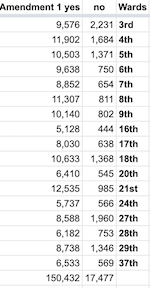
* The Workers’ Rights Amendment is getting almost 90 percent support in Chicago’s Black-majority wards. Data compiled by Isabel…
As I told you earlier, it got abut 80 percent citywide.
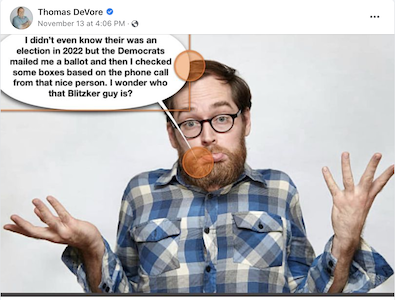
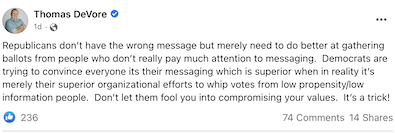
* Tom DeVore apparently believes everybody is as gullible as his handful of followers…
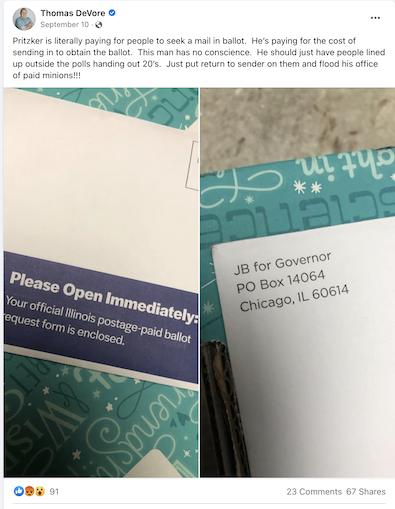
But here’s what he said in September…
Whiner.
* Why would the GOP even try to run a comprehensive and expensive mail and chase program when its base thinks mail-in and early voting are evil and should be abolished?…
Dem campaigns had more money than Rs, real campaigns. We got canvassing back, a D strength. Ds were motivated. DNC spent a lot of money on field.
Look at how much better Ds did in the early vote than 2018, 2020. Sign of organizational strength, hustle, good campaigns. 3/ pic.twitter.com/GMz0w72EWc
Mail and chase works, as do early voting pushes. Democrat Maggie Trevor was trailing Matt Padgorski for a Cook County Board seat by about a thousand votes last week. As of yesterday, she was ahead by 481 votes.
* Pantagraph | GOP chooses new leadership in Illinois General Assembly as Dems retain control: House Republicans elected Tony McCombie of Savanna and Senate Republicans chose John Curran of Downers Grove. The change in leadership comes after Democrats maintained control of every statewide office and had strong gains in last week’s elections across the rest of state government, aside from in the state Senate.
* Center Square | Some question rosy picture painted by Illinois’ five year budget projections: Gov. J.B. Pritzker claims the state is in great financial shape after the release of five-year budget projections. However, one economic analysis says the state still needs to address a particular problem. The state’s fiscal projections released this week show Illinois has been making strides in attempting to clear some of its long-term debts
* Crain’s | Like it or not, the Illinois GOP is now grappling with Candidate Trump: Jeanne Ives, a strong social and economic conservative who almost unseated then-Gov. Bruce Rauner in the 2018 GOP primary, welcomed the idea of a competitive GOP presidential primary. “I think it’s a great idea for Republicans across the country to have a debate over where the party should go,” she said. But, Ives continued, Trump overall is “a mixed bag.” Asked if his running would help the party, she replied: “Not in Illinois.”
* Jim Schultz and Warren Ribley | A December rail strike would be another gut punch to Illinois farmers: Behind the recommendations of an independent panel of arbitrators assembled by the president at the request of labor, the White House brokered a compromise that appeared to appease both management and union leadership. Yet, despite seven of the 12 rail unions approving the Biden deal during the last two months, three have failed to ratify. Two other unions are set to announce the outcome of their ratification votes in the coming days, with the likelihood of approval anyone’s guess.
* Great Lakes Echo | Green-backed candidates for governor fair well in Great Lakes states: Election Day has come and gone, and the results show that green-backed candidates for governor won in six Great Lakes states. They won in Michigan, Wisconsin, Illinois, Minnesota, Pennsylvania and New York, but lost in Ohio. All are Democrats. Environmental groups, such as the Sierra Club and League of Conservation Voters, backed them candidates in hopes of having their environmental priorities enacted.
* Let’s go back to the state’s Economic and Fiscal Policy Report that the administration is required to submit to the General Assembly each year. I posted the walk-down on Monday, but I wanted to look closer at pension payments, since the usual suspects are beating that particular war drum again.
Here are the annual projected state payments for the Teachers Retirement System, the State Employees Retirement System and the State University Retirement System by fiscal year. Dollar amounts are in millions…
Pension payments are estimated to be 20.1 percent of all expenditures this fiscal year and they’re projected to be 20.1 percent of all expenditures in five years.
Of course, that’s only if the current projections hold, which they sometimes don’t. Back in 2019, FY23’s projected state pension contribution was projected to be 20.4 percent of all state expenditures.
That’s obviously manageable.
* The problem is that projected expenditures will start outpacing projected revenues in FY25 by $464 million, and that gap will widen to $792 million by FY28. But those are small percentages and also include annual $80+ million in rainy day fund contributions. But even with those contributions, the budget deficit in FY25 is projected to represent just 0.9 percent of overall spending, and it’ll be 1.5 percent of spending by FY28.
Still, without a new revenue source, this means the state will have to keep a rein on spending.
In a historic win for organized labor, Illinoisans are adding a new amendment to the state constitution that will dedicate a “fundamental right” for workers to unionize and the ability to collectively bargain, according to unofficial results from The Associated Press. […]
The passage of a constitutional amendment is a rare act and the referendum question was being closely watched by union and business leaders across the nation. The Illinois measure required 60% of those voting on the question to vote “yes” for it to pass or 50% of all ballots cast to vote in favor of the question. […]
The amendment outperformed Democrats in many counties throughout the state, particularly in more conservative downstate areas.
In the small, far southern county of Massac, for instance, the “yes” vote on the amendment won by two percentage points even though Republican candidate for governor Darren Bailey easily defeated Pritzker in the county, according to the AP.
According to projections, the amendment received about 2.1 million “yes” votes and 1.5 million votes against. That’s 58.4 percent of the votes cast on that issue but about 53 percent of all the ballots cast in the election.
* Click here to see the list of county results. Click here to see a map of where the measure is currently clearing a constitutional hurdle for passage (60 percent of those voting on the question or a majority of all those voting in the election).
It has 60 percent or more in Cook, St. Clair, Champaign, Rock Island and Jackson counties. It has less than 30 percent in Effingham, Wayne, Clay, Jasper and Edwards counties. It’s at almost 80 percent in vote-rich Chicago and 64 percent in vote-rich suburban Cook.
Today, Lightfoot for Chicago announced the launch of its TV ad campaign with two ads, “Delivers Again” and “Believe.” “Delivers Again” stars characters “Oscar” and “Felix,” the two Chicago “experts” who are discussing Mayor Lightfoot’s track record for the city. “Believe” highlights the Mayor’s personal view on the progress of the city, while acknowledging the unprecedented challenges of the last four years.
“Delivers Again” features “Oscar” and “Felix” discussing Mayor Lightfoot’s public safety and violence reduction efforts, including:
Oscar: People don’t know. She’s delivering record spending for violence reduction, getting guns off the street, and more money for police. You know we didn’t get into this mess overnight.
Felix: True.
Oscar: Getting out of it takes time, and Lightfoot has a plan. Right?
Lightfoot: [On the phone] Hold on. I couldn’t have said it better myself.
Felix: [Offers video game controller] Wanna play?
Lightfoot: Love to, but I’ve got work to do for our city. [Returns to phone call]
Lightfoot: Believe in us. Believe in this city. We have come through hell and back, and we are the better for it.
Our economy is the best in the country.
We are making significant progress in public safety and implemented some of the most progressive policies that are going to make life better.
I’m not going to sit here and tell you we did everything perfectly–we haven’t. But we’ve tried our darndest to make sure that we got it right. And when we haven’t, you pick yourself up, and you listen, and you’re humble, and you learn from your mistakes.
* I long ago lost count of the number of times that the House Republicans won the news media cycle here. Agree with them or not, you absolutely cannot deny that they’ve been amazingly adept over the years at convincing reporters to run with their spin. It’s been quite something to watch. And the person in charge of the HGOP comms operation for most of that time has been Eleni Demertzis. Eleni informed staff today that she is leaving for another job. Culloton + Bauer Luce is fortunate to get her and I wish her nothing but the best…
I wanted to let you all know that my last day on staff will be November 30. I’ll be starting the next chapter as Vice President at Culloton + Bauer Luce, a boutique public affairs firm specializing in corporate reputation, issues management and crisis communications.
I’ve said this before and I’ll say it again – The HGOP has the best communications team in state government. Everyone brings their own talents to the table, but the reason why we are the best is because we always work as a team to get things done. We collaborate on ideas, we pinch-hit for each other no matter what the task is, we are always ready for the fight and we have always been in it together.
Thank you to each and every one of you for the role you play in the HGOP caucus, because it wouldn’t be possible without your contribution.
Malkin: At the state level, where you’re at, some prominent Republicans, such as Jim Durkin and Tim Butler are stepping down. What do you think that means for the future of the state Republican Party?
Miller: Well, I think that one of the things is that conservative ideals are gaining traction, and we have a beachhead, established in Illinois with the Illinois Freedom Caucus where, you know…we’re emphasizing…our worldview, as well as the Constitution and the Bill of Rights and the Republican Party platform. And I know that we’re committed to those three ideals. It’s going to be our true north to guide that…some see their power structure falling apart, then rather than staying and trying to fix things, they’re going to move on and do something else.
Malkin: Do you think that creates some more space or opportunity for the Illinois Freedom Caucus?
Miller: Oh, I think so. I think that, you know, let’s face it, the ideals that we’re promoting with individual liberty, with limited government, with the rule of law, with fair markets, with fiscal responsibility, the sanctity of life and peace through strength. Those are ideals that make America America. And I think one of the things that we haven’t done very well is we haven’t communicated those ideals. Because let’s face it, most of the people that live here in the state of Illinois, those are ideals that they live by, as they raise their families and they work hard and those are the ideals that motivate us to do the right thing, the right way all the time.
And then he went on to talk about how January 6 was just a peaceful gathering of mostly old folks and not an all an insurrection.
* Meanwhile…
Newly reelected GOP House member from rural Illinois wastes no time saying she's sticking with Trump https://t.co/5eUDklvxqK
McFarland Mental Health Center employees to demonstrate over lack of staff
WHO: Frontline employees of McFarland Mental Health Center represented by INA and AFSCME
WHAT: Informational picket to raise awareness of severe staff shortage
WHERE: Outside McFarland Mental Health Center, 901 Southwind Dr.,
Springfield, IL 62703
WHEN: TODAY (Wednesday, November 16 at 2:30 p.m.
BACKGROUND: Frontline employees who support individuals with mental illness at McFarland Mental Health Center in Springfield, Ill., are raising awareness of a severe staff shortage at the state-operated facility and throughout state government.
Members of the Illinois Nurses Association (INA) and the American Federation of State County and Municipal Employees (AFSCME) Council 31 will hold an informational picket outside McFarland Mental Health Center today, November 16th at 2:30 p.m.
AFSCME and INA members say the lack of staff threatens to erode the quality of care for patients at McFarland, poses a safety risk to employees, and is driving out-of-control overtime—including mandatory overtime—that is leading to burnout among workers.
According to INA, there are 49 nurses who work at the Center but there are seven nursing positions open. Meanwhile, 22 of the 98 Security Therapy Aide and Mental Health Technician positions, represented by AFSCME, are also unfilled. Both unions are calling on the State to host a job fair and aggressively recruit to fill these vacancies. Nurses have also told management they want the option of working 12.5-hour shifts to reduce burnout and not being mandated to work overtime. Center management has failed to implement a negotiated agreement on these key issues, according to INA.
Representing registered nurses employed by the state of Illinois, the INA stands for nurses’ rights to be the best advocates for their patients and their communities.
AFSCME Council 31 is the largest union of public service workers in Illinois—with a membership that includes more than 30,000 state employees—and a leading voice for working families statewide.
Illinois Senate President Don Harmon issued the following statement after receiving support Tuesday from the Illinois Senate Democratic Caucus to continue in the position next year.
“I want to thank my colleagues for their continued support. Our accomplishments in the Senate are a team effort. We head into a new session collectively focused on moving Illinois forward.”
The 103rd General Assembly inauguration is scheduled for Jan. 11, 2023.
* Sen. John Curran…
THE FOLLOWING IS A STATEMENT BY STATE SENATOR JOHN CURRAN (R-41st DISTRICT) ON HIS UNANIMOUS ELECTION AS SENATE REPUBLICAN LEADER FOR THE 103RD GENERAL ASSEMBLY:
“I am humbled and honored to have the full support of my Senate Republican colleagues to serve as their new leader in the 103rd General Assembly. We stand ready, with our focus directed toward the future, on developing solutions that will address the critical issues facing our state. We are equally dedicated to growing our ranks, which will give all Illinoisans greater representation and balance in their state government.”
* Sen. Dan McConchie…
In response to the Senate Republican Caucus choosing a new Leader for the 103rd General Assembly, outgoing Leader Dan McConchie released the following statement:
“It has been my distinct privilege to serve as Senate Republican Leader, and I wish Senator Curran the very best as he assumes the helm.
“Running for office, let alone running for Leader, was never something I aspired to do. In both cases I responded to a call to serve. In this latest role, I am proud of my record and accomplishments.
“Illinois’s problems are not a mystery. While people for years have flocked to states with lower taxes and better standards of living, Illinois’s net population has largely stayed flat. We all know people who have left our state for better environments. It is the moral responsibility of the state’s leadership to attempt to address the real systemic problems facing our state so that we once again can become the people magnet we once were. On this point, the Democratic leadership fails miserably while the Senate Republicans stand strong.
“In my tenure, we became a caucus unafraid of putting real solutions on the table and engaging in rhetorical battle for them. We introduced numerous bills covering a whole host of issue areas that outline our vision to once again make Illinois a state to which people flock. We weighed into the debate with vigor fighting for that vision that we know can put us on the path to a brighter future.
“I can only presume that the majority’s refusal to even allow debate on our suggestions is rooted in fear - fear that the public will embrace an alternative to the singular reality they are currently offered.
“When I assumed this role, I committed to grow the Caucus by recruiting outstanding candidates and providing them with resources so they had a chance to win despite Pritzker’s wallet and the gerrymandered maps that put us at a severe disadvantage. To that end, I was able to raise the most money the Senate Republicans have perhaps ever seen and will leave the Caucus with more members than I started - even as our party saw defeats in every other area.
“During my time, we brought forward real ideas to move Illinois ahead, gave voice to them, and worked to have them considered. We stayed true to ourselves and fought for both our values and our constituents. As I continue to serve in the Senate, I promise to keep up this fight for the future of all Illinoisans.”
Hoping to revive their party in Illinois after tough Election Night losses, Republicans on Tuesday met behind closed doors to select their new legislative leaders: state Sen. John Curran of Downers Grove and state Rep. Tony McCombie of Savanna.
House Republicans voted 31-8 to select McCombie as their new leader in a binding caucus vote.
Illinois House Republican Leader Jim Durkin announced last week that he wouldn’t be seeking reelection as minority leader — and the Western Springs Republican threw his support behind McCombie to take the leadership baton. State Rep. Martin McLaughlin, R-Barrington Hills, secured eight votes. […]
A letter signed by 23 House Republicans last Friday acknowledged the caucus was experiencing “profound changes” and needed a leader with “energetic determination to rebuild the House Republican Caucus.”
McCombie also has joined Republicans who’ve been critical of Pritzker’s management of the state’s Department of Children and Family Services. She was the House sponsor on a bipartisan bill allowing the families of DCFS workers to acquire state benefits if the workers are killed while performing their duties. The measure, which Pritzker signed into law, was prompted by the January slaying of DCFS worker Deidre Silas who was stabbed to death during a home visit in central Illinois. McCombie also joined fellow Republicans in opposition of COVID-19 mitigations. In February, McCombie was among several GOP House members who refused to wear a mask on the House floor.
McCombie also joined fellow Republicans in opposition of COVID-19 mitigations. In February, McCombie was among several GOP House members who refused to wear a mask on the House floor. […]
Regarded as a more moderate Republican, Curran, unlike McCombie, has supported various gun control measures over the years. He was the only GOP senator in 2021 to vote with Democrats in passing a bill that overhauled the state’s firearm owner’s identification card system. That legislation was prompted by a mass shooting at an Aurora warehouse that left six people dead, including the gunman, and several wounded, five of them police officers.
“We stand ready, with our focus directed toward the future, on developing solutions that will address the critical issues facing our state,“ Curran said in a statement Tuesday night.
McConchie issued a statement wishing Curran well and saying Democratic leadership in Illinois has failed “miserably” at addressing the state’s systemic problems.
McCombie, who will represent the 89th district in the new General Assembly, was one of the early favorites to ascend to the position, according to Politico, and she was voted into the office during a caucus meeting on Tuesday.
“The House Republican Caucus is focused on helping Illinois families by offering common sense solutions to the many problems our state faces,” she said in a statement. “We will be a unified force that will grow our party by sticking to our core values and ending the corruption that has pervaded state government.”
McCombie is the former mayor of Savanna, with party leadership praising her ability to balance budgets before being elected to the General Assembly in 2016.
She previously headed up the campaign arm of the House Republican caucus, and she is currently the party’s spokesperson on the Restorative Justice Committee.
McCombie will be the first woman to serve in a top leadership position in the Illinois House. In 2009, Senate Republican Leader Christine Radogno of Western Springs became the first woman to serve in a top leadership post in that chamber. […]
“I came up short. And I’ve done this job for nine years and I have no regrets,” Durkin said. “I’ve been involved with some amazing pieces of legislation, historic moments in Springfield, but I’m also – at this point – I believe it’s great for me to be able to say goodbye and pass it off to the next generation. We’re bringing in a new set of eyes, new energy.” […]
While she has a reputation for conservative leanings, those with knowledge of the internal meeting said McCombie did not receive unanimous support – a sign of the ongoing tension within Republican ranks.
Signs the most right-leaning wing of the House Republican caucus would not support McCombie were apparent last week, when news broke that she had locked enough support to win the job.
Rep. Dan Caulkins, R-Decatur, released a statement Friday bemoaning what he said was “strong arming and media manipulation … the kind of tactics that have produced an apparent permanent minority caucus in the House.”
Republican senators also changed leaders, selecting Downers Grove Republican state Sen. John Curran.
“I am humbled and honored to have the full support of my Senate Republican colleagues to serve as their new leader in the 103rd General Assembly,” Curran said in a statement. “We stand ready, with our focus directed toward the future, on developing solutions that will address the critical issues facing our state. We are equally dedicated to growing our ranks, which will give all Illinoisans greater representation and balance in their state government.”
Curran replaces Senate Minority Leader Dan McConchie, R-Hawthorn Woods.
“Running for office, let alone running for Leader, was never something I aspired to do,” McConchie said in a statement Tuesday evening. “In both cases I responded to a call to serve. In this latest role, I am proud of my record and accomplishments.”
…Adding… Press release…
The American Federation for Children, the nation’s voice for educational choice, congratulates newly chosen leadership of the Republican caucuses in the Illinois General Assembly. The Illinois Senate Republican Caucus has chosen Senator John Curran as its next Leader while the House Republican Caucus has chosen Representative Tony McCombie to serve as its next Leader and first female Leader.
The American Federation for Children looks forward to working with both Leader Curran and Leader McCombie to galvanize their respective caucuses in support of the successful Invest in Kids tax credit scholarship program, with the critical legislative goal of removing the sunset.
The American Federation for Children also wishes to extend its strong appreciation for the contributions that outgoing Leaders Dan McConchie and Jim Durkin have provided to the school choice movement during their tenure leading their caucuses in Springfield.
* WAND | Sen. John Curran selected as new Illinois Senate Republican leader: Outgoing leader, Senator Dan McConchie released a statement wishing Curran the best. In his own statement, Curran said that the caucus stands ready, “with our focus directed toward the future, on developing solutions that will address the critical issues facing our state.”
* CBS Chicago | Rep. Tony McCombie elected new Illinois House Republican leader: McCombie was elected to the Illinois state House in 2016, representing a Western Illinois district. She previously served as the mayor of the Mississippi River town of Savanna, where the Illinois General Assembly said she was known for balanced budgets and her solid administrative background.
* WBEZ | Republican challenger concedes to Illinois Democrat accused of domestic violence: Democrat Michael Hastings could claim a narrow reelection win in a state Senate race in the south suburbs after officials reported updated vote totals Tuesday, overcoming accusations of domestic violence to edge Republican challenger Patrick Sheehan. In a statement, Sheehan said he had conceded the race. The concession came hours after Will County officials released the results of their tabulation of hundreds of ballots from the Nov. 8 election.
* Jim Nowlan | Here’s my advice for making the Illinois Republican Party relevant again: What to do? Contrary to the adage of late U.S. House Speaker Tip O’Neill that all politics is local, American politics today have largely been nationalized by social media, Trump and the decline of local and state party organizations. Yet each state has its own issues, and Illinois is struggling with population loss, as well as job growth that has been slower than nationwide. Thus, the Illinois Republican Party needs to have a constructive, appealing program in place as the Trump phenomenon fades away.
* Illinois Newsroom | State Rep. Chris Miller reflects on January 6, analyzes midterm elections in IPM interview:“Well, I think the first thing that we have to, you know, (do is) admit that our projections, and our predictions were off. Actually, by a lot. But, you know, I think…you always have to look for the silver lining in some of these things. And I know that it’s pretty clear that Republicans made inroads in suburban women to Latinos and many other groups. And, you know, and it wasn’t that long ago, where Florida was kind of looked at as a swing state,” Miller said.
* WJBC | Illinois Senators are on the move during Capitol construction: The renovation of the north wing of the state Capitol has pushed out the senators. Tuesday marked not only the start of the 2022 veto session; it was also the first day of a nearly 2 ½ -year stay in the adjacent Howlett Building. A deteriorating auditorium received a massive facelift to function as the temporary Senate chamber.
* SJ-R | Illinois Native Americans to gather at Old State Capitol, demand inclusion: Johnson said the lack of representation on the Illinois State Board of Education’s Inclusive American History Commission, a 22-person group chosen to assist ISBE in revising its curriculum to be more inclusive of all cultures, is telling of how native people are ignored.
* NBC 5 | How a Strange Deal Struck in Springfield a Decade Ago Now Prevents Illinois Communities From Banning Assault Weapons: “I was very disappointed,” former Gov. Pat Quinn said of those days more than nine years ago. “Some of the Democrats who I thought would vote yes on the legislation all of a sudden were saying, ‘People in my district aren’t for it.” Quinn said he was astounded that the proposed statewide ban fell two votes short, despite the presence of Sandy Hook families he had taken to the Capitol to tell their personal stories.
* WPSD | Illinois voters approve collective bargaining amendment: Unions groups said its approval could signal a new chapter in the struggle over workers’ rights as U.S. union ranks have grown. They view it as a way to ensure that workers will always be able to use their collective clout to secure better pay, hours and working conditions.
* Politico | Unbowed by midterms fiasco, Trump tries for president again: It is an extraordinary — although long anticipated — move for Trump, one certain to reshape his party’s trajectory, raise complicated legal questions and alter the presidency for the man who defeated him, Joe Biden. He explicitly discussed his campaign as an effort to restore the presidency he had.