David Gill Ends Congressional Campaign in 13th District
Thanks Supporters & Calls on Rodney Davis to Seek Compromise To Help Middle Class
Dr. David Gill, Democratic candidate in Illinois’ 13th District, issued the following message to his supporters as he ended his campaign for Congress this afternoon:
“My exhausted campaign team has completed a county by county analysis of outstanding provisional and absentee ballots in the 13th Congressional District, as well as some precinct-based anomalies in ballot returns and turnout.
The closeness of this race (less than 1/2 percentage point) demanded that we diligently check the numbers. I am very grateful for the dedicated work of my campaign staff to go through this data in the last few days, and for the cooperation of election officials in each of the 14 counties.
It has become clear to me, based on the numbers I’ve seen, that there are simply not enough uncounted ballots remaining to wipe out the current 1,287 vote deficit I face in this election. […]
While Rodney Davis and I have very different priorities and political philosophies, I hope we share a few things in common: a deep desire to see a better future for the communities we love in this part of Illinois and a commitment to leave things better than we found them for our children. I hope Mr. Davis will seek ways to compromise and support the President so we can see real progress for middle class families.
The time has now come to bring this exciting campaign to a close. I know the friendships and partnerships we have forged in this long fight together will go on for many years to come. I will never forget all that you have done.”
* Davis’ statement…
Congressman-Elect Rodney Davis issued the following statement Friday evening following David Gill’s concession in the 13th Congressional District race:
“I would like to thank David Gill for the passion with which he campaigned. I appreciate that he has forgone dragging this out further with his concession this evening. Shannon, our family, and I are thankful for the wonderful support we’ve received. I am humbled to have the honor to serve as Congressman for the 13th District and am ready to get to work.”
* Someone once said that the end of a political campaign has all the subtlety of a freight train crashing into the side of a mountain. So, let’s have Jamey Johnson and Alison Krauss make the world go away…
* You may have noticed that I haven’t picked on Illinois GOP Chairman Pat Brady this week, despite his party’s big losses. One reason for that is, unlike the Democrats’ top guy, the Republican chairman is rather powerless. The losses cannot really be blamed on him.
Yes, his “Fire Madigan” mantra failed miserably. But lots of commenters have already dinged the guy for that. It didn’t work. At all. Speaker Madigan and President Cullerton picked up almost every seat they targeted, and then some. And while the new map put Democrats in play, it didn’t explain some outcomes, like Sam Yingling’s huge upset win against GOP Rep. Sandy Cole up in Lake County.
I’ve talked with Pat Brady many times over the years. He’s not a bad guy at all. And I was told that he offered to resign on election night because somebody, somewhere ought to man up and fall on his sword. I respect that.
Part of Republicans’ brutal losses can be chalked up to the once-a-decade redistricting process, during which Democrats redrew political boundaries to their favor, Brady said.
But he also said Tuesday’s losses demonstrate that Illinois Republicans have a larger image problem.
“You can’t whine about the map. The map’s the map,” Brady said. “We need to take a cold, hard look at what happened, face the realities and do better, which we will.” [Emphasis added.]
* One of those realities the party needs to face is that making robocalls and even in-person calls hasn’t worked all that well. In 2010, the party claimed to have made 4 million calls to voters, urging them to cast their ballots for Republican candidates. This year, the party made the same claim about the same 4 million calls.
Our beloved Oswego Willy loves to talk about how the Republicans in this state can’t seem to get any sort of ground game going. For instance, here’s a comment from today about the 2010 campaign…
ILGOP needs to do the following:
Find more GOP voters in Cook, as simple as 4 more KNOWN votes per precinct in Chicago and Cook, given that “known” GOP voters and NOT voting, literally VOTING at a 100% turnout. (2034 Pcts in the City, 1673 Suburban Cook), that gets you 14,800 … Brady lost by just over 19,400, you now need to find 4,600 votes … in the entire state.
4 votes …4 voters … 2 houses of a couple that has a recorded GOP history and they didn’t vote … at all. Remember, not AGAINST Brady’s conservative views, they didn’t vote.
4 votes, and then the collars and the rest of the state should be ably to find the 5,000 to easily get over.
If you have a strong GOTV and Field Operation.
* As a group, Republicans just don’t walk many precincts. Some do, but not most. Still, focusing very hard on a smaller number of people could definitely help. And that can be done over the phone, and in mail, and in an efficient and aggressive vote-by-mail campaign.
It won’t solve all the party’s many, many problems. And it won’t insulate the GOP from the national freak show. But it would be a good start.
* Also, I mentioned this yesterday, but the party chairman cannot be timid about calling out the flakes. Chairman Brady could have helped insulate people like Bob Dold by publicly taking that goofball Joe Walsh to the woodshed after Walsh’s infamous “no exceptions” press conference. The far Right might’ve blown up, but it’s not like they’re in danger of voting Democratic.
Brady says he’s putting together an “after action” report. A realistic and effective GOTV program needs to be a big part of that. But he also needs to be willing to be a referee within his own party.
*** UPDATE *** As noted by a commenter, House Speaker Michael Madigan revived a bill of his today that directly impacts this topic…
Declares that the State shall appropriate for no more than an X% increase for wage increases associated with any and all collectively bargained contracts throughout State government.
States the policy of the State of Illinois that the size of, or a reduction in, the State employee workforce shall not be a topic of collective bargaining.
The bill has been languishing for a year, but was moved into the House Revenue Committee today. The proposal has bipartisan co-sponsorship.
[ *** End Of Update *** ]
* A friend of mine came home from work last night and found this Henry Bayer robocall on his answering machine…
This is Henry Bayer, director of your union, AFSCME Council 31.
Negotiations for a new state contract have gone on for more than ten months, and the Quinn administration is still demanding big takeaways that will reduce your pay and drastically increase your health insurance cost.
That’s why state employees are coming together to take action at their worksite next week, between November 13th and the 15th.
We have to make clear to management that we are not going to accept these very steep cuts.
If you’re not willing to settle for a contract that drives down your standard of living, then join in the Unity Days of Action at your worksite next week.
These action days are being coordinated at the local and worksite levels. I asked AFSCME for some examples of what its members will be doing. The e-mailed response….
- “Green Days” in which all members wear AFSCME green shirts, wristbands, jackets or hats;
- Displaying signs with “Stand Together” and “Fair Contract” messages in cars and throughout worksites;
- Solidarity actions such as all members marching into a worksite together in the morning, standing up as one and silently displaying signs in their worksite at an appointed time, or picketing worksites over the lunch hour.
Illinois Gov. Pat Quinn says he’s looking forward to accomplishing pension reform by Jan. 9 with bipartisan cooperation and before a new Legislature is sworn in. […]
Quinn says an overhaul of the state’s employee retirement system is needed so there will be adequate resources for schools, public safety and veterans’ programs.
He says Tuesday’s election results show that voters across the country want to see Democrats and Republicans work together.
* Over 100 people responded to yesterday’s question about state Sen. Kirk Dillard’s upcoming gubernatorial campaign. Large numbers described him as a “moderate” who would save the Republican Party.
I’ve known Sen. Dillard for a very long time. He’s a good guy and a good legislator. He’s well-known for working across the aisle, and his moderate bonafides were boosted when he cut that TV ad for Barack Obama’s 2008 primary campaign.
* But on abortion, guns and gay rights he’s no moderate. And those three issues play heavily in the suburbs.
Dillard was rated as “Fully Pro-Life” this year by Illinois Citizens for Life and was endorsed by the Illinois Federation for Right to Life PAC. Judy Baar Topinka was a moderate on abortion issues, supporting most abortion rights but also supporting things like parental notification. That moderate stance got her labeled as a pro-life fanatic by groups like Personal PAC, which raises and spends big bucks in this state.
And while gay rights has become a far more acceptable issue in Illinois, Dillard attempted to intervene in a lawsuit this year on the anti-gay rights side. He also voted against civil unions.
* All campaigns are cartoons. We are subjected to black and white arguments. Nuance and moderation don’t always come through very well. Topinka was slammed in a cartoonish way for her moderation on abortion. But Dillard’s position is the same as Bill Brady’s on that issue, so he’ll be subjected to a similar assault if he wins the primary. The same goes for guns and gays.
I am not saying here that Dillard cannot win a general election. I’m also not saying that Dillard doesn’t have a moderate persona. What I am saying, however, is that he will be portrayed in TV ads as a hardline right-winger if he makes it to the general election.
When it comes to the idea of raising income taxes, about half felt that families making over $250,000 a year could afford to pay a little more. About four in 10 wanted to see tax rates frozen for everyone, while few backed the idea of an across-the-board tax hike.
Efforts to dismantle a 16-year ban on same-sex marriage in Illinois may be gaining support. Two years after the state legalized civil unions, more than half of voters said the state should legally recognize same-sex marriages. No issues involving same-sex marriage or civil unions were on the ballot.
Illegal immigrants wanting a chance to apply for permanent residency appear to have Illinois in their corner. More than 70% of voters say illegal immigrants working in the U.S. should be given a chance to apply for legal status.
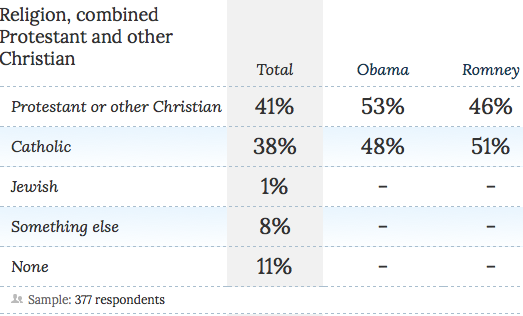
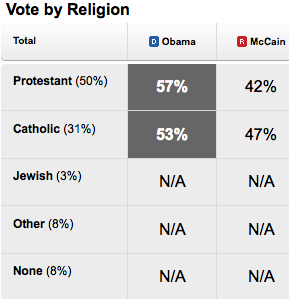
Definite slippage among Catholics, so the bishops should be somewhat happy. But Obama also slipped among white voters overall this year, so that may explain at least part of the Catholic result.
* Sometimes, a graph is easier than reading. My Sun-Times column today is based on a graph I made yesterday afternoon to help myself understand Tuesday’s election. I was so blown away by the chart that I had to write about it. Using exit polling data, here is the partisan makeup of self-identified election day voters since 1992. Click for a better view…
For the first time in at least 20 years, more independents voted in Illinois last Tuesday than Republicans.
I spent part of Thursday afternoon going through some exit polling data to see if I could find anything to cheer up my Republican friends. I really couldn’t.
Way back in 1992, when Republican Jim Edgar was governor and George H.W. Bush was running for re-election against Bill Clinton, 39 percent of Illinois voters told the exit pollsters they were Democrats; 34 percent said they were Republicans, and 27 percent said they were independents.
Two years later, when the country turned against Clinton and the Republicans swept just about everything here and nationally, the two parties were tied at 36 percent each in Illinois, with 28 percent saying they were independents.
The Republicans dropped down to 32 percent two years later, while the Democrats surged to 42 percent. Things stayed more or less the same until 2006, George W. Bush’s second midterm election, when Democrats vaulted to 46 percent, Republicans dropped to 31 percent and independents plummeted to a 20-year low of 23 percent.
Obviously, the Democrats won over independents, and the Republicans lost them. Republicans continued losing more independent-minded folks in 2008, when Barack Obama was elected president. Democrats made up 47 percent of the Illinois electoral pool, but Republicans dropped to 28 percent and independents moved up to 28 percent.
And despite a national Republican landslide in 2010, people who said they were Democrats dropped just 3 percentage points, to 44 percent. Republicans moved up only three points to 31 percent, and independents dropped a couple of points to 24 percent.
Believe it or not, the percentage of voters who said they were Democrats was the same in this year’s election as it was in 2008: 44 percent. But Republicans tumbled to 27 percent and independents rose to 28 percent.
The number of people who say they’re independent really hasn’t moved a whole lot over the past two decades. It has been within a five-point range for more than 20 years.
The Republican Party’s problem is that it has been on the decline overall since its 1994 high. Part of the reason is that a triple whammy hit the GOP: George Ryan, George W. Bush and Barack Obama. Ryan’s corruption turned voters away from their favored state governing party; Bush turned Illinoisans off altogether, and Obama is the home-state guy.
So, it’s possible that with both Georges long gone and Obama having won his final election, Republicans might start returning to a more reasonable level of support. But they probably can’t turn around numbers like this on a dime.
For starters, women have left the party in droves. In 1994, 61 percent of Illinois women voted for the pro-choice Edgar’s re-election bid. By 2010, just 44 percent of women voted for the pro-life Republican gubernatorial candidate Bill Brady. And this year, a mere 35 percent of women here voted for Mitt Romney, according to the exit polls.
If the Republicans don’t do something differently, and soon, they’ll hurt their brand so much that most women will eventually refuse to vote for any GOP candidate.
Latinos, the fastest-growing ethnic group in Illinois, also have trended more Democratic. In 2004, 53 percent of Latinos voted for John Kerry. Two years ago, 63 percent of Latinos voted for Democratic Gov. Pat Quinn. This year, 81 percent went with Obama.
The bottom line here is that the GOP has to stop alienating women and Latinos. Now. Today. There is simply no other path back to relevance in Illinois.