* I’m a huge, committed believer in the right to protest and to peacefully assemble. But these self-described “anarchists” who cause trouble at demonstrations throughout the country have got to be stopped. So, welcome to Chicago, morons…
Several thousand protesters spent five hours peacefully chanting, singing and marching against war. At the end, nearly 40 young veterans dramatically took their military medals and hurled them toward McCormick Place, where world leaders met behind closed doors.
It was supposed to end there — at Michigan and Cermak.
But a “Black Bloc” of about 100 anarchists wanted something else. The group, which chanted “What do we want? Dead cops!” as it left Grant Park at 2 p.m., surged to the front of the protest crowd and tried to break through the imposing line of Chicago cops in riot gear blocking its path.
Then, in a scene Chicagoans feared ever since the city learned it would host the NATO Summit, the two sides violently clashed on live TV, with police nightsticks flailing and protesters unleashing a volley of sticks, bottles and at least one rock.
The battle at Michigan and Cermak flared and then slowed, and then flared again in bursts between 5 and 6:30 p.m. By then, much of the Black Bloc had slipped away, leaving behind a scene of bloodied protesters and four injured cops, including one stabbed in the leg.
* It would help, though, if the city understood what they were dealing with in advance…
Prosecutors say the three men charged Saturday with plotting to attack President Barack Obama’s campaign headquarters, Mayor Rahm Emanuel’s home, police stations and squad cars were anarchists and “members of the ‘Black Bloc’ group.”
But a black bloc isn’t an organization. Rather, it’s a tactic for marches.
Participants wear black clothes, bandanas, masks and anything else to conceal their identities from police.
Black blocs first drew the attention of mainstream America in 1999 during demonstrations against the World Trade Organization in Seattle. A black bloc went on the offensive, bashing windows of many businesses in downtown Seattle including Starbucks, Gap and other businesses with a global reach.
Black bloc vandals also damaged property during the 2010 G-20 meeting in Toronto.
Black bloc participants say they conceal their identities for fear of reprisals from police, who often infiltrate black blocs during demonstrations to identify those committing crimes.
The Black Bloc was also believed to be involved in another incident that took place during the march, an Associated Press report indicated that police and protesters clashed during the middle of the parade. The protesters, dressed in black, allegedly surged toward police and threw objects at officers. Police fought back with batons.
Those protesters ran away, but reconvened with the main crowd near the parade’s end at Cermak and Michigan Avenue and are believed to be part of the later clash with police, who beefed up security around that area — and officers showed up in full riot gear.
When police surged forward a second time — shouting “move” and using their clubs as barricades to shove protesters — many at the front of the crowd could not move fast enough. Several fell to the ground and were trampled by other protesters also being shoved back by police.
As reporters and protesters in the center of the melee screamed “There’s nowhere to go — stop!” the police line stopped just in time to prevent a disaster.
A good rule of thumb is that when reporters feel their safety has been threatened, you’re gonna see harsh coverage. The Sun-Times article was quite balanced, considering.
As someone who walked the entire parade route with the NATO protestors, from the Petrillo Band Shell to the corner of Michigan and Cermak, I can tell you there were two groups no one wanted to come in contact with: the police, and the Black Bloc.
From the outset, it was clear that the march’s organizers were not enthusiastic about the appearance of the Black Bloc, a gang of black-clad anarchists who believe that no protest is complete without a punch-up or a broken window. Marshals in orange vests ordered them to move further back in the crowd. They didn’t want the Black Bloc in the vanguard, as the face of the anti-NATO protests.
And yes, they were all dressed in black: black hoodies, black bandannas, black masks, black jeans, black boots. One Black Bloc member even brought along a black dog. Only the police, in their riot helmets and body armor, must have been hotter on that 85-degree day. Seeing themselves as the purest element of protest, the Black Bloc even tried to intimidate peaceful marchers, who they considered insufficiently radical. […]
At the corner of Michigan and Cermak, the march ended with speeches by veterans of Iraq and Afghanistan, who apologized for their roles in those wars and tossed their medals into the trees behind. After that ceremony ended, the police ordered protestors to “Move West” — toward the Cermak/Chinatown Red Line stop. Almost all the protesters complied. But not the Black Bloc. They’d come for a fight, and they weren’t going to leave without a cut or a bruise they could point to and boast, “Police brutality.” McCormick Place was in sight, beyond a line of mounted police officers.
“NATO is east!” the hardcore Black Bloc shouted. “NATO is east!”
They didn’t put up much of a struggle. Nobody got past the police lines. I hadn’t expected them to triumph in a conflict with the cops. None of them looked very big, very fit, or even very tough.
The Black Bloc didn’t storm McCormick Place, but they got more attention than the thousands and thousands of peaceful protestors surrounding them. That may have been their real mission on Sunday.
Their real mission is fighting with cops and causing trouble. They’re basically just punks who think they’re cool because they dig violence. They’re no different than European soccer hooligans, except their venue of choice is otherwise peaceful protests instead of sporting events.
A tense and often confrontational meeting over gambling expansion last week ended with Gov. Pat Quinn being evasive but not explicitly saying “no” to adding slot machines at horse racing tracks.
That might be the beginning of a reversal on the gambling issue for Quinn, who has adamantly opposed allowing tracks to offer slots.
Installing slots at the horse tracks is viewed as essential to passage of the gambling package that was stymied twice last year, once when Quinn adamantly opposed the concept and never was sent the bill to sign. The plan is to add five casinos, including one in Chicago and the south suburbs, in addition to allowing the tracks to offer slots.
There’s been a push on for months to get Quinn to change his mind. The key here is apparently Quinn’s demand for a ban on campaign contributions from gambling interests.
It’s widely believed that Quinn has opposed slots at tracks and wants the contribution ban at least partly because of heavy Republican contributions by Craig Duchossois in the 2010 campaign, including several to Quinn’s GOP opponent. Duchossois is the son of Arlington International Racecourse chairman Dick Duchossois.
The meeting last week was apparently quite contentious at times.
“I felt like I almost missed Rod,” cracked one participant afterward.
The governor patronizingly attempted to explain to Senate President John Cullerton (D-Chicago), Rep. Lou Lang (D-Skokie) and Sen. Terry Link (D-Waukegan), who have a combined legislative tenure of 73 years, how to pass a bill. Quinn doesn’t exactly have the greatest track record of passing bills, so that advice didn’t go down too well.
Quinn also angrily told Lang that he would “crush” the legislator if Lang attempted to move a bill without a campaign contribution ban.
The meeting apparently took place because proponents managed to build a roll call that showed 67 House members supporting gambling expansion. That’s four votes shy of overriding a gubernatorial veto, but it’s enough to perhaps make the governor think he might eventually lose.
At one point during the meeting, Link reportedly became fed up with the direction and tone and tried to get things back on track. If, Link said, the General Assembly agreed to a campaign contribution ban from casinos, racetracks, etc., would Quinn agree to slots at tracks?
The governor’s response, according to multiple sources, was that Gary Hannig would be working with them on that. Hannig is Quinn’s chief legislative liaison.
Link then repeated his question. If the Legislature agreed to a contribution ban would Quinn agree to slots at tracks? The governor angrily repeated that Hannig would be working with them on the issue.
Despite his deliberate evasiveness, people at the meeting did make note of the fact that the governor was no longer saying that he flatly rejected slots at tracks.
Hannig was then reportedly told by Lang not to bring him a draft bill that didn’t contain slots at tracks. A majority just doesn’t exist for gaming expansion without help for tracks. Hannig’s response was that he’d try to deliver something the next day.
Well, that day came and went, and no Hannig draft arrived.
But then the House left town for a few days, so the governor’s office still has some time to come up with a plan, even though Lang appeared to be growing restless last week. He’d rather have a negotiated agreement, but there is a strong sense among participants that Quinn wants to delay this issue until after the Nov. 6 election, so they’d better do something soon, either with him or without him.
The theory is that Quinn wants to pass a budget this month without using gaming revenue. Patching budget holes with gambling money could be seen as unseemly, and Quinn is attempting to revive his public image these days.
A new gaming law could also dent Quinn’s image when he’s attempting to be viewed as the man who saved pensions and Medicaid and got the budget back on track. Simply put, gaming would taint Quinn’s upcoming victory lap.
The second part of the theory is that Quinn will announce big problems with the budget before the fall veto session and use those “unforeseen” problems to justify gambling expansion, including a flip-flop on slots at tracks. The flip-flop would pale in comparison to the problems he could fix with a lot more gambling revenue.
Gambling expansion bills have never become law in the past unless all four legislative leaders and the governor were working together. This one probably won’t be any different.
* Here are a few stories about the Senate Democrats’ budget proposal, which they unveiled Friday afternoon…
* State Senate Dems set budget goal higher than House’s: Illinois Senate Democrats on Friday outlined a budget plan that spends less than Gov. Pat Quinn wanted, but more than the House declared earlier that it is prepared to spend next year. The Senate plan would keep education spending at the same level as this year, but does assume the state will have to close facilities and cut jobs next year. Democrats declined to offer specifics of those reductions.
* Senate Democrats’ spending plan offers deeper cuts than Quinn proposed: However, a top Senate Republican was not convinced the Democrats’ math was correct, saying the amount of cuts to the state’s Medicaid program isn’t large enough and assumes new revenue from a $1 per pack cigarette tax increase.
The Senate Democrats’ proposal would draw money from areas of the state’s budget outside of the General Revenue Fund. In addition to the money being set aside to pay down the backlog, Senate Democrats are calling for more than $400 million be taken from special funds to pay overdue bills. Democrats say the fund sweeps they are proposing would be a one-time move to pay off old bills and would leave enough money in the funds to ensure that they are operational for their original purposes.
Fund sweeps works by taking unspent money in dedicated funds — such as the Cycle Rider Safety Training Fund, which is supposed to support classes on motorcycle safety — and using it for general spending. The Senate Democrats would use about $400 million in fund sweeps to pay down some of the state’s $8.5 billion overdue bills.
“There’s $8 billion sitting in multiple piggy banks, 500 piggy banks, at one time. We’re hoarding money in these little banks,” state Sen. Donne Trotter, D-Chicago, said at a news conference Friday.
The Illinois Supreme Court recently gave the state the green light to sweep these funds, as long as they’re not federal money. Gov. Pat Quinn, however, has only supported borrowing money from the funds. The SDems want to take the cash.
* The Question: Do you support one-time sweeps of these special state funds or just borrowing from them? Take the poll and then explain your answer in comments, please.
* The Sunlight Foundation just released its new analysis detailing the grade level at which members of Congress speak.
The report uses the Flesch-Kincaid test to conduct the analysis, which awards a higher-grade level for using longer words and more complex sentences. The foundation’s results reveal that the vocabulary and spoken sentence structure of Congressmen has slowly been declining over the course of the nation’s history…
Today’s Congress speaks at about a 10.6 grade level, down from a high of 11.5 in 2005. By comparison, the U.S. Constitution is written at a 17.8 grade level, the Federalist Papers at a 17.1 grade level and the Declaration of Independence at a 15.1 grade level.
* So how do our Congressmen rank? The average Illinoisan member of Congress speaks at an 11.34 grade level- almost a grade above the Congressional average. Here’s a descending list (highest speaking grade level to lowest) of where the analysis had Illinois’ delegation…
Rep. Danny Davis (D) 13.81
Rep. Daniel Lipinski (D) 13.49
Sen. Mark Kirk (R) 12.9
Rep. Tim Johnson (R) 12.43
Rep. Jerry Costello (D) 12.38
Rep. Jesse Jackson (D) 11.95
Rep. Mike Quigley (D) 11.79
Rep. Bobby Rush (D) 11.74
Rep. Bobby Schilling (R) 11.72
Rep. Luis Guitierrez (D) 11.63
Rep. Aarron Schock (R) 11.53
Rep. Randy Hultgren (R) 11.44
Rep. Peter Roskam (R) 11.35
Rep. Judy Biggert (R) 11.31
Rep. Jan Schakowsky (D) 11.23
Rep. Robert Dold (R) 10.43
Sen. Dick Durbin (D) 9.87
Rep. John Shimkus (R) 9.67
Rep. Don Manzullo (R) 9.61
Rep. Adam Kinzinger (R) 8.99
Rep. Joe Walsh (R) 8.9
* Some other findings…
Controlling for other factors, it is generally the most moderate members of both parties who speak at the highest grade levels, and the most extreme members who speak at the lowest grade levels. This pattern is most pronounced among freshmen and sophomore members.
Prior to 2005, Republicans on average spoke at a slightly higher grade level than Democrats. Since then, Democrats have spoken on average at a slightly higher grade level than Republicans.
Some of the decline in grade level since 2005 is because junior members speak at a lower grade level than senior members, and some of it is because senior members have simplified their speech patterns over time.
On average, the more words individual members speak on the floors of Congress, the simpler their speech tends to be.
The Supreme Court will not hear a challenge to redistricting in Illinois despite complaints from the League of Women Voters of Illinois that the new congressional and legislative lines are unconstitutional.
The high court on Monday turned away the lawsuit that complained the new congressional and legislative maps are unconstitutional because they assign voters to districts based on their political views and voting histories. A federal court threw out the group’s lawsuit last year.
* I’ve known Rodney Davis for quite a long while. He’s a decent, hard-working young man and he’s now the Republican candidate in the 13th Congressional District…
Davis was chosen Saturday morning by the 14 Republican chairs of the 13th district to replace U.S. Rep. Tim Johnson, R-Urbana, on the November ballot. McLean County Republican Party Chair John Parrott said the leaders felt Davis, a former aide to U.S. Rep. John Shimkus, R-Collinsville, has done well with fundraising.
“He has helped the party out by raising a considerable amount of money to help the party,” Parrott said. “He has worked and gotten a lot of experience working with Congressman Shimkus, and they felt he has the qualifications to hit the ground running and serve in the 13th Congressional District.”
* The final vote was unanimous, but it apparently took three ballots…
Champaign County Republican Party Chairman Habeeb Habeeb declined to say how the vote went but said it took three ballots and that he proudly stuck with Harold through all three as did McLean County Republican Party Chairman John Parrott.
Despite their differences, local party officials appear to be united behind Davis…
Macon County Chairman Bruce Pillsbury would not reveal which candidate he voted for but said all the chairmen now stand behind Davis.
“He has done an excellent job of representing the state party over the years,” Pillsbury said. “He’s well-versed with the issues that we’re concerned with here in the state and our 13th Congressional District and very familiar with working with and around Washington also.”
McLean County Chairman John Parrott said he voted for Harold. But he said going forward, the party is united and he looks forward to having Davis meet McLean County voters.
* Party leaders had promised an open and transparent process, and Chairman Parrott said it was…
“This was as open, as fair of a process as I’ve ever been in,” he said. “I think most of them have been very fair, but this has been the most open process that I’ve ever seen.”
Party leaders from counties with territory in the redrawn district met behind closed at a Springfield hotel for two hours Saturday morning and cast multiple ballots before giving Davis the nod. Their votes were weighted based on the number of Republican primary ballots cast in their counties. […]
The chairmen were mum on what gave Davis the edge over the three other finalists.
Secret Backroom Deal Produces Failed Career Politician & Party Insider Congressional Candidate Rodney Davis
First Congressman Tim Johnson rigs the political process by retiring after the March primary to ensure Republican Party insiders chose his successor for IL- 13 instead of Illinois voters. Now after weeks of secret deals, it should come as no surprise that Republican chairmen chose one of their own: Party insider and career political hack Rodney Davis. Despite reports of Davis fundraising impropriety and a record as a failed career politician, Davis will have to convince Illinois families who supported President Obama in 2008 that he’s not part of the problem.
“Illinois voters didn’t have a say in choosing the Republican 13th Congressional candidate, but they will in November when they reject handpicked, party insider and failed career politician Rodney Davis,” said Haley Morris of the Democratic Congressional Campaign Committee. “Davis may have his reward for serving Republican Party insiders as a career political hack and failed candidate, but at what price? Illinois families deserve better than secret backroom deals that devalue the core of our democratic process and a handpicked candidate who represents everything wrong with Washington’s culture of special privileges. There’s no doubt that Davis will be a loyal vote for Congressional Republicans’ out of touch agenda that protects tax breaks for billionaires and corporate outsourcers, but cuts Medicare so seniors have to pay $6,000 more for the same care.”
Then again, we saw no such press release when the Democrats pulled a similar stunt for Bill Lipinski’s kid.
[Gill] also said that Davis is also a former executive director of the Illinois Republican Party and has been involved in some of the party’s recent questionable fundraising practices to skirt Illinois’ new campaign finance limits.
* And rather than run from his past as a career political operative, Davis is embracing it…
Davis said even though his experience working for Shimkus has largely been in the district, that experience would make for a smooth transition to Washington.
“I’m not going to be in awe of the process, in awe of the city. I’m going to have a pretty small learning curve when I get out there. I want to be effective from day one,” Davis said.
Davis added that the new 13th Congressional District has much of the Central Illinois territory that is presently in the 19th district that Shimkus serves.
“It can be a competitive district, but it’s a district I am very familiar with,” Davis said. “Mr. Shimkus used to represent many of these counties. My career has taken me into many of these counties where I’ve gotten to know the local leaders and the residents.”
“In a seat that favors Republicans, the Democrats are also faced with the daunting task of backing a flawed candidate in David Gill as he attempts his fourth run for a congressional seat. The odds against David Gill are only magnified as the Democrats’ agenda of spending, taxing and borrowing continues to hurt Illinois families.”
Another week, another series of demonstrations against cuts to state spending.
Actually, it’s not demonstrations against all cuts in spending, just state spending that benefits the demonstrators.
One of those was organized by the Service Employees International Union so seniors and people with disabilities could protest cuts to Medicaid programs. They wanted no reductions in Medicaid. Gov. PAT QUINN has proposed about $1.4 billion in cuts to Medicaid programs to help close a $2.7 billion deficit.
To their credit, the group proposed alternative funding, something usually missing from these protests. To their discredit, the alternative included “fair tax legislation that would cause the wealthy to pay their fair share.”
That’s code for a graduated income tax. A graduated income tax is not allowed by the state constitution. It would have to be amended for that to happen.
A graduated income tax amendment will probably never appear on the ballot, but more specifically, the deadline to get such an amendment on the ballot this year is past. It will be another two years before the opportunity comes around again
The problem is the $2.7 billion Medicaid problem exists right now and must be dealt with right now. Not sure that dangling a pain-free solution in front of people that has no prospect of happening does anything to help resolve the issue. [Emphasis added.]
After leading several popular ‘80s cult bands in and around his hometown of Lawrence, Kansas, Chuck Mead landed on Nashville’s Lower Broadway where he co-founded the famed ‘90s Alternative Country quintet BR549. The band’s seven albums, three Grammy nominations and the Country Music Association Award for Best Overseas Touring Act would build an indelible bridge between authentic American Roots music and millions of fans worldwide. With BR on hiatus, Chuck formed The Hillbilly All-Stars featuring members of The Mavericks, co-produced popular tribute albums to Johnny Cash and Waylon Jennings, guest-lectured at Vanderbilt University, and became a staff writer at one of Nashville’s top song publishers. In 2009, he released his acclaimed solo debut album, Journeyman’s Wager, and toured clubs, concert halls and international Rock, Country and Rockabilly festivals with his band The Grassy Knoll Boys.
Friday, May 18, 2012 - Posted by Advertising Department
[The following is a paid advertisement.]
While our opponents have been telling legislators the fiction that coal plant closures were “simply speculation,” Tenaska has been using facts to warn of what’s to come.
The Chicago Tribune yesterday focused on some of those facts for its lead business story:
“Residential electricity prices are expected to spike by more than 10 percent beginning in 2015, with consumers paying between $150 and $330 a year more than this year, as coal plants, the least expensive producers of electricity, continue to close.”
But aren’t closing coal plants “merely speculation” as Taylorville opponents have claimed? Not according to the Tribune:
“The closings of 319 coal-fueled generating units totaling 42,895 megawatts, about 13 percent of the nation’s coal fleet, have been announced nationwide since January 2010, according to the Sierra Club.”
—–
Independent Study Finds Taylorville Project Now Saves Ratepayers With Below Market Pricing
Earlier this week, independent analyst Pace Global used US Department of Energy data to analyze Tenaska’s new “Power Block First” approach and found that because the market has tightened, the Taylorville Energy Center will actually SAVE consumers $437.7 million over 20 years, including more than $250 million in the first five years.
* The Crosstown Classic begins today. They’ll play three games at Ricketts Stadium… um… I mean, Cub Park. With the Flubs’ owners all over the news, I thought fans of both teams might like a little trash-talking opportunity.
So, rather than a question, let’s go at each others’ throats in comments. Civility is out the window today (this is baseball, not politics). But keep your language clean.
Cardinals fans will get an opportunity next month when their club hosts the White Sox.
* A reform group reacts to a proposal that would lift campaign contributions for all candidates in a race when unlimited independent expenditures reach at least $250,000 in statewide races or $100,000 in other races…
Rey López-Calderón, executive director of the Chicago-based political reform group Common Cause, called the current bill “disgusting”.
“It’s an evisceration of the original bill,” López-Calderón said.
“This allows rich people and billionaires to game the system. There are so many ways you can get around it [campaign spending laws] now,” he added. “We’re trying to take the money out of politics.”
You wanna take money out of politics? OK, then go to government financing. Otherwise, campaign caps won’t do it. And, as I’ve said before, candidates ought to have the right to defend themselves when Big Money starts spending tons of cash against them.
That Currie’s plan is moving forward so easily is a troubling indication of lawmakers’ commitment to protections that went into effect only a little more than a year ago. Those protections emerged after years of study and debate, including hearings by the state House and Senate and a report by a wide-ranging task force set up by then-Lt. Gov. Pat Quinn. What could possibly be the hurry in dismantling them so quickly?
True, one might argue that removing caps now would help protect a candidate gearing up for the November election. But one could just as easily wonder about the degree to which PACs will emerge in Illinois legislative or municipal races over the next five months and whether they will actually have an impact so quickly in a given race.
And the degree to which they do or do not can be one factor in the longer-term, expansive study that needs to be undertaken on this issue. In a letter to the state House Wednesday, the CHANGE Illinois! coalition noted that the legislation establishing Illinois’ campaign funding limits created a task force specifically “to evaluate this kind of proposal.” That panel, the coalition said and we agree, “is the logical place to begin a discussion of how court decisions impact the limits system and how best to respond,”
The simple fact is that the reformers don’t have an alternative plan, so they’re trying to delay this one.
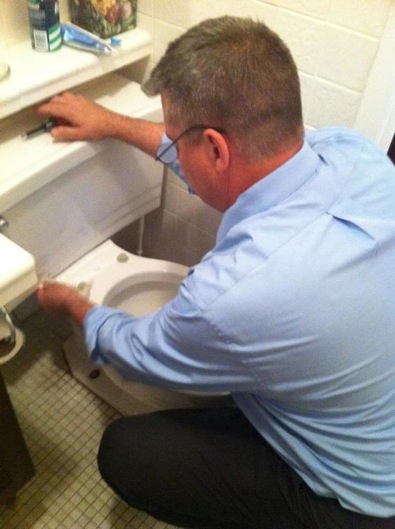
toilet seat at Chicago apt needed be replaced because the hinges had deteriorated (age & water calcium). I bought a new seat in Spfld (sales tax cheaper outside of Chicago) & took it to Chicago. This is my Facebook & I’ve decided to post what my life is really like, not what some expect to hear. Putting on the new toilet seat I need to tell you that when cleaning around the bowl to be sure & take off your neck tie; if not it will definitely end up in the bowl water when you lean over.
Illinois Comptroller Judy Baar Topinka on Thursday said she supports a proposed cigarette tax increase for Medicaid provided that it is tied to significant spending cuts and approval of a gaming expansion bill that includes a Chicago casino and slot machines at horse racing tracks.
The proposal offered by the state fiscal officer represents a compromise in the ongoing state budget and Medicaid negotiations.
“I am not inclined to support any tax or fee increases, but can back the cigarette tax provided that critical spending cuts are made and much-needed support of the horse racing industry is passed,” Topinka said. “Our biggest problem in this state is spending, and that has to be addressed. But the reality is that increased revenue also has to be a part of balancing the budget, and this compromise accomplishes that as well.”
The Governor and members of the General Assembly have been at odds over the proposed tax and gaming expansion. Republican legislators have opposed the cigarette tax, saying the state should focus solely on spending. At the same time, Gov. Pat Quinn has said he will not support gaming expansion legislation.
But given an estimated state bill backlog of $8.5 billion and the urgent need to pass Medicaid reform legislation, Topinka emphasized the importance of finding common ground.
“This is a common sense fiscal solution,” Topinka said. “And most importantly, it will provide important spending cuts and revenue enhancements to help put the state back on track to fiscal stability.”
That statement makes her the first Republican to back the tax hike. But she may not end up being the only one. From the Tribune editorial page…
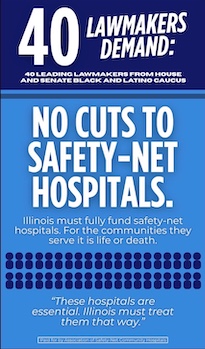
On Medicaid, lawmakers sound like they’re close to a $2.7 billion deal to resuscitate the ailing health care program for the poor. The cornerstone: $1.4 billion to $1.6 billion in cuts, including limits on prescription drugs and certain surgeries. The deal being discussed late Thursday would be relatively good news for hospitals and nursing homes: A proposed 8 percent rate cut has been whittled to 3 percent — $240 million — with protections for safety-net hospitals that treat a disproportionate share of Medicaid patients and for critical-access hospitals that serve large rural areas.
Republicans are signaling that they can live with a $1-a-pack cigarette tax as part of a deal that includes significant spending cuts. That would raise about $700 million, leveraging federal funds. It’s a reasonable way to spare more Medicaid cuts, and higher cigarette prices would encourage thousands of people to quit or never start smoking.
Also in the mix is a state waiver that could add 100,000 patients to Cook County’s Medicaid rolls. This provision would mean a windfall of federal reimbursements for the county’s cash-strapped health care system, but it wouldn’t cost the state a penny it isn’t already paying to care for those patients. It’s win-win.
All of this is in flux, but the lawmakers we’ve talked to hope that the Medicaid reform bills will be filed in the Illinois House on Monday and come to a vote as early as Tuesday. That’s an ambitious schedule for a Legislature content to kick this reform down the road too many times in the past.
* I had a story in yesterday’s Capitol Fax that detailed, among several other things, how Gov. Pat Quinn didn’t explicitly say “No” when asked about slots at tracks during a meeting earlier this week. That was seen as a slight sign of progress because Quinn has always been a “No.” The Post-Dispatch followed up…
Are “slots at the tracks” back in play in Illinois?
The on-again, off-again proposal to allow Illinois horseracing tracks to host slot machines may be under discussion in state budget negotiations. Democratic Gov. Pat Quinn has been a hardcore opponent of the idea, and he still hasn’t endorsed it. But during one closed-door meeting with legislative leaders this week, he reportedly declined to reiterate his earlier entrenched opposition.
Capitol Fax, a Springfield political newsletter, reported on the meeting [yesterday] morning, citing unnamed sources. We asked the Administration to knock it down, and they wouldn’t. In an emailed response, Quinn’s office called the slots proposal a “distraction”—but didn’t reiterate the flat-out opposition (and veto threat) that Quinn has previously expressed on the issue.
We asked a second time if Quinn is still completely opposed, and got the same non-answer.
* The Daily Herald also got the same non-response from Quinn’s office and then interviewed some of the players, including the two sponsors…
State Sen. Terry Link said Thursday that he expects any effort to expand gambling in Illinois will include slot machines at Arlington Park.
Link, a Waukegan Democrat and top gambling-expansion supporter, said allowing for slot machines at Illinois race tracks is the only way to get lawmakers to approve a gambling expansion package that also likely would include new casinos, including in Lake County and in Chicago. […]
Slots at the racetracks have been a sticking point, though. The idea of a subsidy paid from casinos to the horse racing industry has been discussed seriously but mostly dismissed by Arlington Park.
Track officials say the state can’t be trusted to transfer the money. A subsidy that’s already supposed to be going from the Rivers Casino in Des Plaines to the horse racing industry is being held up by the state.
Rep. Lou Lang, a Skokie Democrat, did not rule out lawmakers trying to move gambling legislation that already exists, instead of coming up with a new plan. A proposal that included slot machines at Arlington Park, new casinos and some of the ethical safeguards Quinn has asked for was rejected by the House late last year but could come up again.
The governor’s office was not pleased at all with my story and spent some time trying to figure out just who I talked to and then called around and made some accusations regarding revealing info about private meetings.
Whatever.
The story’s impact is yet to be determined. Opponents think it could cause Quinn to back off any support of slots at tracks. Proponents think it could help. I don’t really care either way. It was a good piece.
* Related…
* Bill Black: More gaming can help state out of money crisis
A federal appeals court is backing Gov. Pat Quinn over pay raises his administration canceled for thousands of union workers.
A U.S. District Court dismissed an effort by the American Federation of State, County and Municipal Employees to force the administration to pay the raises. The Seventh U.S. Court of Appeals on Thursday upheld that ruling.
The appeals court ruled the 11th Amendment prevents the union from prevailing because ruling in AFSME’s favor would force the state to spend money.
The Judicial power of the United States shall not be construed to extend to any suit in law or equity, commenced or prosecuted against one of the United States by Citizens of another State, or by Citizens or Subjects of any Foreign State.
Originally the 11th Amendment only forbade actions by non-citizens against a defendant state. But Hans v. Louisiana, 134 U.S. 1, 10 S.Ct. 504, 33 L.Ed. 842 (1890) extended the doctrine of such sovereign immunity, holding that the 11th Amendment barred suit even by citizens of that defendant state. All private parties were subject to the amendment, although other states and the federal government could still bring actions against a state.
AFSCME’s suit contended the state violated both its union contracts and the equal protection clause of the U.S. Constitution. The union sought a court ruling that would force the state to pay the raises. […]
The equal protection claim made by the union requires it to “plausibly allege that no reasonably conceivable set of facts supports the pay freeze as a rational instrument of cost savings,” the appeals cout added.
“Instituting cost-savings measures is unquestionably a legitimate governmental interest, particularly for a government in such dire straits,” the court said.
“The governor has a moral obligation, and under the union contract and an arbitrator’s order, a legal one, to rescind his illegal pay freeze and make employees whole,” AFSCME said in a written statement. “It is regrettable that he has provoked litigation instead of complying with the contract and the law. We … will consider further steps as we pursue the case now pending in state court as well.”
*** UPDATE 1 *** I didn’t see this New York Times report which cuts through the spin…
The president and general counsel of the Ending Spending Political Action Fund, Brian Baker, said through a spokesman that the plan was submitted to a group that included him and two of Mr. Ricketts’s sons at a meeting in Chicago last week. “I was surprised and troubled by what I saw,” he said. “It was not what we asked for.”
But on Wednesday, when Mr. Baker was asked in an interview whether Mr. Ricketts had rejected the advertising proposal, he said only that no decisions had been made.
The Ricketts family is close, friends say, but politically divided. Two of his sons, Pete and Todd, attended the meeting in Chicago last week to review the advertising proposal, which was titled, “The Defeat of Barack Hussein Obama.” His daughter, Laura, is one of the top contributors to Mr. Obama’s re-election bid and is a member of the campaign’s national finance committee. His other son, Tom, is the general chairman of the Chicago Cubs and said he was not politically active.
Those two sons are Cub shareholders.
*** UPDATE 2 *** With thanks to a commenter, this is also from the NYT article and is very damning evidence…
A page in the proposal about potential staff members for the effort says, “With your preliminary approval at the New York meeting, we have discussed this plan in highly confidential terms with the following proposed team members,” who, it says, are “ready to jump into action upon plan approval.”
Associates of Mr. Ricketts acknowledged that upon seeing a commercial Mr. Davis produced in 2008 for Mr. McCain featuring Mr. Wright, which Mr. McCain rejected, Mr. Ricketts said. “If the nation had seen that ad, they’d never have elected Barack Obama.” The quote was highlighted in the proposal.
The Ricketts family needs to explain this. Now.
[ *** End Of Updates *** ]
* Yesterday’s New York Times report revelation that Joe Ricketts and his family were briefed on a campaign battle plan to make people “hate” President Obama this year created a furious reaction from Mayor Rahm Emanuel, who has been working with the team on a stadium remodeling plan. His aides sent out this e-mail yesterday…
The Mayor was livid when he read that the Ricketts were going to launch a $10 million campaign against President Obama – with the type of racially motivated ads that are insulting to the President and the Presidential Campaign.
He is also livid with their blatant hypocrisy.
The Ricketts have tried to contact the Mayor but he’s said that he does not want to talk with them today, tomorrow or anytime soon.
* Tom Ricketts, the Cub Chairman, issued this statement…
As chairman of the Chicago Cubs, I repudiate any return to racially divisive issues in this year’s presidential campaign or in any setting—like my father has.
My focus is on one of the great American pastimes, baseball. And our team and every other Major League Baseball team are great examples of people of diverse backgrounds working together towards a common goal. I shall have no further comment on this or any other election year political issue. My full-time focus is on making the Chicago Cubs a World Series champion preserving Wrigley Field and making the Chicago Cubs a great corporate citizen.
* Joe Ricketts’ guy at his Super PAC also weighed in…
The political consulting firm that drafted the proposed ad campaign against Obama, Strategic Perception Inc., said the Ricketts family never approved it and “nothing has happened on it since the presentation.”
Brian Baker, president of the Super PAC Ending Spending Action Fund, which is heavily funded by Joe Ricketts, issued a statement today saying the attack ad against Obama won’t go forward.
“Joe Ricketts is a registered independent, a fiscal conservative, and an outspoken critic of the Obama Administration, but he is neither the author nor the funder of the so-called “Ricketts Plan” to defeat Mr. Obama,” Baker said. “It reflects an approach to politics that Mr. Ricketts rejects and it was never a plan to be accepted but only a suggestion for a direction to take.”
The threat to resurrect the Wright controversy that Obama thought he put to rest during the 2008 campaign is poorly-timed for Joe Ricketts’ four children, who now run the trust that their parents set up and the kids used to buy the team. While Joe Ricketts has described himself in public forums as a Cubs owner, and there’s a YouTube video of him talking about the process of buying the team, a family spokesman says he has separated himself from the operation.
The Cubs were hoping for a vote on a state borrowing plan to bankroll the Wrigley renovation using tax-exempt bonds during the final two weeks of the Illinois General Assembly’s spring session, paving the way for construction to begin in October. The team needs the mayor’s support, because the bonds would be retired by new advertising, sponsorship and concession revenues at Wrigley and a variation of the financing scheme that Emanuel once called a “non-starter” — forfeiting 35 years’ worth of amusement tax growth.
Before the Joe Ricketts controversy erupted this week, talks with Emanuel were continuing with a “sense of urgency” to accommodate the Cubs construction timetable, City Hall sources said.
Asked Thursday whether the proposed attack on Obama would derail a deal, Emanuel said, “I’ll have some conversations on that later — comments, rather.”
But later, City Hall sources said they still expect a Wrigley deal to get done because it’s a job creator and because Emanuel is all about “putting points on the board,” as the mayor likes to put it. The controversy could slow down the team’s accelerated construction timetable and empower the mayor to drive a harder bargain, however.
Ricketts founded T.D. Ameritrade and built the financial empire that enabled his family to acquire the Cubs for about $900 million. According to materials leaked to the New York Times, he also was looking to spend $10 million on a series of racially charged attack ads aimed at President Obama, in hopes of “Ending His Spending.”
God Bless America, where everyone has a right to express their views according to their means. There’s nothing wrong with opposing excessive government spending, although it seems an odd stance for someone seeking a hefty government handout.
It looks even worse when the person you’re negotiating with to get those millions was chief of staff for the president on whom you’re planning a hit job.
And in Chicago, a city of 2.7 million where the U.S. Census Bureau says 20 percent of people live in poverty, should the wealthy folks who own Wrigley Field really top the priority list?
Probably not, but eventually they will. This scandal will fade. Chicago Mayor Rahm Emanuel will start taking the Ricketts’ phone calls again – although I wouldn’t want to be the first one to get through.
This might push back the Cubs’ timetable for renovating the crumbling, musty ballpark. But when it gets down to it, even if Mitt Romney himself owned the Cubs, no Chicago mayor would deny him if he threatened to move the team.
Besides, Joe Ricketts isn’t running the Cubs, and doesn’t really care about baseball – Tom Ricketts is the chairman of the team. And the Cubs aren’t asking for all that much, relatively speaking.