Chicago businessman Scott Cohen says he will spend up to $3 million of his own fortune on his Democratic race for lieutenant governor. […]
He revealed his spending plans at a Daily Herald editorial board interview today and was quickly rebuked by the three other candidates in attendance: state Sen. Terry Link of Waukegan, Elmhurst electrician Thomas Castillo and state Rep. Mike Boland of East Moline.
“I’m not even going to come close to that,” said Link, a veteran Lake County lawmaker. “That is ludicrous for an office of this size.”
The lieutenant governor’s position has no official authority. The lieutenant governor becomes governor if the incumbent state executive is ousted, resigns or is incapacitated as was illustrated by Pat Quinn’s rise to upon Rod Blagojevich’s ouster in January.
Whether fair or not, if it’s his money he can spend it as he wishes.
Boland, by the way, called the revelation of the Quinn administration’s secret early prisoner release program “crazy.” Quinn has now mummed up…
Illinois Gov. Pat Quinn isn’t saying when he first knew his administration was releasing inmates who’d served just weeks in prison.
Quinn on Sunday suspended a program that immediately awarded good-behavior credits to inmates instead of requiring them to spend at least 61 days behind bars. His action came after a report by The Associated Press revealed some inmates locked up less than three weeks.
Quinn said Monday that Corrections Department Director Michael Randle has broad discretion to run the department. He says if there are questions about how something is being done, it’s the governor’s job to review it.
* Meanwhile, Gov. Quinn’s campaign has a new promo video called Jobs, Jobs, Jobs…
UPDATE: The Quinn campaign has issued a new version of this video in response to criticism in comments about the claim over how the capital bill “created” and “saved” jobs. The new text says it will “create” and will “save” those jobs. The new video is now displayed.
* The Democratic Senate Campaign Committee has a new Internet video blasting Mark Kirk…
* Related…
* Auction brings $6.5 million for troubled Springfield hotel: Horve estimated it would cost $35 million to build such a hotel now.
Fred and Rita drove from Harlingen
I can’t remember how I’m kin to them
But when they tried to plug their motor home in
They blew our Christmas lights
Cousin David knew just what went wrong
So we all waited out on our front lawn
He threw a breaker and the lights came on
And we sang ‘Silent Night, Oh Silent Night, Oh Holy Night’
* The Illinois State Rifle Association is not at all happy with Republican gubernatorial candidate Jim Ryan.
Ryan told the Associated Press that he would sign a “narrow” ban on the sale and possession of semiautomatic assault-style weapons…
“I would sign it provided it was narrowly drawn and did not violate our 2nd Amendment rights.”
He also said he’d veto an attempt to legalize concealed carry…
“I would veto. I believe reasonable people can differ on this issue but on balance, drawing from my experience as a law enforcement official, I believe we are better off without concealed-carry.”
“I’ve never seen a suburban Republican try so hard to look like a Chicago Machine Democrat,” is how ISRA-PVF spokesman Richard Pearson characterized the behavior of Republican gubernatorial candidate Jim Ryan. […]
“Ryan’s hostility toward law-abiding firearm owners extends way back to his days as DuPage County State’s Attorney. Ryan’s philosophical distaste for the fundamental rights guaranteed under the 2nd Amendment to the U.S. Constitution make him particularly unqualified to serve as Illinois governor. As we saw in 2002, Jim Ryan has slammed the door in the faces of Illinois firearm owners. As primary day draws near, Ryan may find that, if you keep doing the same things over and over, you will keep getting the same result.”
Several people have posted responses on Ryan’s Facebook page, including this one from NRA lobbyist Todd Vandermyde…
Seems like Ryan is up to his old tricks and is not different than Blago was on guns
There have been several well-meaning and respectful people here who have expressed concern about my position on the 2nd Amendment. Please allow me to clarify. Unlike the Democrats, I will not be an activist who works to take away the 2nd Amendment rights of law-abiding Illinois citizens. My priorities are improving …Illinois’ business and jobs climate — and providing ethical, authentic leadership to Springfield. My approach on 2nd Amendment related issues has always been to enforce existing laws rather than creating new ones. My years in law enforcement have influenced me to take a position shared by many law enforcement officials — in opposition to concealed carry and in favor of a narrowly drawn assault weapon ban. While I have a respectful disagreement on this issue with many in Illinois, I think we can all agree this is a big difference from those on the left with an activist agenda of infringing upon your 2nd Amendment rights.
ISRA/NRA has a ton of Illinois members, and if anyone can drive down Ryan’s numbers, it’s them.
* Meanwhile, Zorn asked several candidates why they support rolling back Illinois’ minimum wage to the federal level. Three responded, including Jim Ryan’s spokesman…
JR has always supported a federal minimum wage. Rod Blagojevich’s move to raise Illinois’ MW to a level higher than surrounding states was one of many disastrous decisions he made that has helped make Illinois one of the worst performing economies in America. Those policies have been a disaster for the poorer citizens of our state. Contrary to liberal dogma, unilaterally raising the MW does not help the poor, it hurts them.
* The Daily Herald ran a few outtakes from a recent interview of the GOP gubernatorial candidates. This one is from JRyan…
On former friend Stuart Levine, now a felon: “He ruined his life … I have a clear conscience.”
On not apologizing to Rolando Cruz until running for governor: “I didn’t want to impact the outcome of that case.” (Brian Dugan trial)
On the death penalty: “I do think the state has a right to take a life. The right to life is sacred … but it is conditioned on your behavior.”
On Cruz asking for a meeting with Ryan after the apology: “I haven’t given it much thought. I haven’t excluded the possibility … He knows what I said.”
* Progress Illinois takes gubernatorial candidate Sen. Kirk Dillard to task for saying, again, that the budget can be balanced without a tax hike because he did it under Jim Edgar, who “inherited a mountain of debt” from his predecessor and “left [office with] a billion-and-a-half budget surplus … all without an income tax increase.” From PI…
Dillard’s version of events conveniently omits that Edgar also “inherited” a load of new revenue upon taking office in 1991, thanks to a temporary income tax increase passed in 1989 and made permanent by the new governor. Considering how often Dillard uses this line, it’d be nice to see a reporter respond with the relevant context.
Yes and no. Yes, Edgar did inherit the revenues from that income tax hike, but those revenues weren’t new and most of it had already been put into the budget’s spending base. Edgar didn’t get the “Governor No” moniker for nothing. He did hold the line on major spending increases.
More importantly, though, Edgar benefited from an absolutely huge surge in tax receipts from the Wall Street tech boom during the mid-to-late 1990s. It wasn’t the 1989 tax hike so much, but the boom and the cutting which led to the surplus. What followed Edgar’s departure was a George Ryan spending spree. The structural deficit was exacerbated and then we were hit with 9/11 and have never recovered.
* All but one gubernatorial candidate, Andy McKenna, will appear at a Republican debate in Springfield tonight.
* In other news, AFSCME endorsed Judy Baar Topinka for comptroller. Topinka was the only statewide Republican to get the union’s nod.
* This is what happens when you are a good campaigner and a mediocre governor, and when your good campaign sensibilities don’t translate into sound governing…
Illinois Gov. Pat Quinn has suspended a prison program that allowed repeat drunk drivers, drug users and even people convicted of battery and weapons violations to serve less than three weeks’ total time behind bars.
Records obtained and analyzed by The Associated Press show that since September more than 850 inmates were released weeks earlier than they ordinarily would be. The Corrections Department was saving money by abandoning a policy that requires inmates to serve at least 61 days and awarding them discretionary good-conduct credit immediately upon entering prison.
That means some prisoners have enough good-conduct days to qualify for release almost immediately — before they’ve had a chance to demonstrate any conduct at all. The inmates are kept at the department’s prison processing centers and released after as few as 11 days.
Jorge Bogas spent just 18 days behind bars for aggravated driving under the influence after he hit two cars, hospitalizing one motorist for weeks, while driving the wrong direction on Interstate 57. Bogas sat five days in Cook County Jail, was transferred to the processing center at Stateville Correctional Center in Joliet and released 13 days later.
The campaign self-preservation mode only kicked in when campaigner Quinn was notified about what Gov. Quinn was doing. Typical. Dan Hynes responds via press release…
“The details emerging about the Quinn administration’s secret prisoner release program are deeply troubling, and I think the people of Illinois deserve answers. The Governor’s decision to suspend this program is the right one, and I support his pledge to conduct a ‘top-to-bottom’ review. Given the apparent confusion and misinformation on display yesterday surrounding this program, I would encourage Governor Quinn to begin his review at the top, starting with himself and his top staff. The people of Illinois have the right to know who implemented this program, who signed off on it, whether anyone, and who, will be held accountable, and ultimately, who is in charge on such obvious issues of public safety.
“Given the Governor’s recent misadventures in transparency — including the abrupt resignation of a top aide amid an inquiry for politicking on state time, his refusal to acknowledge his campaign’s effort to knock an opponent off the ballot, and his administration’s outright refusal to allow a news outlet to investigate allegations of decrepit conditions at one of our state’s juvenile justice centers — where the press and the public have been stonewalled on matters large and small, I encourage this review to be conducted in public. Furthermore, given the potential immediate safety risk to communities across Illinois, I strongly encourage the review to be completed and the public made fully aware of its findings within a matter of days. Governor Quinn’s pattern of appointing blue-ribbon commissions will not suffice on this matter.”
* AFSCME decided Saturday to remain neutral in the governor’s race. That’s been anticipated for quite some time, but it’s still a big blow to Hynes because it shows that the state employees union isn’t confident that he can defeat Quinn, with whom the union will have to deal after the election.
* Meanwhile, my statewide, syndicated weekly newspaper column takes another look at the politics of the budget…
Last week we all celebrated - or bemoaned - the first anniversary of Rod Blagojevich’s arrest. After Blagojevich was impeached and removed from the governor’s office, I, like most others, thought things were going to be different with Pat Quinn in charge.
But the Statehouse bickering continues, and the gridlock over the state’s paralyzing and mind-boggling budget deficit is almost as bad as ever. Heck, it may even be worse.
You probably know by now that Gov. Quinn wants to take out a $500 million short-term loan and use about half of it to help pay some of the state’s bills during the holiday season - particularly focusing on private, not-for-profit human service agencies that take care of the poor, the infirm and the aged.
Comptroller Dan Hynes and Treasurer Alexi Giannoulias both must sign off on the borrowing, but Hynes said “no” earlier this month. Among other things, Hynes says there’s no money to pay off the loan and likened the idea to using one credit card to pay down another one. Ironically enough, Quinn nixed a similar idea when he was state treasurer back in the 1990s.
After much back-and-forth bickering between Quinn and Hynes, things seemed to calm down for a few days. Then, Quinn said last week that he wasn’t going to continue harping on Hynes’ refusal to approve the borrowing plan. At the same time, though, he couldn’t resist getting in a shot at his Democratic primary opponent and even attempted to link him to the disgraced Blagojevich.
“A year ago, with the previous governor under arrest, the comptroller signed off on a $1.4 billion short-term borrowing plan,” Quinn said. “I don’t know, if you’re going to do that, at that time, and a year later, running for office, saying you can’t borrow money to help human beings get paid in the month of December, the holiday season … I think he’s missing the boat on that.”
Quinn then said he was dropping the subject.
“But we’re not going to beat that horse,” he said. “If (Hynes) has his position, we just have to move on.”
But it was clear a couple of days later that Quinn was not at all intending to “move on.” Quinn addressed the Governor’s Conference on Aging last week and pledged to “get the necessary funds to pay our bills,” then added, “even if the comptroller is blocking my plan.”
AARP Illinois also held a news conference that day to warn that 200 human services agencies that deal with senior citizens could be out of business in a matter of weeks if the state doesn’t start making good on its overdue bills soon.
Hynes may be right about the narrow fiscal issues at hand - that there is no available money to pay off the proposed loan, that the state will need to use a third of its revenues to pay off its short-term loans in March and April and that the new loan would cover only 5 percent of the state’s overdue bills - but this is a political time bomb, particularly in a Democratic primary race. We’re talking about human service agencies that serve lots of poor people. It doesn’t take a media expert to figure out how to spin that one.
Of course, this would’ve been a much more effective bludgeon had Quinn not so thoroughly muffed the issue earlier this month by attacking Hynes with the false claim that Giannoulias was supporting the loan.
Still, we can expect more and more stories on this growing crisis. It’s the holidays, and this is a ready-made story for the season. Quinn can come off looking compassionate, while Hynes is in real danger of being portrayed as a fussbudget who is more worried about numbers and making Quinn look bad in advance of the primary than he is about real people.
Chicago’s WLS-TV (Channel 7) - the top-rated news station in the region - ran its second long story on this topic last week. In the piece, Rep. Greg Harris (D-Chicago) is featured, demanding that political leaders “put aside our partisan differences, our political aspirations, and take emergency action now.”
That’s the sort of comment we undoubtedly will see more of as the rest of the media begins to pay attention to this topic. It’s a high-stakes game. Unfortunately, there are a lot of “little people” in the middle who are melting down while the state dithers.
* It’s that time again. Nominations are now open for our third annual Golden Horseshoe award.
Today’s categories are…
1) Best state legislative staffer
2) Best state legislative secretary/admin assistant
3) Best political bar/restaurant in Springfield (must be currently operational)
4) Best IL state agency director
As before, please keep in mind that this contest is not just based on the number of votes, but on the intensity of each vote. So, if you don’t explain your vote, or don’t explain it well, it will have far less weight or not be counted at all, depending on my mood.
Also, no negativity and no snark. Thanks.
I’ll announce the winners tomorrow during our second round of voting.
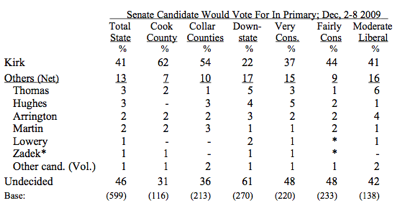
* So, how much of a threat is Patrick Hughes to Mark Kirk? Not much so far…
Kirk 41
Thomas 3
Hughes 3
Arrington 2
Martin 2
Lowery 1
Zadek 1
Other cand. (Vol.) 1
Undecided 46
Yes, the undecideds represent 46 percent of the vote, but that 41-3 Kirk-Hughes lead is gonna be incredibly tough to overcome, to say the very least. According to the Tribune poll, just 8 percent of voters have heard enough about Hughes to rate him.
Even Hughes’ own claimed recent polling shows he’s in serious trouble. From a press release…
A recent survey conducted on December 9th and 10th by Wilson Research Strategies of 600 likely Republican primary voters, shows the race for Illinois’ open U.S. Senate seat is largely undecided. 63% of voters indicated that they are undecided about who they will vote for in the February 2nd Primary. 28% of voters indicated they were leaning towards Congressman Mark Kirk and 5% were leaning towards Hinsdale developer Patrick Hughes. Looking closer at the numbers only 7% of voters polled indicated that they were Definitely voting for Kirk while 2% indicated they were Definitely voting for Hughes. No other candidate polled higher than 1%.
Hughes does go on to claim this, however…
When information was given to the voters about Mark Kirk’s support for Cap and Trade support for Hughes surges to 47% and the support for Kirk drops to 13%
Kirk flip-flop explained. You don’t need a weather man to know which way that wind blows.
Kirk is even leading among “very conservative” voters. That could change if Hughes can get his act together, but so far he hasn’t. Hughes sent out a single mailer to quite a few GOP voters a week or so ago, but that won’t get him very far. Even interested voters will only look at a mailer for a few seconds before tossing it in the garbage.
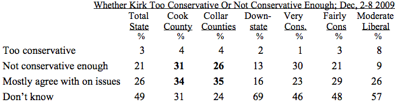
“Thinking now about Senate candidate Mark Kirk - compared to your political beliefs, do you think Kirk is too conservative on the issues, not conservative enough, or do you mostly agree with him on the issues?”…
From the pollster…
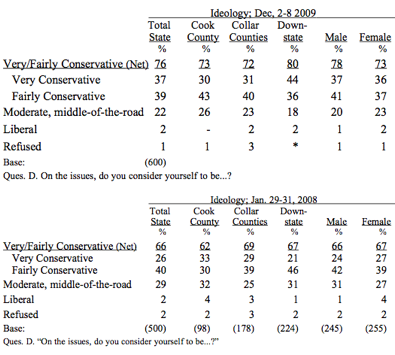
Voter composition in a primary can change over time. The current poll yielded 76% of likely voters who describe themselves as conservative, 37% very conservative, up from the previous results.
In four previous GOP primary polls, Jan., ’08, Dec. ’07, March ’06, and Feb. ’06, total conservatives ranged from 64% to 66% including 21% to 26% very conservative. Who is on the ballot may affect composition of voter turnout. But it is also likely that national politics is having an effect on elections this year.
So, the GOP electorate is getting more “very conservative” than in years past, but it’s still probably not enough to defeat Kirk in a primary with anyone in this field.
Conservative polling history…
Notice that the number of Republicans who once defined themselves as “moderate” dropped to 29 percent. That is partially because so many of those people left the party.
Nearly half of voters who call themselves conservatives said they are undecided in the contest. About the same number of conservative voters said they did not know when asked if Kirk’s ideology was too conservative or not conservative enough.
But Hughes’ candidacy represents an emerging, and very real, challenge for GOPers: In an era of tea partiers, the centrist Kirk has to move to the right to win a primary. Those moves have already cost Kirk, as Planned Parenthood and environmental groups have repudiated him for recent statements. Conservative challengers to more centrist favorites in NH, FL, OH, CO and other states could make those favorites move to the right.
Dems have been hammering Kirk for his rightward move, and they stand ready to do the same for the more moderate candidates in other states. Kirk has a big lead, and one has to wonder whether he needed to leap so quickly to his right, given his lead in the primary. Other centrists should look to their own poll results to see just how much of a threat conservative candidates really are; it might make their general election mission of appealing to centrist voters all that much easier.
Kirk, whose centrist positions on certain issues have led to some speculation about his primary vulnerability, is not over 50 percent. But no other candidate appears to have asserted him- or herself as a strong alternative with a month and a half to go in the primary.
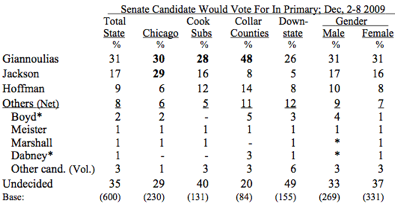
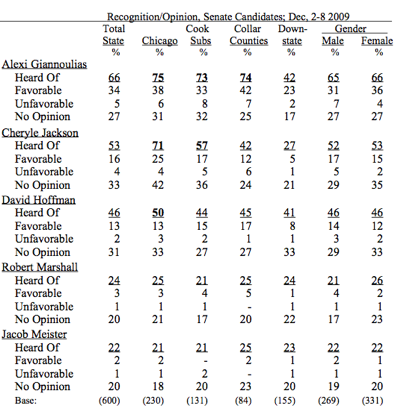
Jackson is doing significantly better in the Tribune poll than in any of the other surveys. Hoffman is about the same. After getting a bump in November, Giannoulias is about the same.
Giannoulias’ strongest geographic support came from collar-county primary voters, 48 percent of whom backed his bid compared with 14 percent for Hoffman and 8 percent for Jackson. Among Chicago voters, Giannoulias and Jackson were virtually tied at around 30 percent support, while the treasurer held a 28 percent to 16 percent edge over Jackson in the Cook County suburbs, where 40 percent of voters said they were undecided.
If Jackson has the money to compete, she’ll likely come close to sweeping the African-American vote and may do significantly better with women. Whether that’s enough to be victorious will depend on whether Hoffman can somehow jump-start his campaign and Meister can gain a little traction. Meister is focusing on the gay and gay friendly vote as his base, and that’s not inconsequential. Still, Boyd was removed from the ballot, but still outpaced Meister, who has put serious money into his campaign.
Name rec…
You can probably downplay the generic name rec numbers in these contests. It’s probably better to focus on the percentage of people who know enough about the candidates to rate them. A good example of this is Robert Marshall, a radiologist who practices in Kankakee and Joliet. He’s never run for office as a Democrat and has received almost zero coverage, yet 24 percent claimed to have heard of him. Only four percent knew enough about him to rate him, however, and that’s probably too high.
If you look at the name rec numbers that way, you get this…
Giannoulias 39
Jackson 20
Hoffman 15
Marshall 4
Meister 3
Back to the story…
The survey found plenty of room for movement before the Feb. 2 primary elections, with 35 percent of Democratic voters saying they were undecided. The major contenders only recently have begun to roll out their campaigns on the TV airwaves.
Methodology…
This Chicago Tribune Poll is based on interviews of confirmed registered voters likely to vote in the February 2nd Democratic and Republican primaries. In 2008, Illinois primary elections were moved to the first Tuesday in February - for both presidential and off-year state office contests. Before then, primaries were held on the third Tuesday in March. Interviewing was conducted December 2nd to the 8th.
State samples of 600 were interviewed for each state primary. Potential margin of error for each sample is +/- 4.0% at the 95% confidence level. Likely voting was determined based on scale question response.
That last sentence apparently means they didn’t use a voter file to determine likely voters in any of these polls. So, this survey probably captures a lot of low-information voters.
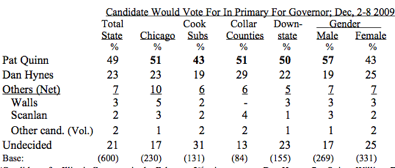
Among the 600 likely Democratic primary voters surveyed by telephone Dec. 2-8, Quinn had the support of 49 percent to 23 percent for Hynes, the three-term comptroller. Among other candidates, activist William “Dock” Walls had 3 percent, and attorney Ed Scanlan had 2 percent. An additional 21 percent were undecided; 2 were for others. The poll has an error margin of 4 percentage points.
Early benchmark polling for Quinn had him leading Hynes 54-to-26, with other polls showing similar results. […]
Recent polling conducted by other statewide Democratic candidates show Quinn ahead of Hynes 50-to-38 and 50-to-35, sources say.
So, Hynes is either regressing back to the days before he spent over $2 million on TV ads, or he hasn’t moved up since this race began. Hynes has been able to slightly lower Quinn’s numbers, but he’s stuck. Bad. Very bad.
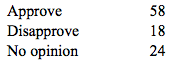
Quinn job approval among Democrats…
That’s pretty darned huge for an incumbent governor with an $11 billion deficit who’s been hit hard in TV ads by his Democratic primary opponent and one GOP opponent (McKenna).
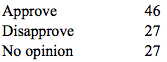
“Do you approve or disapprove of how Pat Quinn is handling state budget issues?”…
Voters also approve of Quinn’s handling of ethics reform in the post-Blagojevich era by a nearly 2-1 ratio and gave him a similar advantage over Hynes when asked which candidate would better eliminate corruption.
The beauty of the Tribune posting their full questions and answers is that we know from the polling memo that Quinn’s 2-1 ratio on his handling of ethics reforms works is actually 42-22. Not party time, but not bad considering all the heat he’s taken on the editorial pages. As far as which candidate would be better at “eliminating” corruption in government (a goofy premise, to be sure), 34 percent said Quinn and 16 percent said Hynes. 15 percent said “none” and 29 percent didn’t know.
Back to the Tribune’s narrative…
Hynes could try to link Quinn to Blagojevich. Quinn served two terms as Blagojevich’s lieutenant governor and has refused to apologize for backing Blagojevich. During the 2006 re-election campaign, Quinn defended Blagojevich as someone who has “always been a person who’s honest and one of integrity,” despite myriad investigations into his administration.
Maybe. Just 11 percent of Dems said they were less likely to support Quinn when reminded that the governor “ran twice as Lieutenant Governor and running-mate to former Governor Rod Blagojevich.” From what I’ve been told, polling for both Democratic candidates shows that a Blagojevich attack just doesn’t work well against Quinn.
Also, Democrats are split on whether a tax hike is necessary, with 42 percent saying it is necessary and 47 percent saying it isn’t - even though both candidates are pushing for a tax hike…
Among Quinn’s supporters, 57 percent said they believed a tax increase is needed, while 38 percent of Hynes’ backers said they think one is necessary.
That’s one big reason why Hynes has been slamming Quinn on taxes. At least that part of his message is working.
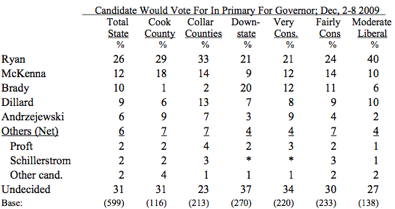
* On to the Republicans and a big Jim Ryan lead…
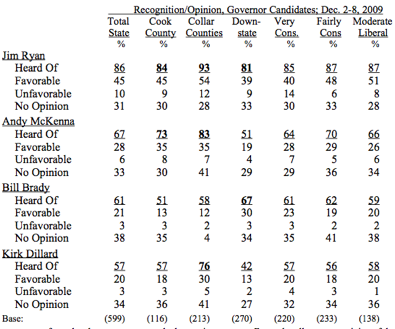
The Trib says that this is a name ID race so far, and they may be right…
Notice in the head-to-heads that 37 percent of Republicans classify themselves as “very conservative.” That’s why the far right is so hopeless statewide.
The Tribune results are pretty close to Adam Andrzejewski’s poll taken in mid November, except that Andrzejewski scores much lower in the Tribune poll. The Trib’s new numbers are in parentheses…
Jim Ryan 30% (26%)
Adam Andrzejewski 11% (6%)
Bill Brady 11% (10%)
Andy McKenna 10% (12%)
Kirk Dillard 7% (9%)
Bob Schillerstrom 3% (2%)
Dan Proft 2% (2%)
Andy McKenna has spent a fortune on TV ads in the weeks since that Andrzejewski poll was taken, but he hasn’t budged.
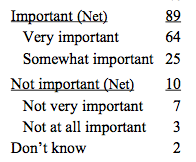
The Trib asked: “All of the Republicans running for Governor oppose increasing state government taxes. How important is a candidate’s opposition to a state tax increase in deciding on a choice for Governor?” The answers were predictable…
Dillard and Ryan’s recent open-mindedness to a tax hike won’t help there, but just 45 percent said it was likely that the winner would keep his promise to oppose tax hikes, while 49 percent said it wasn’t likely he’d keep it.
But it is the 31 percent of undecided voters that makes the outcome of the contest far from certain as candidates use the post-New Year holiday period to ramp up TV advertising and telephone pitches. A majority isn’t necessary to win the nomination — in 2006, Judy Baar Topinka won a four-way primary with 38 percent of the vote.
The race has been pretty much static since Jim Ryan declared his intentions. Dillard’s TV blitz during the Tribune’s polling period didn’t help at all. Maybe the voters will change their minds come the big (and, don’t forget, very crowded) January hoo-ha, but unless somebody’s message really catches fire, this is Ryan’s race to lose.
Democratic Sen. Kirsten Gillibrand of New York urged the U.S. Army Corps of Engineers on Friday to close shipping locks on a waterway south of Chicago that could provide a pathway for the carp to reach Lake Michigan.
And to do that, there needs to be more work done on the Chicago Region Environmental and Transportation Efficiency (CREATE) Program to improve freight, passenger and automobile traffic, according to U.S. Rep. Daniel Lipinski.[…]
“You cannot have efficient passenger train service without the freight rail out of the way,” Lipinski said. “They’re all using the same track.”
The DuPage Water Commission lost $19 million and its managers want you to foot the bill to clean up their mess.
It’s not clear what happened. Forensic auditors are crunching numbers and pricey lawyers are investigating. Meanwhile, water rates likely will be increasing.
A procurement policy adopted by aldermen in 2006 has done little to boost the number of contracts awarded to businesses owned by women and minorities.
Less than 2 percent of city contracts went to minority- and women-owned firms in 2006. And today, about 2 percent of those contracts are held by minority-owned companies, while another 2 percent are held by businesses owned by women, said Ron Moore, the city’s diversity procurement officer.