* Illinois Review has a post up about Lake County Sheriff Mark Curran’s letter to Rep. Ed Sullivan, a Republican supporter of gay marriage. Curran is definitely opposed…
In the letter to Rep. Sullivan, he gave three main reasons based on his experience and expertise in criminal justice:
“First, same sex marriage is not in the best interest of children; Second, same sex marriage is not in the best interest of society; and Third, same sex marriage will result in the loss of liberty for those opposed to same sex marriage.”
Curran told Sullivan that the overwhelming majority of people incarcerated in this country are male, up to approximately 90 percent in most correctional institutions.
“The single greatest common denominator of those incarcerated in this country is the absence of a father in their lives,” he said. “Some studies show approximately 85 percent of those in correctional institutions had no relationship with their fathers. All reliable studies show a boy that does not know his father is more than twice as likely to wind up incarcerated.”
Um, so if a boy has two fathers doesn’t that make him even less likely to wind up incarcerated?
Unfortunately, I have not yet had the opportunity to read his letter; a surrogate brought the letter to a meeting I had with approximately forty constituents Sunday night to discuss SB10. However, I am waiting for a return call from the Sheriff, and have been waiting for some time. When I heard that Sheriff Curran was going to be the lead speaker at the rally against the bill at my office, I called him thinking we could have a collegial discussion about marriage equality. I continue to extend that offer.
I have great respect for Mark, and have supported him for many years. When he changed parties from being a Democrat to being a Republican, I spoke at his press conference and welcomed him into our party, and that was after he was going to oppose me as a Democrat in the 51st District! When his conscience and religious beliefs dictated that he oppose the Death Penalty in Illinois, I supported him. When he backed a proposal to allow illegal immigrants the ability to have driver’s licenses, I was respectful of his beliefs even though I disagreed with him. And when the Sheriff was quoted as being in favor of decriminalizing arrests for marijuana possession in Waukegan, as a friend I was respectful of his views even though I did not share them.
Heh.
…Adding… Roundup…
* Editorial: Raising the Illinois speed limit would kill more motorists
Well, well, what a coincidence. On the same day Ann Callis resigned as a Madison County judge to run for Congress on the Democratic ticket, Gov. Pat Quinn announced the appointment of David Gill to a high-level state job.
Gill was the party’s nominee for the 13th District in 2012 and had been contemplating another run, but his appointment as associate director of the Department of Public Health clears the way for Callis.
Actually, there’s nothing coincidental about the Callis and Gill news. These were cleverly orchestrated moves by Democrats to avoid a primary fight, just like the party decided who would run for former Rep. Jerry Costello’s 12th District seat in 2012.
Hey, getting Gill out of the way was a very smart political move, but it was just way too ham-handed. They couldn’t wait a few weeks in between developments? What the heck? How do you allow this to happen?
The gentle clicks of pieces falling into place last week didn’t go unnoticed by national Republicans. On Monday, a full day before Callis’ formal announcement of her candidacy, the National Republican Congressional Committee’s official blog led with a searing pre-emptive piece headlined: “Ann Callis: Bringing the ‘judicial hellhole’ to Washington.”
That’s a reference to Madison County’s national reputation as a haven for high-dollar lawsuits. It’s a side of the Metro East that Callis knows well, as the daughter of prominent Granite City trial lawyer Lance Callis. She later took the helm of the judicial system that oversees those national asbestos suits and other topics.
Callis was dogged early in her career by allegations that she got to the bench because of her influential father. That and Madison County’s reputation for litigation are attacks the GOP is likely to launch early and often in the long campaign ahead.
Not to mention the way the path was cleared for her. It’s exactly the sort of thing that Rodney Davis railed against when he forced Jerry Clark out of the race last year. The Democrats just played right into Davis’ hands.
Callis has been the apparent party favorite since January, when she was invited to the presidential inauguration for vetting by the party, according to national media reports at the time. Her press interviews Monday, and distribution of today’s expected formal statement, were coordinated in part by Washington-based party staff.
Yep, those crack operatives at the DCCC are definitely behind this. Check out her announcement press release…
Chief Judge Ann Callis Announces her Candidacy for Congress
When Washington has Failed,Judge Callis has Delivered Reforms for Middle Class Families
Citing the need for a proven reformer who can get things done for middle class families in Illinois, former Madison County Chief Judge Ann Callis announced today that she is running to represent Illinois’ 13th Congressional District in Congress.
Even as Washington has failed to tackle the problems impacting middle class families, Judge Callis has stepped forward with reforms that have delivered for Illinois. She pushed for a mediation process that allowed families facing foreclosure a chance to stay in their homes. Judge Callis opened more court records to the public. And her work to create the first Veterans’ Court in Illinois led to national recognition from the Foundation for Improvement of Justice – all while returning thousands of dollars of her budget to the taxpayers.
“Like many of my friends and neighbors, I’m frustrated right now that Washington is not listening, and it’s not delivering for the middle class,” said Callis. “As Chief Judge, I’ve delivered reforms when Washington didn’t, and I’m running to deliver solutions for middle class families who are looking for good-paying jobs, and someone to protect Medicare and Social Security.”
Blah, blah, blah.
That press release screams “WE’RE FROM WASHINGTON, DC AND WE’RE HERE TO HELP!!!”
Champaign County provided the largest share of votes in last year’s 13th District race, 54,834 to 48,190 from Madison County, 48,033 from Macon County and 41,104 from Sangamon County.
Champaign County also was one of only three counties in the district (the others being Sangamon and McLean) where Gill defeated Davis last year.
Champaign, Macon and Sangamon won’t turn out in a mid-term anywhere near like they did in the presidential. She’s really got a tough race ahead of her in more ways than one. The DCCC got their self-funder, and Callis is gonna get fleeced.
I truly think MJM is wanting to push through his [pension reform] plan, which is constitutionally suspect in order to force a lawsuit. This way he passes legislation that in the end, results in the status quo. The payoff is his daughter runs on a platform to fix the mess wrought by the GA and makes good with the unions…or maybe not.
I conclude that major pension reform, though not guaranteed, is really moving now. And then, we can get to the inevitable legal challenges — and a race for governor by Mr. Madigan’s daughter, Attorney General Lisa Madigan, who really would like to be able to run without the race focusing on Daddy’s pension failure.
With the recent failures in the House to come up with comprehensive pension reform, some Springfield observers have suggested Speaker Madigan might be dragging his feet, and setting the stage for his daughter to ride in on a white horse and solve the state’s biggest problems.
For Quinn, Madigan’s push carries important ramifications heading into the 2014 election cycle. The governor’s inability to rally the Legislature behind a pension-reform package after repeated efforts has made him look ineffective in some quarters.
Coming up with a signature accomplishment that could be portrayed as a partial cure to the state’s massive budget problems could boost his re-election hopes, even if the speaker’s daughter, Attorney General Lisa Madigan, opts to take on Quinn in a primary.
“Why now?” Why would Madigan expend all this political capital and risk the ire of a core constituency of the Democratic Party? It’s hard to believe that a 40+ year political veteran would suddenly wake up one morning and possess the noble principles and leadership skills that the Tribune now gives him credit for.
Then it dawned on me: his daughter – Attorney General Lisa Madigan – is gearing up for a gubernatorial run in 2014.
Bingo.
If this bill becomes law today, Madigan clears the path for his daughter’s gubernatorial campaign just long enough to get through the 2014 election but before it gets in front of the state Supreme Court.
Boom, he just saved Lisa countless hours of public pension reform ideas on the campaign trail and grilling questions during the debates. She can consider this potential law as “problem solved,” and if she’s pressed on the legality of it, she can simply dismiss all responsibility with, “That’s up for the Illinois Supreme Court to decide.”
Some cynics speculate that the speaker might be motivated to get this fixed because of Attorney General Lisa Madigan’s gubernatorial aspirations. Maybe. But I think he’d like to get it fixed on the merits, no matter who becomes governor.
Will the public employee unions take out their anger, especially if this thing is passed, on Attorney General Lisa Madigan, who is just about certain to challenge Governor Pat Quinn (no relation) in the 2014 Democratic primary for governor? If they do, where do they go? To Pat Quinn, who has been working for something like this plan for at least the last year? Could this be an opening for Bill Daley, who also is pondering a run for governor? Unless Mr. Daley is completely mercenary, one suspects not; Mr. Daley’s theme, his entire reason for running, is that he is the one who can bring fiscal sanity back to Illinois. Backing the public employee unions in this case will not help that image. Could the public employees go with the Republicans? Though with the sorry batch of GOPers we have in this state, anything is possible, one can’t see even ultimate insider, collaborator, and go along, get along guy Kirk Dillard siding with the unions here, let alone someone like Bill Brady or someone even more conservative.
It looks like the unions have nowhere to go to vent their anger against the Speaker here…and Mr. Madigan knows it.
* Lesson: People will see what they want to see. Especially on this topic. It’s really getting ridiculous.
Tuesday, May 7, 2013 - Posted by Advertising Department
[The following is a paid advertisement.]
ComEd is disappointed that Senate Bill 9 has been vetoed. This legislation would get the Smart Grid back on track and allow ComEd to build a modern grid to reduce power outages and give customers more choice and control over their energy use.
Governor Quinn’s veto threatens millions of dollars of investment in our state’s economy and more than 2,400 jobs that have already been created through grid modernization. The delay of the Smart Grid also harms Illinois’ overall economic competitiveness and ability to attract and grow business here.
SB 9 merely clarifies existing language in the original Energy Infrastructure Modernization Act of 2011 – nothing more and nothing less. In fact, the Illinois Commerce Commission participated in developing the bill’s language and retains its regulatory oversight over ComEd.
Even with the planned delivery service increases, customers on ComEd supply will still be paying about 10 percent less on their electric bill in January 2014 than they are today, due to a reduction in the supply charge that takes effect in June 2013. With energy prices relatively low, now is the right time to invest in Illinois’ electric grid.
We urge members of the General Assembly to override the veto to get the grid modernization program back on track.
The Illinois Partnership for the New Economy & Jobs today announced the state’s leading voice for agriculture and farmers, the Illinois Farm Bureau (IFB), joined the coalition calling to update Illinois communications policies to create jobs and promote opportunity in rural areas of the state.
“Broadband brings economic opportunity to rural areas of Illinois. For farming and agri-buisiness in Illinois, wireless and broadband infrastructure opens new markets for products and provides access to technologies and information to operate farms and businesses more efficiently. We need more access to broadband for families and businesses in rural Illinois, and that’s why the Illinois Farm Bureau supports updating the state’s communications policy in 2013,” said Philip Nelson, President, Illinois Farm Bureau.
The Illinois Farm Bureau represents two out of three Illinois farmers.
The partnership is basically just a front for AT&T and other large phone companies. From the Citizens Utility Board…
The big phone companies in Illinois, including AT&T and Frontier, want to rewrite the state’s Telecom Act to:
-Eliminate the “Obligation to Serve” requirement. That means Illinois would be one of the only states to allow phone companies to potentially abandon areas they deem “unprofitable.” More than 2 million Illinois households—including seniors, the disabled, and those on fixed incomes—still rely on a landline to stay connected with friends, relatives, job opportunities, and emergency services.
-Eliminate “Safe Harbor” local calling plans, such as the Consumer’s Choice offers that CUB helped create. CUB estimates these plans have potentially saved consumers some $9 million a year.
-Eliminate service quality protections for people on standard rates or the Consumer’s Choice plans. Among the protections now threatened is a requirement that AT&T provide customers with a bill credit when their phone is out of service for an extended period of time.
Eliminating the “obligation to serve” could really impact farmers, so this is surprising. But AT&T is promising more broadband, so maybe there was some sort of deal. From an earlier press release…
AT&T recently launched Project Velocity IP (VIP), a three-year investment initiative to expand and enhance its wireless and wired IP broadband networks. As part of Project VIP, AT&T plans to increase the density of its wireless network by deploying more than 10,000 macro sites, more than 1,000 distributed antenna systems, and more than 40,000 small cells. Through this initiative, we also plan to:
Expand 4G LTE to cover more than 300 million people by year-end 2014
Expand the AT&T wired IP broadband network to cover approximately 75 percent of customer locations in our wired service area by year-end 2015
Expand the AT&T fiber network to reach 1 million additional business locations by year-end 2015
All I know is that I can’t get any AT&T service at all when I visit my grandma at her nursing home in Sheldon. And I don’t get anything but that painfully slow “Edge” network when I visit my uncle in Iroquois County just south of Kankakee. It’s like using a 2400 baud modem. And if you don’t know what that is, trust me, it’s slow. Veeeeeeeeeeerrrrrrrrrrrrrrrrryyyyyyyyyyy sssssssssssssllllllllllllllllllooooooooooooowwwwwwwww.
Not surprisingly, those five areas are all located in affluent sections of the North Side: two census tracts in Lakeview, one census tract each around Sheffield Avenue and the Park West area in Lincoln Park, and one census tract in River North.
In fact, college graduate-majority areas are largely confined to the North Side along the lake, Hyde Park and Beverly.
On the other hand, there are 55 census tracts where fewer than 5% of residents are college graduates. Again, not surprisingly, virtually all of these areas are located in the West (West Humboldt Park and Hermosa), Southwest (Little Village), and South (Back of the Yard, Englewood, New City, and Marquette Park) Sides of the city.
This heavy concentration by formal education is not solely about simple division of economic status. If higher income leads to better housing, given that there is plenty of good housing stock spread across the city, we should have far less concentration by educational level. Anyone who has seen small studios and one-bedroom apartments in Lincoln Park and Lakeview can testify that even in these affluent areas, some conditions are far less than desirable. And yet, they are fully occupied by those who long to fit into these neighborhoods.
Conversely, West Humboldt Park, Hermosa, Gage Park and Marquette Park have more than adequate housing options available at fraction of the cost of living in Lincoln Park or Lakeview. This means educational attainment is one of the major determining factors for supply and demand in residential selection: Those with similar levels of education seem to seek similar lifestyles (and living in a certain neighborhood is just as much of a status symbol as cars, clothes, or any other consumption patterns).
* Statement by Michael T. Carrigan, president of the Illinois AFL-CIO, on behalf of the We Are One Illinois coalition…
“The union coalition has made a great effort to ensure fairness for the public employees and retirees who did not cause this problem, to ensure the stability of the pension systems for future generations, and to offer a credible way forward. This agreement is our coalition’s bottom line.
“We continue to strongly oppose Speaker Madigan’s mega-bill, SB 1, which threatens to rob the retirement savings of teachers, police officers, and others in public service, by 20-40 percent. His proposal is not only drastically unfair, but it is blatantly unconstitutional, rendering any advertised savings fictional.
“We urge lawmakers from both parties in both chambers to embrace the agreed bill and oppose SB 1.”
For the past several weeks, our union coalition has been meeting with Senate President John Cullerton to try to negotiate a pension agreement, demonstrating our willingness to share in the sacrifice and be part of the solution in the fairest way possible.
And finally, we have reached an agreement.
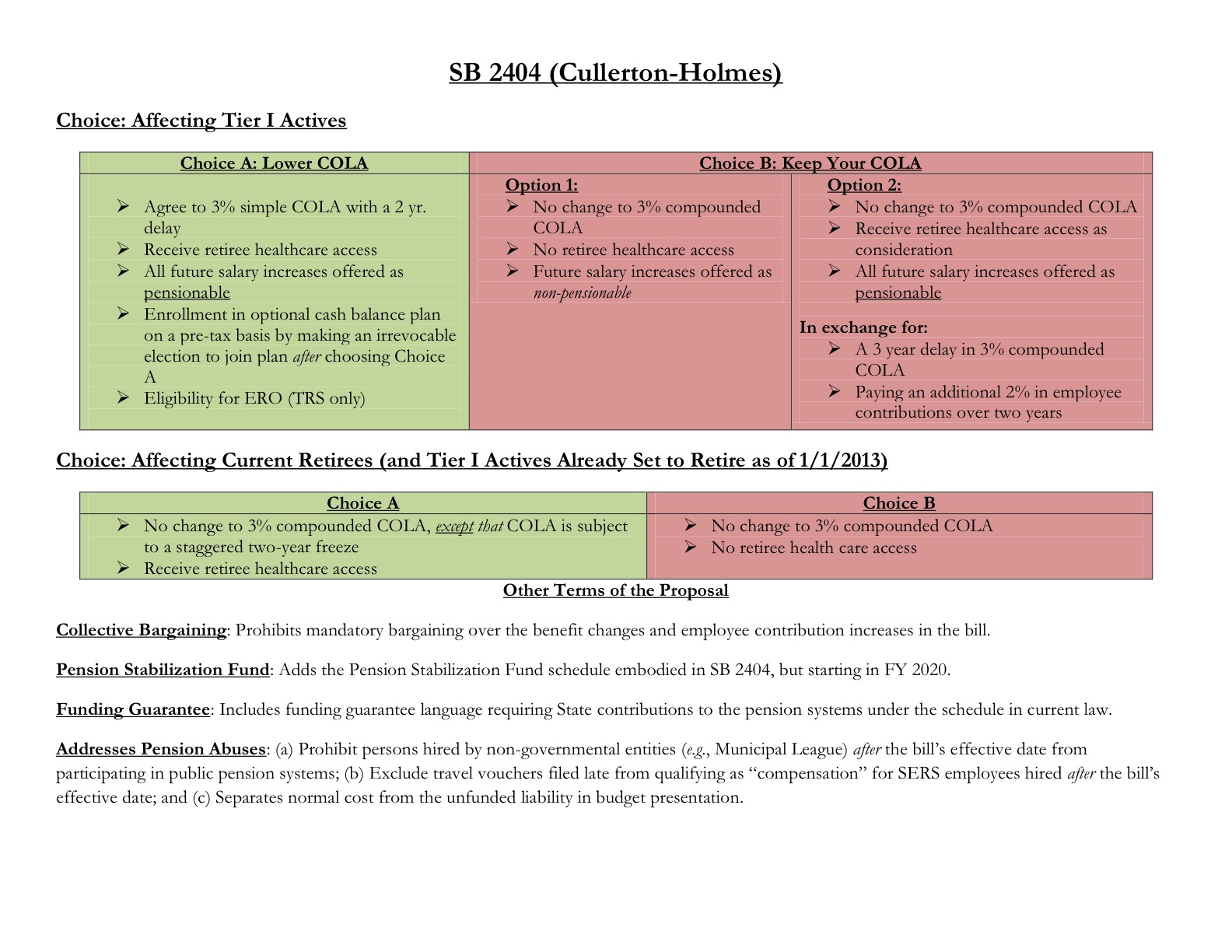
The agreement echoes our principles. It includes an ironclad funding guarantee, revenue by dedicating additional payments to the pension system, contractual protections for access to health care in retirement under several options, and limits the shared sacrifice asked of workers and retirees who did not cause this problem. You will find a full summary of the agreement here.
President Cullerton calls our agreement “credible” and “constitutional.” It represents our willingness to help stabilize our retirement systems, but remains our final, best offer.
It wasn’t too long ago when John Stevens, Legal Consultant for the “We Are One” Labor Coalition stated: “To take away the Cost-of-Living Adjustment [COLA] for [current and future] retirees is not a free and fair choice. It is a coercive choice under duress.” Indeed, the concept of duress (or coercion) is a vitiating (legally defective) factor and; therefore, Illinois legislators are breaching a contract by forcing public employees to make a choice to diminish their originally-vested and paid-for guarantee (unless, of course, their guarantees are going to be “diminished” through “modification of contract principles” at the bargaining table).
Like previous legislators’ proposals, the impairment of the COLA for both active teachers and retirees in SB 2404 offers public employees no ethical and lawful alternatives except to consent to the General Assembly’s demands and choose between two illicit choices.
It is unlawful to induce undue pressure upon public employees to make an unfair choice. It is a blatant exploitation of influence to obtain an unwarranted advantage – an illegitimacy of the General Assembly’s advantageous attempt to renegotiate a constitutionally-guaranteed contract. Furthermore, the “ironclad” funding assurance for a COLA is uncertain.
It was a short while ago when the We Are One Illinois Coalition stated, “Although [a] bill contains a pension funding guarantee, it can be circumvented if a court finds it significantly imperils broad categories of other funding priorities… [Besides], it does not give employees a separate right to civil action and only provides permissive authority for the retirement systems to sue for payment.” There is no question whether legislators will renege on any new promise made to public employees. The question is how soon it will happen. Let’s not forget that policymakers can rewrite or undo any bill they pass. After all, they are doing it right now.
* And teachers union dissident Fred Klonsky is not happy at all…
To be fair, I have also heard from some in the IEA who are telling me that we have to be pragmatic.
“This is the best the leadership could get. Crossing our arms and yelling ‘no” will get us nowhere.”
But this kind of pragmatism has a history.
It gave us the pension ramp in 1995.
It gave us the two-tier pension system. That royally screwed every teacher in TRS who was hired after January 1, 2011.
It gave us the Performance Evaluation Reform Act (PERA) so the state would qualify for Race to the Top.
It gave us Senate Bill 7.
The horrible Senate Bill 7.
There is nothing pragmatic about this kind of pragmatism. Pragmatism means doing what works.
We have said all along that this is a revenue problem, not a pension benefit problem.
SB2404 does nothing to address the revenue problem.
Does anyone believe that a promise to fund the system without changing the way we raise revenue is a promise that will be kept?
The thieves in Springfield know, as they have always known, that the union leadership can be pushed to a point of fear and capitulation.
If the deal goes through? The state’s political leaders will be back again for more.
They always come back for more.
Because for them it always works.
They are pragmatic after all.
But each time we fall for it, it comes back to bite us in the butt.
A Madigan aide stopped short of shooting down Cullerton’s plan entirely but repeatedly emphasized that it doesn’t carry the same financial impact as the plan the House passed.
Madigan spokesman Steve Brown told the Chicago Sun-Times he had seen fact sheets about Cullerton’s proposal, and they “frankly don’t seem like they save much money. We’ll have to take a hard look at that. The idea is to try to save some money and get the pension systems out of the plight they’re in.
Asked if the union plan would pass the House if it emerges from the Senate, Brown said, “I have no way of knowing. It doesn’t look like it saves money.”
Cullerton’s proposal would wipe out about $10 billion of the nearly $100 billion pension shortfall, compared to about $30 billion under the House version.
The Senate Democratic plan also would save the state nearly $46 billion in pension payments over the next 30 years while the House plan would save about $140 billion.
The Madigan plan would fully fund the pensions in 30 years; the Cullerton plan would fund the pensions at 90 percent, the targeted level of the current law. The differences fall within a major debate over the need to be fully funded or whether 90 percent is good enough to weather economic storms.
Madigan took a firm stance on the House floor last week, vowing to do all he could to get SB 1 through the process. He said of the union negotiations: “I don’t expect that they’ll be able to come to an agreement such that people will be prepared to back away from this bill. There’s two chambers here, and both chambers have to pass the same bill. The House has passed a bill, and so whatever the Senate does, I don’t think it would achieve the cost savings that the House bill does.”
Senate Republicans are wary until they see legislation rather than the outline Cullerton presented as he emerged from a closed-door meeting with fellow Democrats.
Cullerton said he plans to meet with Madigan on the union-backed measure, which will be heard in the Senate Executive Committee on Wednesday. He also said his chamber would hold off on considering Madigan’s pension bill until senators can take up the new measure.
* Reboot Illinois, which is owned by a kabillionaire pension reformer, cries for the children…
None of us willingly takes any solace in cutting the income of retirees, but we are in a crisis in Illinois. We understand fully the motivation of state workers who believe they have been victimized by politicians who skipped payments when they insist that cutting benefits is unconstitutional.
But where is the outcry on behalf of our children? Their education benefits have been cut since 2009, also violating the state constitution. Will no one sue on behalf of our children?
People have sued multiple times over many decades. The Illinois Supreme Court has rejected all education funding lawsuits and I’m pretty certain that the Reboot folks know that. There simply is no constitutional mandate for state education funding as far as the courts are concerned.
Oppose whatever you want, but at least be honest when you try to hide behind the kids.
* We’ll get to a discussion soon about the details and react to a new pension reform plan crafted by Senate President John Cullerton and the unions. But i’m curious about something else at the moment.
As you know, Cullerton attempted to graft his former pension plan onto the Madicrossbritz proposal. The idea was to allow the courts to decide if the more severe House proposal was constitutional first. If that plan was struck down as unconstitutional, then the Cullerton alternative would become law. The idea was flatly rejected by business groups and Republicans.
As you will soon see, there is resistance from House Speaker Madigan’s office to this latest Cullerton proposal. So…
* The Question: Should the Madigan and Cullerton pension proposals be combined into a single “Plan A, Plan B” bill? Take the poll and then explain your answer in comments, please. And let’s just stick to the question here. We’ll have ample time to talk about the merits later this morning.
…Adding… I messed up the code, so if you’ve already voted you need to vote again. Sorry and thanks.
Illinois Republican Party Chairman Pat Brady resigned Tuesday, citing a handful of reasons including an ongoing struggle with several members of the state GOP over his support for same-sex marriage.
“There were several reasons,” why he decided to step down, Brady said in a telephone interview with CNN. “I’ve been going at it hard for six years, I need to focus on my family, and obviously I had lost the support of the state Central Committee because of my position on gay marriage.”
Brady did say that he thought the best thing for the party would be to choose a woman to replace him.
“I really think we need a different face than an old white guy,” he said. “I think it’s time for a woman.”
The party said in a written statement Tuesday that Carol Smith Donovan, the current vice chairman, would serve as interim chairman until the State Central Committee selects a permanent replacement.
Party officials will hold a conference call Wednesday morning about the decision. […]
Tenth District Committeeman Mark Shaw of Lake Forest, Republican national committeemen Rich Williamson and Demetra Demonte, and Cook County Commissioner Tim Schneider of Bartlett are among others being considered. […]
The already drawn-out process to replace Brady is reminiscent of the party’s lengthy, often-frustrating search for a U.S. Senate candidate in 2004. The nomination was eventually offered to former presidential candidate Alan Keyes, who did not even live in Illinois — a move that left a bitter taste in the mouths of a number of Illinois Republicans. President Barack Obama defeated Keyes in that Senate race.
Brady’s resignation marks the latest trouble for a political party that had held Illinois’ governorship for nearly a quarter century until then-Gov. George Ryan’s tenure as secretary of state led to indictment and imprisonment. Though Ryan’s successor, Democrat Rod Blagojevich, suffered the same fate, Gov. Pat Quinn survived a close 2010 vote against conservative Republican nominee state Sen. Bill Brady of Bloomington. Sen. Brady is no relation to Pat Brady.
After the November 2012 losses, which also handed Democrats veto-proof majorities in the Illinois House and Senate, Pat Brady argued Republicans needed to be more inclusive. […]
The decision ends Brady’s three-plus years as party chairman, a post he took over after predecessor Andy McKenna Jr. offered his surprise resignation in August 2009 to mount an ill-fated run for governor,
* And the youngest member of the state central committee, Steven Daglas, sent out a blistering press release last night…
Chairman Brady and his family have made tremendous personal sacrifice while helping lead the Illinois Republican Party since 2008. During that time, Pat has never complained or made excuses.
In light of this, I find some of the rhetoric recently directed his way to be both unacceptable and fundamentally disappointing. While it may be challenging to maintain a level head when discussing issues near and dear to one’s heart, it remains neither appropriate nor helpful for strangers to call or email someone out of the blue with degrading attacks savaging another person, their character or their family.
Such action is reprehensible and appalling, not as a matter of politics, but as a matter of human decency. Ugly behavior and vile, destructive deeds are no way to strengthen any organization. Thoughtful free speech and respectful dialogue do not exacerbate problems in life - they help us develop solutions and find common ground.
Put more simply, agreeing with someone on 9 out of 10 questions does not make them your enemy. It makes them someone you can work with 9 out of 10 times to help improve the quality of life for friends, families and neighbors across Illinois. This is especially true in a state facing the dire challenges and Democratic control ours does.
It is incumbent upon all of us, as Republicans, to lead by example moving forward. We may quarrel and fight as siblings, but shall always support each other as family.
* 5:16 pm - Here’s the “cheat sheet” that the Senate Democrats are using to describe union pension reform proposal. Click here or on the pic for a larger image…
* With so many people bad-mouthing Illinois for being a lousy place to do business, it’s quite different to see how Illinois coddles the coal mining industry. Here’s a rant from Salon entitled “Big coal owns Illinois”…
With state coal production soaring against national trends, Illinois cemented its reputation as the worst rogue state for coal operations last Friday, when the rubber-stamping operations of the state’s EPA issued a pollutant discharge permit to a company already cited by the state for over 600 toxic discharge violations at its central Illinois non-union strip mine.
Translation: Imagine the Department of Motor Vehicles renewing the driver’s license of a toxic-laden truck driver with 600 DUI’s.
Welcome to Illinois–where the brand new Prairie State coal-fired plant is facing “potential fraud” investigations for rocket increases in electricity rates; where the second highest number of contaminated coal ash dump sites in the country abound; where a mind-boggling high hazard coal slurry dam continues to rise in sight of a farm town‘s nursing home and day care center; where Illinois taxpayers underwrite a huge slush fund for coal marketing, including a shameless “coal education curriculum” for students that blatantly covers up the facts on the state’s deadly coal industry; where even the liberal US Sen. Dick Durbin fights for the pork of “clean coal” as the main utility company backs out of the FutureGen boondoggle.
It’s so pathetic in Illinois that even bankrupt energy companies are granted two-year extensions on their deadly emissions clean up requirements.
It’s so pathetic in Illinois that there’s not even a coal severance tax, or collection of sales tax for out-of-state transactions–a huge detail when record coal exports now drive the market.
It’s so pathetic in Illinois that we don’t even celebrate Coal Miners Day–just the coal barons.
And last Friday’s notice by the Illinois EPA, sent in an email after working hours, on the granting of the National Pollutant Discharge Elimination System permit for Springfield Coal’s strip mine operation near the township of Industry might be the most unabashed denial of facts and community input in recent memory.
Metro East voters today have started fielding the first of some 10,000 robocalls that will be flooding predominantly African-American areas in and around East St. Louis in the next few days, with a message from a prominent black Chicago pastor: Oppose gay marriage.
“In my view, same-sex marriage should not be the law of the state of Illinois,” says the Rev. James Meeks on the robocall, which is targeted specifically at state Rep. Eddie Lee Jackson, D-East St. Louis. “. . . Call your representative, Eddie Lee Jackson, and share with him your view.”
Rep. Jackson voted against the bill in committee and said at the time that he would also vote against it on the floor. Unless there has been some major move in the opposite direction, why waste resources on these calls? Why risk alienating somebody with robocalls who is already on your side? Not bright.
* Now, this took some guts. GOP state Rep. Ron Sandack attended a rally organized by both anti and pro gay marriage types and told them exactly where he stood…
In February, Sandack, R-Downers Grove, became the first Illinois House Republican to come out in favor of marriage-equality legislation, and he restated that position Saturday for groups on both sides of the issue.
“To be completely forthright with you all, I am going to vote for the bill,” Sandack said to the group opposed to same-sex marriage.
The Illinois Family Institute, a Carol Stream-based anti-gay Christian group, arranged to hold their “Defend Marriage” rally to assert their opposition to legislation that would legally permit same-sex marriage. They also were there to ask Sandack to reconsider his support of Senate Bill 10, which would create the Religious Freedom and Marriage Fairness Act.
“If same-sex ‘marriage’ becomes the law in Illinois, it will negatively affect every aspect of our society and have disastrous consequences for children,” IFI spokesperson Kathy Valente said in a press release for the rally.
As with those who predict ungodly calamities if concealed carry becomes law, I would very much like to see some actual hard data about how states with gay marriage statutes already on their books have been the scene of disastrous societal collapses.
Do you know why people who talk this nonsense don’t have any data? Because the data doesn’t exist. They rely way too much on fear and ignorance to hype their causes. It’s goofy.
I oppose it because marriage is a religious institution. Once they have a law allowing same-sex marriage, they will come after churches and ministers demanding they perform same-sex marriages.
“The Constitution allows for a separation of church and state, but they will come after (churches’) tax-exempt status and file lawsuits claiming (ministers) have violated their civil rights if we refuse to marry same-sex couples.”
Yeah, because that bill will pass right away. I’m telling you, it’ll zoom through both chambers with unanimous support. Yep. No legislator would ever get any pressure from his or her local ministers on a bill like that.
Sheesh.
* Related…
* Black church leader urges lawmakers to oppose medical marijuana: Evans said if the law passes, African-American homes will be broken and black women and men will be sucked into the drug environment even more. “The church’s job is to urge against that climate and to oppose the bill,” Evans said. “If lawmakers want the black community to stand with you, vote against HB 1.”
* Which one of the following stories interests you the most? Take the pollafter you’ve taken some time to at least scan each of the stories and then explain your answer in comments, please.
* The nice thing about leaking stuff like this to Sneed is we don’t hear about such pesky problems as the bungled Koschmann case and the disastrous 60 Minutes interview. Instead…
Sneed hears Cook County State’s Attorney Anita Alvarez is talking with pollsters about exploring a run for Illinois attorney general in the 2014 primary election. . . . if Attorney General Lisa Madigan decides to run for governor.
◆ The bankshot: Sneed is told Madigan is already lining up bigbucks Dem fundraisers — a k a high-priced legal eagles — to back her bid for governor in the Dem primary. “She’s running,” said a top Sneed source.
◆ The sureshot: Word is Alvarez, who was a prosecutor in the trenches for nearly 20 years before becoming state’s attorney, is putting out feelers.
◆The upshot: Watch the state ticket to be heavy in the Dem femme category if Lt. Gov. Sheila Simon decides to run for state comptroller.
Background on that bizarre 60 Minutes interview can be found here and here. If she runs, African-American politicians are gonna be up in arms. Guaranteed.
Also, I’d love to see a poll pitting Sheila Simon against Judy Baar Topinka. Hey, wait. I have a pollster. Hmm.
And one other thing. I’ve been saying privately that I was about 70 percent convinced that Lisa Madigan would not run for reelection and/or will run for governor. I’m up to 80 percent these days.
* I received this bulk campaign e-mail from Sheila Simon last week…
Dear Rich,
People are talking — about the future of Illinois and who can lead us forward.
Working families are worried about their pensions. Parents need to know their children are safe. As Lt. Governor, I am an advocate for Illinois. I strive to be a voice for what’s right, even if it isn’t easy.
In case you missed it, I took that message straight to one of the top political reporters in our state on Monday. Watch my interview with Carol Marin on Chicago Tonight by clicking HERE
Can you help me build momentum by donating $50 or $100 today? Early support will help me stand out as the most effective advocate for reform.
Thank You,
Sheila
P.S. If you believe I’m the candidate to watch, forward this email to two of your friends and ask them to sign up for my email list. You all will be among the first to know my plans for the future!
* A full five days later, I got this e-mail from Simon’s campaign…
Dear Rich
Last week, we sent an email featuring Sheila’s interview with Chicago Tonight’s Carol Marin. We apologize for the broken link and want to thank those who caught the mistake!
You can watch the entire interview by clicking HERE.
Sheila Simon has been a constant advocate for working families in our state. With your help, Sheila will be able to serve our state in a larger role.
Waukegan mayor-elect Wayne Motley made it clear Thursday, May 2, that he feels his city is in the lead after he met privately with Gov. Pat Quinn in Springfield as the Senate bill was unfolding.
“I spoke to him for an hour and we discussed the bill in detail,” Motley said. “It never hurts to have the governor on your side.”
Motley added that he feels “without question that bill was written for the city of Waukegan,” even though the Illinois Gaming Board would be asked to choose from the roster of three county communities.
Um, the Gaming Board is supposed to make that siting decision, not the governor. Then again, Quinn and the Gaming Board’s chairman seem to be locked at the hip. The most recent example…
To meet the governor’s demands, Link added a prohibition on political contributions from gambling interests, created a new executive inspector general for gambling and gave Jaffe’s agency oversight over a Chicago casino commensurate with all other Illinois casinos. […]
Link said he made 28 revisions to this latest effort that were sought by the Gaming Board, including removing a provision that would give the state lottery power to set up casino-style wagering over the Internet. […]
“In the preamble, they say yes, the Gaming Board will have total control. But do we? I don’t think so. I think the Chicago casino authority…is the one that’s going to undertake building the casino. The worst fines that have come out of the Gaming Board come when they have contracts like this,” Jaffe said.
Link said the Gaming Board hasn’t issued construction contracts for any other casino and has the power to immediately shut down any construction work involving contractors it deems ethically suspect.
“They can’t hand out the construction contracts. He’s trying to go way way overboard,” Link said. […]
Jaffe also ridiculed several revenue set-asides spelled out in the legislation. The plan would put $13 million annually into a fund for “depressed communities,” $6.5 million annually to the “Latino Community Economic Development Fund,” $6.25 million annually to soil and water conservation districts and $75,000 annually to the Chicago Botanic Garden, among other things.
“I don’t think they’re necessary at all,” Jaffe said. “It’s a Christmas tree bill — something for everybody that’s orchestrated, I think, with the wrong thoughts, and I’m not happy with it.”
The set-asides are absolutely none of Chairman Jaffe’s concern, but this is an issue that concerns the governor, so the two are on the same page.
* Ben VanMetre, a senior budget and tax policy analyst at the Illinois Policy Institute, says Speaker Madigan’s pension reform plan doesn’t go nearly far enough…
Illinois Speaker Michael Madigan’s pension proposal (House Amendment #1 to Senate Bill 1) perpetuates Illinois’ crisis. The plan locks in the unmanageable defined benefit plan, guarantees the crowd out of core government services and continues the irresponsible pension payment ramp.
Madigan’s plan keeps politicians in control of state employee pensions. By failing to get rid of defined benefit plans, it keeps taxpayers on the hook for bailouts of a broken retirement system.
Worst of all, it creates a new guarantee obligation that prioritizes pension funding above the education of school children, providing health care for the poor and the provision of public safety for neighborhoods across the state.
Ultimately, the plan fails to provide what Illinois so desperately needs: comprehensive pension reform that ends the state’s pension crisis.
“Hi. My name is Mike and I’m a spend-a-holic, with an addiction to power.” To which the other gathered spend-a-holics and / or power-addicts compassionately replied, “Hi, Mike.”
This was the scene that played out in the Illinois State House on Thursday afternoon, as House Speaker Mike Madigan deigned to step onto the House floor and argue for a bill that would reform pensions.
While it was not the bill that my colleague, Rep. Tom Morrison, and I put forth, which would bring the real reform needed in Illinois, it was a first step. And in Illinois, we needed that first step. […]
As I questioned him about how the pension crisis originated, he acknowledged, on the record, the role of his party and the fact that this bill is just the first step to further reforms.
Rep. Ives was far more deferential to Madigan than she makes it appear in her op-ed. Watch.
* Meanwhile, Rep. John Bradley (D-Marion) said publicly that he wasn’t sure how he’d vote on the bill, but he ended up forcefully behind it during debate. Have a look…
* Cook County Sheriff Tom Dart will propose a local concealed carry ordinance in case the General Assembly doesn’t come to an agreement by the court-imposed June 9th deadline…
Dart’s ordinance would give him the power to approve and reject licenses to carry concealed guns in Cook County. Applicants would have to pay a $300 fee for a license. […]
Chicago Police spokesman Adam Collins said: “If a statewide law is not passed, the city is preparing to implement a comprehensive concealed-carry ordinance to ensure that guns stay out of the hands of criminals.” […]
Dart said he recently spoke to elderly people in the south suburbs. They complained that the police were unresponsive. Some said they were regularly burglarized while they attended church.
“It’s a matter of timing,” Dart said, noting that those people could have become homicide victims if they came home during a burglary.
Those are the types of people who might show a need for a concealed-carry permit, Dart said. But someone without a specific need for a gun would have difficulty receiving a license, he said.
Business owners who could hire armed security for protection also might have a hard time getting a license, Dart said.
…Adding… I wish the Chicago police would get a freaking clue. The concealed carry debate is not about criminals getting guns. Criminals cannot legally obtain a FOID card in this state, which is a prerequisite to a concealed carry permit - or even carrying publicly if the state’s unlawful use of a weapon law is finally struck down on June 9th.
* I asked the NRA’s Todd Vandermyde for a response…
One state, one law. They want a no carry zone that encompasses 40% of the population and we won’t budge on it statewide with preemption.
Either by fees or fiat they want their Jim Crow gun laws to deny a fundamental right. What part of the decision do they not understand? $300 for a permit plus what ever other things they pile on top of it– no way
But it lessens any reason to work with Dart on his other legislation.
He added…
So Matt Murphy and Chris Radogno are supposed to go beg Tom Dart for a carry permit? Yeah, I don’t think so.
Monday, May 6, 2013 - Posted by Advertising Department
[The following is a paid advertisement.]
Credit unions are not-for-profit financial cooperatives. They were first exempted from federal income taxes in 1917 to fulfill a special mission as valuable and affordable cooperative alternatives to for-profit banks. Even though credit unions are exempt from income tax, they still are subject to, and pay, property, payroll, and sales taxes, and a host of governmental regulatory supervision fees. Since their inception, credit unions have more than fulfilled their mission, as evidenced by Congressional codification of the credit union tax exemption in 1951 and 1998. Though the range of services has evolved to effectively serve their members in an increasingly competitive financial marketplace, the cooperative structure, which is the reason for their tax exempt status, has remained constant. Nationally, consumers benefit to the tune of $10 billion annually because credit unions are tax-exempt. In Illinois, by most recent estimates credit unions annually provide more than $198 million in direct financial benefits to almost three million members. In an era that continuously poses economic and financial challenges, credit unions remain true to one principle - people before profits - and represent a highly valued resource by consumers during these uncertain economic times.
* This is old news for subscribers, but since nobody else picked up on it I decided to make it my statewide syndicated column…
In yet another blow to the Illinois Republican Party, state Sen. Matt Murphy (R-Palatine) has withdrawn his name from contention as state party chairman.
And, no, it didn’t have anything to do with Murphy being injured during the annual House vs. Senate softball game last week.
Murphy was approached a month or so ago about taking the top party job when the current chairman, Pat Brady, eventually resigns.
Brady, chairman since August 2009, has been under fire for the Illinois GOP’s lack of electoral success, criticism that intensified from the party’s right wing when he public supported the gay marriage bill. The party platform specifically opposes gay marriage, so Brady was accused of being in flagrant conflict with the party’s beliefs.
Brady has said that he merely supported gay marriage as a private citizen, but the social conservatives in the GOP didn’t buy that.
Murphy initially was open to the chairmanship and seemed to be leaning toward taking it. He wanted assurances, though, that Brady would be allowed to resign on his timetable.
Republicans appeared to be going along with Murphy’s program. Votes to oust Brady and to initiate a rules change to make it easier to get rid of a party chairman never took place at the state central committee meeting last month in Tinley Park.
So it began looking like the path was being cleared for Murphy. No such luck.
Murphy’s withdrawal is a big setback to the state GOP’s efforts to quell the controversy within its ranks and move forward.
He’s a media-friendly social conservative who talks like a moderate. He has friends in both the conservative and moderate camps.
Murphy wouldn’t comment other than to confirm that he had withdrawn his name from consideration. Others said he decided that the job just wasn’t worth the hassle.
He’s probably right. The GOP chairman’s job is a thankless one, likely doomed to fail in this state. It has only a tiny fraction of the power of the Democratic chairman, mainly because that chairman, Michael Madigan, is the longest serving House speaker in Illinois history.
Even so, the Republican Party’s right wing has had a fixation for years on who fills the post, blaming Brady for the party’s failures while coveting the job for themselves.
The party’s moderates have frantically fought a rear-guard action to prevent the right wing from obtaining the position and have, therefore, kept control of the finances. The state party serves as a cash pass-through for the national party, and the moderates don’t trust the conservatives with that dough.
And because Republicans haven’t had a governor in more than a decade, the position also is a somewhat high-profile job requiring media skills. Access to the media is a big reason behind the fight over this position.
The old guard doesn’t want to give the right wing a public platform, especially when it’s trying to drag the state party to the center.
They see that as necessary in the wake of last year’s devastating electoral defeats and what appears to be Americans’ rapidly changing views on issues such as gay rights and medical marijuana, not to mention a big surge in Hispanic voting.
During last week’s annual House vs. Senate softball game, Murphy walked to the plate with a determined look on his face. His team was trailing by several runs. The Senate has had a lousy record against the House in recent years, blowing their last game badly.
Murphy fouled off a pitch and gritted his teeth hard, shook his bat and growled. He hit the very next pitch, charged down the first base line and then collapsed to the ground in a cloud of dust.
He had dislocated his kneecap, which ended up a few inches above his knee joint. Murphy didn’t appear to be in any pain, but he couldn’t move and had to be taken to the hospital in an ambulance.
I have a feeling that Murphy would’ve suffered the same ugly ending if he had taken the party chairmanship. It’s best to just stay away from it.
Thoughts?
* Murphy had surgery on his knee and is now recuperating. Ironically enough, he talked about the possibility of injury in an intervew before the annual softball game. Check the 5:43 mark…
* Related…
* Speaker: Same Sex Marriage Stalled, Fracking A Go
Four country music stars are announcing their support for legislation that would legalize same-sex marriage in Illinois.
“Big” Kenny Alphin of the musical duo Big & Rich, Mary Chapin Carpenter, Emmylou Harris and Rodney Crowell signed an open letter released Thursday.
They say “gay or straight, when two people are lucky enough to find each other and want to commit their lives to one another, it is nothing less than a blessing to us all.”
* From a Gov. Pat Quinn press release announcing various appointments…
Dr. David Gill, of Bloomington, received his bachelor’s and medical degrees from the University of Illinois and has served as a family practice doctor and emergency room physician for more than 20 years. Most recently an emergency room doctor at Advocate BroMenn Medical Center in Normal, Gill has been named Assistant Director of the Illinois Department of Public Health.
Gill is just one of several failed Democratic candidates to land a gig in the Quinn administration. Two 10th Congressional District candidates - Dan Seals and Julie Hamos - got state jobs after their 2010 defeats. 2010 US Senate candidate Alexi Giannoulias was appointed chairman of the Community College Board. And then there were all the legislators who got slots after voting “right” during the lame duck session.
But this appointment, as with Seals before him, may take the perennial candidate Gill out of the 2014 congressional race, which would be good news for Democrats. He’s just not a good candidate.
David Hylla is the new chief judge for the Third Judicial Circuit. He replaces Ann Callis, who broke the news Friday morning at the Madison County Judiciary Committee.
Callis also announced at the meeting that she is stepping down to run for a seat in the new 13th Congressional District. She will make a formal announcement on Monday.
As we’ve already discussed, the DCCC has courted Callis to challenge Republican freshman Rodney Davis. Their work paid off, and Gov. Quinn looks to have gotten Gill out of the way.
State Senator Matt Murphy (R-Palatine) is going into surgery this morning for a dislocated knee cap; Murphy was injured during the annual softball game between Illinois house and senate members on Wednesday in Springfield.
“Senator Murphy sustained the injury and was taken away from the field by ambulance,” said Patty Schuh, press secretary for Illinois senate Republicans. “We’ve had injuries before, but it was clear to bystanders and folks at the game his injury was serious.”
Murphy had an MRI on Thursday, which determined he would need surgery, Schuh said.
Murph’s knee cap ended up a few inches above his knee. This was no little injury.
*** UPDATE *** From the Senate GOP…
Sen. Murphy had surgery today at Northwest Community Hospital in Arlington Heights. He had extensive surgical repair for a torn patellar tendon. He is recovering at home and plans to be back at work as soon as possible.
* Earlier this week, state Rep. LaShawn Ford’s attorney filed a response to the charges against him. Ford has been indicted for fraud and lying to a bank…
Ford’s attorney, Tom Durkin, said in a new court filing that Ford was indicted because he was elected.
“He is the only person, to my knowledge, to ever get charged with anything out of the whole ShoreBank collapse,” Durkin said in a phone interview Tuesday. “Which I find odd.”
ShoreBank provided loans to low income parts of Chicago, Detroit and Cleveland. It shuttered after the housing collapse.
Durkin wrote in his court filing that Ford was a long-time customer of ShoreBank. The former head of the bank’s loan committee once said of Ford, “when an individual [like LaShawn Ford] is a well known customer of the bank, the paperwork may be more relaxed and not completed as thoroughly as by newer customers.”
Durkin also requested that prosecutors identify the expenses that were allegedly unrelated to the rehabilitation of Ford’s properties before trial.
Durkin said prosecutors wrongly charged Ford with 17 counts. He said some of those counts are duplicative, and could be in violation of double jeopardy standards.
* Back in January, KPLR TV in St. Louis led off a report with this…
It would be hard to find anybody against the idea. Missouri U.S. Senator Claire McCaskill and Illinois U.S. Senator Dick Durbin are behind the move in Washington to get the bridge named after the late Cardinal hall of famer [Stan Musial].
Not so fast. There have been a large number of disagreements over a new bridge between Illinois and Missouri over the years, and naming it is no different. KMOV TV St. Louis was indignant this week…
Illinois lawmakers turned their backs on the wave of support to name the new Mississippi River Bridge after Stan “The Man” Musial.
Instead the Illinois House unanimously voted this week in favor of a resolution to dub the Interstate 70 span the Veterans Memorial Bridge.
[Rep. Jay Hoffman’s] resolution… is co-sponsored by Rep. Jerry Costello II, D-Smithton; Rep. Dan Beiser, D-Alton; and Rep. Eddie Lee Jackson, D-East St. Louis.
“By naming this bridge in memory of the men and women who have served our nation, we are honoring them on a daily basis. I thank my colleagues on both sides of the aisle for supporting this measure to honor the sacrifices our military veterans have made,” Hoffman said. “I look forward to continuing to advocate on behalf of veterans across our state.”
* Back in April, the Missouri legislature voted unanimously to name the bridge after Musial. The US Senate did the same in March…
Matching legislation is now pending in the U.S. House, sponsored by Rep. Rodney Davis, R-Taylorville, and co-sponsored by Rep. John Shimkus, R-Collinsville.
* Hoffman, who has been a Cardinals season ticket holder, explains…
Hoffman was asked by KMOX’s Mike Kelly that since Stan Musial was a veteran, why not name the bridge after veterans and Musial?
“There are some that have suggested that. I can tell you that, personally, I’m not totally opposed to doing that. However, we here have given our word that we’re going to name it the Veterans Memorial Bridge but if that’s what comes of it, I could certainly be in support of it,” he said.
As part of a lingering squabble over how to finance the bridge, Missouri insisted that it be a tollway - a notion flatly rejected by Illinois as potentially onerous for tens of thousands of its residents who commute daily to St. Louis and its Missouri suburbs.
Illinois later proposed a sister bridge to an existing span, calling it affordable at $450 million. Missouri said it wasn’t a long-term solution.
Both states ended the impasse in early 2008, announcing a compromise after Missouri relented on the tolls.
The bridge naming has not come without some controversy. The widow of a worker who fell from the bridge wants it named after him. Andy Gammon, 35, fell off the bridge in March 2012. “We love Musial, but we would like Andy to be remembered, ” Tracy Gammon said.
Q: Did you have a harder time getting members to come on board as Senate President John Cullerton was working on a separate plan with union leaders?
A: “That wasn’t our experience as we worked through the roll call. It was a difficult roll call to work but not because of action in the Senate. The difficulty would relate to opposition from unions and from teachers unions and from citizens who have already retired and are drawing their pension. But none of it related to the Senate.”
Q: You vowed to do whatever you can to get the bill to Gov. Pat Quinn’s desk. What does that mean now that it’s in the Senate?
A: “Well, I’m committed to the bill. I’m committed to solving the issue. I’ve spoken to this publicly that the state’s fiscal problems are so bad that they require radical surgery, and this is the first step. We’ve taken that first step in the House. My expectation is that the Senate will approve this bill.”
Q: Have you been briefed at all on Cullerton’s negotiations with the unions?
A: “I could clearly see the fine work of Mr. Henry Bayer, who is an expert at delay. I think this is a continuation of what we experienced a year ago from Henry Bayer and the We Are One coalition where day to day they simply want delay. Delay. Delay. Because maybe the problem will go away. It’s precisely what they did on the collective bargaining. And they only came to a conclusion on the collective bargaining because they knew there would be action in the Legislature.”
Q: Will this action in the House spur unions to greater heights with the Senate?
A: “I really don’t know what they’ll do, but I don’t expect that they’ll be able to come to an agreement such that people would be prepared to back away from this bill. There’s two chambers here, and both chambers have to pass the same bill. The House has passed a bill and so whatever the Senate does, I don’t think it will achieve the cost savings that the House bill will achieve.” […]
Q: What was the tipping point in passing today’s pension reform bill?
A: “I think it was the vote that we took about two weeks ago simply on the COLA adjustment where it got 66 votes. I think that told the tale, and then we put the bill together. Today, we were four votes short of that, but it was a good roll call.” […]
Q: What are the bill’s chances in Senate?
A: “My expectation is the bill will pass the Senate.”
Q: Have you spoken to Cullerton about it?
A: “I have. On several occasions.”
Q: Cullerton hasn’t committed to working a roll call though. So what makes you so confident?
A: “Maybe it’s that 43 years around this building.”
Twenty-two House Republicans sided with Madigan’s push, with Democrats accounting for the rest of the “yes” votes. Among the Republicans backing the plan was House Minority Leader Tom Cross (R-Oswego), who signed on to Madigan’s legislation as a co-sponsor.
* Public Pensions’ Fate Rests Largely With Divided Democratic Leaders: CULLERTON: “The fact that the president of the Senate and the unions are putting their full weight behind something means something too. So if we’re able to get our caucus to support a position the unions are for, that would be significant as well.”
* Madigan’s Pension Bill Passes A Full House Vote: The We Are One Coalition has released the following statement in response to the House’s passage of the bill: Senate Bill 1 is unfair to the active and retired teachers, nurses, police, and other employees who paid out of every paycheck to fund their pensions, even as the state shorted its share. On top of that, it is blatantly unconstitutional and thus saves nothing. It simply exacerbates Illinois’ fiscal problems. In contrast, our coalition had a productive meeting today with President John Cullerton, and we hope to be able to continue the dialogue.
* House passes comprehensive pension changes: Senate Minority Leader Christine Radogno said she expects Republicans to support SB 1 if it is called for a vote in the Senate.
Apr 26 2013 Application (12A1053) to extend the time to file a petition for a writ of certiorari from May 23, 2013 to June 24, 2013, submitted to Justice Kagan.
May 2 2013 Application (12A1053) granted by Justice Kagan extending the time to file until June 24, 2013.
More in a bit.
* Illinois State Rifle Association Executive Director Richard Pearson recently had this to say about Attorney General Lisa Madigan’s request…
I have had several calls and emails asking what I think the result of Lisa Madigan’s request for an extension of the deadline to appeal the Seventh Circuit’s decision to the United States Supreme court will be. In my opinion it does nothing. The clock is ticking toward the June 9th deadline.
* 10:29 am - Response from AG Madigan’s office…
The extension allows for additional time to prepare a draft petition to allow the Attorney General to make a final decision on whether to seek cert, as the legislature continues to work toward the June 9 deadline set by the 7th Circuit Court of Appeals.
The 180-day clock does not stop as a result of this extension.
It also doesn’t delay or impact when the case might be considered by the U.S. Supreme Court, if the Attorney General ultimately decides to seek cert.
* One of the arguments being made in support of Speaker Madigan’s pension reforms is that the General Assembly has certain “police powers” in the event of a crisis. The GA has long had the latitude to pass bills which, um, stretch the limits, shall we say, of the Constitution when a crisis is at hand.
The Illinois Supreme Court has addressed police powers in quite a few cases, and talked about that history just three years ago when ruling on a lawsuit that sought to overturn a comprehensive medical malpractice reform law…
In a related vein, the Attorney General posits that section 2–1706.5 is but one part of a massive “multidimensional” response to the health-care crisis which requires all interested parties–insurers, medical professionals and health-care consumers–to make tradeoffs and sacrifices. According to the Attorney General, the Act, through a number of interrelated measures, constitutes an equitable means of ensuring that everyone who stands to benefit from a resolution of the health-care crisis contributes to its resolution.
The Attorney General cites to the Workers’ Compensation Act (820 ILCS 305/1 et seq. (West 2008)) as an example of a multidimensional exercise of the General Assembly’s police power which, although modifying the common law, has been upheld by this court in a long line of cases. See Duley v. Caterpillar Tractor Co., 44 Ill. 2d 15 (1969); Moushon v. National Garages, Inc., 9 Ill. 2d 407 (1956); Grand Trunk Western Ry. Co. v. Industrial Comm’n, 291 Ill. 167 (1919); Matthiessen & Hegeler Zinc Co. v. Industrial Board, 284 Ill. 378 (1918). The Attorney General argues that section 2–1706.1, like the Workers’ Compensation Act, constitutes a legitimate exercise of the General Assembly’s police power.
* But the Supreme Court ruled against the police powers argument in the med-mal case. A couple of prominent medical malpractice defense attorneys penned this analysis…
The Lebron Court also addressed the argument posited by the State Attorney General in an amicus curiae brief that the legislation amounted to a proper exercise of the state’s police power because it appropriately balanced the benefits and burdens of resolving the health care crisis among multiple stakeholders, including insurers, health care providers and patients.
The Court was not persuaded. Instead, the Court noted that because it was not resting its decision on the special legislation analysis of Best, the fact that the act may have served to address a legitimate legislative goal or may have addressed that goal in a balanced and equitable manner would not cure the statute of the constitutional infirmity.
The Court also noted that while the legislature is permitted to alter the common law and change or limit available remedies, that power is not absolute and must be exercised within constitutional bounds. [Emphasis added.]
This is just one more reason to exclude judges from the pension bill because including them could easily prompt a separation of powers argument similar to the med-mal case.
But, more importantly, the Lebron decision gives opponents of Madigan’s pension bill a very powerful argument.
Governor Pat Quinn is expected to fill a couple of empty seats on the board of trustees for Southern Illinois University. Quinn is reportedly expected to name former Illinois National Guard chief Randal Thomas and former SIUE history professor Shirley Portwood as early as today. The Illinois Senate rejected three of Quinn’s earlier appointees who were expected to support the naming of trustee Roger Herrin as board chairman.
Herrin has clashed repeatedly with SIU President Glenn Poshard. Controversy has surrounded the board recently, as three members with ties to Edwardsville - Edwardsville School District Superintendent Ed Hightower, Alton attorney John Simmons, and businessman Mark Hinrichs of O’Fallon - were not retained by Quinn in February.
This was the most easily avoidable problem Quinn has ever created for himself. All he had to do was work with the Senate from the beginning. He refused to even meet with Senators.
So, not only did Quinn damage himself in the Senate, he hurt himself politically in the Metro East, which views SIU-E as its crown jewel. I’ll never understand this as long as I live.
State Sen. Bill Haine, D-Alton, praised the nominees, saying he worked with the governor to find new members after threatening to push legislation through the Senate that would have limited who Quinn could have appointed.
“I appreciate very much the governor engaging in a colloquy with us in the legislature,” Haine said.
State Sen. Dave Luechtefeld, R-Okawville, who represents the university’s Carbondale campus, said he is anxiously awaiting Quinn’s pick to fill the final vacancy on the board.
“SIU-Carbondale is the most important entity in my district. If it succeeds, then Carbondale succeeds. And it has struggled lately,” Luechtefeld said. “We have to get this thing fixed. The board has to work with the administration. The sooner that happens the better.”
Thomas and Portwood are expected to join the board at its meeting on Wednesday.
Haine praised the nominees because his chamber’s chief of staff is the one who first floated the idea. That chief of staff, by the way, used to work for Glenn Poshard as his legislative liaison - just one more reason why this was a stupid, stupid move by Quinn.
* From the Commission on Government Forecasting and Accountability…
Monthly income tax revenues leaped in April, growing by $1.521 billion. The infusion of cash into the State’s coffers allowed for the repayment of a voluminous amount of overdue Medicaid bills. That action subsequently generated a massive amount of federal sources over $1 billion during a single month.
(P)reliminary Commission assumptions are that gains are strongly related to final and estimated payments stemming from actions taken by taxpayers in efforts to minimize the tax consequences of the higher 2013 federal tax rates. As such, they are not repeatable in future fiscal years, and should be viewed more in terms of a “one-time” event.
As will be discussed in a following section, Illinois’ employment situation is dominated by less than positive news, offering little in the way of argument for sustainable higher expectations.
“We do not have a real guarantee,” said Rep. Michael Fortner (R-West Chicago), who voted against Madigan’s legislation. “The fact we can change it through our budget implementation process gives me concern a future Legislature will do very much the same things we’ve seen happen all too many times during the past decades under a variety of different administrations.”
There are no absolute guarantees in life, and that’s particularly so when you’re talking about the General Assembly.
The guarantee in the Madigan bill is pretty darned solid. But Fortner is right that it could simply be undermined.
* So, I suppose that Madigan could propose a constitutional amendment guaranteeing that the state funds the pension systems.
Membership in any pension or retirement system of the State, any unit of local government or school district, or any agency or instrumentality thereof, shall be an enforceable contractual relationship, the benefits of which shall not be diminished or impaired.
That benefits guarantee was thought by the framers to be etched in stone. Not so, according to Madigan and everyone else who voted for (or cheered on) the pension bill yesterday.
* There really is no way to forever guarantee anything. Using the lack of a guarantee as a reason to vote against the bill is just as illogical as claiming that the guarantee will definitely lead to assured state fiscal disaster if and when Wall Street crashes again. So, Bruce Rauner is wrong as well.
…Adding… Eden Martin uses the “The guarantee will ruin Illinois” argument in the Sun-Times today. It’s just not a very good argument at all.
All you can ever do to deter human beings is construct a high wall and hope they don’t decide to build a longer ladder.