* Usually, bills based on extreme cases can get a bit outta hand. But there are lots of problems out there with visitation rights, with parents using children as weapons in nasty divorces. So, this may not be too unreasonable…
A bill that increases the penalties for parents who violate visitation agreements passed out of an Illinois House committee on Wednesday on a unanimous vote. The proposal now goes before the full House.
House Bill 1604 allows judges to impose fines and possible jail time if visitation is continually denied.
The so-called “Steven Watkins bill” stems from the 2008 case where Watkins was fatally shot when he went to pick up daughter Sidney, now 3, for a court-ordered visit in Ashland. Shirley Skinner, the grandmother of Watkins ‘ ex-wife, Jennifer Watkins , was convicted of first-degree murder in the killing and is serving a 70-year sentence.
Steven Watkins’ parents were granted visitation rights with Sidney, but Jennifer Watkins has not produced the girl for court-ordered visits.
* The bill does a lot more than impose fines and jail time. It grants judges a lot of new powers…
Amends the Illinois Vehicle Code and the Illinois Marriage and Dissolution of Marriage Act. Provides that the court, upon finding that a party engaged in visitation abuse, may: suspend the offending party’s Illinois driving privileges pursuant to the Illinois Vehicle Code until the court has determined that there has been sufficient compliance for a sufficient period of time with the court’s order concerning visitation and that full driving privileges shall be reinstated; order that the offending party be issued a family responsibility driving permit to allow limited driving privileges for employment and medical purposes; order that an entity that issued a professional license to the offending party suspend or revoke the party’s professional license for a period of no more than 6 months; and fine the party not more than $500 for each finding of visitation abuse. Provides that a finding of visitation abuse constitutes a change in circumstances for purposes of a modification of a custody judgment. Provides that if a parent has been previously found in contempt by the court for visitation abuse, the court may further: incarcerate the offending parent one day for each day of denied visitation; or require the offending party to post a $5,000 bond subject to forfeiture for the purpose of assuring compliance with future visitation.
* By the way, an arrest warrant has been issued for Jennifer Watkins because she defied a judge’s order...
A Cass County judge has ordered the arrest of the widow of the late Steven Watkins for not allowing visits between the couple’s 3-year-old daughter and the murdered man’s parents.
The visits between Sidney Watkins and her paternal grandparents, Dale and Penny Watkins, stopped Nov. 26 because the child and mother Jennifer Watkins reportedly moved to Florida.
Jennifer Watkins did not appear Tuesday at a hearing on multiple petitions that Dale and Penny Watkins’ attorneys filed seeking she be held in contempt of court and a warrant issued for her arrest.
Jennifer Watkins’ attorneys, Michael Goldberg of Chicago and Dan Fultz of Springfield, told Judge Bob Hardwick Jr. they do not know where she is and could not provide any defense because they have been unable to communicate with her.
Thoughts?
…Adding… This ruling may not go down well with some…
The First Amendment protects hateful protests at military funerals, the Supreme Court ruled on Wednesday in an 8-1 decision.
“Speech is powerful,” Chief Justice John G. Roberts Jr. wrote for the majority. “It can stir people to action, move them to tears of both joy and sorrow, and — as it did here — inflict great pain.”
But under the First Amendment, he went on, “we cannot react to that pain by punishing the speaker.” Instead, the national commitment to free speech, he said, requires protection of “even hurtful speech on public issues to ensure that we do not stifle public debate.”
Illinois already has a law on its books restricting the protests (which were enacted because of those idiot cultists who protest at military funerals), but there was a push this year to strengthen it…
State Rep. Frank Mautino, D-Spring Valley, is backing legislation to discourage loud and threatening protests at funerals.
“Hateful rhetoric has no place at private ceremonies like funerals where mourners should be able to pay their final respects in peace,” said Mautino. “That right cannot be infringed, so we should do all we can to keep discouraging, despicable protests from taking place at funerals, especially when fallen soldiers are laid to rest.”
In response to demonstrations by a Kansas-based group that regularly protests the families and funerals of soldiers killed in Iraq and Afghanistan, including funerals in Illinois, in 2006 Mautino and the General Assembly passed the Let Them Rest in Peace Act — a law prohibiting anyone from protesting loudly, blocking access to and from any funeral and displaying threatening words or images 30 minutes before, during and 30 minutes after a funeral or memorial service.
Under current law, protesters cannot be within 200 feet of the entrance or exit of the cemetery or memorial facility. The law defines protesting as disorderly conduct, which includes loud protests of singing, chanting, whistling or yelling, and displaying any visual images that convey fighting words or actual or veiled threats against any other person.
* Who is your favorite Illinois politician who is not from the party you generally support? In other words, if you’re a Democrat, who is your fave Repub? Etc.
Let’s keep this confined to currently serving politicos, please. Thanks.
* This won’t cause any controversy and over-hyped misinterpretation at all. Nope…
The names of people authorized to own guns in Illinois is public information that the state must disclose, the attorney general has ruled.
The Illinois State Police determines who gets Firearm Owners Identification cards but has always kept the information confidential.
Attorney General Lisa Madigan’s office issued a letter Monday rejecting state police arguments that releasing the information is an invasion of privacy prohibited by the state public-records law or that disclosure would endanger the lives of gun owners.
The State Police say they “respectfully disagree” with AG Madigan’s opinion, which was prompted by a FOIA request by the Associated Press.
* There aren’t any state laws which specifically keep the information private, but you can expect legislators will be moving measures to do so. Gubernatorial candidate state Sen. Kirk Dillard already introduced a bill in January…
“In January I introduced legislation that would declare Firearm Owners Identification information private. I am urging Director Keen by letter to give lawmakers the opportunity to consider my legislation before making this information public,” Dillard said.
He said he is worried the information could be used by criminals and commercial solicitors.
“I will also ask Senate President John Cullerton and House Speaker Michael Madigan to expedite consideration on this landmark issue of privacy and public safety,” he said. “In this era of Big Brotherism, I am concerned that the list will not only be used by commercial solicitors, but could be used by criminals to identify which homes might contain a firearm, so they know which homes to systematically burglarize.
“The attorney general’s opinion will compromise firearm regulation if people are worried that their names will be identified, which could lead to more straw purchases of guns or total non-compliance,” Dillard said. “This is not about guns — it’s about privacy and public safety.”
Proponents of releasing the information argue that it’s a public policy issue. “There should be public scrutiny on any licensing system, whether it’s to own or to buy or to carry,” Brian Malte of the Brady Campaign to Prevent Gun Violence told the Tribune. “The public has a right to know how well those systems are working, especially when it involves firearms.” But opponents of releasing the information, such as Todd Vandermyde, Illinois lobbyist for the National Rifle Association, think that if people know who has a card who doesn’t, those who own and don’t own firearms alike will become targets. “You potentially make us targets,” Vandermyde told the Tribune. “Or, on the inverse, you could say, ‘These are the homes that don’t have FOID cards so it’s likely they don’t have guns, so therefore they make better targets.’”
* But the fears appear to be at least somewhat overblown. From a Madigan letter to Illinois Review…
The only information our office has advised should be released is the FOID cardholder’s name and the effective date or expiration date of the card. No other personal information is to be released.
So, there won’t be any addresses released. Not even the names of towns would be listed.
State officials are investigating whether religious agencies that receive public funds to license foster care parents are breaking anti-discrimination laws if they turn away openly gay parents.
If they are found in violation, Lutheran Child and Family Services, Catholic Charities in five regions and the Evangelical Child and Family Agency will have to license openly gay foster parents or lose millions of state dollars, potentially disrupting more than 3,000 foster children in their care.
Though Illinois legislators championing the civil union bill earlier this year insisted that religious institutions would not be forced to bless same-sex unions, it said nothing about same-sex parents.
Now, Attorney General Lisa Madigan, Gov. Pat Quinn’s legal team and the Department of Children and Family Services are carefully researching the Illinois Human Rights Act, the Civil Union Act and the Illinois Constitution to determine whether they prohibit agencies from considering sexual orientation as a factor in foster care and adoption. In Illinois, all adults who adopt or become foster care providers must obtain foster care licenses.
*** UPDATE *** The Illinois Policy Institute’s John O’Hara was on Chicago Tonight yesterday and said the real issue here was whether the country will have “two classes of people: a highly politically powerful, public employee unions and everyone else who pays for their salaries.” Watch…
[ *** End Of Update *** ]
* One of the refugee legislators from Indiana was at the Illinois Statehouse last night and spoke briefly at a Senate Education Committee meeting…
[Rep. Mara Candelaria Reardon] said she chose to stop by the education committee because the subject is “one of the reasons we’re fighting.”
“The most important thing that we can do is provide a free and quality education to our students,” Reardon said. “The fact that this governor in Indiana does not recognize the contributions that educators make is very disappointing to me”
State Sen. James Meeks, D-Chicago, chairman of the committee, used his microphone to ask the fleeing lawmaker: “Is there any kind of reward for you?” […]
Reardon said she would remain in Urbana, Ill., for “as long as it takes.”
I was at a different meeting and missed that one. But it’s kind of ironic that she stopped by an education hearing, considering what the Illinois Federation of Teachers thinks about a proposed education reform…
(T)he Illinois Federation of Teachers is watching a proposed legislation that they say is an attempt to eliminate collective bargaining for teachers.
“It’s actually worse than that Gov. Walker is proposing in Wisconsin,” said federation spokesman Dave Comerford. He said the proposal would make it so “the district could legally walk in and say they’re going to cut pay and there’s literally no recourse” for the unions.
The group responsible for the proposal, which was heard by a special committee convened by Illinois House Speaker Michael Madigan (D-Chicago), is supported by a coalition of child advocacy and business groups. While Comerford said they are by no means taking these measures for granted, “I think our lawmakers are watching what’s going on [in Madison] and saying they hope it won’t happen here.”
The leader of boycotting House Democrats plans to return to Indianapolis.
Spokesman John Schorg says House Minority Leader Patrick Bauer will return from Illinois to Indianapolis for a meeting on Wednesday, but it is not clear if the meeting will be with Republican House Speaker Brian Bosma.
House Republican spokeswoman Tory Flynn says Bosma does not have any meeting scheduled with Bauer.
[Sen. Tim Cullen, D-Janesville] said he was one of the Dems who met [Monday] with Majority Leader Scott Fitzgerald, R-Juneau, near Kenosha. He said the meeting was cordial and Dems gave Fitzgerald a list of changes to the budget repair bill that they wanted.
Fitzgerald took the suggestions to the speaker and guv, and they exchanged counter offers later in the day, but couldn’t reach a compromise, Cullen said.
He said he spoke with Fitzgerald this morning, but it wasn’t a negotiating session.
“The door may be closed to the kinds of changes that we need,” Cullen said. “But I think the possibility of talking again will be there.”
* A first-hand look at Wisconsin lawmakers’ life on the lam - Democratic state senator Bob Jauch from Poplar and the rest of the 14 senators who escaped from Wisconsin spent parts of several days last week in the charming northern Illinois town of 22,000 where the movie “Groundhog Day” was filmed.
* Even Without Muni Bond Sale, Wisconsin Not in Fiscal Peril
* Why Your Boss Is Wrong About You: As anybody who has ever worked in any institution — private or public — knows, one of the primary ways employee effectiveness is judged is the performance review. And nothing could be less fair than that.
* Cook County law aimed at tax lawyers questioned: A Cook County ordinance aimed at Assessor Joe Berrios and the piles of money that tax attorneys threw at him during last year’s assessor’s race may be unconstitutional. That’s the opinion of the state’s attorney’s office, which in a Feb. 8 memo says campaign donation limits are a matter of state law, and the county ordinance “violates the separation of powers doctrine established in … the Illinois Constitution.“
* Lawyers warned their Berrios contributions could be illegal
* Foreman: Deadlocked Blago jurors held ‘reunion’: He says a lone holdout juror who prevented conviction on several serious charges helped organize the union but, at the last minute, wasn’t able to attend.
* Immigration crackdown nets 678 arrests, including 14 in Chicago area
* State’s universities urged to partner for more research funding - U. of I. board chief Kennedy calls for more cooperation with businesses and politicians
* Chicago Police Supt. Jody Weis quits; Terry Hillard returns
* Agency says it has no file on 2000 complaint about doctor - Physician now seeks to have court records of another incident sealed
This article concludes that legislation enacted to unilaterally reduce the pension benefits of current employees would violate the Pension Clause based on the Clause’s text and origins, constitutional convention debates revealing the framers’ intent, contemporaneous news articles demonstrating voters’ understanding of the Clause, and a host of court decisions construing the Clause.
This circumstance, coupled with the fact that the legislature already had a poor track record of making its actuarially-required pension contributions, caused public employee groups to lobby Convention delegates to include the Pension Clause. These groups reasoned that constitutional protection was necessary because the General Assembly would renege on its pension obligations to public servants during a financial crisis. Convention delegates agreed and included the Clause to foreclose that result.
* Can benefits be unilaterally changed by the General Assembly for current employees? Madiar says no…
The article finds that the Pension Clause not only makes a public employee’s participation in a pension system an enforceable contractual relationship, but also constitutionally protects the pension benefit rights contained in the Illinois Pension Code when an employee joins a pension system, including employee contribution rates. The Clause also safeguards pension benefit enhancements that are later added during employment. Further, the Clause ensures that pensions will be paid even if a pension system defaults or is on the verge of default.
* However, there is a way to change those benefits. And it involves that new national bugaboo word “collective bargaining”…
(W)hile the Clause bars the General Assembly from adversely changing the benefit rights of current employees via unilateral action, these rights are “contractual” in nature and may be modified through contractual principles. In sum, while welching on public pension promises is not an option for Illinois as some legal and civic commentators have suggested, legitimate contract principles provide a solution to mitigate this crisis.
That looks to be the Senate Democrats’ stance for the spring session: It’s up to the governor to negotiate any pension changes with the public worker unions.
* 2:15 pm - If at first you don’t succeed, try, try again…
It took two years, but Jonathon Monken finally got approval from the Illinois Senate to be director of a state agency. But he’ll be in charge of the Illinois Emergency Management Agency, not the Illinois State Police.
The West Point graduate’s nomination, sponsored by state Sen. Larry Bomke, R-Springfield, sailed through the committee Tuesday on a unanimous vote, with no questions from the committee members. It later passed 52-1 in the full Senate, making the appointment official.
“You’re going to do good in your new position,” Sen. Antonio Munoz, D-Chicago, the committee’s chariman, told Monken.
Sen. Munoz was one of those who held up Monken’s nomination for State Police Director. Nobody thought the war hero Monken was a bad guy. They just didn’t believe a non-cop should be running the ISP.
Discuss, but try to avoid petty, personal attacks. I really don’t like it when state employees do that, and I don’t have time to, um, police you this afternoon.
* Meanwhile, Illinois did well in a recent Site Selection magazine ranking. From a press release…
The state of Illinois and Chicago today were named among the top 10 locations for new and expanded corporate facilities. Illinois ranked eighth among states and Chicago first in the metropolitan areas category in the annual analysis by Site Selection magazine, one of the nation’s premiere corporate real estate and economic development publications. […]
In 2010, Illinois had 205 corporate facilities locate or expand in the state. Illinois joins Texas, Ohio, Louisiana, Pennsylvania and Georgia on the list of the top ten states with the most locations and expansions. With 184 projects, the Chicago-Naperville-Joliet metro area topped the list of cities in the tier one, top ten metropolitan areas list. Illinois companies that have relocated or seen significant expansions this year include Navistar, Chrysler, Mitsubishi, Ford and Groupon, among others.
Legislation that two Elgin police officers helped draft will come before state lawmakers later this week.
Lt. Jeff Adam and Officer Chris Jensen are the force behind House Bill 1258, which, on top of other penalties associated with such crimes, would fine those convicted or placed on supervision for delivering or manufacturing cannabis, controlled substances or methamphetamine for costs associated with their arrest.
Jensen said such drug arrests can cost cities such as Elgin thousands of dollars in labor-related expenses, including overtime. .
Illinois has a similar law allowing locals to recoup DUI arrests after convictions.
* The Question: Should the Illinois General Assembly approve this bill which allows the police to recover costs for drug arrests? Take the poll and then explain your answer in coments. Thanks…
Illinois Gov. Pat Quinn is the new finance chair of the Democratic Governors Association, I’m told, responsible for raising millions of dollars from across the country to help bankroll upcoming governor contests.
Quinn was tapped for what is his first big national political role by DGA chairman Maryland Gov. Martin O’Malley. Taking on the finance chair chores means Quinn will travel more around the country to raise Democratic cash.
At one-time seen as reluctant to be involved in major fund-raising, Quinn stepped up to the plate when it came to his battle to win election on his own in 2010, after becoming governor after Rod Blagojevich was impeached in 2009. Quinn raised $23 million in what was a brutal Democratic primary and general election campaign against Illinois State Sen. Bill Brady.
There are four governor contests in 2011: Republicans are governor in Mississippi and Louisiana and Democrats hold the seats in Kentucky and West Virginia.
He really needs to finish fixing some of the bigger problems at home before taking on these added, partisan responsibilities. But, he’s tight with public employee unions, which contributed heavily to his campaign last year. And he’s spoken vigorously on their behalf during the Wisconsin/Indiana turmoils. For instance…
“It’s a war on workers: You know, the people who teach our kids, who plow the snow off our interstates,” Quinn Monday said on MSNBC. “Those are working men and women and they deserve a decent pay and decent retirement. They’ve already given up concessions in that area.
“The right to have a union and collectively bargain – about your conditions, working conditions – that’s a fundamental American right,” he said. “So what Governor Scott Walker’s doing in Wisconsin is just plain wrong. and I think he’s going to realize it. The people of America are not on his side.
“He didn’t show up at our governors’ conference here in Washington,” Quinn continued. “I think that he knows even Republican governors – many of them know – that he’s on the wrong track and he’s not going to help working people and middle class people retain a good job in America.” […]
“We’re not going to give in and roll over here,” Quinn said. “The governor of Wisconsin is just plain wrong. I noticed today – this past couple days – many other Republican governors are not buying into this trying to bash unions, and bust unions, and hurt working people. That’s not what America is all about. We believe in hard work and rewarding that with decent pay and a decent retirement.”
Those unions have big bucks and the DGA will likely use Quinn to get their cash for Democratic candidates.
Also, it’s a bit of an irony that the DGA is tapping Quinn to raise money now, after having to run TV ads for him last summer because his campaign apparatus was stuck in low gear.
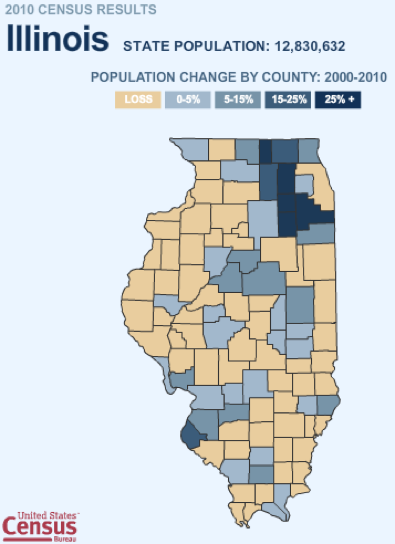
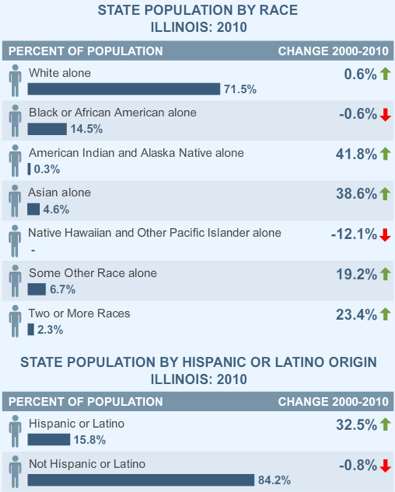
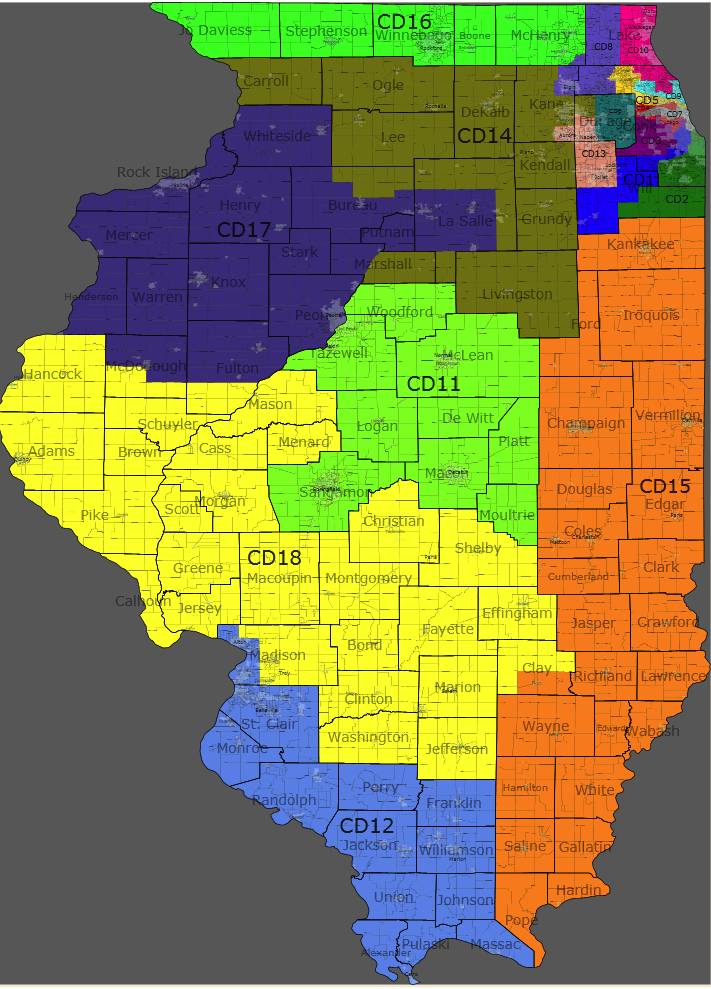
*** UPDATE *** I meant to post this below the census data and forgot. Charlie Cook’s team gamed out a possible new IL congressional district map. Click the pic for a larger version…
[ *** End Of Update *** ]
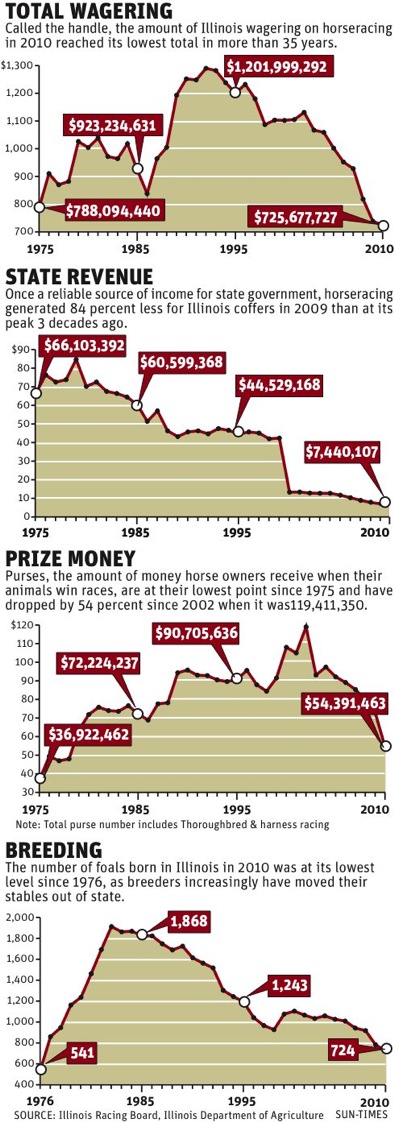
* The Sun-Times ran a storythis week about how the horse racing industry is dying. The paper’s charts paint a dismal picture…
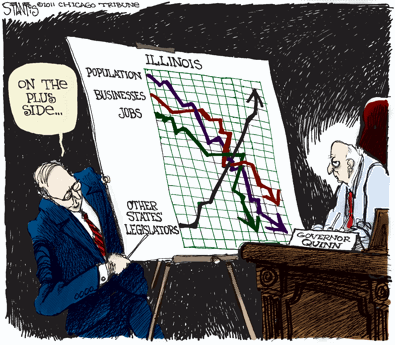
* Scott Stantis’ recent cartoon contained a chart with graphs…
Tuesday, Mar 1, 2011 - Posted by Advertising Department
[The following is a paid advertisement.]
AARP strongly supports House Bill 96 and Senate Bill 144. These bills would repeal a discriminatory unemployment law in Illinois that unfairly penalizes laid-off workers who receive Social Security benefits. It is called the Social Security unemployment “offset” and Illinois is now one of only two states in the nation (along with Louisiana) that has never taken action to repeal the law.
People who receive Social Security work because their Social Security payment is decidedly not enough to live on. To further penalize these workers by unfairly reducing their unemployment benefits is simply wrong. These are individuals who have worked and fueled the Illinois economy, but then become victims of both age and economic discrimination when they lose their jobs.
These bipartisan bills would repeal the unemployment law in Illinois that classifies one-half of an older adult’s Social Security payment as disqualifying income for purposes of receiving unemployment benefits.
AARP, on behalf of its 1.7 million Illinois members, is urging lawmakers to support these bills.
* Rod Blagojevich’s PR guy responds to questions about the convicted felon’s invitation to speak to a national group of high school kids…
The governor has many supporters who admire his courage to take on the system and challenge the allegations with all he’s got. He’s spent a career fighting duplicitous politicians and for government transparency. He has passionately pursued issues that impact ordinary, hard-working people.
His tenacity both as a politician and as a man earned him a spot to address the JSA regional conference and he’s looking forward to speaking to the youngsters.
Blagojevich is one of the most well-known politicians of our time. We have to learn from the actions of the corrupt. We can’t shelter ourselves from reality. If we want to end corruption, we have to learn from the corrupt.
The man is an accomplished snake charmer. There’s not much to “learn” from him except not to do what he did. And you don’t need to invite him to appear at a conference to know that. A half an hour on the Internet would suffice.
* It’s obvious from the PR flak’s statements that Blagojevich intends to offer up a full-throated self defense on the eve of his second trial. Take a look at Blagojevich’s website to see how he promotes himself…
Since his controversial ousting from office, Rod Blagojevich has refused to be silent.
The twice elected former governor of Illinois has insisted he is innocent of all charges since his arrest in December, 2008.
Now he continues his mission to prove to the world he did not betray his family, friends and the Illinois voters.
His crusade for justice and his uncanny ability to deal with adversity has made him an in-demand public speaker where he consistently draws huge crowds.
Look for Quinn to sign off [this] week on legislation to abolish the death penalty.
Quinn telegraphed his support for the proposal during a chat with reporters Wednesday.
Supporters of the abolition effort began hearing inklings of a news event surrounding the signing last week. The likely location: Northwestern University, home of the Center on Wrongful Convictions.
* Meanwhile, former Gov. George Ryan talked about his decision to empty death row during a just released deposition. Some excerpts…
* “The families of the victims were just brutal. They threw stuff at me when I stood on the podium and swore at me and, you know, called me all kinds of names when I hadn’t really made up my mind about what I was going to do and told them that,” Ryan said of family members related to victims of crimes.
* At one point Ryan admitted spending as little as 10 minutes on petitions but at another point he said he burned the midnight oil pondering decisions.
* ”How can governors say we’re going to kill these people and then ask a state employee to go down and pull the switch. Who are those people to make that determination?” Ryan says.
* Ryan said he made pardon decisions based on evidence and discussions with staff. “When there was evidence there, I weighed the evidence and came up with what I thought was the best response to that evidence. I never dealt in hypothetical cases, and I don’t want to do it here.” […]
# Ryan said what propelled him to clear out Death Row and offer a slew of pardons before he left office stemmed from the case of Andrew Porter, who was wrongfully imprisoned for 15 years. “I turned to my wife, and I said, how the hell does that happen?” Ryan said of watching the events on the TV news. “How does an innocent man sit on death row for 15 years and gets no relief except for the students of journalism, not law students, students of journalism at Northwestern University? Tell me how that happens. And that piqued my interest, Anthony Porter. And I followed that case right through to commutation of 167 guys. I thought it was 177. Whatever it was. And that’s what triggered me. I still can’t believe it.”
He appeared to blow up when the city attorney linked the timing of Ryan’s moratorium on the death penalty to when the governor was first questioned by authorities concerning the federal probe. […]
But Ryan couldn’t keep quiet. “You’re here to talk to me about the Walden pardon,” he said. “What the hell does my indictment got to do with it?”
A short time later, when the attorney asked again about the criminal investigation, Ryan threatened to leave.
“I’m about ready to walk out of here, and you can do what the hell ever you want to do,” he said. “Send me to jail if you want. I’m not going to put up with that. If that’s — if that’s what you’re here for, and I’m starting to believe that it is.”
Indeed, Illinois residents would gladly trade positions with the people of Wisconsin.
Yeah. OK. And pay higher income taxes, live in a cultural desert and endure massive social unrest and a Republican governor who makes Bill Brady look like Dawn Clark Netsch? Gotcha. Right. Check. That’ll go over extremely well. [/Snark]
* The reason the News-Gazette claims we’d all like to trade positions with the Cheeseheads is that our state has a bigger budget deficit than they do.
But what I’d really like to know from the paper is what major state spending they’d like to see reduced in their own area. What U of I schools should be shuttered? What community college campuses should be closed? How much should class sizes grow in area K-12 schools? Which local families should lose their Medicaid, and which doctors, hospitals and nursing homes should be paid less? Which Champaign-Urbana domestic violence shelters, substance abuse centers and childcare programs should be closed? What newspaper industry tax breaks - on everything from ink, to newsprint to machinery - will the News-Gazette give up?
* This is the sort of empty rhetoric we see all the time from newspaper editorial boards. But none ever offers to sacrifice themselves. In fact, there’s a huge push on right now to block a bill in the General Assembly that would kill off a sacred government subsidy. From the Illinois Press Association…
Industry must rally against Public Notice bill
The introduction of HB 1869 in the Illinois House of Representatives has created a rumble through the Illinois newspaper industry that could be equated to kicking a hornet’s nest. The subsequent response from Illinois publishers to the IPA’s “call to action” has been tremendous and it appears certain that response will not calm down until this bill is defeated.
In short, HB 1869 would remove full-text publication of public notices from newspapers and allow government entities to post them on their own websites. The coalition behind this bill —eight groups comprised of elected officials from townships, school boards, county officials, etc. — are claiming this is a cost-cutting move necessitated by their tight operating budgets. They also claim circulation has decreased so significantly to the point of newspapers being obsolete and, also, that the Internet is now the better and preferred place for public notices.
Several newspapers have published editorials blasting the proposal since the IPA cranked up the opposition. But state and local governments spend a ton of cash on these notices, and few papers put the notices online. Since fewer and fewer people are reading dead tree editions, they won’t see the public notices.
It’s the same old story. “Cuts for thee, but not for me.”
* Illinois corn yield decreases 10 percent: U.S. reserves of corn have hit their lowest level in more than 15 years, reflecting tighter supplies that will lead to higher food prices in 2011. Increasing demand for corn from the ethanol industry is a major reason for the decline.
* Illinois requests federal aid for winter storm costs
* Strike avoided as Caterpillar, UAW reach tentative deal
* New Metra CEO outlines reforms - Pagano’s successor vows ‘zero tolerance’ for ethics violations
* Trains will travel through stations during boarding: A policy preventing trains from rolling past a station while another train is boarding passengers will end Tuesday at some stations on Metra’s Union Pacific West Line.
* Details, details: Sneed hears rumbles Loop lawyer Matthew Hynes, a brother of former state Comptroller Dan Hynes and member of a politically powerful Southwest Side family, heads the list to become Mayor-elect Rahm Emanuel’s chief of staff.
* Poor Showings Leave Black Candidates Blaming Media in Chicago Mayoral Race
* Rhymefest’s raps become campaign fodder in aldermanic race: In his songs, Grammy-winner Che “Rhymefest” Smith spits and stutters curse words, homophobic slurs and the N-word. He sometimes busts rhymes about shooting guns and selling drugs. In his song, “Chicago” — a tale of his hometown where he’s running for 20th Ward alderman — Rhymefest raps, “Ain’t sorry that I did it/ I’m sorry I got caught.”
* Defense calls prosecution ‘incredibly reckless’: McHenry County State’s Attorney Lou Bianchi is free on his own recognizance after being indicted for a second time along with two of his investigators.
* 2:07 pm - As you know by now, ICC Chairman Manny Flores was having big trouble with his nomination. He had opposition in the Senate because of past political differences and because of utility company opposition. He wasn’t going to be confirmed.
So, as subscribers already know, Gov. Quinn decided to withdraw Flores’ nomination and move him over to another job while giving the ICC chairmanship to IEPA Director Doug Scott. From a press release…
Today Governor Quinn named Doug Scott as chairman of the Illinois Commerce Commission (ICC) and Manuel “Manny” Flores as director of the Division of Banking of the Illinois Department of Financial and Professional Regulation. Scott has served as director of the Illinois Environmental Protection Agency (IEPA) since 2005 and Flores has chaired the ICC since January 2010. Governor Quinn also named Andrew Ross as the state’s chief operating officer and Lisa Bonnett as interim director of IEPA.
Lisa Bonnett will be the IEPA’s interim director. She is currently the acting deputy director.
* Also today, Quinn filled chief of staff Jack Lavin’s old job of chief operating officer…
Today Governor Quinn also named Andrew Ross as the state’s chief operating officer. Ross, who for the last two years has served as a deputy chief of staff in the governor’s office, will lead efforts to promote continued job growth in Illinois. He will manage efforts in the governor’s office and across state government to keep and attract new companies, encourage expansion of the green economy, and spur entrepreneurship and innovation across Illinois. In his previous position, Ross worked on an incentive package to keep Navistar and 3,000 jobs in Illinois, aided implementation of the state’s $31 billion capital program and helped overhaul the regulation of the Illinois cemetery industry following the tragedy at Burr Oak Cemetery in Alsip.
* Meanwhile, the Atlantic has uncovered Chicago’s best kept secret: The name behind the “fake” Mayor Emanuel Twitter account. It’s Dan Sinker, the founder of Punk Planet and a journalism teacher at Columbia College…
As a professor, Sinker focuses on entrepreneurial journalism and independent media. A student in one of his classes described him as down-to-earth, knowledgeable, and interesting. She said he encouraged his students to build businesses around their work, helping underserved groups find places to congregate online. “He’s DIY,” she said and “big on building communities.” Most importantly, in a journalism world drenched in negativity, she said Sinker inspired students because he’s actually positive about the future of media. […]
“My wife has asked me,’Why did you actually start tweeting?’ And for the life of me I can’t remember,” Sinker said. “I remember I was at home. I think everyone had gone to bed. And I remembered, ‘Oh, I have that account. This might be kind of funny.’”
From the start, the account began to take off. After three tweets, Sinker himself retweeted a message and @MayorEmanuel had a few hundred followers in just a few hours. Within two days, it had 1,000 followers, largely on the quality of its industrial-strength swearing. “At the beginning, a lot of the mental amusement was putting two words together, one of them is profanity and maybe the other one is also profanity and it’s kind of weird,” he recalled.
But that started to change around Halloween, during a particularly excellent hallucination brought on my eating too much candy corn. “I started to think, I can really tell a story about this,” Sinker said. “And Halloween probably also marks the beginning of the end of creative profanity.”
The story about Fake Emanuel and Quaxelrod (the duck - you had to be there) floating on a Chicago River ice floe and bumping into Mayor Daley on his own ice floe is an all-time classic.
Illinois Republican Party Chairman Pat Brady [yesterday] called upon the Board of Directors of the Regional Transportation Authority to rescind the employment agreement of Speaker Mike Madigan’s son-in-law, Jordan Matyas. Matyas, who is married to Madigan’s daughter, was recently given a $130,000 per year lobbying position with the RTA.
“Whether the job offer was a peace-offering with the Speaker or an attempt to curry favor, it stinks and we need to stop running the State of Illinois like a banana republic,” said Brady. “How about hiring an experienced Government Relations professional with a deep understanding of regional transportation issues instead of an individual whose only qualifications are family dinners at the Madigans and an occasional ride on Metra?”
But the senior Republican on the RTA Board, Addison Township GOP Committeeman Pat Durante, said it’s Mr. Brady who needs to back off.
Mr. Durante noted that Mr. Matyas has worked as a Capitol lobbyist for several years, most recently with the Humane Society of the United States.
“His (Madigan) relationship shouldn’t be held against him,” said Mr. Durante, a longtime adviser to the late Congressman Henry Hyde. “I’ve been in politics a lot longer than Pat Brady. There are relatives who are qualified to hold a job, and this young man is one of them.”
…Adding More… From the Emanuel campaign…
Now that the cat is out of the bag, the Mayor-elect will keep his commitment to donate $5,000 to the charity of Prof. Sinker’s choice. Details to follow in the coming days.
After decades of dominating every tiny aspect of life in his legislative chamber, Illinois House Speaker Michael Madigan now appears to want his members to grow up a little and do some things for themselves.
One of the first steps in that process to adulthood is handing more power to the House’s five appropriations committees and the House Revenue Committee.
The appropriations committees have been toothless kittens for decades. They listen to a parade of agency directors outline their upcoming budget requests and press them about jobs for various constituencies, minority and otherwise. Occasionally, an appropriations chairperson will briefly have a seat at the bargaining table when the governor and the leaders sit down to talk turkey.
But, for the most part, they’ve been cut out of the process. That’s especially been the case the past two years when the General Assembly has sent “lump sum” appropriations to the governor in order to avoid cuts.
But Illinois’ new “Budgeting for Results” law has given Madigan an opportunity to hand off a bit of power to see how his members deal with it. The law requires that the state first determine how much revenue is available to spend before deciding how to spend it. Then, agencies have to come up with realistic benchmarks to prove that their programs are performing up to par.
So, Madigan has introduced a House resolution to establish how much cash will be available to the state from every possible revenue source. Determining the actual anticipated revenues will be the job of the House Revenue Committee, which will begin holding hearings on the matter this week.
Once the resolution is passed, each of the five appropriations committees will be given a spending limit. They will then decide how the state cash is divvied up agency by agency. If they exceed the limit, or discover they don’t have enough money to go around, they’ll have to make cuts.
To be sure, Madigan’s staff will have a lot to do with this process. And dealing with how the Senate determines its own revenue and spending process hasn’t yet been figured out. The two chambers could hold a conference committee (which we haven’t seen in years), or the “budgeteers” (trusted appropriations lieutenants) could step in and negotiate, or Madigan and the other leaders could just take it from there.
But considering that more than half the chamber’s members sit on the various House appropriations committees, it will, at the very least, be a needed eye-opening experience for these people, who so often have been shielded from making any hard choices.
Madigan, by the way, also has informed standing committee chairmen that they need to learn to say “No” a lot more often. Usually, the committees will approve legislation as a courtesy, or send bills to the floor even though the measures still may need a lot of work.
But Madigan reportedly is concerned about the large number of bills introduced this year and wants the chairmen to start weeding them out. In the past, Madigan has imposed limits to the number of bills his members could advance. Now, though, he wants members to try to take more responsibility for themselves.
To an outsider, this story probably looks pretty silly. Of course legislators should be more responsible. But those of us who’ve watched the House over the years know how much they’ve been spoiled by a leader who has taken it upon himself to do everything for them.
After the 2001 terrorist attacks, Illinois’ revenue streams crashed with the economy. The General Assembly was faced with the prospect of approving a budget with less money than the year before. Madigan told Republican Gov. George Ryan and Republican Senate President Pate Philip that his chamber was full of people who wanted to keep spending freely. So, they devised a scheme to pass a bloated budget and then Ryan would either reduce or delete spending items. The House would vote to override the cuts, then the Senate would vote to accept and everybody would be happy.
Now, though, Madigan may be thinking of what might happen when he’s not around to protect his members from reality. Nobody will ever again have the immense power and sway over the process that he’s had.
The question, however, is: After three decades of pampering his mushrooms, how long will it take to move his members into adulthood?
* concealed possession of hand guns,
* waiting periods for firearm purchases,
* changes to the criminal code for minors when handguns are involved,
* rules requiring women to have ultrasounds before having an abortion,
* required reporting of child abuse, and
* gaming.
That “gaming” bill involves horse racing, which is in Ag’s natural domain.
But when bills are placed in committees that have nothing to do with their subject matter, the entire legislative process risks being subverted.
Pam Sutherland, head of policy for Planned Parenthood of Illinois pointed out that placing a bill about women’s health into the Agriculture Committee is “like sending a hog-farming bill to the Public Health committee.”
House members were chosen to sit on the Agriculture Committee because of their expertise and interest in agriculture. They do not have the subject matter expertise that allows them to make informed decisions on legislation unrelated to that topic.
House Speaker Michael Madigan knows how to play the game and is aware that bills with little chance of passing in the correct committee can sail through another committee simply because lawmakers don’t know or care to ask the right questions.
Actually, a hog farming bill might very well have an impact on public health.
People aren’t necessarily chosen for committee assignments based on their “expertise.” If they were, the committee assignments would look a bit different than they do now. The sparsely populated Counties and Townships Committee would have a lot more members than it does, for instance.
* The truth is that the House Ag Committee has been the place to send more culturally conservative legislation for a while now so that the sponsors are assured that their legislation makes it to the floor. Madigan likes to make his members happy, and getting floor votes on bills is part of that process. This started with guns and went from there. Pro gun bills were sent to Ag. Gun control bills were sent to whatever committee had the most liberals on it.
The “child abuse” bill assigned to Ag requires people whose work encompasses “abortions, abortion counseling, abortion referrals, contraceptives, contraceptive counseling, sex education, or gynecological care and services” to report suspected child abuse. Hence, the assignment.
* Anyway, I’ve been thinking for a while that Ag’s name should be changed to reflect its far more influential role in the process. So…
* The Question: What should be the House Agricultural Committee’s more “appropriate” new name?
Former Illinois Gov. Rod Blagojevich will be the keynote speaker at a student political convention sponsored by the Junior State of America (JSA), the largest high school student-run organization in the country.
The two-day seminar in Chicago will host over 500 students from 13 states. JSA strives to invite speakers who have applied their interests in government, politics, and debate towards real-world success.
“As both a Chicagoland local and the most recognized politician of our generation, Mr. Blagojevich is ideal for this role,” says Tony Castagnoli from JSA. “Students are excited to hear the former governor speak and we believe this will be our best convention ever.”
“Real-world success?” Really? He succeeded at what? The guy is barred from running for state or local office for life. And the FBI surveillance tapes reveal a deeply cynical man who wanted to use his office to line his own pockets. Not to mention all the swear words. Yes, he’s a fantastic role model for kids.
The Junior Statesmen mission is to strengthen American democracy by educating and preparing high school students for life-long involvement and responsible leadership in a democratic society.
And Blagojevich can do that how, exactly? By showing them what they shouldn’t do?
The mind reels at this one.
*** UPDATE *** The AP reached the group and asked what the heck they were doing…
JSA spokeswoman Lindsey Bowen says it’s up to Blagojevich to decide the focus of the speech. But she adds students are sure to ask tough questions about the accusations that led to his impeachment.
* Apparently, Judy Erwin didn’t tell Team Emanuel that she’d just been busted for ethics violations and the Emanuel people didn’t check. Oops…
A veteran politician Rahm Emanuel named to his mayoral transition team resigned her high-level state job last summer and paid a fine for conducting political business on state time, according to a newly filed ethics report.
Judy Erwin, a co-chair of Emanuel’s mayoral campaign, said late Friday night that she would resign her new post on his transition team after the Tribune contacted her and the campaign. She said she hadn’t informed Emanuel of the ethics violation.
Erwin, the former executive director of the Illinois Board of Higher Education, admitted using her office e-mail and phone while working on a campaign committee for presidential candidate Barack Obama, using staff resources to plan her trip to the 2008 Democratic National Convention and engaging in campaign fundraising activity while on the job, the state’s Executive Ethics Commission ruled in a decision filed Feb. 16.
The ethics commission said she cooperated with the investigation by the executive inspector general, reimbursed the state, agreed to pay a $4,000 fine and promised to never work for the state again. She resigned Aug. 15.
In the filing, Erwin’s explanation was that she “was not careful enough in separating her political work from her state responsibilities . . . and also that she had become accustomed to using administrative assistants in the private sector in a way that is not permitted in the public sector.”
But the commission found it “particularly troubling” that Erwin had made a campaign contribution to a state representative who was chairman of a committee overseeing the Board of Higher Education’s budget.
“This suggests that she was responding to a real or imagined pay-to-play incentive within state government,” the commission wrote in its filing.
While there were clear violations in the ethics report, that campaign contribution amounted to just $125 to former Rep. David Miller. Not exactly a king’s ransom.
* From a Tribune editorial urging Gov. Pat Quinn to sign the death penalty abolition bill that’s sitting on his desk…
Taxpayers have spent more than $122 million in 10 years to send 15 new prisoners to death row, but the moratorium remains in place because the system can’t be trusted. That’s why lawmakers passed the bill that awaits Quinn’s decision.
* It turns out that walkouts have been a relatively common occurrence in the Indiana House for the past 16 years by both parties..
– In 1995, Democrats staged a two-week walkout during the 1995 session until Republican leaders withdrew a surprise proposal to redraw legislative districts for the 1996 elections and reduce the 100-member House by one Democratic seat. Democrats won back the House majority in the 1996 election as Democrat Frank O’Bannon was elected governor.
– In 2001, outnumbered Republicans holed up for two days, refusing to take the floor in protest of new legislative districts drawn by Democrats. But Bosma and Democratic leaders agreed to some minor changes that were just enough to break the impasse. Democrats kept their slim majority in the 2002 election.
– In 2004, Republicans blocked action for a week by staying off the floor because then-Speaker Bauer refused to let a proposed constitutional amendment to ban gay marriage even be debated. Republicans won a 52-48 majority in the 2004 election that also saw Daniels win the governor’s office.
– In 2005, Democrats staged a one-day walkout that temporarily derailed a voter ID bill and other Daniels initiatives that later became law, leading to the governor lashing out at Bauer. Democrats regained House control in the 2006 election. [Emphasis added.]
Union workers and supporters ignored wintry weather Saturday as they rallied downtown to protest efforts by Wisconsin Gov. Scott Walker to strip most public employees in that state of their collective bargaining rights.
The rally came as one of the 14 runaway Wisconsin senators said in an appearance at Operation PUSH Headquarters on the South Side that she and the other Democratic legislators won’t return home until the GOP governor agrees to negotiate on his plan to end collective bargaining for public workers.
“His agenda is wrong for Wisconsin, and we’re standing our ground,” Wisconsin State Sen. Lena Taylor said.
Organizers estimated about 2,000 people braved snow and cold winds to attend the rally outside the James R. Thompson Center. There were no arrests, police said.
Chicago police estimated the crowd at less than half that.
* US Sen. Dick Durbin spoke at Saturday’s Chicago rally. Watch…
* There was a Springfield demonstration as well, but I didn’t see any SJ-R coverage on its website. The Quad City Times and the St. Louis Beacon did post stories, however…
Several hundred demonstrators representing Illinois unions and political action groups gathered in front of the Capitol in Springfield, Ill., Saturday to show support for public workers in Wisconsin.
For a second straight day, a Papa John’s pizza delivery man showed up with 20 pies that pranksters — not the Democrats — had ordered.
On Thursday, the Democrats each chipped in enough cash to buy the pizza anyway.
On Friday, Rep. Mara Candelaria Reardon, D-Munster, sent the delivery man away.
* Related…
* Quinn hits GOP union ‘crusade’: “I think some of the animus against the unions, the public employee unions, is motivated by their political activities in the past, and I don’t think that is right,” Quinn told me. “I have had strong disagreements on policy with AFSCME. They did not support our public pension reform at all, nor did the teachers unions, both IEA and IFT, but we were able to get that done and signed into law and we worked with them on a variety of other issues. But clearly some of the other Republican governors are on an ideological crusade.”
* Largest crowds since Vietnam War march in Wisconsin: A crowd estimated at more than 70,000 people on Saturday waved American flags, sang the national anthem and called for the defeat of a Wisconsin plan to curb public sector unions that has galvanized opposition from the American labor movement.
* Union battle in the Midwest a pull for political power: “It’s very simple. Wealthy individuals and corporations can still give six-, seven-, eight-figure checks to all the candidates, state parties and causes they want to,” said Michael Fraioli, a Democratic strategist who works closely with organized labor. “If you take away unions and their ability to organize … you cut at the heart of our financial support.”
* State budget shortfall hits Morton East day care center for students’ kids: During the last two years, the Children’s Center has cut 10 percent of its offerings, from bus service to snacks at holiday parties, administrators said. It expects to lose another $68,000 in state funding next school year and plans to eliminate weekly support groups, home visits and summer outings for teen parents, they said.
* Finke: In southern Illinois’ Franklin County, Mary Ann Adams worked for the regional office of education. She decided she wanted a raise. She went to the then-Franklin Williamson regional superintendent, Barry Kohl, who agreed to the raise with the stipulation that Adams kick back half of it to him each month. The raise came in two paychecks in addition to Adams’ regular paycheck. She’d cash one of the two pay raise checks and give the proceeds to Kohl. This went on for several years before she retired. Three years later, an auditor employed by the Teachers’ Retirement System uncovered the deal. TRS said money involved in an illegal kick-back scheme doesn’t count as salary for retirement benefits. Adams said she earned the money and should get a pension on it. She fought TRS’s ruling. She lost an administrative review, in circuit court and most recently in an appeals court. All said she can’t collect taxpayer-funded pension benefits for salary that was part of a kickback scheme. That will cost her $15,000 a year in pension benefits. She’ll still get about $50,000.
* Charter schools spark emotions, debate at School Board meeting
* Schools chief says Illinois needs to consolidate districts
* Lawmakers, Superintendents Talk Illinois State Funding for Education