…Quinn did attempt to turn up the heat on fellow statewide office holders, including Attorney General Lisa Madigan, the daughter of House Speaker Michael Madigan and a potential challenger for the state’s top post next year. He said he was “disappointed” in statewide officials who didn’t stand by him in calling for tax hikes. He said they where “going out the back door, not willing to take a stand.”
While railing against lawmakers who refused to back a tax hike, Quinn repeatedly quoted the Bible and invoked Illinois veterans who rely on state services. He said he expected better from the Democratic Party.
“We do not throw people on the side of the road as the wagon train moves forward,” he said.
The Illinois Republican Party is demanding answers from Attorney General Lisa Madigan and House Speaker Michael Madigan.
GOP spokesman Lance Trover says serious questions have been raised after The Associated Press reported former Gov. Rod Blagojevich had considered Lisa Madigan for President Barack Obama’s former U.S. Senate seat.
Trover says voters need to know of any involvement by either Madigan in the Blagojevich corruption allegations.
* 12:34 pm - The US 7th Circuit appellate court has rejected a lawsuit brought by the National Rifle Association against Chicago and Oak Park over their handgun bans. You can read the decision and listen to oral arguments by clicking here. And here’s the basic gist of the decision…
Before EASTERBROOK, Chief Judge, and BAUER and POSNER, Circuit Judges.
EASTERBROOK, Chief Judge. Two municipalities in Illinois ban the possession of most handguns. After the Supreme Court held in District of Columbia v. Heller, 128 S. Ct. 2783 (2008), that the second amendment entitles people to keep handguns at home for self-protection, several suits were filed against Chicago and Oak Park. All were dismissed on the ground that Heller dealt with a law enacted under the authority of the national government, while Chicago and Oak Park are subordinate bodies of a state.
The Supreme Court has rebuffed requests to apply the second amendment to the states. See United States v. Cruikshank, 92 U.S. 542 (1876); Presser v. Illinois, 116 U.S. 252 (1886); Miller v. Texas, 153 U.S. 535 (1894). The district judge thought that only the Supreme Court may change course […]
The Court did not say that Cruikshank, Presser, and Miller rejected a particular argument for applying the second amendment to the states. It said that they hold “that the Second Amendment applies only to the Federal Government.” The Court added that “Cruikshank’s continuing validity on incorporation” is “a question not presented by this case”. Ibid. That does not license the inferior courts to go their own ways; it just notes that Cruikshank is open to reexamination by the Justices themselves when the time comes.
If a court of appeals may strike off on its own, this not only undermines the uniformity of national law but also may compel the Justices to grant certiorari before they think the question ripe for decision. […]
Chicago and Oak Park are poorly placed to make these arguments. After all, Illinois has not abolished self-defense and has not expressed a preference for long guns over handguns. But the municipalities can, and do, stress another of the themes in the debate over incorporation of the Bill of Rights: That the Constitution establishes a federal republic where local differences are to be cherished as elements of liberty rather than extirpated in order to produce a single, nationally applicable rule. […]
Federalism is an older and more deeply rooted tradition than is a right to carry any particular kind of weapon. How arguments of this kind will affect proposals to “incorporate” the second amendment are for the Justices rather than a court of appeals.
The Justices deliberately kicked the case upstairs to the US Supreme Court. An NRA lobbyist just told me the group will definitely appeal.
As always with hot-button issues like this, please do your utmost to avoid canned talking points in comments. And no hostile “drive-by” bumper sticker slogan comments, either. Use your own mind and your own words, please. Thanks.
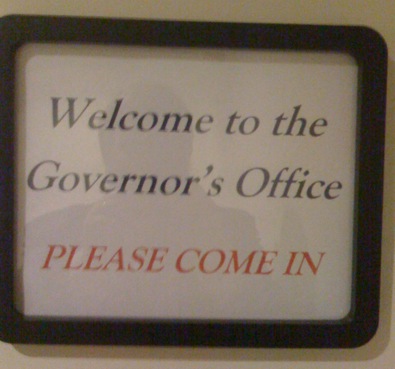
* Before Pat Quinn became governor, this was a staff only, do not enter sign…
And the staff was quite nice to me when I walked through the door and took a wrong turn.
Well, most of them. Bob Reed, the governor’s top spokesman, didn’t seem all that pleased when he looked up and saw me standing in his doorway. He didn’t throw me out, though, so it was worth the test.
* Question 1: How often do you access this blog via your “smart” phone, if ever? …Adding… Which smart phone do you use?
* Question 2: Is there a particular smart phone-ready, etc. news site that you particularly like which we could use as a model here? Explain.
With the legislative session kinda over, I’m about to embark on a total revamp of this site. I saw tons of lobbyists, staffers, lawmakers, etc. accessing the blog via their phone during session. Conversations in the past few days have often gone like this…
Lobbyist, staffer, etc: “What’s new?”
Me: “35 House Dems voted for Senate tax plan in caucus five minutes ago.”
Lobbyist, staffer, etc: “I know. I saw it on the blog. What’s new since then?”
Me: “It’s only been 5 minutes! lol”
So, naturally I’m wondering if this smart phone usage is also happening a lot outside the Statehouse. The mobile revamp will just be one part of the reconstruction, so let’s stick to that topic right now. We’ll get to the rest in time. Thanks.
* Any time the General Assembly passes a capital bill [which you can peruse here], you’re gonna see stories like this…
Before bolting from Springfield Monday morning, Democrats and Republicans took out their knives and participated in what has become a tradition: carving up a fortune in pork-barrel projects around the state.
The article was entitled: “Illinois lawmakers feast on bigger slice of pork - Legislators take home $500 million chunk for pet projects.” And it even makes this argument…
Legislators also took care of Chicago aldermen, doling out millions to repair roads and lights.
Repairing roads and fixing street lights are now considered pet projects?
* But you’ll also see plenty of stories like this…
The statewide capital bill passed by the Legislature early Monday morning includes $38.1 million to virtually rebuild the Lincoln’s Challenge Academy in Rantoul.
East Central Illinois also gets money for a great number of other projects, large and small, that were submitted by lawmakers as part of the $28.3 billion construction plan. But the money set aside for Lincoln’s Challenge, an Illinois National Guard youth intervention program, dwarfs almost every other project in the state.
For Southern Illinois, that means projects like the $103 million widening of Illinois 13 between Marion and Carbondale will be in limbo until things are sorted out in Springfield.
The following is a rundown of some of the other projects that are part of the proposed statewide construction program.
• $925,000 for Saline Valley Water Conservancy District for improvements to Stonefort Water Supply Line;
• $740,000 for sewer work in Benton;
• $163,000 for a new water tower in Christopher;
• $205,000 for road work in Colp;
Etc.
* There are always gonna be items that can be pointed to with glee. The House Republicans steered me to this one…
The sum of $200,000, of so much thereof as may be necessary, is appropriated from the Build Illinois Fund to the Department of Commerce and Economic Opportunity for a grant to the Black on Black Love for costs associated with the acquisition and renovation of a new facility.
The sum of $125,000, of so much thereof as may be necessary, is appropriated from the Build Illinois Fund to the Department of Commerce and Economic Opportunity for a grant to the Southeast Alcohol and Drug Abuse Center for costs associated with replacing the roof at the facility.
Hard to argue with something like that. Trouble is, the state is slashing program money for drug and alcohol abuse centers. So, they may end up with a nice, new roof and no clients.
There were only 42 votes for the temporary tax increase in the 118-member Illinois House, all Democrats. Madigan said Quinn had counted on upward of eight Republicans who would support the tax. He said additional Democrats would have voted for the increase but were unwilling to do so if it was going to be a Democrats-only tax increase.
Now, the challenge for Quinn is finding even more votes if he wants his tax increase. Because lawmakers failed to meet the constitution’s midnight, May 31 deadline, it’ll require 71 rather than 60 votes to approve a tax increase, a budget or just about anything else. In the Illinois House, that means Democrats will need Republican help. There are 70 Democrats and 48 Republicans in the House.
Quinn initially said he thought Republicans would come around and simply wanted to voice their displeasure with the process by voting “no” on taxes.
The governor’s office believed they had 55 House Democratic votes and about 8 GOP votes. But they’ll need a lot more now. I talked to several Republicans who wanted to back a tax hike but didn’t think they could do so because of the House’s political climate.
* Meanwhile, I’ve made this same argument, and I stand by it, but there’s also a problem with it…
House Speaker Michael Madigan shot down the widely held Statehouse belief that he sat on his hands as Quinn’s tax hike failed in a chamber the speaker runs with an iron fist.
“That comes from people that want to be critical of me,” Madigan said.
The governor’s reform commission had zeroed in on Madigan’s tight grip of his chamber. They had good reason to want to loosen that grip but they never really explained it. Had Madigan forced 60 of his nervous members to back a tax hike, that would’ve been some obvious proof.
In some ways, MJM gets a bad rap. On the one hand, people shout: “He’s a bad dictator!” And then when he doesn’t pass something, they shout: “He should be a dictator on this one issue!”
But I think there was a lot more going on here than Pat Collins and his merry band of reformers.
Madigan also denied deliberately leading the state to the brink of a fiscal calamity to complicate Quinn’s 2010 gubernatorial prospects in a potential showdown with Attorney General Lisa Madigan, the speaker’s daughter.
“I’m the speaker of the House. I’m trying to work on adopting a budget for the people of the state of Illinois. I’ve done it for 38 years. OK? Lisa Madigan is going to do what she’s going to do, and she’ll do it on her own. Her record stands,” said the speaker, who said he did not know what his daughter’s plans are.
“…What he did do was cave in to Michael Madigan every step of the way. Quinn said he wanted a budget bill passed before a capital spending bill was passed. Madigan said he wanted a capital spending bill done first, and Quinn gave in.
“Quinn said he wanted to permanently raise the income tax from 3 percent to 4.5 percent. Madigan said he wanted it to be a temporary income tax hike. Quinn gave in.
“Quinn wanted to increase the personal exemption on the income tax from $2,000 to $6,000 and Madigan said he couldn’t pass that bill. So Quinn came down to $3,000.
“The governor acquiesced to the demands of Speaker Madigan every step of the way, and in the end what did he get? Nothing,” Meeks said. “And Mayor Daley didn’t do anything, either. The mayor continually says the Chicago schools need more money and the state should do something. But he didn’t hold a single news conference during this legislative session calling on Chicago officials to support a tax increase. I didn’t hear about a single state legislator from Chicago getting a call from the mayor. He did nothing.”
Watch for Gov. Quinn, whose income tax hike was shot down, to launch a crusade to capture the conscience of the voters.
• • The plan: “I’m going to fight back,” Quinn told Sneed. “This mission will be a real test of our conscience. It’s easy to look the other way. I want to make sure we do not.”
• • The push: Calling his plan the “Good Samaritan Initiative,” an irate Gov. Quinn — furious over the state Legislature’s massive cuts in state services — tells Sneed he plans an “epic battle” for the hearts of the people and a push to reconvene the Legislature.
• • The punch: “Our goal is to rally all those to the principle of the Good Samaritan; to take care of our neighbor in need. Our state has a big heart. But it seems some people in Springfield worry more about campaign contributions.”
• • The pitch: “We’ve got to find a place in our hearts for those who have been dealt a bad blow in life through no fault of their own: like rape victims, foster children who need to be adopted, senior citizens. In the next few days, I plan to summon the good people of Illinois and alert them to what all this means. I’m going to visit the places where the service cuts will be devastating.”
• • The place: Watch for Quinn to launch what he considers “the challenge of a lifetime” at the Illinois Maternal and Child Care Coalition luncheon at Maggiano’s restaurant.
The visits are fine. The rhetoric? Well, we’ll just have to wait and see.
* Human service programs on state’s hit list: Two of [the GOP’s] primary goals are to put Medicaid recipients into managed care programs and make major changes to state government pensions. The latter could include charging employees more for their pensions and retirees more for health care and putting newly hired state workers into a separate pension program with fewer benefits.
* Governor, lawmakers see long road for budget: Their budget staffs will be together Wednesday to crunch numbers. The governor and leaders will meet Thursday in Chicago to go over recommendations to be made by Quinn’s Taxpayer Action Board. The board is supposed to ferret out waste in government and recommend how to get rid of it. After that, though, no schedule is in place. “Reforms will not happen overnight,” Cross said.
* Patti Blagojevich, when asked why her husband Rod is facing jail time…
“I can’t really get into it too much, except that, yeah, they made a big hoopla about something that wasn’t even the truth,” Blagojevich said. “My husband was governor for six years, and you know was always about doing the right thing for people.”
Discuss.
…Adding… Rod Blagojevich’s trial will likely happen soon after the 2010 primary and before the general election, which won’t be fun for Democrats…
U.S. District Judge James B. Zagel told attorneys he wants the trial to get under way between April and June 2010 and would prefer it closer to April.
Zagel also said he is thinking about “public anonymity for the jury at least until the trial is over.”
“I’ve been getting lots of advice as to how I should rule and what I should do and I would not want members of the jury to be influenced by anything like that,” he said.
Just two weeks before his arrest on corruption charges, then-Gov. Rod Blagojevich floated a plan to give President Barack Obama’s former Senate seat to the daughter of his biggest political rival in return for concessions on his pet projects, people familiar with the plan told The Associated Press.
We’ve known that Lisa Madigan was Senate Candidate 2 in the federal arrest report since Day One.
* And this isn’t new news, either…
Blagojevich also said he wanted a deal in which the elder Madigan would allow a long-stalled capital construction program through the House and take action on a Blagojevich-backed health care plan in return for his daughter’s appointment to the Senate seat, the aides said.
I’ve already reported that, and it can also be inferred from the arrest report…
Advisor B agreed that the three-way deal would be a better plan than ROD BLAGOJEVICH appointing Senate Candidate 2 to the Senate seat and getting more done as Governor. [Emphasis added]
And this is the story Blagojevich leaked to Sneed back in November…
“The latest from Blagoville is Gov. Rod Blagojevich toying with tossing Barack Obama’s U.S. Senate seat to Illinois Attorney General Lisa Madigan, who wants Blago’s job?
“*It may endear him to powerful House Speaker Mike Madigan, Lisa’s dad, who is Blago’s political foe.
There was no way that plan would’ve worked anyway. Speaker Madigan wouldn’t even return Blagojevich’s calls and refused to meet with him. No way would he have cut a big legislative deal like that based on a Senate appointment for his daughter.
Blagojevich told Sen. Dick Durbin he was thinking of naming Illinois Attorney General Lisa Madigan to the seat, according to two Durbin aides who spoke on condition of anonymity.
Read down in the story…
A Durbin aide said that in the conversation a number of names were mentioned as possible Senate picks — not just Madigan’s. He said Durbin spoke about the conversation at a news conference after Blagojevich’s arrest and mentioned Madigan’s name but none of the news reports that emerged mentioned Madigan — only Obama confidante Valerie Jarrett.
The only thing that may be new is that Durbin said he’d help. Trouble is, according to the story, Blagojevich told Durbin to “do nothing” and never got back to him.
Durbin spokesman Joe Shoemaker said the two discussed about 20 possible appointments for the senate seat, of which Madigan was one, and Blagojevich had asked the senator’s opinion about the decision.
“Sen Durbin tried to get across two messages. Pick someone who can hit the ground running as a senator, and number two, find someone who can be appointed quickly,” Shoemaker told The Roll Call, a newspaper covering Capitol Hill in Washington, D.C.
I have bumped up the information and videos from the Press conference held after the meeting due to their importance.
Begin post-meeting coverage
*1:27 pm - The meeting has ended. I missed the first 10 minutes of the press conference and so I do not have video of each leader’s individual statement that was made in the beginning. However I do have footage from the Q & A session and Speaker Madigan talked to the press for a few minutes after the group press conference. Before I put the video up, here are some key points from the press conference.
* Governor Quinn said their discussions were positive and would not say if he would sign the 50% cut budget.
* Quinn said he would like to have the issue resolved by July 1st, but he will send out notifications to groups who work on behalf of the state to let them know that they will no longer receive funding as of July 1st. (These groups are mostly social services providers and non-profits who receive grants from the state). Quinn said the layoffs would affect thousands of people.
* Republican Leadership stressed the need to completely reform the structure of government before taking on the budget.
* Cross claimed that Democrats did not include Republicans in negotiations.
* Leaders agreed to continue dialogue on the issue, and the next meting will be this Thursday in Chicago.
* 2:20 pm - Speaker Madigan addressed the notion that he was trying to get the tax increase passed…
* 2:28 pm -Speaker Madigan on a question about whether more should have been done to work with Republicans…
*2:34 pm - Gov. Quinn said that this week the state will begin mailing out notifications to state funded organizations about the possibility of funding reductions beginning July 1…
* 2:37 pm - Quinn also said he was more likely to sign capital bill now that it includes 400 million for high speed rail…
* 2:44 pm - Finally, here is 6 minutes of raw video from the Speaker’s interview with the press. It covers a variety of issues. Definitely worth a watch…
Begin pre-meeting coverage
* 12:06 pm - The 10am leadership meeting with the Governor was rescheduled for 11am when Speaker Madigan and President Cullerton failed to show up by 10:30. Madigan and Cullerton finally both showed up at 11:30 and the meeting is now underway. Leader Cross spoke with the media before he went into the Governor’s office for the 11 O’clock meeting. We will have some video up in the next 15 minutes or so.
* 12:13 pm - Cross addressed the House GOP agenda for the leadership meeting. He plan’s on discussing the budget and ethics reform…
* 12:20 pm -This video is worth a gander. Cross responded to questions about Speaker Madigan’s motivations as well as the possibility that Lisa Madigan might factor into the equation. Watch…
* 12:24 pm - Cross reminded the media that the Governor Quinn currenlty has a full fiscal year budget on the table…
* 12:32 pm - Cross reiterates his belief that the Governor should sign the capital bill, however he understands Quinn’s objection. That said, Cross needs to see some supporting documentation before he can accept the claim that IL will bu unable to sell bonds without first balancing the budget…
* 12:37 pm - Finally, Cross grades the progress on ethics reform in IL. “C- or D+ at best” …
* Hopefully we will have more video once the meeting is over.
* My weekly syndicated newspaper column takes a look at the campaign finance reform bill, which was passed by both chambers and is on its way to the governor…
While reform groups, newspaper editorial boards, Republicans and others blasted a campaign finance reform bill passed by the Illinois Senate last week, there were a couple of big surprises which went almost unnoticed.
For instance, powerful leaders of Statehouse special interest groups said they would be hobbled by the bill.
The legislation not only caps the amount of money that political action commitees can give to candidates, it also caps the cash that PACs can raise from its own members - an almost unheard of limit on political activity.
PACs are limited from accepting any contributions over $10,000 a year from “natural persons” and can’t take more than $20,000 per year from corporations, labor unions and associations.
The new rule would slam corporate PACs like the Associated Beer Distributors of Illinois, according to ABDI President Bill Olson, who testified against the legislation during the Senate Executive Committee last week. Olson’s PAC is one of the most influential and wealthy in the state, but its success relies on a relatively small number of large contributions from its members. Several other business groups are in the same situation.
PACs would also be severely limited on what are called “in-kind” donations. Quite a few groups, particularly labor unions, don’t just give money to candidates. They also assign paid staff to campaigns, run phone banks, do mailers to their own members and even air TV ads. But the bill is written in a way which would include in-kind donations in a PAC’s $10,000 annual campaign contribution cap to candidates. So, most of that will apparently end.
The legislation allows only a “natural person” to make independent expenditures on behalf of candidates, so that option - which is used extensively under the federal campaign system - would not be available to PACs and other groups in Illinois.
By severely limiting spending activities, the hugely powerful legislative leaders will be able to more thoroughly control the message they want delivered to voters and prevent outside interference in campaigns.
Groups like the pro-choice Personal PAC spend hundreds of thousands of dollars on direct mail and other advertising during election cycles to define candidates as pro-choice or anti-abortion. That independent spending has made Personal PAC one of the most feared political forces in the state. But much of the group’s spending would likely be banned by this new legislation, unless it, and others, can find a way around the law.
Republicans blasted the bill because they said it was designed to strengthen the already powerful legislative leaders. They have a point. Besides the PAC limitations, the bill allows leaders like the House Speaker and the Senate President to make unlimited in-kind contributions. Their cash donations would be limited to $90,000 a year, but that means a Senate incumbent with a four-year term could still receive as much as $360,000 in cash from his or her leader.
The use of annual limits in the bill also came under fire by reformers.
Campaign contribution caps are often criticized as unfair to challengers because they limit how much money they can raise against incumbents who often have far more ties to the monied interests. On the federal level, though, contributions are capped per election cycle. For instance, PACs can only give $5,000 to a federal candidate for a primary race, even if that primary is for a US Senator who won’t run again until five years from now.
But under this state legislation, the caps are annual. That means a sitting governor can raise $10,000 every year for four years from a single PAC. Since his or her challenger wouldn’t likely gear up to run until the year before an election, a challenger would only get two, at most, bites from the same PAC apple, putting that person at a distinct disadvantage.
Some of the bill is quite good. But these annual caps are a horrible abuse of power by incumbents.
* And I never got around to posting anything about this topic last night…
A plan to fire 750 state workers and appointees brought on the payroll under two former governors hit a snag in the final hours of the legislative session Sunday.
The proposal, Senate Bill 1333, was put together by top Democratic leaders to help Gov. Pat Quinn get rid of people in jobs considered the most politically connected in state government.
Senators began debating the measure late Sunday, but some asked whether it went too far. […]
But before the debate was finished, Senate President John Cullerton delayed action so senators could turn to other pressing matters, including a new state budget, and the bill did not come up for consideration again before the legislature’s midnight deadline to wrap up work.
State lawmakers have gone home for the summer – well, at least for a little bit of summer.
Legislators wrapped up their spring legislative session early this morning. But they’ll be back before too long because they sent Gov. Pat Quinn a budget for next year that only spends about 50 percent of the money needed and he’s planning meetings with legislative leaders to work out the differences.
We have to stay after school,” Quinn said late Sunday. “Right now, the budget is not in balance. People will suffer.”
Under the legislature’s spending plan, hundreds of human service programs would get only 50 percent of the funding that Quinn requested for them. In a news release, Quinn’s office said that means 20,000 seniors will lose home care services, 80,000 low-income mothers will lose childcare services, and foster parents of 9,000 children will lose stipends.
Some lawmakers suggested state agencies could spend money under the budget as through they are fully funded, although acknowledging the money will run out after six months. By that time, they suggested, the General Assembly will come up with additional funding.
Currie cautioned that state agencies under this plan should treat it as funding at lower levels for the entire year, rather than assuming lawmakers could fix the shortage in a few months.
“This is it. This is all we have to spend. When we spend these monies, our pockets are bare,” Currie said.
Quinn is calling a summit with legisaltive leaders today at the Capitol in the hopes of breaking a logjam over raising taxes. Quinn says the state needs an income tax hike to help dig out of a huge deficit. Quinn says he has no plans to act on what’s been termed a “lights on” budget designed to keep government operating if no compromise is reached by the start of the new fiscal year July first.
Lawmakers left Springfield early this morning, but could be called back to town in the future. Quinn downplays specualtion of a long, drawn out budget battle.
One more uncertainty from the lack of an agreed budget is when construction will begin for roads, bridges, schools and other infrastructure projects. Although the General Assembly approved a $26 billion construction program 10 days ago, with a second installment approved early Monday morning, Quinn said he wouldn’t sign it until lawmakers sent him a balanced budget.
He said bond-rating agencies and bond buyers wouldn’t buy bonds from a seller (the state) “as long as that seller has a gaping hole in its operating budget of billions of dollars. It’s just common sense.”
What was less clear was how Quinn intends to win support for the plan now that he needs even more votes than he did before.
The state’s new fiscal year starts July 1. Under the Illinois Constitution, any bill passed after midnight on May 31 — Sunday — cannot take effect until the following calendar year unless it is passed by a three-fifths vote. As of today, Quinn needs a “supermajority” in both chambers to win passage of a new budget.
That means he will now need votes from Republicans, who are likely to be even harder to sway than Democrats have been. Republicans have been clamoring for deeper spending cuts and government reforms before agreeing to any new taxes, and Sunday’s development will give them the muscle to press those demands.
* Can you picture what will be so limitless and free…
But Republicans say they’ve been left out of talks to this point and aren’t quick to help the Democratic majority pass tax hikes.
“You can’t come over to us on the last night and say, “let’s be bipartisan,” Cross said during the tax debate.
But Quinn said Republicans wanted to be able to say they voted against taxes and predicted they’ll flip in the coming weeks and put votes on a tax increase.
* Desperately in need of some stranger’s hand in a desperate land…
After Quinn’s evening press conference to wave the white flag on a pre-adjournment tax hike vote, Meeks slammed the governor for not pushing the plan until the legislative stopwatch expired.
“I’m not satisfied Gov. Quinn worked as hard as he could have,” Meeks said. “The governor should be meeting with 25 people who are ‘nos,’ trying to turn them into “yeses.” He should be meeting with them, rather than having a press conference.
The political punt on the budget deficit is similar to what Democratic leaders did last year. Unable to find an agreement on how to plug the budget hole, lawmakers sent an unbalanced budget to then-Gov. Rod Blagojevich and told him to use his executive authority to fix it.
Instead, the more likely scenario is that legislators will return to the Capitol in November, after they know how stiff their competition will be on the ballot next year, and try to reach agreement on a major tax increase to balance the budget.
Rep. Julie Hamos (D-Evanston) summed up what she thought many of her colleagues were thinking.
“We’re going to come back for veto session, and we’ll take care of the next six months,” she said during House debate on the makeshift budget.
The City Council may soon have its first openly homophobic alderman. If Mayor Daley decides to appoint the Rev. Wilfredo De Jesus to replace 26th Ward Ald. Billy Ocasio, Chicago’s GLBT activists might go ballistic. Then again, they might just punt.
Ocasio, who has resigned his seat and has signed on as a top adviser to Gov. Quinn, has asked Daley to appoint De Jesus, senior pastor of New Life Covenant Ministries, to replace him in the Humboldt Park ward.
De Jesus, an influential evangelical minister with 4,000 church members, has taken stands and uttered words that infuriate many in the city’s gay, lesbian, bisexual and transgender community.
“The Bike Program is already reviewing areas where meters have been removed for possible bike rack installation, based on requests from citizens and aldermen,” said Steele. He said the best way to request a bike rack is through the Bike Program’s Web site (chicagobikes.org/ bikeparking) or by calling 311. More than 11,000 bike racks have been installed citywide to date, and that number will continue to grow.
Titan Worldwide is supposed to pay the CTA an annual guaranteed amount for ads — this year it’s $23.5 million — and pay a certain amount of that each month. In March, it was $600,000 short of its anticipated payment of $1.9 million.
Titan’s revenues for the year are down 25 percent around the United States, and it has fallen short on payments to transit agencies around the country.
“We’re in discussions with them on how to address it,” said CTA spokeswoman Noelle Gaffney. “We expect them to meet their contractual obligation.”
If Titan isn’t able to meet its guaranty for the year, it will be another hit to the budget of the CTA, which is already struggling from decreased sales tax and real estate transfer tax revenues.
A reminder to motorists, pedestrians and anyone taking a bus to or from Union Station — Jackson Boulevard between Canal Street and Wacker Drive will close starting today through next spring for repairs to the viaduct.
The university president responded to the Tribune’s report with a dissembling statement as egregious as his school’s role in this admissions scheme. “First and most important, all admissions to the University of Illinois should be based on merit. . . .” B. Joseph White said. “[T]he Tribune makes no assertion that unqualified individuals were admitted to the University.”
False. As Friday’s paper reported, the Tribune’s investigation found that “University officials recognized that certain students were underqualified — but admitted them anyway. . . . University officials delayed admissions notification to weak candidates until the end of the school year to minimize the fallout at top feeder high schools.” That is, to hide blatant injustice.
White also tried to spin the customary defenses of public officials caught playing favorites: What happens here is no different than what happens at other schools; not that many applicants benefited; I think we deserve the public’s trust.
No, Mr. White. Neither you nor any other state official can justify cheating even one applicant. The questions here are grave:
“The buck stops with Chancellor (Richard) Herman for the Urbana campus and with me for the entire University which includes the Urbana campus.”
Actually, a lot of bucks stop with both Herman and Joe White, the president of University of Illinois who wrote the above statement to me in an e-mail.
About a million dollars a year to pay their salaries, which are the two highest salaries paid in Illinois to any government employees.