Preckwinkle boots Cisek
Thursday, Feb 21, 2019 - Posted by Rich Miller
* From Toni Preckwinkle…
As of today, Scott Cisek is no longer affiliated with my campaign in any capacity. His recent social media post was unconscionable and showed insensitivity to the issue of anti-semitism. It does not reflect my values or the values of my campaign. I apologize to Lori Lightfoot and everyone who was offended by this insensitive comment.
That is huge. Cisek has been a top Preckwinkle aide.
* This thing blew up fast…
* And then came this…
Chicago mayoral candidate Lori Lightfoot released the following statement in response to a Facebook comment in which Scott Cisek, a top adviser to mayoral candidate Toni Preckwinkle, posted a picture of Nazis at the Nuremberg Trials in an argument about whether to support Lightfoot.
“Politics is a tough business,” said Lightfoot. “I knew that before I jumped in. But it is disturbing to me that a mayoral candidate’s top adviser believes the genocide of millions of people is a casual enough subject to be used as a joke to settle a political argument. Take note of those that surround the people we expect to lead.”
* And this from Amara Enyia…
This foolishness from Toni Preckwinkle’s senior adviser is a testament to the values and character of her campaign. This is the latest in a long history of problematic behavior from several of Preckwinkle’s closest advisors. Does she condone this kind of behavior and attitude? Being progressive is not just about policies, it’s about the integrity and authenticity of your values. This is actually regressive and indicative of the kind of mayor she would be, and it’s exactly why voters are cynical about politics. Chicago deserves better.
* And then the apology…
A top campaign adviser to Cook County Board President Toni Preckwinkle apologized Thursday after invoking Nazis to criticize former federal prosecutor Lori Lightfoot in a Facebook post. […]
Cisek, who is a former executive director of the Cook County Democratic Party and has worked for Preckwinkle’s administration, is a longtime Preckwinkle adviser. […]
Cisek later deleted the post and also tweeted, “I apologize for my Facebook comment. It was a stupid comment and I took it down.”
“It was revenge for Billy Batts, and a lot of other things.”
49 Comments  
|
Caption contest!
Thursday, Feb 21, 2019 - Posted by Rich Miller
* I briefly chatted with some SIUC students who were waiting to meet with Senate President John Cullerton yesterday. They seemed pretty stoked to be there…
Shortly after delivering his first budget address as governor, J.B. Pritzker put on a Saluki baseball cap, and met with about 20 SIU Carbondale students in his office.
They asked questions, took photos, and presented Pritzker with a bag of Saluki gear. In total, the students met with some two dozen state lawmakers Wednesday, according to organizer Clay Awsumb, president of the SIUC Graduate and Professional Student Council, and a doctoral student in sociology.
“Other universities are showing up in Springfield pretty consistently, and we didn’t have anything scheduled in terms of a student lobbying day or legislative day,” Awsumb said. He teamed up with Undergraduate Student Government President Toussaint Mitchell to get some face time with state leaders. […]
Murphysboro State Rep. Terri Bryant pitched in, calling Pritzker’s office to arrange the meeting and photo op with the students. Downstate Sens. Dale Fowler and Paul Schimpf both took out time for meetings.
* Here you go…
Nice hat.
34 Comments
|
The harm done by the “pension crisis” narrative
Thursday, Feb 21, 2019 - Posted by Rich Miller
* Press release…
Few will argue that Illinois has significant issues with the underfunding of its five public employee pension systems. In fact, many say the state faces a continuing “pension crisis.”
However, three University of Illinois researchers argue that this “crisis” framework or mentality surrounding the issue actually impedes a sustainable solution. Their new report urges policymakers to rethink the conversation about pensions and Illinois’ finances. Download the report.
“Illinois lawmakers have long sought a silver bullet solution that will not increase (or even lower) the state’s required contributions while simultaneously shoring up pension systems’ finances,” write researchers Robert Bruno, Amanda Kass and David Merriman. “We view such a policy as unattainable and its pursuit a distraction from the job of responsible policymaking.”
Bruno is director of the Project for Middle Class Renewal and is a professor in the School of Labor and Employment Relations at the University of Illinois at Urbana-Champaign. Kass is associate director of the Government Finance Research Center at the University of Illinois at Chicago. Merriman is director of the Fiscal Futures Project and a senior scholar at the University’s Institute of Government and Public Affairs and a professor at the University of Illinois at Chicago.
Their paper makes three arguments: 1) that to resolve the pension underfunding issue the focus should be on long-term trends and peer comparison; 2) that a “pension crisis” is a situation in which the pension system is insolvent and unable to pay benefits – which is not the current case in Illinois; and 3) rather than a singular problem, there are two interrelated and in-conflict issues – the concern over pension finances and state operating budgets where expenses regularly exceed revenue.
Bruno, Kass and Merriman suggest that referring to the issue as a “crisis” leads to focusing only on short-term metrics and solutions. They urge state lawmakers to abandon the crisis rhetoric and to also abandon the practice of reducing that state’s pension contributions in order to balance the state budget.
“Our goal with this paper is to change the conversation about pensions and the state’s finances,” the report says. “We believe this is important for addressing the challenges facing the state in a calm, thoughtful and deliberate manner.”
* First, a chart…
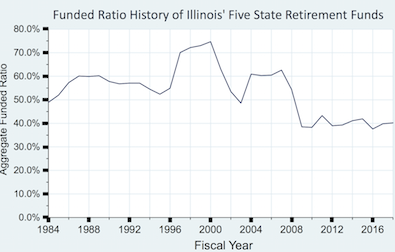
* Excerpt…
If future Illinois GDP growth is similar to growth over the past 20 years and if pension contributions increase in-line with the current actuarial projections, then the state’s annual pension payments will stabilize at about one percent of state GDP over the next several decades.
In other words, it’s relatively manageable, but only if you think current contributions are not too high.
* Gov. Pritzker obviously thinks current state pension payments are too high, so he’s proposing several things to deal with it, including extending the ramp out an additional seven years, which will “save” the state $878 million (not “about $800 million” - the actual number is $878 million) this coming fiscal year and about that in each of six years afterward. Pritzker’s “plan” fits right in to this section…
Assuming a “pension crisis” narrative has costs that are evident in Illinois’ legislative history. Not only in how it impacts the finances of the pension systems but also in the way it predetermines approaches to the subject. As Section III highlighted there are two main issues that are interrelated, yet in-conflict: (1) the financial condition of the pension funds, and (2) the state’s annual pension contributions as burdensome for the state budget. Importantly, in moments of political pressure to do something about pensions, what often materializes is legislation that alleviates the short-term pressure with the creation of a future, long-term problem. As a result, Illinois is stuck in a seemingly endless cycle of pension crises and problematic legislation.
Yep.
There’s a whole lot more, so click here to read it all. If Amanda Kass is part of a study, you know it’s good.
110 Comments
|
What Is The Credit Union Difference?
Thursday, Feb 21, 2019 - Posted by Advertising Department
[The following is a paid advertisement.]
It’s simple. Credit unions are member-owned, so any earnings are simply returned in the form of lower loan rates, higher interest on deposits and lower fees. Credit unions create a fair financial alternative for the taxpayers of Illinois. Credit unions are not-for-profit financial cooperatives that don’t focus on increasing revenue or paying dividends to outside stockholders. Illinois credit unions are focused on the member-owners we serve. Visit www.asmarterchoice.org to learn more about the benefits of credit union membership.
Comments Off
|
Unmentioned?
Thursday, Feb 21, 2019 - Posted by Rich Miller
* Chicago Tribune editorial…
The only way to save the pension funds, and protect taxpayers, is to amend the Illinois Constitution’s pension clause. No, Pritzker didn’t say anything about that.
From his budget address…
Throughout my campaign I said that we must pay the pensions that are owed
He didn’t say anything about a constitutional amendment to cut pension benefits because he’s clearly against it.
* Illinois News Network…
For some state lawmakers, it’s not what they heard at Wednesday’s budget address, it’s what wasn’t addressed.
“I’ll tell you what is top of mind is what wasn’t heard: Property taxes,” said State Rep. Mark Batinick, R-Plainfield. “We didn’t hear about property tax relief.”
State Rep. Robert Martwick, D-Chicago, agreed he didn’t hear enough about how to tackle the second highest property taxes in the country.
“If you really wanted to improve the overall health and economic wellbeing in our state, you need to address property taxes,” Martwick said.
He did mention property tax relief, but he said it wouldn’t happen until a progressive income tax hike is enacted…
This is only Year One of a multi-year endeavor, and very importantly it is built on the state’s current regressive tax structure that I do not favor and that puts the greatest burden on working families. Not only is our tax system unfair, it’s also inadequate to solve our long-term financial challenges.
It’s time for a change.
Workers deserve an income tax cut and a property tax break. A fair tax system will allow us to eliminate the structural deficit that has plagued our state for nearly two decades.
43 Comments
|
Question of the day
Thursday, Feb 21, 2019 - Posted by Rich Miller
* The setup…
* The Question: If you had to bet money, for whom do you think Gov. Pritzker voted? Don’t forget to explain.
42 Comments
|
* Beware of this lede from the Illinois News Network…
Gov. J.B. Pritzker is formally asking lawmakers to shut down Illinois’ private school scholarship program and pour more into public schools.
In his budget proposal Wednesday, Pritzker proposes taking the $100 million cap on donations to the Invest in Kids private school scholarship program and cutting it down to $50 million, $11 million less than what was donated in the program’s first year. He proposed to phase it out over the next three years.
As part of the overhaul of Illinois’ education funding formula in 2017, lawmakers added the five-year Invest in Kids pilot program, which grants a 75 percent income tax credit to those who donate scholarship funds for private schools. Officials with the program said most of the donations were for less than $1,000 and from individual donors.
“The governor is proposing to phase out the program over the next three years so that the state can direct its limited revenues to funding its commitments to public schools first,” according to the proposal. […]
More than 40,000 students applied for scholarship funds through the program in 2018. The program raised $61 million statewide that year, a national record for the first year of this kind of program, and paid the private school tuition for more than 6,700 students. Pritzker’s administration estimated that ending the pilot program would put $6 million into the state’s coffers.
Pritzker said he opposed using tax revenue to subsidize private schools when he said Illinois does such a poor job of funding public schools, the Sun-Times reported. […]
Holter said Pritzker’s assertion that the funding for the scholarships could be put into public schools is misleading.
“It’s not like there’s a big $100 million or $75 million pool of money out there that we’ve taken from some other pot of money,” he said. “We work hard to make sure that the story of [this program’s] importance and impact is out there so that these private citizens feel inspired to give.”
It’s a five-year pilot program. It began midway through Fiscal Year 2018. It’ll expire in three more years unless action is taken.
What he’s doing is starting the process of phasing it out by lowering the limit on tax credits for next fiscal year.
Also, money has to come from somewhere.
58 Comments
|
Snoop Dogg will perform at Illinois State Fair
Thursday, Feb 21, 2019 - Posted by Rich Miller
* Pretty sure I’ll be in attendance…
Rap icon Snoop Dogg is coming to the 2019 Illinois State Fair! Snoop Dogg and Friends will perform Friday, August 16 on the Grandstand stage.
With more than two decades of award-winning albums and songs, hit television shows, films, lifestyle products, philanthropic efforts, and digital ventures, Snoop Dogg is an unparalleled musical force at the forefront of popular culture. Since 1993, Snoop Dogg has released 17 studio albums, sold more than 35 million albums worldwide, reached #1 on Billboard charts, and received nearly 20 Grammy® nominations. His most recent album, Snoop Dogg Presents Bible of Love, debuted at #1 on the Billboard Charts in 2018 and was his first offering in the gospel music genre.
Snoop Dogg is the third Grandstand act announced for the 2019 Illinois State Fair; a capella group Pentatonix and country duo Dan + Shay were announced earlier this month.
30 Comments
|
* From the governor’s budget address…
I have been advocating for large investments in early childhood education for decades, long before I became governor. Real focus on the learning that happens from birth to age 5 can determine the entire arc of a person’s life. Investing in early childhood is the single most important education policy decision government can make, and it has proven to provide a significant return on investment. That’s why I’m proposing funding the Early Childhood Block Grant at $594 million, an increase of $100 million from fiscal year 2019. It will allow us to begin the march toward universal preschool so that every child in Illinois will have a real opportunity to succeed.
* Chalkbeat…
Later in the address, Pritzker detailed a smaller increase, but one that some advocates said was a welcome shift in policy: He described first steps toward repairing a child care assistance program that was drained of families and providers during the administration of his predecessor, Gov. Bruce Rauner. The new governor plans to spend $30 million more to rebuild the program. He also will increase income eligibility so an estimated 10,000 more families can participate. […]
The state early childhood grant also supports prenatal programs and infant and toddler care for low-income families. […]
But policymakers and advocates on Wednesday said the considerable $100 million increase is a step in the right direction for a state that has been spending less per student than many of its neighbors. According to the National Institute for Early Education Research, Illinois spent $4,226 per young learner in 2016-2017 compared with a national average that topped $5,000. Seven states spent $7,000 or more. […]
One item Gasner said she hoped to hear, but didn’t, was increased spending on home visiting programs for families with new babies. Spending on such programs next year will remain flat under Pritzker’s proposal. Home visiting has been suggested as one antidote to the state’s troublingly high maternal mortality rates. An October report from the state’s public health department found that 72 percent of pregnancy-related deaths in Illinois were preventable. […]
In addition to the $100 million, Pritzker’s office reportedly also will add $7 million to early intervention services for young learners with disabilities and set aside $107 million to help buffer the impact of his new minimum wage increase on daycare center owners and other child care providers who operate on thin margins.
* WBEZ…
Maria Whelan, CEO for Illinois Action for Children, said she likes the change in direction the governor’s budget seems to be proposing.
“We have 40,000 fewer children on the state’s child care assistance program than we had four years ago,” she said. “So we have a lot of rebuilding to do, but it’s very clear that we’re moving in the right direction.”
Ireta Gasner, vice president of Illinois policy at the Ounce of Prevention Fund, praised the increase to early childhood programs, but hopes it’s targeted. She said therapists who serve at-risk children haven’t received a rate increase since 2008.
Discuss.
14 Comments
|
* Summary of HB3550, sponsored by 17 members…
With regard to a sex education course, provides that course material and instruction in grades 6 through 12 must include an age-appropriate discussion on the meaning of consent that includes discussion on recognizing that (i) consent is a freely given agreement to sexual activity, (ii) consent to one particular sexual activity does not constitute consent to other types of sexual activities, (iii) a person’s lack of verbal or physical resistance or submission resulting from the use or threat of force does not constitute consent, (iv) a person’s manner of dress does not constitute consent, (v) a person’s consent to past sexual activity does not constitute consent to future sexual activity, (vi) a person’s consent to engage in sexual activity with one person does not constitute consent to engage in sexual activity with another person, (vii) a person can withdraw consent at any time, and (viii) a person cannot consent to sexual activity if that person is unable to understand the nature of the activity or give knowing consent due to certain circumstances. Removes a provision requiring material and instruction to include, with an emphasis on workplace environment and life on a college campus, discussion on what constitutes sexual consent.
* Proponents held a press conference today…
* Meanwhile, here’s a summary of HB3528, sponsored by just one member…
Provides that the Act may be referred to as the Consent-Required Workplace Act. Amends the Illinois Human Rights Act. Defines terms. Provides that an employer shall require active consent for any physical touch beyond a handshake between colleagues, contractors, customers, students, direct reports, or business-to-business clients. Provides that a person with a higher pay grade or higher status than another person shall not ask the other person to initiate a physical touch beyond a handshake or engage in unwanted or offensive speech. Provides that if employees develop a personal relationship, active consent paperwork may be filed with their employer. Provides that if a non-consensual behavior complaint is filed against an employer, the employer’s policy shall be updated within 7 business days to address the current complaint. Provides that any employer having a complaint of a violation filed against it with the Department of Human Rights is subject to randomized auditing to ensure the company has an acceptable policy and is following the policy to protect its employees. Provides that if an employer receives 10 or more non-consensual behavior complaints, the Department is required to conduct an audit. Provides that a violation of the new provisions constitutes a civil rights violation. Provides that, in addition to any remedies available under the Act, a person or employer is subject to a $1,000 penalty for each violation, collectible by the Department and to be used by the Department for the administration of the new provisions. Effective January 1, 2020.
If you read the complete text, there are no exemptions for people like medical workers, who routinely touch patients. In fact, there are zero exemptions, including for people like child care workers and those who work with the aged and infirm, who do things like change diapers.
31 Comments
|
Way to go, Tina
Thursday, Feb 21, 2019 - Posted by Rich Miller
* Background is here if you need it. From the AP…
Reporters were briefed on the details after the speech by deputy Gov. Dan Hynes and Pritzker budget director Alexis Sturm, but the governor’s press office prohibited reporters from quoting the two directly. The Associated Press chose not to participate.
* Tina Sfondeles participated and slipped this little quote into her story…
Regarding delaying pensions payments — which many have scoffed at — Hynes said it is the “sensible” thing to do with an unsustainable ramp that forces the state to dedicate 21 percent of revenue to pensions.
Heh. Let ‘em complain about that.
* Because she went to the briefing, Tina’s story had some info that the AP’s story lacked. For instance…
Should that new revenue package fail, the administration would propose a 4 percent cut to all state agencies, Deputy Gov. Dan Hynes said in a budget briefing Wednesday afternoon. A budget document stated those cuts would work to fill a budget gap but wouldn’t include employee health care or pension and debt service costs.
But the AP’s story was good, too.
I skipped the briefing, not because of the restrictions, but because I have my own system for covering these proposals which has always worked pretty well for me. The object here is to get the information to your readers. We all have our own way of doing that. The AP chose one path, the Sun-Times chose another and I went a different route.
45 Comments
|
A look at some of Pritzker’s increased spending
Thursday, Feb 21, 2019 - Posted by Rich Miller
* Illinois Public Radio…
State Rep. David McSweeney, a Republican from Barrington Hills, said he’s skeptical. “This budget is a joke. More of the same. Higher taxes. More spending. That’s the Pritzker plan.”
* The SJ-R had a different take…
It took years for Illinois’ fiscal situation to get as terrible as it is. It will take time to dig out of it too.
That message clearly came through during Gov. J.B. Pritzker’s first budget address Wednesday. Pritzker did not try to sugarcoat the state of Illinois’ financial challenges during his address: $3.2 billion budget deficit, $15 billion debt in unpaid bills, $133.5 billion unfunded pension liability. We are cautious and concerned about some of the ideas he presented. Yet we found Pritzker’s speech to be a realistic, but still optimistic, message from the person who starts off the annual state budget process.
* Tribune…
He proposes spending an additional $630 million on education, including more money for early childhood programs, elementary and secondary education, and public universities and community colleges. He also plans $542 million in added spending on social services, including money to provide child care assistance for the parents of 10,000 more children and hire 126 more child welfare workers at the Department of Children and Family Services.
* Capitol News Service…
K-12 education would also see a $5 million boost to career and technical education, $2 million in funding for an Advanced Placement low-income test fee waiver program, and $250,000 in added educator misconduct investigation funding.
Early intervention programming would see a $7 million increase, and the federal preschool birth-5 grant will be allotted $3.8 billion.
Mark Jontry, president of the Illinois Association of Regional Superintendents, said the group was pleased to see more money invested in education, but will emphasize alternative education going forward.
“I think we’re a little disappointed that we’re flat-funded with our alternative programs,” he said. “We’re going to want to continue to have conversations with the governor’s office around trying to put additional dollars into those programs, because it is a population with some real needs and we’ve been held level while our costs to serve those kids continue to escalate.”
* News-Gazette…
The governor proposed a 5 percent increase for public universities and community colleges in fiscal 2020, which would boost the UI’s general operating funds by 5 percent, or $26.8 million, to $621.4 million, officials said Wednesday.
The UI had requested an increase of 16.5 percent, or almost $98 million more, but President Tim Killeen, who was in Springfield for the budget message, wasn’t complaining.
“We’re really happy to see the resolute attention to an investment strategy in higher education,” Killeen told News-Gazette Media on Wednesday. “It’s turning the tide after 20 years of less favorable budgets.” […]
On scholarships, Pritzker said he would expand the pool of matching funds for the new “Aim High” merit-based scholarship program to $35 million next year, up from the current $25 million. And he would expand funding for the Monetary Award Program’s need-based grants by $50 million.
“There’s still a gap there for what is really needed for socioeconomically disadvantaged students,” Killeen said, “but it’s great to see it going in this direction.”
* Pantagraph…
Pritzker’s call for an increase in income eligibility for the Child Care Assistance Program would help local families who struggle to make ends meet because they don’t qualify for assistance but can’t afford child care, German said.
“While we are hopeful about the change in the minimum wage and the positive effect it will have in our state, we do have concerns there was no mention about adjusting reimbursement rates to help offset the substantial increase in program costs,” German said.
* SJ-R…
* $100 million for early childhood grants
* $30 million to provide child care assistance to more families
* $375 million more to implement the revised school funding formula
* $5 million more for career and technical education
* $50 million more for the Monetary Award Program for college students
* $52.2 million increase for public universities and $13.9 million for community colleges.
* $85 million in state funding to help human services agencies cover the minimum wage increase.
* Adds 126 direct service staff for the Department of Children and Family Services at a cost of $9.8 million.
* Adds $20.6 million to open a 200-bed Chicago Veterans’ Home that has sat empty since it was built.
* Funds two state police cadet classes of 100 people each for $7.6 million.
* Contains $5 million to implement the new state gun dealer certification law.
37 Comments
|
A quick look at Pritzker’s new revenue streams
Thursday, Feb 21, 2019 - Posted by Rich Miller
* I really think that proposed cannabis license fee is too high…
The governor’s plan includes an estimated $1.1 billion in new revenue, with the Pritzker administration banking on selling 20 sports betting licenses at $10 million a piece [$200 million], and selling “thousands” of marijuana business licenses for a one-time fee of $100,000 [$170 million].
Other tax bumps would include raising taxes on a pack of cigarettes from $1.98 to $2.30 [$55 million] and taxing e-cigarettes at a 36.5 percent rate, the same as all other tobacco products [$10 million]. The administration is also pushing for a 5 percent statewide bag tax [$20 million]. […]
[Revenues also include] a tax on [Managed Care Organizations] to generate $390 million in revenue to help cover the costs of the Medicaid system. Pritzker’s revenue package also includes $175 million from a proposed delinquent tax payment incentive program.
* Greg Hinz…
A couple of things will catch the eye of business groups: a $75 million annual cap on how much retailers are paid to collect the sales tax—that expenditure has run over $100 million in some years—and $94 million in revenue that will come from closing what budget aides call a “loophole” by decoupling from the federal tax credit for repatriated international earnings.
* I’ve been calling for a graduated tax on the video gaming industry for a while now, so I’m glad to see it included in the budget proposal…
Pritzker would generate an additional $89 million from a higher tax structure on successful video gaming terminals
38 Comments
|
* Reuters…
In a decision that may curb the rise of financial penalties and property seizures in the U.S. criminal justice system, the Supreme Court on Wednesday for the first time ruled that the U.S. Constitution’s ban on “excess fines” applies to states as well as the federal government.
The nine justices ruled unanimously in favor of an Indiana man named Tyson Timbs who argued that police violated his rights by seizing his $42,000 Land Rover vehicle after he was convicted as a heroin dealer.
Justice Ruth Bader Ginsburg, back on the bench for a second straight day after undergoing lung cancer surgery in December, wrote the court’s opinion, which clarified the applicability of the “excessive fines” prohibition contained in the Constitution’s Eighth Amendment.
“For good reason, the protection against excessive fines has been a constant shield throughout Anglo-American history. Exorbitant tolls undermine other constitutional liberties,” Ginsburg said in court as she announced the ruling.
The vehicle was taken in a process called civil asset forfeiture that permits police to seize and keep property involved in a crime.
* NBC…
The Eighth Amendment’s other two restrictions, forbidding cruel and unusual punishment and banning excessive bail, were previously declared to restrict state as well as federal authority.
When the Bill of Rights was ratified in 1791, it imposed limits only on the federal government. The Supreme Court has gradually ruled that most of its provisions also apply to the states. […]
Indiana argued that even if the ban on excessive fines applied to the states, the restriction should apply only to fines that a person has to pay, not to the seizure of property used to commit a crime.
“We disagree,” the Supreme Court said Wednesday, finding that the right is fundamental and deeply rooted in the justice system.
* Nina Totenberg at NPR…
[Ginsburg] noted that those fines could be used to retaliate against political enemies and have been used as a source of revenue.
The ruling effectively means states and local municipalities cannot use fines as a mechanism for raising revenue, something many local governments do.
* One more…
Thus, now the only rights enumerated in the Bill of Rights that are not incorporated through the Fourteenth Amendment to the states are: the Third Amendment prohibiting quartering of soldiers, Fifth Amendment right to a grand jury indictment in a criminal case; and the Seventh Amendment right to a jury trial in civil cases.
34 Comments
|
|
Comments Off
|
|
 Support CapitolFax.com
Visit our advertisers...

 ...............
 ...............
 ...............


|
   
|
Hosted by MCS |
SUBSCRIBE to Capitol Fax |
Advertise Here |
Mobile Version |
Contact Rich Miller
|



