* Capitol News Illinois…
The number of African-American students enrolled at public colleges and universities in Illinois has fallen nearly 26 percent in recent years, while enrollment among other minority groups increased. […]
The latest annual [Illinois Board of Higher Education] report examined the five-year period from 2013 to 2017. During that period, enrollment among African-American students in Illinois fell 25.9 percent, to 54,370 students.
Over that same period, enrollment among Hispanic students grew 6 percent, to 95,167. Asian student enrollment grew 1.9 percent, to 28,745, and enrollment among all other underrepresented groups, including Native Americans, Pacific Islanders and disabled individuals, grew 5.1 percent, to 12,439.
The decline in African-American enrollment was especially sharp in the state’s community colleges, which saw drops of just more than 30 percent. The drop-off was less extensive among undergraduates at public universities, where African-American enrollment fell 14 percent.
22 Comments  
|
Question of the day
Wednesday, Mar 6, 2019 - Posted by Rich Miller
* It’s just a bill, of course, but kind of interesting…
State workers would be required to live within the state of Illinois under a new proposal by State Senator Laura Fine (D-Glenview).
“State workers’ salaries are paid by Illinois taxpayers,” Fine said. “It just makes sense that if you’re going to be paid by income, sales, and property taxes that Illinois residents pay, then you should be subject to those same taxes.”
Senate Bill 1639 establishes a requirement that to work for any state agency within Illinois, a person must live in the state. The measure would not affect employees who work for a contractor that has a contract with the state, and allows for a three-month grace period.
The bill passed the Senate Committee on State Government and now moves to the full Senate for consideration.
The bill is here.
* The Question: Your position on this legislation? Take the poll and then explain your answer in comments, please…
polls
125 Comments
|
The last gasp of opposition
Wednesday, Mar 6, 2019 - Posted by Rich Miller
* Oh, Marty…
A suburban lawmaker is receiving bipartisan support to put the brakes on fellow Democrats’ and Gov. J.B. Pritzker’s push to legalize recreational marijuana in Illinois.
“The people of Illinois are going to be safer when it’s legalized,” the new Democratic governor told the Daily Herald’s editorial board Monday.
Democrat Marty Moylan of Des Plaines disagrees, and so do 34 lawmakers in both parties co-sponsoring his House Resolution 157 to slow the process.
Moylan and legalization opponents including the Illinois Association of Chiefs of Police will participate in a rally against the proposed law Wednesday at the Capitol in Springfield.
“The more information you have about this bill, the more people are against it,” Moylan said, adding that he is worried about a spike in impaired driving. […]
Asked about preventing “driving while stoned” crashes, Pritzker said those are “happening now. If nothing changes, it’s still happening now.” He noted that researchers are developing products similar to a Breathylzer that police can use to test for marijuana.
Wake me when he gets to 59 total co-sponsors. Without that, this is yet another publicity stunt from a publicity stunt master.
* Speaking of publicity stunts, there he is today…
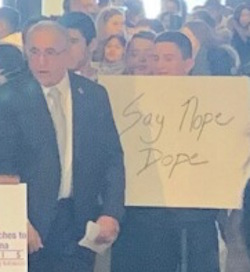
* Meanwhile, a columnist who apparently can’t pick up a phone and doesn’t come to Springfield says he somehow has a “sense” for why the legalization bill hasn’t yet been introduced…
My sense is three problems are gumming up the works and that lawmakers are no longer as confident of passage since the confetti was swept up after Pritzker’s victory party.
The first obstacle is the federal government. Donald Trump is a teetotaler and seems in no rush to undo federal restrictions on interstate transport or on banking laws that permit the deposit of cannabis proceeds.
Complicating matters is a new attorney general; more than three months passed between Jeff Sessions’ departure and William Barr’s confirmation, which undoubtedly left Illinois lawmakers waiting to see what position the Department of Justice would take on state’s rights.
The second is the number of states that have already enacted legalized cannabis. Heading into 2019, it seemed as if Illinois would simply climb aboard the pot train and join in the swelling number of states to put it on the books. It appears now lawmakers in Springfield have looked closely at states that have enacted and discovered myriad complications such as whether legalization supersedes no-smoking rules such as hotels. Legalization may have been popular, but it’s been anything but seamless.
Last but not least has been pushback from law enforcement. Police and sheriff’s associations were rightly concerned about how to reconcile legalized cannabis with keeping the roads safe from impaired motorists. The lack of comprehensive legislation suggests lawmakers are, to their credit, taking such concerns seriously.
Where to even begin with this gigantic “traffic jam of uninformed drivel” (as one co-sponsor called the column today)?
The president has always been an issue and former AG Sessions wasn’t exactly pro-legalization, either. Lawmakers have been working on this for almost two years, and there is more support in the GA than in past years. Four years ago, Moylan’s resolution would’ve had maybe 70 co-sponsors and Speaker Madigan’s staff would’ve been helping Marty collect even more. These days, Madigan supports legalization. And law enforcement has been pushing back forever.
One reason they haven’t introduced language yet is they’re still negotiating the bill and working out details. Also, there’s the issue of the lack of involvement by the governor. The sponsors are unwilling to move forward until they get some things worked out with the 2nd Floor. Pritzker says he’s all for it, but it’s time he puts his effort where his mouth is.
35 Comments
|
* Decatur Herald & Review…
Illinois lawmakers want answers about how 2-year-old Ta’Naja Barnes slipped through the state care system designed to protect her and was instead allowed to die of starvation and neglect in a Decatur home.
A House of Representatives Adoption and Child Welfare Committee hearing on Tuesday shined a spotlight on the nine-month active involvement of the Illinois Department of Children and Family Services in Ta’Naja’s case. Lawmakers heard how a Decatur organization, Baby TALK, had called a hotline to report concerns about Ta’Naja and her 1-year-old brother on Nov. 6, after the case had been closed, but the allegations did not fit criteria to pursue further investigation. […]
Ta’Naja’s cold body was found Feb. 11 wrapped in a urine-soaked blanket in a Decatur home police officers described as filthy and rodent-infested. Her mother, Twanka L. Davis, 21, and the live-in boyfriend of Davis, 25-year-old Anthony Myers, have both been charged with first degree murder alleging they caused the child’s death through a combination of starvation and neglect. […]
Ta’Naja’s biological father, Dartavius Barnes, told reporters last week that he had tried to obtain custody of his daughter and even thought of kidnapping her to remove her from what he knew to be poor conditions.
Six months of DCFS aftercare services, designed to be provided when a child is returned home, began in March when Ta’Naja was placed with Barnes instead of in August when she was returned to her mother. Ta’Naja’s younger half-brother was placed with Myers and Davis in March; he had been allowed to sleep in a heated room with his parents, while Ta’Naja was left alone in a bare, freezing room. The boy has since been taken into state custody.
Rep. Delia Ramirez pointed out that the six months would have ended on Feb. 8, three days before Ta’Naja’s death, if they had started when she was returned to Davis and Myers.
* WICS TV…
We now know that during the time that Ta’Naja was involved with the Department of Children and Family Services from December 2017 to October of 2018, she had three different case workers [from social service provider] Webster-Cantrell Hall.
* OK, this is just insane…
State Rep. Sue Scherer, D-Decatur, who is not a member of the committee but called the hearing, asked if caseworkers are notified that a child has been in and out of DCFS if the agency gets a call about a family.
Dyer-Webster said there is not.
“The history of the family’s involvement with DCFS is already on the computer,” she said. “The worker has to go and put that identifying information (in) to find it.”
DCFS needs an internal alert system.
* From a letter the governor sent to committee members the day before the hearing…
DCFS has taken several initial steps to address some of the IG’s findings; among the steps DCFS has taken are: reducing caseloads, implementing new technology, collaborating with the Department of Human Services to provide critical services that support children and families, and moving higher-risk cases back to DCFS from private agencies.
DCFS promised to shift higher-risk cases to in-house employees way back in 2017.
45 Comments
|
Feds agree to drop charges against Schock
Wednesday, Mar 6, 2019 - Posted by Rich Miller
* This prosecution had serious problems…
In a surprise move for a high-profile public corruption case, federal prosecutors in Chicago have agreed to drop all charges against former U.S. Rep. Aaron Schock if he pays back money he owes to the Internal Revenue Service and his campaign fund.
The stunning deal, known as a deferred prosecution agreement, was announced Wednesday during what was supposed to be a routine status hearing for Schock before U.S. District Judge Matthew Kennelly.
According to the agreement, Schock, 37, must pay $42,000 to the IRS and $68,000 to his congressional campaign fund. If he does so — and stays out of any new trouble — prosecutors would drop all felony counts against Schock, leaving him with a clean record.
Schock, once considered a rising star in the Republican Party, resigned in 2015 amid the federal investigation into his use of his campaign funds and House allowance to pay personal expenses ranging from an extravagant remodeling of his Washington office inspired by the British television series “Downton Abbey” to flying on a private plane to attend a Chicago Bears game.
I’ll likely have more in a bit.
…Adding… To refresh your memory…
Schock’s lawyers say in a motion filed in U.S. District Court that prosecutors and investigators repeatedly asked potential [grand jury] witnesses “irrelevant and highly invasive questions” about Schock’s personal relationships and sexuality, including whether he is gay.
Prosecutors denied allegations Schock’s attorneys made in March that investigators crossed legal lines by recruiting a confidential informant from Schock’s staff.
That informant brought documents to the feds without a warrant.
Also…
The federal judge overseeing the criminal case against former Rep. Aaron Schock leveled an unusual public complaint Tuesday that he was misled by a prosecutor on the case.
Judge Colin Bruce, of the U.S. District Court for the Central District of Illinois, also ordered the prosecution to conduct a review of all its court filings in the matter for potential inaccuracies.
This is when the tide really turned…
The increasingly odd corruption case filed against former U.S. Rep. Aaron Schock took another bizarre turn Thursday when local prosecutors were removed from the case by their superiors in Washington, D.C.
The news came in the form of a motion filed by Springfield-based federal prosecutors who asked for a delay in a status hearing scheduled for 10:30 a.m. Friday at the U.S. Courthouse in Urbana. Assistant U.S. Attorney Patrick Hansen sought the delay because “the Department of Justice (in Washington, D.C.) is in the process of reassigning the prosecution of this matter to a different prosecution team outside the Central District of Illinois.”
The dismissal of the Central District prosecution team comes just a couple weeks after the judge presiding over the case — U.S. Judge Colin Bruce — was removed by Chief Judge James Shadid for engaging in impermissible ex parte email communications with a paralegal with whom he worked while he was an assistant U.S. Attorney.
…Adding… Schock speaks…
67 Comments
|
Madigan denies inaction, but did he do enough?
Wednesday, Mar 6, 2019 - Posted by Rich Miller
* Sun-Times…
A whistleblower whose #MeToo allegations prompted Illinois House Speaker Mike Madigan to fire a longtime political operative has put another big spotlight on a former Madigan staffer, detailing in a federal document an allegation that the ex-staffer sexually harassed two women — “but nothing was done in response.”
The allegation against Travis Shea, detailed in Alaina Hampton’s federal lawsuit against the Democratic Party of Illinois and Madigan, claims Shea, who is now a lobbyist, “sexually harassed and/or assaulted” two women. […]
In the federal document, Hampton’s lawyers were responding to a question about their claim that defendants “have ignored and/or disregarded other reports of sexual harassment of female employees and volunteers working for the [Defendants].” […]
In response, Hampton’s lawyers said “she [Hampton] came to learn that other females employed by the Speaker had been sexually harassed and/or assaulted by a male co-worker, Travis Shea,” the document alleges. “Both females reported Travis Shea’s sexual harassment and/or assault directly to attorney Heather Weir Vaught but nothing was done in response. In fact, Mr. Shea remained on the Speaker’s staff for an additional two years thereafter. Plaintiff’s investigation continues.”
Shea is now a lobbyist at Michael Best Strategies. According to his profile, Shea focuses on the state budget, state bonding, capital budgeting, economic development and gaming. He previously served as an analyst for the speaker, but also worked for the Democratic Party of Illinois on campaigns across the state.
The lobbying registration report for Michael Best Strategies shows that Shea is no longer lobbying for the firm as of today. Shea’s bio has also been scrubbed from the firm’s website.
Hampton’s court filing is here.
* Speaker Madigan’s office denied Hampton’s allegation that nothing was done…
In February 2018, the Office of the Speaker released a summary of past complaints of discrimination and harassment. That document included descriptions of two allegations involving Travis Shea. Both women were consulted prior to the release and requested confidentiality. To date, neither has given permission to disclose any personal or identifying information.
In 2015 and 2016, Heather Wier Vaught was contacted with allegations of workplace intimidation against Mr. Shea, once in a personal setting, another in her official capacity as the House Democratic Ethics Officer. Each woman alleged Mr. Shea had intimidated them and threatened to “make or break” their careers.
Former Chief of Staff, Tim Mapes, and Mr. Shea’s supervisor, Jessica Basham, were immediately notified of Mr. Shea’s alleged behavior. Mr. Mapes met with Mr. Shea, and he was told the alleged behavior must immediately cease. He was reprimanded and advised such alleged behavior would not be tolerated. Additionally, Ms. Basham met with Mr. Shea and made it clear he was not in a supervisory role and told he would not be given additional responsibilities.
To further determine whether other staff experienced issues with Mr. Shea, or if there were additional concerns that needed to be addressed, Ms. Basham held meetings with each member of the unit and inquired if there were issues they would like to bring to her attention. No other issues were identified at that time.
Speaker Madigan was not made aware of the allegations. Had the allegations been brought to the Speaker at the time, he would have terminated any employment relationship with Mr. Shea, as he has done on other occasions upon learning of such incidents.
* More from WBEZ’s Tony Arnold, who broke the story…
In September 2017, Hampton claims she had talks with the Chicago Teachers Union about working on a campaign for state representative, according to court documents. In October 2017, she was under the impression CTU was ready to offer her a position, but just a week later Hampton was asked by a CTU lobbyist “if she was ‘on the outs’ with Ald. Marty Quinn as someone had informed [CTU Political Director] Stacy Davis Gates that such was the case.”
Hampton didn’t hear back from CTU after that conversation, the filing states.
“We’re frankly baffled we’d even be mentioned here,” said CTU spokeswoman Chris Geovanis. “We take orders for any hiring decisions from no one. We are quite capable of making our own hiring decisions.” Geovanis claimed Hampton had already done work for an opposing campaign in that race. […]
Hampton also said she pitched campaign work from her consulting firm to three other aldermanic campaigns: Ald. Scott Waguespack, 32nd Ward, and John Arena, 45th Ward, and 46th Ward challenger Erika Wozniak, according to last week’s filing.
Joanna Klonsky, a spokeswoman for Waguespack, Arena, and Wozniak told WBEZ in a statement: “As set forth in documents attached to a recent court filing, and as, in fact, is the case, Alaina Hampton’s non-employment by the campaigns of Ald. Waguespack, Ald. Arena and Ms. Wozniak Francis was unrelated to the events described in her lawsuit against Michael Madigan and others.”
…Adding… It turns out that Klonsky was actually speaking on Hampton’s behalf in the above quote. I’ve asked for a more clear statement.
…Adding… From Ms. Klonsky…
None of Ms. Hampton’s interaction with any of these three campaigns were affected or influenced in any way by the allegations in her suit or the defendants in that case.
…Adding… Again from Klonsky…
Ms. Hampton’s reference to Mr. Shea, as the court filing clearly reflects, was in response to the Madigan defendants’ specific request for such information of which she was aware.
55 Comments
|
* Ignore the hype and read the actual numbers…
A new poll — paid for by a pro-business group opposing a graduated income tax — finds President Donald Trump has a higher favorability ranking in Illinois than both Democratic Gov. J.B. Pritzker and Illinois House Speaker Mike Madigan.
The We Ask America poll was commissioned by the not-for-profit dark money group Ideas Illinois, which is led by former Illinois Manufacturers’ Association head Greg Baise. The group is working hard to publicly oppose Pritzker’s plan to push for a graduated income tax, which the governor wants on the 2020 ballot. […]
The poll of 800 voters was conducted between Feb. 24 and 27, using a mix of automated calls to landlines and live cell phone calls. It has a margin of error of plus or minus 3.46 percentage points. We Ask America did not release the crosstabs — including the gender or ages of those who were polled.
The poll asked about the job performance of Pritzker, who has only been in office since Jan. 14. It found that 37 percent said they approved of the governor’s job performance, while 36 percent disapproved. Among Republicans, 69 percent disapproved, while only 16 percent approved. Among Democrats, however, 57 percent approved of his performance, while only 13 percent disapproved. Of independent voters, 29 percent approved of Pritzker’s job performance.
Voters were also asked about Trump, and 41 percent said they approved of Trump’s performance, while 56 percent disapproved. The president’s approval is at 86 percent among Republicans, while his disapproval was at 89 percent among Democrats. Among independents, 42 percent approved, while 51 percent disapproved of his performance. The net job approval — the approval minus disapproval — for the president is at minus 15 percent. The latest Morning Consult poll had Illinois at -23 net approval for a poll conducted in January.
Where to begin?
Yes, 41 percent approved of Trump’s job performance compared to 37 percent for Pritzker. But that’s not how you judge who’s more popular. Trump’s disapproval rating of 56 percent was higher than his approval rating. Pritzker’s disapproval rating (36) was below his approval rating (37), giving him a +1 net approval. And +1 is far better than -15 every day of the week. And since 56 is much higher than 36, you could just as easily say that Trump is far more unpopular than Pritzker.
Also, while only 3 percent appeared to not have an opinion of the president’s job performance, 27 percent had no opinion of the governor’s performance. That makes sense because he’d barely been in office a month when the poll was taken.
* To be clear, 37-36 approve/disapprove numbers are not anything to write home about, particularly a few months after winning by 16 points. A We Ask America poll taken in January of 2015 showed that newly inaugurated Gov. Bruce Rauner’s approve/disapprove numbers were 52/23. A month later, another pollster had Rauner’s approve/disapprove rating at 43/28.
So, if this new poll is right (and it’s only one poll, snapshot in time, yadda, yadda) Pritzker is definitely not starting off with the people at his back.
* From the pollster…
While nearly half of Illinois voters (45%) are not sure of their opinion of Pritzker’s recent budget proposal, those that do have an opinion are not in favor. Less than one-quarter of voters (22%) support it, while one-third of voters (33%) oppose his budget proposal. Only 17% of Independents and 6% of Republicans support his budget, while 31% and 63% oppose the budget, respectively. Among Democrats, 37% support and 13% oppose it.
In other words, it’s a big “Meh” from voters. I can’t disagree with them.
* Also…
House Speaker Mike Madigan remains very unpopular. Just 18% of Illinois voters have a favorable opinion of Madigan, while 41% have an unfavorable opinion. Even among Democrats, Madigan is under water with just 26% having a favorable opinion, while 30% have an unfavorable opinion. Independents have a highly unfavorable opinion of Madigan, with just 13% expressing a favorable opinion but 44% an unfavorable one. Among Republicans, he sits at 13% Favorable/54% Unfavorable (41% Very Unfavorable).
Favorability and job performance are different measures, but -23 is obviously bad. The best thing Madigan has going for him is that 41 percent don’t have any opinion about him. He’ll take that all day.
62 Comments
|
* Press release…
With the strong support of Governor JB Pritzker, the Illinois State Police (ISP) is taking wide ranging steps to improve operations, firearms services processes, and information sharing to aid law enforcement officials statewide with enforcement of Firearm Owner’s Identification (FOID) card revocation laws. These first steps are part of ISP’s continued commitment to improving the enforcement of existing gun laws in Illinois.
“While the weaknesses of our nation’s background check system remain daunting, we must take whatever steps we can, large and small, to strengthen the fabric of these systems because any improvement could be the one that makes the difference,” said Brendan F. Kelly, Acting Director of the Illinois State Police. “While we simply cannot do it alone, we must increase sharing of information, the quality and value of information shared, and most importantly enforcement. Mailed letters are not enough.”
ISP Information Sharing
Access to firearms data within the Department and outside the Department by law enforcement agencies and state’s attorneys cannot be limited and siloed at the expense of public safety. FOID revocation and Firearm Transfer Inquiry Program (FTIP) data must be readily accessible to all Illinois law enforcement agencies. To that end:
· The ISP Firearms Services Bureau is providing the entire current list of individuals with revoked FOID cards to every District and Zone Commander within the ISP.
· Every ISP Patrol and Zone Commander has been instructed by the Director to deliver to each sheriff, police chief, and state’s attorney in their respective zone a current electronic list of all individuals with revoked FOID cards within each jurisdiction and confirm receipt of the list.
· The Firearm Services Bureau has been directed to share FOID card revocation data and FTIP data with the Statewide Terrorism and Intelligence Center (STIC) for appropriate dissemination to state and local law enforcement.
· The Firearm Services Bureau has been directed to require its IT vendor to modify the secure law enforcement web portal to include a FOID revocation list accessible 24/7 to all Illinois law enforcement with a mechanism to log each agency’s date of access.
· The Department is working with our federal partners to ascertain the scope of criminal cases that may have a federal identification number associated with a fingerprint record, but no correlating state identification number for Illinois.
· The Department is working with state entities like the Illinois Criminal Justice Information Authority (ICJIA) to determine if funding to law enforcement agencies and courts can be tied to substantial compliance with criminal record submission requirements.
Quality and Value of Information Provided by ISP
Firearms Services Bureau eligibility determinations for FOID, Firearm Concealed Carry Licenses (FCCL), and FTIP must be standardized, thorough, and inspected. Furthermore, thousands of general notices that simply indicate an individual has a revoked FOID card are not useful data in a law enforcement environment with unending demands and limited manpower. Potential threats can only be assessed and prioritized if law enforcement has useful context and detail. To that end:
· The Firearms Services Bureau has been directed to require all firearms eligibility analysts to follow a standardized FOID/CCL protocol and a comprehensive checklist when conducting and completing FOID/CCL application reviews.
· The Firearms Services Bureau has been directed to increase quality assurance measures for FOID, FCCL, and FTIP transactions to include random reanalysis of approvals, scrutinizing those samples, reporting results to the Director monthly, and taking immediate corrective action as needed.
· The Firearms Services Bureau has enhanced the FOID revocation list shared with all law enforcement to indicate if the revoked FOID has been returned and/or if a Firearm Disposition Report has been submitted to ISP. This information is critical for law enforcement to determine whether a revoked FOID card holder has complied with Illinois law.
· The Firearm Services Bureau has enhanced the FOID revocation list shared with all law enforcement by adding descriptors that include the reason for revocation, such as a felony charge, a clear and present danger determination, an order of protection, mental health prohibitor, or other regulatory reasons for revocation. This will enable law enforcement to properly vet and triage the law enforcement response for a revoked FOID card.
· The Firearms Services Bureau has enhanced the FOID revocation list shared with all law enforcement to include FTIP history which indicates firearm purchase history as well as the number of firearm purchases utilizing FTIP.
Increasing Enforcement
Enforcement must be increased through greater training and awareness among law enforcement stakeholders of FOID laws and penalties, use of FOID data in routine law enforcement, and implementation of specialized gun violence task forces. To that end:
· The Director is working with sheriffs, police chiefs, and state’s attorneys to increase awareness of FOID provisions and penalties.
· The ISP Academy has been directed to review current training of new cadets as well recurring training requirements regarding FOID laws and update as needed.
· The Director’s designee on the Illinois Law Enforcement Training and Standards Board(ILETSB) will encourage ILETSB to review local police training requirements on FOID laws.
· ISP officers in Patrol within each District have been directed to always query FOID revocation status when conducting patrol enforcement activity.
· ISP officers in Investigations within each Zone have been directed to always query FOID revocation status when conducting an investigation.
· The ISP Communication Services Bureau has been directed to require all telecommunicators to query FOID revocation status when officers are conducting enforcement or investigation activity.
· The Firearms Services Bureau has been directed to provide each ISP Investigative Zone with a list of revoked individuals who may have provided false information on a FOID or CCL application to determine if an investigation and request for charges of Forgery may be warranted on a case-by-case basis.
· Each Zone Commander has been directed to review the most current revocation list with local state’s attorneys to determine if investigation and citation for violation of various FOID laws is warranted on a case-by-case basis.
· The Division of Operations has been directed to immediately triage the FOID revocation list by Zone, develop a plan of action for the highest risk individuals, work with sheriffs and local police to plan enforcement actions as appropriate, work with state’s attorneys to seek search warrants as appropriate, and conduct ISP-only enforcement operations as appropriate.
· The Division of Operations has been directed to plan for more specialized enforcement over the long term. In late January 2019, the Office of the Governor requested from ISP the funding, manpower, and new cadet requirements necessary to establish a potential gun violence task force that would include FOID related enforcement to be submitted as part of the budget for FY 2020. That proposal was submitted February 8 and included in the Governor’s budget proposal.
· As part of these efforts, Gun Liaison Officers will be designated in every Investigative Zone to collaborate with local law enforcement agencies, coordinate FOID revocation details with an emphasis on getting guns out of the hands of the most dangerous individuals, and ensuring information regarding FOID card revocations is shared with local law enforcement agencies on an ongoing basis.
This is an aggressive, exhaustive effort within existing ISP manpower and statutory parameters. The ISP Office of Governmental Affairs and Public Information Office have been directed to provide any and all available information to the public and policy makers as further action is considered by the legislature.
This is all long overdue. Many kudos to Director Kelly for taking this on.
Your own thoughts about individual aspects?
69 Comments
|
|
Comments Off
|
|
 Support CapitolFax.com
Visit our advertisers...

 ...............
 ...............
 ...............
 ...............


|
   
|
Hosted by MCS |
SUBSCRIBE to Capitol Fax |
Advertise Here |
Mobile Version |
Contact Rich Miller
|



