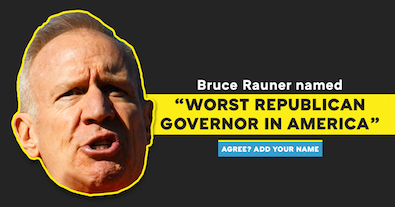
It’s Day 3 of Governor Bruce Rauner’s new reelection strategy – “I’m not in charge” – and Rauner’s office has been hard at work reinforcing the new slogan. In the past two days, two different no-bid contracts awarded by Rauner’s administration have been shut down, and the Governor was somehow not aware that the United States Senate passed a major tax overhaul.
Yesterday, the Associated Press reported the State’s Procurement Officer cancelled a $12.5 million no-bid contract with McKinsey & Co., a consultant that “maintains a direct line of communications” with Rauner’s office, for violating procurement rules. The contract is related to the $63 billion state Medicaid managed care transition, which inexplicitly jumped $23 billion in costs that the administration will not explain. The Associated Press said the cancellation is “likely unprecedented.”
And this morning, the Department of Children and Family Services announced it was ending a “high-profile” data mining program that failed to keep children safe. The deal was one of a “series of no-bid deals” awarded under disgraced former Director George Sheldon. In May, Sheldon resigned in disgrace but Rauner reportedly urged him to stay on.
For his own part, Rauner did not know that a major federal tax overhaul passed the United States Senate just days before. The Governor is clearly not in charge.
“Bruce Rauner seems intent on reminding voters of his administration’s failures,” said Illinois Communications Director Sam Salustro. “Rauner wants to deflect blame for the state falling behind but his office’s missteps clearly show that the Governor is the problem. Illinois families see the state fall behind every day, and will not be fooled by Rauner’s lame attempts to dodge responsibility for his actions.”
* I missed this yesterday afternoon, but here’s the DGA’s react to the governor saying he’s “not in charge”…
“Bruce Rauner would deny his name was Bruce Rauner if he thought it would help his re-election campaign,” said DGA Illinois Communications Director Sam Salustro. “The fact is Rauner has never taken responsibility for the skyrocketing debt, the diminished services or the continued exodus of people and jobs from the state. The more his administration’s failures pile up, the more likely Rauner will deny he’s even been governor for three years.”
* Pritzker campaign…
Bruce Rauner’s secret $63 billion Medicaid deal is under fire after a no-bid consulting contract was voided by the state’s Chief Procurement Officer.
Rauner snuck the $13 million contract awarded to McKinsey & Company into his $63 billion Medicaid deal that has been shrouded in secrecy. Cost estimates for the deal have skyrocketed 57 percent, and it’s the subject of separate House and Senate committee investigations.
“The Rauner administration broke state procurement law to sneak in a $13 million no-bid contract into Medicaid reform,” said Pritzker campaign spokeswoman Jordan Abudayyeh. “This deal reeks of the incompetency and unethical maneuvering that Illinoisans have come to expect from the Worst Republican Governor in America and it’s time Bruce Rauner gives voters the answers they deserve.”
* More Pritzker campaign…
Today, Crisis Creatin’ Rauner continues RAUNER TOP FIVE, a five-day series highlighting the lasting damage, misplaced priorities, and embarrassing stumbles that led Bruce Rauner to be crowned: ‘The Worst Republican Governor in America.’
Over 48 hours after the vote, Bruce Rauner was unaware the Senate had passed Donald Trump’s devastating tax plan that’s opposed by a majority of Americans, with 61% saying it favors the rich at the expense of the middle class. But this isn’t the first time Bruce Rauner has failed to stand up to Donald Trump’s hateful agenda. The #WorstGov has also neglected to fight Trump’s efforts to strip healthcare from millions, demonize immigrants, and deport DREAMers.
“The U.S Senate passed Donald Trump’s devastating overhaul of the tax system and 48 hours later the governor of the fifth largest state didn’t even know it happened,” said Pritzker campaign spokeswoman Jordan Abudayyeh. “Bruce Rauner cowers and pleads ignorance as he consistently fails to protect Illinois families from Trump’s destruction.”
The IL GOP is writing an amazing number and amount of checks.
An unprecedented $1 Million to the Republican State Senate Campaign Committee. Another $3 Million to the House Republican Organization.
Nearly $55k to candidate for Attorney General Erika Harold - none to the other GOP statewide candidates running for Comptroller, Treasurer or Secretary of State. Only Harold thus far.
Then $25k each to Cook, Lake and Will County Republican organizations in late November. Another $5k to downstate Henry County. $2500 to Republicans in Stark County.
That’s how the Illinois GOP has spent the party’s funds thus far this fall. But where did that money come from?
Besides $10,000 from the Beer Distributors, every other major contribution to the IL GOP reported thus far has come from Governor Bruce Rauner’s political action committee.
Seems like standard stuff, but the IR asked the ILGOP some questions and heard nothing back…
How does the IL GOP determine where the checks are going?
Who is involved in that decision making?
How much does the IL GOP expect to be distributed and to whom in the upcoming days before the March primary?
“Political insider Tim Schneider is a lapdog for failed Governor Rauner, the Worst Republican Governor in America,” [Rep. Dave McSweeney] said in a text message to Illinois Review. “Incredibly Governor Rauner just admitted that he’s not in charge of the state. Schneider, who was the chief Rauner cheerleader for the Capitol Compromise tax hike and sanctuary state bill, should immediately resign as GOP Chairman.”
I heard from both sides that a telephone conversation between Hicks and Christian County GOP Chairman Seth McMillan didn’t go well when McMillan said his central committee is backing Bourne in the March primary. McMillan said Hicks was “confrontational,” which Hicks denies, saying it was McMillan who raised his voice.
“Maybe we both raised our voices,” McMillan said, adding that he hung up on Hicks.
But in an email to me about the situation, Hicks also wrote this: “Joe Woodward and the HRO are trying to run the Republican Party like a Nazi cult. If Avery Bourne does not disassociate herself from the HRO and Joe Woodward this election, she might as well start wearing the HRO swastika on her sleeve.”
No charges have resulted, but Illinois State Police interviewed legislative candidate Christopher Hicks after he made what was reported as an “aggressive” statement at the Litchfield office of state Rep. Avery Bourne, R-Raymond.
According to the police report, Hicks told a legislative aide to Bourne that he would be “coming for blood and vengeance” if Bourne did not co-sponsor a bill about parental rights.
Police interviewed Hicks for about 30 minutes at his home on Nov. 13, and Hicks told them that what he had said was that if the bill did not pass, it would get pushed through with “political blood and vengeance,” according to an incident report obtained by The State Journal-Register under the Freedom of Information Act.
Hicks told police the comment was “political in nature” and meant that advocates of the bill would challenge candidates and “push them out of office,” the report added. It also said Hicks thought the comment was taken out of context and that he had no intention of causing physical harm or violence.
“Hicks acknowledged that some of his words may not have been the best to use, but he never threatened anyone with physical harm,” the report stated. “Hicks was extremely apologetic and wanted us to pass on … to Representative Bourne that he was sorry for the misunderstanding.”
Allegedly threatening to come back for “blood and vengeance” if you don’t get what you want is not your usual every-day mild-mannered comment. They were obviously freaked out enough to call the ISP, no matter what Hicks claims he said.
I sure hope the state cops know what they’re doing here.
Hicks is running in a contested Republican primary for the 48th District Senate seat.
* Rep. Chad Hays talks about how the Boat Drink Caucus has helped the Statehouse come together. Watch it…
Rep. Hays sat down with us to talk about his work on 911 funding and the interesting way that he has found common ground in Springfield – a bipartisan musical group called the Boat Drink Caucus. Listen to the full podcast: https://t.co/O4mk6NJ9Y6pic.twitter.com/SfIttdQate
Ives is a conservative, which to her means belief in fiscal restraint, limited government, freedom of speech and conscience, rule of law and personal responsibility. She is often called a social conservative, but Ives says she is running for governor as a fiscal conservative.
“It is 100 percent not true that I am all about social issues,” Ives said.
She used taxpayer funding of abortion as an example.
“Taxpayer funding of abortion is a fiscal issue. You don’t start programs when the state is practically bankrupt,” Ives said.
She is also concerned about education funding and was adamantly opposed to the education funding bill that passed.
“We now have made another promise we cannot keep,” Ives said.
“Illinois can do a lot better with the right leadership,” said Ives. “We have a very strong governorship. We happen to have a weak man in office right now.”
Ives’ “grassroots campaign” focuses on what she calls, “Rauner’s lies”. […]
After Ives filed her paperwork Monday, Gov. Rauner called her a “fringe candidate”. She says, he’s the one on the fringe with his policies.
Ives said, “Actually, Rauner’s the fringe governor, quite frankly. He’s the one really extreme. He’s not been moderate on anything.”
Ives also stresses, she’s not a “Chicago politician.” She thinks southern Illinois’ resources provide another key to growing the state’s economy.
“Forty percent of our energy still comes from coal, that’s great,” said Ives. “I’m a proponent of it. We need to invest in our infrastructure to expand our energy resources.”
That’s legislation that the governor signed and he did not have to sign that. So he imposed the agenda of Mike Madigan rather than fighting Mike Madigan.
Today, Citizens for Rauner released a new digital ad highlighting J.B. Pritzker’s shady tax history.
On Tuesday, Governor Rauner pointed out some of the questions surrounding Pritzker’s reported income. Pritzker’s disclosure of just $15 million in income despite his $3.4 billion in assets suggests that Pritzker is either the “worst investor in the world” or “hiding from taxes.”
This coming after just last week, Pritzker made it clear he believes “Illinois may need another tax hike to balance the books.” JB Pritzker’s plan is to raise your taxes, but is he even paying his fair share?
With the Pritzker family’s history of stashing money abroad, the people of Illinois deserve answers.
You knew I was running for governor to get Illinois back on track, but you didn't know the best advice I've ever received or my favorite TV show – until now. Check it out! pic.twitter.com/37Q9wkYPeW
Whatever else you may think of Pritzker, I cannot imagine Gov. Rauner pulling off something like that.
*** UPDATE *** Press release…
In response to JB Pritzker’s “Up Close & Personal with JB” video, Daniel Biss asked a question of his own, calling out Prtizker for the continued questions swirling around his usage of offshore tax havens to avoid paying his fair share of taxes.
JB Pritzker isn’t the only billionaire candidate running for governor in Illinois who has a history of using offshore accounts to shift their tax burden to working families. During his time as a chairman of private equity firm GTCR, Bruce Rauner had a stake in several Cayman Islands-based investment pools. He’s falsely claimed to have placed his assets into a “blind trust” but it’s been repeatedly demonstrated that isn’t the case.
The only way for both Pritzker and Rauner to earn the trust of Illinois voters is to release their full tax returns as Daniel Biss did more than 8 months ago.
December 6 marks the anniversary of the last legislative leaders’ budget meeting with Gov. Bruce Rauner. The governor then cancelled all future meetings. Lawmakers ultimately approved and enacted a bipartisan budget without him.
Illinois Senate President John J. Cullerton issued the following statement.
“It’s hard to run a state without a governor. I’ve said all along that I’m willing to work with Governor Rauner. But I’m also willing to work without him.
“Governor Rauner has a state budget proposal due in 70 days. He needs to take charge and finally deliver a balanced and realistic budget for the people of Illinois. To do otherwise would threaten to plunge the state back into the impasse that has so far haunted his administration.”
* Senate Democrats call on Franken to resign amid further allegations of sexual harassment: More than a dozen Senate Democrats called Wednesday for Sen. Al Franken (D-Minn.) to resign amid mounting allegations of sexual harassment, raising the possibility he will become the second lawmaker to step aside over recent accusations of inappropriate behavior. In a campaign started by Democratic women, senators said Franken should leave Capitol Hill. Franken faces multiple accusations of inappropriate touching and unwanted advances. He has denied intentional wrongdoing and has apologized… The other senators urging Franken to resign were Mazie Hirono (Hawaii), Claire McCaskill (Mo.), Maggie Hassan (N.H.), Kamala D. Harris (Calif.), Tammy Baldwin (Wis.), Debbie Stabenow (Mich.), Heidi Heitkamp (N.D.), Maria Cantwell (Wash.) and Patty Murray (Wash.), the highest-ranking woman among Senate Democrats, along with Joe Donnelly (Ind.), Robert P. Casey Jr. (Pa.), Sherrod Brown (Ohio) and Senate Democratic Whip Richard J. Durbin (Ill.).
J.B. Pritzker’s Campaign Supporters Are Riding To The Rescue Of Pritzker Friend Rod Blagojevich
Does J.B. Pritzker agree with his campaign supporters that the U.S. Supreme Court should hear Rod Blagojevich’s appeal?
The Chicago Sun-Times is reporting that Illinois Democrats, including key allies of J.B. Pritzker, signed an amicus brief asking the U.S. Supreme Court to hear imprisoned Governor Rod Blagojevich’s most recent appeal to get out of prison early.
Congressmen Luis Gutierrez, Mike Quigley, and former Congressmen Glenn Poshard all have endorsed Pritzker’s campaign for governor and all have also signed their names onto the brief concerning Blagojevich’s appeal.
Does J.B. Pritzker agree with his campaign supporters that the U.S. Supreme Court should hear Rod Blagojevich’s appeal?
J.B. Pritzker has long been under fire for his extremely close ties to Rod Blagojevich.
In a bombshell investigative report from the Chicago Tribune, it was revealed that Pritzker was recorded on FBI wiretaps conversing with Blagojevich about being appointed State Treasurer, among other offices. Pritzker and Blagojevich also discussed campaign contributions on the same wiretap recordings.
In the late 90s, Pritzker said that Blagojevich would be “very helpful” for Pritzker’s own political plans. Public records also reveal that J.B. Pritzker was Rod Blagojevich’s fifth-largest gubernatorial campaign contributor.
Given J.B. Pritzker’s close ties to imprisoned former governor Rod Blagojevich, surely Pritzker has an opinion on Blagojevich’s latest attempt to get out of prison early.
Democratic gubernatorial candidate, Chris Kennedy, announced today that he has accepted four televised debates and one non-televised debate ahead of the March 20, 2018 Democratic Primary. As he originally proposed, three debates will be in the Chicago market and two will be outside the Chicago market. Most of the debates will be accessible statewide through online streaming or through broadcast TV.
Jan. 23, 2018 — NBC Chicago/Telemundo
Feb. 21, 2018 — State Journal-Register/WMAY-AM (Springfield-Decatur-Champaign)
March 2, 2018 — ABC 7 Chicago/Univision/League of Women Voters
March 5, 2018 — WCIA-TV (Springfield-Decatur-Champaign)
March 14, 2017 — WTTW-TV (Chicago)
“Democratic primary voters deserve numerous debates to hear directly from the candidates,” Kennedy said. “I hope my primary opponents join me in accepting these debates so voters can hear our plans for the future.”
The Kennedy campaign also committed to two all-candidate gubernatorial forums, including:
Jan. 30, 2018 — Daily Herald Media Group/Southern Illinois University
March 1, 2018 — WBEZ-FM/POLITICO/University of Chicago
Pritzker just sent out his own press release (click here) and he agreed to all the above except one: The March 5th WCIA TV debate. I haven’t yet heard from the Biss campaign.
…Adding… Biss’ campaign says the candidate is “looking forward to being at any debate, anywhere at any time.”
…Adding More… WCIA TV, I’m told, has debate carry agreements with WBBM, KMOV (St. Louis) and stations in Rockford, Quad Cities, Peoria-Bloomington, Carbondale and two Indiana border cities. This is, in other words, a statewide debate.
*** UPDATE 1 *** Press release…
Response from Rebecca Evans, Chris Kennedy’s spokeswoman:
In September, Chris Kennedy publicly committed to doing a series of televised debates leading up to the March 20, 2018 primary so that voters throughout Illinois have access to where we stand on issues that are critical to bringing opportunity back to Illinois. Our opponents all agreed.
Given the diversity and geography of our state, it’s important for voters to have access to televised debates. The fact that JB Pritzker has not committed to a single televised debate outside of the Chicago market, tells us where he stands in his commitment to Illinois voters. He has no problem spending millions of dollars on TV time so he can speak to voters in soundbites, but it appears as though he’s dodging an opportunity to have a robust conversation about issues that affect downstate voters.
*** UPDATE 2 *** Biss spokesman…
Don’t know why we’re even debating the debates. But @JBPritzker must think he has the election locked from his tower in Chicago to skip the @WCIA3 debate that will be televised in every media market in Illinois. @danielbiss will be at any debate, anywhere, at anytime. #ILGov18https://t.co/5Y8Z2b8CqD
Bruce Rauner’s candidacy makes some Illinoisans nervous. The prospect of him in the governor’s mansion leaves some long-time Springfield power brokers absolutely apoplectic.
To which we reply: Good.
Illinois requires the kind of shake up Rauner promises. Reform the state’s awful, unfair education funding formulas. Slash the number of redundant local governments and departments. Revive redistricting reform trashed by House Speaker Michael Madigan. Cut spending. Raise some taxes.
It will be ugly, but no uglier than the cabal that has dragged Illinois deeper in debt and despair. The Democrat legislative stronghold led by Madigan has failed to not only deliver for Illinoisans. They’ve let down Democrats, beginning with Gov. Pat Quinn. […]
Rauner prevails as a promising alternative because of his focus on growth and education reform and an eagerness to initiate tough cuts and targeted revenue hikes needed to curb Illinois’ descent.
We give Pat Quinn our thanks for a lifetime of reforms that still couldn’t sway his own party’s bosses. We give Rauner our support to shake up Illinois and free the state from crony politics that stymied even the renowned reformer.
“… I am not in charge. I’m trying to get to be in charge,” Rauner cracked, while listing a slew of legislative reforms he’s wanted since before taking office.
Just take that quote in for a second. What Rauner intended as a partisan shot at broken politics spearheaded by Madigan’s Democrats was, instead, an admission that he, a sitting governor, was a lame duck. […]
On Monday, Rauner admitted that he’s powerless in a state that needs reform as much as any other. Make no mistake, statements such as these will make their way into black-and-white Democratic television ads paid for by the likes of J.B. Pritzker for Governor.
Rauner took office in 2015 with plenty of promise. The new governor had, on many counts, correctly identified that which plagues Illinois. But, almost immediately, he took it too far. Full of hubris, he targeted unions from day one. He amassed a huge war chest and hung it like an ax over the heads of Republicans in the General Assembly. He played incessantly to rural parochialism and anti-Chicago sentiment.
The miscalculations have piled up and rendered Rauner completely ineffectual.
And, apparently, even Rauner himself seems to know it.
A Chicago Public Schools plan to close four high schools on the city’s South Side has been met with an avalanche of criticism, including from students in the area.
“It makes me feel like I’m worthless,” Harper High School student Traivon O’Neil said.
O’Neil was one of several students who staged a sit-in at the high school on Friday. Harper is one of four in the neighborhood that CPS is planning on closing to make way for a privately-operated new $85 million charter school that is slated to open in the fall of 2019.
The plan has been criticized by the Chicago Teacher’s Union and elected officials, including State Representative Sonya Harper. […]
Harper, Hope, Robeson, and Team Englewood are all set to close in June as part of the plan, meaning that hundreds of students in those schools will have to transfer to different institutions for the 2018-19 school year.
* JB Pritzker tweeted out his support last night…
I stand with our students because public education needs investment, which will help bring stability to our communities. Juliana and I stand in opposition to school closures, which further destabilize communities that are most in need. https://t.co/WyFW0qSKBR
We strongly support a progressive income tax in our state to ensure that Illinois public schools are fully funded, so that every child gets a quality education no matter where they live.
Today, Daniel Biss will join members of the Chicago Teachers Union, and students and parents at a press conference and rally being held at 9:30 a.m. at Chicago Public Schools headquarters to speak out against Mayor Rahm Emanuel’s plan to close more schools in mostly Black and Latinx neighborhoods.
“I stand in support of Chicago’s students, parents, and teachers,” said Daniel Biss. “Once again, Mayor Rahm Emanuel has targeted schools that serve mostly black and brown communities for closure — ripping the heart out of neighborhoods already weakened by years of disinvestment.
“We’re being sold a lie, that we can’t afford schools. But that’s only true in a system that doesn’t make the wealthy pay their fair share. It’s no wonder that when the wealthy and well-connected govern, their schools are funded without debate while black and brown working class families have to constantly fight to keep their schools open.
“I’m proud to stand united with the working families of Chicago to demand an end to school closures, a moratorium on charter school expansion, a repeal to private school vouchers, and a duly elected school board.”
* Kennedy campaign…
Five years ago, Mayor Rahm Emanuel closed 50 Chicago Public Schools. Since 2013, we’ve seen 32,000 students leave CPS schools, which is enough to fill over 50 additional schools.
Now, the Mayor says it’s not enough. CPS has put out its School Action Plan that includes closing even more public schools — primarily impacting students in the black community.
“Closing schools is not a plan for building up communities and fostering economic growth,” said Chris Kennedy, Democratic candidate for governor. “It’s a recipe for more violence. It’s a plan to push people out. It’s a tool of strategic gentrification. We should be investing in our neighborhood schools by ending our reliance on the broken property tax system that is chronically underfunding our schools. Our public schools are the backbone of rebuilding our economy; they’re not line items in our budget that we can cut.”
Kennedy’s running mate, Ra Joy, spoke at a Chicago Teachers Union press conference this morning in front of CPS Headquarters in support of students whose schools are facing closure.
“What’s happening with our schools is a symbol of dysfunction, it’s a symbol of racism: the massive cuts, the massive layoffs, the massive school closings,” Joy said. “If politicians had half the courage that these student advocates have, Chicago would be a just and more vibrant city. We need a Chicago where equity is paramount.”
*** UPDATE *** Ra Joy spoke eloquently on this topic. Watch this video…
* From the Illinois Policy Institute’s news service…
Add a Republican senator from Central Illinois to the growing list of Illinois lawmakers who say the state should legalize recreational marijuana.
State Sen. Jason Barickman, R-Bloomington, says he is ready to support legal, recreational marijuana if the law is written correctly.
“I think fiscal conservatives need to be in this debate,” Barickman said Tuesday. “It is inevitable that this is going to happen. Our opportunity is either to sit on the sidelines and watch how it happens, and not influence the outcome or put ourselves at the negotiating table.”
Barickman says that way he can try and shape how a legal, recreational marijuana program will work. And he can shape how the hundreds of millions of dollars that Illinois could see in new taxes is spent.
“I would like to see these revenues pay down our backlog of bills, our debt, our pension liabilities,” Barickman said. “I’d like to see us move our income tax rates.”
Industry experts say legal, recreational marijuana in Illinois could be worth as much as $700 million a year.
Barickman said he’s ready to vote yes for legal marijuana, but not to co-sponsor the plan. He expects other Republicans to also endorse marijuana, and he hopes Gov. Bruce Rauner changes his mind.
Barickman said for him recreational use of cannabis is not a moral issue. And it is not in the same realm as the opioid epidemic as a health concern. He said the state already has a template of laws to draw on regarding alcohol use, transportation, and youth use of alcohol that could be adapted to marijuana.
“Rather than flippantly dismissing this idea, the governor ought to study it further, hear from Republicans around the state, and others, and re-evaluate the position that he has taken on this issue,” said Barickman. […]
“I come as a fiscal conservative who recognizes we need to broaden our tax base. This is an issue that we have talked about through our budget stalemate of the last few years. This is an opportunity to broaden our tax base and hold, if not reduce, the individual income tax rates that today we’re struggling with,” said Barickman. […]
Some advocates have said this year is too soon for a bill to be ready to pass. Barickman said he’s not sure exactly when one will. He said he would be surprised if it were later than 2019. Eight states already have legalized recreational use of marijuana and more are considering proposals.
* First, our winners from yesterday. The 2017 Golden Horseshoe Award for Best Statehouse-area Bartender goes to Marcena Fleischli…
Marcy at Boone’s always keeps my glass full, and she can handle the Happy Hour Rush by herself with ease. The statehouse should really keep her on retainer. Plus she is great conversation. Honestly favorite bartender I have ever had.
She is by far the best waitress in Springfield. She has an eye for detail and makes such a great impression, you will always ask if she is working tonight.
Agreed. Also, she’s the late John Brillhart’s niece, so that helps in my book. Glad to see she was nominated by several people.
* On to today’s categories…
* Best political tavern in Springfield
* Best political restaurant in Springfield
Remember, this is about the intensity of the nominations, not the number of the nominations, so make sure to fully explain your votes. And, please, nominate in both categories. Thanks.
* Some of you have noticed that House Speaker Michael Madigan has an opponent in his reelection for state party central committee. If Madigan somehow loses that race, he can’t be state party chairman. Mateusz ‘Mat’ Tomkowiak had originally decided to run for Congress as a Democrat. From this past June..
While no Republican contender has yet come forward, Democratic U.S. Rep. Daniel Lipinski, of Illinois’ 3rd District, continues to gain challengers from his own party.
The latest candidate to announce his intention to run is Mateusz “Mat” Tomkowiak, an academic with an eye toward health policy, who wants to be the first openly LGBT federal elected official in Illinois’ history. He will be joining Lipinski and marketing consultant Marie Newman, who announced her candidacy in April, in the March 2018 primary.
Being the first federal LGBT elected official from Illinois would be a significant step for the LGBT community, Tomkowiak told Windy City Times. He believes LGBT members of Congress are important in demonstrating that LGBT people are “capable of representing constituents in the same way that non-LGBT people are.”
* I asked Tomkowiak about his race and he sent me this…
The thing that I believe in more than anything is single payer health care. I have fought for that most of my adult life (ever since my brother’s and mother’s mental illnesses tore apart their lives). I thought I could change the health system from a university (so I got a PHD at Princeton), or by advising politicians (so I got involved in writing the ACA); but, those avenues didn’t work. So, I tried to run for Congress in the place I grew up (the place where my family first stepped on American soil when we came here from Poland). Sure, I am half the age of the two other people in the race, but, at least on paper, I thought that my resume of progressive accomplishments was longer than both of my opponents’ records combined. Nonetheless, I realized that I don’t have the money to buy the Democratic primary for Congress in the 3rd. Both Lipinski and Newman (two rich folks, from the two wealthiest cities in the district, Western Springs and La Grange) spend more money in a month, then my parents or I made in a year.
Name and wealth are destiny in American politics. The rich rule while the poor spectate, fooled into thinking that their cheering has an impact on the outcome of the game. While I was pursuing my PhD at Princeton, I was part of study that demonstrated empirical evidence for this conclusion. For instance, when the rich and the poor disagree in public opinion polling, the rich almost always win in public policy, whether the Democrats or Republicans are in power (we called America an “oligarchy”). Still, I wanted to experience this on my own skin. Maybe the data were wrong.
The data were NOT wrong. And what I have seen over the last few months has only further convinced me that the Democratic party is not the vehicle for the changes I want to see in the world. For instance, I have watched as a wealthy businesswoman who worked as a PR consultant for the health insurance industry, working to deny health care to the poor, has bought herself the label of “progressive.” This is America in a nutshell. The wealthy and the well-connected can make catastrophically bad decisions, yet elude accountability.
All of this is to say that I have decided to run as an independent against whoever buys the Democratic primary for Congress, and for the State Central Committeeman of the 3rd Congressional District in the March Democratic primary (against Madigan).
In my race against Madigan, I don’t paint him as some cartoon villain; but, I point out the obvious – the current status quo lays squarely at his feet. Rauner is terrible, but Illinois’ problems didn’t begin during his term. Madigan and the cogs in his machine had plenty of opportunities to make changes. They failed. Now, it’s time for something new.
I will propose a number of changes to the party, to make it more open to independent voices. Like the progressives of the late 19th century, who broke the party bosses of their day by turning towards proportional representation, I believe we need to change the rules that govern our elections. I argue for multimember districts, proportional representation and public financing of elections. Cross-national studies have shown that democracies with such insitutions have greater trust in government, higher turnout, lower polarization and more diverse legislatures. Moreover, I will argue for a bold progressive economic and social agenda, which should have as it’s centerpiece, the necessity of a single payer health care system.
* Yesterday was the first time I can recall Gov. Rauner ever uttering the name “Pritzker” to reporters. Sun-Times…
For months, the governor has been coy about talking about his re-election campaign or his competitors. But with a Republican primary challenger surfacing and a costly primary battle ahead, Rauner went full forward with an attack on Pritzker’s finances.
Until Tuesday, the trading of jabs largely had been confined to competing campaign press releases. Rauner, however, has had a difficult week, saying Monday that he’s “not in charge” of Illinois despite being governor for nearly three years, and fending off attacks from Ives, his new Republican primary challenger. Faced with reporters’ questions Tuesday, Rauner lobbed his charges against Pritzker, providing no documentation to back them up.
A commenter believes that Rauner went after Pritzker yesterday to show his GOP base that “he, and only he can dig the dirt up on Pritzker,” and win in November. Rauner himself said on Monday that his core message during the Republican primary will be this…
I will win the general election. I will win the general election. And if we don’t win the general election, nothing else matters. If we go back to being a one-party state that’s controlled by one person, we don’t have a future. We don’t have a future.
So, he’ll probably try to ignore and/or marginalize Ives as long as he can by focusing on Madigan and Pritzker, who are two peas in a pod as far as he’s concerned.
* Ives, on the other hand, will need to put some real cash behind her red meat attacks if she wants to get Rauner’s direct attention. This one didn’t work, for instance…
Ives, who formally announced her candidacy Monday, wasted no time launching a vitriolic attack on Rauner. She questioned his manhood — Is our governor really a girly man? — as well as his loyalty to regular voters.
“We were promised a conservative, reform governor. Instead we got an Ivy League gender studies professor,” Ives said, referring to him as “Benedict Rauner.”
As long as she’s raising ho-hum money, and/or unless she catches real fire on social media, she’ll be ignored in an attempt to keep the party together as much as they can and to avoid giving her more attention that she otherwise would.
In Florida, Sheldon worked closely with the Clearwater-based nonprofit called Eckerd Kids, which last year took in $169 million in government contracts to run child welfare and other programs in that state and others.
In Illinois, DCFS under Sheldon gave Eckerd a $375,000 contract to help develop a web-based program to pinpoint abuse and neglect investigations with the highest probability of serious injury or death to children.
In contract submissions filed as part of its Illinois DCFS contract, Eckerd touted the “remarkable” accomplishments of its predictive analytics method in Florida’s Hillsborough County, where it won a $65 million annual state contract to oversee child welfare services there in 2012.
But the firm has been embroiled in a series of controversies there, according to published reports. In October, a court-appointed advocate filed a lawsuit alleging that Eckerd and a subcontractor negligently placing a minor brother and sister in the home of an accused sexual predator. Eckerd separately acknowledged last year that 43 children were forced to sleep in offices and other unlicensed locations because Eckerd had run out of foster beds — after initially telling Tallahassee media that 17 youth were sleeping in the offices.
* Like much of what Sheldon did here, that contract has not turned out well and DCFS has announced its demise…
Two Florida firms — the nonprofit Eckerd Connects and its for-profit partner, Mindshare Technology — mined electronic DCFS files and assigned a score of 1 to 100 to children who were the subject of an abuse allegation to the agency hotline. The algorithms rated the children’s risk of being killed or severely injured during the next two years, according to DCFS public statements.
But caseworkers were alarmed and overwhelmed by alerts as thousands of children were rated as needing urgent protection. More than 4,100 Illinois children were assigned a 90 percent or greater probability of death or injury, according to internal DCFS child-tracking data released to the Tribune under state public records laws.
And 369 youngsters, all under age 9, got a 100 percent chance of death or serious injury in the next two years, the Tribune found.
At the same time, high-profile child deaths kept cropping up with little warning from the predictive analytics software, DCFS officials told the Tribune.
One child who did not get a high-risk score was 17-month-old Semaj Crosby, who was found dead under a couch in her Joliet Township home in April following at least 10 DCFS abuse investigations and an ongoing “intact family” care plan.
Today, Secretary of State Jesse White announced his endorsement of Cook County Assessor Joseph Berrios.
“Assessor Berrios has been a dedicated public servant and tireless advocate for our families. As the first Latino elected office in Illinois, he has worked to build coalitions between our communities and helped elect more women and people of color into office. As Cook County Assessor, he has brought fairness and equity to the Assessor’s office by helping taxpayers file appeals and recover savings. I’m proud to call him a colleague and a friend,” said Secretary of State Jesse White.
As County Assessor, Berrios has been working to fix the broken system he inherited. He has made sure that every taxpayer has the ability to file an appeal easily and without an attorney making the process simpler and more transparent, which has resulted in a record number of appeals. Joseph Berrios has made the Assessor’s office user-friendly and has expanded community outreach seminars to help taxpayers file appeals and recover savings. He and his staff have held over 227 property tax appeal seminars throughout Cook County this year alone.
Born on Valentine’s Day, Berrios grew up as one of seven children in a public housing high-rise at Cabrini-Green. Berrios worked as a dishwasher in a restaurant, eventually becoming a waiter. He graduated from Lane Tech High School and earned a Bachelor’s Degree in Accounting from the University of Illinois at Chicago. In 1982, Berrios became the first Latino member of the Illinois General Assembly. During his time at the Board of Review, Berrios developed a deep understanding of the importance of property tax fairness throughout Cook County.
A group of high-profile Illinois Democrats have asked the U.S. Supreme Court to hear former Gov. Rod Blagojevich’s case.
In an amicus brief filed Monday, the who’s who list of current and former Illinois Democratic congressional delegation members emphasized that they take “no position on Mr. Blagojevich’s innocence or guilt on any of the counts of conviction.”
Instead, they wrote that the nation’s highest court should hear his appeal to “distinguish the lawful solicitation and donation of campaign contributions from criminal violations of federal extortion, bribery, and fraud laws.” […]
The amicus brief filed Monday echoes many of the points argued by Blagojevich’s lawyers, who say the high court must settle questions over whether prosecutors in a case like Blagojevich’s must prove a public official made an “explicit promise or undertaking” in exchange for a campaign contribution.
The petitioners in Monday’s brief wrote that current laws create “confusion” over “the necessary, legitimate solicitation of campaign contributions, on the one hand, and unlawful extortion, bribery, and fraud, on the other.”
They said they are not taking a stand on the ex-governor’s guilt or innocence. What they are doing is asking the country’s highest court to clear the air around campaign finance law. […]
The amicus brief said blurry lines between legal and illegal fundraising leave politicians vulnerable.
“Although amici take no position on Mr. Blagojevich’s innocence or guilt on any of the counts of conviction, they submit that this court’s guidance is needed to distinguish the lawful solicitation and donation of campaign contributions from criminal violations of federal bribery, extortion and fraud laws,” the document said.
“This isn’t a plea for a pardon. This is, I think, a demand that the court clarify what constitutes a bribe, extortion and what constitutes doing something for a constituent or somebody that asks you to do something,” Gutierrez said.
“So long as the law is vague, and so long as there’s a split of opinion about what exactly it takes for there to be criminal action, a bribe, politicians of all kinds in all places will have criminal exposure,” said ABC 7 Political Analyst Gil Soffer. […]
The current and former lawmakers who signed the amici curiae brief are:
- U.S. Rep Jan Schakowsky (D-IL 9th District)
- U.S. Rep. Danny Davis (D-IL 7th District)
- U.S. Rep. Bill Foster (D-IL 11th District)
- U.S. Rep. Luis Gutierrez (D-IL 4th District)
- U.S. Rep. Mike Quigley (D-IL 5th District)
- U.S. Rep. Bobby Rush (D-IL 1st District)
- Former U.S. Attorney and Rep. Bob Barr
- Former U.S. Rep. William Lipinski
- Former U.S. Rep. David Phelps
- Former U.S. Rep. Glenn Poshard
- Former State Sen. Emil Jones
- Former State Sen. Carol Ronen
- Elmwood Park Village President and former State Rep. Skip Saviano
- Attorney and former DNC general counsel Joe Sandler
- Former FEC special Assistant General Counsel Lyn Utrecht
- Edward M. Smith, former vice president of Laborer’s International Union of North America, Midwest Region
- Nancy Shier, retired manager of Early Childhood Organization
- Attorney Harvey Silverglate
- Attorney [and Cook County Commissioner] Lawrence Suffredin
Lots of FoBs (Friends of Blagojevich) on that list.
“A correct determination of what words and actions are legal and what are not legal is absolutely critical,” [the Illinois Association of Criminal Defense Lawyers wrote in a second brief]. “The various appellate courts are in disarray regarding whether, in a campaign finance prosecution, the government needs to prove that there was an explicit quid pro quo in trade for the donation as originally outlined in McCormick v. United States, or whether there need only be something implicitly understood as a ‘wink and a nudge.’”
In his appeal to the Supreme Court, Blagojevich argued that he was innocent under the standards of McCormick, which stated a campaign finance crime only occurs when a politician makes an explicit promise of an official act in exchange for a campaign contribution, something the former governor says that he never did.
Another case, Evans vs. United States, adopts the “wink and nod” standard, saying one or both of the parties only need to believe there is such an arrangement.
“This court needs to eliminate the confusion,” the Illinois Defense Lawyers wrote. “The political candidate seeking office is supposed to ask for money. The political candidate is also expected to take the money.”
Conversely, they wrote, “political donors, by definition, are supposed to give candidates money.”
Three years into his first term after promising to “shake up Springfield,” Rauner continues to allow the most powerful man in Illinois politics — yes, it’s House Speaker Michael Madigan and let’s not feign surprise — to mess with his psyche. At a news conference Monday, Rauner offered a quirky assertion that even though he is governor, he is not “in charge” of state government. Madigan is. Rauner also suggested Madigan “rigged” the Democratic primary field, presumably clearing the path for gubernatorial candidate J.B. Pritzker, who has picked up numerous endorsements from the Dems’ political elite — most of whom genuflect to you-know-whom. […]
With Madigan constantly in his sights, however, Rauner comes across as a perpetual victim. That posture only elevates the stature of Madigan, who is adept at getting under people’s skin. That’s what he does. Those people include former governors of both parties. Chicago mayors. Fellow Democrats statewide. Even his staunchest loyalists and, at times publicly, his daughter, who happens to be the attorney general.
Rather than partake in Madigan’s games, Rauner should be talking about his own record and what he would do with another four years. As a candidate in 2014, Rauner was John Wayne: “Mike Madigan has never negotiated with someone like me. He’s negotiated with career politicians who need money, who need favors, who owe special interest groups. I don’t owe anybody anything and I don’t need money and I don’t need a political career and I don’t need a job,” he said the month before he was elected. […]
Madigan shouldn’t be the focus of Rauner’s re-election campaign. Rauner should be the focus of Rauner’s campaign.