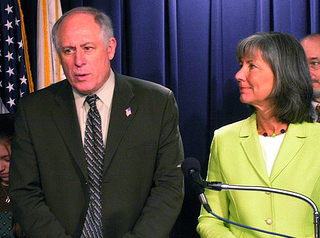
* Citing anonymous sources familiar with the decision, the Chicago Tribune is reporting Gov. Pat Quinn plans to announce he would prefer to run with Sheila Simon.
The sources, who asked not to be identified so as to not preempt Quinn’s public announcement of a running mate on Friday, said the governor ultimately rejected another top contender for the post, state Sen. Susan Garrett of Lake Forest, who has been reluctant to fully embrace his call for an income tax increase without preconditions. Simon said she would back the governor’s plan.
* Simon is daughter of the late former U.S. Sen. Paul Simon, a southern Illinois Democrat. An associate law professor at Southern Illinois University School of Law in Carbondale, Simon is a former member of the Carbondale city council and challenged incumbent Republican Mayor Brad Cole in the spring of 2007.
Rich says he had been hearing talks of Quinn’s decision, which he expects to formally announce Friday, throughout today.
Gov. Pat Quinn said he intends to be conservative when using expected savings from the massive pension overhaul to help balance next year’s state budget.
At a Statehouse news conference today, Quinn said the administration will stick with an estimated $300 million in savings that he built into his budget proposal earlier this month. The legislature’s Commission on Government Forecasting and Accountability thinks the changes could save the state anywhere from $500 million to $1 billion next year.
Quinn has not yet signed the pension bill, but said he will shortly.
“This is the mother of all cutting spending proposals,” Quinn said. “Anyone who wants cuts in government, you’ve got it. This was a political earthquake.”
* The governor also took a funny little shot at the Tribune’s reactionary editorial board today when asked a question by a Trib reporter about his lite guv choice. Watch…
* Quinn also took questions about the cuts to the State Police. He essentially admitted that his proposed tax hike for education could take the pressure off other areas of the bureaucracy. Have a look-see…
The lawmaker who drew criticism for initially refusing to relinquish a $25,000 statue that belonged to Chicago State University is now in trouble over remarks she made about minorities Wednesday.
Rep. Monique Davis (D-Chicago) apologized to Hispanic lawmakers after she generalized about Latinos and tacos while protesting a bill to license hair braiders.
“You do not license a Chinese person to sell Chinese food. You do not license a Latino to sell tacos,” Davis said. “You do not license an African-American woman to hair-braid.”
Representatives Edward Acevedo (D-Chicago) and Susana Mendoza (D-Chicago) quickly rose to protest Davis’ stereotype.
“For anyone to come to this floor and make fun of my ethnicity, I’m so appalled at the statement that was made on the House floor,” Acevedo said.
The quotes above don’t do her initial comment or the rebukes justice. You can listen to it all by clicking here. Davis’ logic was weird and twisted, and she deserved the blow-back.
She did eventually apologize…
“I apologize to them and I want them to know and the body to know that I have the utmost respect from the bottom of my heart for the multicultural diversity of our body,” Davis said.
* We didn’t post this story from earlier this month, but it was something I broke and then eventually followed up on by Kristen McQueary of the Southtown Star. I found it today while looking for something else.
The basic gist is that a Democratic township committeeman with close ties to the Pat Quinn campaign is alleged to have pressured a potential appointee to the Illinois House to vote for the governor’s tax hike.
Worth Township Democratic Committeeman John O’Sullivan supported Kelly Burke for the House and she supported his campaign against an incumbent as well. Burke defeated a candidate backed by House Speaker Michael Madigan, but she made up with MJM and wanted the appointment after incumbent Rep. Jim Brosnahan (D-Evergreen Park) resigned. Everybody figured it was a “go” since Burke and O’Sullivan were allies. But it all fell apart.
While Burke told O’Sullivan she wanted the appointment, things started to unravel last weekend. In a series of phone calls, O’Sullivan began pressuring Burke to commit to supporting an income tax increase if she was sent to Springfield.
Burke wouldn’t comment publicly on that part of the story, but four sources confirmed it happened - including someone from O’Sullivan’s camp.
O’Sullivan denied he pressured her.
“The fact of the matter is (Burke) couldn’t give me a commitment as far as protecting these teaching jobs. My wife is a teacher. She’s one of them,” O’Sullivan said. “We felt with (Carberry’s) union background - he’s very affiliated with the teachers in our community and the unions - he would be a great candidate. Saving teaching jobs is our main objective. I don’t know if (Burke) thinks she was owed this appointment, but we have plenty of teachers in our community who are very nervous about this.” […]
Burke, however, wasn’t comfortable with strings attached to the appointment.
There are many claims from insiders that the Quinn campaign was directly involved with this pressure on Kelly, but the governor’s campaign won’t comment.
* Speaking of MJM, he had a bit of fun with my intern Barton Lorimor yesterday. Watch…
And while we’re looking at silly videos, here’s a weird one of Rep. Bill Black…
* 11:14 am - The Senate just SB2494, which would create a pilot school vouchers program for Chicago elementary schools. It would impact about 22,000 students.
Whew, I wouldn’t want to be a teachers union lobbyist this week, man. “If they would just vote down a tax increase this week we’d have the trifecta,” cracked one union official a few minutes ago.
* 11:15 am - The Senate is now taking up the red light camera bill, SB935.
* 11:51 am - The bill, which was a compromise worked out by Senate President John Cullerton, passed 45-10.
Over Republican objections, the Illinois Senate endorsed legislation Thursday that will assure the state’s prison guards get paid in June.
Democrats argued the stopgap spending measure is needed because the budget approved last summer was based on Gov. Pat Quinn laying off hundreds of prison guards.
But the union representing the workers was able to block the move, meaning the state will still have to pay the employees. The shortfall — expected to affect the state’s June payroll — is about $31 million.
Republicans complained the Illinois Department of Corrections should cut its spending on things like cookies and cable television for inmates in order to make up the shortfall.
“The mismanagement from this administration does not warrant more money,” said state Sen. Matt Murphy, R-Palatine.
A $50 million job creation program is headed to Gov. Pat Quinn’s desk.
In action Thursday, the Illinois Senate unanimously approved a plan to give small business owners a $2,500 tax credit for each full-time position created in the next year.
It would affect people hired at a rate of $13.75 or above at companies that have fewer 50 employees. The program would be capped at 20,000 workers.
* House Republican Leader Tom Cross teamed up yesterday with former GOP gubernatorial candidate Adam Andrzejewski to call for a “forensic audit” of the state budget…
[Andrzejewski] said during the Blagojevich and Quinn administrations, even other elected officials and government agencies couldn’t get a handle on how large state government has become and how much state government is spending.
“The comptroller said we have 252 state programs. Auditor [Bill] Holland said we have 1,750, and he said we had more but he couldn’t quantify the number. Auditor Holland said we have 100 state agencies. The comptroller said we have 69. We don’t even know the basics of Illinois financial data,” said Andrzejewski.
Andrzejewski said if an audit could straighten-out those inconsistencies, Illinois could find $1.25 billion in savings.
House Leader Cross wouldn’t go that far. But said there could be some money found which could be better spent.
Some of those differences are about semantics, but he has a good point.
Andrzejewski told the SJ-R in January that the cost of the audit would be at least $60 million. The auditor general would be in charge of this project, but the current fiscal year’s appropriation for the auditor general’s office is $24.3 million all funds, including $6.8 million GRF. So, a $60 million project would be unprecedented for that office.
The price tag is one reason House Democrats are dismissing the idea.
“I question what the motivation is and why you’d want to spend tens of millions of dollars when the state is broke,” said Steve Brown, spokesman for Democratic House Speaker Michael Madigan. “It’s a huge waste of money.”
Brown also said the study would essentially duplicate the auditor general’s responsibilities.
Cross’ resolution was introduced yesterday and is now in Rules Committee. You can safely bet that the HGOPs will make a stir on the floor to get that thing released.
The Daley administration will strongly oppose Gov. Quinn’s plan to impose State Police cutbacks so draconian, they would require Chicago Police to assume primary responsibility for patrolling 53 miles of Chicago area expressways, City Hall sources said today.
State Police have had exclusive control over Chicago area expressways since 1985. That’s when 12 months of negotiations between then-Mayor Harold Washington and then-Gov. Jim Thompson culminated in a deal that transferred responsibility to the state in exchange for the right to sell lottery tickets at O’Hare Airport.
Sources said Mayor Daley will attempt to hold the state to that agreement on grounds that Chicago cannot afford what amounts to an unfunded mandate from the state.
If they didn’t put it into statute, I’m not sure he can hold Quinn to it. We’ll see.
Chicago Mayor Richard Daley says a four day school week isn’t the answer to school funding issues.
That’s after the Illinois House of Representatives passed a measure giving local school districts the option of closing schools one day a week, while offering longer school days. The move would save schools money on transportation and utilities.
But Daley says it would place an unfair burden on parents.
DALEY: Again, when you think four day school week, what do parents then do on a Friday or a Monday or a Wednesday? Many parents are working. A single parent has to work. And so how do they afford then… what do they do with their child? There’s so many problems with this issue.
We always encourage schools and lawmakers to work together to save money and improve learning. For a rural district with long bus routes, the reduced transportation costs - along with salary savings on other nonunion personnel such as food service workers - might save enough to make this worth considering.
However, we doubt this kind of change would be a good fit for suburban districts, which generally have a smaller percentage of students taking buses and travel a shorter distance. Lifestyle issues such as child care and activities also would make a four-day school week more of a hardship.
“We would save $100,000 or more a school year … (if we) run the buses one less day a week. I turn the heat off an extra day a week. Your cafeteria is open one day less a week,” said Mark Janesky, superintendent of Jamaica School District in Vermilion County.
His district, with less than 500 students, covers 110 square miles. The cost savings in busing alone would be substantial, he said.
“We’re out in the middle of a cornfield,” he said. “Under the circumstances, busing is a huge issue for us.”
* There was a microscopic bit of good news on the budget front…
Illinois’ prison population declined by 313 inmates in 2009, says the Pew Center on the States, adding to an annual decrease in the number of inmates in state prisons nationwide for the first time in nearly four decades.
In a report titled, “Prison Count 2010,” Pew says the number of inmates in state prisons nationwide dropped .4 percent in 2009 – the first decline since 1972. That equates to about 5,700 fewer prisoners, out of about 1.4 million in state prisons across the United States.
“After nearly four decades of uninterrupted growth, an annual drop in the state prison population is worthy of note, no matter the scale of decline,” Pew says. “However, it is too soon to say whether the 2009 decline will be a temporary blip or the beginning of a sustained downward trend.”
The decrease in Illinois comes after nearly 2,000 Illinois inmates were released early from state prisons in 2009, and many were subsequently re-incarcerated when public outcry forced a halt to the early release program. Illinois currently holds about 45,000 inmates in facilities designed for about 31,000.
* Some people are just never happy unless they get everything they want. For instance, here is a press release by R. Eden Martin, the president of the Civic Committee of The Commercial Club of Chicago regarding the pension reform bill approved yesterday…
“This bill is a small step in the right direction but it doesn’t begin to solve the State’s urgent fiscal problems. The only way to achieve significant cost reductions now is to reform retirement benefits for current state employees prospectively and new hires moving forward. The people of Illinois are not going to be satisfied with tiny steps in the right direction when we have a State fiscal crisis of this magnitude on our hands.”
Senate President John Cullerton said yesterday that his research shows cutting benefits not yet earned by current employees cannot legally be done. And the General Assembly was nervous enough about cutting benefits for future employees that a cut to current employees would’ve been hugely tough, if not downright impossible.
That said, we understand the realpolitik here: Democrats and Republicans who voted for this bill Wednesday can tell voters they’ve done something worthwhile, even if it doesn’t much diminish the state’s current budget crisis or pay down our already staggering unfunded pension obligations.
What the politicians can’t pretend, though, is that this bill repairs how Illinois spends money today. Until they’ve made the major spending reforms that this page and other voices keep advocating, Gov. Pat Quinn is free to keep scaring people with his threat to slash education funding by $1.3 billion.
As we’ve already discussed, the Tribune’s budget cut ideas are grossly inflated and some are even downright bogus. And if editorial board members had bothered to read their own paper, they’d know there are some significant immediate and longterm budget savings in this package…
But the growth in the state’s pension debt should be reduced dramatically, said Dan Long, executive director of the Commission on Government Forecasting and Accountability. Long also said the state will save $119 billion over the next 35 years under the legislation.
Though major pension savings won’t accumulate for years, Quinn and lawmakers plan to use the pension changes to save money as they craft a budget in the face of a $13 billion shortfall. Because the bill allows officials to recalculate the state’s overall pension burden, they estimate saving $300 million to $1 billion in pension payments that would have been required in the next budget.
COGFA has a rough estimate of $500 million to $1 billion for next fiscal year. It won’t cure the deficit, but it ain’t chump change, either.
* Doug Whitley of the Illinois Chamber was far more optimistic than the naysayers…
“This bill is not window dressing. It’s substantial reform,” said Senate Minority Leader Christine Radogno.
The Sun-Times editorial board, which is way more reality-based than the Tribune’s grumpy old men, praised the proposal as a “giant first step.” But they did have some quibbles…
We don’t think all employees should wait until 67 to retire. Is that really the right age for a kindergarten teacher?
We’re concerned that the cost-of-living reduction is too severe. The bill exempts the financially weak pension systems for police officers and firefighters, which we think is a mistake.
* Require an employee to be 67 years old with 10 years of service in order to qualify for unreduced benefits. A person could retire at age 62 with 10 years of service, but with a reduction in benefits of 6 percent per year.
* Cap the salary used to determine benefits at $106,800.
* Base benefits on the highest average salary earned during eight consecutive years of the last 10 years of service. Now the benefit is based on four years of service.
* Would stop compounding annual cost-of-living benefit increases; those increases would be based on 3 percent or one-half of the consumer price index, whichever is less.
* Limit participation in the “alternative formula,” which provides enhanced benefits for high-risk state jobs, to correctional officers, state police and state firefighters.
* Do not allow a person to draw a pension from one system while working a full-time job covered by another pension system. Pension payments would be suspended during such a period.
The measure that passed Wednesday takes aim at 13 pension systems, including those representing state workers, teachers, Chicago city and park district employees, Cook County workers, legislators and judges. Police and firefighters are exempt from the changes.
The plan also gives Chicago’s public schools a windfall to address what could be a $1 billion deficit next school year by reducing the amount that must be contributed toward teacher pensions by $1.23 billion over three years. The measure also extends by 14 years the period when the Chicago Teachers Pension Fund must be 90 percent funded. It is now 74 percent funded.
We support this, reluctantly, because the only real alternative is unconscionable cuts in the classroom. In general, we oppose underfunding pensions. That is, after all, how Illinois got into this fiscal mess in the first place.
“This bill is nothing more than lawmakers shifting the burden of the state’s past mistakes onto future teachers and public employees,” said Ed Geppert, president of the Illinois Federation of Teachers. “If this bill becomes law, Illinois will have the highest teacher retirement age in the country.”
The Illinois Federation of Teachers’ political director Steve Preckwinkle talked to me last night about the bill and the union’s political plans. Watch it…
David Vaught, Gov. Pat Quinn’s budget director, said he was concerned that Illinois’ bond rating, which determines the interest rate the state will have to pay on borrowed money, could be downgraded again when the state seeks to borrow about $1 billion in April to fund the capital construction plan.
Vaught said pension reform could help Illinois avoid a slip in its rating because it would show investors that the state is taking steps to address its structural deficit and “the straitjacket of skyrocketing pension costs.” The state’s total pension liability is $126.5, billion, $77.8 billion of which is unfunded.
* 12:12 pm - As I already told subscribers this morning, Speaker Michael Madigan has moved a pension reform plan that is hotly opposed by the unions. The bill passed the House Personnel and Pensions Committee by an 8-2 vote. The two “No” votes were both Springfield-area Republicans, Raymond Poe and Rich Brauer.
Madigan is expected to run a floor vote today and the Senate is expected to take up the bill as early as tomorrow.
The legislation creates a two-tiered pension system. It raises the retirement age, gets rid of double-dipping by a retiree if that person gets another public job, limits pensionable salaries to $106,800, etc…
Proposed by House Speaker Michael Madigan, D-Chicago, the changes raise the retirement age to 67 in order to qualify for full benefits, restrict annual cost of living increases for retirees, limit the salary that can be used to determine retirement benefits and restrict those who qualify to earn enhanced benefits under the “alternative formula” set aside for high risk jobs.
If eventually enacted into law, the changes would go into effect Jan. 1 and affect future members of the State Employees Retirement System, State Universities Retirement System and Teachers Retirement System. Senate Bill 1946 also incorporates changes to lawmaker and judges retirement systems that were approved by the House last week. […]
A precise savings from the changes has not been determined, but a top Madigan aide said it should save “well over $100 billion” over several decades.
David Vaught, budget director for Gov. Pat Quinn, said lawmakers need to act quickly before an upcoming bond sale to pay for public works projects. Vaught said bond rating agencies will be looking at whether Illinois is taking steps to address its budget problems and could downgrade Illinois’ bond rating if nothing is done.
Speaker Madigan talked to reporters afterward. Among other things, he wasn’t optimistic that Republicans would support the pension bill. Watch the avail…
We’ll have budget director David Vaught’s comments in a bit as well as committee testimony by at least one opponent.
* 12:17 pm - From an IFT spokesperson…
Our estimate is this bill would reduce the state’s cost for a new teacher to 1 percent of payroll. Basically, new teachers will pay the entire cost, while the state pays over 8 percent for a new legislator.
* 12:25 pm - Budget director David Vaught testifies…
* 12:58 pm - Rep. Raymond Poe (R-Springfield) asked Speaker Madigan a whole lot of questions. Here’s part one…
*** 1:54 pm *** The House Republicans asked for a one-hour conference as soon as Madigan’s bill was brought up on the floor. They need to figure out what they’re gonna do. Back at 3ish.
*** 2:34 pm *** The IFT has issued a fact sheet on the bill. Click here.
*** 3:48 pm *** The House is now bebating the bill on Third Reading.
*** 5:05 pm *** The House approved the pension bill 92-17-7. Speaking to reporters minutes after the vote, Speaker Madigan said he expects the Senate to call the bill either tonight or tomorrow morning.
*** 8:20 pm *** Senators sent the pension reform bill that began movement in a House committee this morning to Gov. Pat Quinn by a 48-6-3 vote. From the committee hearing where Speaker Madigan read the amendments to SB1946 to the final Senate vote, it took the Legislature roughly 10 and a half hours to approve the bill.
* As I told subscribers today, a new lawsuit is about to be filed against the way the state funds schools. The Sun-Times editorialized in favor of it today…
The new lawsuit charges that the [school funding] system violates the equal protection clause of the Illinois Constitution because it forces homeowners in poor communities to pay higher property tax rates than owners of homes of similar value in more affluent areas.
It’s an interesting tactic, based on the state Constitution’s equal protection clause…
No person shall be deprived of life, liberty or property without due process of law nor be denied the equal protection of the laws.
By law, the state each year establishes a “foundation level” of funding. Depending on property values, communities rely on different tax rates, along with state aid, to get there.
A $200,000 home in the south suburban Homewood-Flossmoor school district, for example, was taxed at a rate of 4.1 percent in 2006 while a home of the same value in the north suburban New Trier district was taxed at a rate of 1.7 percent. And, at the end of the day, New Trier spent about $3,400 more per student.
This lawsuit differs from all other suits filed anywhere in the country by using the equal protection language. The Urban League filed suit in 2008 based on violations of state anti-discrimination laws…
The [new] suit, filed on behalf of taxpayers by the nonprofit Business and Professional People for the Public Interest and the law firm of Sidley Austin, applies a novel legal approach. Nationally, most other suits resemble the Urban League’s. The remaining claim in that suit alleges that Illinois’ funding system discriminates against black and Hispanic students.
Thoughts?
* And now, your legislative roundup…
* Developer considers next step for hobbled STAR bond plan: Rebecca Rausch, a spokeswoman for University Town Center Development, said its representatives would meet today in Springfield with aides to Gov. Pat Quinn and officials from the Illinois Department of Revenue.
* Senator Don Harmon Wins Approval of Bill to Limit Cable TV Contracts to 2 Years: the bill would limit cable and video service contracts to a two-year contract instead of [the current] one-year.
* Bill preventing employers from checking job seekers’ credit scores passes Ill. House committee
* Phony cigarettes are a real threat, say Illinois health advocates
* Rep John Bradley Wins Approval of Plan to Draw Child Psychiatrists to Southern Illinois
Republican members of Illinois’ congressional delegation want Attorney General Lisa Madigan to sue to block the new health care overhaul.
Six lawmakers signed a letter Tuesday urging Madigan to join more than a dozen other state attorneys general who are claiming in court the law is unconstitutional.
Madigan’s office says it isn’t filing a lawsuit. Gov. Pat Quinn, a fellow Democrat, says Illinois won’t do anything to try to block health care reform.
The letter to Madigan was signed by U.S. Reps. Don Manzullo, Aaron Schock, Peter Roskam, Judy Biggert, John Shimkus and Tim Johnson.
This was about the “base,” not about any hopes that AG Madigan would act on this request.
Also, notice that Mark Kirk isn’t on that list of letter writers. [ADDING: Kirk’s absence is a bit puzzling since he promised just the other day to “lead the effort” to repeal the new law.]
* But top Democrats in the GA are nervous about this law. A week ago, the House took up a resolution on the national healthcare issue…
[Resolved] we urge President Obama and the United States Congress to take immediate action to adopt meaningful heath care system reform in keeping with the Obama administration’s articulated goals
The resolution passed with just 62 votes, even though the Democrats have 70 seats.
Democrats voting “No” were Reps. Crespo, DeLuca, Farnham, Franks, McAsey, Sente and Walker. Rep. Jehan Gordon voted “Present.”
Except for Franks and probably Gordon, that’s most of the people on the Republican target list. The Repubs said they’d be whacking the Dems who voted “Yes” and claimed it was an indication that President Obama’s bill is not polling well in key districts. Perhaps the biggest surprise on that “No” list is Rep. Carol Sente, who has a north suburban district formally represented by Kathy Ryg, who quit the seat last year to take a job running Voices for Illinois Children, a statewide group that lobbies for greater health care spending, among other things.
* A new report by NCSL about states introducing measures to repeal or limit healthcare laws is probably destined to get some media coverage. From the report…
As part of state-based responses to federal health reform legislation, individual members of at least 36 state legislatures are using the legislative process to seek to limit, alter or oppose selected state or federal actions, including single-payer provisions and mandates that would require purchase of insurance. In general the measures seek to make or keep health insurance optional, and allow people to purchase
any type of coverage they may choose. The individual state language varies.
Make sure to keep a few things in mind if this does break through. First and foremost, an introduced bill or resolution often means nothing. The Senate Republicans here could introduce a bill banning compliance with the national law and it would never get out of Rules Committee, for instance.
And then there’s this…
None of the other proposals [besides Virginia and Idaho] listed have been finally approved; Arizona’s resolution of June 2009 was the first measure to have passed the legislative process; A Utah bill passed both chambers and awaits action by the governor. A Tennessee and a Georgia bill has passed one chamber; Constitutional resolutions have advanced through initial steps in Florida, Georgia and Missouri (3/16/10). One amendment failed to pass in Georgia on 3/18/10.
“Did not pass” measures: So far in 2010, bills have been rejected or failed to pass in: Indiana, Mississippi, New Hampshire, New Mexico, South Dakota and Wyoming. A Non-binding resolution in Indiana passed the Senate but did not pass the House.
Many of the measures appear to modeled on the conservative legislative group ALEC’s “Freedom of Choice Act,” which was unveiled in 2008. Most of these state proposals appear to have been introduced last year, and they haven’t moved since.
Also, keep this in mind…
In 29 of the states, the proposals include a proposed constitutional amendment by ballot question. In a majority of these states, their constitution includes an additional “hurdle” for passage - requiring either a “supermajority of 60% or 67% for passage, or requiring two affirmative votes in two seprate years, such as 2010 and 2011.
* Related…
* State Insurance Director Michael McRaith discusses the impact of health care reform on Illinois: Right now, ICHIP is prohibitively expensive, with premiums of $12,000 to $16,000 annually. It’s funded two-thirds by premiums and one-third by general revenue funds. The federal law shifts that burden so enrollees pay no more than 35 percent of the cost of the program. That’s about a 30 percent reduction in costs. Our expectation is that we’ll get clear guidance from Washington (about who can get insurance through the pools) within 90 days. We expect an implementation time of 15 to 45 days following that. Since individuals in Illinois can be denied health insurance for any reason other than race, religion, color or national origin, we expect a large number of people will sign up.
The Chicago Police Department may be forced to assume primary responsibility for patrolling 53 miles of Chicago area expressways — at a time when police manpower is woefully short — under Gov. Quinn’s proposal to slash the State Police budget and lay off 464 state troopers.
State Police have had exclusive control over Chicago area expressways since 1985. In 2001, Chicago Police joined forces with the State Police to help enforce traffic laws on the Eisenhower, Dan Ryan, Stevenson, Kennedy, Edens spur and Bishop Ford to curb rampant speeding.
Now, Quinn’s sweeping budget cuts are threatening to shift the entire burden to Chicago as early as July 1 — and it couldn’t come at a more difficult time. The Chicago Police Department is 700 officers short of its authorized strength and more than 2,100 officers short each day, counting those on medical rolls and limited duty.
With expected retirements, the layoffs will reduce the number of sworn state troopers by about 600, or 30 percent, Monken said. The force currently has a little over 2,000 troopers.
The five offices are those in Litchfield, Carmi, Pecatonica, Macomb and Des Plaines. State Police have 22 offices now.
“There will be significant consequences to public safety,” Monken warned.
“We expect an increase in traffic fatalities, increased exposure to terrorist threats in Illinois, an increase in gun and drug trafficking, in addition to the loss of an estimated $12 million in citation revenue for counties across the state,” he said.
Specialty units would be hit hard by the cuts. The Statewide Terrorism Intelligence Center would lose more than half of its officers, and Monken said the State Police’s methamphetamine response team would be “all but eliminated.”
“Investigations will get hit pretty hard when we send people to the Illinois Gaming Board. Those are investigators that go over,” he said.
And while the governor’s office claims this is unrelated to the budget, it most likely is. Gov. Quinn wouldn’t even think about dinging veterans if budget times were good…
The cost to stay in one of the state’s four nursing homes for veterans could jump by as much as 45 percent under a plan being pushed by the Quinn administration.
Quinn, who made veterans a priority during his tenure as lieutenant governor, has asked lawmakers to approve a $400 per month increase in the maintenance fee for veterans’ home residents.
Now, you could say that the proposed $32 million cut to the State Police budget and the increased rate for veterans are just more scare tactics by the governor. Cut schools, cut the coppers, cut the vets. Create panic.
Then again, the state is deeply in the red. The governor’s proposed $2+ billion in cuts would have to be tripled to erase the current structural deficit. And then there’s that projected $6+ billion in past due bills that the state can’t afford to pay and will roll over into Fiscal Year 2012.
You can’t just cut “fat” and make the numbers work by magic. You have to cut muscle and bone.
A top contender for Gov. Pat Quinn’s running mate job said Tuesday that Quinn has failed to make the case that raising taxes is the only way to solve Illinois’ budget crisis, potentially undercutting the governor on his signature issue.
Sen. Susan Garrett said if the state cuts unnecessary spending and reduces pension costs she would be willing to consider Quinn’s proposal for higher taxes.
“But we’re not ready to do that yet. The message hasn’t been articulated to the general public,” the Lake Forest Democrat told reporters.
I don’t think she was nearly as harsh on Quinn as the lede implies (watch the video if you missed it yesterday). She never specifically blamed Quinn for not articulating the message, using “we” over and over again. But this sort of story was easily predictable.
The Illinois GOP e-mailed the article to its press list earlier this morning. They’re clearly happy with the result. Expect more like this.
Also along that vein, Sen. Garrett admitted publicly yesterday that she had been contacted by Gov. Quinn’s chief of staff about running for the LG office. Others, however, haven’t even been able to get their calls returned…
Unlike Garrett, [state Rep. Mike Boland (D-East Moline)] said he has not been contacted by Quinn or his top aides, but he has tried.
“All of us have probably sent communications to the governor, but none of us have ever gotten called back,” he said.
Rep. Boland has touted himself as Quinn’s top legislative ally for years. If people like him can’t get a return call while top Quinnsters court Garrett and supply her with a “driver” on interview day, then you get a good idea of where this is going.
I had a long talk with Garrett yesterday, and I’ll have more on this for subscribers tomorrow.
*** UPDATE *** From a press release…
State Representative Mike Boland (D-East Moline) yesterday announced he would step aside in his quest to be the Lt. Governor and throw his support to Art Turner to be named the Democratic nominee.
…Boland’s wife, Mary Boland, is a member of the Democratic State Central Committee.
“It is my strong belief that the nominee to replace Scott Lee Cohen should be someone who ran for the office of Lt. Governor in the February Primary,” Boland stated. “To not choose someone who has already campaigned extensively throughout this huge state and garnered over 180,000 votes would be to tell all of the hundreds of thousands of voters who took the time and made the effort to vote in the primary election that their votes meant nothing,” Boland emphasized. “Art Turner came in second in the primary voting and that has to mean something,”said Boland.
* 2:20 pm - A proposed constitutional amendment sponsored by House Speaker Michael Madigan failed to pass today and was pulled out of the record and put on “Postponed Consideration.” That means Madigan can bring this back for another vote if he thinks he can pass it.
The rare public failure by the Speaker ended with 67 “yes” votes, 21 “no” votes and 27 “present” votes. The measure required a three-fifths majority of 71.
Provides that a person must have been a licensed attorney-at-law for a minimum of ten years to be eligible to serve as a Circuit Judge, a minimum of twelve years to be eligible to serve as an Appellate Judge, and a minimum of fifteen years to be eligible to serve as a Supreme Court Judge, except that a person serving as a Judge on December 31, 2010 is not disqualified from completing the current term of office or seeking an additional term.
As we discussed yesterday, the Republicans are upset that Madigan is apparently attempting to pack the ballot with constitutional amendments so that the Republican proposal to change the redistricting process couldn’t be approved. The state Constitution limits to three the number of articles that the GA can propose to amend. One is already on the ballot (recall), and Madigan is proposing another to abolish the lt. governor’s office. This judicial amendment would’ve been the third.
During the debate, however, Madigan did say that he intends to support changes to the redistricting process. He didn’t elaborate.
* Sen. Susan Garrett talked to reporters today about the lite guv post. She said she has “no indication” that she’s the frontrunner, which kinda defies most evidence, but that’s media talk. She also addressed a report in Capitol Fax that she’d been driven to various events on Saturday by a Quinn campaign worker. She characterized the person as “just a driver.” Yeah. OK. Take my word for it, the guy ain’t just a driver. Gov. Quinn appeared to deny the report yesterday, so this is becoming a bit of an issue for me.
Garrett also talked about her position on Quinn’s tax hike. Have a look…
* Sen. Rickey Hendon hasn’t exactly been a fan of his fellow member of Democratic leadership Susan Garrett. Back when Garrett was leading the charge against a legislative pay hike in 2008 Hendon had this to say about her…
“People should not miss out on the fact that she’s a millionaire. She don’t need it. Have you seen her house? Mind-boggling,” Hendon said. “So it just blows my mind how the filthy rich are always the ones saying, we don’t need the raise. No she don’t.”
But Hendon did have plenty of nice things to say about Garrett today, and called that ‘08 fight over the pay raise “minor,” adding, “She has a kind heart.” Hendon also said the pick was a good strategy for Quinn and that the two would be a good fit. He also had some unkind words for Rep. Art Turner, with whom he has been feuding for ages and who is also vying for the lite guv job. Have a look…
How much will Medicaid cost the state should the federal health care legislation become law? No one really knows for sure, including Gov. Pat Quinn, who backs health care reform.
Speaking with reporters Monday, Quinn said it won’t worsen the state’s deficit, yet he doesn’t know how much the cost will be. According to Quinn, the state hasn’t made a cost estimate.
Progress Illinois has run the broad Medicaid numbers, but there will also be some benefits to the state not included in this list…
After covering the full cost until 2016, Washington will cover 95 percent of the expansion in 2017, meaning Illinois would need to pay an additional $130 million that year. In 2018, the federal assistance drops to 94 percent, costing Illinois $156 million. In 2019, it drops one more percentage point, adding $183 million to the state budget. That means the grand total Illinois would owe, between 2014 and 2019, will be approximately $469 million. Thought about another way, Illinois will extend health coverage to about 5 percent of its population at a cost of just $40 per person annually.
Schools could shave a day off the school week to try to save money under legislation the Illinois House approved Monday.
The plan that passed 81-21 requires students still be taught the same number of total hours in a year, but would allow it over four days rather than five. The decision to cut a day would rest with the locally elected school boards, though the Illinois State Board of Education would maintain some oversight authority.
Local boards would be required to have public hearings on reducing the school week. State Rep. Bill Black, a Danville Republican and the plan’s sponsor, said 19 states already allow for reduced school weeks. […]
Black brought the proposal to Springfield at the behest of a small, rural downstate district trying to save transportation and utility costs. He said the state is months behind in reimbursing the school for transportation costs, local fuel providers can’t afford to carry the school much longer and officials are running out of options.
Though the bill passed 81-21, there was considerable opposition from some Chicago Democrats who questioned whether parents would be able to care for their children on the new off day.
* Chicago Republican state Rep. candidate Scott Tucker has been getting a whole lot of mileage out of the red-light camera issue. Tucker, who’s up against Ann Williams in the November general, has been featured several times in Chicago and national media blasting the cameras as unsafe.
No problem with that, of course. That’s just good politics. People generally don’t like red-light cameras, so it’s a great issue, even though his rhetoric has often been way over the top…
“Red light cameras are causing accidents, hunger, evictions, and foreclosures in Illinois.”
More than a bit much, but it’s in keeping with his tea party-like appeal.
* The real problem is with Tucker’s oft-repeated claim that he has timed several red-light camera intersections and believes Chicago is rigging the system…
“We’ve actually gone out and timed 13 Chicago intersections that have these red-light cameras and we’ve found that the city is shortening the yellow light to two and a half seconds.”
The yellow lights are supposed to last three seconds, but Tucker claims the city is not telling the truth, and that the alleged timing change has resulted in more red-light tickets and more accidents.
The Chicago Tribune did the due diligence and clocked 70 Chicago red-light cameras. All came in at 3 seconds or longer. They took apart a control box to see how difficult it would be to reprogram the lights. Not easy at all. In fact, the lights are programmed to revert to flashing red if the yellow light time meanders lower than 2.8 seconds.
Also, the 3-second yellow light has been the standard in Chicago for 50 years, according to the article. And then there’s this…
[Brian Steele, a spokesman for the Chicago Department of Transportation] also said a recent sampling of 14 high ticket-generating intersections found that 99.87 percent of all cars passing through did so without triggering red-light cameras.
Not exactly a “trap,” as has been claimed.
And why are yellow lights longer in the suburbs? This makes logical sense…
With only a few exceptions, the speed limit on Chicago thoroughfares is 30 mph. Speeds tend to be faster in the suburbs — one reason why yellows last longer there.
Anyway, it’s fine to hate the cameras. There are plenty of good reasons. But let’s try to stick to the facts from now on.
* Mark Kirk’s US Senate campaign took another tack today. They issued a press release slamming Alexi Giannoulias for telling the Illinois Education Association that he is for a state tax hike. From the release…
Congressman Mark Kirk today criticized State Treasurer Alexi Giannoulias for endorsing a state income tax hike just days after new jobs numbers put Illinois’ unemployment rate over 12 percent.
“I have said from day one, as your state Treasurer, that, while politically it’s not the smartest thing to say, we need an income tax increase,” Giannoulias announced Saturday.
“With unemployment topping 12 percent and Illinois families struggling, the last thing we need is higher income taxes,” Congressman Kirk said. “We know that Rod Blagojevich and his allies in Springfield taxed and spent our state into economic ruin. Raising taxes further will make our state less competitive, stifle job creation and slow our economic recovery. After wiping out $70 million in college education savings, Alexi Giannoulias wants to bail out his party’s fiscal mismanagement on the backs of hard working Illinois families. Put simply, Illinois families cannot afford Alexi Giannoulias.” […]
In December, Giannoulias revealed his office lost roughly $150 million in Bright Start college education savings and only recouped about half of the loss. Giannoulias did not comment whether families that lost money in Bright Start would be exempted from his income tax hike proposal.
Kind of a snarky line, eh? The release went on to reiterate the campaign’s claim that Kirk “voted to cut taxes more than 40 times for Illinois families.”
*** UPDATE *** The Giannoulias campaign responded this morning by saying the candidate’s position that any tax increase “needs to be coupled with lower property taxes.”
* In lite guv news, it appears that Sen. Sullivan got the cold shoulder…
State Sen. John Sullivan did not attend weekend meetings held for potential candidates for lieutenant governor on the Democratic ticket.
“I met the governor and his people and said if they were looking for someone like me, I was interested,” Sullivan said. “It was quite clear that the governor is not looking for someone like me.”
Sullivan is a pro-life, pro-gun conservative downstate Democrat. The governor, of course, has huge problems with women, which would seem to rule out Sullivan. But as I discussed with subscribers this morning, Dan Hynes cleaned Pat Quinn’s clock downstate. Quinn’s problems transcend gender.
Despite her willingness to serve, Simon doesn’t believe she is the favorite for the [lt. governor] job and believes recent news reports which peg state Sen. Susan Garrett, D-Lake Forest, as Quinn’s choice of running mate.
* Paul Vallas’ father-in-law says picking him would mean the process was honest. Hooookay…
After Round 1, Dean Koldenhoven remains in the running to be the next Illinois Lieutenant Governor Idol.
Even he’s not sure if he should believe it.
“Is this for real? I hope it is. I want the job. I want to do it,” an energized Koldenhoven told me Monday. “If I do get the job, you will know the process was honest.”
Or we will know that the process went way off the rails. Just sayin…
Illinois residents are largely passive when it comes to the state’s culture of corruption, allowing it to fester for decades, says one author in a new book on state government.
The public has come to expect a certain level of bribery and backroom dealing in state politics, and people are tolerant when it does happen, said James Nowlan, a former state lawmaker and senior fellow in the Institute of Government and Public Affairs at the University of Illinois.
But I’m not 100 percent sure this startling classroom exercise totally matches up with the hypothesis…
To emphasize his point, Nowlan has his students at the University of Illinois take an ethics quiz every semester. He poses a simple scenario to his students: A relative is arrested for driving under the influence, which threatens his job. The relative’s lawyer, however, says he can pull some strings and get the charges dropped for an extra $1,000. Should he do it? Nearly two-thirds of the students say he should.
“Ingrained in them is a sense that this is the way things are done in government,” he said. “They have to play the game to get what they want.”
That’s probably true. But I’d add a question.
Could it also be that the students have embraced this perceived system and are corrupt themselves?
After all, believing that the system is inherently corrupt doesn’t at all excuse bribing somebody to get out of a DUI. Then again, if the belief is that the system is completely corrupt, a bribe may be seen as necessary just to get fair treatment.
Open bribery was a part of life in Iraq when I was there. I witnessed it several times first-hand. The Iraqis use a more polite word than “bribery,” however. They call it “Baksheesh,” which translates somewhere between a tip and a bribe. Perhaps then they don’t feel as bad. But if you wanted something done with the government, you paid money. Period. No money meant it didn’t get done. It was a bribe in everything but name.
The students in Nowlan’s class appear to believe the Baksheesh system is very much alive and well in Illinois, and they’ve embraced it to the point where they are willing to break the law themselves to get a governmental favor. That’s disturbing on more levels than I can fathom at the moment.
I’ve also seen this attitude in campaigns, mainly when it comes to first-time amateur volunteers. The last 50th Ward aldermanic contest featured plenty of whispers about lawbreaking by both sides. Much of the more blatant problems appeared to result from recent or somewhat recent immigrants who had heard lots of Chicago corruption stories and thought what they were doing was standard operating procedure. Oops.
Illinois has been a corrupt state pretty much since its inception. Back when Abe Lincoln was a state House member, individual businesses were required to pass a law before they could incorporate. That meant lots of legislators were put on corporate boards, or got bigtime corporate contracts.
So, maybe it really is a part of our DNA.
Anyway, this is more than a little rambling, so let’s move on.
Yes, there are lawmakers who award the scholarships based on merit or financial need. But the abuses are shameless and widespread. Anyone who takes the time to scrub the public documents can find dozens of examples in any given year, and the bad apples are brazenly unapologetic.
“Dozens of examples” every year? I must’ve missed that series.
* With unemployment rates climbing, workers forced to retrain for high-demand jobs
Retraining programs seem to hold the best hope for unemployed workers to change their situation. However, the reality seems to be that workers who take retraining do little better than those who don’t.
Too often, they want the retraining program that will have them back in the job market in the shortest amount of time. They are competing for the available jobs with everyone else in their situation. And until businesses are ready to hire again, the scarcity of open positions means it may not matter how well-qualified a worker is.
The median price in the Chicago area — at which half the homes sell for more and half for less — fell to $165,000 in February, a 10.3% decrease from last year, according to the release, and down from $175,000 last month.
Prices for raw land in exurban Chicago have plummeted to around $10,000 an acre from $50,000 an acre or more during the peak of the housing boom…..And for banks that lent heavily to residential developers, there’s a lot of raw land on the books. Case in point: First Midwest Bank, with $7.7 billion in assets, had $113 million in seriously delinquent residential development loans as of Dec. 31; nearly $33 million, or 29%, of that was secured by raw land, according to an investor presentation the bank made in February.
Most Chicago yellow lights last three seconds, the bare minimum recommended under federal safety guidelines. In the suburbs, yellows generally stay on for four to four-and-a-half seconds….City officials insist, however, that Chicago’s three-second yellows adhere to sound engineering principles and predate the installation of red-light cameras by decades. And they say the number of red-light-running violations caught on camera is tiny compared with the volume of traffic, proof that yellows in the city are not a trap.
When U.S. Education Secretary Arne Duncan ran Chicago Public Schools, his office quietly kept a log of elected officials and others seeking to help kids win admission to the most coveted schools in the system, a former top Duncan aide said Monday.
That list has now come under the scrutiny of both federal officials and the schools inspector general as part of a probe of whether clout played a role in admissions to Chicago’s elite schools, sources said.
* Duncan’s staff kept list of politicians’ school requests
The log is a compilation of politicians and influential business people who interceded on behalf of children during Duncan’s tenure. It includes 25 aldermen, Mayor Richard Daley’s office, House Speaker Michael Madigan, his daughter Illinois Attorney General Lisa Madigan, former White House social secretary Desiree Rogers and former U.S. Sen. Carol Moseley Braun.
* Daley to Chicago Teachers Union: Only shared sacrifice can avert drastic budget cuts
Daley was asked whether the threat to raise class size to 37 students might prompt him to sign off on another school property tax hike on the heels of last year’s $43 million increase.
“You can’t raise real estate taxes. People can’t even pay ‘em today. That’s the difficulty. I’m just telling you,” the mayor said during a news conference at Mozart Park fieldhouse, 2036 N. Avers, called to make yet another push for property tax relief.
* Mayor Daley considers extending deadline to apply for property tax relief
The Chicago Tax Assistance Center has received just 20,000 applications — and only after a surge prompted by a TV news report last week about the lack of interest. To date, 5,000 of those homeowners have received debit cards totaling $600,000.
* Strike up the bandwidth; Google parade marches through Peoria
Woodruff High School cheerleaders traded their pompoms for special signs Monday, cheering not for the school’s team, but for Google.
Each of the six cheerleaders held a sign with a letter spelling out Google. At the Google parade, Mayor Jim Ardis, members of the City Council and County Board and about 50 people marched to music from Woodruff’s pep band in another push to attract Google to Peoria.