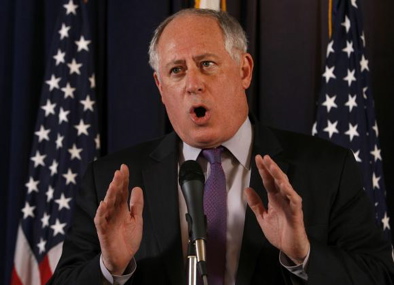
Rod Blagojevich will appear on NBC’s ‘Today’ show Thursday morning, according to the PR firm that represents the former Illinois governor.
This is his first interview since a federal judge denied Blagojevich’s request to travel to Costa Rica for the upcoming NBC reality show ‘I’m a Celebrity… Get Me Out of Here’ that begins in June, says Glenn Selig, the former governor’s spokesman and founder of The Publicity Agency.
*** UPDATE 1 *** Video…
*** UPDATE 2 *** He just can’t let it go. From a press release…
Former Illinois Governor Rod Blagojevich delivered a suprise during an appearance this morning on NBC’s ‘Today’ show by announcing he would be heading to L.A. to promote the upcoming reality program ‘I’m a Celebrity… Get Me Out of Here.’
Earlier this week, a federal judge in Chicago said he would not alter the former governor’s bond allowing him to travel to Costa Rica to participate in the show.
“He’s mindful and respectful of the court’s ruling that he can’t leave the country but we’re still exploring ways for him to be part of the show,” says Glenn Selig, Blagojevich’s publicist and founder of the PR firm, The Publicity Agency. “He wants to be supportive of the program.”
Selig declined to elaborate on the options being explored.
The former governor will attend a press event for NBC this Friday, April 24.
Blagojevich had hoped to earn a salary for appearing on the program that airs in June, in addition to raising money for his favorite charity.
A criminal background check at the heart of a growing controversy surrounding Cook County Board President Todd Stroger was completed long before Stroger has suggested, according to the Illinois State Police.
In interviews this week, Stroger said he fired troubled steakhouse busboy-turned-patronage-worker Tony Cole earlier this month for not disclosing a felony conviction on his job application. Stroger also said Cole’s criminal background check took several months to complete.
Today, State Police Lt. Scott Compton said the agency mailed background check results on Cole to Cook County on Dec. 20—nearly four months before Stroger fired Cole. (The Tribune called a different state police spokesman Monday but did not get a return call until today.)
Anyway, Stroger’s people never called me back, but they did call the Tribune today…
Stroger spokesman James Ramos said today that the state police report was not received in December and suggested it could have been lost in the mail. Ramos said another request was made to state police and the agency faxed it to the county Feb. 11. Then on Apr. 2, the county inspector general issued a report on the matter. Within days, Cole was fired, he said.
So, now it’s the inspector general’s fault for the delay. Stroger’s Tony Cole story has been changed more times than a baby’s diaper. It’s just ridiculous how they can’t seem to get anything straight over there.
While the Chicago Tribune laid off more than 10 percent of its news staff Wednesday, the paper’s corporate overlords sought bankruptcy court approval of a plan to pay $13 million in bonuses to top managers.
Tribune Co., operating under Chapter 11, said in court documents that the bonuses are essential for executives who provided “extraordinary contributions during an exceptionally difficult year” in 2008. They would be shared by 700 managers throughout the company, excluding its 10 top officers. […]
Relying on findings from compensation consultant Mercer (U.S.) Inc., Tribune said that even with the awards, the executives would be paid 41 percent less than their market competitors. […]
Meanwhile, newsroom employees at the media giant’s flagship had their own morale issues as managers conducted the biggest one-day purge since real estate entrepreneur Sam Zell took over the company. The layoffs are a response to declines in advertising revenue, a fate shared by media companies across the country.
* A new citywide poll conducted on behalf of SEIU by the Democratic polling firm of Bennett, Petts, & Normington has some pretty awful results for Mayor Daley…
The survey found that 41 percent of respondents give Daley an “excellent” or “good” job rating, while 58 percent give him “only fair” or “poor” marks. Here are the crosstabs, which show African-Americans and Latinos are particularly dissatisfied:
The poll also found that only a plurality - 47 percent - believe that Daley has “the best interests of Chicago at heart.” Yikes, man. PI has now run a correction…
This post originally stated that 47 percent of responds believe Daley has “the best interests of Chicago at heart.” In fact, that figure was 58 percent.
What’s fascinating is that, despite holding the collected aldermen in such low regard, 71 percent of respondents agreed that the “City Council should have a bigger role in how to spend the rainy day funds in Chicago,” referring to the estimated $2.1 billion in unobligated funds identified by SEIU’s researchers. The poll also found that 76 percent of respondents would like both the mayor and the City Council to “be in charge of how these funds are spent,” rather than just one or the other. This goes back to the strong agreement among 90 percent of the respondents that “Mayor Daley should be questioned because he is not always right.”
The take-away seems to be this: The public is giving the City Council a bad grade not because of what it’s doing, but because of what it’s failing to do (i.e. provide a counter-balance to the mayor).
Another striking finding: 91 percent of respondents agreed that it is “important to have a progressive voice at the table when important issues are being discussed in Chicago,” with 75 percent strongly agreeing. This suggests that the “progressive” brand is one worth embracing at the municipal level.
State Sen. Michael Bond (D) is gearing up to run for Rep. Mark Kirk’s (R) seat, according to sources familiar with the situation. Kirk is pondering a bid for Senate in 2010, and his departure would make his north Chicagoland seat a prime pickup opportunity for Democrats.
Bond has tapped John Lapp to do his media campaign, Bennett, Petts & Normington to his polling and Ed Peavy to do direct mail for the race, according to one source familiar with the arrangement. The source also said a former aide to Rep. Melissa Bean (D), Brian Herman, will manage his campaign.
As a deputy state treasurer, Peoria native Raja Krishnamoorthi was involved in administering billions of dollars in funds and tough ethics rules.
Now, he wants to maintain the state’s central fiscal accounts as comptroller.
Krishnamoorthi, 35, now of the Chicago suburbs, is exploring a run for state comptroller - assuming Democrat incumbent Dan Hynes does not seek re-election.
“My perspective is shaped in important ways by my time growing up in central Illinois and Peoria,” Krishnamoorthi said. “At the same time, having lived and worked in Chicago and now the suburbs, I feel like I have a broader perspective on some of the issues that confront the state, so I can view the different issues from different perspectives and angles, and that will help me in the decision-making process going forward.”
Ethan Hastert, a lawyer and son of former Speaker of the U.S. House of Representatives J. Dennis Hastert, has confirmed that he is considering a run for Congress. […]
However, Kenyon and Wiggins both said they wondered whether an entrance by Ethan into congressional politics at this time might be a little soon.
Both men questioned what impact his father’s political history might have on the younger Hastert’s aspirations. […]
“I want to win,” Kenyon said. “That’s the important thing to me. So I want the time to be right.”
Should he run, Burris faces a virtual certainty of serious Democratic primary competition. Democratic state Treasurer Alexi Giannoulias plans to run. William Daley, who was Commerce secretary to President Bill Clinton and is a member of the prominent Chicago Democratic family, is weighing a campaign, as are several other Democrats.
Republicans have suffered a string of election defeats in now-strongly Democratic Illinois, including losses in nine of the past 10 Senate races. But the GOP has a shot at winning the seat, particularly if voters blame Democrats for the state’s political mess. Among the Republicans weighing the race is Rep. Mark Steven Kirk, a GOP moderate who is serving his fifth term in a pro-Obama district north of Chicago.
Sneed hears embattled U.S. Sen. Roland Burris, who’s been unpopular with his peers since accepting the job from former Gov. Rod Blagojevich, is apparently having a hard time finding help.
• • To wit: Sneed is told Burris has placed job postings for interns with colleges throughout the state, including Loyola University Chicago and John Marshall Law School.
Rep. John Shimkus, R-Collinsville, is no friend of climate change legislation and he showed it [yesterday].
On the second day of a House hearing on the Waxman-Markey bill, which among other things would initiate a cap-and-trade system to regulate carbon emissions, Shimkus used his turn of questioning to rip the bill as downright destructive.
“I think this is the greatest assault on democracy and freedom that I’ve ever seen in Congress,” Shimkus said, adding that he’s presided over two wars and a terrorist attack. “I fear this more than all of the above activities that have happened.”
I doubt he’ll have much of an opponent next year, but he’s sure acting like it.
Just a week after hundreds protested taxes at the Capitol, a larger group, including some suburban residents, turned out Wednesday to support higher taxes that’d prevent deep cuts to state programs.
The crowd, which organizers pegged at 1,500, was welcomed by Gov. Pat Quinn, who vowed to help working families and defended his plan to raise income taxes to help eliminate a deficit that’s grown to nearly $12.4 billion over three years.
But some of those people apparently haven’t gotten the message. Asking for a tax hike this year for a new program or increased spending other than capital projects is almost assuredly dead on arrival…
More than 200 dentists came to Springfield to convince lawmakers a tax increase on drinks high in sugar would greatly increase funding for state-sponsored dental programs across the state. The dentists say an added 5 percent tax on such drinks would generate $94 million.
You can debate the merits of that tax hike if you’d like. I just don’t see it happening.
* In Chicago, a few aldermen are talking about tax and fee cuts…
Specifically, ten City Council members led by Aldermen Brendan Reilly (42nd) and Tom Tunney (44th) want to:
* Waive the $3-per-car city parking tax on Saturdays and Sundays in the Central Business District.
* Phase out the $4-a-month employee head tax by lopping $1 off the hated tax in each of the next four years.
* Declare a moratorium on parking meter rate hikes tied to the 75-year lease of Chicago’s 36,000 parking meters until “pay-and-display” boxes are installed. Pay-and-display boxes take credit cards and are relatively free from the mechanical problems that have plagued the transition to a private contractor.
They also included “roll back the Cook County sales tax hike” in their plan, which they have zero control over, so one wonders about the “realness” of this as well.
More than 100 educators plan to protest education funding during Governor Pat Quinn’s stop in Rockford. […]
The protest is being organized by the Illinois Education Association. They’re upset because they say Quinn’s state budget proposal doesn’t do enough to balance education opportunities at all Illinois schools.
Imagine a rerun of Blagojevich’s 2006 re-election campaign, but this time under the tight donation caps [$2,400 individuals, $5,000 PACs] now being pushed by a blue-ribbon commission named by Gov. Pat Quinn. Even under that scenario, the analysis found, the Democratic incumbent would have enjoyed a nearly 3-1 fundraising edge over Republican challenger Judy Baar Topinka.
Blagojevich oversaw a fundraising juggernaut that raked in a state record $60 million in just eight years, including 454 separate gifts of at least $25,000. Plug in the commission’s proposed limits, and Blagojevich’s jackpot would shrink nearly in half, according to the analysis. But that’s still an impressive $34 million.
That’s just $6 million shy of the amount George Ryan raised throughout his entire political career.
Then again…
[Michael] Madigan’s state party has raised $25.5 million over the last eight years, but caps would have rolled that back by 69 percent to just under $8 million, the analysis showed. Since 2001, Madigan has used the state party to funnel $1.2 million to the coffers of his daughter, Atty. Gen. Lisa Madigan. Caps would have trimmed that back to $100,000.
However, Madigan isn’t accused of doing anything illegal by any prosecutors.
A large suburban management-consulting firm whose founder has been a major political donor was hit Tuesday with a wide-ranging deceptive business practices lawsuit from the Illinois Attorney General’s office. […]
[Attorney General Lisa Madigan], a potential 2010 contender for governor, accepted $22,700 in Burgess-linked campaign cash and in-kind services before becoming attorney general in 2003. She has not taken Burgess-related money since then and will not in the future, aides said. […]
Between 1999 and 2009, Burgess and entities tied to him contributed $679,933 to more than two dozen state campaign committees but saw $278,942 of that total returned as IPA’s legal problems deepened. Besides deceptive business practice allegations, IPA is fighting an EEOC class-action sexual-harassment lawsuit filed in 2001.
State campaign records show ex-Gov. Blagojevich was the largest recipient of Burgess-related cash, taking in $200,200 and another $15,000 through an affiliated campaign committee called Democratic Victory Fund. But all of those funds were returned.
The company’s contributions to Republican Rep. Sid Mathias became an issue in his campaign last year. Mathias won big.
* Time to keep a scorecard on reform ideas: When the Quinn commission brought forth ideas on changes in government procurement, or how the state goes about securing goods and services, attorneys for the House and Senate Democratic leadership “closely questioned the reform commission about its procurement proposals, and an array of officials from state agencies testified that the commission’s ideas could cost the state time and money.”
Sometime in the coming months, the scandal-plagued, corruption-scarred, worse-than-useless Illinois Health Facilities Planning Board likely will cease to exist.
You can stop applauding. It’s not what you think: The board, which regulates hospital construction, isn’t being abolished, as this page has urged.
It’s just getting a new name — the Health Facilities and Services Review Board — if a proposal in the legislature passes and is signed by Gov. Pat Quinn. The board would add four more members (for a total of nine). And the board members, who have been unpaid, would get paid. (One good thing: That would be a government salary, not the pay-to-play shakedown schemes that tainted the board in the Rod Blagojevich era.)
Quinn, who replaced Blagojevich after he was thrown out of office in January, was more direct on April 15 when he ordered the sites reopened. He called Blagojevich’s decision to shut them a “huge blunder” that cost the state thousands of dollars in tourism.
Quinn, who is expected to preside over the sites’ grand reopenings from the Dana-Thomas House on Thursday, authorized half of $1.6 million in public works funding to pay for their openings and management through June 2010, Blanchette said.
Gov. Pat Quinn marked Earth Day by ordering state agencies to cut waste and making the Governor’s Mansion more environmentally friendly, but he gave a cold shoulder to fighting pollution through Illinois taxes and regulations.
After signing an executive order Wednesday requiring state agencies to conserve energy and reduce pollution, Quinn said he remains opposed to raising gasoline taxes, even if that would encourage the use of more fuel-efficient cars.
Mayor Larry Morrissey plans to fly back to Rockford Thursday with Gov. Pat Quinn after lobbying for state capital money for various infrastructure projects and federal stimulus funding for passenger rail service and green-technology development.
Quinn is expected to hold an afternoon news conference here Thursday to announce Rockford is receiving up to $7 million in weatherization grants over two years. The money, administered by the city’s Human Services Department, will make homes of low-income families more energy-efficient with new furnaces, windows and improved insulation.
“The governor understands that Rockford is pushing to be on the cutting edge of economic development opportunities and on the cutting edge of industrial and manufacturing opportunities,” Morrissey said. “We will talk about going green and going global.”
About 80 Illinois firms will be exhibiting at this year’s show, Ms. Bode said. The typical wind turbine has 8,000 components, such as gears and fasteners, and “Illinois is right in the middle of the manufacturing boom because they have this expertise.”
Illinois currently ranks eighth in the nation in wind energy production, she added, with about 915 megawatts of capacity, or enough to power more than 200,000 homes.
ComEd parent Exelon Corp. plans to build the nation’s largest urban solar power plant on the city’s South Side by year’s end.
The $60 million project is expected to create about 200 temporary construction jobs and 10 to 15 permanent positions at the plant. The project is contingent upon Exelon getting a federal loan guarantee for up to 80 percent of its cost under the federal stimulus package that is doling out money for green jobs and emissions reductions.
The plant’s 32,800 solar panels would convert the sun’s rays into enough electricity to meet the annual energy requirements of 1,200 to 1,500 homes. It would eliminate about 31.2 million pounds of greenhouse gas emissions a year, the equivalent of taking more than 2,500 cars off the road or planting more than 3,200 acres of forest, Exelon said.
The case of Empress Casino Joliet Corporation v. Alexi Giannoulias, Illinois State Treasurer is a case the Illinois Supreme Court ruled on last June that said the four largest casinos in the state must pay all Illinois race tracks money that had been held in an escrow account for two years. At the time, Fairmount was set to receive about 10 percent or about $7 million of a reported $70 million.
Half of that $7 million would be used to increase purses for the horsemen at Fairmount, while the other half would be spent by management for operations and capital improvements of the facility.
But lawyers for the casinos appealed the Illinois Supreme Court’s ruling last December to the U.S. Supreme Court. If the federal high court agrees to review the case, it could be a year or more before a ruling is issued, and a delay that long could doom the Collinsville facility.
“Our message is really about the need for a capital bill,” said Rick Baker, president of the Illinois Quad-City Chamber of Commerce.
This trip was more pleasant than in years past because lawmakers are more willing to work with Quinn than ousted Gov. Rod Blagojevich, Baker said.
“That lack of trust that existed between legislators and the governors office is gone, which gives us a lot of optimism for a capital budget,” he said.
Reese’s fate gives a sense of the vast health-care challenges in underserved areas like the South Side. Tight financial resources here can make it difficult to sustain advanced-care centers such as Reese and the University of Chicago Medical Center, where I work.
No single hospital will solve the South Side’s health disparities by working within its own four walls. And no center here can thrive without strong affiliations — that’s one lesson of Reese’s demise. But if we learn to trust one another and work together, we can help our patients and prevent more hospital lights from flickering out.
Donations totaling nearly $200,000 have given StreetWise and its magazine vendors something to shout about.
Bruce Crane, StreetWise’s executive director, said $195,000 raised in the past week is more than enough to keep the doors open for the rest of the year.
RTA’s own financial disposition fact sheet explains the transit system faced a $400 million structural deficit prior to the General Assembly’s sales tax hike. While the legislation also included a real estate transfer tax to sustain the RTA and its agencies, that revenue has been lower than anticipated.
RTA receives a total of $410.5 million annually. The money, however, is less than half of what is needed for one year just to maintain the current system and its maintenance needs, according to RTA.
The RTA estimates it needs $10 billion during the next five years to address crumbling infrastructure on trains and buses. It spends more than $50 million annually to operate outdated equipment. It is one of the oldest transit systems in the country.
And yet, express coach buses are under consideration? How about fixing the machines and improving the routes it currently operates?
When you stop and think about it, organized labor cannot give the city $350 million worth of concessions, because they’re not there. There (aren’t) enough adjustments that we can do to ease their budgetary woes.
According to the Chicago Sun-Times, union leaders have been warned that 1,600 workers could lose their jobs if a new agreement isn’t reached. That’s on top of the 420 union employees the city has already laid off.
As promised, Ald. Howard Brookins (21st) introduced an amended redevelopment agreement at Wednesday’s Council meeting that would allow Wal-Mart to build its second Chicago store - and first “supercenter'’ that sells groceries - at a former Chatham industrial site at 83rd and Stewart.
Brookins’ decision puts the City Council back on the hot seat with labor unions, which opposed allowing Wal-Mart to open in the city. But Brookins sloughed off the suggestion that he’s putting his colleagues between a rock and a hard place.
“This economy has put us between a rock and a hard place….People really need jobs….The only people who appear to have money in this economy are Wal-Mart and McDonald’s. They’re the only stores that are expanding,” the alderman said.
He added, “Midway [Airport] didn’t get sold. The city’s facing a significant deficit. We need all the revenue we can find so we can avoid laying off workers.”
Less than five months after the Chicago City Council quickly and overwhelmingly approved the deal, aldermen buffeted by public complaints pushed a slew of ordinances Wednesday targeting the $1.2 billion lease of Chicago’s parking meters to a private company.
One measure calls for hearings to examine the deal, which ushered in dramatic rate hikes at 36,000 meters across the city. Another would halt rate increases until all meters are uprooted and replaced with “pay and display” equipment allowing motorists to pay with credit cards and place tickets on their dashboards. Yet a third would require a 30-day waiting period before aldermen could approve any plan to privatize city assets.
The number of Chicago Public Schools operating on a year-round schedule is expected to more than double following a vote today by the Board of Education.
Schools CEO Ron Huberman said the 132 schools that will start the 2009-10 school year on the so-called “Track E” — which replaces the traditional 10-week summer break with shorter breaks interspersed throughout the calendar year — are designed to prevent students from losing information over an extended summer break.
Just last year, Fran produced more than 600 bylined stories from City Hall, and I can tell you her great frustration was that — in an era of shrinking newspapers — there wasn’t room for hundreds more she wanted to write.
On a typical day, Fran will propose six stories, settle with the editors on three or four for which there is space, then write four or five anyway. Nowadays, the stories that previously wound up on the cutting-room floor are published on the Web site, suntimes.com, which only partly placates her.
Nobody fences with Mayor Daley more than Fran Spielman — nobody.
“Basically, he was cursing us out and [saying] to leave him the “f - - - alone,” Ponder said. “He also said ‘I’m not coming down the f - - - - - - stairs.’ ”
Cole’s attorney Peter Bormes questioned why his client was checked on 76 times over 64 days.
Cook County Circuit Judge James P. Murphy said it appeared to be 66 times and that on eight occasions Cole couldn’t be found.
According to the county’s adult probation office, officers made 45 home visits and phoned Cole 29 times between Jan. 30 and his mid-April arrest, acting Chief Probation Officer Jesus Reyes said. His records show Cole couldn’t be found on four occasions.
College of DuPage President Robert Breuder said he won’t reject a three-year contract extension approved by trustees last week amid a torrent of controversy and protests in a packed-to-capacity meeting.
“Your contract was for 42 months, giving you plenty of time to show that you are worth the big bucks,” Debbie Fulks, of the community-based group DuPage United, said to Breuder. “Extending your contract is a dirty trick by a lame-duck board that the voters have kicked out of office. Do we really need to bring shenanigans worthy of [former Gov. Rod] Blagojevich to DuPage?”
Gov. Pat Quinn today flatly refused to apologize for his testimonials to the honesty of his now-indicted predecessor, Rod Blagojevich, when the two ran for re-election as a team in 2006.
“No, I don’t think apologies are necessary,” Quinn said after an Earth Day event at the Executive Mansion. “I think, what we want to do is, if people find out things that aren’t right, you roll up your sleeves and you correct them. That’s what I have believe in all my life.”
Quinn defended Blagojevich as they sought re-election in October 2006–just weeks before voters went the ballot box and five months after federal investigators revealed they were investigating “endemic hiring fraud” in the Blagojevich administration.
…the governor has spent a whole lot of time pointing fingers at everyone else for their ethical lapses, but has yet to issue any sort of mea culpa for his own role in Blagojevich’s rise to power. Quinn was blatantly used by Blagojevich in 2002 and in 2006 to help boost his own reformer bona fides and Quinn seemed always happy to comply.
Quinn repeatedly defended Blagojevich against charges of corruption and happily went along with the program in both the 2002 and 2006 campaigns. When it was evident to just about everyone that Blagojevich was a criminal, Quinn cheered almost every move.
He’s been able to get away with it because people (myself included) are so happy to finally be rid of the criminal ogre that we’ve been willing to cut Quinn extra slack.
That may not last forever.
…Adding… Apparently, the guv charmed some protesters today…
Gov. Pat Quinn spoke to hundreds of protesters Wednesday as he tried to charm participants in a rally against his proposed budget.
Quinn didn’t back away from the proposed spending cuts that have angered unions and social-service groups. But in a surprise appearance on the state Capitol steps, Quinn sang the praises of grass-roots democracy.
He revved the group up and applauded its efforts to influence state policy.
As Quinn left, protesters began chanting in support of his comments.
The cuts…
* $40 million to Department on Aging’s Community Care Program
* $50 million to Child Care Assistance Program
* $7.7 million to Department of Human Services Home Service Program
And they cheered him? Oy.
*** To Clarify ***
SEIU called to say that ralliers were cheering Governor Quinn for showing up and for expressing his willingness to work together on the budget. The union disputes the AP story’s characterization of the crowd’s reaction.
With unemployment in Illinois now at 9.1 percent and the state facing an estimated $12.4 billion budget deficit, the easiest way to fix the Illinois’ economy is to ban gambling statewide, a University of Illinois professor told state lawmakers Tuesday.
“If you’re dumping money into these slot machines, you’re not spending money on cars, refrigerators, computers, education. In studies, it shows that around these slot machine areas we have people spending even 10 percent less on food,” said John Warren Kindt, a professor of business and public policy at the Urbana-Champaign campus.
A gambling ban would lead people to spend more money on consumer goods and services, which would lead to the creation of more jobs supplying those goods and services, which would lead to still more spending by the people with the new jobs, Kindt said.
“The lost consumer spending is enormous. The lost sales tax revenue - enormous. We’re losing. And when you start losing the economy, you want to go back to basics, you don’t want to keep going down the wrong path,” Kindt said.
* The Question: Does this argument have merit? If it does, then should Illinois ban gaming? If not, why? Explain fully.
A key member of Gov. Pat Quinn’s reform panel called Tuesday for lawmakers to approve meaningful state contract reforms so businesses that have given up on getting a fair shake no longer will view Illinois as the “Nigeria of the Midwest.”
Noting the state’s pay-to-play politics has been compared to a corrupt African nation, Chicago Inspector General David Hoffman said Illinois’ reputation prevents true competition for contracts and inevitably makes doing state business “more expensive, inefficient and wasteful.”
Comparing Illinois to “a corrupt African nation” is just a wee bit much. Obviously, that person has never been to a corrupt African nation or he would know better.
Some of the commission’s reform proposals regarding the procurement system prompted one wag to send me this e-mail…
I doubt any of them have ever bought as much as a pencil through a competitive bid process.
That may be true, but at least some of the commission’s procurement ideas are worthwhile, particularly “real time” reporting of the entire contracting process, identifying subcontractors and creating an independent oversight board to keep an eye on things. I’m not so sure about their plan to consolidate and wall off procurement directors from state agencies. That may not work well.
Anyway, there isn’t really a whole lot of meat in the news stories about yesterday’s hearing. Some drama, but a lot of he said/she said. So, I’ll just give you a roundup and you can discuss amongst yourselves…
* Carol Marin praises Judge Zagel for the way he handled Rod Blagojevich yesterday…
There comes an epiphany moment, said the judge, when a defendant will take delivery of the hundreds of thousands of pages of evidence and thousands of hours of wiretaps gathered against him. Then and “only then,” said Zagel, will the accused “fully understand the jeopardy.”
“It’s way too soon” counseled the judge, for Blagojevich to jet off anywhere. “I don’t think this defendant fully understands or could fully understand” until it happens.
Zagel’s imagination may be as misplaced as mine if he really thinks Rod Blagojevich is going to spend his days poring over boxes of paperwork turned over by the U.S. attorney’s office. That’s never going to happen short of a doctor diagnosing his attention deficit disorder and Blagojevich actually taking the medicine.
Blagojevich showed after yesterday’s hearing that his moment of clarity has not yet arrived…
“I respect the judge and his decision. I am trying to find a way to work to support my little girls and family.
“I’m fully aware of what the allegations are and I know what the truth is concerning me and I know that I’ve done absolutely nothing wrong.”
* And NBC, which has milked Blagojevich for all the publicity it could get for a show that would’ve been otherwise ignored, milked him some more..
“NBC is disappointed in the court’s decision today regarding Rod Blagojevich’s participation on “I’m a Celebrity…Get Me Out of Here!,” but excited about the casting announcement for the show this Friday. There are no plans to move the show to a location in the United States.”
* Quinn has little to say about Blagojevich: Quinn said he didn’t think Illinoisans cared about the NBC reality show “I’m a Celebrity … Get Me Out of Here!”
* Laura Washington had a good column this week about Congressman Jesse Jackson, Jr. My favorite part…
Now the headlines are getting ugly. Now the mouths at the Dirksen Federal Building are spilling salacious, off-the-record but damning details. Political “friends” of the Jackson family are allegedly chatting up investigators, about pay-to-play and quid pro quo.
All true.
* Let’s move away from that former Senate contender to a current Senate contender. As we’ve already discussed, an investment fund in the state’s Bright Start college savings plan lost $85 million last year. Normally, that probably wouldn’t be any big deal since just about everybody lost money in the markets last year. But this one may be different…
Mr. Giannoulias knew about problems in Bright Start’s Core Plus investment fund a full half-year before he finally stopped throwing money into it.
According to Mr. Giannoulias’ office, he e-mailed Oppenheimer on May 6, saying he wanted to discuss Core Plus’ underperformance and how to “turn the ship around.” But it wasn’t until Dec. 4 — after the credit markets and Core Plus’ investments in mortgage-related securities had tanked — that the office diverted all new contributions from Core Plus to U.S. Treasuries.
By that time, the fund had about completed a year in which the value of what was supposed to be a nest-egg dropped a nifty 38%.
Mr. Giannoulias office says it was urged to “stay the course” by an independent advisory panel. But the treasurer made the final decision to wait.
[A no-show grant] is one of 54 state grants frozen by the federal government as part of an on-going investigation into former Gov. Rod Blagojevich’s administration.
* The Chicago Tribune, which has a “calendar” on its editorial page displaying the number of days since the Cook County Board increased the sales tax and the number of days until the next election, says it particularly likes expanding the sales tax base…
[Cook county Assessor Jim Houlihan] wants the broadest possible tax at the lowest possible rate. Specifically, he would cut the state portion of the sales tax from the current 5 percent to 3.25 percent and expand the tax to include services.
Could we cut the rate further if the Trib paid sales taxes on printing equipment, ink and paper? I’m sure the Mothership wouldn’t like that.
Hey, I’m kinda intrigued by the service tax myself, but all those service providers surely won’t be happy. At least, they never have been in the past.
More…
Houlihan acknowledges a reality the governor ignores—that the corporate-income tax is no longer very useful. Only about 20 percent of corporations in Illinois pay it.
Yeah, and Tribune Co. was one of those non-paying 80 percenters at least once itself.
Also, notice how they just breezed by Houlihan’s proposal to raise the personal income tax by 42 percent? I doubt they’d give that tax hike loving Todd Stroger guy that kind of break.
Donna Dunnings said she was “shocked” when her cousin, Cook County President Todd Stroger, fired her at 10 p.m. last Thursday over the potential political fallout concerning her dealings with her former secretary, Tony Cole.
Donna Dunnings says she doesn’t harbor any ill will to her cousin, Cook County Board President Todd Stroger, for firing her from her position as county chief financial officer.
In an exclusive interview with the Chicago Sun-Times on Tuesday, Dunnings said she never had a physical relationship with Cole — a busboy with a criminal past whom Stroger hired in October to a county patronage job, promoted to a $61,000-a-year human resources post and fired earlier this month for lying about his criminal past on a job application. Cole also told the Sun-Times after he was fired that he was not involved with Dunnings.
Stroger “felt with all the allegations and things surrounding the whole situation that it would be better for me to step down,” Dunnings said. “I was shocked, but that happens in life. I trusted his judgment and his leadership. I know he would not do anything that was not in my best interest.”
Cole, a steakhouse busboy turned county patronage worker, said his first jailhouse calls when he was arrested in January for violating an order of protection were directly to Cook County President Todd Stroger.
“Matter of fact, I didn’t call [Dunnings]. I was calling Todd. You know what I’m saying. I was calling President Stroger and I was calling friends of his. And that’s how Gene got involved, if you want to be frank,” Cole said in an interview with the Sun-Times last week.
“Gene” is Stroger’s top spokesman Eugene Mullins, a former Chicago police officer and the president’s boyhood pal.
“Gene Mullins also was coming to bail me out . . . but he said that he forgot the funds and that’s how [Dunnings] was forced to pay it,” Cole said. “Initially, from my understanding, Mullins was supposed to have the funds to come bail me out. They came together.”
You get the feeling there’s something else going on here?
Illinois Governor Pat Quinn is defending his decision not to post his income tax returns online. The returns are available only to people who make appointments to see them at Quinn’s offices in Chicago and Springfield.
QUINN: I’ve done it this way for many years. I did this when I was state treasurer. I did it when I worked across the street at the board of tax appeals. And I found that this is the most orderly way to do it.
The lieutenant governor’s seat is vacant. And if Attorney General Lisa Madigan decides to run for governor, Comptroller Dan Hynes could set his sights on replacing her, creating another vacancy.
But those are two big “ifs,” and Miller said he hasn’t made a decision yet “on what my future will be.”
“Once you start talking about it, it becomes a feeding frenzy,” he said.
That cliché of the day indicates the number of days state legislators have to negotiate major spending and revenue proposals before they’re scheduled to adjourn their spring session May 31. With ethics reforms, health care negotiations and construction projects in the mix today, alone, lawmakers have a ton of work to do in the next five and a half weeks.
Chavez and other members of the Hispanic community are preparing to go to Springfield to fight for more school construction money to ease the overcrowding. They will ask Gov. Pat Quinn and legislative leaders to alleviate the shortage by including the construction of 28 new schools in Chicago in the state’s next budget.
“We’re not going to shout and scream, we’re not there to sabotage anybody,” Chavez said. “We just want to let them know that we need the financial support.”
According to the legislative Commission on Government Forecasting and Accountability, state employees collectively would be on the hook for $200 million more for their health insurance plans. The commission met with medical providers today to determine whether existing contracts should be renewed for next fiscal year, which starts July 1.
Thousands of state employees could see health insurance costs skyrocket, and some retirees could be hit with a 4,000 percent-plus increase under Gov. Pat Quinn’s budget plan for next year, a legislative analysis has found.
Food programs to benefit from the stimulus package include schools in the state to buy supplies to help prepare meals for students ($3-million), $6.3 million for soup kitchens and food pantries, $3.7 million for senior meal programs, and $4-million for nonprofit and faith-based organizations to help provide emergency food and shelter.
Area steel workers are facing layoffs, as a slumping demand for steel has ArcelorMittal officials contemplating shutdowns at their East Chicago plant and U.S. Steel’s Gary Works this weekend idled its largest blast furnace after a major equipment failure, the Gary Post-Tribune is reporting.
It likely will take months to repair the damage to the furnace, which also was the newest at Gary Works. As many as 320 steel workers stationed around the plant could be idled during the repairs.
Exelon Corp. will unveil on Wednesday plans to build a $60 million solar power plant on Chicago’s South Side, a small step to fighting climate change that leans heavily on government funding due to the high cost of turning sunlight into electricity.
“It’s a way to start participating in renewable energy,” said Tom O’Neill, Exelon’s senior vice president of generation development. “Ultimately, we are putting 10 megawatts of electricity on the grid. It’s not much. But you’ve got to start somewhere.”
Good government fans could score a small but important victory today if the Chicago City Council approves a modest measure to shine some light on a dark corner of Mayor Daley’s spending.
We’re talking about a proposal by Aldermen Manny Flores (1st) and Scott Waguespack (32nd) to make information about the city’s tax-increment financing districts accessible by putting all of it in one spot online.
The Bulls have some news to announce later today and no doubt it’s what we’ve all been expecting since last October — Derrick Rose will be named NBA rookie of the year.
Rose averaged 16.8 points, 6.3 assists and 3.9 rebounds this season. Just as impressive were his elevated shooting percentage (.475) and low turnover rate (2.5 per game).
* This won’t go over too well with state employees.
The Commission on Government Forecasting and Accountability has a new study of the state employee group health insurance program. And by the looks of things, it appears that Gov. Quinn is all but foreclosing the preferred provider health insurance option and attempting to move state workers and retirees to HMOs…
Employees, under the Governor’s FY 2010 budget proposal, would pay increased premiums if they participate in the [PPO Quality Care Health Plan]. Currently, an employee in the QCHP pays an average of $89.57/month.
If the Governor’s proposals are implemented, as shown in Table 8, employee monthly premiums will rise to $309.56 a month or 245.5% and a non-Medicare retire would see their premiums increase from $12.98 a month on average to $582.71 a month on average or 4,389%.
Managed care HMO prices will only rise by about $10 a month, so this rate change proposal is pretty transparent. The change will also apply to legislators, so I’m wondering how that’ll go over.
AFSCME claims that moving just about everybody to HMOs will quickly drive up HMO rates. AFSCME also claims that this change cannot be implemented unless it is approved by the unions.
…Adding… Retirees who haven’t yet qualified for Medicare are shafted either way. Both their PPO and HMO rates are gonna zoom through the roof.
“It’s just another day,” Blagojevich said after the hearing.
[ *** End of Updates *** ]
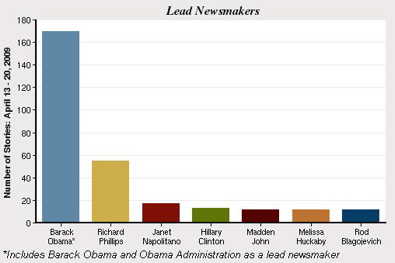
* The Pew Research Center’s Project for Excellence in Journalism publishes a weekly study of various aspects of news coverage, including leading newsmakers. Here is an item from this week’s report…
From the narrative…
The battle for fifth-leading newsmaker (1%) was a tie between three very different types of celebrities. They included retiring pro football announcer John Madden; Melissa Huckaby, the woman charged in the murder of eight-year old California girl Sandra Cantu; and indicted former Illinois Gov. Rod Blagojevich, who reportedly plans to ask a judge to allow him to travel to Costa Rica in order to be a contestant on the TV show, “I’m a Celebrity…Get Me Out of Here!”
With Blagojevich, reality is even stranger than reality television.
Tell me about it.
Blagojevich’s rating may go up this week, depending on the judge’s decision today. As you probably already know, Blagojevich has a court hearing today…
Tuesday’s hearing in Chicago comes one week after the ousted former governor said he wants permission to go to Costa Rica to take part in a reality TV show set in the jungle.
A more pressing matter is how much of his campaign fund U.S. District Judge James B. Zagel will let him use to pay his lawyers.
Apparently, they’re having yet another media circus at the federal building. More later.
* SEIU recently conducted a poll of Chicagoans. One of the areas the union’s pollster asked about was local city services. Click on the pic to see a better image of the results…
* The Question: Rate your own local government on those same criteria: Trash collection, snow removal, crime prevention and street repair.
* One of Gov. Quinn’s problems is that he likes to appoint friends to important posts instead of searching around for the best possible person. He did that with his completely inexperienced State Police director, among other positions.
At first, I thought Quinn’s appointment of his longtime friend and former personal physician Dr. Quentin Young to chair the horribly corrupt Illinois Health Facilities Planning Board wasn’t a bad move at all, despite the obviously disturbing trend about putting buddies into important slots. Young is widely respected and may have done a good job over there.
But another big problem with Quinn is that he’s not yet ready for prime time, partly because he often doesn’t do all his homework. Which leads us to this story, which combines both problems into one…
Dr. Quentin Young has withdrawn from consideration as chairman of the Illinois Health Facilities Planning Board, citing a potential conflict of interest.
Young, a former top official at Cook County Hospital and longtime advocate of health-care reform, “voluntarily withdrew his appointment upon discovering that his former medical group practice had partial ownership in a property that leases space to a health-care provider,” a spokesman for Gov. Quinn said.
* This story about vinyl chloride in south suburban Crestwood’s drinking water is pretty horrific. You can read the initial Tribune piece by clicking here if you’re unfamiliar with the situation. Here’s today’s Tribune update…
In a statement released Monday, Illinois EPA Director Doug Scott said “the public’s health never was at risk” because the well water was diluted with treated Lake Michigan water. But one of the chemicals found in Crestwood’s well, vinyl chloride, is so toxic that the U.S. EPA says there is no safe level of exposure.
Crestwood told state regulators in 1986 that the village would get all of its tap water from Lake Michigan and would use the well only in an emergency. But records show Crestwood routinely kept drawing well water, relying on it for up to 20 percent of the village’s supply some months.
The well was finally shut off in December 2007, after the EPA tested the water for the first time in more than two decades. The agency found not only that the well still was contaminated but that Crestwood had been piping the water, untreated, to residents. […]
Before the Tribune story in Sunday’s editions, the only public hint that something might be wrong with Crestwood’s water was an Aug. 13 news release from the Illinois Department of Public Health. In the release, the agency warns that vinyl chloride might have contaminated private wells in the area, but it does not mention that village officials for years been adding contaminated water to the municipal water supply.
Crestwood Mayor Robert Stranczek did not return calls seeking comment Monday.
His father, Chester Stranczek, who served as mayor for 38 years before his son took the post, said he could not go into details about the water supply under his administration without consulting an attorney.
“But I can tell you that it was and is being tested,” he said when reached at his home in Florida. “I can guarantee you the well was being tested regarding IEPA rules and time lines. Even more.”
The former mayor, 78, has sipped on Crestwood tap water since he was born there.
“As far as the water being contaminated I don’t believe that,” he said. “Reports showed it was drinkable. Tests that were taken never showed that we had bad water.”
That’s some serious denial.
* The Kankakee Daily Journal has an editorial today about another major problem ignored by local and state officials…
Back in 1988, a Shell Oil pipeline broke, spilling gasoline into the soil and water table in Limestone Township.
Here we are in 2009, 21 years later. County chairmen have come and gone. State governments have come and gone. The Illinois Environmental Protection Agency, surely a toothless watchdog in this case, has yet to come up with the critical solution for Limestone residents.
That would be the construction of public water lines to carry unquestionably clean drinking water to the residents of Limestone Township.
You see, once the gasoline spilled into the soil, it occurred to such an extent that the volume would not easily break down. It will remain, toxic and treacherous, for the lifetime of anyone in its path.
Back in 2007, when Shell finally settled the case, it agreed to $46 million in compensation. Part of that was slated to build new water lines. But there was no timetable for completion. Those lines were promised in 2005.
They are still not there. Nor is there a firm date when they will arrive.
* My syndicated newspaper column this week takes a look at that poll we discussed late last week…
Pat Quinn is the most popular Illinois governor in more than a decade.
A new statewide poll conducted by Rasmussen Reports found that Gov. Quinn has a 61 percent job approval rating. The poll of 500 likely Illinois voters conducted April 14th claims that Quinn’s job approval rating is five points higher than US Sen. Dick Durbin’s 56 percent “favorable” rating, and six points lower than President Barack Obama’s home state 67 percent job approval rating. The poll’s margin of error was +/- 4.5 percentage points
That’s pretty darned good for a guy who has been widely denounced for proposing a “50 percent income tax increase.”
Drill into the numbers, though, and Quinn’s support is a bit soft, or “shallow,” as the case may be.
The vast majority of voter opinion is in the muddled middle, which isn’t surprising considering that he’s only been governor for less than three months and wasn’t elected on his own. Forty-four percent of likely voters “somewhat” approve of his job performance (compared to 16 percent who said the same about Obama) and 23 percent “somewhat” disapprove (9 percent for Obama).
Quinn’s “strongly” approve and “strongly” disapprove numbers are both fairly low - 17 and 14 percent, respectively. Few truly love or hate him at this point.
The governor’s “somewhat approve” numbers are near or above 40 percent in almost every single demographic, including Republicans. An impressive 41 percent of Republicans “somewhat” approve of Quinn’s job performance. Just 21 percent of GOP voters said the same about Obama. Almost half, 47 percent, of Democrats somewhat approve of his performance (13 percent for Obama), while 37 percent of conservatives, 46 percent of whites, 45 percent of blacks 39 percent of married people and 53 percent of unmarried folks all “somewhat” approve of Quinn’s performance in office.
That softness might mean things could change in a hurry if voters decide he isn’t living up to expectations. His tax hike proposals, especially, could move numbers fast. So far, though, they haven’t, despite widespread reporting on the tax hike plan and lots of angry commentary against it. That’s incredibly good news for Quinn, at least for now.
Quinn’s “somewhat disapprove” numbers follow about the same sort of pattern. Thirty percent of Republicans, 19 percent of Democrats, 21 percent of whites and 24 percent of blacks all “somewhat” disapproved of Quinn’s job performance. Always keep in mind, of course, that margins of error in these subgroups will be substantially higher than the entire sample.
These appear to be the highest job approval ratings of any Illinois governor we’ve had since Jim Edgar left the governor’s office in January of 1999 with job approval ratings in the high 60s to mid 70s.
Former Gov. George Ryan’s numbers dropped like a rock soon after he was inaugurated because of the quickly expanding federal investigation and his flip-flop on a sales tax hike. Rod Blagojevich topped out at 55 percent in a January, 2004 Tribune survey, although he bragged at the time that his own polling showed he had a 66 percent approval rating.
People are obviously pleased with this new change in leadership, if understandably hesitant to give Quinn a full-throated endorsement.
This will also be welcome news for Illinois Democrats in general, who have been pummeled by scandal after scandal the past few years and are attempting to deal with a gigantic state budget deficit. The result will also likely embolden Quinn and possibly strengthen his hand in dealings with the General Assembly this spring.
But, like I said above, he has to be careful here.
For instance, the governor has spent a whole lot of time pointing fingers at everyone else for their ethical lapses, but has yet to issue any sort of mea culpa for his own role in Blagojevich’s rise to power. Quinn was blatantly used by Blagojevich in 2002 and in 2006 to help boost his own reformer bona fides and Quinn seemed always happy to comply.
Quinn repeatedly defended Blagojevich against charges of corruption and happily went along with the program in both the 2002 and 2006 campaigns. When it was evident to just about everyone that Blagojevich was a criminal, Quinn cheered almost every move.
He’s been able to get away with it because people (myself included) are so happy to finally be rid of the criminal ogre that we’ve been willing to cut Quinn extra slack.
* Several members of the Cook County Board signed a letter yesterday asking Cook County Clerk David Orr to call a special meeting Thursday at 10 o’clock so they could look into circumstances surrounding the mysterious firing of President Todd Stroger’s chief of staff.
Fearing that the county’s funds may have been abused, Cook County Commissioner Lawrence Suffredin (D-13th District) called on the U.S. Attorney to investigate the circumstances surrounding the firing of Cook County Chief Financial Officer Donna Dunnings.
Dunnings was forced to resign late Thursday night last week from her position as Cook County’s CFO by her cousin, County Board President Todd Stroger. It came in the wake of questionable dealings Dunnings had with another fired county employee, Tony Cole. A busboy working at Ruth’s Chris Steak House in River North, Cole was hired by Stroger when Stroger met him while having dinner there. Cole had been arrested on domestic violence charges involving an ex-girl friend and was bailed out several times by Dunnings who used undisclosed credit cards to pay the court bails.
“I am concerned about how much money might be missing. I don’t know that there is any. I have discovered over the weekend that one of these PR people Stroger hired was with Ms. Dunnings when she bailed out this individual Cole from the County Jail. She used a credit card,” said Suffredin during an interview Monday on WJJG 1530 AM’s “Radio Chicagoland.”
* Stroger’s explanation for the firing has been widely ridiculed…
Cook County President Todd Stroger explained why he fired his cousin, Chief Financial Officer Donna Dunnings, from her $175,000 job last week: for her own good and the good of the county.
When Stroger fired her, he knew the Chicago Sun-Times was poised to reveal Dunnings twice bailed her secretary Tony Cole out of jail after being arrested for violating an order of protection, and some county commissioners were planning to take her to task for it.
“All I can tell you is that I know certain commissioners were determined to drag Miss Dunnings through the mud, and I thought it was undeserved and it would not serve her or the county for that to happen,” Stroger told the Sun-Times Monday night.
Last night, Stroger acknowledged for the first time in an interview with Carol Marin on WTTW-Channel 11’s “Chicago Tonight” program a few troubling facts.
Stroger said he knew about one of Cole’s two arrests as a county employee, although Stroger wasn’t clear on which one.
He knew that Dunnings bailed out Cole in one instance, but said he did not know about the other.
And he knew that, despite all that, Cole got promoted.
Stroger acknowledged that another of his top lieutenants, Eugene Mullins, accompanied Dunnings to bail Cole out of jail — confirming a fact first reported by Chicago Sun-Times reporter Mark Konkol on the newspaper’s Web site Monday night.
The paper went on to demand answers to seven questions. Go read them all.
“President Stroger, I do want to talk about a few other things, but not until we’re done with this,” Marin said.
“We’re done now,” Stroger shot back.
Later, Marin asked, “It’s not true that the 8th Ward, which is your home ward, has a disproportionately high number of people who have been hired by the county?”
“I don’t know where you get your information, but I [bet] you couldn’t even tell me where the boundaries of the 8th Ward are!” Stroger replied.
WTTW hasn’t yet posted last night’s show online, but check back later.
*** UPDATE *** The Chicago Tonight episode is now online, and Progress Illinois has a snippit…
In the above clip, Stroger blames the Illinois State Police backlog of background checks for not knowing about Cole’s recent arrest problems.
Stroger says the background check process takes “2-3 months.” Cole appeared on the county payroll on October 14, 2008 — about six months ago. But Stroger didn’t receive the report on Cole until two weeks ago? Huh?
Mayor Daley’s $2.5 billion plan to privatize Midway Airport collapsed today for lack of financing, leaving taxpayers with a $126 million down payment, but no apparent way to shore up city pensions and rebuild Chicago’s aging infrastructure.
But, over the weekend, MidCo informed the city that it would be unable to raise the money. Instead, the consortium comprised of New York’s Citi Infrastructure Investors, YVR Airport Services Limited of Vancouver and Boston-based John Hancock Life Insurance walked away from the $126 million in earnest money it pledged.
But the bigger truth is, the city is out more than $2 billion, money that would have gone to retire debt, replenish way-underfunded employee pension funds, pay for capital projects for the 2016 Olympics, and other needs.
It’s gone. Adios. Au revoir. The $1 billion or so the city would have netted after retiring existing debt on Midway ain’t here no more.
At a City Hall news conference today, the Service Employees International Union maintained that Chicago has a $2.1 billion surplus — from tax-increment financing and by leasing the Skyway, parking meters and other assets — and should use that one-time windfall to avert layoffs and service cuts.
To bolster its case, the union revealed results of a new poll that shows voter discontent with city services and demand for “more transparency and accountability” in city finances. The union was joined by community leaders and a handful of progressive aldermen.
Denise Dixon, executive director of Action NOW, noted that the city created “rainy day funds” when Chicago parking meters were sold for $1.2 billion and the Chicago Skyway was leased for $1.83 billion.
“It’s a rainy day, but there’s a flood coming. And when the flood comes, that’s what we’re concerned about,” the mayor told reporters.
Talk about a no-brainer. Two Chicago aldermen think the public ought to know what’s going on with hundreds of millions of dollars in off-the-books property tax spending. Ald. Manny Flores (1st) and Scott Waguespack (32nd) have been trying for months to get their colleagues on the City Council to pass an ordinance requiring the city to post the details of its tax increment financing deals online.
Flores and Waguespack aren’t trying to shut down the TIF districts, which generated $550 million for the city in 2007. What they’re worried about is accountability. Because there’s so little oversight of TIF spending, those millions are basically a glorified slush fund for Mayor Richard Daley’s pet projects.
This cycle, top Democratic targets for retirement include Reps. Henry Brown Jr. (R-S.C.), Judy Biggert (R-Ill.), Ginny Brown-Waite (R-Fla.), John McHugh (R-N.Y.), Mary Bono Mack (R-Calif.), John Mica (R-Fla.), Elton Gallegly (R-Calif.) and Don Manzullo (R-Ill.).