* The Illinois House and Senate Republicans’ lawsuit against the state legislative remap can be read by clicking here. From their press release…
* The [Democratic] map violates the federal Voting Rights Act of 1965 because African Americans and Latinos have not been provided a “fair opportunity” to participate in the political process.
* The process by which the map was approved violates the Illinois Constitution because the map was not made available to the public or the legislature for a sufficient amount of time for review.
* The map violates the 1st Amendment to the United States Constitution because it dilutes the voting power of Republican voters throughout the state
* The map violates the compactness requirement of the Illinois Constitution and is less compact than the previous map and the Fair Map put forward as an alternative.
Other plaintiffs include African-American and Latino individuals, but no major groups from either of those communities. That could be significant, because the federal courts traditionally give huge weight to complaints from minority groups that feel they have been cheated of their opportunity to elect officials from their communities.
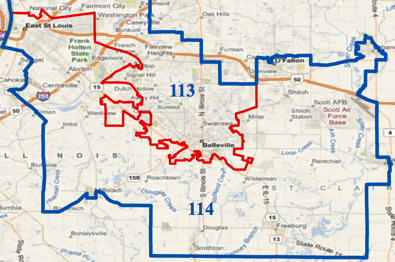
The suit contends that two new House districts, the 7th and 114th, could easily have been given a more than 50% voting-age African-American population, but were not. As a result, it says, the map creates only 16 black-majority districts, not the 18 required by results of the 2010 Census.
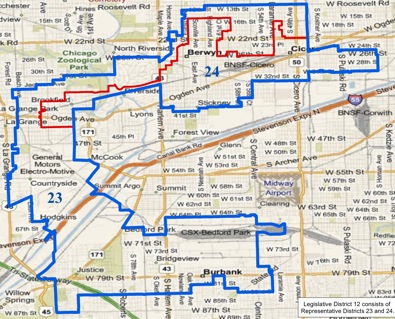
Similarly, House districts 23 and 60 could have been made Latino majority, but were not, and six other districts could easily be more Hispanic, it says, calling that failure a “gross deprivation of . . . constitutional and statutory rights.”
The suit also contends that the map approved by lawmakers last spring is “an intentional, systematic and unfair political gerrymander” designed to “protect Democratic members of the General Assembly and to prevent re-election of a Republican majority.”
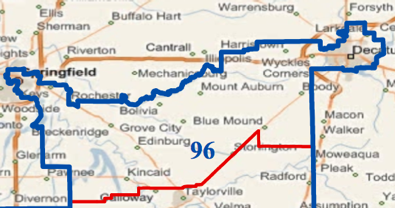
Certain of the districts in the Redistricting Plan including, but not limited to, Representative District 96, are of a shape so bizarre on their face that the shape can only rationally be understood to be an effort to separate voters into different districts on the basis of race.
No sufficient or neutral justification exists for the bizarre shape of Representative District 96.
The Redistricting Plan pits 25 incumbent Republican members of the General Assembly against one another while pitting only eight incumbent Democrat members of the General Assembly against one another, without any neutral justification for this partisan
discrepancy.
The Redistricting Plan’s pitting significantly more incumbent Republicans against one another than incumbent Democrats is a deliberate attempt to enhance Democrats’ prospects for reelection and targets Republicans to prevent their reelection. […]
…many of these bizarrely-shaped districts are clearly intended to slither across traditional lines in order to place multiple incumbent Republicans into one district. […]
The Redistricting Plan systematically and intentionally unfairly burdens Republican voters’ rights of political expression and expressive association because of their political views.
African-American voters comprise a sufficiently large and geographically compact group to constitute a majority of the voting-age population (”VAP”) in at least 18 Representative Districts.
The Redistricting Plan creates only 16 Representative Districts where a majority of the VAP is African-Americans.
The African-American VAP in the area of Representative District 114 is sufficiently large and geographically compact such that Representative District 114 could have African-American VAP in excess of 50 percent.
Representative Districts including, but not limited to, 1, 2, 21, 22, 77 and 83 could be drawn to include Latino VAP sufficient to provide Latino voters a fair opportunity to elect representatives of their choice without violating constitutional requirements.
The Latino VAP in Representative District 23 is 46.27 percent.
The Latino VAP in the area near and around Representative District 23 is sufficiently large and geographically compact such that Representative District 23 could have Latino VAP in excess of 50 percent.
* An independent arbitrator has ruled against Gov. Pat Quinn’s decision to nullify contractual union wages for state employees…
Arbitrator Edwin Benn on Tuesday ordered Quinn to start paying the 2 percent increase within 30 days with back pay. That’s according to a copy of Benn’s opinion provided by the American Federation of State, County and Municipal Employees.
Quinn had said the Legislature did not appropriate the $75 million necessary to pay the employees in 14 state agencies.
…as a matter of contract, the State’s position that it is not obligated to pay the reduced negotiated increase is clearly incorrect.
* However…
Because I am an arbitrator functioning solely under the terms of the Agreement and the Cost Savings Agreement, I have not considered the State’s statutory or Constitutional arguments.
So, this was a slam dunk case for the union. The contract says pay the raises, and the arbitrator’s decision is confined solely to the contract’s language. Pretty simple. The union had basically no chance of losing that one.
* The arbitrator did take up the governor’s logic that since no money was appropriated for the contractual raises, he doesn’t have to pay them…
Multi-year collective bargaining agreements bring stability to the parties and the public. Multi-year collective bargaining agreements set forth the parties’ obligations and responsibilities over a period of years.
It is mostly employers who seek multi-year collective bargaining agreements (typically longer agreements than those sought by unions).
If the State is correct that negotiated wage increases in multi-year collective bargaining agreements are unenforceable or are contingent upon action by the General Assembly (or, for other public entities, the various county, city, village, district councils, boards of trustees, etc.), it is quite likely that very few unions, if any, will now ever agree to multi-year collective bargaining agreements.
If the State is correct in its position, I highly doubt that any interest arbitrator setting terms and conditions of collective bargaining agreements in security employee, peace officer and fire fighter disputes under Section 14 of the IPLRA will choose to impose anything more than a contract for one year’s duration because final economic offers made by a public sector employer will, for all purposes, be illusory if those offers are contingent upon subsequent appropriations being passed by the public employer.
Very good points. If Gov. Quinn prevails in the courts, multi-year public union contracts will likely never be used again…
If the State is correct in its statutory and Constitutional arguments, the multi-year collective bargaining agreement is, for all purposes, probably dead.
* Meanwhile, Gov. Quinn said he’d make good on his NFL Championship game bet with Wisconsin Gov. Scott Walker…
.
Quinn told reporters during an unrelated news conference Monday that he’d pay up before the new season.
In a move that caught some DuPage County GOP foot soldiers by surprise, Chairman Dan Cronin resigned as Republican Party leader late Monday.
The party’s executive committee, which consists of nine township political leaders, unanimously voted in state Rep. Randy Ramey as his successor.
Rep. Ramey is former Senate President Pate Philip’s stepson. Pate was also county party chairman back in the day and now Rep. Ramey is gearing up for a state Senate bid.
Illinois Gov. Pat Quinn will head to Israel next week on an education mission paid for by the Jewish United Fund of Metropolitan Chicago, his office said Thursday.
Quinn leaves Monday and will spend about a week in the country, a close U.S. ally that many American politicians have visited.
His absence means a very low chance of drama and newsworthy events, so, I’m gonna shut down the blog and take a break. Capitol Fax will be published on Monday, but that’ll be it for a week or so. I’ll try to post any big stories that might pop up, but I could use some down time.
* Monday, July 25th is our annual White Sox outing, so anyone who has won tickets needs to contact me before then - even if you’ve contacted me already. Thanks.
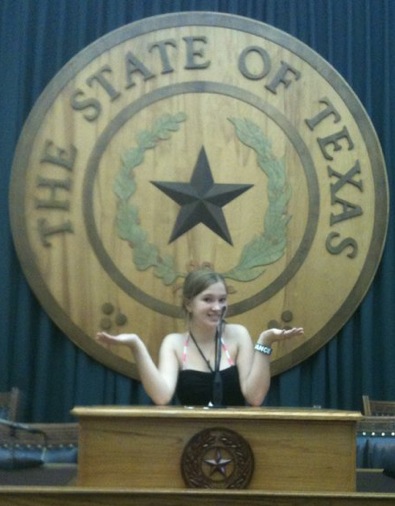
* Allow me a brief personal aside. This is my niece, Reagan Miller, possibly a future president or Texas governor…
* Get yourself a cold drink, find a shady spot, and let War play us out…
When you feel those balmy breezes on your face
Summertime is the best time any place
* A friend of mine told me the other day that Rod and Patti Blagojevich were actively looking for a Chicago condo. Turns out, she was right. They have their house up for sale, but I’m not sure how they can sell it when it’s being used as collateral for Rod’s bond…
A federal judge today set bond at $450,000 for former Gov. Rod Blagojevich and ordered him to post his North Side house and Washington condo as collateral despite the defense declaring that the Chicago residence is up for sale.
* Prosecutors had asked for a million dollar bond. No luck…
“I understand the symbolism of a million dollars, but $450,000 is enough,” Zagel said.
The former governor and his wife said they had about $600,000 in equity in the two properties.
U.S. District Judge James Zagel then called Blagojevich and his wife Patti before him to issue the standard warning that they could lose both properties if the former governor violated bond conditions.
“I have no intention of violating the bond,” Blagojevich said.
Just like he had no intention of violating his oath of office?
* Prosecutors claimed earlier this week that they hadn’t received all the necessary paperwork on the two properties, but that’s supposedly all settled. Also, the judge barred Blagojevich’s attorneys from talking with the jurors for now.
Mayor Rahm Emanuel said he will send lay off notices to up to 625 city employees today he tries to close a $30 million budget hole.
Custodians, call center operators at the city’s water department and seasonal workers at the Department of Transportation will be among those affected.
Emanuel said he will close an entire $30 million budget hole left by the expiration of a deal with City Hall labor unions for unpaid days off. The mayor previously had turned up the pressure on unions for concessions or cost-cutting ideas at a series of news conferences.
* But is this for real? Are these 625 city jobs going to immediately disappear, or is this yet another delay to the threats he’s been issuing for weeks? Read all the way to the bottom of the Sun-Times story and you’ll see the answer…
Last week, the mayor turned up the heat on labor by pinpointing three of the nine work-rule changes he is seeking. They are: time-and-a-half for overtime, instead of double-time; a 40-hour work week, instead of 35 hours and straight-time for prepping a vehicle at the start of a shift instead of time-and-a-half.
Those three changes alone would save the city $3.2 million and spare 200 union jobs, the mayor said.
The layoff notices still give union leaders 30 days to come around.
If they agree to those three reforms and select $6.8 million more from the mayor’s $19 million list — or pinpoint an equivalent amount of savings elsewhere in the budget — then the immediate crisis would be averted. At least until Round Two. [Emphasis added.]
The labor unions reportedly intend to talk this over on Monday.
* Here are the work rule changes demanded by the mayor…
* Instead of double overtime, the city would pay employees time-and-a-half;
* For prep time, city employees would receive their regular pay, not overtime pay;
* Workers would be expected to work a 40-hour week, not a 35-hour week
* Workers doing the same job would receive the same pay, no matter what union they belong to;
* Salaried employees will receive the same number of sick days and holidays as hourly employees;
* The city would eliminate rate differences for driving different vehicles;
* Rate differences for operating different non-vehicle equipment would be eliminated;
* A worker who works alone on a truck will not receive more pay than if he or she works as part of a crew; and
* Union apprenticeship programs would be enhanced to achieve cost savings.
* And here are the items announced today…
* Custodial services at the airports and libraries will no longer be provided by city workers, but rather by the companies that currently services the rest of the city;
* There will be a 75 percent reduction in the seasonal workforce at the Chicago Department of Transportation, which will mean 61 fewer blocks of curb and gutter improvements and the repair of 76 fewer blocks of sidewalk this year;
* The city’s benefits services will not be managed by the city, but rather by a professional benefits management company; and
* The city’s water bill call center currently has an average wait time of 20 minutes, and 40% of callers hang up before being helped. The service will be outsourced to realize savings and increase efficiencies for Chicago’s taxpayers.
These steps, which may impact up to 625 jobs, will result in a savings of $10-12 million over the remainder of this year.
Also, notice that the press release says the cuts “may impact up to…”
*** UPDATE 1 *** From Charles Thomas’ Twitter feed…
Big trade unions from whom #Rahm wants work rule changes go untouched by layoffs. Low-paid workers take hit.
*** UPDATE 2 *** From AFSCME Council 31 executive director Henry Bayer…
“Mayor Emanuel’s announced intention to lay off 625 employees will diminish the availability and quality of city services on which Chicago residents depend. It will also increase the ranks of the unemployed, raising Chicago’s already too-high jobless rate.
“We are surprised and disappointed at Mayor Emanuel’s scattershot approach to the city’s budget shortfall. We are particularly disappointed that most of his bullets are aimed at frontline employees who do the real work of city government.
“The vast majority of city employees are out there every day giving their best efforts to the wide array of jobs that are essential to meeting the needs of Chicago’s citizens.
“Contrary to Mayor Emanuel’s claim, neither he nor his representatives have ever made any attempt to meet with our union to negotiate changes to work rules affecting AFSCME members. If the mayor were serious about attempting to change any work rule, he would have taken the appropriate measures to engage in such discussions. The fact that he has never done so is clear evidence that his attempt to blame union work rules for the city’s massive deficit is mere public relations gimmickry.
“AFSCME has been working closely with the Chicago Federation of Labor in an effort to conduct a serious review of city operations based on direct input from frontline employees. We intend to develop recommendations that have the potential to effectuate real cost-savings while actually improving service delivery. We will continue in that endeavor, despite the Mayor’s irresponsible actions today, because we believe it is the best way to make Chicago the city that works even better. In that spirit we call on the Mayor to rescind his layoff threat and work collaboratively to reduce costs while protecting city services and jobs.” [Emphasis added.]
*** UPDATE 3 *** From the Chicago Federation of Labor….
We are perplexed by the decision of Mayor Emanuel to announce layoffs and the further privatization of city services today.
We are greatly concerned about the 625 families and workers who did nothing wrong and did nothing to create the budget deficit we faced two years ago as well as today.
I want them to be assured that their union leadership will fight for them, their rights and their jobs.
Mayor Emanuel asked us to be a partner and come up with ideas to save the city money through identifying efficiencies in government operations.
We took him at his word and agreed to help.
The unions representing workers at the city have been operating under good faith to develop ways to make the city and its departments operate more efficiently and provide better service to taxpayers.
We believe the Mayor is serious about and committed to making the city run better and more efficiently and we share his urgency.
That is why we have taken the extraordinary step to hire expert budget analysts to help develop ideas in a way that will be useful to the Mayor and his to team.
But before we balance the budget on the backs of working people, we should look at better ways to run city government.
City workers have shared the sacrifices over the last few years.
Mayor Emanuel’s decision to layoff as many as 625 workers today is unfortunate for the city, it’s unfortunate for the people who rely on city services, and it’s unfortunate for the labor-management process.
We notified the Mayor earlier this week that our report would not be ready today, and he accepted that. It will not be ready Monday, either.
We aren’t stalling. We are serious about this process and we want to do it right. This issue is too important to the city and the taxpayers to do things half-heartedly.
Mayor Emanuel presented some facts this morning that need correction:
There have been no negotiations over work rule changes.
When Tom Villanova and I met with Mayor Emanuel, we were presented with ideas—less detail than you were given today.
In fact, before he mentioned his desire to share his ideas, we made it clear that if he wanted to negotiate these, his team needed to reach out to the authorized individuals and adhere to the contractual process.
That process did not begin until the end of the day Tuesday when a few phone calls were placed.
Another point of clarification:
There have been no deadlines given by the city.
June 30 was never a deadline to us.
We didn’t agree to extend the furlough agreement, and the city never presented it that way.
July 15 was never a deadline for presenting our efficiency ideas.
There is no doubt that labor and management can–and should–come together in ways to save the city money.
We have already demonstrated that through the LMCC—the Labor Management Cooperation Committee.
Since its inception, the LMCC has led to roughly $78 million in savings in health care for the city and its sister agencies. $20-30 million of that savings goes toward the city.
The apprenticeship program is another way we can save money, bringing work back in house where it can be done cheaper, and create job opportunities throughout our communities.
This is an idea labor brought to the city three years ago but it declined to move forward.
We’re not looking for credit. The Mayor can take the credit. We just want to help the city save money and people save jobs.
For too long, mismanagement and scandal have plagued City Hall and put taxpayers in a difficult position.
That’s why Mayor Emanuel’s decision to lay off these workers and privatize services without really engaging in the process is both perplexing and disappointing to all of us.
When there’s a fire, you don’t pour gasoline on it. You pour water on it.
We’ve shared the sacrifice. We’re willing to be partners. But this is no way to treat a partner.
They left out a couple of zingers from their story, including these about the General Assembly…
“They don’t want a good regulatory board to interfere with their nonsense.”
“I’m trying to represent the people. I don’t know who they represent.”
Ouch.
* Chairman Jaffe also claimed this change was made to existing law…
“We can’t fingerprint anybody to check their background [at racetracks]… And you can be assured that they’re trying to sneak that in now, so they can do it with regular gaming later.”
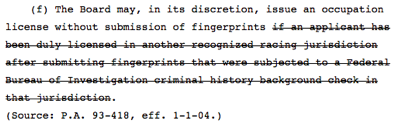
That’s absolutely not true. The Racing Board has always had discretion to waive fingerprint requirements. The new proposal deletes the requirement that waivers could be given only to applicants who’ve undergone FBI background checks for licensure. Sen. Terry Link explained the proposal this week…
SB 744 allows the Illinois Racing Board to waive fingerprints in its discretion, but it does not do away with fingerprinting. Under current law, the Illinois Racing Board is required to obtain fingerprints from all horse owners. Illinois is fortunate enough to have hosted high-level races that included horses owned by international dignitaries. However, the way current law is drafted, a horse owned by the Queen of England cannot race in Illinois until Her Majesty the Queen has submitted her fingerprints. SB 744 gives the Illinois Racing Board discretion to waive the fingerprinting requirement in such circumstances.
I’m not sure if that’s everything involved here, of course, but Jaffe’s statement is still false on its face. If he had actually read the bill, he wouldn’t known this because it’s pretty darned clear in the legislation…
*** UPDATE 2 *** ISN has also posted Rep. Lou Lang’s complete interview…
State Sen. Terry Link, D-Waukegan, points to Jaffe’s criticism of legislation that would allow for five new casinos in the state and the slow roll-out of video gambling that was passed back in 2009.
“We have a gaming board that is clearly anti-gaming,” Link said.
Link added that Jaffe has used his position as the state’s top gambling regulator to take a personal stand.
“It’s his job to regulate Illinois gaming industry,” said Link. “It’s not his job to preach.”
But Jaffe said he is doing exactly what he’s supposed to be doing.
“I’m not pushing for anybody or anything. I’m trying to protect the public interest,” Jaffe said. “If lawmakers think they’re representing the public interest, I don’t think they know what they are talking about.” […]
Jaffe said Lang, Link and other critics in the statehouse have questions about their own fairness to answer.
“I don’t know whether they’re acting as legislators, or they’re acting as lobbyists,” said Jaffe. [Emphasis added.]
If Jaffe is reappointed, don’t expect him to survive Senate confirmation. Back in 2009, he said the Gaming Board would probably need a police force the size of the Illinois State Police or the City of Chicago’s to adequately monitor video gaming in taverns…
He touted a plan for high-speed rail from Chicago to Champaign, which he said could become “a Chicago suburb,” just 50 minutes away by high-speed rail.
Yes, the governor actually said that Champaign could be a Chicago suburb. He was even asked whether he thought Champaign wanted to be a suburb…
* Gambling regulator again slams gaming bill: “Look, the way the legislature did it was terrible, ” Jaffee said. “They passed it on the last day. Nobody knew what was in it.”
* Mayor predicts Quinn will sign gambling bill, but gov won’t say
* Emanuel ducks gambling chairman’s criticism of Chicago casino bill
* The governor’s office has been implying privately for days that they did try to talk to AFSCME about avoiding a confrontation over their members’ contractual pay hikes. I asked AFSCME for a statement and this is what I received…
To imply that they tried to engage us in any meaningful sense at any point in the budgetary process is simply not accurate. In fact, during the legislative session, we more than once reached out to the budget office but never heard back.
Then, well after the session ended—just a few days before the Governor amendatorily vetoed more than $300 million out of it—Dave Vaught, director of OMB, and Robb Craddock, CMS Labor Relations Chief, came to meet with AFSCME officials. They asked us to share any ideas we had concerning the budget, and we made some suggestions.
They bemoaned the inadequacy of the budget adopted by the General Assembly and suggested that the state employees forgo their scheduled pay raise to help address the situation. When AFSCME leaders said that our members had already deferred raises and should not have to forgo those now scheduled, they appeared to accept that.
They never indicated at any time that they believed the Governor lacked the legislative authorization to implement the pay raises or that he was considering rescinding them.
* The governor’s people are also pointing to this end of session report by House GOP Leader Tom Cross as evidence that everybody should’ve known weeks ago that this problem with the contracted pay raises was real…
As we wrapped up the regular spring legislative session this week, Illinois House Republicans drove the General Assembly to a balanced budget by only allowing the Governor to spend money that we estimate we will receive in revenues next year. That number is $33.2 billion—any dime we receive above that number will go to pay down our backlog of bills.
Our spending level is $2 billion less than what Governor Quinn wanted to spend and $1 billion less than what the Illinois Senate originally wanted to spend. […]
In a bipartisan way in the House, we eliminated hundreds of millions in raises for state workers, cut grants, reduced travel lines for state agencies and reformed the Medicaid system saving taxpayers millions of dollars. [Emphasis added.]
It’s truly amazing to me that reporters who covered this House Republican demand seem now to have completely forgotten about it.
* Even so, the unions claim Quinn had alternatives…
But the unions say other budget-saving measures could have been taken, including using hundreds of millions of dollars in unexpended appropriations, slowing the procedure for filling vacant positions, or imposing a freeze on filling vacant positions and transferring funds for personal services.
The state is notifying all 211,000 participants in the Illinois Cares Rx program that they either will be paying more for their drugs beginning Sept. 1 or are being terminated from the program.
However, about 5,700 recipients have mistakenly been sent letters telling them they no longer qualify for the drug assistance program because they no longer meet income eligibility limits.
The Department of Healthcare and Family Services is in the process of sending that group new letters stating that they do, in fact, still qualify for the program.
The bypass leading to O’Hare Airport’s west side needs to be built and tolls on Illinois tollways ought to be raised to pay for it, an advisory council said in its report Thursday.
“In order to have good roads, you have to pay for them,” Gov. Quinn said as he accepted the report from the council he commissioned in October. “We have to invest in something important that creates jobs. Transportation is our competitive advantage.”
The council concluded the road granting western access to O’Hare could create 65,000 permanent jobs and relieve congestion in the western suburbs.
Reduction in congestion will save motorists $145 million a year, the council concluded. But money for the $3.6 billion project has to come from somewhere, said DuPage County Board Chairman Dan Cronin.
A state university in Peoria involves “many questions that need to be answered” but should be explored, said the director of the state agency in charge of reviewing and determining the fate of new university program requests.
George Reid, executive director of the Illinois Board of Higher Education, said Wednesday he had been unaware of Peoria’s interest in making a four-year state university a “high priority” for the city, adding that now is “not the best financial time to establish a new institution” with the state struggling to pay its bills.
He said he was caught by surprise by the attention last week surrounding the City Council’s wishes to have the exploration of a setting up a public university placed as a city priority.
“We know many of the existing colleges and universities already have a debt owed to them (from) the state in the hundreds of millions of dollars,” Reid said. “If there is a way to (establish a new university) that wouldn’t add to that burden, we’d certainly want to investigate that and give it a fair reading.”
* Related and a roundup…
* Feigenholtz lauds state budget bill but says there’s more to do: “I’ve chaired the Human Services Committee for a decade and this year was the first year that I actually got to do the budget,” Feigenholtz said. “We kind of turned the process upside down.”
* Study Reveals Black Nursing Home Residents More Likely to Develop Bed Sores
* Editorial: No middle ground in foster care lawsuit