* The House passed the human services appropriations bill today, which cuts hundreds of millions of dollars from this year’s spending. The vote was 83-25-2.
The House has now finished passing its budget bills, and Speaker Madigan congratulated his chamber this afternoon for taking on the very difficult task of handling these budget cuts on their own, without the usual end-of-session, back-room negotiations between the leaders and the governor. As Madigan pointed out, this is the first time a budget has been crafted by the approp committees since 1991. Before that, one chamber would handle half the budget and the other chamber would take on the rest. Watch…
As I write this, the Senate is voting on its approp bills as well. No Republicans are voting for the bills, complaining that the legislation hasn’t been heard in committee. They make a valid point, but it’s not like they were going to vote “Yes” anyway.
* The Question: Do you think Speaker Madigan is training his members to act on their own because he might be planning to retire? Or, do you think Madigan is doing it this way for the first time ever because he knew he couldn’t negotiate a spending-cut budget with Gov. Quinn and President Cullerton and then convince his more liberal members to accept it? Or is it something else? Take the poll and then explain your answer in comments, please.
*** UPDATE *** Sorry. I screwed up the code and had to dump the poll. You may also have to clear your browser cache because when I did the new poll, I kinda screwed it up as well. Sheesh. Friday the 13th. Vote again, please…
* All of this site’s current advertisers are stirring things up in Illinois. For instance, I received this same robocall the other day, which offers to connect you to your state legislator…
State Rep. Dan Brady, R-Bloomington, is among those targeted by the phone campaign. His office has been flooded with about 100 calls a day this week from people who were contacted by a group called “Illinois Is Broke.”
Brady said some people believe he’s the one initiating the calls.
“They think this is coming from my office. It’s not,” Brady said. “I have nothing to do with it. They are extremely misleading.” […]
Like Brady, state Rep. Mike Bost, R-Murphysboro, said his office phones have been clogged by callers on both sides of the pension question.
“They are running people scared,” Bost said. “This is pretty extreme stuff.”
In Illinois, where pensions have been underfunded for decades, Democratic House Speaker Michael J. Madigan says it’s time to consider cutting benefits. Senate President John Cullerton, also a Democrat, is backing a bill to make retirees pay a bigger share of premiums for health care and to force school districts to shoulder more of the teacher-retirement costs. Republican Governor Pat Quinn has said that he would prefer negotiating with unions to win concessions, but has not threatened to veto legislation to cut benefits. Lawmakers may act before the legislative session ends on May 31. “We paid our share for the pension, and the politicians did not put in their fair share,” says Kathy Reno, 55, a certified nurse’s aide at the state-run LaSalle Veterans Home, who makes about $38,000 a year. “Why should we be punished for something they didn’t do?”
To fight the proposed changes, a coalition of public and private labor groups called We Are One Illinois has launched a $1 million ad campaign. “All I have is the pension I paid for,” says one voice in a 30-second spot featuring a firefighter, teacher, and police officer. “But the politicians broke their promise, failed to make payments. And now they want to punish me for their mess?”
The battle over reshaping the way Central Illinois families and businesses are charged for electric and natural gas service is coming down to the wire with no clear winner in sight.
At issue is House Bill 14 in the state legislature that would allow Ameren Illinois and Commonwealth Edison to receive annual delivery cost rate hikes for electricity and natural gas that would be subject to review only after they go into effect. […]
But the bill’s stance may be undergoing some voltage fluctuations. An amended version is in the works that apparently would make the bill more palatable to the governor and other critics. This tweaked version wasn’t made public as of Thursday, but opponents already fear it will offer only cosmetic alterations in an attempt to make Quinn put down his veto pen. […]
Ameren counters by saying the critics are misrepresenting how the new delivery fee system would work. It said the proposal would be more efficient than the present system, which dates to the 1920s, and ensures a more reliable and timely revenue stream for utilities to recoup their costs and investment. But the company said that does not mean it gets an blank check to charge whatever it wants.
Though the state ranked second in most new wind added in 2010, Illinois wind farm development could come to a halt this summer.
According to the American Wind Energy Association, the state’s industry faces a substantial financial hurdle if Illinois’ in-state preference expires as scheduled June 1, 2011.
The in-state preference requires the Illinois Power Agency, which is responsible for meeting the state’s rising requirement to use electricity from renewable sources, to procure that electricity from facilities located in Illinois. Only if such in-state power is exhausted can the IPA buy from outside, first from states that adjoin Illinois, then from elsewhere.
“If the General Assembly does not extend the geographic preference, the industry could lose momentum,” said Brad Lystra, director of the AWEA. “If developers can’t finance projects, then we can’t put shovels in the ground.”
We have grown incredibly weary of the casinos’ whining about having to operate within the laws of this state. In fact, Illinois went to great trouble to change its laws 20 years ago to allow casinos to operate here at all. The state has done nothing in the years since but make it easier for the gambling industry here.
The Illinois Clean Indoor Air act protects all employees and patrons of businesses in Illinois. That includes those in casinos. This is a public health issue, not a money issue.
* And SEIU Healthcare’s ads against cuts to various state programs were recently scrutinized…
“(But) because it’s so removed from the outcomes, groups are usually reluctant to take that kind of effort, to put those resources in that kind of effort, when it’s much more direct for them to send their lobbyists over to talk to a public official,” Morrison said.
These messages sometimes lose focus.
“Advocacy groups are often times providing information in a way that is advantageous to their organization and loses the broader context,” said Philip Habel, a professor at Southern Illinois University in Carbondale.
SEIU Healthcare is advocating the state’s Community Care Program, Childcare Assistance Program and the Home Service Program be fully funded. And the advertisement campaign will play a part in getting that done, Seibert said.
“Every other state has some kind of regulatory scenario,” [SAF Executive Vice President Alan Gottlieb] noted. “Even in Wisconsin, where there is no concealed carry statute, the state attorney general has recognized that open carry is legal. Only Illinois makes it statutorily impossible for average private citizens to carry firearms for self-defense.
“Whether Illinois lawmakers like it or not,” he added, “the Second Amendment right to keep and bear arms is the law of the land. A complete prohibition simply does not pass constitutional muster. The state cannot stick it’s head in the sand and pretend this problem does not exist..”
* The lawsuit contends that the state’s “Unlawful Use of Weapons” statutes are unconstitutional because they “prohibit otherwise qualified private citizens from carrying handguns for the purpose of self-defense.” More…
Plaintiffs do not seek to establish how the State of Illinois should regulate the carry of handguns in public. For example, Plaintiffs do not seek to establish that the State should enact a licensing program, or any particular licensing program, nor do Plaintiffs contend that the State should in some other manner amend its laws.
Rather, Plaintiffs seek to establish that the recognition and incorporation of the Second Amendment – the right to possess and carry weapons in case of confrontation – renders the State’s present regulatory choice unconstitutional. Whatever the contours of a constitutional scheme might be, the Second Amendment renders a ban on carrying guns impermissible.
In reality, the maps are drawn and the month of May 2011 should be devoted to real transparency in the redistricting process
The coalition has been claiming for a month or more that the maps are done. They’re not. There’s lots of activity going on right now. Boundaries are still changing.
As subscribers know, a large group of Democrats just got their first look at the proposed new map boundaries yesterday. Subscribers also know approximately when the maps will be released. But I can tell you that the maps are not yet finished. Members are still tweaking them.
Aiming to ensure its voice isn’t drowned out by the Democratic-controlled state House, Senate and governor’s office, the party has filed a lawsuit challenging the constitutionality of the way the political lines for congressional and General Assembly districts are drawn.
The lawsuit, filed by Illinois GOP Chairman Pat Brady of St. Charles and the Illinois Republican Party in Springfield Wednesday, asks the Supreme Court to declare the tiebreaking provision of the politically prickly redistricting process in violation of the state’s constitution, and stop the General Assembly from completing the redistricting process until the court makes a decision.
“Drawing a statewide map by a method involving random chance deprives the plaintiffs a republican form of government,” the lawsuit reads. […]
“The map that Democrats produce will surely favor them and it’s not the result of a transparent process,” said [Brien Sheahan, general counsel for the Illinois GOP].
The lawsuit says nothing about the current process’ transparency. It’s about the tie-breaker provision. Actually, it’s about convincing the Illinois Supreme Court to delay the remap process until after the end of May, which would mean that the map would require a three-fifths majority (read: Republican votes).
One of the governor’s other priorities is approval of a new, fair, legislative map. Lawmakers have presided over hearings in both chambers for the past few weeks to take testimony about what the new maps, which are redrawn every ten years, should look like.
“We want to make sure we don’t have lines drawn that look like they were drawn by somebody who’s majoring in Egyptian hieroglyphics,” said Quinn, addressing a gathering at Western Illinois University. “That’s happened, I guess, elsewhere. But we don’t want that to happen in Illinois.”
* Tribune editorial: Let’s see the map: Here’s the thing about that May deadline: It’s baloney. The constitution gives the General Assembly until June 30 to pass a map before a bipartisan commission takes over. Once the regular legislative session ends, though, it takes a supermajority to pass a bill. The Democrats don’t have that many votes. That’s what the May 31 deadline is about. Revealing and voting on the map at the last minute will show that keeping Republicans out of the drawing room is far more important to Democrats than letting the public in.
* Press release: Broad Coalition submits “fair and inclusive” legislative map to Illinois House
The House plan would challenge the unions representing state employees, said Rep. Frank Mautino, D-Spring Valley. He said the budget won’t contain money for raises that were promised in the latest contract.
Mautino, a House leader on budget issues, said the unions can agree to give up their raises or agencies would run out of money and have to cut [positions].
AFSCME has a “no layoff” agreement with Gov. Pat Quinn. So, the state would have to eliminate positions instead of just laying people off.
AFSCME said its analysis of the proposed House budgets show significant cuts in personnel spending in a variety of areas. The departments of Corrections, Children and Family Services and Healthcare and Family Services all show reductions in personnel expenses of 6.5 percent to 7 percent. Cuts in the Department of Human Services range from 10.4 percent to 21 percent, depending on the division.
“Those cuts are much, much more than the scheduled pay increase for this year,” said AFSCME spokesman Anders Lindall.
AFSCME agreed to defer some raises called for in its contract negotiated three years ago. Union employees are now scheduled to receive a 2 percent increase on July 1, another 1.25 percent on Jan. 1 and a final 2 percent Feb. 1. The annualized increase is 3.5 percent, AFSCME said.
“It’s disgusting for these politicians to blame hard-working state employees who have already given up pay increases and unpaid furlough days,” Lindall said. “The politicians are trying to divert focus from what is a deeply irresponsible budget, maybe the most reckless budget plan ever introduced in the state of Illinois.”
The Illinois House Human Services Appropriations Committee is proposing a $463 million payment reduction of Medicaid to hospitals for next year’s budget. But the Illinois Hospital Association is offering an alternative – why not delay reimbursement payments than making deeper cuts?
“The state could extend the payment cycle rather than do cuts across the board,” said Howard Peters, executive vice president of Illinois Hospital Association. “Hospitals would rather be paid timely payments, (and it’s) better to be paid late than taking inadequate payment, because the Medicaid program is already paying less than the cost to deliver Medicaid care.”
Hospitals are familiar with delayed Medicaid reimbursements. Illinois’ Medicaid backlog bill is $448.6 million with the oldest bill dating back to Jan. 3, said Brad Hahn, spokesman for the state’s comptroller’s office. Illinois’ total backlog of unpaid bills is hovering around $4.5 billion for the same period.
“It’s not a new notion that the state would pay slower,” Peters said. “So when we say, ‘We would agree to extend the payment cycle,’ that’s been what’s more normal than a prompt payment approach.”
State Rep. Patti Bellock, R-Westmont, said the House Human Services Appropriations Committee is taking everything, including suggestions, into consideration to meet service providers’ needs.
“Well we don’t like to (delay payments) but to extend the cycle out that is what the hospitals have asked us to do rather than taking more cuts,” said Bellock, a committee member. “By extending the (payment) cycle out, (the state would save) around $250 million.”
* The complaining from local governments about proposed state budget cuts targeting them is really heating up…
In a story earlier this week, Tinley Park Trustee Greg Hannon encapsulated that outrage.
“They haven’t done their job in 20 years-plus,” he said. “So now they’re going to balance their budget on the backs of municipalities and the citizens who are already taxed too high, and then pat themselves on the back for a job well done.”
The locals not only didn’t help lobby for the income tax increase, many mayors (like Mayor Daley) publicly bad-mouthed it. That didn’t go down too well at the Statehouse. So when the Senate Republicans floated the idea of cutting payments to local governments by $300 million (almost 30 percent) the Democrats began to take notice.
“We have already shared the pain,” said Kerry Cummings, village president of north suburban Glenview. “We have already made the tough decisions.” […]
Aurora Mayor Tom Weisner said lawmakers must rein in “the culture of spending” instead of raiding funds promised to cities and towns.
“This is a transfer of responsibility for state overspending to local communities and to local taxpayers,” Weisner said. “It’s time for Springfield to clean up it’s own mess.”
They’re right that they’ve already experienced pain. Everybody has in Illinois. They’re wrong that they’ve already shared the pain at the state level other than late payments.
And, if the state is overspending, as Mayor Weisner rightly contends, then that state spending problem would logically include local government cash. It’s not a great argument.
“We either have to dip into reserves, which affects the asset performance of our reserves. Or in some cases we have to go out and borrow this money. So we’re now paying interest on this money, real interest,” he said.
Here’s a bit of lobbying advice: Never tell the General Assembly that you have cash reserves.
* Look, I don’t like this at all. Passing problems down the line is not a good way to govern whatsoever. But schools are being cut and so is everybody else. I don’t see how you can cut schools and not touch municipalities. These cuts are totally unacceptable, but these are totally unacceptable times.
* To understand union politics, you first have to recognize that it’s about politics.
Every five years, somebody is elected president of the Chicago Teachers’ Union on promises to be far more aggressive than the incumbent. Then, once elected, they have to govern. When we talk about the CTU, you have to keep those elections in mind. And the education reform bill which was sent to the governor yesterday on an overwhelming bipartisan vote is no different. Included in the bill is a provision requiring a 75 percent super-majority to authorize a strike. The CTU president agreed to it in negotiations, even though the provision applies only to Chicago. And that’s enraged quite a few of her constituents…
CTU President Karen Lewis has already gotten heat from union members about the bill. Said former CTU President Debbie Lynch, “In our opinion, this went down without a fight. … If it was me, I would have never agreed to the 75 percent threshold. Period.’’
As you already know, President Lewis used some significant language problems with the bill to rail against the entire proposal and its backers on the other side of the equation. Other than the real issues with the bill’s language, most of her comments were meant entirely for her union voters.
[House Majority Leader Barbara Flynn Currie] said she is open to passing follow-up legislation to address the CTU’s concerns about who has voting rights in a strike-authorization vote and about language in the bill that takes the pending layoff dispute out of the hands of the Illinois Educational Labor Relations Board.
But so far, Currie said, unions, business groups and reform organizations have not coalesced around a compromise.
Ken Swanson, president of the Illinois Education Association, one of Illinois’ major teacher unions with 133,000 members, said the real take-away from Illinois’ reforms was the way that all sides — lawmakers, schools, unions and advocates — worked together.
“Look at what happens when everyone can come together at the table and talk,” said Swanson. “That’s something that colleagues in other states have not been given the opportunity to do.”
Swanson also downplayed the national potential of Illinois’ reforms.
“I think the Department of Education monitors the goings on in every state,” said Swanson.
The IEA prepared its membership for the bill by explaining it throughout the process. Also, Swanson is retiring soon, so he can be a convenient fall guy.
* Teacher seniority would no longer be the sole basis on which teachers are laid off when school boards cut jobs. Instead, teacher performance and qualifications would be factors in the decision.
* Decisions on hiring and assigning teachers would be based not on seniority, but rather on who would best serve the district.
* Extra steps would be required before teachers can strike — a mediator would have to release to the public the last offers made by each side.
* The Chicago Teachers Union would need a three-fourths vote from its membership before being able to strike. Downstate, a simple majority vote of the membership would be needed, as is the case now.
* School boards could more quickly fire teachers for bad conduct or performance.
* Teachers would have to receive two “proficient” or “excellent” evaluations during the last three years of a four-year probationary period to achieve tenure. New teachers could get tenure early if they receive three “excellent” reviews in their first three years. Currently, a teacher gets tenure after four years, or is not rehired.
Illinois schools would lose $166 million in state support under cuts approved Thursday as the Illinois House passed parts of an austere new state budget.
That’s about 2.3 percent less than schools get under the current state budget. Most of the cuts would come from funds that schools use for general needs. Early childhood education also would take a significant hit, falling 5 percent.
The cuts were approved 102-12. Legislation making cuts to a wide array of smaller state agencies also was approved, and more budget bills could be approved Friday.
The budget is far from settled, however. Senate Democrats have their own ideas on how much to spend and where. So does Gov. Pat Quinn, although his budget proposal has found little support in the Legislature.
“You can only spend what you have,” said Rep. Will Davis, D-Homewood, who chaired the House committee overseeing budgets for elementary and high schools.
A key reduction calls for general state aid for all schools to be cut by around 4 percent, according to lawmakers.
The education foundation level, the figure viewed as the minimum amount of per-pupil spending, would remain flat at about $6,119, Davis said. If more money comes in later, the state could boost school spending, he added. Transportation funds would rise above the current year’s level, which had been reduced by Quinn, but it does not go up as high as in prior years that were more flush.
Early childhood education funding would drop to $325 million come July 1, which is about a 5 percent reduction, according to Davis.
* The new owners of Boone’s Saloon appear to be looking at the long term because they’re certainly not concerned about the short term. They’ve been working on that place for weeks. Word was the former Statehouse hangout would open by May 1, but that date has long since passed. Warm session nights in that beer garden have truly been missed by many of us.
And I just received a Facebook notice that the steakhouse in Vinegar Hill is reopening - on May 20th. That’s just 11 days before the scheduled end of session.
I wish nothing but the best for the owners of both establishments. But, hurry up already, guys.
* It used to be that you could find just about every session type at just a few places in Springfield. Nowadays, though, everybody has spread out. That makes my job a bit tougher because I do a lot of, um, “work” in the evenings. Actually, there’s no “um” about it. What I do in the evenings may not look like work, and some of it ain’t, but much of it is.
Where have you been hanging this session?
…Adding… In case you haven’t yet heard, the House just canceled Sunday’s session. The Senate is still scheduled to be in Sunday, but there’s a Democratic caucus this afternoon so we may know more when it’s over.
Thursday, May 12, 2011 - Posted by Advertising Department
[The following is a paid advertisement.]
…..but a wolf in sheep’s clothing is still a wolf.
ComEd and other Illinois utility companies have revamped their automatic rate hikes bill – House Bill 14 (Amendment #3). They claim the bill is now more “consumer friendly.” The reality: the revamped version of House Bill 14 is now a wolf in sheep’s clothing.
In spite of changes in the way in which rate cases would be brought before the Illinois Commerce Commission, the most troubling aspects of the bill are still in place: locking in rate hikes for Illinois consumers for a number of years; and bolstering utility company profit margins. The consumer is still on the losing end of House Bill 14
The simple fact that utility companies have revamped the bill shows that it was the wrong bill to begin with. The changes are no more than cosmetic, aimed at deflecting some of the public pressure brought on utility companies by a number of elected leaders, including Governor Pat Quinn and Attorney General Lisa Madigan, as well as consumer advocacy organizations.
House Bill 14 is still the wrong bill at the worst possible time. AARP urges lawmakers to oppose House Bill 14.
“I think you need to make the parents responsible. You’re looking at every other avenue. It’s the parents’ responsibility that have obese kids. I think you need to look at a bill to take the tax deduction away for their child if he’s obese. And in poorer families, they actually get money for their kids. I’d take that money away.”
Sen. Cultra later said it was a “tongue-in-cheek comment taken out of context - and should not be taken seriously.” To me, the video doesn’t appear to show any intended irony on Cultra’s part…
The tenor of the debate was that Republicans were mocking the [soda pop] tax and saying it would do nothing to solve childhood obesity. In light of this, it is easy to understand that Cultra was merely being sarcastic with his tax exemption removal proposal.
To back up the idea that Cultra was not seriously proposing this idea we can also note that he’s introduced no legislation to remove the tax exemptions nor begun any process to do so.
This misreported story is a perfect example of how bad our Old Media establishment really is. They look for sensation, not truth. Cultra’s joke was turned into “news” by reporters that didn’t bother to discover the real context of the remarks. Makes one wonder how often this happens, doesn’t it?
Drudge and Bill O’Reilly linked to it, Rush commented on it and Cultra’s been quoted all over the place. The New York Times’ Economix blog took it seriously, as did the, um, Big Fat Blog. And I can’t quite figure out what Kass’ column meant.
For true “tongue-in-cheek,” though, it was tough to beat Gawker…
* There’s been a lot of talk amongst the chattering classes about Rahm Emanuel’s future, even though he hasn’t even been sworn in yet. Some have suggested that he might even run for governor, which I find highly unlikely. A Chicago mayor running statewide? More than tough. Emanuel might possibly have tipped his hand in a recent magazine interview…
In an upcoming GQ interview, Emanuel omits Quinn’s job from his list of the top five chief exec jobs in the country.
† Rahm’s pick: “The president, the governor of California, the governor of New York, the mayor of New York and the mayor of Chicago. I hope I am not insulting anybody else, and if I am insulting a governor somewhere, I apologize.”
He’s probably right about that list.
* For months now, the chatterers have speculated about how Emanuel would deal with Ald. Ed Burke. Burke was just too powerful to roll, they mostly said. Maybe not…
In letting word out that Chicago Ald. Edward Burke (14th) gets to keep the chairmanship of a somewhat diminished Finance Committee in the new City Council, there’s a suggestion of civility in both Burke and Mayor-elect Rahm Emanuel that papers over what actually happened. […]
But the pow-wow at 40th ward Ald. Patrick O’Connor’s house aside, this is a lot less about two titans choosing to put their swords down than about the aftermath of a battle that’s already been won – and lost.
And have no doubt about it, Burke lost. And it was epic. That he gets to stay on as chair of the Finance Committee is not a sign of enduring power. What Emanuel is doing is letting him keep the crown while looting his kingdom.
We already know that there will be a new committee, the Workforce Development and Audit Committee, headed by O’Connor, the new mayor’s floor leader. The new committee will take over the most important thing the Finance Committee did under Burke: It will shepherd every single piece of proposed legislation to the City Council.
So it will now be Emanuel’s man, O’Connor, not Burke, who will have the power to move or kill legislation without even taking a council vote. (Yes, it has been an awesome power.)
* Meanwhile, Emanuelchose Matt Hynes as his Intergovernmental Affairs director. Some speculated when Emanuel brought Hynes into the campaign that it was simply a political move to ingratiate himself with the Hynes family. But Hynes was far more than that. And now he’s the top city lobbyist. He also has what appears to be his first win…
In the House, a sweeping education reform package moved a step closer to the desk of Gov. Pat Quinn, who has promised to sign it. The proposal would make it easier to dump bad teachers, prevent strikes and lengthen school days — a wish of Chicago mayor-elect Rahm Emanuel. The measure, which has passed the Senate, moves to the House floor.
The House did not amend the bill to make it more hostile to the teachers unions, as Speaker Madigan has been threatening to do for weeks. Getting the governor a “clean” bill is a win for Emanuel’s team. More on that topic…
The bill makes major changes to teacher tenure and how teachers are hired, fired and reassigned.
The hang-ups involve provisions affecting Chicago Public Schools, not downstate districts. The bill makes it harder for Chicago teachers to strike by requiring 75 percent of members to agree to a strike before it can be called. The CTU wants to make sure that only members of the union count when it comes to tallying such votes, not CPS personnel who fall under the CTU collective bargaining agreement and are assessed dues by the union but are not union members.
The CTU, which is a subsidiary of the Illinois Federation of Teachers, also wants to ensure that the bill’s provisions do not interfere with a case the union has before the Educational Labor Relations Board having to do with layoffs in the district.
“Since passage (in the Senate), a few cracks have developed,” said House Majority Leader Barbara Flynn Currie, D-Chicago, one of the bill’s sponsors. “There are a couple of issues upon which now there is a dispute as to whether the language actually reflects the agreements that were made. How to make those changes is still the subject of continuing debate.”
The changes will be made in a trailer bill. Team Emanuel also managed to hold up a school closure bill until they could negotiate changes…
A bill that stalled in the House, which would force Chicago Public Schools to plan ahead for school closures and capital expenditures, remains a work in progress, according to the bill’s sponsor. […]
Soto described the bill as an accountability measure created with the cooperation of Chicago Public Schools that would simply force them to establish and then follow their own policies on school closures. With Mayor-elect Rahm Emanuel being sworn in Monday, his education team wanted to take an extra look at the language, Soto said.
“Senate Bill 620 is being negotiated with (Emanuel’s) education team,” she said. “With the new administration, new education team, we’re going to be courteous and let them review the bill.”
* Yesterday’s hearing of the House Human Services Appropriations Committee was far from a pleasant event as members overwhelmingly approved several spending cuts…
A lengthy list of witnesses registered with the committee Wednesday, all of them opposed to the proposal.
“We were given the absolutely breathtaking, stunning task to reduce the budget by $1.2 billion,” committee chairman Rep. Sara Feigenholtz, D-Chicago, said. “It was a hideous task.”
The Republican spokesperson on the committee, Rep. Rosemary Mulligan, R-Park Ridge, was the only “no” vote on the appropriations, saying that she appreciated the work of the committee in rewriting the budget but that “I don’t agree with it.”
The human service agencies took major cuts, with most travel and telecommunications line items reduced by 50 percent, and most personnel lines frozen at this year’s levels. Contractual services were for the most part cut as well. Perhaps the biggest reduction was an 18.4 percent cut in funding for state-operated developmental centers and mental health facilities. Lawmakers said they wanted to make greater use of community-based facilities. In fact, grant payments to some local programs for the developmentally disabled increase under the House budget. […]
Overall, the House committee plan — which could be voted on by the full House as soon as today or Friday — contains more than a billion dollars in cuts for the Department of Healthcare and Family Services and about $650 million for the Department of Human Services.
State Rep. Sara Feigenholtz, D-Chicago, said she heard plenty of people say they wanted more from the state. In response, she restored 27 different pieces of the human services budget that Quinn zeroed out in the final draft she helped craft.
“He chose to take pharmaceuticals away from senior citizens; we put it back. He chose to take relief away through the Circuit Breaker (program); we put it back,” Feigenholtz said. “We want services and dollars and assistance to get to the people who have earned it, paid for it and worked for it their whole lives.”
Specifically lawmakers added $1.98 million for funeral and burial services for low-income families; the governor had scratched that program from his budget. Quinn also zeroed out money for the Children’s Place, a museum, and crisis nurseries that provide emergency shelter for women with babies and young children, across the state. Lawmakers added $487,500 and 100,000 respectively.
The numbers are included in budgets from the Illinois House. State senators have their own plan, both of which have yet to be voted on.
Feigenholtz said compromise is likely, but she expects a final spending plan to be close to her numbers. She said too many people worked too hard to produce what she hopes will be a “fair” budget.
The budget would extend the payment cycle for Medicaid bills from 24 to 45 days, a $500 million saving.
* Meanwhile, over in higher education, some MAP grants were cut to preserve other funding…
This draft for next year’s budget seeks to prevent the state’s Monetary Award Program, or MAP, from awarding grants to students attending for-profit schools.
For-profit schools operate as a business and receive public funds, according to Education.com. Among the for-profit schools is The School of the Art Institute and DeVry University in Chicago. The House’s proposed higher education budget, which aims to reach its $2.1 billion spending goal, also seeks to cut 1 percent in funding to universities. State Rep. Kenneth Dunkin, D-Chicago, who heads the budget committee on higher education, has said his committee found it easier to make cuts to for-profit schools, rather than deeper cuts to nonprofit schools.
Funding for community colleges, however, will not be cut and may, in fact, receive a financial bump from this proposal.
“The state of Illinois is broke,” said State Rep. Chapin Rose, R-Charleston. “I think the taxpayers would think it’s outrageous that their taxpayer money is going … basically into the pockets of private, for-profit owners of some of these colleges.”
* And in K-12, some cuts the governor proposed were restored…
Quinn made headlines and raised eyebrows in February when he suggested that the state stop paying for regional school superintendents, which totaled $12.6 million this year. The governor zeroed out that portion of the budget for next year, but lawmakers returned $11.3 million in their draft.
State Rep. Will Davis, D-Homewood, who helped craft the education budget, said lawmakers feared that doing away with regional superintendents would cost the state more than the governor’s cut would save. […]
Lawmakers also returned millions of dollars that Quinn wanted trimmed from schools’ transportation budgets. The governor wanted to spend $175 million on school buses, but lawmakers increased that to slightly less than $295 million.
Dan Cox, superintendent of the Jasper County School District, said that with gas around $4 per gallon and a fleet of aging buses, he will need every dollar he can get.
* Budget roundup…
* ADDED: Could state’s bus funding plan hurt suburbs?
* 4-H, Extension back in budget cross hairs: One version projects a cut worth $13 million, which could force layoffs and office closings throughout the state. The latest proposal comes a year after the Cooperative Extension received $7 million less in state funding, resulting in a statewide reorganization that included combining some counties into single operating units.
* Mayors tell Illinois to keep hands off tax dollars: The mayors scheduled a news conference Thursday at the Thompson Center in Chicago to discuss what they call a “hijack” of money designated for local governments. A confidential memo from Gov. Pat Quinn’s office last month mentioned keeping about $1 billion from local governments’ portion of state income tax revenue.
* The press tables at yesterday’s Senate Executive Committee hearing were both completely full. That’s not unusual. Senate Exec is a very powerful committee and as the session grows late Rm. 212 is the place to be.
But most reporters appeared to be waiting for a bill to be called which would lift the casino smoking ban. The AP ran a huge story on the hearing yesterday morning…
An Illinois Senate committee could deliberate Wednesday on a bill to allow smoking in casinos so gamblers don’t escape to Indiana, Iowa and Missouri.
Casino owners blame the bans for the loss of millions of dollars in revenues and the subsequent fall in tax receipts. The American Gaming Association estimates that about 20 percent of casino patrons smoke.
But gambling and smoking opponents say the loss claims are exaggerated and that the loopholes are bad public health policy. The Illinois bill passed the House 62-52, but faces stiff opposition from key senators and Gov. Pat Quinn.
“It’s discrimination against the people who work in casinos,” said Kathy Drea, vice president of advocacy for the American Lung Association in Illinois. “They’re saying their health isn’t worth the same as everyone else’s.”
* I didn’t play up the story much because I looked at the bill status yesterday morning to see where it had been assigned…
Traditionally, the chamber’s leader controls Exec with an iron grip. Bills go there to pass or to die based on orders from on-high. Senate President John Cullerton hates cigarettes with every fiber of his being. He once said he’d support a tax hike on cigs even if it wouldn’t raise a dime in new revenues.
Health activists say they have the votes to snuff out legislation that would allow smoking at Illinois casinos, but they didn’t get a chance to prove it Wednesday.
Sen. Martin Sandoval did not call his bill for a committee vote. The Chicago Democrat said he’s still building support by arguing the change would help create jobs.
Kathy Drea of the American Lung Association did not declare victory, but said she assumes Sandoval knows the bill would fail in the Senate.
Illinois Gov. Pat Quinn has said he opposes the exemption for casinos, and Senate President John Cullerton actually was the sponsor of the statewide smoking ban. Cullerton has said he is “wildly opposed” to making any exemptions in the legislation.
Sandoval said he thinks he can gin up enough support from Republicans and Democrats to clear committee next week, and then take it up in the full Senate.
“I have a significant number of supporters on lifting the smoking ban, and I just want to work over the weekend to continue to solidify those votes,” Sandoval said. “I never underestimate the power of the Senate president. This is his committee. Nonetheless, at the end of the day, we may be able to find a balance.”
Sandoval pointed out that the other chamber’s leader, Speaker Michael Madigan, D-Chicago, voted for the measure when it passed the House.
“If it’s good enough for the speaker, it’s good enough for me,” Sandoval said.
That bill will get out of Senate Exec if and only if Cullerton says so…
The sponsor of a proposal allowing smoking in Illinois casinos said the idea might be dead because of opposition in the Senate.
State Rep. Daniel Burke, D-Chicago, said Wednesday he thought Senate President John Cullerton would not allow the legislation exempting casinos from the statewide indoor smoking ban to be called for a vote in a Senate committee. The Illinois House already has approved the measure.
* 9:41 am - My fax service crashed this morning and it’s still not working yet. I just activated my backup system, so today’s edition will be going out soon. Sorry for the delay. In the meantime, you can read today’s subscriber-only report by clicking here and using the password. Share it with others. Thanks.
* In talking with people this week who support the recently failed concealed carry bill, I heard about a possible compromise: Allow sheriffs to decide whether or not to hand out concealed carry permits. The current legislation requires sheriffs to approve the permits after applicants successfully complete their training. The argument is that making the sheriff language permissive would mean proponents wouldn’t have to carve out counties and towns which don’t want any part of a concealed carry law. That, they say, would make Illinois a patchwork of regulations which would be difficult to follow.
The other side of this, of course, is that even if the Cook County Sheriff decides not to issue any concealed carry permits, those with permits who live in other counties could still come to Chicago with their concealed weapons, which would certainly make things confusing for the police.
* The Question: Would you support changing the concealed carry bill to make the sheriff language permissive instead of a mandate? Take the poll and then explain your answer in comments, please. Thanks.
…Adding… As always, please do not post drive-by, bumper-sticker slogans in comments. They annoy me, so come up with an original thought. Thanks.
Christopher Coleman was convicted of taking three lives, but St. Clair County Circuit Judge Milton Wharton has decided that Coleman gets to keep his.
Given Illinois’ plans to abolish the death penalty later this year, we didn’t expect the state to actually carry out the sentence. Still, we thought it would be Gov. Pat Quinn trying to explain why Coleman received mercy rather than the judge who knew the cold-blooded details of how Coleman plotted then strangled his wife Sheri and sons Gavin and Garett.
The judge said sentencing Coleman to life in prison would be the most expedient means of disposing of the case for the victims’ family. But after a two-year wait for the trial, they were much more interested in getting the full measure of justice than expediency.
Wharton said it would have been disappointing for Sheri Coleman’s family to have the governor later commute a death sentence as he had indicated he would. But having Coleman spared that sentence is also highly disappointing.
Just because the death penalty has been abolished doesn’t mean that the public debate is over. Far from it. Search Google News for Gov. Pat Quinn and the death penalty and you’ll get a whole lot of results. His name comes up all the time in stories about murder cases.
I’m not sure how long trend this will continue, but it can’t be good to constantly be associated with society’s worst of the worst. However, despite the BN-D’s editorializing, the jury struggled with this Coleman case according to the AP…
One juror, Kimberly Ferrari of Pinckneyville, told the St. Louis Post-Dispatch for Tuesday’s editions that all 12 members of the panel believed Coleman was the killer. But the nurse said several jurors initially were unwilling to convict him because the prosecution’s evidence was largely circumstantial, with nothing directly linking Coleman to the crime.
Early into deliberations, Ferrari said, jurors voted 8-4 in favor of convicting Coleman, though hours later that weakened to 7-5.
“Nothing solid or concrete, no murder weapon,” said Ferrari, who said she voted for guilty all along. “They all believed he did it. They were just trying to figure it out.”
The next day, she said, jurors shifted to 9-3, with jurors agreeing that dates listed on photographs on the cellphones of Coleman and his mistress, Tara Lintz, showed deception.
* We talked about the education budget a bit yesterday, but here’s a story that might knock your socks off. Schaumburg Township Elementary District 54 Assistant Superintendent Mohsin Dada has received three 22 percent pay raises during his contract and now makes $341,747 a year, which is $60,000 more than his boss…
Dada, who did not return phone calls seeking comment, is considered by the board to be the district’s chief financial officer and is retiring at the end of this year. He received those big raises in 2007, 2008 and 2009, which allowed him to nearly double his 2005 salary of $177,111 within six years.
Dada’s 2010 salary also made him the third highest paid public school employee in the state. […]
Board members believe they got a bargain in Dada.
“The reality is District 54 would not have had a balanced budget for the last 15 years without someone like Mohsin,” said board Secretary Karen Strykowski, who also noted she wasn’t on the board at the time Dada’s contract was negotiated. “This is the largest elementary school district in Illinois with over 2,000 employees and 14,000 students. In the private sector he would be making twice as much.”
A key reduction the panel endorsed calls for general state aid for all schools to be cut by about 4 percent, one lawmaker said. […]
The education foundation level, the figure viewed as the minimum amount of per-pupil spending, would remain flat at about $6,119, Davis said. If more money comes in later, the state could boost school spending, he added.
Transportation funds would rise to $294 million from the current $270 million, a level that had been considerably lower than in prior years, Davis said.
And early childhood education funding would drop to $325 million come July 1, which is about a 5 percent reduction, Davis said.
In the Springfield School District, a 4 percent reduction in state aid would cost the district about $1.4 million, said spokesman Pete Sherman.
“We’re already considering cuts to break as even as possible for our next fiscal year’s budget while at the same time going through collective bargaining with our teachers and other union employees,” Sherman said. “It’s a very challenging time as it is.”
The proposed budget would increase transportation spending, but the total is still less than was spent two years ago and less than the state Board of Education recommended.
* Meanwhile, Rep. Rosemary Mulligandenied a Daily Northwestern report yesterday that Human Services would be cut by 10 percent across the board. According to the Tribune, the House is looking to cut $368 million from the current human services budget…
Major cuts in the proposal include about $181 million from state operations and about $186 million in cuts to grants, such as social services that go to private organizations in communities throughout the state, she said.
Even so, many of the cuts Gov. Pat Quinn proposed for community-based substance abuse and mental health programs would see some money restored for their programs, she said. That move would represent a nod to the notion that prevention and treatment saves money in the long run.
Programs Quinn put on the chopping block for senior citizens, such as the circuit breaker program, would fare better with the House plan, Feigenholtz said. Another program at least partially saved from elimination would be Illinois Cares RX, she said. The programs have provided property tax relief and assistance in paying for prescription drugs.
One additional cost-savings move would cut even deeper than Quinn proposed for programs that pay for Medicaid services provided by doctors, hospitals, nursing homes and pharmacies, she said.
Balancing the budget, however, means slashing spending in areas that require the most money, said Charlie Wheeler, a public affairs reporting professor at the University of Springfield in Illinois.
“(Human services) does not spend as much as Medicaid, but human services as a (whole) does indeed spend a lot of money,” said Wheeler. “If you want to save big bucks, you have to cut programs that cost big bucks. That’s sort of elementary.”
Human services accounts for about 36 percent of the entire House budget.
* The SJ-R has more on that study by the Commission on Government Forecasting and Accountability. COGFA looked at several spending and revenue scenarios over the next four years…
Only when spending was held flat would the state erase billions of red ink under the commission’s projections. However, that will prove difficult because of higher pension payments called for by a law designed to bring the systems to 90 percent funding by 2045, increased Medicaid costs and a desire by many lawmakers to spend more on items like education.
If the state spent $33.5 billion every year through fiscal year 2014, it would end up with a $3.5 billion operating budget surplus and a $2.1 billion overall surplus. The overall surplus is less because over the previous four fiscal years, the state would be gradually eliminating the $6.3 billion budget deficit it faced at the beginning of fiscal year 2011.
If spending increases were held to 2.7 percent annually, the state would still have an overall $3.4 billion deficit at the end of fiscal year 2014.
If spending were held to 4 percent increases each year, the state would have operating and overall deficits every year, including fiscal year 2012, which starts July 1.
A state official warned that Illinois is at risk of losing at least $1 billion a year in federal Medicaid funds because of a legislative panel’s decision Tuesday on how senior citizens needing nursing-home care can shelter assets.
If not reversed, the decision by the Joint Committee on Administrative Rules could prompt the federal government to deny Illinois between $1 billion and $7 billion in Medicaid funds, according to James Parker, a deputy administrator at the Illinois Department of Healthcare and Family Services. […]
On a 10-0 vote, JCAR stopped HFS’ proposed rules from taking effect Tuesday. The commission sided with opponents- including elder-law lawyers and senior groups - who said the provisions would penalize seniors and went beyond what is required to implement the federal Deficit Reduction Act of 2005. […]
The law shrinks loopholes that allow seniors to transfer assets to family members and friends and still qualify for Medicaid. Illinois and California are the last two states working to enact rules.
* Related…
* U of I pay hike a possibility: Hogan said the raise would be something below 4 percent under the best scenario — a 1 percent to 3 percent cut in the UI’s appropriation and no major new costs associated with pension reform or changes in health benefits.
* VIDEO: Rep. Mulligan on human services budget cuts
*** UPDATE 2 *** I hate to beat this thing to death, but since Sen. Cultra issued his statement I took a look at the video and he certainly doesn’t look like he was speaking tongue in cheek to me. Watch it for yourself…
Sen. Cultra also said more than was quoted below…
“In poorer families, they actually get money for their kids. I’d take that money away.”
*** UPDATE 1 *** Statement from Sen. Cultra…
“I certainly regret my choice of words in the recent debate on Senate Bill 396. It was a tongue-in-cheek comment taken out of context - and should not be taken seriously. I am sensitive to the need to reduce childhood obesity. But I don’t believe a new tax on everyone who buys juice, soda and energy drinks will accomplish the goal. Parents have to take some responsibility.”
An Illinois lawmaker says parents who have obese children should lose their state tax deduction.
“It’s the parents’ responsibility that have obese kids,” said state Sen. Shane Cultra, R-Onarga. “Take the tax deduction away for parents that have obese kids.”
Cultra has not introduced legislation to deny parents the $2,000 standard tax deduction
Of course he didn’t introduce a bill. No legislator is that crazy.
* Speaking of obesity, the sponsor of the Senate bill to tax sugary soft drinks by a penny an ounce says the legislation is going anywhere…
State Sen. William Delgado, D-Chicago, is sponsoring the measure. He said that after the recent income tax increase, the idea of more taxes has fallen flat among his colleagues. Delgado, a self-professed reformed soda drinker, said he hopes the interest groups involved in the debate could come up with another way to at least slow the amount of sugary drinks Illinoisans consume.
“The low cost of sugary beverages has made it possible for consumers to purchase these beverages at three to eight times the size of when sugary beverages first came on the market,” Elissa Bassler, director of Illinois Public Health Institute, said. “Eight- to 12-ounce cans used to be the norm, now 20 ounces are the norm, and it’s possible to find portions as large as half a gallon.”
Adding a quarter to the cost of that 24-ounce Pepsi would have a twofold effect, Bassler said. People would think twice before buying the drink, and at least half of the tax revenue would go to a special fund to fight obesity in the state.
Bassler said the tax increase would cause the average adult in the state to lose about three pounds, and the average child to lose about four pounds.
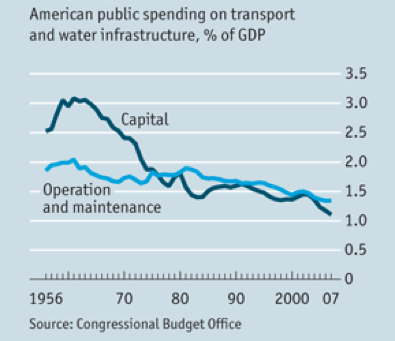
Total public spending on transport and water infrastructure has fallen steadily since the 1960s and now stands at 2.4% of GDP. Europe, by contrast, invests 5% of GDP in its infrastructure, while China is racing into the future at 9%. America’s spending as a share of GDP has not come close to European levels for over 50 years. Over that time funds for both capital investments and operations and maintenance have steadily dropped (see chart 2).
Although America still builds roads with enthusiasm, according to the OECD’s International Transport Forum, it spends considerably less than Europe on maintaining them. In 2006 America spent more than twice as much per person as Britain on new construction; but Britain spent 23% more per person maintaining its roads. […]
The Congressional Budget Office estimates that America needs to spend $20 billion more a year just to maintain its infrastructure at the present, inadequate, levels. Up to $80 billion a year in additional spending could be spent on projects which would show positive economic returns. Other reports go further. In 2005 Congress established the National Surface Transportation Policy and Revenue Study Commission. In 2008 the commission reckoned that America needed at least $255 billion per year in transport spending over the next half-century to keep the system in good repair and make the needed upgrades. Current spending falls 60% short of that amount.
And the accompanying graph…
Discuss.
* Business roudup…
* ADDED: Move made to exempt bakeries from artificial trans fat ban
* ADDED: Editorial: Give craft brewers an exemption
* Amtrak can’t get new cars fast enough - Rail line to receive $286M fed grant: Additional rail cars and locomotives can’t come soon enough on three Illinois Amtrak lines expected to carry well over 1 million passengers this year, a spokesman said Monday… According to an Amtrak study released in February, the average rail passenger car in Illinois has traveled 2.5 million miles and is 20 to 21 years old.
* Caterpillar CEO tells industry to lobby Quinn on biz agenda: Noting that Illinois’ workers’ comp rate is seven times that of Indiana’s, Mr. Oberhelman said lawmakers must rewrite the law so it protects only workers hurt on the job. He also said the state should adopt the American Medical Assn.’s physician guidelines for compensation settlements, which are used by 37 states. “Those are two things we’re very close on,” he said.
* Transit agencies fear ‘loophole’ in tax bill: Addison Mayor Larry Hartwig is among numerous local mayors also concerned about losing revenues. Rival downstate counties are wooing suburban businesses with low taxes and promises of rebates, he said. And that’s unfair to towns that provide roads, police and fire protection and snowplowing to companies that send their tax dollars elsewhere.
* Whitley: Time is now to rebuild Illinois economy