A federal jury convicted the Cook County Commissioner on all counts after deliberating for just a few hours.
Earlier Thursday, prosecutors blasted the former alderman as a tax cheat who “decided the rules shouldn’t apply to him.”
But Beavers’ defense team painted him as an elderly man who “may” have a gambling problem and never intended to defraud the IRS.
Jurors began their deliberations Thursday afternoon after hearing closing arguments in a packed courtroom, during which defense attorney Sam Adam Jr.’s theatrical style again clashed with prosecutors’ dry demeanor — and irritated Judge James Zagel, who issued a series of rulings in an attempt to rein Adam in.
Accused of cheating on his taxes in 2006, 2007 and 2008, Beavers “has been an elected public official for the last 30 years — he understands and he knows the importance of paying taxes,” Assistant U.S. Attorney Carrie Hamilton told the jury.
Instead of paying taxes on checks he cut himself from his political campaign funds and spent on losing gambling runs at the Horseshoe Casino in Hammond, Beavers deliberately “kept everyone in the dark,” by falsifying his tax returns and campaign records, Hamilton said.
The Illinois House voted Thursday to limit compounding annual cost-of-living increases for state retirees in a constitutionally questionable move targeting the largest driver of the state’s $97 billion pension crisis.
The Senate-bound measure, sponsored by House Speaker Michael Madigan (D-Chicago), passed the House on a 66-50 roll call and would affect current and retired state workers, university employees, legislators and downstate and suburban teachers. Judges weren’t included.
Under the measure, current and future public employees would have to wait until age 67 or five years after retirement to begin collecting retirement benefits. State employees'’ annual cost-of-living adjustments would be capped at the lesser of 3 percent or $750 per year. […]
The vote represents the third incremental pension-reform measure to pass the House, following votes last week to cap the size of pensions and raise retirement ages.
…Adding… My reading of the bill indicates that the shorthand used in the above story is wrong. COLAs can’t be collected until age 67, not pensions.
In a rare speech from the floor, Speaker Michael Madigan indicated today’s move, in addition to other measures the House approved last week, means lawmakers should be close to “finalizing” more comprehensive legislation.
But while most observers agree cutting annual pension increases would save the state the most money, the move is also among the most controversial. The Illinois Constitution states pension benefits are not to be “diminished.”
State Rep. Mike Fortner, a West Chicago Republican, was among those who raised legal questions in opposing the plan. […]
A proposal from state Rep. Tom Morrison, a Palatine Republican, that would move most public employees into 401k-style retirement plans is set for debate in a House committee later today. But it isn’t expected to be approved.
* I told you earlier today that some anti-gun protesters planned to picket Attorney General Lisa Madigan over her refusal so far to appeal the federal court decree on concealed carry to the US Supreme Court.
Madigan has pointed out before that it’s too late to get on the Supremes’ docket at the moment. But these folks (and Gov. Quinn) didn’t want to hear that.
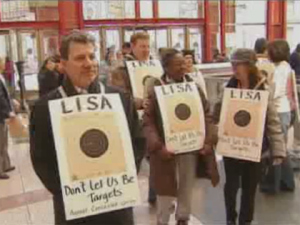
* Turns out, just a dozen people showed up to the protest, and they paraded around the Thompson Center wearing signs that said “Lisa, Don’t Let Us Be Targets”…
The pro-gunners often describe a fevered dystopian future of blood-thirsty dictatorial tyrants to justify their personal arsenals. On the other side we have folks who actually fear that licensed, trained, concealed carry permit holders will be targeting them for, I suppose, murder.
Man, do I ever despise arguments based on ignorant fear. It’s a big reason why I have such a hard time talking to some hardcore pro-gunners on this site. I don’t oppose much of what they want to do, but too many of them are such wussy fraidycats that I can’t deal with ‘em.
I’ve been in two war zones (three if you count Albania’s civil war) and never once carried a gun. The only time anybody around me had a gun was when I embedded with a National Guard unit in Baghdad on night patrol. I just don’t get this crazy fear. And today’s anti-gunner protesters appear to be pretty much a carbon copy of their opponents.
David Borris, president of Chicago Area Peace Action said, “believe me, there’s going to be all the Dirty Harry wannabes that are gonna see that purse get snatched, and they’re going to want to drop to one knee, and start shooting.”
I hear this sort of thing a lot from anti-gun folks.
* The Humane Society recently held a pet photo contest for legislators and staffers. Rep. Renee Kosel’s new puppy “Cookie” won for most adorable dog…
What a sweetie!
* “Frau Frau,” whose owner is Senate Democratic legislative assistant Mitchell Remmert, won the most adorable cat contest…
Aww.
* No offense whatsoever to Rep. Kosel, but I wish the Humane Society had allowed me into the competition because I would’ve submitted this undoubtedly winning video of my new puppy…
* The University of Illinois’ campuses will become totally smoke-free later this year. Some legislators want the ban applied to all public colleges…
An Illinois Senate committee approved a measure Tuesday that would ban people from smoking on state-supported university and community college campuses.
The vote was 7-5, with all but one Democrat, including Sen. Andy Manar, D-Bunker Hill, voting for the measure, while Sen. John Sullivan, D-Quincy, voted against it.
State law already prohibits smoking within public buildings, certain indoor areas and within 15 feet of building entrances. The proposal would prohibit smoking anywhere on campus, including parking lots and vehicles.
The bill’s sponsor, Sen. Terry Link, D-Waukegan, said such legislation would encourage people to quit smoking.
Sullivan noted that people currently can step outside the State Capitol building and smoke as long as they are 15 feet away from the door, so why did Link want to have a total smoking ban on all college campus property?
“Maybe what we will do is help people from ever starting,” Link said. “If we just get them while they are young, maybe they won’t take this up.”
“But what about from the staff and employees’ standpoint?” Sullivan asked. “Smoking is legal. So, what kind of accommodations will be made for employees who work at these universities and colleges?”
“It’s the same thing you have even in private industry when we went smoke-free,” Link answered, noting that the campuses of some hospitals and pharmaceutical companies are now entirely smoke-free.
* The Question: Should the GA pass a bill to make all Illinois universities and colleges completely smoke-free? Take the poll and then explain your answer in comments, please.
* Former Chicago Bears linebacker Hunter Hillenmeyer has been in the news quite a bit lately. He’s starting a fascinating new gaming company…
According to Hillenmeyer, the core concept behind OverDog is a simple one: Many professional athletes and even more sports fans are avid gamers, so why not create a product that allows them to face off against each other? […]
As Hillenmeyer explains, the way the product would work is a pro athlete would log on to the app via his smart phone and issue a challenge to his fans in any game of his choosing. After the athlete has issued the challenge, fans would get a notification on their phones and decide whether or not they want to play against the athlete. However, not every fan is going to be able to play against an athlete every time, so potential opponents for pros will be decided by a random drawing. Also, Hillenmeyer says that they are working to incorporate a streaming aspect, so at some point in the future of the product you could still watch the matchup even if you weren’t the one facing off against a pro athlete.
* But Hillenmeyer is also becoming involved in Statehouse issues. For instance…
Former Chicago Bear linebacker Hunter Hillenmeyer is backing a plan to limit tackling in practice for high school and youth football players.
The legislation from state Rep. Carol Sente, a Vernon Hills Democrat, could come before state lawmakers this week.
Hillenmeyer has written a letter to lawmakers urging support for Sente’s plan, which would limit full-contact tackling in practice to two days per week during the season in an attempt to reduce the risk of long-term injury from concussions. How often young players tackle at preseason practices would be left to coaches’ discretion.
“Without it, a rogue, wannabe-Mike Ditka youth coach will continue to have unchecked ability to overexpose our next generation to harm, harm that is avoidable and has long-term implications,” Hillenmeyer wrote.
State lawmakers Wednesday balked at a suburban official’s plan to limit tackling at youth and high school football practices.
State Rep. Carol Sente’s plan to limit full-contact practice to twice per week tried to address a new focus on the long-term brain damage the repeated hits in football can cause.
But an Illinois House panel disagreed it was something the state should try to regulate, and rejected it by a 5-6 vote.
“I still have concerns about legislating these kinds of rules for athletes,” said state Rep. Sandra Pihos, a Glen Ellyn Republican.
Two Hall of Fame athletes signed a letter supporting a gay marriage bill on its way to the Illinois House.
Former Chicago Cubs shortstop Ernie Banks and former Chicago Bears defensive end Richard Dent, along with former Bears Hunter Hillenmeyer and Brendon Ayanbadejo, wrote that the “Illinois General Assembly should act now and give same-sex couples the freedom to marry.”
“In sports, any time a player is not treated with fairness and respect, the game is diminished,” the letter reads in part. “Similarly, treating any group of people as second-class citizens hurts us all, because discrimination is wrong no matter whom the target is.”
I’m not sure I’ve seen an athlete take this much of an interest in Springfield on bills as diverse as these. He hasn’t started contributing to campaigns yet, so maybe it’s just a passing thing.
* Roundup…
* Senate panel: Schools must carry catastrophic accident insurance: The Illinois Senate Wednesday started moving forward on an issue sought for years by former Rolling Meadows High School football player Rob Komosa, who died last weekend. A Senate panel Wednesday approved legislation that would require public and private schools to carry catastrophic accident insurance to cover their student athletes.
Thursday, Mar 21, 2013 - Posted by Advertising Department
[The following is a paid advertisement.]
Wireless broadband technologies make life safer for citizens and our first responders who courageously step into harm’s way.
Police officers use wireless broadband technology to run facial recognition checks on suspects, process fingerprints, and share photos and videos.
Ambulances are equipped with wireless broadband technology that sends critical vital statistics ahead to emergency room doctors, saving critical minutes when life hangs in the balance.
Soon, wireless broadband technology will let fire commanders in the field receive real-time thermal imaging information so they can observe how fires are changing and moving
That’s why the state’s leading public safety organizations ― the Illinois Fraternal Order of Police, the Associated Fire Fighters of Illinois, the Illinois Sheriffs’ Association and the Illinois Police Benevolent and Protective Association ― joined the Illinois Partnership for the New Economy & Jobs to support a modern communications law in Illinois.
Remarkably, Illinois’ communications law still requires some companies to invest in 100-year-old technology, diverting limited resources from new broadband networks.
In 2013, the state should adopt a modern communications law to attract more private investment in the broadband networks that help make Illinois safer.
* Two things to think about before we move to the actual topic of this post. First, from the Illinois Constitution…
Membership in any pension or retirement system of the State, any unit of local government or school district, or any agency or instrumentality thereof, shall be an enforceable contractual relationship, the benefits of which shall not be diminished or impaired.
Pretty darned plain language there.
* And this is from the S&P downgrade back in January…
If there is meaningful legislative action on reform, we believe that there could be implementation risk based on the potential for legal challenges, and it could be several years before reform translates into improved funded ratios and budget relief.
* Now, on to today’s stories about the pension votes yesterday…
The Illinois Senate Wednesday approved a plan to cut working teachers’ pensions while rejecting a more sweeping plan, sending mixed messages about where the debate over one of the state’s biggest financial problems will go next.
A plan by state Sen. Daniel Biss to cut the pensions of public employees including teachers and lawmakers, which had appeared to gain bipartisan momentum in recent months, was instead soundly defeated 30-23.
Biss’ plan would have cut annual cost-of-living pension increases, raised the retirement age and required local school districts to start paying into a 401(k)-style plan for teachers, among other things.
But whether it would pass muster under an Illinois Constitution that says benefits cannot be “diminished” was a key question in the debate.
As a result, a proposal from Senate President John Cullerton was approved by a 30-22 vote.
I have yet to hear any credible arguments about how Biss’ plan survives constitutional muster. The best argument is that nobody ever knows for sure how a court will rule. That’s true. Other than that, the Constitution is pretty clear here.
The Senate voted 30-22 to reform just one state pension systems facing financial trouble, but it was the largest of five, the Teachers’ Retirement System.
True to the approach he’s taken previously, Cullerton, a Chicago Democrat, wrote the legislation to give teachers a choice between health care coverage during retirement or reduced annual cost-of-living increases. The “consideration” approach, Cullerton insists, would allow the state to sidestep a prohibition in the Illinois Constitution against reducing previously promised pension benefits.
“Benefits cannot be changed unless the Legislature offers public employees and retirees a choice and the opportunity to consider and accept that offer,” Cullerton said.
But between the slim victory on a narrowly drafted bill and the earlier defeat of another Democrat’s comprehensive approach to the pension crisis, the action Wednesday leaves questions about whether the General Assembly has the stomach to tackle the pension mess.
Biss, D-Evanston, and Cullerton took different approaches toward overhauling the retirement plans, and the divide broke down along partisan lines — as well as along Cullerton’s power base.
Biss’ broader pension measure picked up a dozen Republican votes, including that of Senate Minority Leader Christine Radogno of Lemont. She called Biss’ measure the most comprehensive approach and the “best path forward at this point in time.”
But only 11 Democrats jumped in with Biss. The 23 votes fell seven short of passage.
The Senate Democratic rank and file sided with Cullerton over Biss. No Republicans backed the Cullerton plan, noting it only affected active teachers. […]
The Biss plan would save an estimated $150 billion over 30 years. Cullerton’s plan would save an estimated $18 billion to $40 billion.
Biss’ plan won’t save a freaking dime if it’s kicked out by the courts.
These Democrats voted against the bill: Jennifer Bertino-Tarrant, Melinda Bush, James Clayborne, William Delgado, Mike Frerichs, William Haine, Linda Holmes, Toi Hutchinson, Emil Jones III, Dave Koehler, Dan Kotowski, Terry Link, Andy Manar, Iris Martinez, Pat McGuire, Julie Morrison, John Mulroe, Tony Munoz, Kwame Raoul, Martin Sandoval, Ira Silverstein, Steve Stadelman, John Sullivan and Donne Trotter.
These Republicans voted against the bill: Jason Barickman, Dave Luechtefeld, Sam McCann, Kyle McCarter, Dale Righter and Chapin Rose.
And these three Democrats voted “present,” which is tantamount to voting “no”: Democrats Jacqueline Collins, Tom Cullerton and Mattie Hunter.
There are some hardcore conservatives amongst those GOP “No” votes. But they also have state facilities in their districts.
* Sen. Rose was one of those “No” votes, but he wants to cancel spring break…
“I see all of this as a gradual progression,” said Sen. Chapin Rose, R-Mahomet. “If you start tweaking this cost of living adjustment cap on people who have already retired, you started putting this thing together.”
Rose said he wished the Legislature would stay in session for the next two weeks — when it is scheduled to take a recess — “on joint House and Senate meetings and just focus on this and not anything else. I would take everything else off.”
Sen. Jason Barickman, R-Bloomington, criticized the “piecemeal approach” of Cullerton’s bill.
But Barickman also voted against the more comprehensive bill.
* The Biss bill died because the Republicans, prodded by Ty Fahner and the business groups, killed Cullerton’s hybrid SB1 bill, which included his language and Biss’ language. It was a politically possible bill. Now, we’ve got a stalemate. The Sun-Times remains optimistic…
Illinois’ $97 billion unfunded pension bill demands a big, sweeping solution. If there was ever a time to make it happen, it’s now.
The answer lies in a separate bill that failed in a Senate vote Wednesday.
That plan, sponsored by Sen. Daniel Biss, is the only plan out there that truly reforms public employee pensions. It significantly cuts benefits — we won’t sugarcoat that — but does so in a fair and targeted way by phasing in an increased retirement age, shielding the pensions of the lowest income retirees from cuts and giving the retirement systems the right to sue if the state fails to pay its share.
Biss’ bill fell short by seven votes. Insiders tell us it simply can’t pass and it’s time to get real.
No doubt there is truth to that claim. But Illinois lawmakers can do better.
And really, 23 votes on a bill that wasn’t pushed by the Senate president is a pretty good showing the first time out of the gate. Picking up seven more votes as the spring legislative session continues is doable, particularly since Biss’ bill appears to be the favored approach in the House. A similar House bill is sponsored by Reps. Elaine Nekritz and Tom Cross.
There is almost no doubt in my mind that if Ty Fahner and the Tribune editorial board hadn’t stuck their big noses into this thing, Cullerton’s SB1 would’ve passed the Senate.
I’m starting to think that somebody doesn’t want anything to pass until 2015.
* And while I fully understand the criticism of Cullerton here (that he ought to just give up on his consideration idea and go with something else that might be able to pass like a stand-alone Biss plan), I’d point out that the Senate President strongly believes Biss’ bill is unconstitutional. So, this is something to keep in mind…
SECTION 3. OATH OR AFFIRMATION OF OFFICE
Each prospective holder of a State office or other State position created by this Constitution, before taking office, shall take and subscribe to the following oath or affirmation:
“I do solemnly swear (affirm) that I will support the Constitution of the United States, and the Constitution of the State of Illinois, and that I will faithfully discharge the duties of the office of …. to the best of my ability.”
No one’s supposed to know it, but the parent companies of the Chicago Tribune and the Sun-Times are on a collision course over unpaid bills.
At issue are the $70 million-a-year contracts for Tribune Co. to print and distribute the Sun-Times and its suburban daily newspapers. (The distribution deal began in 2007, and the printing deal began in 2011.) Just as Tribune Co. was emerging from bankruptcy at the end of December, Sun-Times owner Wrapports LLC paid only a fraction of what it owed, according to sources at both companies.
Since then, nothing. Some see it as a sign of financial trouble at Wrapports, where advertising revenues have fallen far short of projections. Others see it as a strategic move to force a renegotiation of the agreement or as a precursor to a bid for the Tribune.
Fearing that Tribune Co. could simply pull the plug, Wrapports has begun searching for alternate printing facilities. (Just a bluff? Who knows?) On the other hand, Wrapports chairman Michael Ferro appears to be gambling that the Tribune won’t put its No. 1 client out of business while it’s trying to attract a potential buyer. In the end, it all may wind up in court — if not on the front pages of both papers.
The Chicago Democrat said Wednesday he often breakfasts by peeling the potassium-packed fruit.
He spoke to reporters after announcing the winners of the Illinois School Breakfast Challenge. The competition challenges schools to increase participation in the school breakfast program. Winners attended an afternoon event at the Executive Mansion in Springfield.
Quinn said he also added some scrambled eggs to break his fast Wednesday.
But the event comes after he’s proposed some steep cuts to school nutrition.
The governor’s budget calls for $400 million in cuts to education. Out of education cuts comes $5 million from free school breakfast and lunch programs.
Governor Quinn shifted the blame saying, “Obviously our pension challenges. Our foremost fiscal challenge in Illinois. It’s squeezing out money in the classroom.”
He’s hyping a program that he’s cutting, without mentioning it. Marvelous.
The percent of Illinois students who are homeless or living in poverty has grown in recent years.
The Illinois State Board of Education reported Wednesday the proportion of low-income students grew from 37.9 percent to 49 percent between 2003 and 2012.
The ISBE says the spike in low-income students and those with limited English has led to increased costs for school districts. But state funding for education has decreased by more than $861 million, or nearly 12 percent, since the budget year that started in July 2008.
So, we have more homeless school kids while the governor is cutting breakfast programs, but there he was yesterday touting the breakfast program and talking about how he likes to eat bananas in the morning.
Demonstrators Wear Targets to Show What Illinois Will be Like Under Concealed Carry
Advocates for safe streets plead, “Lisa Madigan, Don’t Let Us Be Targets”
WHO: Rev. Wendy Ann Witt, Associate Pastor, Chicago Temple; Garrett Evans, student shot at Virginia Tech University; David Borris, Chicago Area Peace Action; Ellen Chiocca, Moms Demand Action; Lee Goodman, Stop Concealed Carry Coalition; and other community leaders
WHAT: Demonstration to ask Illinois Attorney General Lisa Madigan to appeal to the U.S. Supreme Court the 7th Circuit Federal Court’s decision that threw out Illinois’ ban on carrying concealed weapons in public
WHERE: James Thompson State of Illinois Building, 100 West Randolph, Chicago, IL (Street level, plaza entrance, inside)
WHEN: Thursday, March 21, 2013 at 11:00 am
CHICAGO (March 19, 2013) – Community leaders wearing National Rifle Association approved pistol targets will publicly call upon Illinois Attorney General Lisa Madigan to comply with Governor Pat Quinn’s request that she appeal to the U.S. Supreme Court the 7th Circuit Federal Court’s decision that threw out Illinois’ ban on carrying concealed weapons in public.
Madigan has stated that she does not plan on appealing since the Illinois General Assembly may pass a new law authorizing people to carry concealed weapons. But once the legislature acts, the case becomes moot, and it will not be possible to appeal. “Madigan is acting like a lawyer who waits until after her client has been executed to appeal the sentence,” said Lee Goodman, organizer of the Stop Concealed Carry Coalition.
Lee Goodman, a Northbrook resident and a member of the Stop Concealed Carry Coalition, was heartened by the governor’s stance and his statement that Attorney General Lisa Madigan should appeal the decision of the circuit court.
“I believe that’s the first time he said the decision should be appealed,” Goodman said.
* Sen. Durbin said today that he believes Attorney General Lisa Madigan will make up her mind soon about whether she’s running for governor. He also didn’t have the kindest of words for Gov. Pat Quinn…
Senate Majority Whip Dick Durbin (D-Ill.) pointedly declined Wednesday to endorse Illinois Gov. Pat Quinn and said Attorney General Lisa Madigan could be the only Democratic challenger if she chooses to run against the embattled governor next year. […]
“There’s a feeling that the governor needs to show leadership and produce results in order to merit renomination and reelection.” […]
Asked after the breakfast whether he would offer an endorsement in the race, the veteran senator said he was not likely to. As for whether Quinn was seeking his support, Durbin said: “It hasn’t happened yet, and I don’t expect it to.”
Durbin demurred, however, when asked the question that is on the mind of many politicos in Illinois: Can Madigan run and serve as governor if her powerful father remains in his post as speaker of the House?
While acknowledging Speaker Mike Madigan is the most powerful political figure in Illinois, Durbin noted that Lisa Madigan “has really earned her stripes as an individual, not as his daughter” and has “one of the highest approval ratings of any state official.”
Sounds like Durbin has his mind pretty much made up.
* I actually agree with the folks over at Illinois Review and Breitbart that some Chicago political reporters have been way too hard on 2nd Congressional District GOP nominee Paul McKinley. Yeah, he was a felon. He served a whole lot of time in prison. But he has risen above his past and is now living a decent life and encouraging others to do so as well.
Some of his positions are a bit odd, but, whatever the case, the guy has no chance of winning, so this breathless hyperbole just doesn’t resonate…
But what none of them is watching is one of the most interesting races in Illinois’ history develop in front of their own eyes.
An opportunity that is only possible in a special election such as this one: a lazily campaigning Democrat, an awakened populace tired of being trampled on, an enthralling candidate, and an energized grassroots making history by coming together across racial and economic barriers to support McKinley, a convicted felon who has turned his life around and is trying to save his community. Is it any wonder, as McKinley says, “The Machine is panicking?”
The Illinois Republican Party did not respond to Breitbart for comment.
I do believe that the national, state and local GOP ought to put some resources into his campaign to build some infrastructure there for future reference, like the 2014 statewide races. Hey, it couldn’t hurt.
McKinley, unfortunately like a lot of black men, did some time behind bars. But he’s now on the straight and narrow and he ought to be celebrated for that, not condemned.
* Meanwhile, I still don’t think we have the full story about why state Sen. Toi Hutchinson dropped out of the Democratic primary…
Monday, in what is believed to be her first public comments on the race since she bowed out, Hutchinson answered questions about her candidacy before the Kankakee Kiwanis Club during the club’s luncheon at the Quality Inn & Suites in Bradley.
[…]
Hutchinson said she had raised more than $300,000, and might have been able to double that, but that she was unwilling to do what it took to win.
“It would have meant scorched earth, going right to the wall to raise that kind of money,” she said. “And I would have had to go entirely negative.”
She said leaving was the hardest decision she ever had to make. Her own teen daughter advised her against quitting. But, she said, she couldn’t complain about negative campaigns and million dollar fundraising and then do the same thing.
“It would have made me something I’m not,” she said.
That is essentially what she told everyone who asked when she dropped out. But she didn’t run an entirely positive campaign, and she’s still having some trouble in the Senate because of it.
* If you want to see what a successful Illinois Republican is - not some ideologically embittered hyperpartisan - then you have to go no further than Big Jim Thompson.
Elected four times as governor, Thompson embodied Illinois Republicanism. Tough, accomplished, governing-focused and pro-business but with a decidedly humane and moderate face.
Thompson spoke this month to the World Presidents’ Organization/Young Presidents’ Organization Chicago Chapter forum and part of his speech has been transcribed. We ran some excerpts the other day, but I strongly urge you to read the whole thing now. This guy still has it…
We need to improve the business climate in the state of Illinois because we need to increase employment in the state of Illinois. There is no sounder reason to increase employment and to drive down the cost to the state of Illinois of pensions and pension reform than more jobs in this state. Two million people in a population of 12.8 million, 2 million people in the state of Illinois are on food stamps. Two million, Why? Because they don’t have jobs that can support themselves and their family. They don’t have enough money to buy food, so they’re on food stamps.
Now we’ve got a choice. We can continue all those people on food stamps and just push (them) away, put them behind the curtain, don’t think about them. Or we can work to increase the business climate in this state to provide the jobs that will start taking people off food stamps and off welfare and off government assistance.
Thompson, unlike so many modern “conservatives,” did not demonize the poor and heap condemnations upon them He fervently wants to help them with the only hand up that really matters: A decent job.
We’ve got to scour the tax code of this state, get rid of wasteful tax expenditures, or have a rational tax policy that encourages business and its growth in this state. And you can tell the difference. And yes, various businesses will come and say, “But keep mine.” OK. That happens all the time. But the governor and the legislature can decide who’s right in that one. Academics can help them decide who’s right in that one., Economists can help them decide who’s right in that one. You don’t have to listen to every special plea no matter where it’s from. But if we’re not constantly looking at our tax policy, looking at our unemployment compensation policy, looking at our workers’ compensation policy to make this state a haven for business and send those carpetbaggers from Wisconsin and Indiana and Iowa and Mississippi and Alabama and Texas back to their own states. Thank you very much, we’ve got just as good a business climate in Illinois as any that you can conjure up to make our people move. If we don’t put our efforts behind that, if we don’t link it to government expenditures beginning with pension reform, we are going to be in even bigger trouble.
* And he wants us to think big, like he did back in the day…
We need to substantially repair Illinois’ infrastructure. The governor is going to hope to sell $800 million in bonds shortly that would go for capital projects, infrastructure. It’s not enough. It’s not enough. […]
Look, I used to be proud to say that Illinois was the transportation center of the world. And it was literally true. What’s the largest economy in the world? The United States. What state has more components of a transportation system than any other? Illinois. Sitting in the heart of the nation. Criss-crossed by Interstate highways north, south, east, west. The Mississippi River flowing down, the Illinois River. Railroads running into the state and out of the state. Illinois in Lincoln’s time was the jumping-off place for the railroads to go west, To bring the finished goods from eastern and Midwestern factories out to the West and to bring the grain and the beef back. We still occupy that position even though the cargo that we carry may be different now.
O’Hare until just recently was the busiest airport in the world. Now, if the United States is the largest economy in the world and if Illinois has more transportation components than any other state, then Illinois is literally the transportation capital of the world and we ought to act like it and keep that system in repair. Because when you talk about the economy of this state you have to pay very close attention to what I call the economic backbone. Of the state. What do I mean by that?
The transportation system, obviously. The ability to get the employees to and from work. The ability to get goods out of your factory to where you’re sending them across the world. The ability to get raw materials in to aid in your process of manufacturing. If we don’t have a good, decent transportation system, we will never have a strong economy and won’t have the jobs we want.
* Thomspon also took a swipe at Attorney General Lisa Madigan and Gov. Pat Quinn when he made this point about utility infrastructure…
A lot of politicians like to pick on the utilities. Our electric utilities. Our telephone systems. Well that’s all well and good. An attorney general can be the people’s lawyer and bash the utilities and oppose rate hikes and try to hold down profit. I mean, the list is endless.
But governors, governors responsible for the economic climate of the state have to ensure that our utilities as well as our transportation system are doing their job. That our utilities are strong, technologically advanced and dependable. And you can’t have a utilitly system, whether it’s phones or electricity or gas, that’s strong, technologically advanced and dependable if you are consistently trying to starve it in the name of consumers or customers. That’s why the job of attorney general and governor are different. Very different.
And we have to scour the state budget to end the boondoggles. I know everybody decries the boondoggles. The press likes to expose them. Grants going to community organizations that turn out to be just for the private profit of those who are running them. Look, it’s not a lot of money. The state budget is $35 billion. Stuff like that is in the millions. Small potatoes. But what it is, it says something about the credibility of the state. It says something about the credibility of state government if you’re wasting money.
I know that candidates’ favorite refrain is “fraud, waste and abuse.” They’re going to end fraud, waste and abuse and then when they get elected it’s the last you ever hear about it, and they start participating in fraud, waste and abuse. And I’m not here to tell you, as some politicians have before me, that if we cut fraud, waste and abuse we can cut taxes and don’t have to spend as much. That’s all wrong. It’s wrong. That’s such a miniscule part of the state government that makes no difference except that it debases state government. And people feel less about their state government when they read something like that in a newspaper and there’s no reason why we shouldn’t get rid of it.
The point is, people in Illinois — and in other states; we’re not the only ones – the point is that people in this state have allowed things to go so far that they think they can get away with anything. And they have. They have. And let’s stop pointing fingers about who’s responsible for this, the legislature, the governor, the public employees – it’s irrelevant. They’re all responsible. And we’re all responsible.
Right freaking on.
Yeah, he made his share of mistakes, kicked his share of cans down the road. I could give you a very long list of all of that. But, man, the dude was a giant, and he loved every square inch of this state and had the skills to make his visions a reality.
This used to be a great state. We still are in many respects, but we’ve slipped partly because we’ve completely lost our confidence - and for good reason. Too many clueless governors and voters. Too much inertia, partisan and otherwise. Not enough vision.
I don’t know about you, but, personally, I’d vote for Big Jim if he ran again. This is exactly the sort of leader we so desperately need in Illinois right now.
Illinois Lt. Gov. Sheila Simon is [in Washington, DC] for a series of profile-raising interviews with state and national media and meetings with the National Lieutenant Governors Association and the Democratic Lieutenant Governors Association as she is putting together a political team for her anticipated 2014 statewide run.
The office Simon is to run for is to be determined. She’s waiting to see if Attorney General Lisa Madigan vacates her spot to challenge Gov. Pat Quinn in a Democratic primary for governor. She’s also mulling comptroller.
Comptroller, eh? Some of her people are flatly denying that she’ll run against Judy Baar Topinka, but that’s what she told Gov. Quinn back in December when she informed him that she wouldn’t be his 2014 running mate.
I doubt she’d do it, or that she could defeat Judy Baar Topinka if she does run. Some of her people have flatly denied that she intends to run against JBT.
Still, I’m interested to know what y’all think about a possible matchup.
Following Adam Andrzejewski’s announcement today that he will not be seeking public office in 2014, activist Bill Kelly publicized his own possible candidacy for State Comptroller. In a press release, Kelly said he would make “an updated announcement” about his plans for the 2014 election season on April 13 - the same day he’s planning a protest outside a meeting of the Illinois Republican Party State Central Committee in Chicago.
“It is no mystery that I have been exploring another bid for Illinois comptroller,” Kelly said. “After four years of [Judy Baar] Topinka, Illinois is worse – not better off. I have run against Topinka before and I can do it again,” said Kelly.
According to his website, the announcement “will be based on whether Pat Brady is forced to resign his Illinois GOP chairmanship.” Kelly has been a vocal critic of Brady since 2010.
* Yesterday’s dismissal of lawsuits which attempted to link free retiree health insurance premiums to the state Constitution’s pension benefits protection clause prompted this reaction from Senate President John Cullerton…
“The real impact of this ruling is that it reinforces my position that a guarantee of health care access can be negotiated as part of a contractual change to protected pension benefits. Only the benefits found in the Illinois Pension Code are protected by the Pension Clause.
“Pension reform is my top priority. While I acknowledge that there are a number of ways to structure a bill, I believe that a reform based on contractual principles of offer, consideration and acceptance is the best way to ensure that the legislation is upheld in court. I will continue to advocate that giving state employees and retirees a choice between cost of living allowances and access to health care is the best way forward”.
Since insurance is not a guaranteed right, then he can now argue that he’s offering retirees a real choice: Keep your COLA or keep your access to insurance.
* The House rejected several gun control measures yesterday. The Sun-Times has a pretty comprehensive story up about yesterday’s debate. The failed proposals would…
(R)equire gun-owners to report private transfers of firearms to state police within 10 days; train and be certified separately for each weapon a gun owner wishes to carry; carry only one firearm per license; purchase a $1 million liability insurance policy; and give the Legislature until Jan. 1, 2016 before any legislation can take effect.
The first piece of legislation, sponsored by Rep. Ann Williams (D-Chicago), passed by a 67-44 margin and would ban gun owners from “knowingly” bringing firearms into bars or restaurants that serve alcohol. The restriction would not apply to street fairs and vendors, Williams said.
The second was opposed by the NRA, but backed by several of its supporters…
And the second adopted measure, sponsored by Rep. Robert Martwick (D-Norridge), gives police the option to object to a concealed-carry application when the applicant has been arrested five times or three times for gang-related offenses in the last seven years. The legislation passed by an 84-29-1 vote.
Rep. Jack Franks didn’t like that one…
“I could be arrested on the House floor if I start screaming and throw a box of Kleenex,” Rep. Jack Franks (D-Marengo) contended. “I can think of lots of reasons people get arrested but not convicted. So, why are we using an arrest standard and not a conviction?”
The provision was supposedly aimed at gangbangers and others who are habitually arrested, but never actually convicted.
* Other amendments which have passed the House in previous weeks…
require gun owners to register their firearms, report lost or stolen guns to state police within 72 hours and lock up their guns if living with someone who could be mentally ill or have a criminal history.
Take a deep breath before commenting, campers. I had a long conversation with some idiot this morning who sent me an e-mail calling me a “Nazi,” so I’m in no mood for nastiness here. Deletions will be swift.
* Moody’s lowered credit ratings by one notch yesterday for several state universities, including NIU, Governors State, Eastern and Northeastern. The ratings agency also revised its outlook to “Negative” for for ISU, WIU and SIU.
The ratings and outlooks were lowered because of the state’s poor budget health. Reuters…
The credit rating agency also warned that further deterioration of Illinois’ general obligation rating, future higher education funding cuts and payment delays could also pull the universities’ ratings down. […]
Moody’s said a review it launched in December was due to the universities’ significant dependence - ranging from 31 percent to 46 percent - on Illinois for operating revenue and continued delays in the payment of those funds.
The University of Illinois, the biggest state system, received a negative outlook on its long-term ratings of Aa2, Aa3 and A1, affecting $1.56 billion of debt. The system has had to resort to tuition hikes, unpaid days off for workers and salary freezes to cope with the state’s financial problems, according to Tom Hardy, executive director of university relations. […]
Eastern Illinois University, which Moody’s downgraded to A3 from A2, has received only 20 percent of its $44 million annual appropriation and could have a $2.2 million funding cut in fiscal 2014, said Paul McCann, the university’s treasurer and business services director.
“As state leaders continue to drag their feet on meaningful and constitutional pension reform, Moody’s Investors Service has more terrible news for Illinois. Moody’s has downgraded the ratings of Governors State University, Northeastern Illinois University, Northern Illinois University and Eastern Illinois University. These are universities that rely heavily on state funds for operations. This comes after Moody’s placed the long-term ratings of all Illinois public universities under review for possible downgrade on December 18, 2012, due to ‘significant dependence on the state for operating funds and fringe benefits, as well as extensive appropriation payment delays in a challenging budget environment that continues to pressure Illinois’ public universities cash flow and liquidity.’ Moody’s also said in December 2012 that the state’s credit rating can go up with a sustainable pension reform plan, and three months later, there still has not been any significant action.”
“This means it will cost these universities more to borrow money. Therefore, I fear these downgrades will hinder the universities from borrowing money to make essential improvements to their institutions. I do not think it is fair to students, parents and teachers to put residence hall and educational building upgrades in limbo because state leaders cannot pass solid pension reform measures. If universities do want to make these upgrades, will the increased cost be passed onto parents and students through higher fees for tuition, room and board? Illinois needs to have strong and competitive universities to offer a better future for our children.”
Members of the largest state government employee union have ratified a new contract covering 35,000 state workers.
The American Federation of State, County and Municipal Employees said Tuesday the vote was 96 percent of voters in favor of the deal to 4 percent against.
* From AFSCME…
STATE EMPLOYEES RATIFY NEW UNION CONTRACT
State workers represented by the American Federation of State, County and Municipal Employees (AFSCME) Council 31 have voted to ratify a new collective bargaining agreement.
The contract covers some 35,000 employees, including child protection workers, nurse aides, correctional officers, police dispatchers, environmental technicians, and many others who provide vital services to Illinois residents.
The tentative agreement between AFSCME and the State of Illinois was reached on February 28 and submitted to union members for approval by secret-ballot vote at locations across the state over the past three weeks.
The agreement was reached after more than 15 months of often-contentious negotiations with the administration of Governor Pat Quinn.
“This new contract takes into account the state’s fiscal challenges, while also recognizing the vitally important work state employees do,” AFSCME Council 31 executive director Henry Bayer said.
“AFSCME members are on the front lines every day,” Bayer added. “They care for the elderly and people with disabilities, protect public safety, maintain state parks, respond to emergencies and more. They often work without sufficient staff or resources, going the extra mile to provide services that residents rely on, and they deserve to be treated fairly.”
Employees will receive a general wage increase that averages 1.3% per year over the contract’s three-year term. Those eligible for step increases will receive them as scheduled, while workers with more than 10 years’ seniority will receive a $25 per month increase in longevity pay.
At the same time, union members agreed to higher health care premiums, co-pays and deductibles, changes that will save the state some $900 million in the aggregate over the life of the agreement.
“While this contract doesn’t fully keep pace with the rising cost of living, it will help employees meet those costs,” Bayer said. “At the same time, it will help the state to address its economic challenges.”
* Gov. Pat Quinn’s announcement wasn’t overstated at all. Umm…
Governor Quinn Announces Best Contract for Taxpayers in Illinois History
Three-year Agreement Ratified by Union After Longest Negotiation in History
SPRINGFIELD – Governor Pat Quinn today praised the American Federation of State, County and Municipal Employees (AFSCME) Council 31 members’ approval of the new union contract covering some 35,000 state employees. Negotiations took more than 15 months and the agreement was ratified by AFSCME members over the past two weeks. Today’s development is part of the governor’s commitment to restore fiscal stability to Illinois.
“This is the best contract for all taxpayers in Illinois history,” Governor Pat Quinn said. “This contract recognizes the fact that the state is facing unprecedented financial challenges. I want to thank the members of AFSCME who approved the agreement and the women and men who negotiated at the table for more than a year to get this job done. Even in difficult times, the process can work. This is a win for all of our taxpayers and a win for state workers as we continue to move Illinois forward.”
AFSCME announced ratification of the contract this evening. The approved agreement will result in $900 million in healthcare savings over the life of the contract. The contract puts an end to free retiree healthcare in Illinois to ensure all retirees will begin paying a modest portion of their health insurance premiums starting July 1. In addition, the contract includes the most modest Cost of Living Adjustments in state history at a rate of 0 percent, 2 percent and 2 percent. Combined with step and longevity adjustments, this will total about $200 million over the life of the contract. The contract calls for new hires to start three steps lower, which amounts to about 9 percent less starting salary, which will save taxpayers money for years to come.
The contract also settles the pay raise litigation that has been tied up in court. As part of the agreement, the union and the administration have agreed to seek approximately $140 million in fiscal years 2012 and 2013 wages from the previous contract that were never appropriated.
This 15-month negotiation was the longest in the state’s history.
* I told subscribers about this development yesterday…
A coalition of African-American clergy from Cook County has begun airing radio commercials on black-oriented stations urging opposition to the measure. The radio ads come on top of automated telephone calls placed to African-American households by former state Sen. James Meeks, pastor of Salem Baptist Church of Chicago.
The African American Clergy Coalition, as the group calls itself, is also working with the Catholic Conference of Illinois and representatives of the Lutheran Church-Missouri Synod against the gay marriage bill.
[Rep. Greg Harris] would not say whether the efforts by the African-American clergy group have cost him votes.
“I think people are going to listen,” he said. “They are going to listen to all sides. They are hearing from ministers and parishioners on both sides of the issue in their districts. I think they are going to come to the same conclusion the majority of Americans have in that this is the fair thing for government to do — to treat all people equally.”
Wednesday, Mar 20, 2013 - Posted by Advertising Department
[The following is a paid advertisement.]
The U.S. Department of Transportation’s Pipeline and Hazardous Materials Safety Administration (PHMSA) has issued a “Call to Action,” to actively engage all the state pipeline regulatory agencies, technical and subject matter experts, as well as pipeline operators to accelerate the repair, rehabilitation, and replacement of the highest risk gas and liquid pipeline infrastructure.
Peoples Gas believes in PHMSA’s directive and the agency’s recommendations – in 2011, the utility implemented an accelerated plan for upgrading its natural gas distribution system to replace all of the cast iron and ductile iron mains. This program is the right thing to do for our customers and our state, especially while natural gas supplies are abundant and wholesale costs are low.
State utility regulatory commissions have been advised by PHMSA that they should play a key role in reducing the amount of cast iron pipe by adjusting utility rates to incentivize replacement. However, Illinois’ regulatory environment has not changed in response to this federal priority and remains unpredictable, outdated and inefficient. Without the assurance and under the current regulatory system, Peoples Gas’ upgrades could take over 40 years to complete.
Senate Bill 1665/House Bill 2414 is necessary to get timely cost recovery in Illinois to give natural gas utilities the confidence to continue investing in infrastructure upgrades.
Wednesday, Mar 20, 2013 - Posted by Advertising Department
[The following is a paid advertisement.]
ComEd and Ameren are at it again – this time trying to pit the General Assembly against the Commerce Commission with Illinois consumers caught in the middle.
Senate Bill 9 and House Bill 2529 is not about improving infrastructure, or ending ComEd’s smart meter delay. It’s about money — your money! ComEd and Ameren want to get more of you money through higher rates. And they will even charge you interest!
ComEd and Ameren are failing to meet the very metrics they wrote in PA97-0616. But instead of being accountable to ratepayers and legislators, Senate Bill 9 and HB2529 would make it look that they are in compliance with the law and grant them retroactive rate hikes plus interest.
As Crain’s Chicago Business points out:
“…ComEd will be allowed to charge ratepayers interest on its unreimbursed pension contributions with no regulatory review.”
We urge the General Assembly to hold ComEd and Ameren accountable and Vote NO! on SB9 and HB2529